• Donate
  • Our Purpose
  • Contact Us
Executive Magazine
  • ISSUES
    • Current Issue
    • Past issues
  • BUSINESS
  • ECONOMICS & POLICY
  • OPINION
  • SPECIAL REPORTS
  • EXECUTIVE TALKS
  • MOVEMENTS
    • Change the image
    • Cannes lions
    • Transparency & accountability
    • ECONOMIC ROADMAP
    • Say No to Corruption
    • The Lebanon media development initiative
    • LPSN Policy Asks
    • Advocating the preservation of deposits
  • JOIN US
    • Join our movement
    • Attend our events
    • Receive updates
    • Connect with us
  • DONATE
Opinion

A letter to our readers

by Executive Editors April 10, 2020
written by Executive Editors

To our readers,

The world is living through unprecedented times, and for many of us, uncertainty and anxiety are running high as the disruption to our day-to-day lives is acute. The coronavirus outbreak is one of the greatest challenges that we face as a global community. The threat of the virus to our health, to our economies, to our way of life, all constitute an existential crisis for Lebanon.

The events of the first quarter of 2020 lead us to believe that this year will be a challenging and difficult one, and likely its knock-on effects will reverberate for years to come.

Each and every one of us is prioritizing the health, safety, and welfare of our loved ones.To flatten the curve and ensure that our healthcare system is not overwhelmed, Lebanon is adhering to a strict social distancing, through the lockdown and nightly curfew. These measures are vital to slow down the spread of the virus.

Executive has been committed to independent, ethical, and authoritative journalism since its inception. In the current climate, our investigative journalism is vital. Executive is, more than ever, convinced that the development of content to the highest standards of journalistic integrity is a priority. We firmly believe that our readers have a fundamental right to clear, accurate, and independent information on which they can form their opinions.

Given the pressing need for quality reporting amid lockdown, Executive has focused its attention on its online presence and has been deploying an online-first strategy for our content that has shifted our publishing schedule from once monthly to multiple weekly analyses. Executive’s team is dedicated to working remotely to maintain a steady stream of news and analysis regarding the impact of the pandemic on the local economy, as well as other pressing concerns that Lebanon faced prior to the COVID-19 outbreak.

For the health and safety of our readers and our staff, our April issue will be fully published online. Our aim is to empower you through, as always, free access to our online platform. We also further encourage you to follow us on our social media platforms (Twitter, Instagram, Facebook, LinkedIn), where we will be sharing updates from our own content as well as studies and reports relevant to our readership.

For our print readers, Executive’s printed editions will resume once the lockdown period is lifted. In the meantime, please enjoy all of our digital content on our website and social media channels.

We hope to remain your source of choice for quality, in-depth journalism amid these trying times.

Stay home, stay safe. 

     — Executive Staff

April 10, 2020 0 comments
0 FacebookTwitterPinterestEmail
Coronavirus AnalysisEconomics & PolicySpecial Report

How coronavirus could bring about a historic chance for change

by Thomas Schellen April 8, 2020
written by Thomas Schellen

About two months ago, the assumption was that in terms of viral speed, the only things spreading faster than SARS-CoV2—the coronavirus’ official name—would be coronavirus rumors and fears. This view could pass as news of the month at the time when World Health Organization (WHO) Director General Tedros Ghebreyesus explained to the world that there was an infodemic going on, on top of the new epidemic—before the WHO’s declaration of the coronavirus pandemic on March 11.

But tracking what are now the four dimensions of the coronavirus crisis trajectory—infection numbers and death tallies; data on markets and rescue budgets; social catastrophe indicators; and fixation on coronavirus news and rumors (as well as its Lebanon specific impacts)—as they speed ahead on a daily basis is the new impossible task. All four of these new dimensions, by the way, are first-class generators of pain and fear. 

Staying on the virus’s trail in spite of data uncertainty 

The data on the virus itself, meaning its confirmed incident rate, its mortality, the time in which infections double in affected clusters or per country, its longevity or eventual seasonality, and the total count of unreported and unnoticed infections—is by now widely acknowledged to be overall uncertain, too much so to enable perfect decisions. 

The least uncertainty has been assumed to exist in the mortality rate. But even in the reported deaths one encounters hidden data uncertainty. For example, the numbers of COVID-19 (the name of the disease caused by the virus) fatalities reported from G7 member country France, one of the most heavily affected nations in the pandemic’s European epicenter, had a massive error margin. 

It became a matter of wider awareness only in early April that the French death tallies reported throughout March did not include deaths in nursing homes but only deaths in hospitals. Under a revised reporting methodology, a retroactively amended tally in early April showed a different and substantially higher number of deaths since March 1, which indicated that over 25 percent of COVID-19 deaths were occurring in nursing homes (which according to reports in French media also have no testing capacities for the virus).  

As to fatalities, question marks thus come into play under several perspectives. One emotionally unsettling, but for response planning necessary, angle is the need to consider how many of the confirmed deaths in a given cluster or country might have occurred without any outbreak of the COVID-19 epidemic. This does not subtract one decimal from the sense of total horror that is created by the increasing fatality numbers but it could have consequences for designing optimal strategies for fighting the virus and alleviating its impact. 

Besides uncertainty over the accurate mortality rate in clusters of seniors in nursing homes in the developed world, it does not appear unreasonable to wonder if a deep information gap related to death tallies is to be found across poorer countries. To what degree do clusters of mortality exist in slums across the southern hemisphere that have at best informal governance, with deficient or totally absent state presences? How accurately will deaths from COVID-19 be identified and reported from human population clusters in MENA, whether in camps of migrants in North Africa, informal refugee camps in Lebanon, camps in conflict zones in Syria, or in densely populated Palestinian territories that are ostracized by the nominal national government, namely the occupation government in Israel?    

Confirmed incident numbers moreover are not universally transmitted into a consolidated tally with the same rapidity, even within developed countries, which is complicating analyses of infection patterns in addition to the fact that infection numbers are rising very, very fast. Nonetheless, the big picture says that the spread of the virus will not slow down anywhere with any abruptness. No country and no individual is magically protected. This means containment measures need to be strong and lasting. 

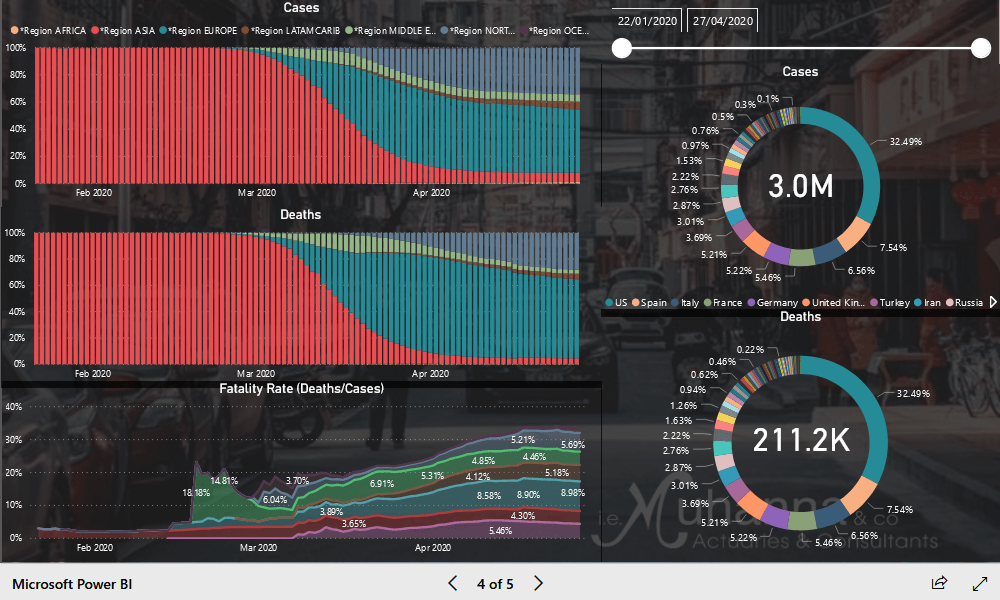
It also means that by end of March, it was a sure bet to predict that the line of one million confirmed infections and over 50,000 deaths would be crossed in the following days—in a ten-fold increase when compared with the 100,000 confirmed infections tallied by March 6, a mere four weeks earlier. The tally of infections and deaths will continue to climb.

Venturing further into granular details does nothing to remove uncertainties. The location of the first reported coronavirus outbreak, China, was tallied to have 82,278 confirmed incidents and 3,309 deaths by March 31. Germany, France, Iran, and the United Kingdom were next in the gruesome statistics, with respectively 65,600, 45,200, 44,500 and 25,500 infections. Switzerland, Turkey, Belgium, the Netherlands, and Austria were shown as five countries that also counted more than 10,000 confirmed infections by the end of March, while earlier victim South Korea reported just below 10,000—not that the 10,000 infections line would make any difference. But as the numbers change and become more shocking by the minute, what is the value of such information for concerned global citizens by the second week of April? 

From a perspective of policy-makers having to enact and adapt virus response plans, information gaps pertain to actual incident ratios in the pandemic, to existence or non-existence of seasonality, to the availability of tests, of emergency medical supplies, and to the time until vaccines and treatments will be available. Given the additional uncertainty about the effects and, inversely, potential short-term or long-term medical and economic detriments of one or the other containment strategy, the overall data insecurity and simultaneous decision-making pressure must be a living nightmare.       

The financial world: a flood of pain mixed with determined rescue signals 

The second, very powerful contender in the coronavirus race toward a global ground zero are financial market impacts, real economy impacts, and unemployment numbers. These doomsday notices are juxtaposed with signals of new governmental—meaning fiscal and legislative—measures and rescue packages, packages of monetary stimulus, bond buying and interest rate reduction by national central banks, and announcements of financing and debt relief initiatives by global financial institutions. 

On the world’s financial markets, stocks and their trading platforms are the most sensitive seismographs, signal givers of the first order when it comes to economic health. Beginning from mid-February and all throughout March, equities around the world were impacted by radical drops followed by uncertain movements, sideway trading, and resumption of drops. 

Between record highs in American and some European stock markets on or around February 19 and market readings on March 20, lay steep drops of about 30 percent in leading US indices Dow Jones and S&P 500, 40 percent on the German DAX, a drop of over 30 percent on Italy’s MIB, and more than 20 percent weakening on large Asian exchanges. 

Sideways trading and minor temporary price recoveries made not only the indexes of equity markets show pictures of mayhem and uncertainty at end of March and into April. Markets for bonds, oil, commodities, currencies, precious metals, and cryptocurrencies were shaken into bouts of volatility. Many markets passed through phases of deterioration last month that in their sum defied comparisons and left it to the mind of the beholder whether to describe the various down phases in sensationalized terms as crashes or euphemize them as severe contractions. 

Oil prices were caught between the rock of vanished demand due to the coronavirus pandemic and a hard place of a spat over production cuts between Russia and Saudi Arabia. Already subdued to levels below $50 over the first two months of 2020, due to weakening demand, prices moved down by 25 to 35 percent relatively early in March under the added impact of the price war. Scratching a $20/barrel price level that had in the oil price cycles during the 21st century only been recorded at a time when they were emerging from the $10 dollar lows seen ten years earlier, oil climbed back to the $30s by end of March and early this April. However, these signs of slight recovery were spiced with fears of possible further drops. 

Dollar prices and currency exchange rates also had a wild and wily month—the latter in the fact that they were advantageous to investors who played their wiles best. For most countries in the developing world, the month was wild, as they were hit by capital flight and depreciating national currencies. In the confusing environments of fear and flight, even gold seemed less solid, swinging from gains to losses in coronavirus uncertainty. The supposed digital gold, bitcoin, had value sucked out of it as investors cashed out bitcoin positions to cover exposures elsewhere, and even as bitcoin and a few other cryptocurrencies were gaining some territory as markets moved in late March and into April, it seems crypto-hell was bent on demonstrating that virtual does not have the same tangibility as physical. 

And so the sad markets stories went on and on. The data flood of bad and worse numerical signals from financial markets in March have in their volume and frequency rivaled the bad news on coronavirus infections and COVID-19 fatalities—the two crucial differences being that financial epidemics with inundation of deteriorating numbers do not imply growing risks of death and that the volatile financial signals reflected human behavior patterns. A crucial further element of financial signaling to the economy last month were the fiscal and monetary promises of countermeasures to the gathering coronavirus recension and ever-larger packages of support issued to themselves by leading economies.    

Emergency rescue packages in the richest nations 

In money trails on the global emergency supply plains, the top developed economies of G7 status have constructed the largest virtual caravans. Their money wagons are equipped with supplies that other countries can only dream of. The United States has legislated a $2.2 trillion dollar package, signed into law by President Donald Trump on the last weekend in March—an upward revision of the package and addition of another $1 trillion was later put on the table as parts of the program already looked insufficient to meet needs. Emergency packages worth double and triple digit billions of dollars were adopted by governments of the other G7 group countries. They were reported in early April as being: Canada ($75 billion); France (€45 billion in emergency aid to companies alongside €300 billion state loan guarantee package); Germany (€156 billion, upping its 2020 budget by almost 45 percent); Italy (€25 billion fiscal package, expected to be followed by much larger package); Japan (package according to government announcement on April 6 will amount to almost $1 trillion); and the UK (£350 billion/$430 billion under adjustable response framework with no limit). 

On EU level, according to a statement of current European Central Bank (ECB) President Christine Lagarde on March 19, the Eurozone’s central bank designed a €750 billion Pandemic Emergency Purchase Program on top of a €120 billion program adopted earlier in the same month. “We are fully prepared to increase the size of our asset purchase programs and adjust their composition,” Lagarde assured. 

It is predictable that these financial packages will not remain at these levels nor be nearly enough for doing what is needed, as already seen in the US context. A report in German newspaper Süddeutsche Zeitung said on April 5 that documents from the German finance ministry showed a total predicted cost of almost €1.2 trillion for measures in the country when all public measures are included. 

Using a phrase that reminds of the then-ECB President Mario Draghi’s 2012 rescue assurance during the euro crisis, leaders of the G7 said in a statement on March 16 that they were “resolved to coordinate measures and do whatever it takes” to restore growth in their economies and avert downside risks. 

Another early April news update: The United States’ rescue armament according to the New York Times comes with $454 billion in ammunition to enable Federal Reserve lending programs to small businesses, large businesses, local governments, individuals, and households. As a Treasury Department program for small business relief launched on the first Friday in April, the paper reported that over 10,000 applications for more than $3.2 billion in loans were processed that day.         

The big multilateral money guns 

Multilateral development banks and international financial institutions (MDBs and IFIs) were in the first tier of engineering their responses to the coronavirus pandemic and recession. With a financing quiver holding $1 trillion, the International Monetary Fund (IMF) signalled its readiness to mobilize all of its lending capacity, IMF Managing Director Kristalina Georgieva announced repeatedly last month, as the reality of a global recession projected at least as bad or worse than seen during the Great Recession of the 2000s dawned on international markets and global institutions. 

While assuming a recovery of the global economy in 2021, the return to growth will require tremendous medical responses as well as extraordinary financial efforts, Georgieva stated on March 23 (after a regular G20 conference call), making appreciative references to efforts by major central banks and fiscal packages that had been declared by G20 countries. 

After acknowledging the coronavirus-related economic relief measures taken by many G20 countries, she emphasized the continued presence of concerns over “the negative outlook for global growth in 2020 and in particular about the strain a downturn would have on emerging markets and low-income countries.” Early in March, Georgieva had announced that about $50 billion in fast emergency IMF funding, 20 percent of it in interest-free facilities, would be mobilized toward support for low-income and emerging markets.      

The IMF endeavors to facilitate better access to its emergency facilities, given that “some 85 countries” have indicated that they would need to rely on IMF emergency funding, the IMF chief said in a further, extraordinary conference call with G20 members on March 31. According to her, besides widening its emergency support umbrella the IMF is seeking to enlarge its capacities to help its poorest member nations and assist countries that experience foreign exchange shortages. 

In related efforts, the IMF in March initiated measures asking member countries to replenish a special catastrophe fund that has previously been used to support Haiti in 2010 and countries affected by the ebola epidemic in 2015, to a size of about $1 billion. Revising the catastrophe fund’s criteria enabled the granting of debt service relief for up to two years to poor nations as balance-of-payments support. 

According to a World Bank press release from April 2, the group initiated a first wave of emergency support operations worth $1.9 billion for 25 developing countries, including Yemen and Djibouti in the Middle East and North Africa (MENA) region. New operations are moving forward in over 40 countries under a fast-track process, in addition to redeployments of $1.7 billion in already existing projects. Further redeployments of funds for countries with approved projects could reach up to $160 billion over the next 15 months. 

An earlier World Bank Group factsheet had announced in mid-February that the group’s immediate emergency response would be dedicated to lifesaving operations, meaning support of healthcare needs, prevention and testing, medical research, and related development of community-based disease surveillance systems.  

A list compiled by Reuters in the first week of April showed 28 countries in the developing world that were beginning to receive emergency funding in support of their efforts to fight the pandemic in these countries from the World Bank Group and IMF. Containing 13 countries in Africa, 10 in Asia, and five in Latin American and the Caribbean, the highest indicated amount was destined for the most populous country on the list, India, at $1 billion, followed by Senegal with $226 million. 

Seven of the named countries, including India, were going to receive upward of $100 million, five $10 million or less. The smallest amount was earmarked for Sao Tome and Principe at $2.5 million. The countries identified on the list were of different income levels and population sizes, without apparent correlation of either factor with the amount slated for emergency support. The Arab countries benefiting from the first wave of emergency funding by the World Bank or the IMF according to the Reuters compilation were Yemen, Djibouti, and Mauritania.

Notable MDB/IFI initiatives from around Asia and the Middle East   

The four-year old Asian Infrastructure Investment Bank (AIIB) announced in the wake of the March 27 extraordinary G20 summit by conference call to its directors the creation of a $5 billion crisis facility for public and private sectors to alleviate financial pressures and support post-pandemic recovery. The flexible facility would be part of coordinated international response efforts and could be expanded, the AIDB said on April 3. 

Responses to the coronavirus pandemic from Islamic and Arab development institutions have come underway more recently and support announcements have been trickling when compared with the flood from global multilaterals. The Islamic Development Bank (IsDB) announced on April 1 that it would support implementation of “pioneering ideas in the fight against COVID-19” with a $500 million fund designed to invest in startups and entrepreneurship. 

Kuwait-based Arab Fund for Economic and Social Development (AFESD) on March 30 announced a $3.2 million grant to assist Jordan in its fight against coronavirus impacts. The Kuwait Fund for Arab Economic Development (KFAED) said on March 25 that it would contribute 30 million Kuwaiti dinars ($96.5 million) toward the country’s efforts in countering COVID-19. Kuwait announced its first COVID-19 fatality on April 4. 

Multilateral initiatives with private sector support angles 

The World Bank Group’s International Finance Corporation announced $8 billion in support for private sector companies through its trade finance and working capital lines, in addition to support for clients and invested private sector companies in the agricultural, manufacturing, services, and infrastructure sectors. Commitments from the group also include $6 billion in guarantees from credit insurance arm, the Multilateral Investment Guarantee Agency (MIGA), according to the press release.

The European Bank for Reconstruction and Development (EBRD), released a €1 billion “Solidarity Package” aimed at the countries where the EBRD is active. The measures are targeting support for private sector client companies that are in financing troubles through temporary credit problems. 

In addressing the global banking system’s very specific challenges under the coronavirus scenario, the Bank for International Settlements (BIS) declared additional funding and supervisory support measures for banks on April 3. Alleviation of pressures on banks according to the Basel Committee on Banking Supervision at BIS will relate to expected credit loss (ECL) accounting frameworks and regulatory capital requirements linked to ECL frameworks, as well as margin frameworks and annual assessment of global systemically important banks. 

On March 27, a preceding statement by the Basel Committee’s oversight body of central bank governors and heads of supervision (GHOS) endorsed measures to free up operational capacity of banks and supervisors in the corona crisis by deferring introduction of Basel III standards, revised market risk frameworks, and revised pillar 3 disclosure requirements. 

The specter of a global social crisis—a crisis of labor

What the entire relief army of fiscal and monetary initiatives in the G7 economies and the measures directed at the global economy’s countries in the “also-run” category could evidently not solve last month, was a scary momentum in the development of joblessness. The sad record in job loss news came from the United States with 10 million new claimants of unemployment benefits in the second half of March. Job losses in the first half of March, reported at over 700,000, were high by comparison with earlier periods but paled in comparison with the latter part of the month.   

This translates into a dichotomy between relatively benign US job loss numbers in the first half of March and the outlook for next month and beyond. The existing data up to March 12, while indicating that over 10 percent of the review period’s job losses actually occurred in the healthcare sector (in services not involved with the coronavirus pandemic), mainly showed that about 65 percent of jobs lost across the US during the pandemic’s initial social impacts were in hospitality-related sectors—most of them in restaurants—and that job losses generally affected younger and less educated employees. 

The shockingly high numbers of US unemployment in late March had to be expected in view of the immediate emergency of a shut-down US economy. There also is no reason to think that employment numbers in the US will become better in the medium term where a deep global recession—with, at least temporary, history-making work paralysis—now is the dominant assumption. 

Reasons why the US numbers have jumped so strongly last month and resulted in alarmed reports by news organizations might include the fact that employment preservation is less of a thing in the US than in Europe, which explains the higher spike of American unemployment when comparing these two economic areas. A perception bias is another usual suspect. Job losses in China, which were in the millions in February, seem to be perceived in western media as a statistic, not a social catastrophe.  

This is all unsurprising, and since surges in social challenges have kicked Washington into activist gear in March, the US Department of Labor in early April informed state-level authorities of a $600/week boost to unemployment benefit payments for eligible groups and instructed them in perfect bureaucratic precision to what categories of benefit claimants these additional benefits are to be disbursed. Notwithstanding specificities of the American labor market and social response system, the indications from March 2020 as to the social groups most affected by unemployment in the US foreshadow where the enormity of social troubles is likely to be clustered in other, less affluent economies.   

Overall, the outlook for restoration of labor prospects across developed markets and creation of jobs that can substitute for those lost in financially destroyed SMEs and long-term devastated sectors also appears rather dim, considering that design of emergency measures for workforces generally has been aimed at softening financial blows by compensating for losses in labor income. The most promising steps range from loan holidays, rent suspensions, and disbursement of survival cash to laid-off individuals. Regulated reduced-work arrangements—Austria’s and Germany’s employment defense recipes via labor department substitution of a part of lost wages and salaries, if employees are forced to work fewer than their contractual hours but remain on payroll—will help, just as similar arrangements in countries where governments have announced they will be assuming responsibility for paying as much as 80 percent of wages if employers keep their staff members on even if they have nothing for them to do. 

The future looks dim 

All these measures are beneficial and immeasurably superior to total absence of personal security—but they cannot negate the destruction of work in the coronavirus crisis or guarantee the creation of additional job opportunities for new labor market entrants during the interlinked national recessions that are expected to follow upon the pandemic and be unlike other cyclical downturns. Nor can the measures generate new jobs that would replace jobs lost in hard-hit sectors where, for a long time, no full recovery of pre-corona employment levels is expected, be that service jobs in travel, tourism and hospitality or manufacturing jobs in automotive and aviation industries. 

Moreover, most countries in the world do not come near to the fiscal power of the US and other G7 countries. Yet it seems unpleasantly safe to assume that similar patterns to those of the March 2020 job losses in the US will be seen by the time when downward labor developments across the world will come to be analyzed for G20 countries as well as less privileged economies. 

In a short-term outlook projection by the International Labour Organization, developing markets will be impacted more severely by evaporation of work than developed countries. Arab states will suffer the largest loss of labor that is being inflicted by the COVID-19 crisis on the world economy in the current quarter, the ILO said on April 7. The organization expects 8.1 percent of work hours to be lost in the Arab states, equating to 5 million full-time workers, which is 1.4 percentage points above the projected 6.7 percent rate of work hours that will be wiped out worldwide. Under the ILO projection, the global loss of work will be equivalent to 195 million full-time workers, 125 million of which will be in Asia.  

Job losses beyond the current quarter are very hard to anticipate because they would, to a significant proportion, depend on the timing and speed of recovery from the expected global coronavirus recession—key open questions are if recovery would start as early as the third quarter or only later on and if the recovery will be fast (a V-shaped recession), slow (U-shaped) or marginal (as in a L-shaped recession). However, the residual unemployment that has to be expected even after the pandemic has turned into a bad memory means that repercussions from increased chronic unemployment—including impaired physical health, increased emotional distortedness, and damaged mental stability—are likely to affect the entire globalized economy of the 21st century over decades. 

Socioeconomic epidemics will affect countries with highly developed analytical methodologies and data on domestic labor markets but will be even more hurtful to countries where the domestic labor market is a job casino with crooked croupiers—a large group of countries that includes Lebanon, which is in no way unique in this regard. 

The ultimate result of all this could be that job loss in the coronavirus crisis turns out to be a class of harmful societal bacteria prone to induce chronic illnesses in developed and poor countries alike, inflicting social pains and causing mental epidemics with unrestrained emotional infectiousness in all seasons and comparatively minor but unpredictable death rates.                   

The fourth stream in the deluge 

Such a social reality, unless balanced by a surge in social solidarity, looks to be no fun at all. Moreover, it links to the fourth swelling torrent that impacts and impairs daily lives in the form of a deluge of narratives. 

This torrent combines several sub-streams. One is flooding the internet and social networks with inane conspiracy theories. These dystopian fantasies are too numerous and on average far too stupid but they command a lot of attention. They can traumatize listeners with artificial fears and even lead to damages in the real world, as a brand new example from the UK demonstrates: burning mobile phone towers. Some towers were targeted by arsonists this month, apparently because of a conspiracy tale that fifth generation (5G) mobile networks have something to do with the spread of the coronavirus. Scientists were dismayed.

There are furthermore significant streams of deliberate fear mongering and disinformation. The disinformation stream’s fake news can be state-sponsored or state-aligned, suggest observatories of such data, and are revealing digital frontlines that are culturally entrenched and throwbacks to Cold War times. Unimaginative horror movie scripts about villainous military leaders underwriting secret laboratories for biological weapons research that have set a virus loose deliberately or inadvertently, are an old hat. But such allegations recently seemed to be popular fake news grenades deployed by various global powers on their disinformation fronts.   

A third detrimental sub-stream of the online information deluge is criminal with the objective of financial gain. Real world price gouging and criminal behaviors of seeking to exploit the desperate demand of municipalities, public and private healthcare institutions, and individuals by charging sky-high prices for—often substandard—emergency medical supplies from masks to ventilators for COVID-19 patients is a morally despicable and legally criminal practice that has surged with the pandemic. 

Mirroring and even preceding these practices have been cybercrime syndicates and individual crooks who fraudulently promised to deliver medical equipment, virus tests, imaginary vaccines, and even miracle cures in online environments. Further fraud strategies include scams related to banking, financial services, coronavirus research, donation solicitations—the Action Fraud reporting system in the UK warned of soaring fake governmental emails asking for donations to the UK’s National Health Service, in one example—and charities. 

While real-world property crimes saw a downturn during the lockdowns, virtual crime in connection with the coronavirus pandemic soared into existence by February and ballooned in March, to the point that platforms for reporting such crimes, such as Action Fraud, were flooded and sometimes overloaded with requests by April. 

“The pandemic opened up a business opportunity for predatory criminals,” said a report by Europol that announced the results from a global operation against counterfeit medicines, mostly counterfeit surgical masks, which, according to the report, resulted in the dismantling of 37 organized crime operations and closure or some 2,500 online links. In the US, the justice department warned of rising online scams related to the coronavirus and the National Center for Disaster Fraud asked coronavirus fraud victims to contact a hotline. It is too early in the trajectory of coronavirus-related online crime to have meaningful numbers on average damages to victims or the accumulated financial gains of fraudsters during the pandemic, but as with all crime, this online scamming epidemic will leave behind traumatized victims.   

The rise of mainstream news and economic forecasts

On the other end of the information spectrum are the not so bad guys—news organizations and individual journalists, academic research initiatives, for-profit consultancies, and individual economists, celebrity and otherwise. In this realm, the coronavirus has been dominating the attention of journalists for more than a month, which resulted in daily flows of virus-related news on every mainstream and niche media that Executive accessed during the pandemic (including Executive’s own website and social networks). 

Detailed and high-level economic research reports from academic institutions, bank research departments, and professional consultancies have flooded the global info sphere with studies, graphs, tables, projections, and guesses about the trajectory, severity, and outcome of the global coronavirus recession and nation-scale recessions. There was even a first “infodemiological study” by Chinese scholars about correlations between the COVID-19 epidemic and the COVID-19 infodemic.    

It can and must be pointed out that the work of journalists and media organizations is driven largely by people’s right to information on the pandemic and all that it implies (NB: Many for-pay online magazines and news sites have punched holes in their paywalls and are offering their coronavirus coverage pro bono, and advertising revenue at other media sites is down). This is the media’s mission. However, with the rise in mainstream reporting, daily monitoring of the flood of journalistically produced news also nurtures concerns over imbalances in reporting, the nurturing of self-fulfilling prophecies, and the reinforcing of prejudices and misperceptions in absence of sufficient verifiable information. 

Concomitantly, the relentless spike in production of economic opinions, analysis papers, and presentations suggests an increase in risks that the users of these reports will by way of selective perception chose to peruse materials that reinforce their narrow views and existing biases. 

Many economic research departments and consultancies appear to compete in bringing out reports fast (as a non-representative example: the World Economic Forum’s lineup of contributors and experts in April churned out over 25, often elaborate, online pieces in less than a week). Many such reports will have to come at the price of having to use preliminary, partial, uncertain, and not yet corroborated and robust data. Perhaps too many.      

Casually put, the fourth stream in the corona environment of spring 2020 is a lavish information kitchen that allows economic addicts to overeat on a high-protein diet of advice and opinion, conspiracy theorists to indulge in nutty snacks with no nutritional ingredients and news junkies with a taste for the morose to feast 24/7. Given, however, that the torrents of so far mostly depressing SARS-CoV2 and COVID-19 data, discouraging economic data, and highly worrying social trend data in their confluence already make any previous experience of TMI look like a joke for preschoolers, the presence of the fourth stream in the deluge seems to transmute the combined mental coronavirus experience into something like a distributed denial-of-service attack on human brains—with no telling about the damages that might be inflicted.  

In any event, as a long defunct economist and political philosopher wrote in an exchange with a fellow socialist one and a half centuries ago, “Every child knows [that] a nation which ceased to work, I will not say for a year, but even for a few weeks, would perish.” It seems that the world will in due course find out if, per chance, Karl Marx was right on this one.  

Deeply embedded in the coronavirus crisis: The case of Lebanon

And where is Lebanon in this global apocalypse that comes with the destruction of all human ability to predict what will happen to the world economy in the coming six, nine, 12, 21, 40 or even 120 months? The answer might be mostly one of cultural coherence and mental resilience.  

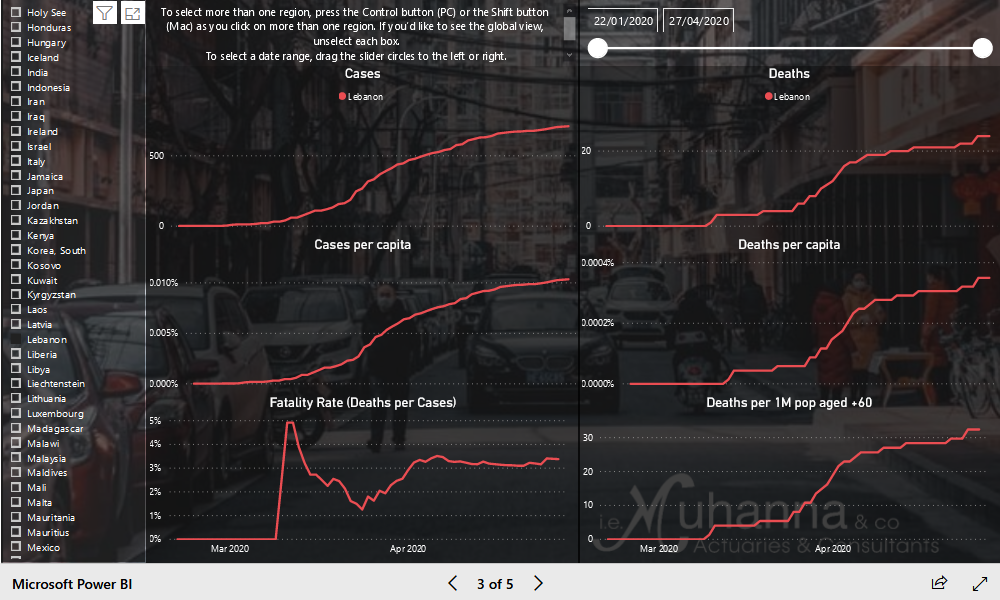
In terms of infection count, Lebanon, showing 541 infections on April 6 on a continually updated list maintained by Johns Hopkins University in the United States and registers in the middle field of the 183 countries that are included in the tally. The list on that day shows more than 60 countries with 10 or less infections each and just over 100 with more than 500 such incidents. 

A world map at the site shows a not too large red spot in a world that is plastered with circles of red (one must assume that the size of the circles correlates with the number of infections but does not give information on the ratio of infections to national populations). Over 70 countries have reported higher infection counts than Lebanon. The world total that day is approaching 1.3 million confirmed infections and 70,356 deaths. 

Lebanon’s tally of 19 deaths seems elevated in relationship to other countries that show between 400 and 700 infections, as countries in the group with a lower count outnumber those with a higher fatality count about three to one. The time for the doubling of infections in Lebanon is shown as about 30 days, with a stable trend and looks rather good in context of another visualization of the Johns Hopkins COVID-19 data. However, the overall robustness and depth of country data about most countries, including Lebanon, appears at a fleeting glance to not be sufficient yet to allow for real analysis and conclusions with a high degree of confidence.     

Carnage and more carnage

The economic picture in Lebanon is not one of a country that has been ripped away from its healthy economic trajectory by a sudden external shock—as is the scenario in other countries that have come to regard a lockdown as the only way to avoid an unacceptably high loss of lives among their citizens. Lebanon’s economic picture is one of sustained carnage, or rather the governmental self-dismemberment of the little that has remained of the country’s political and socioeconomic integrity after a series of vacuums and utterly result-free policy cycles in the 2010s. 

With transmission of guidance impulses into the economy through the administration’s dysfunctional central nervous system frequently interrupted over the course of a decade, vital parts of the economy started to wither and die off. The resulting dismal state of economic and financial affairs, having become unmistakably clear in the third quarter of last year, is by now known perfectly well and has been documented almost to excess. There is no need to reiterate a description. 

However, if one wishes to refresh one’s memory on the entwined elements of the Lebanese mess, one only needs to glance across national and international assessments of this existential crisis, for example by reviewing the six joint statements which the International Support Group for Lebanon (ISG) has issued in course of the past seven months. 

A meditation over such documents and the economic realities delineated therein gives the impression of only two possible approaches. In recognition of the persistent economic emergency that has only been exacerbated but not induced when the first coronavirus infection was discovered in the country seven weeks ago, the possible reactions to the twice cursed reality of pandemic and deep economic crisis are a realist’s approach and a utopian one.   

Realistically, and this is prudent, the country needs things: the virtue of hard work by motivated and determined business movers, shakers and makers—the kind of people who are investing themselves into the Lebanese economy and put their own fortunes on the line—and help from outside by whoever is willing and able to help. Leaders of industry and economists have reconfirmed earlier in the coronavirus crisis that they are determined to work with everything they have and that foreign help is vital and urgently needed, ascertaining at the same time that they would not expect the Lebanese government to be able to spend any significant own financial resources on alleviating the repercussions wrought by the coronavirus crisis or the economic malady. (See March 2020 industry story). 

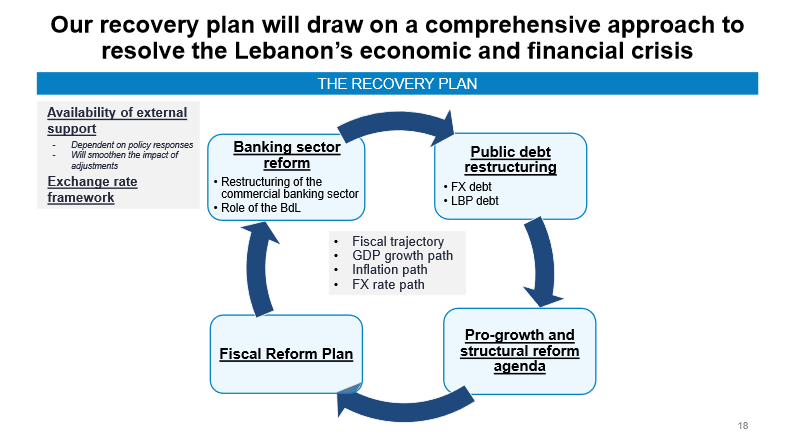
All that can be said at this moment with reasonable confidence about the search for foreign help, is that talks between the Lebanese government and interlocutors on the global level, such as the IMF, the World Bank Group, and stakeholders in the ISG, have been ongoing for months now. The details discussed in these talks are by and large less transparent than one would wish for and the outcomes appear not predictable, but the potential enablers, foremost the enabler of fiscal reform, are known. 

In this regard, the latest communication between the Lebanese state and the ISG has reconfirmed this month that Lebanon is appealing for and depending on international support. The official message to the ISG reiterated baseline information on the Lebanese government’s perception on the scope, roots, and growth of the national economic crisis, and the fundamental precondition for receiving aid that consist of empowering an efficient government that enacts reforms and disavows all corruption. The message contained the assurance that “the Lebanese state is currently working on putting up a comprehensive financial and economic plan, within a national rescue program,” and the promise that “the plan is about to be completed” as President Michel Aoun told ambassadors, EU, UN, and World Bank representatives in a April 6 speech.    

An alternative utopian approach might reason differently, however. It might admit for example that unadulterated carnage of the Lebanese economy is just as strong as it was before the coronavirus struck—but continue to say that under the conditions of the coronavirus crisis, financial drainage, ballooning debt, currency blowout, poverty explosion, social emergency, and vanishing jobs are no longer just cluttering the Lebanese horizon but that these ominous signs now are looming over multiple countries. 

A utopian approach might further reason that the current outlook of a deep global recession represents an opportunity. With the entire world facing the possibility that new economic paradigms—a need that had also been debated toward the end of the 2007-09 Great Recession but that did not materialize then—a utopian Lebanese might argue that the financial and economic apocalypse is finally taking shape, but that in Lebanon it is the apocalypse of flawed finance and dysfunctional economy and does not mean the end of the world. 

Utopians are raising their voices and concerns internationally, advocating for debt forgiveness or introduction of universal basic income solutions, stakeholder capitalism and new social contracts, replacement of outdated models for externalizing climate and environmental costs, for trying out Modern Monetary Theory, for better financial constitutions in the public economy, for central banks that become pawnbrokers of last resort, or for ending the antagonism between markets and public administrations, societies and states.  

A Lebanese utopian might see an opportunity for contrarian thinking to be effective in the country’s redesign of the national economic strategy, perhaps by way of a new form for sustainable monetization of state-owned lands while retaining public ownership, or by encouragement of a creative revolution in design and tech entrepreneurship and a giant national leap into digitalization in pursuit of a moral economy, or by activation of a diaspora network for long-distance job creation, or by institution of a policy that would encourage restructured banks to deploy their knowledge into healthy banking sector growth, or, or, or. A determined utopian might even rejoice that the global powers that are, have been put under downsizing pressure by the coronavirus pandemic and its collateral recession so that they have less ability to deploy financial superiority for their own power gains, being false friends for countries that should realize that they have more than enough talent and more than enough own concentrated wealth to stand on their own feet.   

One thing to remember 

The Lebanon apocalypse is unfolding but it will not be the end of the Lebanese and not the end of Lebanon. The economic apocalypse of 2020 is a chance and a double opportunity to learn from the country’s systemic failures and step up to global challenges. 

Henrik Mueller, professional observer of international business realities and professor of economic journalism in Germany, argues this month that the coronavirus revision of everything has just successfully refuted the old accusation that capitalism subordinates everything to the almighty profit motive. Some budding economists, meanwhile, blurted out in an Austrian School economics forum in the United States their ideology that, fundamentally, freedom is more important than security, or an illusion of security.

A Lebanese observer of such discourses might ask in response, “What is most valuable and important in and after the coronavirus crisis for a society that has neither security nor could benefit from past laissez faire capitalist freedom in a rentier state?” The answer, one hopes, is human solidarity and productive collaboration between utopians and realists.   

April 8, 2020 0 comments
0 FacebookTwitterPinterestEmail
Agricultureagro-industryCoronavirus AnalysisSpecial Report

Economic and coronavirus crises threaten Lebanon’s already fragile food security

by Nabila Rahhal April 1, 2020
written by Nabila Rahhal

For almost anyone residing in Lebanon, trips to the supermarket have become laced with a vague sense of apprehension. The more privileged may wonder how much the price of their favorite brand of imported cereal is now (as prices have been inflating since the last quarter of 2019), or if indeed it is still found in the Lebanese market. Those at a low income level worry that they will no longer be able to purchase the basics needed to feed their families, as prices of even staple items are rising—not to mention the requirement to wear a mask at many supermarkets now, retailing at pharmacies at LL2,000 a pop.

The ongoing economic crisis in Lebanon—and now coronavirus-inspired trade restrictions—have led to inflated prices on imported goods, which, according to the Food and Agriculture Organization (FAO), account for 85 percent of Lebanon’s food basket (a list of basic food commodities calculated according to the minimum daily diet of 2,100 calories per the World Food Programme). This has led to questions about our food security, defined by the FAO as when “all people, at all times, have physical and economic access to sufficient, safe and nutritious food that meets their dietary needs and food preferences for an active and healthy life.” It has also made many question Lebanon’s lack of food self-sufficiency, defined by the FAO as when “a country produces a proportion of its own food needs that approaches or exceeds 100 percent of its food consumption.”

The size and scope of global food supply chains today has made nations largely interdependent on each other for food security. According to FAO’s Food Outlook Biannual Report on Global Food Markets 2019, an estimated 168.2 million tons of wheat was traded in 2018/2019 and 172.1 million tons are expected to be traded in 2019/2020, an increase driven by larger expected imports from drought affected Morocco and higher purchases by several countries in Asia (the report was compiled before the coronavirus crisis). This year-on-year increase in trade of a key staple food is just one example of the importance and common practice of global food interdependence.

A high dependency on imports for food supplies, however, makes a country’s food security vulnerable to external factors such as lower production in source countries due to climate change-related factors or when trade routes are disrupted because of political tensions or strife in an exporting country. An example of this is the coronavirus-related trade restrictions and food hoarding being witnessed in many countries, which has a potential negative impact on global food supplies, according to an article by Reuters published on March 26, 2020. While the article assures readers that, according to analysts, global supplies of the most widely consumed food crops are adequate, it still gives several examples—such as surging prices of soymeal in Argentina—where closed borders and reduced workforces are “putting a strain on the usual supply routes.” 

These potential disruptions to trade routes are why most countries aim for a balance between food self-sufficiency and trading within the global food supply chain to ensure high levels of food security. One of the categories used by FAO to measure a country’s food security is “stability,” under which falls indicators such as per capita food production variability and cereal import dependency ratios (the higher the dependency ratio, the less food secure the country).  

Lebanon falls on the lower end of food self-sufficiency as it imports 85 percent of its food basket. This makes its food security highly vulnerable: the liquidity crisis—which cut off traders’ credit lines—and the more recent restrictions on global trade brought on by the coronavirus crisis both indicate the extent to which this is true.

Around the world

For Lebanon to strengthen its food security, it needs to begin with a better strategy for securing its food imports, says Rabi Mohtar, dean of the faculty of agricultural and food sciences at the American University of Beirut. Mohtar is critical of the fact that information regarding where Lebanon imports its foodstuff is not easily accessible through government reports, and that deciding on sources for agricultural imports does not appear to follow a strategy or plan set by the responsible ministries such as agriculture, industry, and trade.

According to Mohtar, the concept of food security has evolved from when a well-stocked silo of grain at the village entrance meant a happy and well-fed population to become “more complex and akin to portfolio management.” Just like it is considered prudent to diversify investments when managing a stock portfolio—or else risk losing all money invested if one stock plummets—it is wise to have more than one import source for staples. Mohtar gives the example of Saudi Arabia, which he says is one of the most food secure countries in the region because it imports the same staple from multiple countries, therefore diversifying its portfolio of agricultural imports and minimizing the risk to its food security.

Lebanon, by contrast, tends to opt for the cheapest source country for importing a staple foodstuff, meeting all its demands from it. For example, all of Lebanon’s wheat imports are from Ukraine (the 6th largest exporter of wheat in dollar value), according to Mohtar. “Our criteria were to import at a low cost and so we were not looking at that from a robustness of the food system and diversification perspective but I think moving forward we need to be looking at these issues and the tradeoffs,” he says. 

Made in Lebanon

Regardless of how much Lebanon diversifies its sources for imports, however, its food security will remain weak if 85 percent of its food basket comes from external sources. To decrease this dependency on global food supply chains, Lebanon needs to work toward increased food self-sufficiency. On aggregate, Lebanon is most self-sufficient in fruits (147 percent) followed by vegetables (93 percent) while it imports 83 percent of its total cereal consumption, as per ESCWA and World Food Programme’s 2016 Strategic Review of Food and Nutrition Security in Lebanon. 

The first and most basic step for Lebanon to become more food self-sufficient is to further develop its agriculture and agro-industry sectors, according to Kanj Hamade, assistant professor of agricultural economics and rural development at the Lebanese University. “Before we talk about food sufficiency and decreasing our dependence on imported foods, let us first talk about supporting and strengthening our local production, our local agro-industry,” he says.

The ongoing economic crisis in Lebanon and the more recent trade restrictions due to the global coronavirus pandemic have made clear the importance of productive sectors to the economy (see Q&A with Nadine Khoury) and more attention is now being given to improving the country’s agriculture and agro-industry sectors (article forthcoming). Strengthening agriculture and agro-industry is easier said than done, however. Four years ago, in 2016, Executive covered the Lebanese agricutural sector and its limitations, which back then included a problematic and traditional irrigation system, limited availability of irrigated land, and lack of planning and coordination at the ministerial level, coupled with a lack of regulations and weak implantation of existing ones. Sadly, not much has changed since. According to FAO’s website: “Agriculture plays a relatively minor role in Lebanon, contributing about 5 percent of GDP.” In terms of the number of Lebanese dependent on agriculture to make their living, however, the picture is slightly different. Both the FAO and ESCWA estimate as high as 25 percent of employment in the country is through agriculture and up to 80 percent of economic output in rural areas is agriculture-based. On agro-industry in Lebanon, the FAO says it accounts for an additional 5 percent to GDP and “constitutes a major and growing employer in the economy.” 

It is often said that opportunities lie in every challenge for those who know where to look. To Hamade, the difficulties in getting food products into Lebanon nowadays and their increased prices (caused by both the economic and coronavirus crises) creates an almost golden opportunity for import substitution in agro-industry. He sees the most potential for import substitutions in dairy production but says goat meat, pasta, and wheat-based breads—if we expand our wheat production—are all areas to consider. “In agro-industry, you can easily use existing production lines to produce and substitute items like pasta and other hard wheat products,” he says. “We have an opportunity in almost all food products to first try and get raw material from local markets—so we can support them—and if [the local supply] is not enough or not available, then import raw material to develop any part of the agro-industry sector so you can substitute imports and meet local demand.”

The best laid plans

Both Hamade and Mohtar told Executive that increasing self-sufficiency is not a zero sum game—no country in the world is a 100 percent self-sufficient. Decreasing our percentage of imports, however, is still an important goal. “Because of the economic crisis and now the corona crisis, we have an opportunity to decrease this figure, which is very good,” Hamade explains. “We don’t have to be fully self-sufficient, however—which is hard anyway because we are a small country with limited resources such as water and land that are needed if we want to raise livestock, for example—but we can move the percentage lower.” Doing so, he says, will help Lebanon reduce its balance of trade deficit and move toward having a productive economy instead of being dependent on remittances.

Mohtar believes that any plan for Lebanese food security should first take into account the modern day Lebanese diet and then concerned ministries can set a strategy for what can be locally produced and what should be imported. “The need is not to make [the percentage of agricultural products that we import] zero because at some point it becomes a tradeoff—if it is too expensive to produce locally, then it is better to import—but we need to have a national plan for food security,” he says. “A plan would say, ‘Ok, this is my food basket, I am going to import this much wheat from multiple sources because I don’t want to be dependent on one country and I am going to produce my vegetables, eggs, and chicken. I will import some of my needs for red meat but I need to reduce my consumption of it and return to the traditional Lebanese diet where red meat was not consumed daily.’” Mohtar explains that the balance between import and local production would be a function of water, land, and technological availability, which, when combined would dictate the cost of local production against importing these commodities. “A national plan to protect, invest in, or to promote certain food products will guide this balance,” he says.

As it stands today, Lebanon’s food security is highly vulnerable due to the challenges facing food imports, which our national food basket depends on, and due to years of neglect toward the agro-industry and agriculture sectors. This cannot continue as is. Lebanon is now in serious risk of seeing a significant percentage of its population go hungry, as prices of basic imported commodities increase with limited viable locally produced options. If there ever was a time for the state to have a food security plan, then it is now. 

April 1, 2020 0 comments
0 FacebookTwitterPinterestEmail
Economics & PolicyOpinion

How feasible is the recovery of stolen Lebanese assets?

by Riwa Zoghaib March 30, 2020
written by Riwa Zoghaib

The Lebanese uprising that burst into the streets across the country on October 17, 2019 was a focal point for long held frustrations over a poor governance system and widely perceived endemic corruption. The trigger for the protests was a series of proposed taxes that the previous Lebanese cabinet had agreed on, as part of its austerity push amid a declared state of economic emergency. Those that took to the streets saw these measures as punching down on a populace already suffering economically, and instead directed their anger toward a political class that had, since the end of the civil war, been presiding over Lebanon’s ever-expanding fiscal deficit and public debt. Among the demands that emerged from the streets over months of protests was a call to retrieve stolen public funds and freeze the assets of Lebanese politicians located abroad. Recovering these assets, however, is not a straightforward process.

The full scale of illicit proceeds from corrupt practices is challenging to calculate. The United Nations Office on Drugs and Crime (UNODC) estimates that the amount of money laundered through corrupt or criminal activities in the world ranges from 2 to 5 percent of global GDP, calculated as between $800 billion to $2 trillion per year at the time of estimation. UNODC notes that, while the margin is huge, even at the lower scale it “underlines the seriousness of the problem.”

Those engaged in corrupt activities have various strategies to conceal the origins of their illicitly gained assets. They can illegally—or legally—transform them into several forms, including but not limited to: hard or electronic currency, movable and immovable property, shareholdings, and offshore companies. These asset transformations facilitate their circulation across multiple jurisdictions, while using the names of different owners to further camouflage their real point of origin. This makes it increasingly challenging for law enforcement agencies to track, trace, and legally confiscate them. Tracing and identifying these assets is time consuming as it requires lengthy and costly legal investigations, which, in turn, require the relevant jurisdictions to have open access to public registers such as court records, company and land registers, customs records, and bank accounts. These investigations need to identify the causal link between the crime(s) and the offender(s)—and lead to prosecution and the recovery of the assets.

Effective cross-border judicial assistance requires transparent and effective communication; this is complicated by the differences, in many cases complex, between legal processes and terminologies across multiple jurisdictions. The efficiency of the assert recovery process is also hindered by the lack of qualified and experienced judges in state authorities, as well as the absence of focal point agencies and local and international assistance networks. To overcome these challenges, strong national legal and institutional frameworks compliant with the international measures and best practices—such as the United Nations Convention Against Corruption and United Nations Convention Against Transnational Organised Crimes—are indispensable.

Unfortunately, the legal anti-corruption and anti-money laundering tools in Lebanon pose several serious obstacles to the asset recovery process. A 1956 law on banking secrecy law prohibits national banks from revealing any information concerning banks’ books, transactions, or correspondence of depositors—including politicians and their relatives. Sitting unvoted on in Parliament is a now almost three-year-old draft law to amend Law 154 (1999) on illicit enrichment, yet neither the law or the awaited amendment require government officials and politicians to publicly disclose their assets in all their forms located in or outside Lebanon. Two laws designed to control, prevent, and criminalize acts of corruption—Law 44 (2015) on anti-money laundering and terrorism financing, and Law 55 (2016) on the exchange of information for tax purposes—were also not effectively implemented. Law 44 states that the Special Investigation Commission (SIC) of Banque du Liban (BDL), Lebanon’s central bank, is the focal point within the authority to seize suspicious bank accounts and to confiscate the movable and immovable assets that are proven to be the results of money laundering activities. The law is silent, however, regarding any further measures or practical procedures regulating the asset recovery process—from the pre-investigation and investigation to the judicial and the return phases. Law 28 (2017) on access to information, which took almost a decade to be passed by Parliament, has faced endless implementation challenges. In particular, Law 28 is hampered by its co-dependence on a National Anti-Corruption Commission (NACC) that is yet to be established. Besides the slow passage of necessary legal tools to combat corrupt practices, as well as the obsolescence and the incompliance of Lebanese laws with the international measures the country has ratified, there is also an entrenched culture of secrecy that is wearing down every attempt for reform and compounding the obstacles brought on by the lack of a clear, full-fledged, and unified asset recovery legal framework.

During a seminar that took place in Beirut on January 26, 2020, on fighting corruption, tax evasion, and asset recovery, Charles Bratz, a French judge specialized in anti-corruption and asset recovery, stated that the independence of the judiciary is a prerequisite for a successful and efficient asset recovery process. The Lebanese Judges Association did call, on October 18, 2019, for the temporary seizure of the accounts of all politicians, senior officials, judges, and public sector workers, in addition to their family members, whose deposits exceed LL750 million ($500,000 at the official rate). Yet this never materialized, and, in the now over five months since the protests first broke out, there have been no indictments or investigations by our judiciary into corrupt practices. Serious questions remain over whether the Lebanese judiciary, hampered by a severely politicized judicial system lacking in basic independence, would be able to prosecute corrupt politicians and succeed in recovering stolen funds.

One further—and crucial—aspect to consider before originating an asset recovery case is cost. These kinds of investigations can often be prohibitively expensive, as they involve all kinds of anticipated or ad-hoc costs—such as employing additional experts, translating large number of documents, and managing and maintaining the frozen assets—that Lebanon currently cannot handle, given the economic, financial, monetary, and now coronavirus crises that are unfolding in tandem.

Given the above, there is a serious question to be answered: Is recovering stolen assets from abroad the entry point for Lebanon or should efforts be focused on bridging the legal gaps in ways that would prevent politicians from looting and laundering public funds in the future? In other words we must ask ourselves moving forward if the benefits, i.e. the amount of recovered assets, would outweigh the costs, i.e. the money spent throughout the process of asset recovery. 

The views and opinions expressed in this article are those of the author/s and do not necessarily reflect the position of the Lebanese Transparency Association or the editorial views of Executive Magazine.

March 30, 2020 0 comments
0 FacebookTwitterPinterestEmail
Economics & PolicyLabor

The jobsforlebanon initiative envisions a new labor paradigm for Lebanon

by Thomas Schellen March 27, 2020
written by Thomas Schellen

For those who are addicted to adrenaline rushes from springtime thrill rides, March 2020 may very well be as good as it can ever get. But only as far as the thrills of being exposed to the mother-of-all economic shocks. For the large majority of us, it is a world-engulfing nightmare. For the Lebanese, it is a nightmare that is embedded in a disaster. 

This fourth week in March 2020, jobless claims in the United States jumped by a record 3 million filings, and this is just one of the scary numbers from the global labor market. In macroeconomic terms, this month appears as prime candidate to enter the history books as a pinnacle of global economic shocks, a time when some countries started to think seriously about helicopter money and new economic formulas, and a time when Lebanese government officials felt compelled to wax lyrically about social responsibilities, the state’s duty to assist the people, and about money (money that is nowhere certain) for the support of suffering citizens and the army of newly laid off workers—an army of many divisions. 

But it is also a month when a new startup portends to offer “a glimmer of hope” for employment of people who call Lebanon their home (and who to continue to live here). Startup movement jobsforlebanon.com (J4L) was intended to be launched online on March 16, 2020, but leaped into existence a bit prematurely and unintentionally on March 10, its co-founder and newly minted president Roy Baladi tells Executive during an extensive interview with the J4L founding team (see Q&A). 

Over merely two full weeks of virtual life, the initiative encountered what Baladi says were spectacular rates of attention. “We had 26,000 people—probably almost 30,000 by now—come onto the site in less than two weeks; we had 118 jobs posted [and saw] Lebanese expatriates from 126 countries [visiting the website]—rich Lebanese in Nepal, Botswana, and Bhutan,” he says. “We had over 1,300 candidates apply to these 118 posted jobs and are now seeing hires happen. Four hires were completed. Also, more hiring managers and candidates are reaching out and saying that they were able to [arrange] jobs through jobsforlebanon.” 

The backstory 

According to Baladi, the J4L movement was conceived toward the end of 2019 during the thawra (revolution), at a time of high optimism fueled by the national unity witnessed in the rising protests. During a conversation with Baladi, J4L co-founder Yalda Aoukar expressed her dismay over having received a shocking number of appeals for loans or any sort of work and living income from highly qualified and yet out-of-work friends back home, and so she brought up the idea to call upon Lebanese expats in the diaspora to provide freelance jobs that could be worked remotely from Lebanon. Next was a conversation with another co-founder-to-be, Neal El-Jor Taouk who at the time was already engaged in the organization of a Lebanese expat network called Meghterbin Mejtemiin (Lebanese diaspora united) who, it was agreed, would commit to building the diaspora network for J4L.

This meant that two key building blocks for J4L were ready for sourcing: a recruitment tool and a network. Recruitment software could be sourced from San Francisco-based Smart Recruiters—a company whose business was the development and provision of exactly this type of software. Baladi, an early employee of the company, could access the product under a corporate social responsibility commitment by his employer. The nucleus of a diaspora network was also already in place. 

Constructing a narrative

In addition to this, Baladi, El Jor (a former Facebook employee and marketing and communications expert), and Aoukar (a finance expert and entrepreneur who is managing partner in an investment company), set out to find someone who would provide them with a snappy marketing message that could send J4L on a viral trajectory on social networks. They found Rhea Nasard, creative director at Lebanon-based agency its communication. 

By early 2020, while seeing Lebanon languish under its economic crisis and unemployment rise ahead of the days of the coronavirus crisis, J4L had its three main arrows in the quiver: a product, a network, and a message. “Our aim with this initiative was to provide a glimmer of hope and offer people in Lebanon a way to stay in their country, and empower the diaspora, like Neal said, to tap into a market place of extremely competent individuals who also happen to be your compatriots,” Aoukar explains. 

Next to join was Natasha-Christina Akda, lawyer and founder of a New York-based corporate advisory—and also a passionate advocate for Lebanon with high civic involvement. While progressing on its trajectory toward incorporation and a legal identity J4L met with a surge of attention in the days of the exploding global coronavirus crisis. In this context, it rapidly encountered interest not only from Lebanese job seekers and diaspora members but also from potential emulators of its non-profit recruitment model in countries from the Netherlands and Germany to Australia. The venture also established two outreach enhancement programs, one an ambassador program and the other a partner program.

Even more fascinating to this observer than this narrative of growth beyond expectation is the way in which J4L’s own path and experience mirrors its founders’ vision and aims. Here is a core team of diverse Lebanese expatriates who “made it” and by all appearances built viable existences in important economic hubs and vibrant sectors. This team links back to Lebanon but does not follow an—often seen and not always successful—track of moving physically back into the home country for the Lebanese economy to benefit from all they acquired abroad in a reverse migration of brainpower and skills. Instead, they clone their own cultural and entrepreneurial DNA into a platform that has global potential—with Lebanese ingenuity inside. Irrespective of its somewhat parochial name, which might evoke misgivings of a narrow agenda and nationalism, this new online startup initiative comes across as not exclusionary, nor racist, nor populist, nor politically exposed. It is not just about Lebanese jobs either, at least not conceptually and not in the long run. 

Caveats and potentials

There are caveats, as with all human endeavors and daring innovations.  While the enthusiasm and creative energy of the J4L team are as laudable, as their optimism and dedication to their self-chosen mission, assurances by team members that this team will “always” remain committed to the movement irrespective of what changes it might undergo and how responsibilities might shift from board oversight roles to operational officer roles have to be regarded with a caveat about the very limited predictability of human relations over multi-year time spans. 

From a perspective of potential conflicts of interests and corporate behavior, the, at this point exclusive, reliance of J4L on the software solutions of Smart Recruiters, which itself is said to operate under a software as a service (SaaS) business model, in conjunction with the overlap of Baladi’s personal involvement as president of J4L and as head of communications in charge of corporate social responsibility at Smart Recruiters, some cautiousness seems to also be warranted. Even as a casual look and reputation check of Smart Recruiters does not raise any red flags, it cannot be overlooked that the company is a fairly young corporate partner, which undertook a Series D funding round a little less than one year ago and raised $50 million in this round according to US-based tech website Venturebeat. 

Further, it can not be ignored that the operation of a recruitment platform using algorithmic and artificial intelligence (AI) that is incorporating processes for vetting candidates for their technical skills, language proficiency, personality, and backgrounds by third-party providers is not necessarily void of errors or even biases (such as male chauvinism seen in genderless AI). Moreover, the field of recruitment companies is marked by high competitive pressures. 

Finally, when looking at the Lebanon aspect of the J4L equation from the perspective of the enormous rise in competition for finding work across most national and all international labor markets, the horizon for 2020 and 2021 is clouded to a fright. The rise in US jobless by a brutal three million people in a single week this March and an Chinese urban unemployment statistics showing five million people to be out of work for the months of January and February—with forecasters’ expectations of another increase due to global vanishing of demand for Chinese manufactured goods for at least several months—imply a glut of labor supply in the world’s two largest economies. Even if only 5 or 10 percent of this added rise in eager job seekers were highly qualified or experienced, their number would be overwhelmingly large when compared to the number of the entire Lebanese labor supply. 

J4L’s repeated assurances and conviction that this country has an abundant supply of highly skilled and multilingual candidates for employment or freelance positions on global level must be thus juxtaposed with the fact that—while job seekers from other countries of origin may or may not be equipped with on average equivalent skill level, motivation, multilingual background, tech savviness, or entrepreneurial drive—there is no denying that the absolute number of Lebanese talent does not measure up to the numbers of job seekers from much more populous countries. This observation applies not just in these days of high global unemployment but even at times when corporate demand for labor in coming years might be reaching levels that are closer to full employment—which is in itself a doubtful proposition in a decade where speculations over job destruction due to increased automation and substitution of human workers by AI have been globally rampant for the last few years. 

In terms of numbers, furthermore, the one-year vision of seeing 50,000 jobs happening in Lebanon due to J4L and its partners, which J4L’s Baldadi very determinedly stated to Executive (see interview), would require a disproportionate candidate pool, given the average 100:1 ratio of job candidates per successful hire that is assumed by J4L itself—even when assuming an extensive involvement of partners of over 50 percent in the supply creation and hiring activity. In a rough back-of-the-envelope estimate, a pool of 2 million candidates (for achieving just 20,000 hires at the anticipated 1 percent conversion rate of applications to hires) would have to exceed the entire working-age Lebanese population of 2021, let alone the pool of top-skilled university graduates or experienced professionals—such as teachers, designers, journalists, researchers, lawyers, copywriters, and creatives—that are on the prowl for better economic opportunities.      

Caveats over risks and fundamental uncertainties are common and prudent in contemplating daring economic propositions and projects—and more so than ever in a period of an unprecedented global economic shutdown, recession, and unpredictability. Resilient to any caveat, however, is the impression of the J4L core team’s professionalism, strategic thinking, individual commitment, passion, and collective emotional intelligence. 

Despite the uncertainty that must be apportioned to any prediction of how the global labor markets, labor practices, and AI-driven or human-driven human resource acquisition patterns will develop in the coming year, and years, bona fide social-good centric recruitment as professed by J4L is an enterprise that is not just worth watching for jobseekers and to link up to for job creators from the diaspora. It is equally worth tracking for labor-focused policy-makers, activists, researchers, and reporters. From this perspective, it would be ill-advised to presently preclude anything as far as J4L. This movement’s involvement in and for Lebanon could well generate a positive labor push and produce something that significantly exceeds initiating a few positive growth impulses and sparkling comet tails of hope for the country’s large pool of individuals who are desperate for dignified work and livelihood.  

March 27, 2020 0 comments
0 FacebookTwitterPinterestEmail
Economics & PolicyLaborQ&A

Q&A with the team behind jobsforlebanon

by Thomas Schellen March 27, 2020
written by Thomas Schellen

They want to bring jobs to jobs-starved Lebanon. They also want to do something that has been tried many times and rarely been crowned by success: mobilize direct investments into Lebanon from the country’s large global diaspora. Specifically, they want to seed job investments—work opportunities that can be located anywhere in the world, yet be done by people in Lebanon. They have combined both missions into one vision that they are chasing. “They” are a cheerful group of successful expat professionals with a brand-new online venture that can be found at jobsforlebanon.com. To learn more, Executive talked, naturally remotely by video conference, with jobsforlebanon (J4L) team members Roy Baladi and Neal El-Jor Taouk in San Francisco, Natasha-Christina Akda in New York, and Yalda Aoukar in London.  

As you are telling me, your initiative for creating jobs for Lebanon has met with a very positive initial response and is moreover already evolving. How do you explain that this initiative is so successful with the diaspora? And as your platform is changing, will J4L activities still be focused mostly on channeling remote jobs for Lebanese freelancers, as was said in some early reports, and do you expect partner organizations to help with scaling in terms of job offers?  

Yalda: The reason that this is really resonating is because [faced with the problems in Lebanon] there was a lot of appetite from the diaspora to get involved. But they were not knowing how to get involved or what the right channels are. 

Roy: Starting with the vision that we have for ourselves: [We envision] that one year from now we will have a very reliable source of jobs for Lebanese where people can export their skills without necessarily having to export their bodies. This becomes a reliable source of jobs, a reliable source of income, and an alternate economy. To get to that level, we aim to unite the Lebanese diaspora wherever they are, having a global expat network with a simple message: Hire a Lebanese in Lebanon.  

Neal: The beautiful thing about this movement is that it is growing and changing shape as it grows. Even though we started as an initiative to bring jobs to Lebanon as freelance opportunities, we are now in talks with several industry-specific agencies in Lebanon who are interested to partner with us to open it up to even contractors. This is making it scalable on the Lebanese level and even more beautiful is that the movement is going to be scalable to other countries.  

You seem to be working on modifications to the J4L approach also on the demand side, meaning its functionality for Lebanese job applicants. Can you elaborate?   

Roy: What we are doing right now in Lebanon is to start making it easy for not just individuals to say ‘I am interested in this job,’ but also for teams, so that they can come in and say, ‘We are a team of creatives and can take over a project.’ 

Do you want to operate continually as a not-for-profit enterprise, as a civil society organization (CSO) or non-governmental organization (NGO), or as a for-profit social enterprise? Are you working toward a commercialization model and are you seeking to monetize the site, for example by charging commissions from talents who found a freelance job via J4L?  

Roy: After talking about what we will be, an NGO or a [Certified B Corporation], we have decided to be an NGO. We want to be self-sustainable as an NGO but we are not looking at this as a for-profit venture. This subject is where Natasha comes in. 

How do you want to sustain J4L then beyond the initial phase of enthusiasm-driven volunteer work, which is how you appear to be operating at this point? 

Natasha: This is a question that every entity and organization has to confront. The team of volunteers has thankfully very early on started to look at the long-term sustainability for the organization and the movement, and how do we plan our next steps and how do we institutionalize these next steps so that we can continue to exist and serve in the long run. As Roy said, the original conversation ran between either incorporating as a non-profit or as a B-corp. These were the two main options just because this team wants to make sure that the mission and spirit of the movement are legally protected at all times. This is not about money.  However, money is required to make sure that this process can continue in the long run.  

How are you planning to obtain this money?  

Natasha: They have started by creating a non-profit organization that is a self-sustaining social good enterprise. There are also different ways built into the model so that they are going to be able to monetize the business and structure that they have implemented. The board of directors has already been identified. As [the movement] starts to get larger and more time is taken up, those roles are going to morph from board of directors to officer roles and at that point there will be a conversation about how we take this to the next level. Right now I think this is still premature because all energy, all effort, and all finances are dedicated to the movement and not to the individuals.  

Has each participant in the founding team contributed and pooled hard cash to make this vision happen?    

Roy: We have so far funded it ourselves.    

How do you plan to sustain the movement’s operational momentum and growth in the long run? Do you have targets or KPIs, key performance indicators for monthly increases in a) the supply of job opportunities and b) the number of job applicants? 

Neal: We meet on weekly basis to discuss everything that happened in the past week and what we plan on doing in moving forward. We have four initiatives within this movement, one being the product function where we do everything to improve the product to make sure that we can provide the best service possible; we have the marketing department that is in charge of everything creative and branding, as well as of course social media. We then have a business development function that is in charge of the ambassador program, the partnership program, and any other outreach that needs to be done. Finally, there is legal. Each of the four functions has their own set of KPIs, all of which feed into a main one, which is to seed as many jobs as possible and get candidates which will then hopefully translate into new hires.  

To go into the practical side of the matchmaking between candidates and job givers: Are you vetting prospective job suppliers and vetting prospective job seekers in any way or just trusting everyone to be honest? Do you do background checks?  

Roy: In the product, there are three ways in which you can vet the candidates. The first thing that you can do with the product is to compare. It has an algorithm to give a ranking to each candidate relative to the job. So you start with an ordered list with a percent fit of every candidate to every job. The second thing is that based on the responses of the candidate [via a variety of presentation formats], the algorithm can read their command of the English language, or the German or French language—40 plus languages in all. That is an objective metric done by a third party that tests the validity of a person’s skill. The third tool that you have are background checks.  

Are these functionalities connected to the Smart Recruiters software as part of the backend package?  

Roy: Correct. Smart Recruiters is a company that is ten years old, has 80 engineers, and that is supporting more than 4,000 companies all over the globe using it at this very moment. We have the ability to use that product in order to repurpose it for jobsforlebanon. So yes, it is in the back.  

How are you then protecting J4L to not become a marketing outlet as a covert profit-oriented enterprise, or from being perceived as a marketing outlet for Smart Recruiters?  

Roy: Smart Recruiters has done the one percent pledge, giving away one percent of the equity, one percent of the product, [and] one percent of the time of employees. I look after these CSR initiatives. It is a cost for Smart Recruiters to offer the software for free for Lebanon and it is the same thing for Germany and Ireland, Australia and the other countries, but this is also part of the mission of Smart Recruiters.  

So you as president of the NGO will be the guardian to make sure that Smart Recruiters doesn’t use this network and the movement’s social good centered outlets as a way to gain influence and make money?   

Roy: Yes. As the president, I look after that, and our whole team does too. But also every partner that comes in and connects with us is offering something as well as getting exposure. So as we partner with BDD, they are offering their office space at cost for our community that gets hired. [In turn], they will get advertisements on our platform. Similarly, [this applies to] any partner that comes in. Every piece that comes together is going to benefit from exposure and good will coming out of it. This is part of the collaboration. It is a fringe benefit of being part of this movement that you are betting on and which will help grow an economy. 

Natasha: I want to add to what Roy was saying. We as a team are very conscious of the risks and the entire team is very protective of the mission and the underlying philosophy and spirit of the work that is being done. As part of that, from a legal standpoint, the social good components are actually being built in as part of the contracts that we are developing with our future partners so that we can make sure that we protect the product itself and the nature in which it is presented to the world.  

As your name hints to jobs in Lebanon, how far are there restrictions requiring candidates that want to join the community to be Lebanese or live in Lebanon? Could I for example, as someone who has lived some 23 years in Lebanon but is a German expatriate here, be eligible to be among the talent on your platform or would you say, ‘No, you are not Lebanese and can’t participate’?  

Roy [chuckling]: There is no way for us to restrict this. This product is an open product where anybody can create a job and anybody can post a job. When you post a job, anybody can apply. However, there is a lens. The campaign that we have is geared primarily toward calling on Lebanese, wherever they are in the world. Also [we aim] beyond the diaspora, if you are not Lebanese and want to hire someone in Lebanon, because the [availability of] talent [for hire] in Lebanon is honestly very high at the moment. This is because of the layoffs and unemployment that have been done due to a systemic issue, not a job performance issue. I am meeting people with 15 or 20 years of experience that have been let go. So there is a skill abundance in Lebanon at the moment; our main campaign is calling on anybody who wants to hire those people without making them leave the country. However, anybody can apply and if they do and are well vetted and get the job, this is excellent.  

In your initial outreach to the Lebanese diaspora, did you start using any existing database of Lebanese expats or did you work on peer-to-peer basis?  

Roy: Peer-to-peer. We did a bit of information research in terms of journalists and in terms of the embassies and their contact information and charted [those groups] but we did not [use practices found elsewhere such as scraping websites for jobs]. With us, it was zero catalysts and zero jobs. [The network] populated organically. 

From a Lebanese perspective, the issue of the diaspora has what everything in Lebanon has, namely a political connotation and not necessarily the most innocent one. Do you, as a movement, have any political links in Lebanon or internationally with political organizations in the diaspora?  

All in unison: No.  

Do you have any partnerships with any Lebanese bank as part of their CSR activity, financial intermediaries, with someone like IM Capital or anybody in the venture capital space in Lebanon, with the Capital Markets Authority or Banque du Liban (BDL), Lebanon’s central bank? 

Roy: Everybody is shaking their head.  

So you are all financially outside of Lebanon and emotionally inside of Lebanon? 

All interviewees: Yeah. 

And may I presume that—merely in an operational sense—it was almost serendipitous for J4L that the coronavirus struck in the Middle East just at the time when you were ready to start rolling?  

Yalda: We are going to see a massive shift to teleworking. Everyone in the world is now working from home and a large part of the jobs that are now being conducted remotely will continue to be conducted remotely. That can only serve our mission. It is our hope that due to its highly skilled, multilingual population that has a very strong aptitude as well in the field of technology, Lebanon will become the destination of choice [to hire people that work remotely], at least for its diaspora.  

In the promotional video there was the number of 16 million mentioned with respect to the diaspora, but this is a wide count and a bit of a popular myth considering that this includes millions who are descendants from people who emigrated three or four generations ago. What is your addressable market as far as entrepreneurs in the Lebanese diaspora who can create and offer jobs?   

Natasha: You will be surprised. I have family in Mexico, distant relatives, some of whom have not even been to Lebanon but they eat their grandmother’s [Lebanese food]. As soon as we launched that promotional video, third generation Mexican-Lebanese were telling me that they loved it and were sharing it with their network of 25,000 people that are part of a Lebanese club in a district of Mexico City. Let’s not underestimate the power of the emotional ties of the Lebanese.  

Also I think that 16 million [as a target outreach number] would mean that we are limiting ourselves. [Stipulating an] addressable market of 16 million people for me is really underselling ourselves. Lebanon has extreme talent to offer to the world. Our aim of connections with the Lebanese diaspora is our first step.  

So you want to reach job creators internationally beyond the Lebanese diaspora?  

Natasha: Yes. In our team of 23 people, we have people that work for Facebook, for Google, and for some of the largest corporations in the world. If at some point we can forge partnerships with these huge organizations, [this would be] a power that goes beyond the 16-million diaspora.  

Would it then be correct to say that you want to scale up from the job givers among the Lebanese diaspora to other mega-large corporations or even SME job givers all around the world who are not linked to the Lebanese diaspora?  

Neal: That would be safe to say. One thing to mention is that, before the launching, we took part in a conference and participated in a hackathon. In this conference it was very interesting to see the feedback from non-Lebanese people. I was positively shocked how emotionally touched non-Lebanese people were by this initiative.  

In wrapping this interview up, do you have a target ratio regarding job offers versus applications? It seems that you now have about ten or 11 ratio to one in terms of applicants for each job. But as it has occurred especially in times of high job demand that 500,000 people sometimes apply for something like ten available jobs. This can be a strong deterrent from any job initiative. What is our target ratio in this regard? 

Roy: It takes roughly ten applications per interview and ten interviews per hire, so one percent of people who apply get hired. So it takes about 100 applications for one hire. Right now we are trending at about ten or 12 to one. Our KPI is the one—the job. Our focus is really on maximizing the number of jobs and maximizing the number of hires and everything else will fall into place. Yes, we can fall into the trap of getting too many applicants to very few jobs. We are very focused on this issue and that is why our KPIs are the way they are and why our organization is broken down into departments that are focusing on those KPIs.  

It seems that you are applying time-tested or newly orthodox recruitment methodologies, including assumptions of ratios on what real chances job applicants have when they apply. Do you plan for any education effort for candidates to explain how big or small their chances are when they apply? 

Roy: Yes. As Neal was mentioning, we have four departments. In the product department, we have product and product education. We are putting in motion right now video tutorials that reach the two segments, the candidates and the hiring managers. This includes education and surveys to keep our finger on the pulse of who is coming into our system.  

From all that you have told me, you are not looking to terminate your project after the corona recession ends, whenever that is. You are in this for the long haul and envisioning an institutional future that is open ended and benefiting from the worldwide shift to more home office work and remote work. Is that correct?   

Roy: Yes. As for where we want to see us in a year, we want to see very large hype and first of all a large number of Lebanese—we cannot put a number to it yet but internally we say 50,000. Visions are sometime based on bets so let me say we anticipate 50,000 jobs happening in Lebanon with jobs that they obtained from jobsforlebanon and partners. Anybody who is working on this mission, is a partner of ours. [In addition to the 50,000], we [foresee] another pipeline of 100,000 plus jobs that are on the platform and ready to hire and make this a sustainable major sector of the Lebanese economy. That is what we are hoping to see in a year.   

Our analysis piece on the J4L initiative can be read here.

March 27, 2020 0 comments
0 FacebookTwitterPinterestEmail
AgricultureCoronavirus CloseupOpinionQ&A

Q&A with Nadine Khoury, COO of Robinson Agri, on how COVID-19 has impacted agriculture

by Nabila Rahhal March 26, 2020
written by Nabila Rahhal

Lebanon’s ongoing economic crisis has highlighted the importance of well-functioning productive sectors—namely agriculture and industry—to a country’s GDP and economic well-being. This was further emphasized with the COVID-19 global pandemic significantly slowing down trade, disrupting food supply chains, and forcing each country to think of its own supply needs first.

Executive spoke with Nadine Khoury, chief operating officer of Jbeil-headquartered Robinson Agri, a greenhouse producer and provider of agricultural and irrigation products and services with customized turnkey projects, to learn about how COVID-19 is impacting agriculture in Lebanon and what potential opportunities can be gleaned from this challenging time.

How has COVID-19 impacted Lebanon’s farmers and the agriculture sector in general?

In Lebanon, the agriculture sector was already suffering from the severe economic crisis and now their challenges have been compounded with this crisis. 

In his March 22 statement, the minister of interior placed the agriculture sector on the list of exceptions [that can continue to operate under certain conditions, despite the lockdown] and the minister of agriculture also stated (in a decree issued on March 23) that farmers and agricultural companies can continue to operate, but under reduced hours.

This is important because agriculture companies are an essential part of the food supply chain and we should make sure that our country’s food supply is not disrupted by unforeseen events. For example, at Robinson Agri, our skeletal warehouse is open only on schedule for the delivery of materials and the receiving of orders, although now it is the growing season and the whole sector is usually busy. 

Another problem is that growers need workers to sow seeds and seedlings and do other tasks, as most farms are not yet mechanized in Lebanon and we don’t have the machinery whereby one employee in a plant machine can plant the whole field. Because of COVID-19, farmers have reduced the number of workers on the field and are following precautionary measures so the growing phase is taking a longer time.

In times like these, it is very important for us not only to give tribute to healthcare providers but also growers and food suppliers who are working daily to bring food and fresh fruits and vegetables to our plate.

Do you think that this crisis will serve to foster more value and consideration for the agriculture sector?

We cannot take the agriculture sector for granted anymore. Lebanon’s economic crisis opened our eyes to the importance of productive sectors, especially agriculture. Studies from the Food and Agriculture Organization (FAO) indicate that 65 percent of the land in Lebanon is arable and yet only 25 percent of that is planted.

So the potential is huge.

Yes, it is. What is happening today is that because of the corona crisis, we are no longer able to import [foodstuffs and agriculture supplies] as much as before. In Lebanon, we already had difficulties importing because of the liquidity problem, and now, because of corona, each country is taking care of its own needs first. What is affecting the world is also affecting us and here we are talking about decreased productivity, decreased transport etc.

To give you a simple example, I am now being asked to place orders from European companies five months in advance whereas before orders needed a maximum of 20 days to be processed. This is because globally all companies have reduced their working hours and are under a lot of pressure.

What will be the impact on this season’s harvest and our supply of locally grown vegetables and fruits?

We had already received seed varieties for some families of products before the corona crisis had started but were too late for the irrigation equipment and some fertilizers.

Because of the economic crisis, many growers had already planted roughly half the amount they usually do. Even if, let us consider that, consumers will stick to the bare minimum of food needs because of their decreased purchasing power, the produce we are talking about are considered basics. In Lebanon, can you live without tomatoes when a big portion of our cuisine is based on tomato sauces? There are some vegetables and fruits that are considered luxuries and one can live without them, but a lot are necessities and less of them has been planted this year.

Also, because of the corona related closures, the season has been disrupted in that many growers delayed planting by up to three weeks (since warehouses decreased their working hours, it takes more time for the farmers to secure the needed seeds).

Will this delay affect the produce?

Yes of course. When you delay planting, it shortens the season and reduces the amount of fruits or vegetables that you harvest. Also, if after planting growers don’t have access to quality fertilizers, plants will not grow properly which will impact the produce.

Agriculture engineers are no longer able to physically visit farmers anymore. Sometimes growers do send them pictures of the plants and agriculture engineers address the issue remotely but it is not the same [as being physically present].

When will we consumers feel the impact of these scenarios?

Starting June or July when it is harvest time. Fruits should be OK because they grow on trees and this year, the weather was favorable for them. Some types of vegetables will also not be affected at the consumer level because big growers had already stocked up on needed seeds and equipment. The problem will be with the small and medium farmers who constitute up to 50 percent of farmers in Lebanon. Their income will be reduced because of their decreased production.

How have you adapted your working environment in light of the government measures taken to reduce the spread of COVID-19?

We are having online meetings via Zoom with our line managers and sales engineers to keep business on track. We are trying to keep our warehouse open as much as possible.

We in the agriculture domain are used to work in uncertainty and difficult circumstances—because we work with nature which is unpredictable—and so we are trying to see what we can offer to mitigate this crisis so that Lebanon doesn’t face a food security problem down the line.

Anything you would like to share in that regard?

We are thinking of ideas that don’t need a lot of investment, since there is a financial problem these days. We are also thinking of how we can support people in planting in their own gardens, about what crops grow best in this scenario, especially for those that have homes in rural areas. We are using our online platforms to promote this idea, encouraging people to visit our nurseries to receive vegetable seedlings and grafted seedlings that are resistant to soil borne disease and climate change and produce more.  

When it comes to the farmers, we are trying to support them, regardless of whether they are paying us or not, so they can still plant on time. We also introduced crop varieties that are naturally resistant to diseases so they can decrease the usage of pesticides, if not enough quantities of that are available.

We are also promoting hydroponics, which is a way of planting that produces healthy clean produce with more yield and 90 percent less water and minimum fertilizers. A well-trained farmer or a new investor could seize this opportunity to meet consumer demands and improve the local market.

This interview is part of a wider report on food sufficiency and the food supply chain that Executive will be publishing in the coming weeks. It has been edited and condensed for clarity.

March 26, 2020 0 comments
3 FacebookTwitterPinterestEmail
Coronavirus AnalysisEconomics & PolicyHealthcareOpinionSpecial Report

Watch: Coronavirus Facts vs Fiction — Interview with Infectious Diseases Specialist Ramzi Saliba (Part 1)

by Youmna Naufal March 25, 2020
written by Youmna Naufal

Ramzi Saliba, infectious disease expert and program manager in humanitarian and emergencies based in Canada, interviewed on what coronaviruses are and why we need to practice social distancing to help flatten the curve.

Interviewed by producer and host of Y Chats, Youmna Naufal.

March 25, 2020 0 comments
3 FacebookTwitterPinterestEmail
Coronavirus AnalysisEconomics & PolicyIndustrySpecial Report

Lebanon’s economy and industry suffer under coronavirus impact

by Thomas Schellen March 23, 2020
written by Thomas Schellen

When seeking to fathom how Lebanon’s pre-existing economic woes correlate to the newly unfolding global coronavirus recession, a first obstacle is posed by the extreme speed with which this recession is unfolding. In February, and even earlier in March, international agencies, leading economic powers, financial institutions, and noted economists assumed that the virus’s impact might be sharp or moderate but limited to the short term.

By the end of the second week in March, however, the tone of assessments had changed dramatically. Expectations of recessions in leading economies such as the United States now see a recovery starting in the fourth quarter of the year—in optimistic scenarios marked by a seasonal pattern with the first wave of coronavirus infections peaking this spring. Less hopeful scenarios see no resumption of GDP growth in corona-stricken G7 economies before the first quarter of next year, and some noted economists anticipate far worse, a deep recession of unpredictable length.

In a summary view, roughly three quarters of 41 Europe and US-based economists polled by Reuters in the third week of March said 2020 would see a global recession, and their sentiments reportedly grew still gloomier as the week progressed.  Where does this leave Lebanon, struggling already with an historic economic crisis of existential proportion?

Frontline sectors of the Lebanese economy with reliance on uninterrupted daily business—from the marginally self-employed and informal workers to general retail, luxury retail, hospitality ventures, and hotels—are unquestionably the immediate victims of the standstill of economic activity forced upon them by the necessary containment efforts to counter the threat of the COVID-19 epidemic in Lebanon.

Beyond this portion of the economy that is exposed to short-term impacts, however, the situation has turned so dire for the entire economy, and the Lebanese people as its stakeholders, that attempts to verbalize the disaster’s scope can only choose between metaphors in the superlative range. Is it more appropriate to compare the state of economy to being faced with a volcano eruption on top of an earthquake, or is it more fitting to liken it to a tsunami that follows just after the devastation of a monster hurricane?

Monster clouds over the country

Lebanese economists whom Executive reached by phone confirmed the impression, albeit in less dramatic words, that the country is undergoing a two-in-one crisis. While the implications are especially severe in terms of further increases of poverty and social destitution of the population, it also impairs the motors of hope that had existed (when taking into account that a resurgence of the hospitality industry and tourism has shifted considerably farther away, and that new complications in the financial markets also appear to push prospects of development there farther into the future).

“The coronavirus effect will be catastrophic on the world economy, and the Lebanese economic situation will be more and more catastrophic, amidst the halt of economic activity,” says economist Elie Yachoui, framing the picture in neutral words. But that phrasing makes his subsequent description of the economic outlook no less scary. “We can say that the middle class in Lebanon will be totally extinct. They will be the new poor,” he says.

In Yachoui’s perspective, the economic downturn will leave even the moderately well-off, those who have some savings in their accounts, in no advantaged state as they are not able to fully access those savings due to problems with banking and inability to obtain hard currency. He tells Executive that only the top 10 percent of the population may find themselves to be better off, those who have deposits in accounts outside of Lebanon.

A similar assessment is voiced by economist Roy Badaro, who notes that a recent World Bank warning about the poverty level in Lebanon increasing from 30 to 50 percent of the population under the country’s prior economic crisis may no longer be adequate for describing the scope of the malaise. “I expect an 80 percent poverty level,” he says. “Only 5 percent of families will be able to keep the same level of consumption, and another five percent or so will be okay—all the rest will suffer a lot.” According to Badaro, the scale of economic suffering will vary but the relative poor of today will become very poor, and a serious threat of starvation could surface in about three months’ time.

Notably, the exacerbating effect of coronavirus health crisis and economic recession is also affecting the country’s manufacturing industry, a major driver of the economy. Fady Gemayel, the president of the Association of Lebanese Industrialists (ALI), tells Executive: “It is indeed a very dramatic situation. We [industrialists] are all primarily concerned about public health and of the health of workers in industry and the whole [manufacturing] chain.” 

According to Gemayel, the immediate challenges, in addition to their human impact, have operational and economic dimensions. “We see that things are unfolding very dramatically as industry has been requested to limit their operations to basic sectors of food, pharmaceutical, necessary consumer product industries, and what is needed in the production of these products,” he explains.

New operational challenges affect manufacturing enterprises that can continue to work, he adds, because they have to take extra safety measures not only for their personnel but for all stakeholders involved in distribution of their products. “At the same time, there is a challenge as far as going ahead into the future as most [enterprises] are not working,” he says. “This poses serious [economic] problems because it [compounds on] the previous problems that we had. As if we needed that.”

Nuanced in the details and unseen opportunities

Despite this overall burden that the recessionary environment of the coronavirus puts on all industrial sectors, the picture turns more nuanced when delving deeper into industrial activity and subsectors of manufacturing. Some subsectors—namely those with a stake in the digital realm and orientation toward exporting their goods and services—are saying they see those silver linings on their horizons, even as they are hit by the coronavirus crisis in conjunction with the preexisting Lebanese economic crisis.

Multilane, a company with wholly export-centric profile as supplier of infrastructure components for the global data center market, has been affected by the coronavirus on levels of work flow and its international supply chain but has been able to cope with these impacts, CEO Fadi Daou tells Executive. “We are doing okay,” he says. “Everybody is, of course, working from home, not just here (at the Lebanese manufacturing site) but also in our global offices in the US etc. The company is still on a steady path.”

A challenge that Daou had to deal with specifically relates to the company’s reliance on an international supply chain. Generally, disruptions of work at factories—first in China’s Hubei province, then in manufacturing plants in South Korea, and finally in countries around the world—and disruptions of international shipping and cross-border transport. These disturbances notably represented an impediment that differentiated the downturn of the real economy triggered by the coronavirus pandemic from the financial upheavals that played the central role in earlier recessions, including the Great Recession of 2007-9.

“We are affected by global supply chain delays,” Daou says. “Much of our supply chain is sourced from southern China and some from Taiwan. That has been impacted.” What mitigated the disruption for Multilane, however, were two elements. The first such factor, according to Daou, was that the area of origin of supply for electronic components is centered in the southeast of China rather than the midwest, where the Hubei province, the most heavily affected by the virus, is located. Besides the better functioning of the supply chain on the Chinese end, the second factor aiding Multilane in its management of component supplies was its habit of maintaining some inventory because of the well-known vagaries of importing materials to Lebanon. “We do have one to two months delay in our supply chain,” he explains. “That could, of course, be increasing—and we would be impacted—but since we operate in Lebanon we typically don’t rely on [just-in-time] supply chain but keep two to three months buffer of material.” 

The deepest problems that Daou faced in terms of his international dealings actually occurred at the end of last year and were caused by the Lebanese economic crisis’ sudden restrictions on financial transfers via Lebanese banks. The problem was acute until the company could start to rely on inflows of fresh cash, meaning hard currency wired to its account after last October. “We did face some serious disadvantages when we were no longer able to pay our suppliers and our employees [in our offices abroad], so we lost quite a bit in the initial shock,” he says. “Banks did not give us three months to adjust and that was costly on our topline and our bottom line, which had a significant negative impact in the November/December time period of 2019. However, we recovered by January and we were able to shift some business outside the country.”

Another sector of industry to expect new opportunities are software companies that are currently anticipating a shift in corporate demand of local companies in favor of local suppliers, says Joe Hatem, CEO of Lebanese software house Profiles. The company has been in business for some four decades and is specialized in enterprise resource planning (ERP) software. “We are right now under the shock of the corona crisis but once the shock settles, the software industry has golden opportunities,” he says. “One because it is an industry that can export its services or its goods using very little imported material—mainly no imported materials at all.”

Secondly, in the domestic market, an effect of Lebanon’s economic crisis was that companies suddenly—due to the impossibility of making the requisite international transfers—ran into big problems with paying for software licenses from the international suppliers that dominate global markets. In this scenario, local beats global. “We suddenly become a better opportunity, because we are selling locally [and] cashing locally,” Hatem says. “Thus [software purchasers in Lebanon] can do better business with us than with imported software. I foresee that this will be a factor to give us a boost. What remains is for us to be aware of this and make good use of this opportunity. We are working on that.”

Hatem says it is a blessing for his company during the coronavirus-induced economic restrictions that “its work is digital” rather than dependent on physical production of goods and physical deliveries. Similarly to tech company Multilane, Profiles could quickly shift its engineers from coming to the office to working from home. The ability to service at least part of its client base remotely as well as being engaged in exports and receiving some payments in fresh money enabled Profiles to manage the coronavirus shock relatively well.

However, Hatem voices a grave concern that is of specific importance to his activity and industry. “The internet has become crucial more than ever,” he says.  “We can survive as far as dealing with banks even as things are slowing down. But if internet came to be in a situation of slow operation or no operation, everybody will be in trouble.”

This highlights how different industries with different specializations are exposed to singular bottlenecks and technical vulnerabilities, even if they are embedded in the digital economy. It furthermore illustrates how complex modern economic and social equations are, as a human or economic risk in one area of digital-era existence may have a less obvious tradeoff in another area.

According to Daou, online connectivity does not play as crucial a role for Multilane’s operations as it does for the software industry. Instead of focusing on short-term risks of higher internet consumption and resulting stresses on the existing infrastructure (some European countries saw a 10 percent increase in internet usage in just one week in March), he sees an opportunity in the fact that internet usage has been recently spiking. Providers of web conferencing, video streaming, and entertainment will, in the mid to long term, have to invest in their internet and data center infrastructure. “We don’t know how long this will take but we expect a very significant uptick in business activities,” Daou says.

Support or self-reliance?

One question where the industrialists interviewed by phone for this article were of one and the same mind was the issue of governmental support. Asked if they were looking for any fiscal assistance from the Lebanese state, something that would reflect even a small portion of the large fiscal and monetary relief packages that recently made news from governments in countries all over the world, they just laughed or sighed in exasperation. They all know too well how severe the financial limitations of the Lebanese state are, and how drained the coffers at the treasury and the central bank.  

Referring to what the Lebanese government should do, the Association of Industrialists’ president tells Executive that the government, at a minimum, needs to defer taxes to help mitigate the economic repercussions of the coronavirus pandemic, calling for a “lifeline for industry and for people.”

Gemayal continues, “I think the government should be very responsible in the sense of addressing the issues of dues to the public sector. What can they do with reference to this issue? [But also] there is a social issue that needs to be addressed, [and] a liquidity issue that needs to be addressed. How can the government [respond to these needs] and where can they bring funds from? I think it is necessary to solicit any specific aid from donor agencies that are not necessarily politically connoted.” 

He concedes that it will put Lebanese industry at a competitive disadvantage internationally if they cannot benefit from direct financial support measures from the public coffers, whereas enterprises in other countries receive sizeable fiscal support under very large rescue packages. This is not what is on his mind, however. “We are not here to complain that their situation is relatively better than that of Lebanese industries,” he says. “We are concerned with moving forward and meeting the challenges head on. We need to limit the damage and take advantage of available resources.”

One further point of concurrence among industrialists and economists interviewed in the early stage of the corona crisis in Lebanon was that the beginning of the solution to their dual conundrum and emerging existential recession lies in the realms of politics and changing attitudes. Now, more than ever, a rethink of economic strategy for the Lebanese economy is needed and this enormous task requires universal investments of mental effort by political and economic decision-makers without regard for partisan political concerns, exclusionary views, or special interests on national level or even beyond. The coronavirus crisis is global and thus prone to generate long-term changes that can be opportunities to rectify misaligned political and economic patterns. As Hatem puts it, “We need to reengineer our minds as well [as our strategy for finance and economy], and our relation with nature and with the Earth.”  

In this context of the overriding whole, the particular mood in the industrial camps of the Lebanese economy appears to be both defiant and desperate, but with an overall tendency of being determined to sustain industries against all odds in this two-in-one crisis of Lebanon’s mess and the global coronavirus recession. Even as he acknowledges that the pandemic is globally unique and that today’s obstacles to financing of raw materials similarly were never seen in Lebanon even in the days of the civil war, Gemayel says, “We do not want to give up. In Lebanon we have been through challenges in the past and lived up to them.”

March 23, 2020 0 comments
0 FacebookTwitterPinterestEmail
Coronavirus CloseupEconomics & PolicyIndustryOpinionQ&ASpecial Report

Q&A with Fady Gemayel on the impact of the coronavirus crisis on Lebanon’s industry

by Thomas Schellen March 23, 2020
written by Thomas Schellen

To gauge the extent to which Lebanese manufacturing industry, an often overlooked but crucial driver of the economy, is being impacted by the current global coronavirus pandemic in conjunction with the previous difficulties in Lebanon, Executive conducted a phone interview with Fady Gemayel, president of the Association of Lebanese Industrialists.

How is Lebanese industry coping with the restrictions on economic activity that have been placed on the country? How serious is the situation for you and what measures were taken by the sector? 

It is indeed a very dramatic situation as [the response to the coronavirus] is affecting all the sectors of the economy. We are all primarily concerned about public health of everybody and of the health of workers in industry and the whole chain. We see that developments are unfolding very dramatically as industry has been requested to limit their operations to those basic sectors of food, pharmaceutical, and necessary consumer products, and what is needed in the production of these products. It is a big challenge even for those firms which can continue to work, because they have to take extra safety measures, be it for their personnel, [or] be it for all stakeholders involved in the distribution.

Does the threat of the COVID-19 pandemic and the measures seeking to contain and limit its spread pose a threat to the survival of industrial enterprises? 

There is a challenge going ahead as most [enterprises] are not working and this poses serious problems because it [compounds on] the previous problems that we had. As if we needed that. We are already in a big problem and face many challenges. The way ahead is challenging and we don’t know how long [this crisis] will take. Do we have a social responsibility to our workers, and how can we continue? It is okay if it is for a few days but how will it evolve if it continues? What will happen in general, not only in industry? How will daily workers or those who [rely on daily incomes] be affected? They have no revenue. How will they be able to sustain [their existence and their families]? Furthermore, the disturbance caused by the banking sector adds to the challenges. 

Are you requesting fiscal support for industry from the government or asking it to instigate relief measures such as credit support or easing of monetary conditions?

Deferring taxes I think is the minimum that is needed. For sure, the government should be very responsible in the sense of addressing the issues of dues to the public sector. [But also] there is a social issue that needs to be addressed, a liquidity issue that needs to be addressed. How can the government listen [to these needs] and where can they bring funds from? I think it is necessary to solicit any specific aid from donor agencies that are not necessarily politically connoted. Something should be done. There should be a lifeline for industry and for people. 

Besides the problems related to staying afloat financially, not being able to keep production running, and seeing demand weaken, companies in many countries face serious disruptions of their supply chains, especially when they are long and cross borders. Do manufacturers in Lebanon face significant problems with their supply chains?

We were already faced with the issue for the sake of getting the proper financing for getting raw materials. Now comes, in addition, the issue of corona. But I must say that we have been in close contact on this issue with the government and the central bank; [we were engaging with them] about the highly needed raw materials for those [manufacturers] that are producing corona-related materials. There will be some urgent measures that will allow the imports of needed raw materials. 

How about the supply chain scenario of your own company, to look at an example?

It is in corrugated materials. We supply packaging for companies in food and pharmaceutical, for detergents and such. So far we are able to cater to their needs, mind you that there are also paper companies in Lebanon. The issue [of our supply chains] is not related to corona but to the possibility of transferring funds for purchase of raw materials. This was preceding the corona issue and we are trying to find solutions. 

All industrialists have to face up to costs as they have fixed costs that they have to pay whether they are producing or not. This is a serious issue. In fact, the corona crisis is now for us two crises. It is a raw material crisis that is aggravated by the corona [crisis]. It is two-in-one. This is where we are now. 

News of large and previously almost unheard of governmental and central banking support packages are coming from numerous countries around the world. Are you concerned that the companies benefitting from such lavish support will have an added competitive advantage in global markets when compared with Lebanese manufacturers? 

We are not here to complain that their situation is relatively better than ours. We are concerned with moving forward and meeting the challenges head on. This is why we are saying that we have to find the ways in which we can have damage control. We need to limit the damage and take advantage of available resources. Industry is one of the drivers of the economy. You can imagine [for example] that we are short of many medical supplies that could have been made in Lebanon and that other countries now would not want to export as they reserve them for themselves as a priority. I hope this is a lesson for everybody for the future. 

Now is not the time to complain, though. What we are concerned with is having an emergency mechanism for facing up to the situation and doing all what it takes. For this, the government should revert to the international friends of Lebanon. The International Monetary Fund is a political issue, so let’s avoid that at this point in time. There are other agencies that are keen and that have been willing to help Lebanon. Already three months ago we, as Association of Lebanese Industrialists, approached such institutions. As the banking system was not performing, we were telling them that we needed a lifeline solution. This is what I am talking about. 

Do you think that France, for example, is in a position to help Lebanon at this time and specifically Lebanese industry?

I don’t want to narrow the scope to any particular country. France, Europe [collectively], and other countries have always been close to the Lebanese people and would not shy away from their responsibilities in this most difficult moment. Don’t forget that we have three problems in one: We have the issue of the Lebanese, the issue of the refugees, and the issue of the Palestinians. We are assuming [responsibility] for all of them and should not be left alone.

As the industrialists’ association, do you have a vision and determination on how to grapple with all these compounded crises? 

I want to assure you that we believe that Lebanese industry is called to play a better role in the economy in the future. We do not want to give up. In Lebanon we have been through challenges in the past and lived up to them. Although this one is unusual—the corona is worldwide unusual—and also the [previous crisis] of the need [to find finance] for getting raw materials was also unseen in the past in Lebanon. During the most vicious days of the war and those times, we never did have to think about inability to get raw materials, as it is now. It is a unique challenge.  

March 23, 2020 0 comments
0 FacebookTwitterPinterestEmail
  • 1
  • …
  • 49
  • 50
  • 51
  • 52
  • 53
  • …
  • 696

Latest Cover

About us

Since its first edition emerged on the newsstands in 1999, Executive Magazine has been dedicated to providing its readers with the most up-to-date local and regional business news. Executive is a monthly business magazine that offers readers in-depth analyses on the Lebanese world of commerce, covering all the major sectors – from banking, finance, and insurance to technology, tourism, hospitality, media, and retail.

  • Donate
  • Our Purpose
  • Contact Us

Sign up for our newsletter

    • Facebook
    • Twitter
    • Instagram
    • Linkedin
    • Youtube
    Executive Magazine
    • ISSUES
      • Current Issue
      • Past issues
    • BUSINESS
    • ECONOMICS & POLICY
    • OPINION
    • SPECIAL REPORTS
    • EXECUTIVE TALKS
    • MOVEMENTS
      • Change the image
      • Cannes lions
      • Transparency & accountability
      • ECONOMIC ROADMAP
      • Say No to Corruption
      • The Lebanon media development initiative
      • LPSN Policy Asks
      • Advocating the preservation of deposits
    • JOIN US
      • Join our movement
      • Attend our events
      • Receive updates
      • Connect with us
    • DONATE