• Donate
  • Our Purpose
  • Contact Us
Executive Magazine
  • ISSUES
    • Current Issue
    • Past issues
  • BUSINESS
  • ECONOMICS & POLICY
  • OPINION
  • SPECIAL REPORTS
  • EXECUTIVE TALKS
  • MOVEMENTS
    • Change the image
    • Cannes lions
    • Transparency & accountability
    • ECONOMIC ROADMAP
    • Say No to Corruption
    • The Lebanon media development initiative
    • LPSN Policy Asks
    • Advocating the preservation of deposits
  • JOIN US
    • Join our movement
    • Attend our events
    • Receive updates
    • Connect with us
  • DONATE
For your information

Let e-business be

by Sami Atallah September 27, 2000
written by Sami Atallah

E-businesses are mushrooming in Lebanon. From

Elmazad to SoukLebanon, everything from

microwaves to CDs to medical chairs are being sold

over the Internet. But e-commerce is still in its embryonic stage.

Only 2% of the population is online. E-commerce sales are estimated

to be around $20 million, most of which is business to

business. But e-commerce is more than just buying goods at the

click of a mouse. It is changing the way we live, work and do

business. The sooner we unlock its power, the faster we can reap

the benefits.

E-commerce reduces the price of goods and service. In our

physical world, goods move from manufacturers to wholesalers

to distributors and finally to consumers. E-commerce gives consumers

the opportunity to buy goods straight from the manufacturer,

avoiding the markups charged by intermediaries.

Consumers are the winners. With the Internet, they are armed with more options

and information to find lower prices.

E-commerce provides consumers with

customized goods and services. In our physical

world, suppliers produce product lines

that they believe will appeal to buyers and

buyers make do with what they are offered.

Thanks to e-commerce, customers can

design their own products by selecting from

a menu of attributes, components, prices

and delivery options. With this power, companies can secure the loyalty of their customers like never

before. More importantly, with each transaction, a company

becomes more aware of the customer’s wants and needs.

Hence it is better able to anticipate and fulfill them.

E-commerce also gives people access to the global marketplace.

Businesses are no longer restricted to geographic locations.

In Sri Lanka, businesses have capitalized on this by creating

Cybertrader – an electronic e-mall for traditional and nontraditional

exports. This service groups the products of small

businesses together, increasing the chances that a buyer will find

what he needs.

But the government must foster an environment that

encourages the use of the Internet. It must ensure that the

telecommunications infrastructure is high quality, reasonably

priced and up-to-date. Since the end of the civil war, the government

has rehabilitated and expanded its telephone network.

Today there are more than 976,000 phone lines. The number

of Internet service providers (ISPs) has increased from two

in 1996 to 15 in 2000. Intense competition has brought monthly connection fees down from $250 in 1996 to $10 today.

But there are still only 84,000 Internet users in Lebanon.

Access must be increased and prices must decline further. In

order to maintain and improve technology, it may be best to privatize

telecommunications. A strategy for this has been prepared

but will not be addressed until a new government is

formed. Beyond privatization, the government must build

Internet access capabilities. The governments of Malaysia and

the UAE are financing business incubators and constructing

technology investment parks. South Korea’s Cyber Korea 21

Project will create a countrywide high-speed network by

2001 so that anyone, anywhere can receive multimedia services.

At the same time, the financial sector must be able to handle

online transactions, by providing easy-to-use payment tools that

permit the rapid transfer of electronic funds across borders. The security and authentication of those funds

must also be ensured. Lebanon’s dynamic

banking sector should have little trouble

meeting this challenge. But bottlenecks

remain. Although credit and debit cards

are spreading, people are reluctant to make

purchases over the net because they fear

fraud and abuse.

An efficient distribution and delivery system

must also be assured. Without this, all the benefits

of e-commerce will erode. These include transportation, customs and postal

infrastructure. Lebanon’s record has been dismal in this regard.

Transportation into Lebanon is relatively expensive. LibanPost,

which took charge of the postal services two years ago, is suffering

from a number of problems including excessive bureaucracy.

More recently, it was forced to re-negotiate its contract with the

government. Long delays and exorbitant costs plague the customs

authorities. Despite reforms, it still takes up to 17 days for an

importer to clear goods. It takes seven days to export goods. For

each container entering or leaving the country, bribes and baksheesh

represent between $350 and $450 in extra costs. There are

49 agencies that can effectively prohibit or restrict imports and

exports. Add to this the costs incurred from trade professionals,

customs brokers and shipping agents, all of whom have an

interest in keeping the current compl~xities in place.

E-commerce is here to stay. Its benefits are immense. We need

to get everyone connected to the Internet and use it to its full potential,

not simply for sending emails and browsing websites.
September 27, 2000 0 comments
0 FacebookTwitterPinterestEmail
For your information

Vive la France

by Ibrahim Tabet September 22, 2000
written by Ibrahim Tabet

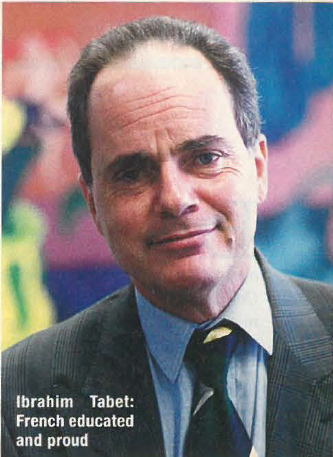
I was shocked by Mr. Walid Khoury’s article. His total lack of objectivity,

insulting remarks about France’s victory in the European football

cup and generally twisted analysis are unworthy of a professional

publication like EXECUTIVE. His article denotes such a manifest antagonism

toward France, and such an inferiority complex toward his fellow

francophone Lebanese countrymen, that even his few correct observations

lose credibility. I’d like to offer some counter-arguments to the cultural,

political and economic issues he raises throughout his piece.

Lebanon’s most important wealth is its cultural pluralism, especially its openness

to the West. I find it fortunate that most educated Lebanese speak French

and English-we need both, if only to counterbalance the negative cultural

influence of our “sisterly” eastern neighbor. (Maybe Mr. Khoury would have

done better to direct his criticism to this invasive neighbor instead.)

As for the respective weight and role of French and English in Lebanon

they are, of course, quite different: An estimated 69% of primary and secondary

school students choose French as a second language, while only

31 % opt for English. More importantly, while English is primarily used as a communication and

business language,

French is part of our

country’s cultural identity .

In an era tom by globalization

between “Jihad

and Macworld” (to quote

Benjamin Barber’s

book), this multicultural

identity, and Lebanon’s

continued fight to be different from neighboring countries. have become

its raison d’être.

The US has proved time and again that it has no particular geopolitical

interest in the survival of Lebanon, using the nation as a mere

pawn in its regional strategy. On the other hand, France’s historical ties

and friendship toward Lebanon are an invaluable asset, especially at

a time when our independence, our identity and our very existence continue

to be threatened.

I find it strange that while both Time and Newsweek have just published

special issues on France’s economic revival, EXECUTIVE, or rather Mr.

Khoury, should remain so completely out of touch. For example, the March

cover of Newsweek read: ”The French Revolution: how high tech and the

pursuit of wealth are driving Europe’s leading economy.” Noting the fact

that France enjoys sustained growth rates since 1998 that are well ahead

of the other big European economies (Germany, the UK and Italy), the magazine

describes today’s France as an appealing mixture of tech startups,

soaring markets, falling unemployment, cultural flexibility and openness

to the world. I’d like to quote a standing joke, circulating from large corporate

boardrooms to tiny startups, to further illustrate my point: ·’I like

the 35-hour work week so much, I do it twice a week.”

As for Lebanon’s lack of competitiveness and the excessive weight of

the state in our country, it is on our government and not on the “‘French

economic model” (which has become more neo-liberal) that we should

lay the blame. Indeed, French influence did not prevent Lebanon from

having a lightweight public sector before the war, and it is only since 1990

that the state apparatus grew out of control.

In any case, there is no ideal economic model that can be replicated everywhere.

Rather, each country should determine a distinct path to development,

based on its own history, resources and culture. The US certainly

has the most dynamic economy, but also the highest rate of income disparities.

Instead of pitting the American model against the French one, we

should take the best of both worlds, confront the challenges of globalization,

and reach for the hopefully forthcoming regional peace. Ill

Ibrahim Tabet is the director of the Association des Publicitaires  Fra11copl,011es

and the general secretary of the Forum Fra11copl1011e des Affaires

Air liquid under new management

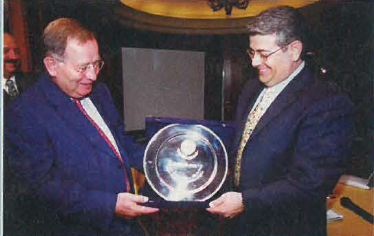
A handover ceremony took place at the end of

July at the Palm Beach hotel between the ex –

m•n•11er of AIR LIQUlDE/SOAL Nr. Didier Cuny

and the new manager Nr. Fouad Haddad.

Participants Included several Industrialists, hospital

 managers doctors, representatives of the

French embassy and French community members.

Nr Fouad Haddad thanked Nr. Cuny for his successful accomplishments

since 1996 at SOAL and asked

the guests to join him In wishing Nr Cuny great

~ In his new career In France.

It is Important to mention that SOAL Is a

subsidiary of AIR LIQUlDE Group, the worldwide

leader in the production of 11a• es, med/a,/ and

Industrial equipment.

AIR LIQUlDE/SOAL has been active In Lebanon

since 1928 and continues to offer the best service

to Its clients In the various field of Industry,

hospitalization and environment.

September 22, 2000 0 comments
0 FacebookTwitterPinterestEmail
For your information

Not much southern comfort

by Robert Tuttle September 22, 2000
written by Robert Tuttle

A year and a half ago, Lebanon’s contractors were locked

in a rough-and-tumble wrestling match with the government

over roughly $400 million worth of unpaid

bills for public sector construction projects, some of which

extended back three years. When the government finally agreed to

pay up, it did so with three-year treasury bills that carried a 5.6%

interest rate. In order to pay back their creditors, contractors were

forced to sell the T-bills to banks at discount rates – the rate that

banks charge to buy T-bills before maturity – that ranged from 8%

to 10%. Couple that with the interest lost while they waited for their

money and some contractors were lucky to walk away with just

three-quarters of the original money owed to them.

The situation is a bit better now – a bit. There remains about $50 million

in unpaid bills, says Hayyan Haidar, counselor to the contractors’

association. Most of that amount should be paid in the coming

months, he adds. Bureaucratic government procedures continue to slow

the processing of bills. “Most projects are not paid on time,” says Fouad

Khazen, president of the contractors’ association. “This has caused a

lot of inconvenience.” But government red tape is nothing new.

What’s hurting contractors today is the same thing that’s hurting

everyone – the recession. But when Israel pulled out of the South

last May, a bright light suddenly appeared. The government

devised a five-year rehabilitation plan for the region, which calls for

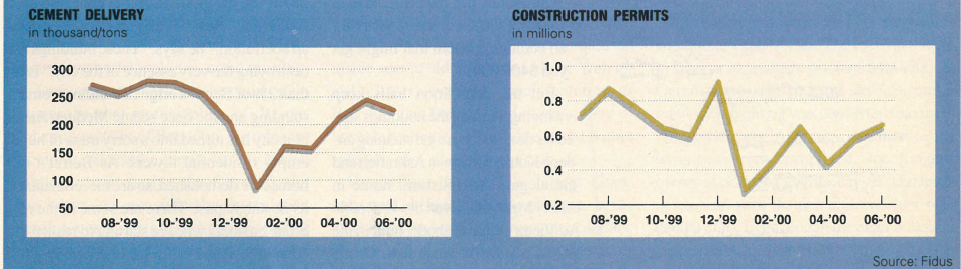
spending close to $900 million on infrastructure. Coming at a

time when cement deliveries and the number of construction permits

issued are at a five-year low, the news was greeted as something

of a miracle.

There was just one problem: “They don’t have any money,” says

Khazen. They, in this case, is the government and the money refers

to foreign donations. So far there’s been just a trickling of funds,

including a $20 million grant from the Kuwaiti government, a $10

million grant from the Arab Fund and a $9 million reallocated loan

from the World Bank. The Lebanese government has given $50 million

to the Council of the South for the rebuilding of homes. The

Islamic Development Bank has proposed a $100 million soft

loan, but the offer hasn’t been finalized.

The government organized a donor’s conference last month to

attract foreign assistance. At about the same time, it permitted Unifil

to deploy in the area and, more recently, the internal security forces

and the army – fulfilling a condition that many donor nations

required before the funding tap would be turned on.

But no contributions came out of the conference. No need to worry,

says Wafa Sharaf al-Din, program administrator at the council for

development and reconstruction, the conference was intended to give

an idea of the government’s development plans and the area’s needs.

“We are receiving lots of missions and they’re reviewing the projects.

In October, the picture should be clearer.” That’s when a second

conference is scheduled. But even if the money starts flowing

then, projects will not be tendered before next year at the earliest.

And there’s a lot that could derail the whole project before then. A

resurgence of violence would leave a nasty taste in the mouths of

even the boldest of donors. Despite the presence of Unifil, the ISF

and Army units in the area, there’s a continuous exchange of rocks

and occasionally bullets between Israeli soldiers and Lebanese civilians

– a potentially explosive situation.

If the South remains calm and donations come through, some contractors

aren’t so confident that projects will be awarded to the most

qualified companies. In July, representatives of the contractors’ association

met with prime minister Selim Hoss, demanding that projects

be handled by the ministry of public works and awarded through open

tenders. “We hope that it will be done through proper channels,” says

Khazen. Some contractors say privately that political considerations,

rather than competence, will probably decide who gets what.

The ministry of public works will not handle all the projects. There

is a range of government offices and ministries charged with

awarding contracts, including the ministry of electricity and water

resources and the CDR. The Council of the South, which has been

charged with overseeing some of the infrastructure work, is an

agency that many contractors particularly dread. Ablan Ablan,

the council’s president, assures that contracts will be handled in a

professional manner. But one contractor, who claims that he waited

nearly five years to be paid by the council, says: “They have a

funny way of dealing with people. Whoever works with them

does so at their own risk.”

What would help contractors now, says Haider, are more lenient

credit facilities from banks. Projects need to be thoroughly studied

before work begins so that no surprise expenses pop up later. The ministry

of finance needs to streamline payment procedures.

Contractors, says Haider, represent a valuable asset to the country,

but many are on the verge of bankruptcy: “I would consider it a pity to loose such potential

September 22, 2000 0 comments
0 FacebookTwitterPinterestEmail
For your information

Cold turkey

by Kirsten Vance September 22, 2000
written by Kirsten Vance

“These people have been forced

to grow hash and be outlaws,

because this region has been

abandoned by the Lebanese

state and the regional and

international community,”

says Hamadan Dandash,

farmer from the Hermel district,

referring to those who

continue to grow illicit crops

despite the government’s

decade-long crackdown.

“If there weren’t patrols

everyone would grow it

because they are,

prisoners; the crisis

taken hold of them

more and more.” (,

Though still minute compared to what was grown during the war,

the last couple of years has seen an increasing number of farmers

in the Baalbek-Hermel region plant illicit crops, according

to the Internal Security Forces (ISF). “Each year the farmers try to

go back to planting hashish and poppies,” says colonel Michel

Chakkour, head of the ISF’s drug control unit, at his office in Ras

Beirut’s notorious Hobeiche building. “But we believe we destroy more

than 95% of the plantation.” Eradication of hashish crops this year was

slated to begin on July 24, but the plan was still delayed when

EXECUTIVE went to print. In mid-August there was a confrontation

between farmers and police on patrols to locate the fields. That’s not

an uncommon event, according to Chakkour, who estimates this

year has brought an increase in hash plantation. Last year the ISF

destroyed almost 8.2 million m2 (~18 hectares) of hashish and

24,520m’ of poppies. That’s up from 1998 figures of 3.3 million m’ and

2,000m’, respectively.

High on the Hermel plateau, much of which has been abandoned

and lies fallow, plots of swaying green cannabis dot the landscape.

On top of the high profits, the appeal of hashish is that it literally

grows like a weed with little care and no irrigation, while a market

is virtually guaranteed. And lines of credit are readily available

through dealers at better terms than the rare bank loans that are provided

for legitimate crops. That’s a pretty attractive combination

for an impoverished, underdeveloped region where water is scarce

and large swaths of land are not irrigated.

Emerging from the civil war, Lebanon came under intense US and

international pressure to crack down on what had become a highly

organized system of drug production and trafficking under militias,

although hashish plantation does predate the war. The eradication

program resulted in the area cultivated with illicit crops being

reduced from about 800 million m’ to 3 million m’ and Lebanon

being removed from the blacklist.

But the tragedy is that almost nothing has been done to help the region

and its farmers substitute what had been a lucrative source of income

despite this country’s success in curbing drug cultivation. It is estimated

that drug cultivation brought $80-100 million a year to the Baalbek Hermel

region and $500 million to the nation as a whole. “Lebanon

after the war was a very very weak country and state,” says Riad Saade,

agronomist and director of the Lebanese Center for Agricultural

Research and Studies (CREAL). ‘Those who wanted at that time to

eradicate prohibited crops should have simultaneously considered how

this weak and unorganized country should be structurally helped.”

What should have been done was the installation of mass irrigation

and other agricultural infrastructure, the creation of a proper marketing

system along with training and the encouragement of

agroindustry. All that should have come within the framework of a

comprehensive development program that would also aim to diversify

the region’s economy.

But the planning stage of projects intended to develop the region didn’t

even begin until after eradication. The main project aimed at the

development of the Hermel-Baalbek region was launched by the

United Nations Development Program (UNDP). The United States,

Europe and Japan were expected to be major donors to the program,

which was initially projected at about $55 million. But the money was

not forthcoming. So far just $12 million has been scrimped together

– eight years since the planning stage began. And more than two-thirds

of that amount was supplied by the Lebanese government. The UN

funding is declining and threatens to scupper the project, according

to Ghassan Seblani, the CDR representative to the program.

Though the UNDP says no concrete promises were made, it undertook

the project at the request of both the Lebanese government and

the international community. ‘There were implicit promises for the

rehabilitation of the area as has been the case in other countries that

made attempts to eradicate illicit crops,” says Christian De Clercq,

senior advisor to the UN resident coordinator in Lebanon, who was

involved in the project from the start. “Other countries may not have

succeeded but received large-scale assistance,” he explains. But Zena

Ali-Ahmad, who heads the program, says the attitude off armers must

also change: “Nothing will compare to what they made from drug cultivation.

If this is what’s expected nothing will ever be done.”

Government initiatives were meant to compliment the UN project

and would be aimed at large-scale infrastructure development

in Baalbek-Herrnel. Hariri’s Horizon 2000 plan included promises

of $300 million in funds, while the current government allocated

about $200 million, according to Seblani. But the outlying areas

have yet to become a real priority and the bulk of that money never

materialized. The largest government plan being implemented –

only to include irrigation infrastructure – is the $57 million development

project of 12 villages in the Yammoune area.

With such limited funds the projects have had almost no impact

on a region that covers about 28% of the Lebanese territory and has

a population of 250,000. “All projects to compensate or treat the

eradication of prohibited crops are folkloric and not serious,”

says Saade. “Up to now they’ve been wasting their time.” Oddly

the ISF has taken up the reigns of crop substitution – such as saffron

and pistachios – but with little thought on finding markets or

when these new plants will produce.

Not surprisingly, Dandash and other farmers are feeling disillusioned

and deceived by both the government and the international

community. “I’m not waiting for them to do anything,” he says. “I

don’t believe they will.” He has given up on the government’s

promises to install an irrigation system in the Henne! district,

spending about $8,000 to build his own well with plans for a second.

But that’s a hefty investment most locals simply cannot afford.

All this at a time when the agricultural sector is already in crisis.

Farmers in the region largely switched to common crops, but the

lack of proper regulations, norms or marketing bodies means

farmers get Little in return for their efforts, according to Saade. The

ministry of agriculture’s resources – under 0.4% of the total budget

– underscores the sector’s neglect. Improving the lot of the

inhabitants of Baalbek-Herrnel will require greater funds, which

the government doesn’t have. And many believe that significant aid

from the international community is an unlikely prospect without

a comprehensive peace settlement. In the meantime, without alternatives

for desperate farmers, the ISF may find itself with a lot more

work to do.

September 22, 2000 0 comments
0 FacebookTwitterPinterestEmail
Editorial

Give me a sign

by Executive Editors September 22, 2000
written by Executive Editors

It’s a sad testimony to the state of Lebanon’s democracy.

Getting elected is more a matter of who you are than

what you actually promise to do. The country is on the

verge of an economic meltdown. It’s virtually impossible

that the government will hit its deficit target by the end of

the year. Debt servicing now exceeds revenues. And the

debt-to-GDP ratio stands at 140%, one of the highest in the

world. In most countries, political candidates and the parties

they represent, in an effort to convince voters to elect

them, would be busy forming detailed platforms to address

such grave concerns. But solutions to Lebanon’s ailments

are rarely heard at this election time.

Meanwhile, banks’ revenues, the country’s most profitable

money spinners, are heading south, thanks in part to the

poor state of the economy. One of the biggest draws for

investors, the real estate market, has been dragged to the

ground. Prices have already dropped and many believe that

they will fall even further.

This government turned down an opportunity to lessen the

bleeding of the economy by selling mobile phone licenses to

LibanCell and Cellis and allowing a third operator into the

market. This would have reduced the bloated budget and

sent positive signals to investors, who have been held at bay

by uncertainties hovering over the country. Will the next

government be wise enough to reconsider? Nobody knows.

And the political candidates aren’t saying.

September 22, 2000 0 comments
0 FacebookTwitterPinterestEmail
Tech Knowledge

Well-read on the web

by Carl Gebeily September 17, 2000
written by Carl Gebeily

The business concept is simple: if you

can stuff enough services and content

into a single web address, you will, in the

ugly parlance of the industry, “aggregate

eyeballs” – that is, bring a lot of people

with disparate interests and needs to the

same place.

This explains why ISPs (Internet

Service Providers) continue to add

entrees to their menu of offerings, as fast

as a short-order cook, hoping to get the

edge in an increasingly cutthroat marketplace.

After web hosting, freefax and

Interactive Voice Service (IVS) comes

the latest in the brave new, value-pumped

ISP: online reading.

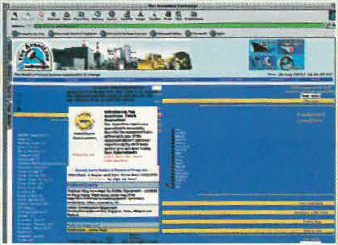
ln Lebanese terms, Cyberia (www.cyberia.

net.lb and www.thisiscyberia.

com) is the 800-pound gorilla in the middle

of the information highway and the

new user’s magneL ln the late 1990s, it

was its simple-to-install software and

ubiquitous distribution that led to its rise

to pole position. But what distinguishes it

from the pack these days is the launch in

July of a bright (some might say garish on

account of the intense background colors)

online magazine – with news, arts and a

variety of features written in-house that

include cinema and book reviews.

Rumors abound that Temmet, who has met

with some success following the launch of

their parallel French site, may be following

suit with their own e-periodical. Nobody

knows bow the fight for online turf will

shake out, and even whether online magazines

will ever be a hit with local surfers, but

at least Cyberia has proven that, if nothing

else, it is riding high on ideas and should be

well positioned to capitalize on whatever the

outcomes may be.                                  

Vote-for-me.com

A thought for the day: how

would those who have

enthusiastically invested in a

website react if the department of

transportation were to design a

huge highway interchange with the sole objective of having drivers continuously

circle a row of billboards?

Unfortunately, such a comparison is not all

that far-fetched. In the run up to parliamentary

elections, cyberspace has emulated

the real world with candidates posting

their pictures on

trees, walls and electronic

nodes alike.

As more inexpensive

Internet campaigning

goes onlinc, a plethora

of sites are cropping up

like mushrooms after the

rain, ranging from the

uninspired (picture galleries

of the candidates

with their families) to the less banal with

manifestos and other political statements.

Some independent sites such as

www.niyabiyat.com have built systems

to enable voters to cast ballots over the

Internet. Since there isn’t a country that

allows Internet voting – few are even in the

earliest stages of contemplating it – the

exercise remains all but academic.

Not everyone sees Internet voting as a

portal to a more democratic future – only

a portion of the online public, which itself

is a minority of voters, are turning to the

Internet for political information. Online

tactics are therefore swaying voters about

as much as a photograph stapled to a

sorry tree.


B2B in a big way

In the West, even businesses are starting

to use Internet auctions to buy everything

from office equipment to electric power. You

can usually haggle over the price of a car, or

cut a better deal

for that rowing

machine at a

garage sale. But a

giant crane or a

drilling rig?

Imagine walking

up to a salesman

of heavy-duty

construction

equipment and

flashing a wad of bills. The salesman

would probably call security.

That is what Lebanese users are virtoally

able to do now with AssetLine (www.assetline.

com), the US-based purveyors of

machinery and building tools following an

agreement with local trading company

Baladi. “Internet commerce is rapidly gaining

recognition as a new engine for growth,”

says Carl Baladi, CEO. Lebanese users are

now able to access nearly l,<XX> equipment

listings ranging from asphalt equipment to

compressors to dumper trucks. Over the

nextyear,Assetline plans to extend the service

to other countries in the Middle East

Made to order

0 nline help is at hand – help, that is, of

the domestic variety. Manpower has

entered the e-cruiting market from the

Wlderside-from the unswept floor, as it were

-offering prospective employers a gamut of

live-in maids and other job seekers of bluecollar

work. Surfing housewives can now

look for their ideal femme ck cluunbre on

www.jalloul.com, a site that is searchenabled

on the basis of age, education, marital

status and nationality. Racial types, with

accompanying photographs, include the

Philippines, Sri Lanka and Vietnam.

There are almost 100 maids to choose

from with monthly salaries that range from

$100 to $150. But if you’re looking for a

Lebanese maid. then look elsewhere. Corne

to think of it, look elsewhere anyway.

September 17, 2000 0 comments
0 FacebookTwitterPinterestEmail
Tech Knowledge

Death of the paper back?

by Carl Gebeily September 14, 2000
written by Carl Gebeily

T he movies couldn’t do it. Radio

couldn’t do it. Even television

couldn’t do it. With each great leap

forward in communications, pundits have

prophesied the death of the lowly, old-fashioned

paper book. Now it’s the Internet’s

tum, as growing numbers of technophiles

claim that Internet e-publishing will deliver

the deathblow to paperbacks.

There is not yet a clear and broadly

accepted definition of the term ‘ebook.’

Sometimes it refers to a book that’s available

in any online or downloadable electronic

form and therefore accessible on almost

any PC. It is also used to describe a handheld

device specifically designed for reading

electronically distributed books, or the

content int~nded for use in such a device.

Microsoft, touting its ebook reading software,

predicts that ebook sales will overtake

paper by 2009. Bill Gates and other hightech

aficionados say digital books will be

significantly cheaper than printed titles,

because there won’t be costs related to

printing, binding and shipping. Although

they are not yet being sold outside the

United States, ebooks are real and their

impact is beginning to be felt. In the United

States, Publishers Weekly has for the first

time received an advance copy from

McGraw-Hill in an ebook form instead of

the paper galley (a printed but unbound

copy) that is traditionally sent to reviewers.

The latest novel from “best-selling

action-adventure writer” Bill Branon,

Spider Snatch, was released by

Huntingdon Press in electronic form two

months before the hardcover edition. The

electronic version costs $10, as opposed to

$24.95 for the hardcover. E-enthusiasts also point to the success of Stephen King’s

Riding the Bullet, a 67-page novella published

in mid-March only as an electronic

book. When the story became available,

Amazon averaged one consumer download

per second for it. Within three days of

its release, more than 500,000 King fans

either paid $2.50 for the story or took

advantage of downloads offered free by

some Internet sites. “Ebook devices are

not ready for prime time in Lebanon,” says

Jacques Hakimian, managing partner and

chief IT consultant of Dialog. “But that

may change. We could see ebooks on the

local market before the end of the year.”

In the US, two companies are trying to

create and spearhead the ebook market.

The first, SoftBook Press, is targeting professional

users – people who read a lot of

material on the job. The second,

NuvoMedia, is trying to crack the consumer

market through partnership with

publishing giant Bertelsmann. Both companies

make their own “reader units” that

look like double-sized PalmPilots, about the

size of a small book or paperback, with large screens. Buttons allow you to flip

back and forth between pages, annotate

text, search your entire book for keywords

and download new material. And, like their

paper cousins, ebooks allow the reader to

make notes in the margin, highlight passages

and place bookmarks.

460 The Multimedia Store, whose main

sales drive is in computer accessories, is

understandably upbeat about the new technology.

“It’s not a matter of whether ebooks

will penetrate the Lebanese market, it’s a

question of when,” says general manager,

AntoineAbi Nassif. He foresees a time when

ebooks will supercede bound volumes in the

way email has all but replaced the posted letter.

Ebook software has changed very little

since companies started moving books onto

CD-ROM in the early to mid-90s. ”The real

difference is that there are now lightweight

readers in the market,” says IT consultant,

Hakimian. ”These provide online content

distribution and encryption techniques to

protect copyright owners’ interests.”

Why you would want an ebook is another

question. Gadget lovers will pounce on

them, but if you just want a novel to read

while you’ re traveling, you’ ll probably stick

with a paperback. It weighs less, you won’t be

too upset if you lose it, you don’t have to

worry about battery life and the flight attendant

won’ t tell you to put it away when the

plane starts to descend. An ebook is another

item to carry. Just as a modem notebook

computer eliminates the need to carry a CD

player, a handheld computer is already close

to matching an ebook. Hakimian believes the

niche occupied by ebooks may even disappear

when the display quality of generalpurpose

handheld devices – such as

PalmPilots and laptops – reach a standard

acceptable for displaying ebook content.

There are two situations where ebooks

could come into their own. First, there is a

corporate and professional market for

bulky reference material where networkbased

access is not appropriate for reasons

such as security, reliability or bandwidth

availability. Today’s ebook readers can typically

hold up to 41 ,000 pages of text and

graphics, or about 200 books. Potential

users include lawyers, medical personnel and

students. The second is ephemera: material

that has a limited life span in the hands of

most readers. For magazines, an ebook

could be a more satisfactory way of reading

text-intensive material that is currently

delivered to Web browsers. This could also

apply to most newspapers and novels that

you wouldn’t read a second time.

Several problems will affect the take-up of

ebooks. First there is the question of the

reading experience. As none of the dedicated

ebooks are available in Lebanon yet, all we

can say is that broad acceptance of ebooks will

require better displays than those on current

notebooks and handheld devices. Language

is another consideration as English – the lingua

franca of today’s ebooks – is the medium

for only a minority of Lebanese. And,

though the French publishers Hachette are

reportedly looking to digitize their own

books, it may be some five years before

Arabic ebooks are available. Another problem

is the position one must sit in to read from a

notebook or desktop PC screen. The fact that

an ebook can easily be held at a normal reading

angle makes a difference.

There are also psychological considerations.

Avid readers tend to be people who take

pleasure in owning books. Even though a personal

library of about 200 books could fit into

one ebook, many people would find that a far

less satisfying alternative.

Bandwidth and storage capacity do not

appear to be big issues. Ebook content is relatively

compact and can therefore be

downloaded quickly. Obviously, the file

size will increase with the amount of text

and illustrations so that,. for instance,

Alice’s Adventures in Wonderland will take

considerably longer to download than

Einstein’s Theory of Relativity.

One of the problems with the current generation

of handheld electronic devices is

that they are not terribly robust mechanically.

Dropping one onto a hard surface may

crack the case, cause internal damage, and

even if the LCD isn’t broken, the impact can

result in part of the screen permanently

turning black. Dropping an ebook in the

bath could see hundreds of dollars going

down the drain. Reports from the United

States suggest that current ebooks have a

problem with battery life, just like earlier

notebook computers and mobile phones.

Also, while the screen resolution is acceptable,

it falls short of what’s really needed.

Another issue is that people often lend or

give away a book or magazine when they

have finished with it, and there is a sizable

trade in second-hand books. Ebook content

can be encrypted for use only on a specific

ebook. It is obvious why publishers and

some authors like this idea, but unless the

price of electronic editions is pushed low

enough, there may be consumer resistance.

Common standards are important.

Publishers don’t want to struggle with producing

multiple versions of their content for

similar media. From their perspective, it doesn’t matter whether th.,a t standard comes

about by industry agreement (as with DVD)

or by market forces (as with VHS).

Consumers have more to Jose if things are left

to the market. ”The decision may quickly

change from ‘which of these competing

products would be the best for me?’ to ‘which

is least Likely to fall by the wayside?”‘ warns

Hakimian. In these circumstances, marketing

savvy and market clout can result in success

for a second-rate product.

It’s too early to say how ebooks will

stack up against ‘dead tree editions.’ As

with much of the electronic economy, the

switch from books to ebooks transfers capital

and running costs from the producer to

the consumer. In the old model, the supply

side invested in printing presses and so on,

and the product was self-contained. Now,

consumers are expected to invest hundreds

or possibly thousands of dollars in hardware

so they can access the product or service.

The ebook industry may follow the example

of the mobile phone industry and, in the

longer term, ebook prices will probably

reach generally affordable levels.

When all is said and done, electronic distribution

should be substantially quicker and cheaper than paper, especially as it

avoids the cost of unsold copies. “This will

drive the transition to ebooks,” believes Abi

Nassif. He is not alone. Microsoft is pushing

an aggressive timeline for ebooks, predicting

that over I million ebook titles will be

sold this year following the introduction of

its Reader software for desktop and notebook

PCs. It predicts that by 2003, ebook

prices will range from

$99 for a small mono-chrome device to about $899 for a magazine-

size color model.

By 2005, the

ebook and ‘e-periodical’

market is predicted

to reach $1 billion,

and another$ I billion

in advertising revenue

will support free publications,

all reaching

an audience of 250 million ‘e-readers.’

The price of ebook

content has yet to settl down. In the West,

vendors talk about distributing cost savings

between authors, publishers, booksellers and

readers, but this rhetoric has yet to be

proven. Free titles are mainly out-of-copyright

works or books by undiscovered authors,

much as new bands release music in MP3 format.

Budget titles cost a few dollars and tend

to be similar to those in the free category.

Finally, there are ‘full price’ editions of current

– sometimes even the latest- books.

There are two basic models for loading

content into an ebook. The Rocket uses a PC

as an intermediary: You download content

from vendors’ websites to the PC, then

transfer it to the Rocket. The alternative, as

used by SoftBook, is to include a modem

interface so the ebook can connect to the

Internet and then to an ebook shop. A onestep

download is obviously more convenient,

but putting a PC into the loop provides

a local backup copy of the content.

Given that the devices have yet to go on

sale here, it’s not surprising that there isn’t

much activity on the content side. Librairie

Antoine’s site currently only sells items

stocked at its main shop, which does not

include ebook content, but the company is aware of the possibilities. Georges Tabet,

senior vice president of Librairie Antoine,

says: “We’ re not unenthusiastic about

ebooks, but we’re not in the front lines of

those saying they will replace bound books

in a couple of years.”

Ebooks are a bigger threat to our booksellers

than offshore suppliers such as

Amazon. Selling content is a puree-business

opportunity unhampered

by the short  comings of shipping.

Publishers could bypass bookshops.

Established authors

could bypass publishers

and book  sellers, bringing a

new meaning to selfpublishing.

“I think

this is going to spark a

renaissance in literature,”

says Abi

Nassif. “Authors will

no longer have to kowtow to the publishers

and write

something they want to sell. lfyou’ve got a

book you want to publish, you will be able

to do it yourself for a modest sum.”

Most authors, though, will lose out if the

book market turns electronic. Royalties are

based on the retail price. On a $20 book, a

15% royalty – the typical percentage – earns

the writer $3. If the ebook version has a drastically

reduced price, as its proponents claim,

authors may lose out- royalties on a $2 sale,

for example, would be 30 cents. So unless

authors and publishers work out a new pay

structure (or ebooks remain as expensive as

print), technophiles might largely be reading

test patterns or a lot of college fiction.

So far, a smalJ portion of the world’s books

– some 3,000 titles – is available electronically.

And because the market is so new,

industry analysts have yet to produce estimates

of its future potential or to profile

ebook users.

None of which, to be sure, is likely to hold

off the rise of ebooks, especially for kids

already more comfortable with laptops and

PalmPilots than printed books. It remains to

be seen whether Gutenberg’s adherents

will go without a fight.

September 14, 2000 0 comments
0 FacebookTwitterPinterestEmail
Real Estate

Like a virgin

by Executive Contributor September 14, 2000
written by Executive Contributor

The 2,000m’ Virgin megastore – slated

to open at the Opera House

downtown next summer – is set to prove

that, when it comes to retail, bigger is

better. Shops in Lebanon are small by

international standards. Despite all the

post-war new build there are, for example,

only 13 supermarkets above 3,000m’.

And the CD market is far less developed

than the food market. To date, record

shops have all been small – with the

exception of the Media Store in Dunes,

which is 1500m’.

Mario Haddad, who runs the Media

Store, reportedly spent $1 million furbishing

the shop. Haddad’s Top Ten

record chaiq claims 40% of Lebanon’s CD

market. The Virgin store represents a $5

million investment. The franchise is 55%

owned by Jihad Murr, the executive manager

of Murr TV, and 45% by Marwan

Kheireddin, vice chairman and general

manager of Al-Mawarid Bank.

Solidere favored the higher social and economic

council as a tenant for the Opera

House rather than Virgin. According to one

insider, the company thought that the

Martyrs’ Square location was not ideal for

a music store: “It will be surrounded by a

building site for ten years,” he says.

Virgin aims to open by June 2001.

Saudi lifeguard

With the success of Spinney’s and

Monoprix, there are many plans

under study for other large-scale supermarkets.

This could spell trouble for Cooperatives du Liban (Co-op), currently

ailing with $59 million in debt on a$150

million a year turnover. But there may be

reason for hope. The Saudi AlMouhaydeb

Group wants to sign a 12-year

licensing and management agreement

with the Co-op in a move that could

revive the nationwide grocery chain.

The Co-op supermarkets at Antelias,

Khaldeh and Chiah are all 4,000m’, but

many of its 50 stores – which employ

2,000 people and are a major outlet of

Lebanese agricultural products – are

much smaller and more expensive to run.

Al-Mouhaydeb Group runs the Giant

Stores chain in Saudi Arabia and could

bring a more dynamic approach to Co-op’s

retailing. “Mouhaydeb is used to trading

from large hypermarkets in Jeddah,” says a

retail specialist. “I would say that only two

of the Co-op stores have any real potential

-Galaxy andAntelias-and theAntelias one

needs knocking down and rebuilding.”

Think less economically

Anyone who applies the laws of economics

in trying to understand the

real estate market in Lebanon may be

using the wrong approach. That’s the theory

of Na jib Hourani, who is researching

a PhD on the Beirut and Amman property

markets from an anthropologist’s point of

view. “I’m looking at discourse, how people

talk and think about real estate,” says

Hourani. “The economic and political

systems are very different in Amman and

Beirut, but real estate works in a very similar

way. This suggests underlying similarities

outside politics and economics.”

The Brooklyn-based Hourani, whose

father came from south Lebanon, is

working for his doctorate at New York

University and currently undertaking

research as the guest of the center for

behavioral studies at the American

University of Beirut.

“Some people think I’m nuts,” he

admits, “but, all the same, they’ve been

very helpful. The key to economics as a

discipline is that everything else is equal.

When it comes to real estate in Lebanon, clearly everything else is not equal. For

example, the economist may say that it’s

irrational to hold on to property when it

could be sold and the money invested for

a good return, but people may have values

that the economist does not recognize.

When I talked to small shopkeepers in

downtown Amman, they talked about

value not just in terms of the dinar but in

terms of community and history.”

Hourani believes that his work could

have practical applications – new

approaches both to finance and architecture.

“We cannot just dismiss non-economic

values as irrational or vestiges of

tradition,” he says. “Rather we should

look for ways of incorporating them.”

Anew tenant

ry,he Bank of New York has become the

.l latest client to sign up for the Atrium, the

new downtown retail/office building. The

bank, represented by consultants Healey &

Baker, has taken a 250m’ office on a nineyear

lease. It will pay $250 per m’ a year.

The bank’s neighbors include Merrill

Lynch – which has taken a whole floor of

over 1500m’ – and American Express.

The Atrium building is seen as the only

destination in downtown that currently

meets international standards for newbuild

(“Doing in Right,” April 2000).

Aside from Circle Hitti, the bulk of the

Atrium’s first floor offices have been

taken by jewelers, who are also the

major clients for the first-floor retail and

have been attracted by the Atrium’s location

opposite what will be – in time – the

gold souks.

September 14, 2000 0 comments
0 FacebookTwitterPinterestEmail
Real estate

A view from the edge

by Michael Dunn September 14, 2000
written by Michael Dunn

0 utside the Beirut Central District (BCD), the majority

of prime new office space is located in Hamra and

Ashrafieh, especially Charles Malek Avenue. New

secondary developments have also emerged in Furn el Chebak,

Badaro, Sin el Fil, Verdun and Tehwita.

Around the city, office centers need to be specialized and flexible

to resist the BCD’s demand-pull. New office buildings in

Ashrafieh and Hamra may still enjoy high occupancy, but

mixed locations – especially those with a preponderance of residential

units – might witness a decline in occupancy rates.

Until last year, prime locations such as Charles Malek avenue

(Ashrafieh) and Hamra were in high demand, with newly built

offices in those areas offering flexibility in size and excellent

amenities. Their location, near the BCD, Beirut’s future business

center, was also attractive to tenants.

In 1999, the market became inactive and investors looked more

closely at prices. The majority of prime locations had reached a

take-up rate of 60% to 70%. But with the stagnant market, the

rate remained constant. We should now expect a declining

occupancy rate in Hamra, Verdun and Charles Malek avenue as

companies relocate to the BCD.

BCD will provide a cross-section of external supporting services,

conforming to the requirements expected in today’s modern

offices. In time, the open spaces of BCD will prove important,

as any large office building will be attractive for big companies

or institutions. Large offices with open spaces can be partitioned

to fit the needs of particular companies. Building new

developments in prime locations outside the BCD is now difficult

because the areas are highly congested and land is scarce.

Hamra’s new developments attracted occupants between

1997 and 1999. The area offers such amenities as shops, bookstores

and retail convenience stores. Ashrafieh offers restaurants

and snack bars. Verdun is known for its upmarket shopping and

will remain a retail destination rather a potential office market.

The office market became very decentralized during the war,

spreading to secondary locations such as Dora, Sin el Fil and

Badaro. Take-up in these locations was also strong during the

early ’90s because of economic growth and delays in developing

more central locations. Major office buildings were constructed

in Furn el Chebak, attracting many companies even

though the area was primarily residential.

This phase of straightforward expansion is now over. As major

companies relocate to the BCD, small companies will move to secondary

locations. We expect few new office developments in these areas, at least for now. Ericsson, opposite the new Metropolitan

Palace hotel in Sin el Fil, is the only major new building.

The development of the Agora on the Damascus highway will

revive surrounding areas, such as Furn el Chebak, Hazmieh, Sin

el Fil and Horsh Tabet. The development of the Metropolitan

Palace Beirut hotel in Horsh Tabet, which is due to be completed

by 2001, may also stimulate demand for offices.

Some office buildings in the secondary locations enjoy a take-up

rate of 80% to 90% and others 50%. Office buildings that do well

– such as the ones in the Furn el Chebak region – have large floor

sizes and are located on the main highways. About 40% of space at

the Galaxy center in Chiah has been bought. With new infrastructure

being built in the area, there is great potential, especially since

the center will accommodate the Marriott Courtyard hotel next year.

During the past year, the pipeline has been concentrated in

Ashrafieh and Charles Helou avenue. Once completed, these

office buildings will attract local rather than international tenants.

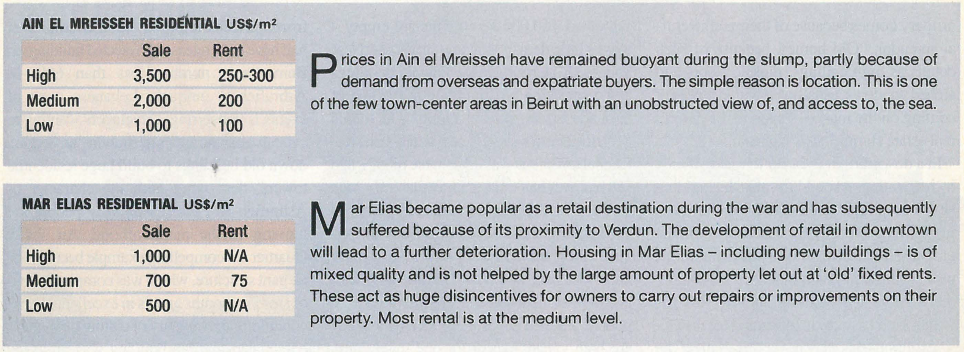
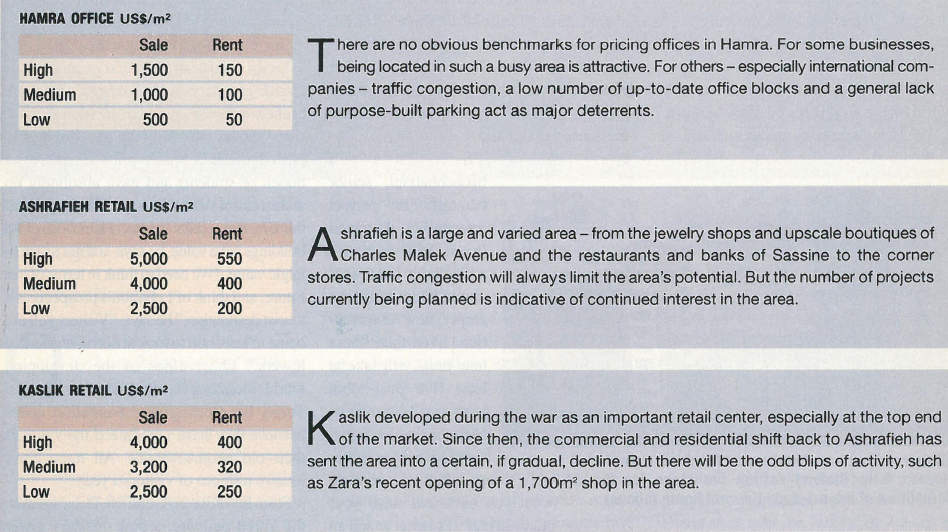
Prices have fallen during the past two years. ln general, rental prices

in prime locations are as high as prices in the BCD -becween $200

to $250 perm’ per year. Pricing in secondruy locations vary from

$150 to $100 perm’ per year. Sale prices have also decreased by 25%

to 30%. There is no reason to expect any of these prices to rise in the

foreseeable future. We hope that we have hit the bottom of the market

and that we shall witness an upturn in the next 12 months.

September 14, 2000 0 comments
0 FacebookTwitterPinterestEmail
Real estate

Under the wrecking ball

by Marwan Naaman September 12, 2000
written by Marwan Naaman

0 ut with old, in with the new. This

has been the philosophy in Beirut

for over 50 years and nowhere

has it been applied more ruthlessly than in

real estate. Knocking down an old twostory

house and replacing it with a multifloor

residential tower is considered

progress – and a potentially great way to

make a bundle of money. It’s no surprise

then that, when the ministry of culture in

I 996 forbade the demolition of 1,100 of

Beirut’s oldest buildings and then attempted

to pass a law to preserve them,

landowners and developers cried murder.

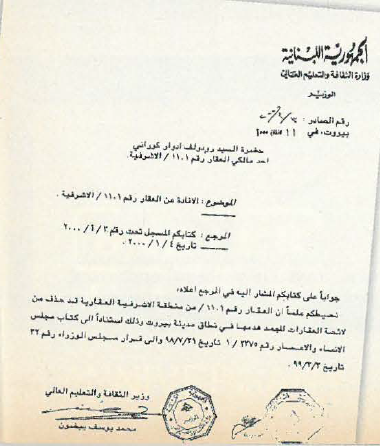
A few weeks ago, their protests paid off. In

a letter to the municipality of Beirut,

Mohammed Youssef Beydoun, the minister

of culture, released a number of protected

buildings, built during the Ottoman and

French mandate eras, from the preservation

decree. Later, according to Mona Hallak of

the association pour la protection des sites et

anciennes demeures au Liban (APSAD), he

issued demolition permits upon request

from individual landowners, although

Beydoun denies this. A dim fate for Beirut’s

remaining old buildings may be sealed. But

a growing number of developers and property

owners are discovering that there need not be

a conflict between the desire to preserve the

city’s heritage and the drive for profits. In

today’s real estate market old is often gold.

“The old buildings have great economic

potential – look at Monot street and AbdelWahab-

al-Inglisi in Ashrafieh,” says Abdul

Halim Jabr, professor of architecture at the

American University of Beirut and a member

of APSAD. The Ashrafieh area is fast

becoming the most expensive residential

section in Beirut. Along Monot street, prestigious

restaurants, including L’Entrecote,

Thai, Le Monot and Sushi Bar, are housed

inside scenic old buildings. Abdel-Wahabal-

lnglisi is home to such eateries as

Babylon and Tribeca, and offers a slew of

upscale boutiques, all of which exist within

splendid turn-of-the-century abodes.

Throughout the world’s capital cities,

areas with old buildings have proven to be the

most lucrative in terms of investment dollars:

New York’s Greenwich Village, Boston’s

Back Bay and Georgetown in Washington,

DC. ‘These are some of the most expensive

and exclusive areas in the world precisely

because of the carefully preserved old

homes,” says Hana Alamuddin Haydar,

architect and APSAD member. In Paris as

soon as the government designates an area as

a national heritage site, real estate prices

soar, says Jacques Tabet, urban designer:

“Now landowners are begging the government

to classify their old buildings just to see

the value of their homes automatically double

or triple.”

A handful of Lebanese are starting to recognize

the value of historical structures. In the

Tabaris area, near the Jardins de Tabaris II

construction site, two elegant four-story

buildings built at the beginning of the 20th

century were renovated and converted into

eight luxury apartments. The units sold within

days at an average price of $400,000. In

Gemmayzeh, on Gouraud street, a multiunit

1930s building was converted into modern

apartments. All units sold before the

work was even completed. Joe Kanaan,

owner of Sodeco Gestion, says he can hardly

keep up with the demand for older residential

units. Even though the older buildings

lack certain modern conveniences, such as

parking and elevators, people choose them as primary homes because of their architectural

splendor. “Old homes, because of such

details as high ceilings, mosaic floors and

arched windows, usually sell within weeks of

coming on the market – even in the current

real estate slump,” says Kanaan.

In a downturn, it is easier to m’ttke money

by renovating old buildings than by building

new ones, argues Jabr. “Rather than investing

$5 million to buy a piece of land with an

old building, tearing it down and building a

new high-rise, you can invest $500,000,

renovate an old building and get revenue

within months, instead of waiting for the elusive

millions that may never materialize,” he

says. He gives the example of Au Vieux

Quartier: “Here you have an enlightened

owner who saw market value in his old

building. He opened a restaurant inside an

antique building and fashioned an oldworld

theme around his business venture.”

With Beirut’s property market satwated-an

estimated 160,000 apartments are empty –

there’s little demand for new structures. Near

Tabaris, L’Hermitage, the Fayyad buildings

and a spanking new building at the end of

Shehade street, remain empty. On scenic

Selim de Bustros street, a new white-stone residential

tower that was inhabitable months ago

still has over half of it~ units available for sale.

In Ramlet Al-Baida, virtually all buildings

overlooking the Mediterranean are empty.

And along the comiche, two luxury highrises

with over 20 floors, Binayat-al-Ahlam

and the Comiche Garden, are monuments to

poorly planned investment schemes. They

are both vacant except for one lonely unit.

“Why build another residential tower fated to

remain empty?” asks Jabr. ‘There’s $12 billion

currently invested in inactive real estate

in Lebanon. The Lebanese can no longer

build their national economy on hope- hope

for regional peace, hope for the return of the

Lebanese expatriates.”

Bernard

Mouchbahani, senior

manager of project

finance at Lebanon

Invest, believes that it

will take a huge economic

boom to fill the empty new construction.

Even then, these

new units will take at

least five post-boom

years to sell out entirely.

Mouchbahani offers a

simple business strategy:

“Stop building, renovate

what you have and slash your

prices in half. It’s better to sell an

apartment for $200,000 and put

your money in a mutual fund than

to wait five, six or seven years for

an economic boom that might get

you $400,000.”

But the demolition balls keep

swinging. Among the buildings slated

for destruction are the stunning artdeco

Kourani home in Ashrafieh and

the elegant Al-Houssami home in

Ain el Mreisseh. Even the venerable

Au Vieux Quartier abode, built in the

1920s, is now on death row. Of the

original I, 100 buildings that were frozen under the preservation decree, over

half have been released. Protected buildings in

Beirut now number less than 600. In

Ashrafieh, a uniquely Lebanese twist of

events is transpiring. Developers wanting to

capitalize on the area’s desirability are tearing

down old buildings to build huge residential

towers, dt:stroying both the character of

Ashrafieh and the reason why people are

moving to the neighborhood. Au Vieux

Quartier is a compelling example because the

elegant structure, which was completely renovated

six months ago, is in excellent overall

condition. The ministry of culture has repeatedly

stated that the building was protected

and that no demolition permit had been issued

– but according to Hallak, its destruction was

approved by Beydoun himself.

Victor Najarian, general manager of

CARE group, one of the biggest real estate

brokers in Beirut, applauds Beydoun ‘s decision.

“Some old buildings were arbitrarily

placed under a preservation decree by a

bunch of students and have absolutely no

architectural value,” he says. It is this kind of

thinking that appalls architect Habib Debs. Old

buildings have value, he says, and not just nostalgic

value. “We need to think in terms of our

future, and think of Lebanon’s prospects as a

tourist destination,” he says. “Visitors will not

come to Lebanon to look at horrid residential

towers.” Other cities in the developing

world, including Istanbul, Mexico City and

Tunis, have stringent preservation codes

because they have recognized the value of

their old neighborhoods. All three cities

receive millions of visitors a year.

From his office in Ashrafieh, Debs points to

the Yared building, a pink IS-story tower

surrounded by a metal gate that was plopped

down in a particularly scenic area of

Ashrafieh. “New buildings such as Yared are

an aberration,” he says. ‘These buildings are

destroying the very essence of the city.” Less

than 3% of Beirut’s original buildings remain

standing and the once scenic Mediterranean

port city has turned into a sorry mess of huge,

empty residential towers. As Beirut’s old

homes are demolished, so are the remnants of

its nostalgic past. There are some in the real

estate business who are starting to realize the

economic value of Beirut’s remaining old

buildings. The question is: ls it too late?

September 12, 2000 0 comments
0 FacebookTwitterPinterestEmail
  • 1
  • …
  • 688
  • 689
  • 690
  • 691
  • 692
  • …
  • 705

Latest Cover

About us

Since its first edition emerged on the newsstands in 1999, Executive Magazine has been dedicated to providing its readers with the most up-to-date local and regional business news. Executive is a monthly business magazine that offers readers in-depth analyses on the Lebanese world of commerce, covering all the major sectors – from banking, finance, and insurance to technology, tourism, hospitality, media, and retail.

  • Donate
  • Our Purpose
  • Contact Us

Sign up for our newsletter

    • Facebook
    • Twitter
    • Instagram
    • Linkedin
    • Youtube
    Executive Magazine
    • ISSUES
      • Current Issue
      • Past issues
    • BUSINESS
    • ECONOMICS & POLICY
    • OPINION
    • SPECIAL REPORTS
    • EXECUTIVE TALKS
    • MOVEMENTS
      • Change the image
      • Cannes lions
      • Transparency & accountability
      • ECONOMIC ROADMAP
      • Say No to Corruption
      • The Lebanon media development initiative
      • LPSN Policy Asks
      • Advocating the preservation of deposits
    • JOIN US
      • Join our movement
      • Attend our events
      • Receive updates
      • Connect with us
    • DONATE