• Donate
  • Our Purpose
  • Contact Us
Executive Magazine
  • ISSUES
    • Current Issue
    • Past issues
  • BUSINESS
  • ECONOMICS & POLICY
  • OPINION
  • SPECIAL REPORTS
  • EXECUTIVE TALKS
  • MOVEMENTS
    • Change the image
    • Cannes lions
    • Transparency & accountability
    • ECONOMIC ROADMAP
    • Say No to Corruption
    • The Lebanon media development initiative
    • LPSN Policy Asks
    • Advocating the preservation of deposits
  • JOIN US
    • Join our movement
    • Attend our events
    • Receive updates
    • Connect with us
  • DONATE
Cover story

Bring in the new economy

by Carl Gebeily July 29, 2000
written by Carl Gebeily

According to latest estimates, there are
about 240 million people worldwide
with access to 1.5 billion Web
pages on the Internet. Most of the users are in
North America and Europe, while the Middle
East, some areas of the Far East and Africa
bring up the rear with the least access to the Web.

Michel Kilsy, managing director and chief
IT consultant of Internet Facilities, notes that
the world is facing two basic truths: “First, the
Internet is truly a global phenomenon and, second,
that phenomenon has hardly touched
our region.” The Middle East in general
needs to look to other models to increase
Internet penetration and connectivity, including
higher bandwidth and embracing wireless
communications brought in by outside
investors. “All around us, in ways and forms
that we have been too sluggish to fully appreciate,
new digitally based economic arrangements
are changing how people work together
and alone; how they communicate and
relate; how they consume and relax.”

Some IT analysts, such as Dialog’s
Jacques Hakimian, are more upbeat about
this country’s e-prospects and estimate that
Internet data traffic between Lebanon and the
rest of the world, already among the highest
in the region, may soon have annual growth
rates in excess of 100% and continue such
growth rates for years to come. “The rise of
the Internet changes many things about how
‘information works’ are distributed,” says
Hakimian. “The Internet should become a
great economic engine for Lebanon, just as it
has become for the USA.”

The case in point is the unheralded growth
in the business-to-consumer (B2C) market. For
instance, where previously there were not enough
artists in
any one place
for the record
stores to carry their
music, now, via the Internet
and the plethora of music sites, artists
can reach audiences anywhere.

The two facets of the digital economy,
ecommerce and the information revolution
that is the driving force behind ecommerce,
are growing and changing at breathtaking
speed. “The ecommerce wave is having
a major impact on the world economy,
thereby fundamentally altering the way we
produce, consume and communicate, and
that is why Lebanon must use its collective
will to embrace and keep abreast of the
new technology,” says Hakimian.

Research shows that the Lebanese
Internet industry, estimated at $20 million
in 1999, could exceed $50 million by
2003 with the expected 140% rise in users.
“We are currently at 85,000 users,” says
Hakimian. “Our potential is of the order of
400,000. And that increase will drive commerce
on the Internet.”

But while the benefits that can arise from full
participation in the information economy are not
limited to the world’s developed nations, for
much of the world, ecommerce and the
movement to a digital economy in general are
constrained by a lack of critical infrastructure.
Hakimian believes that, ultimately, any success
in Lebanese ecommerce will largely
depend on an effective partnership between the
private and public sectors, with the private sector
in the lead.

Furthermore, economies, whether virtual
or traditional brick and mortar, have also
always been a function of geopolitical variables.
And across the region, there is hope that
the new crop of leaders, from Jordan’s King
Abdullah to Morocco’s King Mohammed to
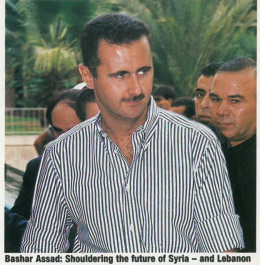
Syria’s Bashar Assad, will bring social,
political and economic change. A new cadre
of young, western-educated Arab leaders
whose focus on economic and democratic
reforms could mark a historic departure from
the ideological leadership of their fathers and
usher in a new era in the Middle East.

As patron of the Syrian Computer
Society, Bashar Assad has worked to
spread computer use in his country. He
wants to move Syria from a Middle East
backwater, where Internet access is available
only to the elite and cell phones operate
in only a few urban centers, to the fast
lane of the information highway.

“The economy is the most important thing
on his agenda,” says Riad Abbas, professor
of light electronics and IT systems at the
University of Damascus. “To him, the
Internet is not so much a value in and of itself,
but rather that computerization is the basis for
economic progress.” Syria, notes Abbas,
will now be looking at ways to make the transition
from an agricultural economy to an
economy based on high-tech.

Certainly compared to Syria, Lebanon with
its cheaper connection fees and “Internet for
all” philosophy represents something of a
cyber heaven. But in relation to the West’s
sophisticated B2B Net-tools and its embrace
of e-consumerism, Lebanon is still the poorhouse
in the global village. In this era of
change, time and regional stability will tell if
Lebanon can rise from virtual purgatory.
July 29, 2000 0 comments
0 FacebookTwitterPinterestEmail
Cover story

Land of plenty?

by Gareth Smith July 21, 2000
written by Gareth Smith

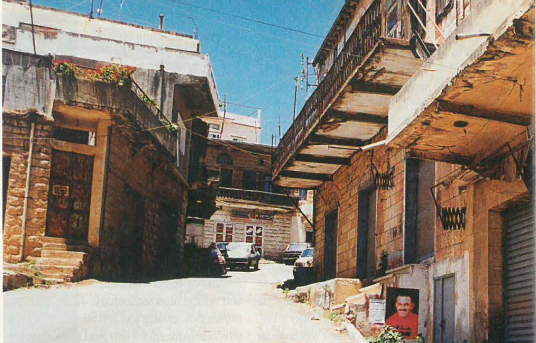
Liberated south Lebanon is slipping
back into rural tranquility. The purple-
topped tobacco plants sway in
the breeze, children play on abandoned
tanks and old men chew the fat under
posters of Hassan Nasrallah. The unspoiled
hills and coast astound visitors.
The quiet is broken only by the sounds of
reconstruction. Bulldozers, sporting the
colorful emblem of the Council of the
South, are out repairing roads and installing
pipes workmen are putting up electricity
poles. New palaces are under construction
others, left half-built during the years of
fighting, are finally being finished.

So will tourism and new housing drive up
land prices? Yes, say many. Expectation of
a real estate boom came almost immediately
after the Israeli withdrawal on May
24. Take Imad Saab, chairman of the
Lebanese Projects Establishment, based
in Kuwait, who told the Kuwait News
Agency: “I know a Kuwaiti businessman
who bought 120,000m² of land for only $2
per m² in the region of Iqlim Al-Toffah five months ago. Now the price per m² in this
region has soared to at least $15 per m².”

But how much of this is hype? Raja
Makarem, of consultants Ramco, is among
the skeptics: “This is daydreaming. Unless
people were selling under the value earlier,
nothing rises from $2 to $15 in five
months.” Ibrahim Murtada, a developer in
Tyre, is also unconvinced: “Some people are
spreading rumors that land is being bought
at $350 per m², but these are all lies.”

Murtada’s judgement is that good land in the
formerly occupied zone is worth between
$10 per m² inland up to perhaps $100 for
prime land near the coast at Naqoura.

The attraction of the coast has figured in
many of the optimistic scenarios for southern
real estate. But Naqoura remains an uncertain
prospect. It is nearly 90km often two hours
from Beirut, and as long as there is no
peace treaty with Israel, political instability
will always lurk in the background. In such
circumstances no one is likely to risk the
substantial investment required for a purpose-
built resort or even a large hotel, which
would usually require a minimum of ten
years to see any return on capital. It is difficult
to envisage anything like the $150 million
project for a 600-room hotel at Khalde
that has been drawn up by an Emirati group
represented by Faisal Awwad.

“There are just as attractive, and fairly
undeveloped, stretches of coastline much
nearer Beirut,” says Raja Makarem. He
cites a plot at Adloun, just south of Sidon,
fully 130,000m² with a 230-m coastal
frontage, that has been on the market for
months at $50 per m². At around $100, land
is available between Jounieh and Byblos, far
closer to Beirut than Naqoura, and with
ready access to the casino, nightclubs and
historical remains as well as beaches.

“Apart from perhaps land actually on the
beach at Naqoura, I doubt anything there
would fetch $100,” says Makarem. “If you
can buy land at Adloun for $50, why would
you go to the end of the world and pay $100
unless of course tourists come from
Israel. In time, with peace, I could see facilities
like a casino aimed at attracting people
to come from over the border, but clearly
that’s dependent on peace and normalizing
relations and that seems some way off.”

And that’s the coast. Inland, prices are
much lower. A 3-million m² plot at Rihane
was sold two years ago for just $3 per m²,
more expensive than Hermel but in line
with much of the Bekaa. Would it be worth
much more today?

Real estate prices are not independent of
general economic activity, which will remain
concentrated in Beirut. Banque Audi recently
estimated a 0.5% contraction in GDP in the
first quarter of 2000. And the outlook for the
southern economy is far from rosy. The government’s
$1.2 billion investment plan,
announced last month, is a target rather than
a commitment, and is dependent on Arab and
international loans: the government plan also
persists with the BOT model that is looked
upon unfavorably internationally.

In many of the Christian villages, Israeli
withdrawal may even depress land prices.
During the occupation, at least and probably
more over 3,000 people worked in
Israel, and another 3,000 received a
monthly paycheck from the South
Lebanon Army (SLA). That income is now
lost. In the SLA heartland around
Marjayoun and Qlaiya, many people have
fled to Israel and this cannot help but
weaken the economy.

Expatriate investment has figured as a
major target of post-war Lebanese governments,
seeking to tap the capital and intellectual
abilities of the 900,000 citizens,
almost one-third of the population, who
emigrated during the war. The expectation
is that returning Lebanese bring in money
saved abroad, and that they buy land and
build luxurious homes. But isolated
palaces will not regenerate the market as a
whole nor create an environment that is
conducive to investment.

“There is pent-up demand, with people
rebuilding the family home,” says economist
Kamal Shehadi. “But in the absence of
planning and zoning, there’ll be chaos. The
traditional villages that have kept their
character will be ruined by wannabe real-estate
developers.”

George Nur, who owns 5 million m² of land
a ten-minute drive inland from Naqoura,
believes that the potential of the land
depends on the government drawing up a
master plan that allows development and at
the same time protects the quality of the
region. “Unlike much of the country, it’s
not too late to save the South,” he says. “So
much of it is green, virgin. But can you find
me a buyer? I can’t believe anyone would pay
even $10 per m² for my land now.”

It is clear that the government will invest
capital although its record as a planner is
hardly convincing. The sites of schools, clinics
and other government buildings already
exist, and constructing them where they do not
is unlikely in itself to drive up prices.

Without planning the more professional
developers, says Ibrahim Murtada, will
keep well away: “I wouldn’t do anything in
the former occupied zone. It’s very difficult.
The government says it will allocate LL30
million for each person to reconstruct their
house. Instead they should build infrastructure,
introduce zonal planning and call
in contractors to build residential units.”

The South, after all, is one of the poorest
regions of Lebanon. Its main income is agriculture.
Tobacco is a major crop because of
state subsidies, but even this offers relatively
poor returns. This is not a recipe for rising real
estate prices, at least not between the immediate
positive effect of the withdrawal and a
peace treaty that opens up trade between
Lebanon and Israel. So while individuals will
build houses, corporate investment is unlikely.
“It’s risky,” says Ibrahim Murtada,
“because few people there have money.”

July 21, 2000 0 comments
0 FacebookTwitterPinterestEmail
Cover story

Who gives a dam?

by Hadi khatib July 21, 2000
written by Hadi khatib

The South’s liberation has brought back into the public eye a 40-year-old
plan to turn Lebanon into an agricultural breadbasket. With the exception
of Turkey, Lebanon is the only country in the region with more water than
it needs. But most of this water is left to flow into the sea or evaporate. The
$400 million Litany project, expected to take 14 years to complete, will channel
and contain the water of the country’s longest river for irrigation and drinking.
The river stretches 170 km and has a 2,700 km² basin, a little more than
one quarter of Lebanon’s surface area. Unfortunately, 50% of this water runs
off into the Mediterranean Sea.

A World Bank loan for the project was initially approved in 1976, but the
war put those plans on hold, until now. The government recently
obtained a $2.5 million grant from Arab donors to update studies
done on the Litany project before 1975. On May 20, Dar Al Handasah Shair
(DAH) started revising project plans.

The Litany project will be completed in several stages along with a number
of sub-projects. The biggest of these is the 800 Project, which involves
building a 57-km channel that will link the waters of Lake Qaraoun to 15,000
hectares of agricultural land in the South. Another project involves building
channels connecting Lake Aanan and Lake Qaraoun with Sidon, Iqlim
Al-Kharroub, Nabatieh and Zahrani, where 23,000 hectares of agricultural
land are cultivated. There is also the Khardali dam, which will be built on
the lower Litany to provide drinking and irrigation water.

But even before the war, the project was controversial. “The Litany water
project will have a huge impact on the current state of agriculture and drinking
water supply in the South, but it’s a crucial source of conflict in the region,”
says Marwan Iskandar, an economist. Since their 1976 invasion, Israelis have been salivating at the chance to tap
into the Litany River, says Iskandar.

And the USA has backed them all
the way on the issue. “If this [World
Bank] loan is to be approved again,
US-Lebanese relations will have to
improve and the project will have to be
part of the peace process,” says
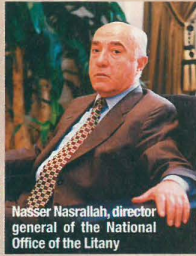
Iskandar. But Nasser Nasrallah,
director general of the National Office
of the Litany (ONL), says that
Lebanon will not bargain over access
rights to the waters of the Litany.
“There is a government decision not to
include the Litany as a bargaining chip during any regional peace talks. Lebanon’s right to full use of the river
is not an issue,” he says. Nasrallah is convinced that the entire project will
have little difficulty obtaining funding from the World Bank, which has already
financed a number of similar projects in the country.
Iskandar feels that there is an alternative. “Why take a loan if the project
can be done as a BOT (build-operate-transfer),” says Iskandar. In many
cities around the world, such as Jakarta, Sydney and London, water projects
have been done this way. Nasrallah feels that making the Litany project
a BOT is a possible alternative, but unlikely. This project is not purely
profit-driven, he says. Rather, it serves to improve the social and economic
situation in one of the poorest areas of the countr
y

July 21, 2000 0 comments
0 FacebookTwitterPinterestEmail
Cover story

party’s over

by Robert Tuttle July 21, 2000
written by Robert Tuttle

Like a stream of ants they swarmed to
the border, families, journalists,
tour groups and politicians. For a
few short days in May, it was carnival time
in southern Lebanon. Pepsi trucks passed out
free six packs and Daliah doled out milk. Ice
cream sellers parked in front of the once-dreaded
Khiam prison to scoop up business.
Merchants sold soft drinks to the
scores who flocked to the Kfar Kila border
crossing to taunt Israeli soldiers. Villages,
which had been nearly empty for decades,
sprang to life with visitors. Even the fishermen
of Tyre were blithe. The once forbidden
waters off Naqoura were providing some of
the biggest catches they had seen in years.

The celebrators have since gone. The
Pepsi and milk are no longer free. Many of
the villages, which for a few short days were
the center of world attention, are once
again empty. And many residents are
beginning to discover that liberation doesn’t
necessarily translate into a higher standard
of living.

“We had our honeymoon stage,” says
Jacques Hagarian, owner of a manousheh
shop in Marjayoun, as he stares out onto the
empty town square. “In a month, if things do
not get better, we are going to start going hungry.
The economy is dead.” Over 500 families,
almost one-third of the town’s roughly
9,000 residents, fled to Israel after the withdrawal,
explains another Marjayoun resident.
Many others were arrested for collaborating
with Israel during the occupation.

While Marjayoun, a former stronghold of
the Israeli-backed South Lebanon Army
(SLA), is an extreme case, across the liberated
areas the story is much the same.
Roughly one-third of the 6,000 to 6,500
households in the area derived their primary
income from the conflict, according to a
1999 United Nations Development Program
study. An estimated 3,000-plus residents
crossed into Israel to work, earning an average
salary of $600 a month. Another 3,000
men were enrolled in the SLA, also earning
$600 a month on average, and another 3,000
individuals were employed by UNIFIL or
depended on the UN soldiers for their livelihood.
A total of $80 million in annual
income was generated from the conflict out
of $300 million in total for the region. What
remained was farming, particularly state-subsidized tobacco cultivation, public sector
employment and a limited number of small
industries and service-based companies.
Fransabank, with its two branches in Marjayoun and Bint Jbeil, is the only bank in
the formerly occupied zone.

Already, much of the population is
impoverished. One quarter of households
live on less than $330 a month and around
10% earn less than the minimum wage of
$200. What’s more, a survey of residents,
done two days after the withdrawal by
Information International Research
Consultants, showed that 21% suffered a
reduction in income following the liberation.
“You had a population of people that
depended on the conflict,” says Riad Al-Assaad,
general manager of South for
Construction contracting company.

Not only will these lost jobs need to be
replaced, but new ones will also have to be
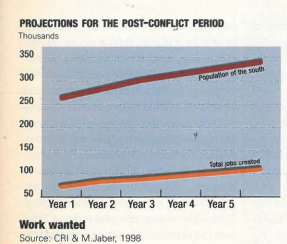
created. Currently, the resident population of
the liberated zone numbers around 65,000,
261,000 if surrounding areas are included. An
estimated 48,000 former residents are
expected to return to their homes within five
years. Most of these will likely be individuals
with limited skills and education who
have not adjusted to life in Beirut or elsewhere.
This means that 37,480 new jobs
will have to be created by the end of 2005,
according to the UNDP. If that is to happen,
investment into the region will need to start
flowing now.

The government has started the ball rolling with a $126 million cash injection,
mostly for band-aid infrastructure repairs
and as compensation for the nearly 5,000
homes that were destroyed or damaged. An
estimated $1 billion will be required to
completely rebuild the region. The money
will help generate much-needed liquidity in
the region, generate new jobs and help the
country’s beleaguered construction industry.
Pierre Dournet, CEO of Cimenterie
National, expects the South to absorb
250,000 tons of cement a year starting in
2001. “The market this year is down 25%
from last year and last year it was down 50%
from the year before. We are estimating a
10% increase in demand due to the southern
effect alone,” he says.

Improved infrastructure should spur private
investment. A few are already lining up to
penetrate what is largely a virgin market.
The central bank recently gave commercial
banks permission to open three branches a
year in the former occupied zone. For the rest
of Lebanon, current regulations allow a
maximum of two a year. Elie Abimrad,
financial controller at Credit Libanais, says
that his bank is planning to open branches in
the area, although he declines to reveal
details. Jammal Trust Bank, which specializes
in providing micro-credit and small loans to
individuals and businesses, plans to open up
to three branches in the former occupied
zone in the next few months. “If you’re looking
for small and medium-sized enterprises,
our business, I think there is lots,” says
Anwar Jammal, the bank’s executive director.

Jammal Trust is already heavily invested
in the region, with numerous branches. Roy
Badaro, owner of Kindou children’s clothes,
plans to invest $100,000 to open a small factory
in the zone in about a year. “There is
good manpower in the South because many
of the people worked in Israel and understand
what it means to work hard,” he says.

But probably one of the most promising
areas for private investment is tourism.
Thirty years of war and destruction has had
the ironic effect of preserving the region
from many of the ailments affecting the rest
of the country: overbuilding, quarrying and
pollution. The coastline is pristine while
areas near Jezzine and Mt. Sheikh provide
opportunities for hiking and horseback riding.
There have even been suggestions of developing
a resort for boar hunting in the area.
South for Construction, which has already
started repairing roads in the region, is planning
to develop a recreation area, says Al-Assaad,
declining to reveal the location as the
project is still in the early planning stages.

A big source of potential investment comes
from the South’s expat community, estimated
to number over 200 million. “Many from
the South have done well in West Africa,” says
economist Marwan Iskandar. “Together, they
have $5 billion. They could invest in tourism,
light industry and possibly even high-tech.
There is a high possibility for investment,
possibly higher than in the rest of Lebanon.”

The government will play a primary role in boosting agriculture in the South, a
potentially rich income generator
as anyone glancing across at the
lush green citrus groves on the
other side of the border would
understand. The problem here is
that less than 10% of agricultural
land is irrigated, despite the existence
of numerous sources of water
including the Litany and Hasbani
rivers. Improving the irrigation system will require hundreds of millions of dollars of public sector
investment.

The government’s policy on tobacco
subsidies needs to change, an unlikelihood
given the politically charged nature of the
policy. The government, under the guise of
helping poor southerners survive the yoke
of Israeli occupation, had been spending
$20 million a year to subsidize tobacco, a virtual
government handout since the crop is
unprofitable. Tobacco leaves are bought from
southern farmers at five to six times the international
market price. The tobacco subsidy
demonstrates one of the primary dangers to the
South’s future economic development.
Government handouts make politicians popular,
but don’t make the region productive. The
region’s long-term development could easily
be sidelined to political interests.

“The South is a clean slate,” says Iskandar.
Lebanon can either develop it properly, or
squander it. Multi-million-dollar irrigation
systems could turn the region into a breadbasket.
But if farmers are not redirected
toward profitable crops, the region’s agricultural
potential will wither away. Its scenery
could make it a tourist Mecca. But if proper
zoning and environmental regulations are
ignored to satisfy the interests of reckless
developers, its natural beauty will be scarred.
The South could be a funnel for millions of
dollars in private investment. But if investors
do not feel that the rule of law and the foot of
state authority are firmly planted on the
ground, many will be deterred. “This region
has been isolated. It needs to be reintegrated
into the Lebanese economy,” says Nassib
Ghobril, analyst at Lebanon Invest. If the
government’s foot-dragging on the deployment
of Lebanese army troops in the region is
anything to go by, we can expect political consideration
to again win out in the South.

July 21, 2000 0 comments
0 FacebookTwitterPinterestEmail
Cover story

Public can’t profit

by Kirsten Vance & Peter willems July 21, 2000
written by Kirsten Vance & Peter willems

Imagine you arrive home to
find that your landlord has
stuck the phone bill in
your apartment door. Shock. For
three months of local calls and
Internet use the total is a whopping
$450. Stuffing the offensive
bill in your pocket and
opening the door, you flip the
light switch. Flick, flick. No use,
you’re the victim of a power
shortage, again. After fumbling
around for matches, you head
for the fridge under the warm
glow of candlelight. You are
dying of thirst and can already
feel the cool, refreshing water
wash over your tongue. Out of
luck. There’s no bottled mineral
water left in the fridge. You’re
almost thirsty enough to stick
your head under the tap and
guzzle, but there’s no telling
what’s in the water. Great. A perfect ending to
a perfectly crappy day: you just arrived
home frazzled and a day late because of
a screw-up at Middle East Airlines.

Sound far-fetched? Not entirely. These are
a combination of true-life experiences of the
EXECUTIVE editorial staff, some of which
you have undoubtedly experienced yourself.
These events underscore the government’s
inability to efficiently operate such services
and the desperate need for privatization.

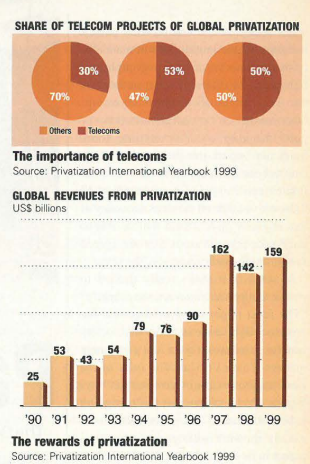
But there are other reasons to privatize.
And perhaps the most obvious is that the
receipts from privatization could bite a
sizeable chunk out of Lebanon’s massive
debt, now almost $22 billion, or 136% of
GDP. “A major purpose of privatization,
the law was specific in terms of that, is that
all privatization proceeds would be used to
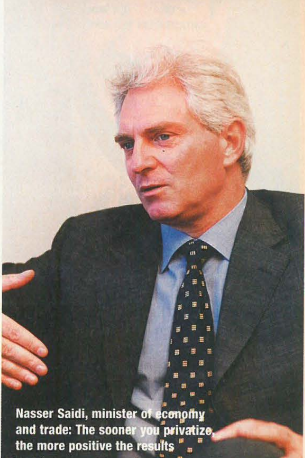
reduce the debt,” says Nasser Saidi, minister
of economy, trade and industry. “And the
sooner you do it the more positive the
results.” That in turn would decrease debt-servicing
costs and therefore the deficit,
which is currently running at about 52%.
According to the government’s fiscal readjustment
plan, privatization is expected to
bring in $4-5 billion over a five-year period.
“But I think we could easily double
that amount,” says Saidi.

Privatization would create a ripple effect
throughout the economy. “Experience
throughout the world in virtually every
sector shows that the economic benefits to
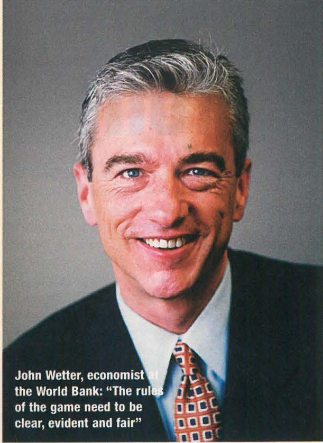
privatization are considerable,” says John
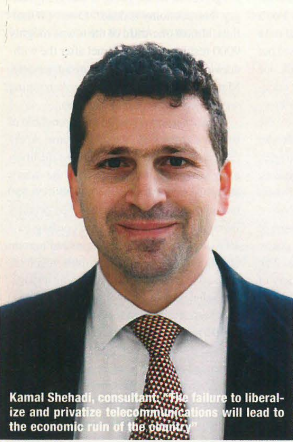
Wetter, country economist with the World Bank office in Beirut. Kamal Shehadi, a
consultant on telecom privatization in the
region, concurs: “It means new investments,
new job opportunities, especially
for the highly skilled Lebanese graduates.
You’re reforming sectors, making these
sectors more competitive and that will
allow all the businesses which rely on
these services to become more competitive
internationally.” Take foreign direct investment
in Jordan as one example. In 1999,
there was an additional inflow of $700 million
as a result of three privatizations,
while the yearly total had previously averaged
$250 million. And revenues from privatization are not simply
one-off sales transactions:
The government will
expand its tax base with the
privatized enterprises and
new economic activity that
is generated.

The lifeless Beirut Stock
Exchange (BSE) would also
get a much-needed boost as
long as privatization goes
hand-in-hand with listing the
new companies. Currently,
the capitalization of the BSE
is just $2 billion. The telecoms
alone, fixed and
mobile, are expected to bring
that to about $5 billion, or
30% of GDP, the first notch
in the development of stock
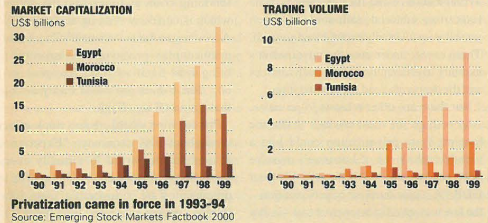
markets. Egypt was at that
level two years ago and is
now at 50% of GDP. “These
big companies would break
the cycle of illiquidity,” says
Fadi Khalaf, chairman of the
BSE. “And that would encourage other
companies to list.” Societe Nationale
d’ Assurance is one such example. Its listing
has already been approved, but the insurance
company is waiting to see an upturn on
the local market first.

Many stock exchanges in Latin America,
Eastern Europe and the Middle East have
developed thanks to privatization. In Egypt
the previously state-owned Mobinil
accounts for 50% of trading. Even in
France the former state-owned telecom,
France Telecom, accounts for 20% of volume.
Creating an efficient BSE, which will
also require reform and the creation of a regulatory body, would have a spillover effect
on the financing of other private projects.
That would give companies in Lebanon
options for raising money other than debt.

But perhaps a more important reason for
increased private sector participation is
that the government has proven itself inept
at running the state-owned entities, and
that is a drain on the treasury. With some 500
employees per plane, MEA is hardly the
epitome of efficiency. Last year’s losses at
MEA, which oddly falls under the central
bank’s realm of responsibilities, will come
close to the $41 million mark, the same as
in 1998. Electricite du Liban (EDL) has
accumulated a debt of over $1.6 billion, regularly
reports annual operating deficits of
$150 million, while uncollected bills now
stand at $530 million. Further, EDL hasn’t
finished auditing 1998 results, two and a
half years later. It can’t even guarantee a
consistent supply of power, Israeli air
strikes or not. The cuts over recent weeks are
the result of the EDL’s inability to secure
sufficient fuel oil.

Believe it or not, the water authorities
are probably in worse shape. “It’s a mess,”
says an official at the ministry of electricity
and water. There is no consolidation of the
results of the various authorities; some
haven’t submitted results in five years to the
ministry, while others have no functioning
board of directors. Further it is estimated
that the antiquated piping network loses as
much as 40% to 50% of the water.

Extracting these and other services from
government hands would bring obvious
benefits to the consumer. “The public sector
does not have the flexibility or discipline
that the marketplace imposes on the private
sector provider of services,” says Wetter.
“Vast country experience has shown that
after privatization, the good, product or
service is delivered more efficiently, at
lower cost and higher quality.” Shehadi
points to the telecommunications sector as
an example: “This is a service-based economy.
Do you realize the impact of reducing
the cost of international calls? It would
make a huge difference for businesses and
individuals.”

Look at France’s Suez Lyonnaise des
Eaux, which has won concessions to operate
water systems in cities around the world. It has performed a miraculous overhaul
of Buenos Aires’ supply since taking
control in 1993. Prices have dropped
across the board while water is now piped
directly to the homes of poorer neighborhoods
that previously relied on a single
communal spout.

With the benefits of privatization so
numerous and the Lebanese economy
struggling, a concerted effort is required to
put things into motion. The recent passage
of the general law on privatization is a good
sign. “But it’s somewhat prohibitive in
terms of giving more leeway to the government
to decide,” says Ziad Maalouf, vice
president at Middle East Capital Group. “It
is likely to slow down the pace. Every company
that needs to be privatized will have to
go individually to parliament to be decided
on and debated in the general assembly.”

On the block are MEA, the Casino and
IntraInvest, but Lebanon’s really big concerns
are the utilities. Three draft laws are
in the works for telecommunications, electricity
and water to create the legal and
regulatory framework for those sectors.
That will include the creation of corporate
entities as well as rules on anti-monopolistic practices, competition and
fair pricing.

Among the utilities, the
telecommunications sector is set
to be the first up for sale and is
undoubtedly key. For Saidi, telecoms
will be integral to the
future of the Lebanese economy.
Analysts share that view
with the minister. “In the age of
the information revolution
where the wealth of nations is
determined by the ability and
willingness to embrace the
reform of telecommunications
and information technology, the
failure to liberalize and privatize
telecommunications will lead to
the economic ruin of the country,”
says Shehadi.

The draft law for the privatization
of telecoms is ready and
has been sitting at the council of
ministers, often a bottleneck of decision-making, for at least three months. “You have to be
encompassing in terms of your view and
careful about what types of legislation
you’re introducing,” says Saidi,
“particularly at a time when
technology is changing extremely
rapidly.” Indeed. But technology
isn’t going to stop evolving,
and the pace is only likely to
pick up. The law is expected to
prepare for the sale of a 25%
stake in the fixed network and is
slated to get underway next year.

Against this backdrop is the
government’s botched effort to
find a resolution to the dispute
with LibanCell and Cellis, the
two mobile phone operators. “The continuation of
the dispute over the $300 million
is very bad for Lebanon because
of what it says about the government’s
policy direction,
which is to keep telecom as a
government monopoly worthy
only of banana republics,” says
Shehadi. “If the government
does not succeed in resolving
the cellular dispute and converting
the BOTs into licenses, then you can kiss
the privatization of telecommunications
good-bye.” If so, that could also put a dent
in the government’s plans to auction
licenses for UMTS, the third generation of
mobile phones. According to Shehadi, no
respectable telecom operator will invest
such large amounts of money in a country
that doesn’t have an independent telecom
regulator, a modern telecom law and a government
committed to liberalization.

Albeit more complicated, preparations for
the privatization of EDL are also in progress.
Under the guidance of the World Bank, draft
plans foresee the corporatization and
unbundling of the utility into transmission,
generation and distribution units. Saidi predicts
that the privatization law for the power
sector should be ready in the fall. “Normally
the network remains in public hands, however
you can have competition in distribution and
generation,” says the minister. “And now
we’ve increased the potential extent of competition
through our linking up to five other
countries in the region.” Lebanon will join the
regional electricity grid being set up with
Egypt, Jordan, Syria, Iraq and Turkey.

Only the first step has been taken in the water sector: A law was recently passed
that foresees the introduction of mandatory
external audits and the regrouping of
Lebanon’s 21 different water authorities
into five such entities within three years. In
other words, don’t expect privatization or
good drinking water anytime soon.

Saidi also notes the preparations of an
antitrust and competition law as well as an
implementation plan for privatization. “I
think we’ve taken all the steps necessary so
that any new government will be able to
undertake privatizations that are agreed
fairly rapidly and efficiently,” he says.

So what is it that’s really needed to
ensure that privatization is done properly?
“The most important guarantee that the
process will be done in a way that society
benefits is to have it done in a transparent
manner. That’s critical. The rules of the
game need to be clear, evident and fair,” says
Wetter. “Privatizations that don’t follow this are going
to be problematic.” The government hasn’t
exactly shown a willingness to be transparent
in its demands that the two cellular
operators pay $300 million each in fines.

The government will also have to
ensure that the regulatory bodies it creates
to govern the newly privatized sectors
will not fall victim to politics. As impossible
as that may seem in Lebanon it’s not
a completely foreign concept. Take for
example the central bank and the banking
control commission, which have been
shielded from political influence and thus
able to perform their jobs properly. This is
a major factor that has led to the relatively
healthy and prosperous banking sector
that exists in Lebanon.

Superseding everything will be the government’s
political will to see privatization
through. Accepting the short-term job
losses associated with privatization is
never easy. And with cases like MEA,
where a large number of the staff of 4,500
are political appointees, it will be even
more difficult. The vested interests will
have to be defeated. “Throughout the
entire process you need political will,
political will,” says Shehadi. “If the government
wants to do it the proper way,
they can. You just bring in people who have
no interest in cozying up to anybody and
doing favors for anybody else.”

July 21, 2000 0 comments
0 FacebookTwitterPinterestEmail
Cover story

Red alert

by Peter willems July 21, 2000
written by Peter willems

In the first month after the Israeli pullout
from the South, there were no skirmishes
at the border and no air attacks on
power stations. Some believe that Bashar
Assad as the new leader of Syria might bring
in a new era. There is hope for economic
reform that would offer a new market to
Lebanese businesses and peace talks may
resume, which would give the stagnant
economy a boost. But just when Lebanon was
starting to feel more at ease, the country was
ambushed and is now under attack. Not from
warplanes or a standing army. From
Standard & Poor’s (S&P).

The international credit agency put
Lebanon’s long-term ratings under
CreditWatch. If some things don’t improve
quickly, the country might be downgraded
in the fourth quarter this year. Is this a real
threat? According to Navaid Farooq, S&P’s
sovereign analyst for the Middle East and
North Africa, the downgrade would, for
example, increase Lebanon’s cost of capital.
That in turn would push up debt servicing
and the debt, which has already surpassed
130% of GDP. It would also hurt
investors’ confidence, something that is
already lacking. “How do you get out of a
recession?” asks Kamal Shehadi, a consultant
on telecom and privatization.
“Economically speaking, there’s just one
way to do it. You have to get from the low
level of investment as a percentage of GDP,
which is around 15% to 17% [in Lebanon],
to about 27% to 28%. That means we need
additional investments and most of these
investments will have to come from
abroad. That’s what creates jobs, that’s how
you pay your bills, that’s how you create
prosperity and wealth.”

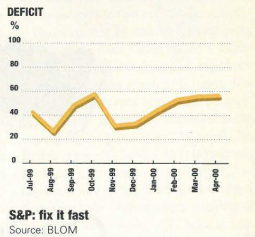
S&P doesn’t want to see the government
miss its budget deficit targets. The target for
2000 is 37.3%. Through April this year,
the deficit reached 52.45%, way above
42.06% for the same period in 1999.

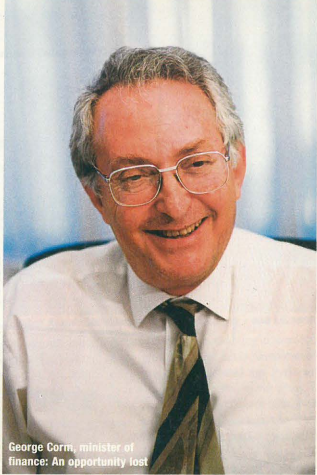
“There was slippage,”
admits Georges Corm,
the minister of finance.
“I allowed public
administration and
public entities to draw
more heavily on the
budget in the first few
months of the year to
activate economic
growth. We have spent
24% of budget appropriations
instead of
16% last year. Nothing
abnormal. Revenues
are going to pick up
and expenditures are
going to begin declining.”

For revenue,
Corm stresses a change
in amnesty on tax penalties. “The budget
depends a lot on whether the amnesty flies
or not. It’s still under discussion. The business
community is ready to get back to the
statute of limitations and create a much
better atmosphere to pay more and pay
their taxes more easily,” says Corm.

Whether his attempt to improve tax
collection works or not, Corm’s best chance
to take a bite out of the debt was snatched
right out from under him. In the middle of the
ongoing dispute over the contract between
the government and LibanCell and Cellis (see
pp. 6-7), the mobile phone operators offered
a combined $2.7 billion for 20-year licenses.
A third operator could eventually be added to
reach over $4 billion in proceeds. The council
of ministers decided not to make a decision
and passed the dispute over to the
auditing department. “The only way the
government could have pleased S&P would
have been a concrete move, which was selling
the licenses,” says an analyst. “They
desperately need the proceeds. Looking at the
fiscal situation, as far as I can see this would have been the only thing the government
could have done.” Corm and Nassar Saidi,
minister of economy and trade, were for
selling the licenses, but were outnumbered.
“Corm has made mistakes and he is always
under fire,” says the analyst, “but this time he
is a victim.”

Instead of receiving a handsome windfall
in revenues, Corm is back to square one facing
fiscal imbalances. “I was not particularly
happy,” says Corm. “Given the deficit situation, it would have been good to enter the
agreements.” If the licenses had been sold,
it would have taken a good chunk out of
Lebanon’s debt. And, “if the government
had agreed with LibanCell and Cellis,
they could have reduced the budget deficit
below 35%, which is well below their target
this year,” says Marwan Iskandar, an
economist. S&P’s opinion on the government
not selling the licenses? “What happened
was deplorable,” says Farooq. Not
only despicable. S&P gave Lebanon
October as the deadline to resolve the
issue, and to eventually turn the $2.7 billion
into revenue.

Next up is value-added tax (VAT). “We
are preparing VAT for next year,” says
Corm, “and it is going smoothly.” Not so,
according to Iskandar: “They haven’t
been preparing adequately for it to be
introduced in early 2001. It could be introduced
in mid 2001 or early 2002.” Worse
yet, “The VAT law is with the parliament,”
says Corm. “It now depends on parliament.
They will discuss it in July or with the
new parliament after the elections.”

Hopefully before the elections. One
demand by S&P is that parliament pass the
law prior to the elections in August in
order to make sure it is implemented in
early 2001. Many doubt that will happen,
considering politicians never like to make
big decisions close to election time.

Some are now on alert and here to
defend the country from a credit rating
assault. “You must be impartial for an economic
assessment,” says Saidi. “For
example, the South is now liberated which
changes economic scenarios. This has
reduced political and economic risk.
Countries and donors were previously
reluctant to assist Lebanon because of
Israeli occupation but are now willing to do
so. This means it’s more likely to be successful
with our reconstruction program,
which improves economic prospects.
S&P doesn’t want to look at this. It’s not an
impartial rating.”

Whether the minister is right or wrong,
S&P has the artillery to downgrade
Lebanon if the government doesn’t mobilize.
Anxiety from the pullout has subsided. But
tension from internal problems for the rest
of this year will continue to rise.

July 21, 2000 0 comments
0 FacebookTwitterPinterestEmail
Cover story

Doctor’s orders

by Peter willems & Robert Tuttle July 20, 2000
written by Peter willems & Robert Tuttle

For years they’ve been looking with bated breath at their eastern neighbor. It’s a market of over 16 million consumers, four times the size of Lebanon’s. Its cheap labor and energy make it a potential haven for frustrated Lebanese industrialists.

Without much of a banking system, Syria is an untapped gold mine for Lebanon’s financial institutions. But Lebanon’s closest neighbor has been, by and large, closed under the vice of a command economy.

But now that might change. A new young leader has taken over the helm in Syria. It is believed that western-educated Bashar Assad has interests in liberalizing and opening up his country’s economy. But will it happen? “His first priority is to consolidate his power,” says political analyst Michael Young. “It’s difficult for him to control the system and be liberal at the same time.” Young feels that a peace agreement must precede
any reforms that could happen.
“Consolidating power, a peace agreement then reform; it must be in that order,” he says.

Others are more assured of Bashar’s position and his ability to carry out reform immediately. “His power
is already in place,” says Patrick Seale, a leading expert on the Assad regime. “It was prepared years in advance. The new government team is aware of radical reform and it’s Bashar’s first priority.” A doctor of ophthalmology, Bashar is already thought to have been behind a recent anti-corruption drive and pushed for limited access to the Internet and mobile phones.

Talk of reform is not new in Syria. For over a decade the country has taken baby steps towards liberalization.

In 1991 the government passed law No. 10, which granted investors tax holidays, exemptions from import restrictions and allowed the importation of capital duty free. Two years ago Syria signed a free-trade agreement with Lebanon, which was to eliminate barriers within four years. But the steps have fallen short of expectations. And for years, the strengthening of the relationship between Syria and the European Union has made little headway.

Some question whether Syria even has the know-how to modernize its economy.

Capital markets, monetary policy and free trade, essential building blocks of a free market, are alien to most Syrians. Most senior civil servants have been educated on socialist principles. “You can’t take a graduate of the old school, of Ceaușescu university for example, and ask him to liberalize the economy,” says Fadi Abboud, president of the North Metn Industrialists’ Association. But economic stagnation could push liberalization to the front of Assad’s agenda.

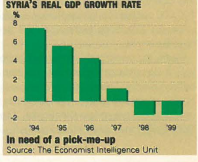
Syria has been in a recession for two years. According to the Economist Intelligence Unit, the GDP growth rate dropped from 7.7% in 1994 to -1.5% in 1998 and 1999 (see graph). Its oil sector, providing around 60% of exports, was harmed by the drop in oil prices last year. The rebound in prices should bring in some economic
growth this year, but its oil reserves are
running out. It’s estimated that Syria will
have to import oil in five to ten years. In
1999, the country suffered its worst drought in
years, which took a toll on the agricultural sector.
It’s estimated that barley production
dropped 60%, wheat 30%, and cotton 10%.
Over half the population is under 30 years old
and each year around 200,000 enter the
workforce only to find that jobs are scarce.

Yet things may be moving forward soon.
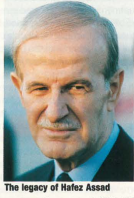
Immediately after Hafez Assad’s death,
Syria announced its willingness to go back
to the negotiating table with Israel. If a
comprehensive peace agreement is signed,
both Syria’s and Lebanon’s economies can
expect far brighter days. “I think Dr.
Bashar is not only willing, but also a strong
advocate of liberalization of the Syrian
economy, and he has interests in the New
Economy,” says Nassar Saidi, minister of
economy and trade. “I believe the
prospects are very positive.”

July 20, 2000 0 comments
0 FacebookTwitterPinterestEmail
Cover story

into the labyrinth

by Kirsten Vance July 20, 2000
written by Kirsten Vance

Let’s face it, in its own way the recent liberation of the South
was as momentous a time for the Lebanese as the
crumbling of the Berlin Wall was for the Germans just over
a decade ago. At last the country was reunited. There was
singing and dancing, and there were tears of joy as relatives were
reunited after years of separation and thousands returned to a
homeland they had once fled. Steady streams of people
flocked to take part in and witness the historic moment. But just
as the Germans quickly discovered, the Lebanese found out that
this was the easy part. The real struggles still lie ahead.

Once the cradle of civilization, where some of the greatest
advances were made in astronomy, philosophy and the sciences,
this part of the world is now faced with daunting challenges
to bring it into the 21st century. Change and development.
These are the issues that matter today in Lebanon.

In a special 12-page cover story, EXECUTIVE takes a look at the
changes taking place, and the changes that Lebanon must make
to develop into a modern society. From the newly liberated South
to neighboring Syria, technology, privatization and economic
recovery, there is hope and fear of what might lie ahead.

In the company of King Abdullah of Jordan and King
Mohammed of Morocco, Syria’s Bashar Assad is the latest
young leader in the region to take up the reins of power following
his father’s death. This brings expectations and uncertainty.
Uncertainty about how Lebanon’s relationship with its
neighbor may evolve. Uncertainty about when, and under what
terms**,** a peace agreement, so vital to a revival in this country,
will be signed. The young western-educated doctor also carries
with him to power expectations of modernization, as have
his counterparts in Jordan and Morocco. The possible political,
economic and social change in Syria, and throughout the
region, could have a significant impact on Lebanon.

And while the regional factor is an important one, Lebanon
must also look to its own backyard, the South. In the wake of
the Israeli withdrawal, business and real estate hawks will probably
scout out the area for opportunities. But the Lebanese
authorities need to ensure continued stability and take measures
to bring the region back into the fold. Those who gained their
livelihood from the occupation, often by crossing the border to
work, must find a new source of income in a region that
boasts little more than tobacco farming. Fully one-fourth of
households live on incomes of less than $330 a month. The
government has launched a reconstruction program for the
South, where the basics like running water, electricity, medical
care and adequate schooling are real concerns.

Seemingly a world away from such a hand-to-mouth existence,
politicians in the capital are talking up the need to enter
the technological revolution. Rapidly evolving technologies have
changed the way the world communicates, works and plays.
Despite Lebanon’s advance compared to much of the region,
this country lags behind the western world with less than
100,000 people “connected”. How quickly and to what extent
Lebanon embraces technology will define its place in the
New Economy.

Clearly the surest path, on top of a coherent government policy,
is via privatization and liberalization of the telecommunications
sector. This region as a whole has been slow off the
mark in privatizing its state-owned entities and Lebanon is being
outdone by countries like Egypt, Morocco and Jordan.
Considering the benefits to consumers, and the economy as
a whole, in terms of prices, quality and a secure supply of services,
the utilities would be better off in private hands. And none
is more important than the telecom sector. The government’s fiscal
readjustment program factored in receipts from privatization
at $4-5 billion over a five-year period. But it is expected that the
revenues could actually be double that figure. Mustering the
political will to get on with the program is vital for the economy**,**
considering the public debt is nearing $22 billion, while the
deficit has topped 50%.

With the Israeli troops gone, Lebanon may be its own worst
enemy, economically speaking. Rating agency Standard &
Poor’s recently delivered a blow to forecasts that better days
are just around the corner. Lebanon risks being downgraded
if it doesn’t get its fiscal house in order and move forward on specific
reforms, including its telecom policy.

So while Lebanon is basking in the excitement of change,
there is also anxiety that this is a make or break window of
opportunity for a country with so much potential, of which so
little has been realized.

July 20, 2000 0 comments
0 FacebookTwitterPinterestEmail
Best Sellers

Short circuit

by Hadi khatib July 20, 2000
written by Hadi khatib

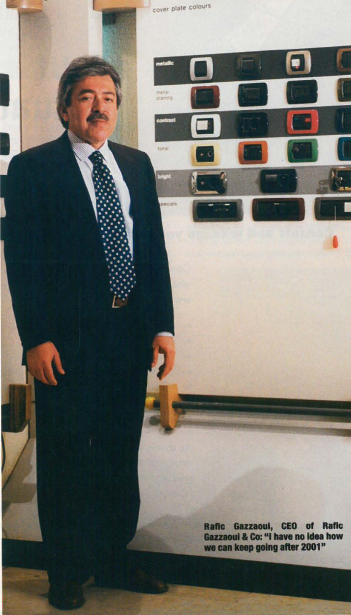
Rafic Gazzaoui, CEO of Rafic
Gazzaoui & Co, has been a little
anxious of late. “I know I can maintain
the same turnover until 2001. But after
that, I have no idea how we can keep going,”
sighs the head of one of Lebanon’s largest
electrical equipment distributors, with revenues
of $13.8 million last year.

It is easy to understand his gloom. The construction
sector is in its worst slump ever, with
the number of construction permits issued in
the last three years down 60%. With projects
scarce, competition has been fierce, reducing
prices and shrinking profit margins.

Gazzaoui has had to pull more rabbits out of
his hat than the best magician in Las Vegas just
to stay in business. Unwilling to lay off
employees, Gazzaoui has been diversifying his
product line. For example, he expanded the
lighting division of his company. In the last two
years, the firm’s Mazda brand lamps have
captured a 20% share of an estimated $9 million
market. At the same time, Gazzaoui has
stepped into the sale of down lights, grabbing
a 10% share of a 40,000 unit ($13 to $14 per
unit) market. Osram, a brand distributed by
Cesar Debbas & Sons, traditionally dominates
the lamps market with approximately a
30% market share.

Gazzaoui has also ventured into the sale of
submersible pumps under the Lowara brand
name. Demand has been on the rise, says Ali
Oueida, retail manager. The depth at which
water can be extracted from wells in Lebanon
has increased from 150 to 250 meters, with
some areas in Mount Lebanon reaching 600
meters. The company has captured 20% of a
2,500-unit ($600 to $700 per unit) submersible
pumps market and increased its market share for the total $1.5 million pump
market to 20%. And as purchasing power
has shrunk, Gazzaoui has also shifted
towards the sale of low-end products. Three
years ago, for example, it started importing a
new line of inexpensive office, kitchen and
bathroom fans from Hong Kong, which have
proven popular. Previously Gazzaoui jumped
on an opportunity by selling supplies used for
UPS (uninterrupted power supply) during
the power shortages of the 1980s. That
move gave a $1.5 million annual surge to the
company’s revenues.

Gazzaoui has expanded operations into
foreign markets. The firm is the only electrical
supplier to have opened an office in Syria.
Until last year, the company was selling
B.Ticino wiring devices (sockets, switches,
cover plates and outlets) in Damascus
through a local distributor, importing the
equipment directly from Italy. That business
represented 5% to 6% of revenues. But in
1999, Gazzaoui opened an office in Aleppo
and a network of direct distributors to service
the rest of the country. “We are expecting to
reach upwards of $1.8 million in sales for 2000
and double that in 2001,” says Gazzaoui. The
company will distribute B.Ticino in a market
for wiring devices worth $12 million a year
as well as supply pumps to a $6 million
market, competing at gross margins set by the
Syrian ministry of supply of about 15% to
20%. Gazzaoui also has plans to start
assembling metal parts and components in
Syria for some of the mechanical and electrical
products it sells.

So far, Gazzaoui’s magic has kept the company alive. While the number of projects
for the company has dropped by 5% in the
last two or three years, Gazzaoui’s wholesale
distribution network and strong exports
have meant that revenues have actually
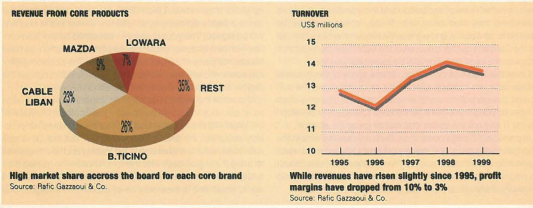
increased, from $12.9 million in 1995. The
firm is currently sitting tight with its two core
brands: B.Ticino and Liban Cable. In the
local market, B.Ticino is running neck and
neck with Legrand, a competing brand
distributed by Hermes Hydroelectrique.
Together, the two brands control around
85% of the estimated $9 million Lebanese
electrical wiring device market. Gewiss
and Vimar brands share most of the remainder.

Of the six distributors of Liban Cable,
Gazzaoui controls a 30% market share followed
by Harb Electric with a 25% share.

But sustaining business has come at a
price. Profit margins have shrunk from a
peak of 10% in 1995 to 3% last year, according
to Gazzaoui. The company is certainly not
alone in facing these troubles. Middle East
Markets and Supplies (Memas), a competitor
with exclusive distribution rights to General
Electric lighting accessories, had a turnover
of $3.8 million last year, a 20% drop from
1997. “We averaged revenues from projects
of $1 million between 1994 and 1997. Now
they don’t exceed $100,000,” says Joseph
Harb, assistant general manager for Memas.
Harb Electric, another competitor, saw the
share of projects drop from 45% to 20% of
total sales in the last three to four years.
Today, its turnover stands at $12 million to
$12.5 million annually.

For Gazzaoui, the situation is becoming desperate. Opportunities for expansion
into new markets are limited because the
company has exclusive distribution rights
for Syria and Lebanon only. There is potential
to sell in Iraq, but the country is still
under UN sanctions and its retail market is
flooded with cheap goods. Most alarming,
30% of Gazzaoui’s revenues comes from
construction projects in Lebanon, most of
which were started two or three years ago
and are now nearing completion. With the
economy in a slump, there appears to be little
business to replace them.

“I am hoping for a resurgence of activity
in Solidere, which would help us tremendously,”
says Gazzaoui. But Solidere is
mired in its own problems. On top of the
stagnant real estate market, there has been a
conspicuous absence of government support
for one of the biggest companies in the
Middle East, manifested through the slow
issuance of building permits. A discrepancy
between the master plans drawn up by Dar
Al-Handasah and municipal planning regulations
is causing projects to stop at every
minor technical problem. Gazzaoui may
have plenty of tricks up his sleeve, but the
magic show cannot go on forever. Profit
margins are shrinking and Gazzaoui is
looking for solutions. The company is now
trying to get compensation from suppliers
who “understand the situation,” says
Gazzaoui. But with no economic turnaround
in sight and 30% of Gazzaoui’s
turnover about to vanish, the company is in
for a shock. Perhaps it’s time for Gazzaoui
to rethink its policy of no layoffs.

July 20, 2000 0 comments
0 FacebookTwitterPinterestEmail
Best Sellers

Wearing new hats

by Tania Avoukdjian July 20, 2000
written by Tania Avoukdjian

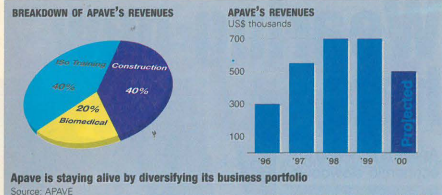
In 1994, Lebanon looked
like a gold mine to Apave.
The construction business
was booming and the French-based
company, which does
quality and risk management
for construction projects, had
just opened an office in Beirut.
Apave came to Lebanon with
two projects already signed,
together worth $480,000. The
firm saw its revenues climb
from $300,000 in 1996 to
$700,000 in 1998. But by
1999, it appeared that fool’s
gold was all Lebanon had to offer. Total revenues
leveled off, while income from construction
projects declined by $50,000.
This year, the company is forecasting revenues
of just $500,000.

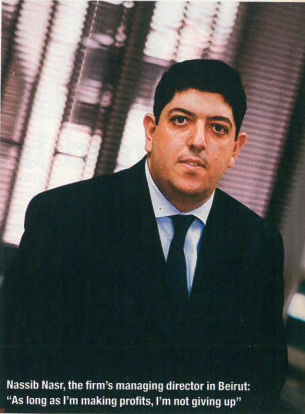
But Nassib Nasr, the firm’s managing
director in Beirut, is not fazed. “It took us
years to get into the Middle East. As long as
I’m making profits, I’m not giving up,” he
says, “even if I need to lay off employees.”

So far, Apave’s response to the building
slowdown has been diversification. Last
year, the company introduced a consultancy
and training service for companies seeking
ISO certification. Sales generated from the
new line of work compensated for losses in the
construction field. Some of Apave’s more
notable clients for ISO training are Khatib &
Alami, Laceco, Hammoud Hospital in Sidon
and St Joseph’s University. The training
costs a minimum of $10,000.

Apave is determined to get its turnover
back on track. Sales from ISO training are
projected to top $200,000 by the end of the
year. The company has recently added a
third dimension to its business: Apave
Biomedical, which does quality control in
the healthcare field.

Apave is already providing this service to
the Beirut Government Hospital, which is
looking to purchase between $25 million
and $30 million worth of equipment, including
scanners and beds. The possibilities for
expansion in this field are vast. Apave plans
to add a control and sterilization department
to its firm as well as a program to train medical
staff. The company is now planning to bid
on a contract to supply radiotherapy equipment
to Hotel Dieu. Revenues from its new
medical department are forecast to reach
$100,000 by the end of 2000.

But Apave is facing stiff competition. The
firm came to Lebanon at the same time that
two other French-based companies arrived,
Bureau Veritas and Socotec. While the latter
restricts itself to quality and risk management in construction, Bureau Veritas is diversified
into other fields. The bidding war between the
three has pushed down profit margins.

In 1999, when revenues were $700,000,
Apave’s profits were $157,000 (22.4% of
turnover). In the first quarter of this year,
with revenues at $180,000, profits were
only $27,000 (15% of turnover). Socotec,
which reported revenues of $1 million in
1999, claims to have profit margins of just
3%, while Bureau Veritas says that half of its
1999 revenues of $850,000 is pure profit.

Even in Apave’s new lines of business,
competition has been fierce. While Apave is
doing ISO certification training, Association
Francaise d’ Assurance de Qualite (AFAQ), an
associate company, actually grants the ISO
certificate to companies. AFAQ is scheduled
to open a local office this year. Similarly,
Bureau Veritas trains clients and Bureau
Veritas Quality International (BVQI) awards
the ISO certificates. Some of the companies
to which BVQI has awarded ISO 9000 certificates
include Obegi, C.A.T and DHL.

Socotec, a former partner of AFAQ, used
to provide ISO training but stopped. “Competition is ridiculous when you are
going up against a company that trains and
gives the certificate, so I don’t want to go
into this field,” says Claude Julliot, director
of Socotec Lebanon and area manager of
Socotec International.

As far as diversification is concerned,
Bureau Veritas has a head start on Apave.
On top of ISO training and certification, it
has ventured into the marine services sector,
where it deals with the control and quality
management for boats. This department
alone generated around $250,000 last year.

Another problem for Apave: Many of its
services are simply not in demand. The
firm provides technical risk management in
17 different fields, including electricity,
fire safety and security systems, environmental
protection and system quality, but
there are very few buyers.

Apave faces plenty of challenges in these
recessionary times. As long as it keeps seeking
out new fields of business, Nasr should be
able to keep the company alive. If that doesn’t
work, he may have to make good on his
word and start handing out pink slips.

July 20, 2000 0 comments
0 FacebookTwitterPinterestEmail
  • 1
  • …
  • 690
  • 691
  • 692
  • 693
  • 694
  • …
  • 705

Latest Cover

About us

Since its first edition emerged on the newsstands in 1999, Executive Magazine has been dedicated to providing its readers with the most up-to-date local and regional business news. Executive is a monthly business magazine that offers readers in-depth analyses on the Lebanese world of commerce, covering all the major sectors – from banking, finance, and insurance to technology, tourism, hospitality, media, and retail.

  • Donate
  • Our Purpose
  • Contact Us

Sign up for our newsletter

    • Facebook
    • Twitter
    • Instagram
    • Linkedin
    • Youtube
    Executive Magazine
    • ISSUES
      • Current Issue
      • Past issues
    • BUSINESS
    • ECONOMICS & POLICY
    • OPINION
    • SPECIAL REPORTS
    • EXECUTIVE TALKS
    • MOVEMENTS
      • Change the image
      • Cannes lions
      • Transparency & accountability
      • ECONOMIC ROADMAP
      • Say No to Corruption
      • The Lebanon media development initiative
      • LPSN Policy Asks
      • Advocating the preservation of deposits
    • JOIN US
      • Join our movement
      • Attend our events
      • Receive updates
      • Connect with us
    • DONATE