• Donate
  • Our Purpose
  • Contact Us
Executive Magazine
  • ISSUES
    • Current Issue
    • Past issues
  • BUSINESS
  • ECONOMICS & POLICY
  • OPINION
  • SPECIAL REPORTS
  • EXECUTIVE TALKS
  • MOVEMENTS
    • Change the image
    • Cannes lions
    • Transparency & accountability
    • ECONOMIC ROADMAP
    • Say No to Corruption
    • The Lebanon media development initiative
    • LPSN Policy Asks
    • Advocating the preservation of deposits
  • JOIN US
    • Join our movement
    • Attend our events
    • Receive updates
    • Connect with us
  • DONATE
Best Sellers

Blueprint for survival

by Tania Avoukdjian July 20, 2000
written by Tania Avoukdjian

Who would want to
be an architect
these days? With
construction at a virtual halt
and a glut of unsold real estate
on the market, it would seem
that designing new buildings is
the last business anyone would
want to be in. But there is at
least one architectural firm that
is bucking the trend.

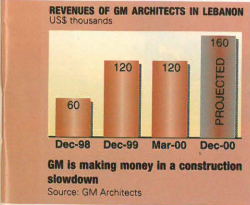
During the first quarter of this
year, GM Architects signed over
$300,000 worth of contracts and
collected $120,000 in revenues.
Compare that with figures for
1999, when just $200,000 worth
of contracts were signed and revenues
totaled $120,000. The previous
year, GM Architects had
signed contracts worth $240,000
and had $60,000 in revenues.

One of the main contributions to GM’s growth has been the firm’s focus on interior
decorating. “Architectural projects need huge
investments, and the country cannot afford this
now,” says architect Pierre El-Khoury.

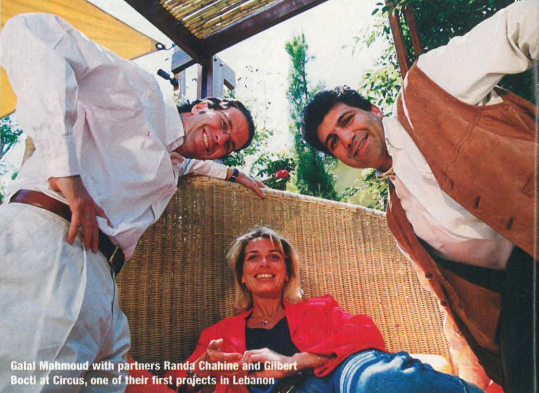
Galal Mahmoud, GM Architects’
founder, moved operations from Paris to
Beirut two years ago. He, and his two partners,
Gilbert Bocti and Randa Chahine,
opened offices in Verdun and Rabieh. The
company has decorated the interiors of a
number of popular establishments. These
include the Country Lodge country club in
Bsalim, the 200-bedroom Crown Plaza
hotel in Hamra, the Circus bar and restaurant
in Ashrafieh, and the Jeitawi branch of
BLOM bank. More recently, GM
Architects signed a deal to decorate the Taj Tower’s cinema, amusement center and
restaurant in Hamra. “I think what attracts
clients to us is our professionalism, our
international exposure and our creativity,”
says Mahmoud. BLOM liked GM
Architects’ work so much that it asked the
firm to decorate its new branch in Nabatieh.
“People recommended them to us and they
fit the requirements,” says Mohammed
Bizri, building manager at BLOM.

GM Architects charges between 8% to
15% of the value of the project, although it often
offers discounts to return customers. But the
firm’s strategy has not been without problems.
Even though interior designers have
not been as badly affected by the recession as
the architects working in the construction
sector, business has been slow. According to Antonie Tabet of the architectural firm Tabet & Partners, business dropped by 40%
between 1998 and 1999. “1999 was a very bad
year,” says architect Bernard Khoury.

To combat the economic slowdown, the firm has been looking overseas for business.
GM Architects has already designed the
interiors of such establishments as the
300m2 Chameleon club and restaurant in
Germany, the 600m2 French Trade Office in
New York, and the 350m² Villa Mykonos in
Greece. It has also done projects in Saudi
Arabia, Ecuador and France. Now the company
wants to break into Middle Eastern
countries where it has not done business, such
as the UAE and Egypt. In addition,
Mahmoud has retained the GM Architects’
office in Paris, where the company was
established in 1987.
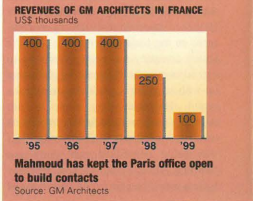
The French division saw revenues drop
from around $400,000 in 1997 to $100,000
in 1999 and made no profits. But the Paris
office allows the company to keep up with the
latest trends in the industry and has helped the
firm establish contacts with other interior
designers as well as furniture companies.
“Keeping the office in France was like keeping
an open door,” says Mahmoud.

GM Architects is not the only architectural
firm in the country seeking business
in foreign markets. Khoury, who projects
local revenues this year to be just under
$500,000, recently agreed with Faber &
Krebs to design a $40 million entertainment
complex that includes restaurants
and theatres, from which Khoury expects
to earn around $1.3 million.

GM Architects’ blueprint for growth in a
sluggish economy has worked. But these
are mere survival skills. Like almost all
companies, what’s really needed is a sharp
turnaround in the economy. In the meantime,
GM Architects might turn an eye to the
recently liberated South, where thousands
of demolished homes are just waiting to be
rebuilt and, of course, redecorated.
July 20, 2000 0 comments
0 FacebookTwitterPinterestEmail
Best Sellers

Another round

by Hadi khatib July 15, 2000
written by Hadi khatib

Two’s company, three’s a crowd, or so
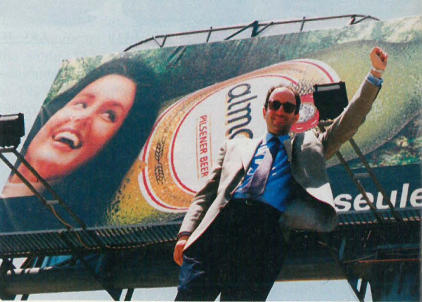
people say. But for Almaza, one was
comfortable enough. Since the mid-1990s, the only locally produced beer was the
big kid on the block. After the war, Almaza
invested almost $15 million in rebuilding its
factory and obtaining ISO 9002 certification.
Brewery production capacity was doubled
from 10 million liters a year to 20 million
liters, although it now operates at half that
level. The company dominated the post-war
beer market, with annual revenues of $10-15
million. Almaza has controlled about 65%
share of the roughly 16-18 million liter yearly
market, according to market estimations.
Its closest competitor, imported Heineken,
claims to have 19%.

Then an old acquaintance moved back into
the neighborhood and things haven’t been
quite the same. Laziza’s boisterous re-entry
into the Lebanese market last year represents
the first serious challenge to Almaza in
almost a decade. Although it was once one
of Lebanon’s leading brands, Laziza is no
longer, in the purest sense, Lebanese. The
company stopped local production in 1995
and is now importing from Holland. But the
firm’s blitz into Lebanon last summer, with
an estimated $1 million advertising campaign,
helped revive the Laziza name.

This summer, the company has turned on
the marketing machine again by launching
two new products, Laziza Light, with
2.5% alcohol, and Laziza Heavy, with 8%
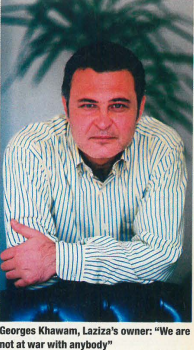
alcohol. Georges Khawam, Laziza’s owner,
claims to have generated $6 million in revenues
since his brand hit the market in May
of last year. He also claims to have 25% of
the market, though his competitors dispute
that assertion. “We are entitled to make a comeback,” says Khawam. “We are not at
war with anybody.” But there is little question
that Almaza has been feeling the heat of
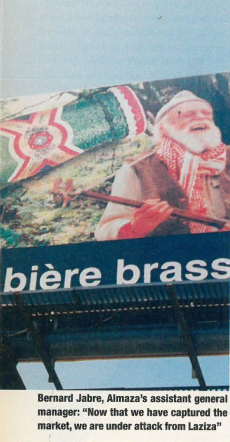
battle. “Now that we have captured the market,
we are under attack from Laziza and we
have to redouble our efforts in order to protect
our market share,” says Bernard Jabre,
Almaza’s assistant general manager.

This has had a sobering effect on Almaza,
which has doubled its marketing budget and
reduced prices since the arrival of Laziza. It
has also begun diversifying its portfolio of
products, including the launch of a new non-alcoholic
malt drink called Malta this year.
The drink will come in a number of flavors,
such as apple and raspberry, and will be sold
both locally and throughout the Arab world.

Almaza is also trying to trim costs. The
recent computerization of its factory has
helped reduce the need for manpower. The
firm has also been trying to convince consumers,
including hotels and restaurants, to
return used bottles, which reduces the costs
of raw materials and storage by about 30%.

Now Almaza is bent on taking over the liberated
South, where it expects to sell
between 10% and 15% of its total yearly output
of 10 million liters. The South is a virgin
market for beer companies. Before the pullout,
Israeli-made Macabi beer dominated the
region and competitors were largely kept out.

Heineken, Laziza’s second biggest competitor,
is less worried about the increased
competition. “They haven’t yet established
themselves with their core product,” says
Salim Bocti, vice president of the Gabriel
Bocti company, the local distributors of
Heineken. “Our estimates indicate that they
have no more than a 5% to 10% market
share in local sales.” But unlike Almaza,
Bocti feels that trying to counter the Laziza
marketing offensive is futile. Prior to
Laziza’s arrival, Heineken’s marketing budget
was $500,000 per year. “For the last two
years, we redirected our advertising budget
into other areas such as promotional items
because of the insane advertising from
Laziza. If they want to spend $1 million, I will
not spend $300,000, because I will look
small,” says Bocti.

But now it looks as if Laziza’s two
biggest competitors might be teaming up.
Heineken already has a 10% stake in
Almaza. Negotiations are currently underway
to increase the international beer
giant’s share in the local brewery. “Last
year, Heineken visited the factory and
wanted to buy shares; we are negotiating
selling 20%, 30%, who knows, but nothing
is finalized,” says Jabre. The move would
increase Almaza’s capital and put the
weight of one of the world’s largest beer
manufacturers behind the local outfit.

Albert Holtzappel, spokesman for
Heineken International, refuses to comment
on the matter, saying only that the
Dutch company has been attempting to
extend its international reach by partnering
up with large local producers around the
world. Heineken may want to use
Almaza’s underutilized factory to brew its
own beer locally. A similar arrangement
was being negotiated two years ago
between Almaza and Laziza, whereby
Laziza would be permitted to make use of the 50% unused capacity in Almaza’s
brewery. But the deal fell through.

Almaza is determined to hold its ground
against the Laziza onslaught. But the battle
has taken its toll. Since Almaza was forced
to cut prices, revenues have dropped,
although Jabre would not provide exact figures.
The company wants to boost exports in
order to make up for the decrease in local
sales, but there are problems. Jabre complains
that customs in nearby countries are
much higher than the local tariff of 55%.
That leaves the tiny Lebanese market,
which is too small to justify new investment.

Almaza could reduce costs further by producing
barley malt locally. But the company
would have to grow a minimum of 100
million tons per year, which is not feasible
in Lebanon. By contrast, the sole brewery in
Egypt, a country of 60 million, produces 500
million liters of alcoholic and non-alcoholic
beer a year and operates at full capacity.
In Holland, Heineken alone has a full
capacity of 12 billion liters per year.

Almaza will also face hurdles when
introducing its new Malta drink. Non-alcoholic
beers represent only 5% of the total
beer market and there is plenty of competition.
Chasco, distributors of Holsten beer,
and Heineken have a head start in distributing
non-alcoholic beverages in the Arab
world. Laziza also makes a non-alcoholic
beer. Since the firm’s arrival, Khawam
claims to have sold 100,000 cases of non-alcoholic
beer in Lebanon alone, and forecasts
selling 500,000 cases by the end of this
year. “By year’s end,” says Khawam, “we will be the third leading malt beverage in
Saudi Arabia and on our way to becoming
leaders in Kuwait and Iraq.”

What’s more, Almaza may soon lose one of
its biggest selling points. Laziza is considering
investing more than $12 million in a
brewery in Lebanon. “I did not have $15 million
to rebuild my factory after the war and no
one would give me a loan, but now I have three
proposals for a factory here,” says Khawam.

It looks like more rough times may lie ahead
for Lebanon’s leading brew.

July 15, 2000 0 comments
0 FacebookTwitterPinterestEmail
For your information

Tapping into the expat community

by Executive Contributor July 15, 2000
written by Executive Contributor

What is the role of the ministry of emigrants?

JOMAA We have organized numerous activities with Lebanese emigrants.
We are trying to create a bridge of communication with the emigrant
community. But we are looking at emigrants from a different perspective;
the existing image is one that paints them as the money or funds
available to the Lebanese.

Lebanese emigrants have influenced other cultures and they play an
important social, educational, political and economic role in other societies.
So we’re dealing with the emigrant community from a social and
economic point of view. Our activities include forging friendly ties in areas
where there are large concentrations of Lebanese living abroad.

Recently, we organized a conference for emigrant business people. So
we have made the first step, but we have a long way to go. The next step
is to organize a follow-up committee, because we are turning this conference
into an institution. For the conference, we received help from
the private sector, about $150,000. We put in around $50,000.

Why are so many people emigrating?

JOMAA This is nothing new. It’s true we need to keep educated and
talented individuals in Lebanon, but we have to provide a favorable climate
for them to stay or for emigrants to return. In addition, there is
competition for intellect around the world; talent is being drawn to East
Asia. It is a very critical and sensitive issue, requiring a plan of action
from the government or the exodus will continue.

What was the general feeling among the emigrants with
regard to investing in Lebanon?

JOMAA Lebanese emigrants dream of investing in their homeland, but
there are complications that impede investments. There should be a special
law for emigrants providing incentives. Now we have a one-stop shop
in IDAL, but it’s only a start and applies to all investors, not emigrants in
particular. We created a committee to facilitate investments from emigrants.
However, the conference achieved several things. It allowed emigrants to
visit Lebanon and not just see it through the eyes of the media. Secondly,
Lebanese emigrants from different countries were able to meet and establish business relations that Lebanon could eventually benefit from.

Can emigrants rebuild the country and the economy?

JOMAA Absolutely, Lebanon would not have been able to withstand
20 years of war without its emigrants. During the war, the money
coming from Australian emigrants to their families back home was about
$1 million AUS per day. Emigrants are great contributors to the local
economy; we don’t have raw materials or natural resources.

Coming back to investments, no real progress will be made unless we
can improve the investment environment and offer incentives. Many
Lebanese emigrants have the means and ideas needed to invest in
tourism, industry or elsewhere, but are wary of the social security system,
the labor situation or red tape.

What about T-bills at no interest for five years?                                                         

JOMAA The idea is for emigrants to participate in reducing the public
debt. Each would invest $100,000 for five years. The annual interest
rate of 7%, or $35,000, would be at the government’s disposal to pay
the interest on the public debt. We presented the idea to the emigrants
during the conference, and 100 were interested. If 200,000 emigrants
participated, we’d no longer have a public debt. The others were
ready to contribute, but some asked for 1% interest to make a nominal
gain. Others asked that the $100,000 be divided into four installments.
Right now we have about 40 people who are ready to contribute.
We are preparing plans with the ministry of finance and government for
that purpose and to increase the number of participants.

What are the chances that action will be taken any time
soon in order to facilitate and offer incentives for direct
investments?

JOMAA We have as a ministry put a plan of action into place, and we
are starting as we speak. Everything takes time, but government incentives
need to come from the ministry of economy and others. We can
only suggest our ideas to those ministries; we can’t control the activities
of other ministries.

July 15, 2000 0 comments
0 FacebookTwitterPinterestEmail
For your information

What’s the right fix?

by Sami Atallah July 15, 2000
written by Sami Atallah

The signing of the trade agreement between Lebanon and
the UAE in May poses serious questions about the
prospects of the industrial sector, the objective of the government’s
trade policy and the challenges of globalization.
These matters will become more acute as other agreements are
signed with Arab countries, Europeans through the Euro-Med agreement
and the world via the WTO.

The agreement with the UAE, which calls for tariff reductions
(50% before the end of the year, 25% in 2001 and zero tariffs in
2002) is part of the Arab Free Trade accord. When the agreement
was signed, some industrialists threatened to relocate their factories
to Dubai. Although hardly any industrialists call for an import substitution strategy, most, if not
all, ask for protection in the form of higher customs duties.

Some industrialists have been more
pragmatic, requesting tariff protection until
they can deal with high production costs.
Otherwise, they rightly state, they will become
vulnerable to overwhelming competition.

On the opposite end of the spectrum, free
market zealots believe that it’s high time to liberalize
and open borders. This will essentially
boost growth, increase efficiency and productivity,
enlarge the market for our products,
decrease prices, improve quality and so on.
These free trade proponents believe that the
industrial sector is not a significant player in the economy since it contributes 17% to GDP and employs 14% of the
labor force, while Lebanon is a country of services. I confess that
I have purposely polarized these two opinions to better show the
fallacies of both.

The first argument, put forth by industrialists for tariff protection,
is actually less fanatic than it sounds. They basically want more time.
Industrialists advocate higher tariffs on imported goods in order to
allow them to restructure their firms so they can become more competitive
and export. This, at first, sounds convincing. After all, the
industrial sector is facing innumerable problems from uncertain government
policies and bureaucratic obstacles, as well as paying the
price of outdated equipment, lack of financing, low productivity and
the high cost of energy, labor and land. Removing tariffs, particularly
on finished goods, no doubt, will make things even harder.

But to believe that trade protection will make the industrial sector
more competitive is hardly convincing. It will save the industrial
sector from the unforgiving forces of competition and the market
but only for a while. This is because Lebanon will eventually and inevitably reduce all tariffs. The point is that lifting customs
might break the back of the industrial sector, but keeping tariffs
in place will hardly make industries more efficient.

Hence, the key to sustainability and eventually competitiveness lies
elsewhere. Industry will not emerge from the mess it’s in without a
clear and conducive government policy so that investment and
modernization can take place. In other words, the problem is in the
process of policy making. What’s needed is a transparent, serious and
pragmatic mechanism to set an objective and strategy for the industrial
sector given the regional and international changes. Customs
duties could then be used as a tool to achieve this objective.

The second argument has to do with the benefits of trade liberalization. Few people dare to say otherwise,
fearing to be labeled old-fashioned,
communist-fanatic or closed-minded. In any
case, conventional wisdom is that openness to the
region and ultimately the world will boost
growth from lower trade barriers. This goes
through various channels which include an
increase in exports and foreign direct investment,
more job creation and the spillover effect
that raises productivity.

An empirical analysis on several countries by
Dani Rodrik, a professor of economics at
Harvard University, shows otherwise. In fact, he
argues that though countries that have grown faster had also witnessed an increase in
exports, the reverse is not true. One could thus argue that exports
are a source of “learning and technological externalities” for
Lebanon, allowing firms to learn from sophisticated markets
abroad. Rodrik shows that this is true. Exporting firms are indeed
technologically more dynamic, they “tend to have larger plants
that better utilize scale economies, employ a mix of better skilled
workers, and generally outperform non-exporting firms.”

But these firms are in fact dynamic and successful for other reasons.
It is actually because they are dynamic that they export. So
again Rodrik shows that there’s little proof that efficiency benefits
accrue from exporting activities.

To recapitulate, industry cannot develop simply by advocating
protectionism. But it’s equally true that opening up the borders
will not reap the list of benefits advocated by many. The solution
lies somewhere in between: open up the borders selectively to
meet your industrial investment strategy.

Sami Atallah is an economist with the Lebanese Center for Policy Studies. The views
expressed here are those of the author and not necessarily those of the LCPS.

July 15, 2000 0 comments
0 FacebookTwitterPinterestEmail
For your information

Glossy outside, gloomy inside

by Hadi khatib July 15, 2000
written by Hadi khatib

A visitor arriving in Lebanon might be impressed by the bustle
of construction at the new airport. Estimates indicate
that by completion, the total cost will run upwards of $800
million. But not all that glitters is gold. Problems at the airport are
affecting trade and the livelihood of companies operating there.

A big problem, not surprisingly, is customs. “The customs
building is something out of the middle ages, it’s dirty, littered
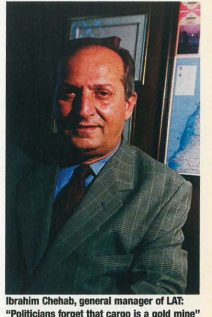
with garbage and nothing works,” says Ibrahim Chehab, general
manager of Lebanese Air Transport (LAT). The erratic customs
procedures and charges, which are often subject to bribes or
wasta, slow the passage of goods. An organized and efficient customs
system would increase cargo and ultimately increase the revenue
for the government, says Chehab. He previously worked as
a cargo manager at Sharjah airport. “It’s small compared to
Dubai’s airport, but their warehouses are full because the government
has a flexible policy and business is booming,” says
Chehab. LAT does cargo and passenger handling as well as
maintenance assistance for 17 international airlines, including Air
France, British Airways and KLM.

The government halted a $15 million BOT project to build a modern
customs building with a warehouse capacity of 200,000 tons a year
and where airlines could have bonded warehouses. “The existing facilities
can absorb 100,000 tons, but Lebanon is only getting 50,000 tons**;**
that’s what stopped the project,” says Fadi Saab, chairman of Trans
Mediterranean Airlines. Customs regulations can impact the cargo
business, adds Saab, but other areas such as industry and trade also
need a boost for the sector to improve. The plans to modernize and
computerize the facilities are encouraging for Saab.

But Chehab believes a better option would be to create a ‘cargo village.’
For 15 years, land would be given rent-free to airlines and cargo
companies to build their own offices and warehouses. “Politicians think the airport is only for
passengers and forget
that cargo is a
gold mine,” says
Chehab. He cites
Singapore as one of
many cities that have
become hubs as the
result of such a project.

The government
did have a plan
to take ownership of
additional land. But
the project failed
because it exceeded the allocated budget for the airport, and
there was political pressure due to its proximity to residential areas,
according to an engineer at the airport’s civil aviation department. “We
don’t have an inch of land to give to companies,” he says.

But land aside, politics have already scuttled one similar completed
project. Last October DHL (see “Down and out in Beirut,” January
2000) invested $2 million in new airside offices that included warehousing
and an area for customs clearance. Those facilities are sitting
idle because no customs officers have been stationed there,
despite promises from both the current and previous government.

Another problem is the high rental fees. Last August, law number
nine increased the rent for offices occupied by airlines or
appointed agents from LL 100,000 to LL 500,000 per m2 and the rent
of hangars and warehouses from nothing to LL 250,000. For LAT
that meant an increase from $7,500 to $35,000 per month.

The new law gave a 50% exemption to local companies that
have scheduled flights, but LAT doesn’t have scheduled flights.
Though the law has since been modified to include companies
without scheduled flights, the ministry of transport is trying to
collect the full fee. The civil aviation authority disputes complaints of high
fees. “It was proven that we have the lowest such fees in the
world, and we need them to cover the operating costs of the airport,”
says one official.

The companies that LAT represents also complain about additional
fees, such as $150 per hour to use the travel counters and
charges of LL 50,000 to LL 150,000 on outgoing passengers. And
on top of the substandard warehousing facilities, the airport has yet
to install telephones and televisions as well as sufficient passenger
seating, arrival and departure monitors. Even with all the
fees it collects, the airport management has failed to provide
good services in return.

July 15, 2000 0 comments
0 FacebookTwitterPinterestEmail
For your information

Breaking down the barriers

by Natacha Tohme July 15, 2000
written by Natacha Tohme

With political and economic issues heading the government’s
agenda, it’s hardly surprising that the rights of
the disabled were put on the back burner. Following
concerted efforts by advocates, the most that law 243 of 1993 stipulated
was that disabled people “have the right to be employed,”
says Jerius Khouri, vice-president of the national association for
the rights of the disabled. “But it didn’t require companies to hire
a certain percentage of the disabled or fine them for not obeying the
law.” The law didn’t even eradicate an antiquated and discriminatory
Turkish law that actually denied handicapped people
access to public jobs.

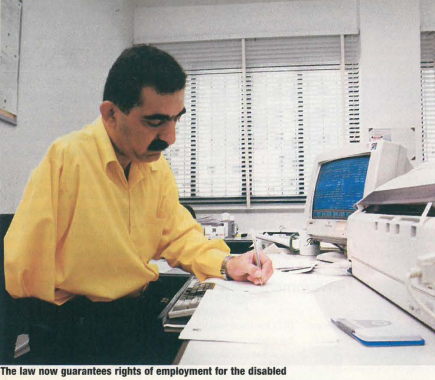
All that was changed when parliament approved a new anti-discriminatory
law in March. “It cancels or amends unfair texts, clarifies
unclear texts and adds new texts,” says Rita Saba, head of
human resources at the rights and access program of the ministry
of social affairs. On employment, the law guarantees equal opportunity
for individuals with disabilities. It stipulates that disabled people
will represent 3% of public jobs in all categories.
Private companies with more than 60 employees must reserve 3%
of positions for those with disabilities. For companies with 30 to
60 employees that figure is 1%. Failing to comply will result in a
fine, but the amount has yet to be disclosed. Companies with a staff of less than 30 are not bound by the law to employ disabled people,
but doing so will procure tax exemptions.

“The purpose of the law is to ensure the rights of the disabled on
a long-term basis,” says Saba. It’s an important step towards moving
the status of the handicapped in society from marginalization
to total integration. But the law must still be enforced. “We have to
turn it into applied rules,” says Khouri, who is blind and works as
a freelance journalist and translator. That will require coordination
between the ministries. “Coordination committees must be formed
within each ministry,” says Saba. “Without them we will not be able
to apply anything concerning the law.”

The law also specifies that all public buildings must be accessible
to people with disabilities. “But the criteria still have to be set in
the implementation stage,” says Saba. Adapting the workplace will
be an important component. “As far as I know, most workplaces are
not accessible for the physically disabled,” says Khouri. That
includes making toilets and elevators accessible to wheelchairs.
Solidere showed vision by building in accordance with international
standards that allow for accessibility, but it will be a while before
building specifications become obligatory by law. When they
do, owners of buildings under construction that fail to abide by
specifications will be fined. Tax exemptions will be given to
property owners who restructure existing buildings.

No statistics are available, but it’s safe to say that the number of handicapped
people presently employed is negligible. The Dr.
Mohammed Khaled Social Foundation cares for the physically
handicapped, for whom it provides training in carpentry and sewing. The foundation employs 12
physically handicapped people,
mostly paraplegics.

“They can’t move their legs,
but they can move their
hands. They have brains and
are intelligent,” says Abdul
Hafiz Elladki, the foundation’s
general director.

One barrier to employment
is that just a small percentage of the handicapped population is educated, according to Raif Shwayri, the director of
the Al-Kafaat Foundation.
Before the 1993 law, handicapped
people had no access to
public schooling. Though the ban was lifted, schools are still not accessible to the disabled.
Additionally, no public transportation is available for the handicapped,
making it difficult to get to work or school. Al-Kafaat is a specialized
organization that caters to socially and physically disadvantaged
people. The organization provides daily transportation for its
4,500 beneficiaries, 2,000 of whom are physically impaired. The government
needs specialized buses for the physically handicapped.
“To integrate the handicapped in society, society must be equipped to
receive them,” says Shwayri.

Compiling the cases

Exactly what percentage of
Lebanon’s population is disabled?
Two studies have been
done: one by the ministry of social
affairs in cooperation with the
United Nations population fund
(December 1995 to May 1996) and
the other by the Central
Administration for Statistics
(1997). The studies put the figure at
1% and 1.5% respectively.

According to a source at ESCWA,
“the figure is way too low.”

Recently the ministry of social
affairs began issuing identity cards
for disabled citizens who meet the
classifications set by the ministry.
“Certain health problems are not
classified, such as extreme cases
requiring medical equipment that
we cannot provide and minor
ones,” says Rita Saba of the ministry’s
rights and access program.

The card is required for disabled
people wanting access to services
provided by the ministry, such as
technical aid. To date 24,493 cards have been
issued, indicating 24,763 disabilities
(some have multiple disabilities).
Of these 6.79% are visually
impaired, 11% hearing impaired,
38.7% mentally disabled and
52.2% are physically disabled.

While many people are reached
through ‘outreach services’ provided
by collaborating NGOs,
such as Arc en Ciel, most people must apply for the cards in person at
the ministry’s offices. For this reason, the figure isn’t a good indicator of the real number of the disabled,
which likely stands at 6% to
7% of the population.

July 15, 2000 0 comments
0 FacebookTwitterPinterestEmail
For your information

Cellular circus

by Kirsten Vance July 15, 2000
written by Kirsten Vance

In the eyes of most spectators, the row has
turned into a complete fiasco for the government
and has been sorely mishandled
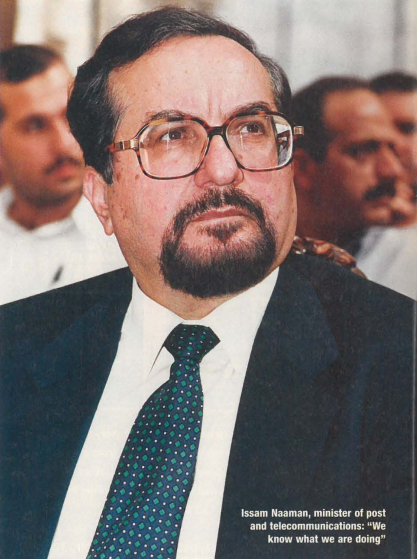
by Issam Naaman, the minister of post and
telecommunications. International rating
agency Standard & Poor’s (S&P) recently
included the government’s inability to find a
solution to the cellular issue by October in a list
of factors that could lead to a possible sovereign
downgrade for Lebanon. In a telephone interview
with EXECUTIVE, the minister brushed
aside S&P’s warning: “Let them go to hell. We
know what we’re doing.”

But the view from the sidelines tells a different
story. “This could have been resolved
quickly, privately and profitably for the government had they been more
politically astute,” says one analyst. And so the dispute has dragged
on. Many point to the vested interests at play as the major culprit: the
politically powerful hoping to get their fingers in the pie and push forward
companies with which they have or hope to form alliances.

Kamal Shehadi, a consultant on telecom privatizations in the
region, points to the government’s failure to adopt a consistent telecom
policy and law in keeping with the information age (see pp.
27-29). “Other reasons, such as the myopic approach to telecoms as
the cash cow for public finances, at the cost of encouraging
growth and investment in the sector and Lebanon catching up with
the information revolution, must have played a big role,” he adds.

And with elections just around the corner, a solution is probably
not in the cards anytime soon.

Naaman is still hunting down that elusive $300 million in fines
for each LibanCell and Cellis. But neither has received a detailed
explanation of that figure. The minister even threatened that the government
could break the build-operate-transfer (BOT) contracts and seize the two companies’ assets if an agreement is not reached
through talks. But negotiations are made difficult when the two
sides are virtually on non-speaking terms. This does not bode well
for possible future investment. “No investor will invest in a country
where governments decide to shut down a business simply
because it is more profitable than its original business plan had predicted,”
says Shehadi.

Both cellular operators have submitted requests for arbitration to the International Chamber of
Commerce in Paris. “We maintain that we have not
violated our contract and that arbitration is the best
path to resolve the different interpretations of the contract,”
says Hussein Rifai, chairman of LibanCell.

Recently, Naaman has been touting a ‘much better offer’ from Vodafone than what Lebanon’s two cellular
companies are willing to pay for their contracts
to be converted into licenses. The UK-based company
has apparently expressed its readiness to pay $1.5 billion for a license. Contacted by EXECUTIVE,
Vodafone denied making any such offer, oral or written, to the Lebanese government, even insisting that
there are no negotiations between the two parties. “If that’s true, it means
they are not telling the truth. I have all the evidence,” says Naaman,
refusing to elaborate. According to the minister, he is conducting meetings
with representatives of three mobile phone companies that are
interested in investing in Lebanon. “Vodafone for me is a ghost,” says
Sima Hafez, marketing director of Cellis, which submitted an offer in
writing. “He said Vodafone’s offer is better than ours. What are the conditions
of Vodafone’s offer? Nobody knows.”

All this comes in the wake of offers by LibanCell and Cellis to
pay $1.35 billion each for licenses that were snuffed out by the government.
Of that amount, $900 million would be paid upfront with
the rest coming in over the 20-year life of the license that would
allow competition. “Our offer was more than fair and exceeds any
price paid until now for a GSM license,” says Rifai. Indeed, in a
study prepared for the Lebanese government in September 1999,
Booz, Allen & Hamilton assessed the price of a license at between
$800 million and $950 million, based on four different scenarios.
While LibanCell points to the unprecedented high price per population
of the offer, that is the proper index for startups, according
to Shehadi, not going concerns. Nonetheless, the price is fair on a
per subscriber basis, he says: “It compares favorably with prices paid for going telecom concerns in
Europe, where the revenue per subscriber and per
capita income are higher.”

At the council of ministers, sentiment was split. The
nay camp included Naaman and Michel Murr, the
interior minister. Naaman listed his reasons for rejecting the offers at a recent press conference: the
initial installment is too low, the length of the license
too long and the right of first refusal for UMTS, the
third generation of mobile phone systems, should not
be included. Those in favor included Georges Corm,
the finance minister and Nasser Saidi, the minister of economy and trade. “I proposed transforming the
BOT contracts into licenses in December ’98, so I believe it should
have been done then,” says Saidi, adding other issues like competition
and new technologies need to be considered.

The matter appears to be shelved for the time being as the government’s
decision was, er, not to make a decision. Instead the unresolved
dispute was passed onto the auditing department’s lap, with
the operators’ offer not accepted, but not officially refused either, and
it was announced that a law would be drafted to allow a UMTS tender.

“The government should not have accepted the operators’ offer
without making modifications that would ensure a fair and level playing
field for LibanTelecom, the state-owned operator, and other
new entrants to the market,” says Shehadi. “However, that does not
justify the decision reached.”

July 15, 2000 0 comments
0 FacebookTwitterPinterestEmail
Editorial

Deadline time

by Executive Editors July 15, 2000
written by Executive Editors

$2.7 billion is big money. It’s about 15% of Lebanon’s GDP. The
entire economy takes close to two months to generate that much
output. It would have substantially reduced the bloated debt, boosted
investors’ confidence and paved the way for privatization. All the
cabinet had to do was say ‘yes’. Instead of deciding on selling licenses
to LibanCell and Cellis, they dilly-dallied and passed the buck.

Procrastination seems to be the theme of this administration, when
action is what’s really needed. Numerous reforms have been on the
table collecting dust. The telecom privatization law has been with the
council of ministers for three months. The decree to allow Solidere
to develop the souqs has been keeping it company. The value-added
tax (VAT) law is sitting in the parliament’s lap. When it will
be debated and actually passed is anyone’s guess, especially since the
elections are approaching and getting re-elected is the priority. And whatever
happened to administrative and judicial reform, not to mention
the anti-corruption campaign?

Since the government couldn’t accept the cellular offer, Standard &
Poor’s made them an offer it can’t refuse. The international rating
agency has threatened to downgrade Lebanon in the fourth quarter
unless it meets a number of criteria, including hitting its deficit targets,
resolving the dispute with LibanCell and Cellis before October and
passing the VAT law before the elections in August. If the government
can’t reach its own deadline, maybe it can reach someone else’s.

July 15, 2000 0 comments
0 FacebookTwitterPinterestEmail
Cover story

Withdrawal symptoms

by Robert Tuttle, Kirsten Vance & Peter willems June 27, 2000
written by Robert Tuttle, Kirsten Vance & Peter willems

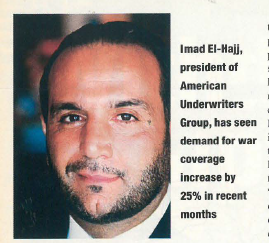
Imad El-Hajj, president of American
Underwriters Group (AUG), probably
never thought of it, but his job is much
like that of a priest. In times of trouble, anxiety,
and worry, people come running to
him. AUG is among a handful of insurance
companies that provide war-on-land
coverage — insurance for damages caused during
a military conflict.

Demand for
these policies increased 25% in recent
months, with tension building prior to the
Israeli withdrawal — not just in the South but
in Beirut and even Jounieh. The price of premiums
shot up by almost a third. Recently,
a professional syndicate requested that its
medical insurance coverage be extended to
include injuries sustained during wartime.

Now the Israelis are gone after 22 years
of occupation. When EXECUTIVE went to
print, there was a sense of victory across the
country. But despite the celebrations, there
remains uncertainty about what will happen
in the weeks and months to come.

Business does not lend itself to an atmosphere
of uncertainty, whether one is a
banana seller, bank manager, importer, or
stockbroker. The withdrawal has perhaps
brought a feeling of greater uneasiness
than during the occupation, which the
Lebanese had grown accustomed to.

“People feel that a scenario will soon be
played out,” says El-Hajj. “What kind of
scenario, they don’t know.”

There are worries that border conflicts
could escalate into far more punishing air
strikes than what has been seen in recent
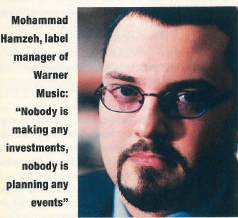
times. “Nobody is doing anything, just
waiting to see what will happen,” says
Mohammad Hamzeh, label manager of
Warner Music. “Nobody is making any
investments, nobody is planning any
events.”

At the Riviera Hotel, 20% of this
summer’s bookings are tentative compared
to last year’s near-zero rate. “They don’t
want to commit themselves,” says Nizar
Alouf, managing partner of the hotel.

The uneasiness of the region is affecting
international business circles. “There’s a lot
of indecisiveness from the Americans at this
point, and when you hear the word
Americans, that is business,” says Michael
Dunn, partner at Healey & Baker, a real
estate consultancy firm that helps local — but
primarily foreign — firms with their real estate
needs.

Even prior to Israel’s promises
of withdrawal, the political environment in
Lebanon had impacted its standing in the
investment community. Standard & Poor’s
sovereign rating for the country is BB with
a negative outlook, which is a speculative
grade allowing for political uncertainties.

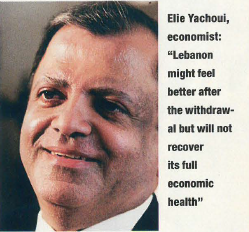
“The probability of conflict after the
withdrawal is becoming higher,” says Elie
Yachoui, an economist, noting the Shebaa
Farms dispute and other issues. “For the
economy, that means a bad outlook for
investors and more recession.”

Probably the most disturbing murmurs
prior to the withdrawal emanated from
financial circles. In April, for the first time
in almost a year, the central bank was
forced to intervene in order to prop up the
pound. While figures were not disclosed,
analysts estimate that the bank spent
between $400 million and $450 million
over several weeks.

The pressure on the
pound had calmed down by the time of the
withdrawal, but the Lebanese currency’s
vulnerability is a cause for worry.

“If the withdrawal of Israeli troops in
South Lebanon leads to a deterioration of
stability, we will see a flight to foreign currencies,”
warns Navaid Farooq, Standard &
Poor’s sovereign analyst for the Middle
East and North Africa.

Even if the central
bank, in a bid to prevent the currency’s
collapse, hiked interest rates and started
spending its reserves, there could be panic.
“If depositors decide, in a mass hurry, to
switch from Lebanese pounds to US dollars,
then nothing that any commercial or central
bank can do could hold them,” says one
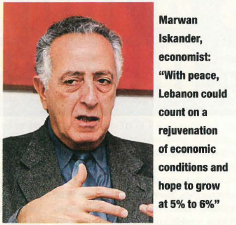
analyst. In the words of economist Marwan
Iskander: “The banking system could be
shaken to its roots.”

Depositors could rush the banks, changing
their pound-based accounts — 61% at the
beginning of 2000 — into dollars. And if that
happens, it could result in calamity.

People’s purchasing power and standard
of living could be reduced overnight. In a
country so dependent on imports, this
would be devastating. “If the pound were to
devalue by 20% or more, the circumstances
would become all that much harder.

Today, we have a difficult situation, and
if compounded further, it could become
explosive,” warns Iskander.

This would
spur high inflation. Many businesses and
individuals would not be able to repay
loans, and the value of Lebanese T-bills,
which represent a substantial portion of
most Lebanese bank assets, would tumble.

The worry isn’t only with local depositors
switching to hard currencies. Capital outflow
is another concern. “If we have confrontation
with Israel, it would be extremely difficult
for Lebanon to maintain the deposits of the
non-Lebanese, which constitute 30% of
total deposits,” says Iskander.

Couple that scenario with the already bad
economy and possibly hundreds of millions
of dollars in infrastructure damage
caused by Israeli air strikes, and it could
cripple the economy. For the cash-strapped
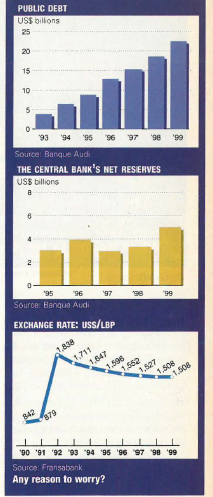
government, already drowning in nearly
$23 billion of debt, devaluation would create
further troubles.

While a weaker pound
would help relieve the domestic debt,
meeting overall debt payments would
become more cumbersome if Lebanon is
destabilized. “In the worst-case scenario,
there would be increased difficulties in collecting
revenues,” says Farooq.

But prophesying the worst might not be
well founded. The last ten years have witnessed
a spate of crises, from large-scale
Israeli bombardments of Lebanon’s infrastructure,
renegade militants in the North, to
a major turn of government. Through it all,
the sky never caved in, the pound remained stable, people
went to work, the kaaki
sellers continued to sell their kaak, and life went on pretty
much as normal.

Whether it is
coming or not now that the
Israelis have gone, conflict
is certainly nothing unusual to
the Lebanese; they have
lived with it through most of
the last three decades.

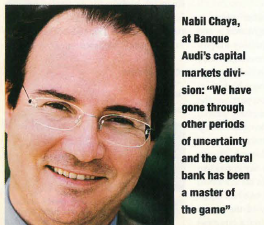
“We have gone through
other periods of uncertainty
over the last few years, and the central bank has been a master
at the game. They know
very well how to contain the pressure,”
says Nabil Chaya, head of the treasury at
Banque Audi’s capital markets
division.

Analysts point to
several key firewalls for the
bank. Foreign investors, who
own less than 10% of
Lebanese T-bills, cannot
directly speculate on the
pound, as they did in Southeast Asian countries during
the economic meltdown in
that region. This will help prevent
a “hot money” problem —
a sudden and massive sell-off
at the first signs of instability.

At the same time, the central
bank’s reserves were about $5
billion at the end of 1999 —
higher than ever since the end
of the civil war. If the bank
needed to step in again to
support the currency, it
should have enough reserves
to last for the short to medium
term.

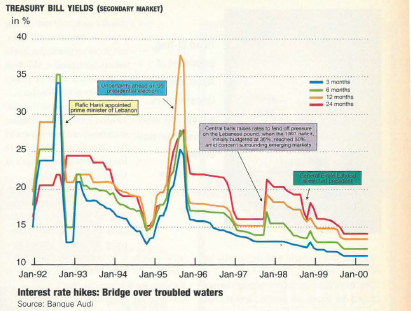
Although it would
choke investment and slow down
the economy further,
interest rates could be hiked to
defend the pound, as they
were during times of uncertainty
in 1992, 1995, and
1997 (see graph).

As a last
line of defense, the bank has
gold reserves estimated to be
worth between $2 billion and
$3 billion.

“Even if things go very badly,
no catastrophe is expected for
the simple reason that even with continuing
pressure, the central bank has huge
reserves,” says Mohieddine Kronfol,
financial analyst in the capital markets
division of Middle East Capital Group.

But even if there is no conflict in the
wake of the Israeli withdrawal, Lebanon has
plenty of problems to lose sleep over. “My
biggest concern,” says Kronfol, “is
Lebanon getting its house in order.”

The
government is stuck with a budget deficit
that reached 51.8% at the end of the first
quarter of 2000. That’s up from 42.4% at the
end of 1999 and a far cry larger than the
37.3% that was targeted for the end of this
year — anxiety.

The economy regressed by between –1%
and –1.5% last year, according to the Economist
Intelligence Unit and HSBC.

Official GDP growth estimates for this
year are at 1.5% to 2%. But a recent report
by the Bank of Beirut & the Arab
Countries states: “This year looks harder
than last, given the prudence and the wait-and-see
attitude of economic agents.”

According to a study done by the General
Labor Confederation and the International
Labor Organization, an estimated 48% of
the Lebanese population is on the verge of
poverty and 68% live below the middle
class line — anxiety.

Serious administrative reform has yet to
get underway, the government is locked in
disputes with a number of foreign companies,
and there are serious doubts that this government’s
privatization plans will go
through — anxiety.

At the same time, parliamentary
elections are coming up this
summer, and many are forecasting a change
of government — more uncertainty.

“These are the issues that weigh heavily
on Lebanon,” says Kronfol. “If the issues
are not addressed, the government will find
itself, against its current intentions, having
to raise interest rates to keep the depositors
from converting and keep banks participating
in T-bill auctions. This
would exacerbate Lebanon’s
current economic problems.”

Without solutions, the economy
will continue to deteriorate,
which itself could put pressure
on the pound.

What’s more, opinions are
divided about what may come
now that the era of occupation
has ended. The pullout could
usher in an era of stability.

“The problems with the economy
are obvious,” says Paul
Salem, development analyst.
“The only thing that can get us
out is peace and investment.”

And many people feel that the
withdrawal could be the first step towards
a comprehensive peace settlement.

“This
will turn a new page,” says Georges
Ghorayeb, general manager of the tile
manufacturer Lecico. “We don’t know
what’s coming, but I think it’s a step
towards a solution. We’re optimistic. We
still believe that the past of Lebanon was
much more dangerous than the future.”

The advantages of a peace settlement are
obvious: millions of dollars in foreign
investment and foreign aid, a flood of
tourists, possible trade liberalization.

“Lebanon could count on a rejuvenation of
economic conditions and could hope to
grow at 5% to 6% [per year],” says
Iskander.

He adds that the country may see
as much as $2 billion in compensation for
damages sustained during the Israeli occupation,
from the European Union, Japan, and
especially the oil-rich Arab countries.

“As
well, the privatization process would result
in greater receipts due to increased investor
confidence, which would lead to a larger
reduction in the debt stock, and we would
see increased tax revenues,” says Farooq.

Without a settlement, the benefits are
less obvious. Many political problems, such as
the Palestinian issue, would
continue to fester.

But if
the situation remains
calm, there would likely
be a certain increase in tourism revenue, and it
might prompt some
investment, especially in
the South.

This, according
to Iskander, would mostly
come from the Shiite community
that made money in
Africa, estimated to have
about $5 billion in wealth.
He estimates that as much as $500 million could flow into the South.

“That kind of investment in an economy as
small as Lebanon’s would make a significant
change,” he says.

While the economic choke on Lebanon
may be loosened, the country won’t
breathe easily. “If someone is sick and has
a siesta, how will he wake up?” asks
Yachoui. “Lebanon will probably feel better
after the withdrawal of Israeli troops, but
it does not mean that the country will
recover its full economic health.”

One thing is certain — Lebanon’s problems
did not go away with the Israelis.

June 27, 2000 0 comments
0 FacebookTwitterPinterestEmail
Best Sellers

Flat out flat

by Avo Tavoukdjian June 27, 2000
written by Avo Tavoukdjian

You couldn’t pick a worse time to be a
contractor. With the economy at a
standstill and the debt-ridden government
reducing public works expenditures,
construction projects are scarce. Contractors
are fighting over whatever business they can
find, even if that means bidding below cost.

But despite the doom and gloom, Butec, one
of the country’s oldest contracting firms, has
managed to keep its annual revenues around
$100 million for the last five years. “We’re
doing OK,” says Ziad Younes, Butec’s secretary
general, “but the market isn’t doing that
well.”

What is Butec’s antidote for the construction
slump? Specialization. Rather than
devoting its energy to building simple apartment
blocks or office buildings — the sort of
jobs that are the first to be hit when the economy
slows down — Butec concentrates on
technically complex projects that require specific
know-how. For these types of projects,
profits tend to be considerably higher.

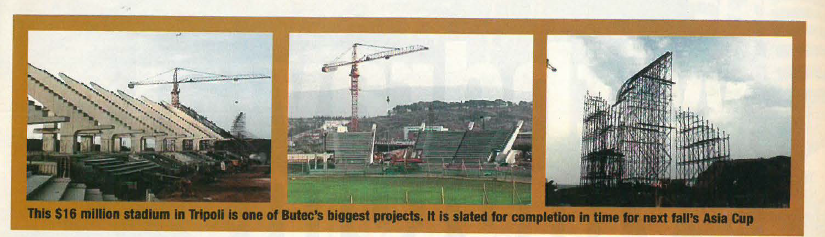
For example, Butec is building a $16 million stadium
in Tripoli. Work started in June 1999, and
the project is slated for completion in time for
next fall’s Asia Cup. Butec is also constructing
a 45-kilometer irrigation system in the
southern Bekaa, worth around $14 million.

Firms capable of handling these projects are
few, meaning less competition and higher
profit margins. “We don’t get involved in
projects where everybody bids, sometimes
below the direct cost of construction,” says
Younes. “Other companies can get a project,
but if they can’t complete it, at worst they
declare bankruptcy.”

Technically difficult projects tend to be
larger, which is another advantage. “The
greater the volume of materials and equipment
you purchase, the better the prices
you are apt to receive,” says Kamal Meine,
an architect. Sometimes, discounts reduce
the price per unit to as low as 50% to 60%
of the original sticker price. Butec manufactures
some of the equipment and materials
it uses itself, reducing costs further.

Because of its specialized nature, Butec
competes with only a handful of other companies.
Consolidated Contractors Company
(CCC), for example, has annual revenues
exceeding $1.5 billion. Along with its
German partner Hochtief, CCC constructed the
new $500 million Beirut International
Airport. Contracting and Trading Company
(C.A.T.), which is projecting a turnover of
$130 million this year, is another big competitor
to Butec.

“With few in the market
capable of taking on such complex projects,
competition is reduced substantially,” says
Ziad Kassis, owner of Unity Group, the company
currently building the Zahrani bridge.

Butec has also been targeting projects outside
Lebanon in order to counter the slowdown
in the domestic market. By doing
business abroad, Butec is able to balance its activities,
keeping itself and its staff operating.

The company teamed up with a local
affiliate to build a $130 million cotton-spinning
plant in Syria. The project was so successful
that, almost immediately, work started
on a second $110 million cotton plant.
Younes expects these two factories to
process between 10% and 20% of the country’s
total cotton exports.

The company was
also involved in the building of a $16 million
sewage plant in Latakia and one in Tartous
for $16.6 million. Butec is building a gas
compression station in Iran, a power plant in
Basra, Iraq, the Dubai Tower in the UAE, and
a pipeline with three substations extending
from Iraq to Jeddah.

Other contracting companies
such as C.A.T., which is working in
the Gulf and Africa — are following a similar
strategy: targeting markets abroad in order to
ride out the recession at home.

Butec has also diversified its services. The
firm, for example, established Butec Property
Management (BPM), which provides building
maintenance, cleaning, and security at facilities
that were built by the parent company.

But before giving Butec a big pat on the back,
consider this: While the company’s strategy of
specialization has kept revenues steady during
the recession, its competitor C.A.T. has
managed to increase its turnover by over
200% in the last four years by focusing on foreign
markets. C.A.T.’s revenues jumped
from $25 million in 1996 to $80 million in
1999.

“Specialization may help Butec hang on
to its turnover,” says Souheil Abou Habib, general
manager of Nassim A. Habib, a local
contracting firm. “But such projects don’t
come along too often and limit growth.”

While specialization has kept Butec alive,
real growth may require the company to look
at new strategies and be a bit less fussy about
the projects it is willing to take on.

June 27, 2000 0 comments
0 FacebookTwitterPinterestEmail
  • 1
  • …
  • 691
  • 692
  • 693
  • 694
  • 695
  • …
  • 705

Latest Cover

About us

Since its first edition emerged on the newsstands in 1999, Executive Magazine has been dedicated to providing its readers with the most up-to-date local and regional business news. Executive is a monthly business magazine that offers readers in-depth analyses on the Lebanese world of commerce, covering all the major sectors – from banking, finance, and insurance to technology, tourism, hospitality, media, and retail.

  • Donate
  • Our Purpose
  • Contact Us

Sign up for our newsletter

    • Facebook
    • Twitter
    • Instagram
    • Linkedin
    • Youtube
    Executive Magazine
    • ISSUES
      • Current Issue
      • Past issues
    • BUSINESS
    • ECONOMICS & POLICY
    • OPINION
    • SPECIAL REPORTS
    • EXECUTIVE TALKS
    • MOVEMENTS
      • Change the image
      • Cannes lions
      • Transparency & accountability
      • ECONOMIC ROADMAP
      • Say No to Corruption
      • The Lebanon media development initiative
      • LPSN Policy Asks
      • Advocating the preservation of deposits
    • JOIN US
      • Join our movement
      • Attend our events
      • Receive updates
      • Connect with us
    • DONATE