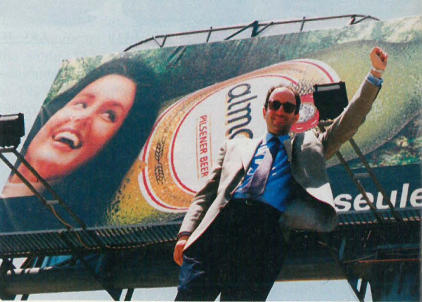
Two’s company, three’s a crowd, or so
people say. But for Almaza, one was
comfortable enough. Since the mid-1990s, the only locally produced beer was the
big kid on the block. After the war, Almaza
invested almost $15 million in rebuilding its
factory and obtaining ISO 9002 certification.
Brewery production capacity was doubled
from 10 million liters a year to 20 million
liters, although it now operates at half that
level. The company dominated the post-war
beer market, with annual revenues of $10-15
million. Almaza has controlled about 65%
share of the roughly 16-18 million liter yearly
market, according to market estimations.
Its closest competitor, imported Heineken,
claims to have 19%.
Then an old acquaintance moved back into
the neighborhood and things haven’t been
quite the same. Laziza’s boisterous re-entry
into the Lebanese market last year represents
the first serious challenge to Almaza in
almost a decade. Although it was once one
of Lebanon’s leading brands, Laziza is no
longer, in the purest sense, Lebanese. The
company stopped local production in 1995
and is now importing from Holland. But the
firm’s blitz into Lebanon last summer, with
an estimated $1 million advertising campaign,
helped revive the Laziza name.
This summer, the company has turned on
the marketing machine again by launching
two new products, Laziza Light, with
2.5% alcohol, and Laziza Heavy, with 8%
alcohol. Georges Khawam, Laziza’s owner,
claims to have generated $6 million in revenues
since his brand hit the market in May
of last year. He also claims to have 25% of
the market, though his competitors dispute
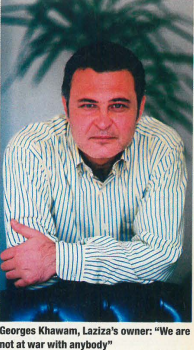
that assertion. “We are entitled to make a comeback,” says Khawam. “We are not at
war with anybody.” But there is little question
that Almaza has been feeling the heat of
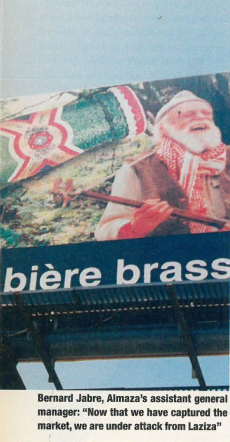
battle. “Now that we have captured the market,
we are under attack from Laziza and we
have to redouble our efforts in order to protect
our market share,” says Bernard Jabre,
Almaza’s assistant general manager.
This has had a sobering effect on Almaza,
which has doubled its marketing budget and
reduced prices since the arrival of Laziza. It
has also begun diversifying its portfolio of
products, including the launch of a new non-alcoholic
malt drink called Malta this year.
The drink will come in a number of flavors,
such as apple and raspberry, and will be sold
both locally and throughout the Arab world.
Almaza is also trying to trim costs. The
recent computerization of its factory has
helped reduce the need for manpower. The
firm has also been trying to convince consumers,
including hotels and restaurants, to
return used bottles, which reduces the costs
of raw materials and storage by about 30%.
Now Almaza is bent on taking over the liberated
South, where it expects to sell
between 10% and 15% of its total yearly output
of 10 million liters. The South is a virgin
market for beer companies. Before the pullout,
Israeli-made Macabi beer dominated the
region and competitors were largely kept out.
Heineken, Laziza’s second biggest competitor,
is less worried about the increased
competition. “They haven’t yet established
themselves with their core product,” says
Salim Bocti, vice president of the Gabriel
Bocti company, the local distributors of
Heineken. “Our estimates indicate that they
have no more than a 5% to 10% market
share in local sales.” But unlike Almaza,
Bocti feels that trying to counter the Laziza
marketing offensive is futile. Prior to
Laziza’s arrival, Heineken’s marketing budget
was $500,000 per year. “For the last two
years, we redirected our advertising budget
into other areas such as promotional items
because of the insane advertising from
Laziza. If they want to spend $1 million, I will
not spend $300,000, because I will look
small,” says Bocti.
But now it looks as if Laziza’s two
biggest competitors might be teaming up.
Heineken already has a 10% stake in
Almaza. Negotiations are currently underway
to increase the international beer
giant’s share in the local brewery. “Last
year, Heineken visited the factory and
wanted to buy shares; we are negotiating
selling 20%, 30%, who knows, but nothing
is finalized,” says Jabre. The move would
increase Almaza’s capital and put the
weight of one of the world’s largest beer
manufacturers behind the local outfit.
Albert Holtzappel, spokesman for
Heineken International, refuses to comment
on the matter, saying only that the
Dutch company has been attempting to
extend its international reach by partnering
up with large local producers around the
world. Heineken may want to use
Almaza’s underutilized factory to brew its
own beer locally. A similar arrangement
was being negotiated two years ago
between Almaza and Laziza, whereby
Laziza would be permitted to make use of the 50% unused capacity in Almaza’s
brewery. But the deal fell through.
Almaza is determined to hold its ground
against the Laziza onslaught. But the battle
has taken its toll. Since Almaza was forced
to cut prices, revenues have dropped,
although Jabre would not provide exact figures.
The company wants to boost exports in
order to make up for the decrease in local
sales, but there are problems. Jabre complains
that customs in nearby countries are
much higher than the local tariff of 55%.
That leaves the tiny Lebanese market,
which is too small to justify new investment.
Almaza could reduce costs further by producing
barley malt locally. But the company
would have to grow a minimum of 100
million tons per year, which is not feasible
in Lebanon. By contrast, the sole brewery in
Egypt, a country of 60 million, produces 500
million liters of alcoholic and non-alcoholic
beer a year and operates at full capacity.
In Holland, Heineken alone has a full
capacity of 12 billion liters per year.
Almaza will also face hurdles when
introducing its new Malta drink. Non-alcoholic
beers represent only 5% of the total
beer market and there is plenty of competition.
Chasco, distributors of Holsten beer,
and Heineken have a head start in distributing
non-alcoholic beverages in the Arab
world. Laziza also makes a non-alcoholic
beer. Since the firm’s arrival, Khawam
claims to have sold 100,000 cases of non-alcoholic
beer in Lebanon alone, and forecasts
selling 500,000 cases by the end of this
year. “By year’s end,” says Khawam, “we will be the third leading malt beverage in
Saudi Arabia and on our way to becoming
leaders in Kuwait and Iraq.”
What’s more, Almaza may soon lose one of
its biggest selling points. Laziza is considering
investing more than $12 million in a
brewery in Lebanon. “I did not have $15 million
to rebuild my factory after the war and no
one would give me a loan, but now I have three
proposals for a factory here,” says Khawam.
It looks like more rough times may lie ahead
for Lebanon’s leading brew.