
S alim Wardy says that it’s his passion
for wine that enabled him to sustain
12 years of invest~nts – $20
million to be exact – without seeing any
returns. All to establish Domainc Wardy, a
wine launched in November 1999.
His family’s arak business provided 70%
of the funds, a bank loan the rest. About $12
million purchased 50 hectares (500,000m2)
of land in the Bekaa Valley, while expenditure
on equipment and facilities was roughly
$6 million. Another $2 million went
towards buying and cultivating 85,000
vines imported from France.
As its distributor, Wardy selected veteran
of the trade Gabriel Bocti – the exclusive
agent for Heineken and Cutty Sark.
Crystallizing the alliance was Wardy’s
like-mindedness with the company’s scion
Salim Bocti. What began as a contract
between two family-run businesses
emerged as a partnership spearheaded by the
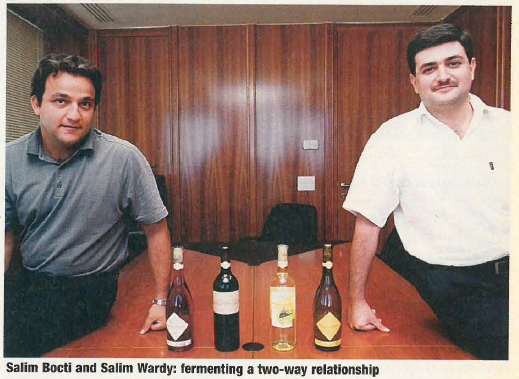
two young men. “Domaine Wardy is our
baby,” says Bocti, whose company is
investing in the winery. The details of the
agreement aren’t finalized, “but it’s really a
two-way partn~rship.”
The compariy declined to reveal exact
turnover, saying only that the first-year target
was surpassed by 70%. About 65% of
the first production
sold. Exports represent
14% of sale,
while domestic sales
are split between
hotels and restaurants
at 35% and retail outlets
and wholesalers at
65%. Domaine Wardy
entered the market with five wines, by
year’s end 12 will be on shelves. Profits
are being reinvested in the business.
Things are looking good for the industry as
a whole. “The market for Lebanese wine is
growing,” says Charles Ghostine, managing
director of Ksara, which manufactures 1.5 million bottles a year, 40% of which are
exported. Ghostine estimates local production
at 4 million bottles, or $ 16 million. An
independent study from 1999 shows that
Ksara and Kefraya together control 70% of
the local market, with Ksara ahead by 4%.
“When you’re up against two major players,
you have to be innovative to succeed,” says
Bocti. “So we’re investing in the best at every level.”
He says that a fortune goes
into packaging details,
such as personalized corks
and wax caps, both of
which are imported.
An aggressive marketing
campaign was
launched, while shrewd
tactics were employed on
the ground to enter res taurants. “We were printing
menus to get our wines on lists,” says Bocti.
“Now we have 80% availability at restau- .
rants.” About $400,000 ha5 been injected into
marketing, which is expected to reach
$600,000 by year-end.
Attractive packaging and striking ads might sway consumers initially, but the
product determines if they’ll buy again. All
grapes used are grown at the Wardy winery as
a quality assurance measure, while the wines
comply with French norms. Innovative
products include varietal wines, which are
made from one variety of grapes. Wardy is
one of two local wineries producing such
wines; Ksara is the other. It presently has two
in the market. One, a 1998 Chardonnay,
recently won an award at an international
competition in Montreal. Three new varietal
wines hit the shelves next month.
The winery will soon introduce organic
wines. “Next year all our wines will be
organic,” says Wardy. Producing organic
wines increases costs by 70% to 90%,
which will be reflected in prices, now at $5
to $8. But judging from the trend abroad, consumers
readily pay premiums for chemicalfree
products. Organic wines are expected to
boost exports, particularly to the American,
European and Asian markets. Newcomer
Wardy has firmly positioned itself on the market
but won’t make claims of specific market
share. “I think we have a fair portion for
eight months’ work,” says Wardy.
