C hange is slow in the Lebanese
business world, where family owned
companies are king
and the boss is the boss. Modem concepts
like stock options for employees
and even layoffs are an anathema to
most local firms. But NuSkills, a local
company that does printing on promotional
materials such as beach bags,
pens, posters and desktop omarnents, is
learning that in today’s business world
old taboos often need to be broken if a
company is to survive.
NI’\
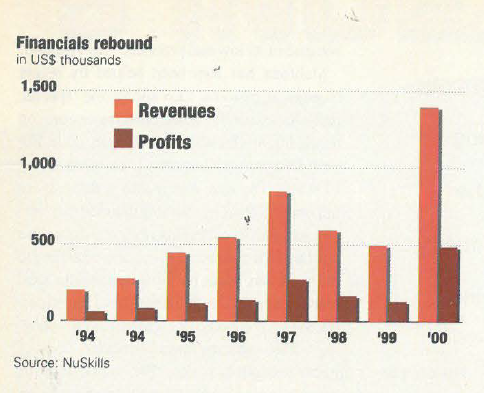
Between 1997 and 1999, NuSkills
revenues dropped from $850,000 to
$500,000, profits shrank from
$500,000 to$ 130,000 and three key
employees left to form rival firms.
Salim Moujaess, NuSkill’s founder, knew it was time for action. One of his first items of business was
the most drastic. To bolster employee loyalty, he offered Nasri
Haddad, his most valued remaining employee, a 47% stake in the
company. He gave a 4% share to Danielle Marie Moujaess, a new
employee, and a 2% share to Joelle Ramy, also new.

He also laid off three under-performing workers, replacing them
with qualified professionals and hired seven new staff members to
boost his team of employees to 12. In an effort to increase efficiency,
Moujaess paid Urban Professionals, a human resource development
firm, $45,000 to train NuSkill’s employees.
The company also began reducing its variety and concentrating on
items that were selling well. For example, he dropped multicolored
matchboxes, keeping only two-colored ones as standard items.
“Sales from colored matches used to be our strong point, but we
stopped when competition caught on to our idea,” explains Haddad.
In order to increase profit margins, NuSkills reduced the number
of items being purchased from local distributors and began
importing directly from the Far East and Europe. Local purchases
went from around 50% down to 10%, cutting costs by about 12%.
In addition, the firm started eliminating non-paying clients.
“We handed out higher prices to our clients who were very tardy with
payments so they would stop working with us,” says Haddad. As
a result, the company’s client base shrank from 120 to just 45 large
customers. Among the biggest are such major brand names as
Canderel and Dunkin’ Donuts.
The company also tried to boost the quality of its products by
investing in over $35,000 worth of new machinery, including silk
screens, ovens and printing machines for T-shirts and badges.
Mistakes in printing were reduced from around 10% to just 2%.
Another $7,000 was spent on computers, printers and a new network
system, and $24,000 went to redecorate the company’s
offices and create a more professional image. “We wanted to
make a good impression on our clients. One way was to change and
improve the image of the offices,” says Haddad.
Last March NuSkills opened a wholesale shop at a cost of
$22,000. The store sells to retail outlets as well as to individual customers,
which helps offload excess stock. In the first six months of
operation, the shop has sold a modest $50,000 worth of merchandise.
But, according to Haddad, “60% to 70% of that amount is profit.”
The firm has also started exporting to Lagos in Africa and to
countries in the Middle East. Today, 30% of NuSkills total revenues
come from exports, says Haddad.
The results of the firm’s restructuring have been tremendous.
Revenues for the first eight months of this year have jumped to
$900,000 compared to $200,000 for the same period of 1999. Profits
totaled $315,000 at the end of August 2000. Nonetheless this is a
highly competitive market. There are many firms in the same
field, and most are also doing well. Garff Group, which was established
in 1981 and includes Nestle among its clients, is the largest
such company in Lebanon and the Middle East and one of
NuSkill’s biggest competitors. “We stick to our word, and deliver
on a specified date,” says Fuad Abi Chakra, Garff Group’s marketing
sales manager. “This is the reason why we have gained the trust of
the market.” Mass Line, another local competitor with such major
clients as LibanCell and Cellis, has its own strategy: “We deliver
the right product at the right time and at the right price,” says Jean
Paul Massoud, ‘Mass Line’s managing director. Its sales reached
about$ I million last year, with profits around $75,000 to $80,000.
Garff Group and Mass Line also import most of their products and
offer a similar line of items as NuSkills. Both companies sell at small
profit margins and rely on high-volume sales. “We have a very low
markup of around 5% to 7% on average,” says Massoud, whose revenues
have been increasing by l0% yearly. Mass Line sells its merchandise
throughout the Middle East, particularly in Gulf countries.
According to Massoud, the reason for the success of so many companies
making promotional materials is the poor economy.
“Demand is increasing due to the economic situation,” he says,
adding that companies are becoming increasingly interested in using
promotional materials to advertise their products because it is less
expensive than advertising on television. ”The elections also
helped sales to increase during the past two months,” says Haddad,
who raised prices on some products during the campaign season.
NuSkills restructuring came at just the right time: It saved the company
and turned its fortunes around. The firm is expecting revenues
to reach $1.4 million by the end of the year, with profits of $490,000
– its highest ever. NuSkills’ revival is proof that the key to saving a stagnant
company is a willingness to change, sometimes dramatically. The
question is: When will other Lebanese firms learn this lesson?