
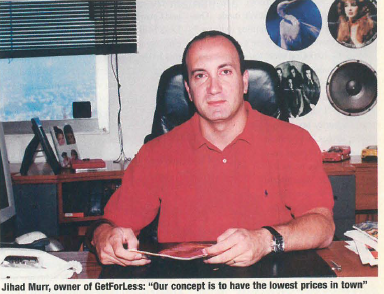
Jihad Murr has got himself a promising
little startup. Yep, the very same Jihad
Murr who’s the executive manager of
MTV and RML as well as 51 % stakeholder
in a $4 million investment to establish a
Virgin megastore downtown. Nonetheless
Murr confesses that it’s his newly sprung
business, a direct mail order company
called GetForLess, that’s dearest to him.
“I had this idea a long time ago,” says
Murr. But to realize it he wanted someone
experienced and trustworthy to handle operations.
Enter long-time friend Alain Arab,
general manager and shareholder, along
with Murr’s brother Carl. The trio established
GetForLess, which started operations
in June 1999, on an initial investment of
$200,000. It is 60% owned by Murr.
GetForLess sells merchandise through a
catalogue published every 45 days and an ecommerce
site. “It demands huge investments,”
says Murr. “Every 45 days we have
a running cost of around $80,000.” A big
chunk goes into printing the catalogue,
which is distributed for free. Ordinarily
60,000 copies are printed, costing about
$30,000. The amount increases in peak seasons.
For the coming November/December
issue, 200,000 will be printed for about
$50,000. With 40,000 people on the mailing
list the postal cost, at 25 cents apiece, comes
out at $10,000. Catalogue distribution is
outsourced as is the majority of deliveries.
GetForLess might be shouldering high
costs, but it is staying afloat. The first three
months sales were roughly $50,000, $80,000
and $150,000. In November and December
they hit about $350,000. “Since then, we’ve
been running at around $200,000 a month,”
says Murr. On average profit margins are
15%. That’s a healthy performance considering
that catalogue sales are still a novelty in
Lebanon. And bear in mind – GetForLess is
up against a crowded retail sector battling for
sales in an economic slump. The key to its
success is convenient services – free delivery
within 48 hours – and good prices. “Our
concept is to have the lowest prices in town,”
says Murr. GetForLess vows to match
the lowest prices in town.To prove it, customers
who find lower prices are refunded the difference
plus 10%.
Ordinarily the company doesn’t keep
stock: Goods are procured from its 77 suppliers
once customers place orders.
However, about $200,000 worth of high turnover
goods is stocked at the company
warehouse for each 45-day interval. These
represent 20% of the product range, which is
made up mostly of electronic items, computer
hardware, household appliances, sporting
equipment, CDs and DVDs. GetForLess
shuns clothing, which has a high percentage
of returns in catalogue sales. The strategy
keeps returns down to about 3%.
Payment is either by cash on delivery or
credit card. E-commerce customers have the
option of paying over the Internet. Credit is
available on items priced from $299.
About 60% of applicants are accepted,
keeping non-collection down to I%.
The only concern so far stems from the e-commerce
division, which presently
accounts for a mere I 0% of sales. “We
expected the website would have generated
much more business,” says Murr.
lO00mabrouk, a similar enterprise selling
wedding gifts via catalogue and a website, is
in the same predicament. “Our catalogue
generates 90% of sales,” says owner Walid
Hanna. “The Lebanese aren’t used to buying
things on the Internet.” Hanna and Murr
anticipate that this will change once people recognize
the ease of shopping over the Internet.
GetForLess plans to widen distribution by
selling its catalogue for LLl,000 at bookstores.
The first catalogue to hit stores will
be a special 80-page November/December
issue expected to generate almost
$500,000 in sales each month. The issue will
have 14 extra pages of gift items, and will
introduce a new brand – Blautech. The line
of electronic items is 25% cheaper than
competitive products and comes with a
three-year warranty.
Further expansion is expected by going
regional. The first step involves making
the company’s website available in Arabic.
Thereafter, GetForLess plans to be present
in the Arab countries through franchises.
The distribution base, earmarked for Dubai
Internet City, “should have at least $2 or $3
million in stock,” says Murr.
