Most Lebanese textile companies are holding on by a
thread in today’s difficult times. Customs duties on raw
materials range from 20% to 25%, higher than in
any neighboring country, while electricity, fuel and labor costs are
the highest in the region. The entire sector must also compete with
cheap imports from East and Southeast Asia and with finished big name
brands from Europe. ”The economy is falling and the textile industry is following it,”
says Sleiman Khattar, president of the Lebanese Textile
Syndicate and owner of La Laniere Nationale.
Textile exports dropped from $73 million in
1973 to$35 million in 1999, while imports rose
from $168 million to $238 million during the
same period. In the last few years, several
local textile companies have ~one out of business.
But in the midst of this malaise, one
local clothing and textile manufacturer,
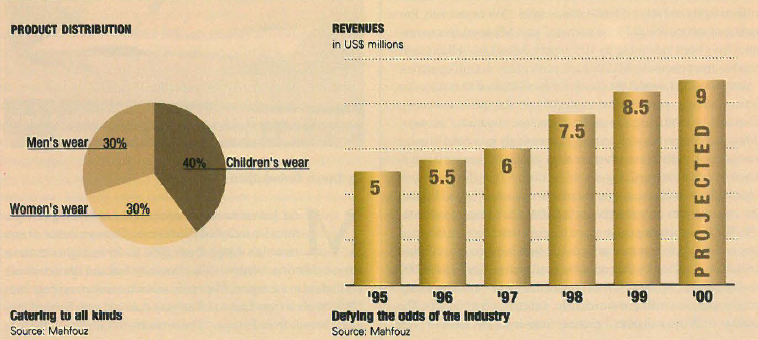
Kassem Mahfouz & Sons, has seen its revenue
grow from $5 million in 1995 to $8.5 million
in 1999, with a projected turnover of $9 million for 2000. Compare Boudakian – a textile
company that makes uniforms. It has decreased production to 1,000
pieces a day from about 1,600-1 ,700 at the start of 1999.
Mahfouz manufactures 70% of its clothes; the rest is either purchased
from local manufacturers or imported from East Asia. The company
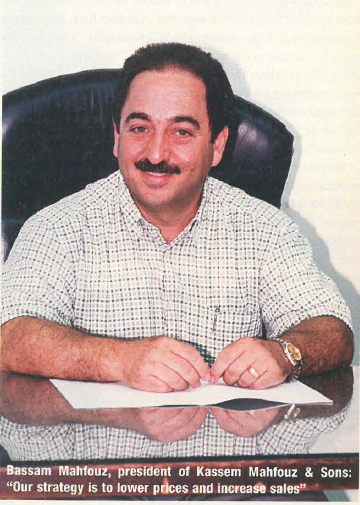
concentrates on high volume sales at low margins. “Our main strategy
is to decrease prices and increase sales,” says Bassam Mahfouz,
the firm’s president. The company controls all stages of the production,
marketing and sales process, cutting out middlemen. “You
find other companies who work in specific areas, but we go through
the whole process,” he says. The company’s clothes are sold at
seven nationwide retail stores and two wholesale outlets. Mahfouz is
in the process of adding two more branches, one in the South and
another in Tripoli. When choosing the location of a new store,
Mahfouz is careful to select places that are far from potential competitors.
But when a competitor is nearby-such as in Choueifat, where
his store is close to another shop called Zakr- he is careful to make
sure that his prices are low and targeted at bargain-conscious consumers.
“Other companies don’t have the same customers I have, so
I feel no threat from them,” says Mahfouz. For this reason, Roy
Badaro, owner of children’s clothing chain Kindou, feels that
Mahfouz is no threat to him either. “Mahfouz has different customers
because of its low end products,” says Badaro.
Mahfouz has also been helped by recent
changes at customs. Last spring, the ‘specific
rights’ law went into force, charging customs on
textile imports by weight rather than value. For
each kilogram, an importer is required to pay
LL9,500. The new rule makes it difficult for
importers to cheat by claiming that clothes or textiles
are used or cost less than their real value. This
law has led to a decrease in imports, according to
the syndicate, hence boosting business for local
manufacturers. “Due to the new law, I started producing
at 70% capacity. I was originally operating at 40% capacity,” says Mahfouz.
His company’s biggest strength is socks. “We have one of the
biggest factories for manufacturing socks in the Middle East,” says
Mahfouz, who has the exclusive rights for the whole Middle East
to manufacture socks under the Disney brand name. “Mahfouz was
chosen because of its competitiveness, its new machinery and its
high-tech equipment,” says Khattar.
Mahfouz keeps up with the pulse of the market by attending exhibitions
in Europe and the Far East up to four times a year and by
browsing through catalogues. He tries to adapt the latest fashions
to the demands of the local market. “We usually start preparing a
particular collection one year ahead of time,” he says. Keeping up
with the latest trends is very important in this business, explains
Khatter. “Some of the factories that didn’t follow the fashion and
the new trends have been forced to close,” he says. “It’s important
that the right product is produced at the right time.”
Mahfouz also exports, with 20% of sales going to places like Italy,
Greece, Cyprus, Hungary and the Gulf. Mahfouz is a rare breed.
In an industry where most textile manufacturers are simply trying
to stay afloat, his company is operating in the fast lane. “I’m working
on increasing demand. I want to increase my production
capacity to 100%,” he says.