P icture this. You start a business from scratch, invest a lot of capital,
make a name for yourself and endure innumerable challenges,
difficulties and streaks of bad luck. Then,just when you
find yourself in the comfortable position of being the only local manufacturer
of a certain product, the market slips out from under you.
That is a story Alexi Habib understands. In 1968, his company
Lefa Liban started manufacturing leatherboard, which is used in the
manufacture of shoe heels and inserts. Since that time, the firm has
been dealt one blow after another. A machine, imported from abroad at a cost of DMS00,000 was looted on arrival at Beirut port.
Several times during the war, production stopped altogether. But
somehow the company has found a way over its hurdles – until now.
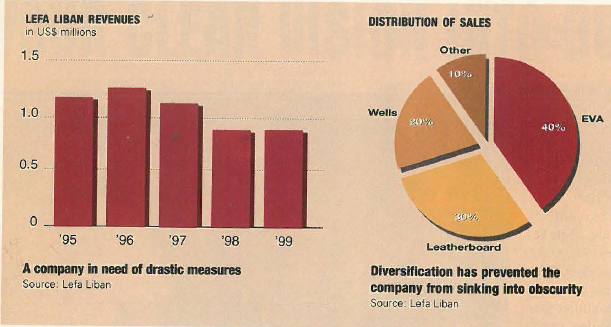
Lefa Liban’s revenues have dropped nearly 23%, from about $1
million in 1995 down to $772,000 in 1999. Unless the company
takes drastic measures, its most recent challenges may prove too big
to handle. “As things stand, we’re barely surviving,” admits
Habib, the firm’s owner and general manager. Lefa Liban is the only
local manufacturer of leatherboard. When the company first went into business it was barely able to keep up with demand. Lefa Liban
not only supplied the local market but also exported to countries
like Iraq and Syria, while investing hundreds of thousands of
dollars regularly in new machinery. But those days are long gone.
The introduction of cellulose based shoe inserts, made out of synthetic
materials, has left the natural leather variety in the dust. The
• synthetic inserts are easier to work with, more rigid, more durable
and also much cheaper. “People aren’t interested in the leatherboard
based shoe inserts anymore,” says Fadi Mardini, co-owner of
Mardini Leather Trade, which sells shoe accessories.
At the same time, Lefa Li ban’s exports have diminished to zero. The
company used to send its leatherboard to Syria. But now factories in
Aleppo are able to produce the same product for cheaper, especially
with fuel, electricity and labor costs lower in Syria. At the same time,
the reduction in customs tariffs between the two countries has opened
the doors to Syrian imports, which enter the market at competitive
prices. ‘We can’t be demanding with customers,” says Habib. “We have
to accept checks post-dated four or five months from the date of sale.
If we refuse to accept, the customers just go to somebody else.”
But Lefa Li ban is not taking this sitting down. Faced with a constantly
evolving market, the firm has been continuously trying to
introduce new products. Sales of leatherboard today amount to
$250,000 a year, making up just 30% of revenues. In the early ’90s,
Lefa Li ban started manufacturing rubber sheets, which are used to
make shoe soles. In I 998, the company began manufacturing
sheets of expanded rubber, EVA sheets, to make the soles of
women’s shoes. These two new products now make up40% of the
company’s sales.
In 1999, the company began producing welts, the strip between
the sole and the upper part of the shoe. These account for 20% of
turnover today. Another I 0% is generated from importing cellulose
board from Finland and EVA sheets from Thailand.
Diversification proved to be a smart move. It has kept Lefa Li ban
from turning into an anachronism and boosted earnings. The profit
margins for leatherboard are just l 0% while for EVA sheets they
are nearly 50%. But the strategy is by no means unique in this business. Mardini has
stocked a multitude of
different shoe products
since he first opened.
“You never know what
the market demand will shift to,” he says. “Our
strategy is to have
everything in stock so
that a drop in demand
for one product is compensated
by another.”
But there are limits to
Lefa Liban’s adaptability
to the demands of the
marketplace. Habib
wants to reduce costs by boosting
efficiency, but
that requires costly investments in new machinery. Recently, Habib
bought a $5,000 extruder, used to produce welts. He expects the new
device to reduce costs by limiting the amount of rubber wasted in the
production process. Until now, Habib was making welts out of
imported rubber sheets, which he would cut into strips. This method
wastes nearly 50% of the rubber sheet. “We just tried a sample and the
results were satisfactory,” says Habib, commenting on his new
extruder. But, warns Mardini, in this business, new technology dates
quickly and needs to be replaced. “Welts are in high demand for the
time being,” he says. “But as new technology is introduced, products
change and demand shifts to cheaper alternatives.”
Lefa Liban would like to produce synthetic inserts. But for that,
the company would have to modify its machines, which requires
an investment of about $1 million, according to Hratch
Chilinguirian, an importer of shoe accessories. Habib does not have
the required financing.
“One thing that would really help in getting Lefa Liban and other
local manufacturers back on their feet are long-term loans with low
interest rates,” says Habib. Unfortunately, banks in Lebanon are hesitant
to issue commercial loans. Government assistance in the form
of lower customs taxes and reduced utility costs for industries would
also make life easier for Lefa Liban. “We would be able to buy new
machinery and recondition the machinery we now have,” says
Habib. “We need to put new blood into the company if we are going
to compete without customs barriers between countries.”
Chilinguirian agrees. “The way things are is detrimental to business,”
he says. Chilinguirian used to be a client of Lefa Li ban, but
he now imports his materials. Lefa Liban, he says, can no longer supply
the goods his clients demand. “IfLefa Liban were to revamp its
equipment so it could produce synthetic inserts, I would buy at least
$100,000 worth from them a year instead of importing.”
And herein lies the dilemma for Lefa Liban. The company is in a
rapidly changing industry. Keeping up demand requires making constant
and often costly upgrades to equipment, which is tough in
Lebanon. Production costs are high, credit is limited and most industries
feel they’re constantly being stepped on.