I n case you hadn’t noticed, a new line oflocally made dairy products
recently appeared on supermarket shelves. Li ban Lail is the
third and riewest major combatant in Lebanon’s dairy wars. The
company’s fresh milk, UHT milk, yogurt, labneh and fruit yogurt
entered the market, in limited quantities, in May. Li ban Lait has been
a bit slow in getting to pasture. Its arrival follows the boisterous entry
of Dairiday into the market in 1998, the first company to sell fresh milk
in post-war Lebanon, and Daliah a few months later.
Since the mid-l 990s, companies such as Taanayel Farms have dominated
the dairy market. Liban Lait may have to play catch-up for a
while, but the new firm has some potent new weapons that could leave
its more established competitors cowering in the barn. “We will grab
a large market share if not eliminate some of our competition within
six months,” says a cocky Michel Waked, managing director and partner
at Li ban Lait. Among the remaining partners are the De Freige family,
cigar tycoon Mohammed Zeidan and Audi Investment Group.
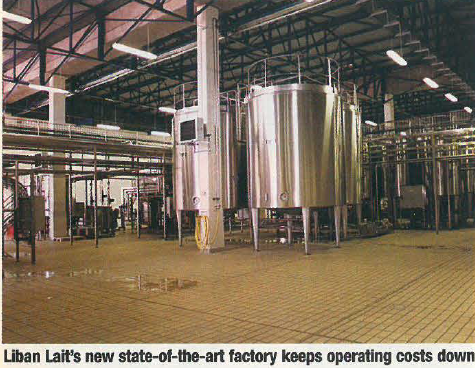
Waked’s confidence is boosted by the company’s state-of-the-art
$30 million factory, equipped with 1,200 well-endowed heifers. The
highly efficient new plant has made it possible for Liban Lait to
undercut competitor’s prices. A I-liter carton of Liban Lait fresh
milk costs LL! ,600, between LO% and 25% less than the same size
carton of Dairiday or Daliah. Since the equipment in the factory is
new, machinery does not break down and Liban Lait’s depreciation
costs are lower. The plant is also highly automated – relying on just
four or five technicians to operate its computerized control room – so labor costs are kept at a minimum. Another big plus for Liban
Lait: It is able to sell its products to Lebanon’s import crazed consumers
under the internationally known brand names Yoplait, for
yogurt, and Candia, for milk. The firm operates under license of the
European companies, which means that Li ban Lait must adhere to
strict quality control standards.
The firm has also become the first local dairy company to produce
UHT milk and fruit yogurt. With no import duties to pay, the
company is able to sell its UHT milk for just LL 1,600 per liter while
imported brands like Elle& Vire, Parmalat, Nactalia and Bride! sell
between LL3,000 and LL3,500. Unlike fresh milk, UHT milk can
also be exported because it has a much longer shelf life. What’s
more, Liban Lait has plans to expand, investing a further $21 million
over the next two years and introducing ice cream, juices and
flavored labneh to its product lines.
But the new dairy producer, in its drive to dominate the market, will
face some formidable competition. “The market is price sensitive and
Li ban Lait is selling, but we are working on counter measures,” says
Salah Khayat, general manager of Daliah. Together, Daliah and
Dairiday control -almost the entire fresh milk market. Dairiday,
which invested just $10 million to start up its factory two years ago
and today owns a 400-cow farm in the Bekaa, has invested heavily
in marketing, spending 35% of its $3-3.5 million yearly revenue.
Dali ah has not been as aggressive in its marketing efforts but has the
largest herd of cattle, with 1,800 cows. Daliah invested $24 million in its plant. Taanayel Farms and Center Taanayel also have plans to
produce fresh milk in the near future. All this in a fresh-milk market
that is just two years old and still relatively tiny. The 15,000 liters of
fresh milk sold in stores each day represents less than 10% of the total
milk market, which is dominated by imported powdered brands. The
market for flavored yogurt and UHT is also very small, with just a few
imported brands being sold in supermarkets.
The yogurt and labneh.markets are far more lucrative, with 75,000
liters a day being sold. But Liban Lait faces tough competition. The
market is controlled by an array of well-established brands.
According to an independent survey by Masri Etudes et Expertises,
Taanayel Farms is the market leader in labneh, with a 17% market
share, followed by Dairiday with 12%, Centre Taanayel with 8%,
Khater with 7%, Khoury with 7% and all others with 6%.
Even in areas where Liban Lait currently enjoys a monopoly, competition
may be coming soon. Daliah has plans to branch into
UHT milk in the near future. “Over 80% of our factory is still unused
and we are planning to introduce at least three new lines [of products]
soon,” says Antwane Khanji, sales manager for Daliah.
Another obstacle for Liban Lait will be in devising a proper system
for distribution. Taanayel Farms has just 2% product returns
(unsold or close to expiry), but it wasn’t easy getting to this level.
“When we first started, we had 15% returns. We had to figure out
the logistics, the velocity of retail sales for each shop and account
for emergency deliveries and overstocking,” says Wajih Abou
Khater, part owner of the company. Taanayel had to supply about
350 small retailers spread throughout the country, all the while maintaining
freshness. Supplying the entire Lebanese market is a difficult
task and taxing in terms of distribution costs and logistics.
So can Li ban Lait maintain its low prices? The answer will depend
on how soon and how much of its products the company will be able
to export. The ability to sell to a larger market will give the firm an edge
over local competitors because its costs per unit sold will be reduced.
With two well-established European brand names marking its products,
the prospects for sales abroad are bright. Watch out Dairiday,
Daliah and all the other Lebanese dairies. Liban Laitjust might be wooing,
or rather mooing, your customers faster than you think.