You couldn’t pick a worse time to be a
contractor. With the economy at a
standstill and the debt-ridden government
reducing public works expenditures,
construction projects are scarce. Contractors
are fighting over whatever business they can
find, even if that means bidding below cost.
But despite the doom and gloom, Butec, one
of the country’s oldest contracting firms, has
managed to keep its annual revenues around
$100 million for the last five years. “We’re
doing OK,” says Ziad Younes, Butec’s secretary
general, “but the market isn’t doing that
well.”
What is Butec’s antidote for the construction
slump? Specialization. Rather than
devoting its energy to building simple apartment
blocks or office buildings — the sort of
jobs that are the first to be hit when the economy
slows down — Butec concentrates on
technically complex projects that require specific
know-how. For these types of projects,
profits tend to be considerably higher.
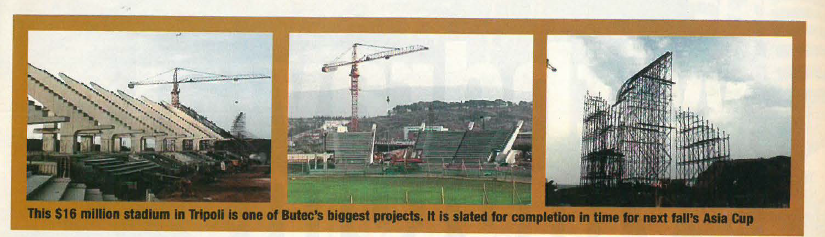
For example, Butec is building a $16 million stadium
in Tripoli. Work started in June 1999, and
the project is slated for completion in time for
next fall’s Asia Cup. Butec is also constructing
a 45-kilometer irrigation system in the
southern Bekaa, worth around $14 million.
Firms capable of handling these projects are
few, meaning less competition and higher
profit margins. “We don’t get involved in
projects where everybody bids, sometimes
below the direct cost of construction,” says
Younes. “Other companies can get a project,
but if they can’t complete it, at worst they
declare bankruptcy.”
Technically difficult projects tend to be
larger, which is another advantage. “The
greater the volume of materials and equipment
you purchase, the better the prices
you are apt to receive,” says Kamal Meine,
an architect. Sometimes, discounts reduce
the price per unit to as low as 50% to 60%
of the original sticker price. Butec manufactures
some of the equipment and materials
it uses itself, reducing costs further.
Because of its specialized nature, Butec
competes with only a handful of other companies.
Consolidated Contractors Company
(CCC), for example, has annual revenues
exceeding $1.5 billion. Along with its
German partner Hochtief, CCC constructed the
new $500 million Beirut International
Airport. Contracting and Trading Company
(C.A.T.), which is projecting a turnover of
$130 million this year, is another big competitor
to Butec.
“With few in the market
capable of taking on such complex projects,
competition is reduced substantially,” says
Ziad Kassis, owner of Unity Group, the company
currently building the Zahrani bridge.
Butec has also been targeting projects outside
Lebanon in order to counter the slowdown
in the domestic market. By doing
business abroad, Butec is able to balance its activities,
keeping itself and its staff operating.
The company teamed up with a local
affiliate to build a $130 million cotton-spinning
plant in Syria. The project was so successful
that, almost immediately, work started
on a second $110 million cotton plant.
Younes expects these two factories to
process between 10% and 20% of the country’s
total cotton exports.
The company was
also involved in the building of a $16 million
sewage plant in Latakia and one in Tartous
for $16.6 million. Butec is building a gas
compression station in Iran, a power plant in
Basra, Iraq, the Dubai Tower in the UAE, and
a pipeline with three substations extending
from Iraq to Jeddah.
Other contracting companies
such as C.A.T., which is working in
the Gulf and Africa — are following a similar
strategy: targeting markets abroad in order to
ride out the recession at home.
Butec has also diversified its services. The
firm, for example, established Butec Property
Management (BPM), which provides building
maintenance, cleaning, and security at facilities
that were built by the parent company.
But before giving Butec a big pat on the back,
consider this: While the company’s strategy of
specialization has kept revenues steady during
the recession, its competitor C.A.T. has
managed to increase its turnover by over
200% in the last four years by focusing on foreign
markets. C.A.T.’s revenues jumped
from $25 million in 1996 to $80 million in
1999.
“Specialization may help Butec hang on
to its turnover,” says Souheil Abou Habib, general
manager of Nassim A. Habib, a local
contracting firm. “But such projects don’t
come along too often and limit growth.”
While specialization has kept Butec alive,
real growth may require the company to look
at new strategies and be a bit less fussy about
the projects it is willing to take on.