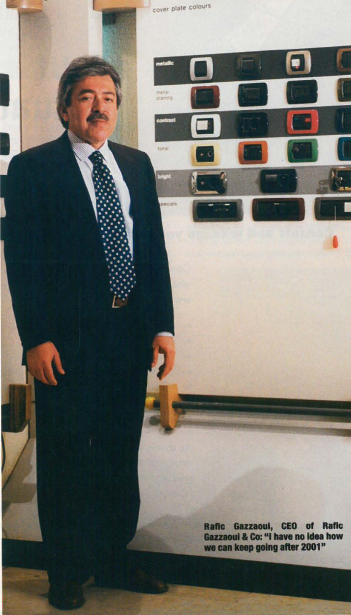
Rafic Gazzaoui, CEO of Rafic
Gazzaoui & Co, has been a little
anxious of late. “I know I can maintain
the same turnover until 2001. But after
that, I have no idea how we can keep going,”
sighs the head of one of Lebanon’s largest
electrical equipment distributors, with revenues
of $13.8 million last year.
It is easy to understand his gloom. The construction
sector is in its worst slump ever, with
the number of construction permits issued in
the last three years down 60%. With projects
scarce, competition has been fierce, reducing
prices and shrinking profit margins.
Gazzaoui has had to pull more rabbits out of
his hat than the best magician in Las Vegas just
to stay in business. Unwilling to lay off
employees, Gazzaoui has been diversifying his
product line. For example, he expanded the
lighting division of his company. In the last two
years, the firm’s Mazda brand lamps have
captured a 20% share of an estimated $9 million
market. At the same time, Gazzaoui has
stepped into the sale of down lights, grabbing
a 10% share of a 40,000 unit ($13 to $14 per
unit) market. Osram, a brand distributed by
Cesar Debbas & Sons, traditionally dominates
the lamps market with approximately a
30% market share.
Gazzaoui has also ventured into the sale of
submersible pumps under the Lowara brand
name. Demand has been on the rise, says Ali
Oueida, retail manager. The depth at which
water can be extracted from wells in Lebanon
has increased from 150 to 250 meters, with
some areas in Mount Lebanon reaching 600
meters. The company has captured 20% of a
2,500-unit ($600 to $700 per unit) submersible
pumps market and increased its market share for the total $1.5 million pump
market to 20%. And as purchasing power
has shrunk, Gazzaoui has also shifted
towards the sale of low-end products. Three
years ago, for example, it started importing a
new line of inexpensive office, kitchen and
bathroom fans from Hong Kong, which have
proven popular. Previously Gazzaoui jumped
on an opportunity by selling supplies used for
UPS (uninterrupted power supply) during
the power shortages of the 1980s. That
move gave a $1.5 million annual surge to the
company’s revenues.
Gazzaoui has expanded operations into
foreign markets. The firm is the only electrical
supplier to have opened an office in Syria.
Until last year, the company was selling
B.Ticino wiring devices (sockets, switches,
cover plates and outlets) in Damascus
through a local distributor, importing the
equipment directly from Italy. That business
represented 5% to 6% of revenues. But in
1999, Gazzaoui opened an office in Aleppo
and a network of direct distributors to service
the rest of the country. “We are expecting to
reach upwards of $1.8 million in sales for 2000
and double that in 2001,” says Gazzaoui. The
company will distribute B.Ticino in a market
for wiring devices worth $12 million a year
as well as supply pumps to a $6 million
market, competing at gross margins set by the
Syrian ministry of supply of about 15% to
20%. Gazzaoui also has plans to start
assembling metal parts and components in
Syria for some of the mechanical and electrical
products it sells.
So far, Gazzaoui’s magic has kept the company alive. While the number of projects
for the company has dropped by 5% in the
last two or three years, Gazzaoui’s wholesale
distribution network and strong exports
have meant that revenues have actually
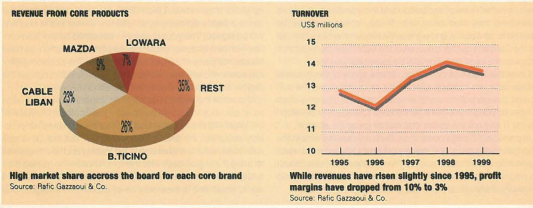
increased, from $12.9 million in 1995. The
firm is currently sitting tight with its two core
brands: B.Ticino and Liban Cable. In the
local market, B.Ticino is running neck and
neck with Legrand, a competing brand
distributed by Hermes Hydroelectrique.
Together, the two brands control around
85% of the estimated $9 million Lebanese
electrical wiring device market. Gewiss
and Vimar brands share most of the remainder.
Of the six distributors of Liban Cable,
Gazzaoui controls a 30% market share followed
by Harb Electric with a 25% share.
But sustaining business has come at a
price. Profit margins have shrunk from a
peak of 10% in 1995 to 3% last year, according
to Gazzaoui. The company is certainly not
alone in facing these troubles. Middle East
Markets and Supplies (Memas), a competitor
with exclusive distribution rights to General
Electric lighting accessories, had a turnover
of $3.8 million last year, a 20% drop from
1997. “We averaged revenues from projects
of $1 million between 1994 and 1997. Now
they don’t exceed $100,000,” says Joseph
Harb, assistant general manager for Memas.
Harb Electric, another competitor, saw the
share of projects drop from 45% to 20% of
total sales in the last three to four years.
Today, its turnover stands at $12 million to
$12.5 million annually.
For Gazzaoui, the situation is becoming desperate. Opportunities for expansion
into new markets are limited because the
company has exclusive distribution rights
for Syria and Lebanon only. There is potential
to sell in Iraq, but the country is still
under UN sanctions and its retail market is
flooded with cheap goods. Most alarming,
30% of Gazzaoui’s revenues comes from
construction projects in Lebanon, most of
which were started two or three years ago
and are now nearing completion. With the
economy in a slump, there appears to be little
business to replace them.
“I am hoping for a resurgence of activity
in Solidere, which would help us tremendously,”
says Gazzaoui. But Solidere is
mired in its own problems. On top of the
stagnant real estate market, there has been a
conspicuous absence of government support
for one of the biggest companies in the
Middle East, manifested through the slow
issuance of building permits. A discrepancy
between the master plans drawn up by Dar
Al-Handasah and municipal planning regulations
is causing projects to stop at every
minor technical problem. Gazzaoui may
have plenty of tricks up his sleeve, but the
magic show cannot go on forever. Profit
margins are shrinking and Gazzaoui is
looking for solutions. The company is now
trying to get compensation from suppliers
who “understand the situation,” says
Gazzaoui. But with no economic turnaround
in sight and 30% of Gazzaoui’s
turnover about to vanish, the company is in
for a shock. Perhaps it’s time for Gazzaoui
to rethink its policy of no layoffs.