
Solidere
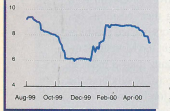
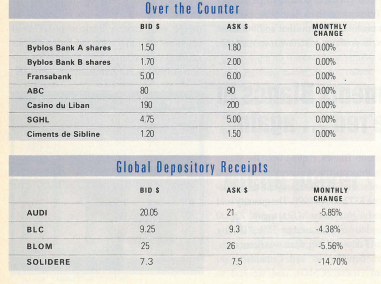
In the last week of March, peace prospects were
pushed forward after the announcement of an
American-Syrian summit in Geneva on the
26th. Investors hoped that the advancement of
the peace talks would give the locally and
internationally listed Solidere a solid boost of confidence. Nevertheless, uncertainty about the outcome of the Geneva summit pushed down Solidere’s GDR by 2.9%, from $8.575 to
$8.325. By late March, negative news from the Geneva summit shattered all
hopes of improving peace prospects anytime soon. Foreign investors quickly
reacted, sending Solidere’s GDR on its biggest slide in quite some time to
close at $7.9, down 5.11% from its previous closing of $8.325.
In the first week of April, internationally listed emerging markets equities stumbled
amid the turmoil on western markets. The largest ever intra-day drop of
the Nasdaq on April 4 brought a fall in all Lebanese GDRs, with Solidere being
the least affected by western markets’ volatility. Solidere’s GDRs closed at
$7.875, down 0.32% from $7.9.
AUDI
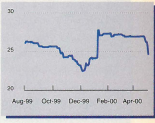
AUDI started the second half of March
with a positive outlook backed by an
increasing public hope of a near-term future
unraveling of the peace process. AUDI’s
GDR was up 2.3% to close at $22.25 on
March 24.
The end of March was marked by the
bank’s much-anticipated general assembly
on March 28, where a lower-than-expected
dividend payout ratio of 30% was
announced, much inferior to last year’s figure of 70%. This news sent
AUDI’s GDR down 2.7% to close at $21.65.
Early April brought more bad news to Audi in the form of increased
volatility on the western equities markets front. Joining a number of emerging
markets equities, AUDI’s GDR recorded a 1.15% fall and closed at
$21.4 on April 7.
BLOM
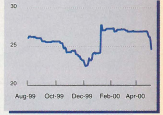
BLOM, still one of the most solid banks in
Lebanon, finished the third week of March
with a slight increase in its GDR. On March 24,
BLOM’s GDR gained a modest 0.09% to
close at $26.975, up from $26.950. This positive
move was an indicator of investors’ optimism about the outcome of the American-Syrian Geneva summit on March 26. But by
the end of the month, it appeared that the
peace negotiations had reached a status quo. Accordingly, BLOM’s GDR maintained its previous price and closed on
March 31 with a 0% change at $26.975. The first week of April saw increasing
volatility in the western equities markets, exhibited mainly in the Nasdaq’s
rollercoaster ride, with the majority of emerging markets equities suffering
from collateral damage. BLOM’s GDR fell 2.9% to end the week at $26.2.
But encouraging news emerged from BLOM’s general assembly which
approved a $1.52 per share dividend and declared a 14.5% increase in first-quarter
2000 profits.
BLC
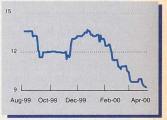
BLC entered the last two weeks of March hoping
that the general assembly meeting on March 22
would renew investors’ faith in the bank.
In a period affected by stagnant peace negotiations,
BLC’s GDR cautiously maintained the
price of $9.675.
Following the bank’s recent change of management,
as a result of the aforementioned
general assembly, investors appeared much
more confident in the appointment of the new chairman. They swiftly reacted to send BLC’s GDR up 2.3% to end the month
at $9.9.
Early April was marked by large volatility in the western equities markets, coupled
with more negative news emerging from the recent American-Syrian
Geneva summit. All of this combined to send BLC’s GDR down 5.81%, from
$9.9 to $9.325.
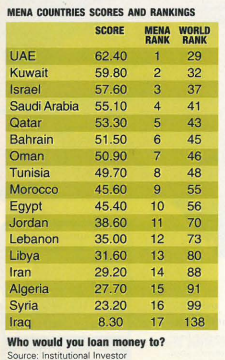
How likely is Lebanon to default on its
loans? More than you might think,
says US magazine Institutional Investor. In
its semi-annual survey of the creditworthiness
of 145 countries, it ranked Lebanon 73rd
worldwide and 12th out of 17 countries in the
Middle East and North Africa. The survey
ranks countries on a scale of zero to 100, with
100 representing the least chance of debt
default. Lebanon scored 35, below the
regional and global averages of 42.64 and
40.9 respectively. Lebanon placed ahead of
regional countries such as Libya, Iran and
Algeria but fell behind Sri Lanka and El
Salvador on a global basis. The highest
ranking in the Middle East and North Africa
went to the UAE with 62.4. “Lebanon has
never defaulted on a loan, even during peak
war times,” says Ziad Maalouf, vice president
of Middle East Capital Group. He adds
that although rating agencies like S&P,
IBCA and Moody’s have not given
Lebanon an investment grade rating, they
also haven’t changed their three-year credit
rating stance of BB-.
Facts
or fiction
about the
Casino?
There have been conflicting
reports in the
media about troubles at the
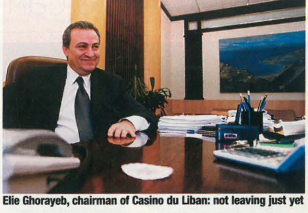
casino. The board of directors of the Casino du
Liban reportedly asked chairman Elie
Ghorayeb, who was appointed in March
1999, to resign or face being ousted at the
upcoming general assembly. But according to
one board member, the request was not made for
Ghorayeb’s resignation. “If anything it
would have to be a political decision and not
ours,” he says.
Another mid-April report claimed that
Georges Corm, minister of finance, had
demanded $80 million in unpaid taxes and
fines from the casino. It said that the casino
must pay 30% taxes on revenues generated
from slot machines. The article also warned
that, as a result, auditors Deloitte & Touche
expected the casino to record a loss of $4 million
to $5 million in 1999 and that some
$45.2 million were owed in taxes on slot
machines since 1997. Another publication
quoted board members and auditors as saying
that the earlier article was incorrect. What’s the
truth? “The casino and the ministry of
finance have conflicting opinions on slots. The
latter wants to impose a fee similar to other
gaming fees at the casino, rather than the
fixed fee they used to impose,” says a board
member. The casino had announced preliminary
pre-tax profits of $19.5 million in 1999,
a 50% increase over 1998.
Niche player
Al-Mawarid’s strategy of investing in
retail products, IT and human
resources is starting to pay off. The bank’s
profits increased 26.9%, from $878,000 to
$1.1 million (unaudited) last year. Total
assets jumped 31.9% to $266.9 million,
and deposits grew to $213.4 million, a
27% increase.
Its focus on retail banking, the bank
moved aggressively into credit and debit
cards (it just launched MasterCard free of
charge), has created growth in fee-based
income, up 60.5%. Its interest income
increased 30%, while loans grew by
28.5%. “As a medium-sized bank, it is trying
to be a solid niche player,” says
Nicolas Photiades, senior vice president at
Thomson Financial BankWatch. “It is
working to rely more on a recurrent fee-based
income stream as a normal bank
should operate, while the majority of
medium-sized banks depend mostly on T-bills.”
At the end of last year, Thomson
Financial BankWatch gave Al-Mawarid a
B+ for senior debt rating and LC-2 for
short-term local currency debt rating. But
Al-Mawarid still has a major challenge
ahead: By moving into retail banking, it has
to compete with top-tier banks.
The Innovator
Last month Banque Audi again proved to
be the leader in innovation. It offered
$100 million worth of ten-year bonds, the
first company in the Middle East to issue a
note with this length of maturity. It coincides
with the bank’s buyback of $100 million worth of
its notes, which were scheduled to mature
next year. Audi paid slightly above the
market price. Those who held Audi’s paper
were given the chance to reinvest in the new bond before fresh investors came in.
According to Audi, its objective was to
contain its outstanding debt and lengthen the
time required to repay the entire loan.
But one question remains: When will
Audi’s aggressive approach pay off? Last
year its profits dropped 11%. The recurrent
fees and commissions generated from new
products along with the bank’s heavy
expansion will start generating results in
2000, says Fadlo Choueiri, project officer
at Arab Finance Corporation (AFC).
AFC’s recent report ranked Audi’s GDRs
“outperform”, one notch below “buy.” The
finance house predicts earnings to reach
$41 million, up 8%, and it expects its
GDRs to climb from $20.5 to $23.45 by
year-end. ABN AMRO, however, recommends
“hold,” saying the sluggish economy
will limit growth. It expects earnings to
increase 4%. According to AFC, Audi
shares, currently trading on the Beirut
Stock Exchange for $26.5, are overpriced.
The 2000
challenge
There were mixed results for
Lebanon’s banks during the first quarter
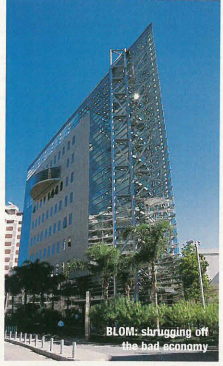
of 2000. Banque du Liban et d’ Outre-Mer
(BLOM), the largest by assets and
deposits, is still managing to shrug off
harsh economic conditions. In the first
quarter, its profits climbed 14.5% compared
to the same period last year. Last
year’s profits grew by 19.97%, above the
average of some of the 15 leading banks,
which saw a 3.7% decrease in profits.
Analysts attribute BLOM’s success to conservatism
and cost control. But the bank is
also making a move in retail banking.
According to Samer Azhari, general manager,
the bank’s non-interest income
increased 25% in the first quarter. Arab
Finance Corporation and ABN AMRO
recently gave BLOM’s GDRs a “buy”
ranking. AFC’s target price is $33.20, up
from the current trading price of $24.75,
while ABN AMRO calculates the target
price at $30. “We continue to favor BLOM as a speculative play for the short term,”
says Ghassan Medawar, financial analyst
for Middle East and North Africa at ABN
AMRO.
On the other hand, Bank of Beirut’s
(BoB) first quarter profits fell 15.8%. This
follows a 27% surge in profits for 1999.
According to BoB, the slump came partially
from non-recurrent expenditures, amortization
and goodwill related to its merger
with Transorient Bank last year, plus the
recent tax hike. It claims that without those
factors, its profits would have increased 6%.
Ciments Blancs in
the red … again
Ciments Blancs, reeling from the slump
in the construction sector, registered
losses of some $564,000 last year, down further
from $372,000 in 1998. The quantity sold
declined slightly from 74,800 tons to 72,000
tons, and losses increased by 35%. “During
the last 15 days of 1998, there was fierce competition
between us and Cimenterie du
Moyent Orient (CMO), and we had to reduce our prices by some $30, which caused a
devaluation of our stock of some $240,000,”
says Georges Ghosn, general manager. If you
take that devaluation out of the $564,000, you
end up with losses of about $324,000, similar
to 1998 figures. A subsidiary of Seament
Group, CMO has been refurbishing its factory
at a cost of $25 million to be able to produce
up to 400,000 tons.
Foreigners
welcome
National Bank of Canada has taken a
15% stake in one of Lebanon’s top-tier
financial institutions, Banque Saradar. The
$22 million purchase will raise Saradar’s
capital from $70 million to $90 million.
“Banque Saradar is set for expansion,” says
Elie Saliba, NBC’s general manager in
Beirut. NBC, the sixth largest bank in
Canada with $70 billion in assets, hopes to
expand its presence in Lebanon. “Foreign
banks cannot compete with well-established
local banks,” says Saliba. And foreign banks
face limits when it comes to expanding their
branch networks. Buying into Lebanese
banks can also be a launching point into the
region. In 1998, the International Finance
Corporation paid $11 million for a 10%
stake in Saradar. It is strong in corporate and
private banking and wants to acquire or
merge with another bank to boost retail
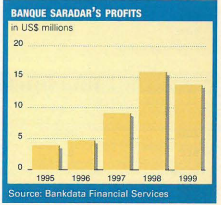
activities. Still in the top ten for profits, its
earnings dropped over 13%, from $15.8 million
in 1998 to $13.6 million last year.
Al-Mashrek has its sights set on
becoming the top insurer in
Lebanon – and not just in terms of
premiums. Already ranked sixth in the country
last year with non-life premiums of
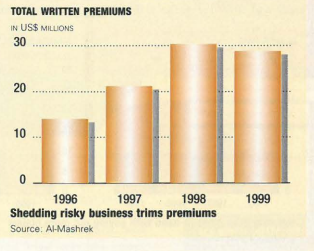
$14.5 million, Al-Mashrek’s global business
was about $29 million in 1999. That’s an
increase of more than 100% from $14 million
in 1996 (see graph). Al-Mashrek is now getting
ready to tackle the 21st century. The company
is aiming to expand both locally and
abroad, where already 50% of its business is
generated. But that won’t be so simple.
The insurance market is no longer the
carefree, anything-goes sector it once was
(see “Premium Pressure,” March 2000).
The players are faced with many new
obstacles, such as consolidation and new
government solvency requirements. Then
there are the foreign big hitters who have
moved in: Assurance Generale de France
(AGF) now owns 51% of Societe Nationale d’ Assurance (SNA), the third
largest insurer with non-life premiums of
about $20 million, while Axa bought 51%
of Societe Libano Française (SLF), the
fifth largest at $18.5 million. There are also
local subsidiaries of international firms,
such as Arab Lebanese Insurance Group
(ALIG), which is majority owned by its
parent company, Arab Insurance and
Reinsurance Group (ARIG). These firms
have the financial strength to compete
aggressively in the Lebanese market, solid
international experience in insurance and the
advantage of having names that carry a lot
of weight. Banks are also joining in the
insurance game, posing a new threat.
That aside, insurers have to find a way of
satisfying market demand, despite the relatively
low purchasing power of the population.
This has forced some to quote rates
lower than they would like, despite liquidity
considerations, and offer extended
credit facilities. If companies don’t walk a
fine line, they could easily follow Mesir,
Income and Phoenix.
All this and Al-Mashrek
doesn’t appear
overly concerned. Why
so smug? Al-Mashrek
thinks it has what it
takes. Part of its strength
comes from its reinsurers.
These help determine
to a large degree an
insurance firm’s credibility.
The reinsurers
behind Al-Mashrek are … and Swiss Re of Switzerland. All are rated
triple A. Al-Mashrek’s pricing strategies
are just as sound. The firm sets tariffs for
each branch of insurance based on statistics
gathered from the markets in which it operates.
Based on volume of expected claims
and rates offered by competitors, Al-Mashrek
works to maintain a balance
between safe underwriting and a competitive
spirit. Some, like American
Underwriters Group (AUG), sell just
below the market norm, while ALIG seriously
undercuts prices (see “New kid on the
block,” July/August 1999).
But with their financial strength (ALIG
has $7 million in capital and AUG has $4
million) and strong reinsurers (ARIG has
$1.7 billion in total assets and $460 million
in shareholders’ funds), both should be
able to cover losses in the event of unexpected
claims. Bankers, Societe Nationale
d’ Assurance and Libano Suisse are much more conservative when it comes to pricing,
with some of the more expensive rates in the
market. Al-Mashrek’s prices fall between
the two extremes.
On the collection front, Al-Mashrek also
tries to maintain a balance between liquidity
and convenient terms for its clients. For medical
insurance, the riskiest branch, it will not
deliver a policy before receiving a deposit
equal to 25% of the premium. The firm
allows no longer than 45 days for full payment. Sixty days is allowed for other types of insurance,
except in cases where large amounts are
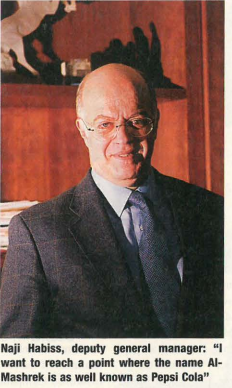
owed. “We have to be realistic,” says Naji
Habiss, Al-Mashrek’s new deputy general
manager. “Someone who buys $4,000 to
$5,000 worth of coverage
may not be
able to pay all at
once.” In such
cases, the limit is
set at three months.
“But we have to
make sure that the first thing we collect
is what we have
to put as reserves
with the government,”
he continues.
Lebanese United Insurance,
for example, demands 35% up front and a
maximum of two months to close the
account, well within the market average
of four months (see “Getting tough,”
January 2000). Middle East Assurance and
Reinsurance Co (MEARCO) leaves no
room for maneuvering, requiring all payments
up front (see “A sure thing,”
February 2000). Some, like Libano Suisse,
play it too dangerously, allowing clients
as long as five months to complete their payments
(see “The $8 million millstone,”
November 1999).
Although initially Al-Mashrek’s activities
were geared towards marine insurance, it
gradually realigned its business by extending
operations to all branches. Now, 35% of its portfolio is in medical and 5% in life. The rest is in general insurance. Of that 40%, or about
25% of Al-Mashrek’s
portfolio, is in motor
insurance. Dealing in
all branches of insurance
assures that the
firm won’t have to turn
away potential clients.
“Often we lose clients
for the branches we do
have,” says Rached
Rached, chairman of
MEARCO, “because we
don’t deal in other branches that the
client needs.”
With 35% of its business in medical, Al-Mashrek
will start working with an international
third party administrator (TPA)
which is in the process of registering to
operate in Lebanon. Though Al-Mashrek
doesn’t work with one, TPAs like Medical
Express and Mednet already handle the
medical portfolios of many Lebanese
insurers. A TPA manages its clients’ healthcare
portfolios and is responsible for ensuring
that the branch is efficiently run, that the
guarantees are in place and a sound level of
liquidity is maintained (see “Doctoring
insurance,” December 1999). With physicians
working full-time on their payroll, the
TPA will screen clients for pre-existing
medical conditions and make sure that hospitals
don’t overcharge the insurer or prescribe
unnecessary expensive treatments.
This way Al-Mashrek can avoid worrying
about the high-risk branch and focus on
the others.
A major advantage for Al-Mashrek is
chairman Abraham Matossian’s wealth of
know-how. With decades of experience in
the insurance field, Matossian is the current
chairman of the Association of Lebanese
Insurance Companies (ACAL) and was
heavily involved in the implementation of
the new law. He was also instrumental in
getting diplomas from Centre d’Etude
d’ Assurance accredited. This qualification
is essential for those who wish to work in the
insurance industry according to the new
government requirements (see “Corporate
medicine,” September 1999).
Al-Mashrek is also in the process of
restructuring its management, reshuffling
personnel to positions where they’re most
qualified. The firm is bringing in new blood
from other insurance companies, including
SNA, !’Union
Nationale and
Libano Suisse. One
example is Habiss,
who ran Libano
Suisse for more than
22 years, which
ranked fourth in
1999 with non-life
premiums of about
$19 million.
As far as the bank
threat is concerned,
Al-Mashrek is loading
its guns. It is
ready to do business
with all financial
institutions, unlike
insurance firms that
are owned by banks.
One example is
ADIR, which does 90% of its business through Byblos Bank. Banks look for securities against loans. Clients are generally required to buy insurance, ranging from car and cargo insurance to house and life insurance, depending on the type of credit. “Banks won’t give credit to someone if he doesn’t get insured,” says Habiss. “We’re creating all kinds of products for the banks’ needs.” This way Al-Mashrek can sell motor policies to those buying cars on credit and cover the dealer if the client defaults on payments.
Another advantage Al-Mashrek has over
local rivals is its business abroad. Through
affiliates and subsidiaries in Cyprus, Saudi
Arabia, Egypt, and France, the firm generated
$14.5 million
or 50% of its business
in 1999. Not
only does Al-Mashrek
bring
home the experience
derived from
those markets, giving
itself the tools
to face the new foreign
threat, but it
takes the battle to
the foreign firms’
home turf. Others
that have offices
abroad include
SNA and Libano
Suisse.
Al-Mashrek is
also seriously looking
at consolidation.
It is currently in negotiations for an acquisition with two insurance companies, though Matossian declined to disclose which ones. The move would increase the firm’s client base and assets as well as provide greater coverage of the market with an increased branch network.
“But nothing has been finalized,” says Matossian. “We aren’t even ready to apply for ministerial approval.” If it is finalized, the firm will have taken a solid step towards achieving its ambitions for growth.
But growth will also come from within. In
this sense, Habiss plans to put a greater
emphasis on life insurance, which now
accounts for about 5% of Al-Mashrek’s total
premiums. “It’s the most profitable of all the
branches,” says Habiss, “unlike medical,
which is like a running faucet with funds
flowing out continuously.” Many others
agree. “It’s the safest and most profitable
branch of insurance,” says Aline Kamakian,
general manager of Insurance Investment
Consultant (IIC). For this reason, MEARCO
hopes to acquire a company for its life
license within a few years.
Is it worth it? AUG seems to think so. It
acquired ELKA insurance, solely for its
life license. Al-Mashrek is also in the midst
of creating services that are so far unavailable
in the market. For example, those who
buy all-risk car insurance will receive a
loaner car for a few days should they have an
accident. For those with house insurance
that get snowed in, Al-Mashrek will have
the snow cleared, saving you the trouble
and saving money for them by avoiding
water damage claims. The firm also plans on
introducing a 24-hour hotline service for
emergency assistance. “I want to reach the
point where the name Al-Mashrek is as
well known as Pepsi-Cola,” says Habiss.
But in order to grow, Al-Mashrek believes
it has to go back a step first. It’s sacrificing
premiums by brushing off some bad and
high-risk clients in favor of a clean portfolio.
Though premiums generated locally have
increased from about $13.9 million in 1998
to $14.5 million in 1999, the non-renewal of
bad business contributed to a drop of $1.5
million in total revenues from $30.4 million
in 1998. With that, Al-Mashrek is seriously
screening all new business.
Talks are now ongoing with potential
new investors. “Al-Mashrek doesn’t need
big names to attract business,” says Habiss,
“but more liquidity can facilitate growth in
new ventures.”
Al-Mashrek is aggressive, but it does
not take the unwise risks that have brought
the downfall of others. It has also found a
balance to counter most of the sector’s pitfalls.
Al-Mashrek is confident that it is
taking the right steps. The question is
whether this will be enough to take the
business further.
Picture this. Mohammed and Mahmoud are good friends. The former is married to the latter’s maternal cousin, and most evenings after work are spent together around the dinner table followed by a session of backgammon and nargileh sipping. Jokes, exaggerated
tales and laughs are mixed with political
chit-chat and complaints about the state of
the Lebanese economy. Shop talk doesn’t
enter into the conversation much, but when
it does, Mahmoud’s $75,000 in outstanding
debts to his friend never does. Even in a
work environment, Mohammed finds it
difficult to press the matter for fear of
upsetting their close relationship.
Though these characters are fictitious and
any resemblance to real persons is purely
coincidental, it’s not a difficult scenario to
imagine in Lebanon, where it can be difficult
to separate personal from business relations.
While some may consider that to be a hindrance,
factoring firm Ipso Facto sees it as an
open invitation for its line of business. “A
client [of Ipso Facto] doesn’t have to jeopardize
his relationship with his buyers, pushing
them to pay, because it’s not his worry anymore,”
says Bassem Yammine, head of corporate
finance at Lebanon Invest.
But there are other advantages to using the services of Ipso Facto on top of safeguarding relationships. Factoring involves a
number of services that revolve around the
management of receivables, including collection,
credit insurance against bad debt
and financing. Ipso Facto receives a fee of
0.5% to 1.5% for its services as well as interest
on the financing it provides to clients
against their receivables. Ipso Facto has so
far concentrated largely on recourse factoring; if a client’s buyer doesn’t pay up,
Ipso Facto has recourse to the client.
Since its inception in 1997, Ipso Facto has
broken even, with losses last year canceling
out the previous year’s profits. But earnings
should be just around the corner as the
company expects profits of about
$250,000 this year. With about 35 clients last
year, Ipso Facto managed about $22 million
in receivables, about the same as it did in
1998. The company needed to increase its
capital and lay the groundwork before
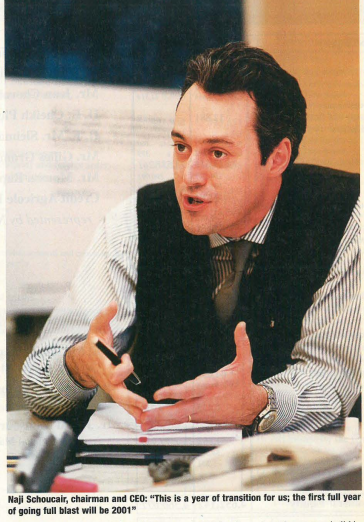
being able to factor more, says Nagi
Schoucair, chairman and CEO, explaining
why business was flat in 1999.
As the first factoring firm in Lebanon,
Ipso Facto has doubled its human resources
since it began and invested about $500,000 in information technology last year. The
investment includes FactoLine, the firm’s
online service for clients to check up on their
accounts. The company has been given a
helping hand through its alliance with
Societe Française de Factoring (SFF),
France’s second largest factoring firm,
which has provided know-how and served
as a partner in international factoring for
trade between Lebanon and other countries.
“The last two-and-a-half years Ipso
Facto has basically been running like a lab:
testing, modifying, improving, testing,
modifying, improving,” says Yammine.
“Definitely, it has a two- to three-year lead
over any potential competitor; it would be
very difficult for someone to duplicate
what they have in a very short time.”
The next big push will come with the
planned capital increase from $2 million to
$8.75 million in May through Lebanon
Invest. This will bring a new shareholder
base into the company, which is 90%
owned by Schoucair and 10% by Rami
Nimr. At that level, Schoucair expects to be
able to handle about $70 million to $80
million in receivables in a full year of operations.
“This is a year of transition,” he
says. “For us, the first full year of going full
blast will be 2001.” The cash injection will
also give Ipso Facto the opportunity to dip
its toes into the regional pool of factoring,
where competition is scarce. Oman,
Tunisia and Morocco are the only countries
in the Middle East and North Africa that
have factoring firms.
SFF sees good potential in the region,
especially in Egypt. “The idea is for Ipso
Facto to be a partner that we’ll go with
into the region,” says Jean Gartner, international
director for SFF. “Now is the time
to go down to these regions, not when
everyone else is already set up there.” And
go they will, starting with Egypt and
Jordan. While SFF already holds a 5%
stake in Morocco Factoring and 10% in
Tunis Factoring, there are no plans to do the
same with Ipso Facto for the moment.
The plan is for Ipso Facto to form joint ventures
with local companies, which will bring
the knowledge of the market and put up the
capital. In its turn Ipso Facto will provide the
know-how and tools, using SFF again as its
partner in international factoring, which they plan to begin this year. Domestic factoring
will come at a later date in Egypt and
Jordan. With margins as slim as 2%, going
regional will help increase volume.
“Lebanon is a small market, so you can only
think of it as a lab to test concepts and see
how you can take it further,” says Yammine.
But what’s the benefit of paying money for
a third party to collect payments, when it can
be done in-house? Outsourcing the management of receivables allows a company to
eliminate related expenses and concentrate
on its core business. According to
Schoucair, factoring firms generally have
a collection rate that is 10% to 15% better
than when the clients do it themselves.
More importantly, financing allows a firm to
turn outstanding receivables into working
capital. Interest rates are 12% to 14%.
Clients include Sony, Megacom, Nike and
Playtime. “One of the major reasons we
decided to go to Ipso Facto is that it’s the only
company willing to offer this service on the
market,” says Mohit Parasher, branch manager
of Sony Lebanon.
Ipso Facto has been creating a sort of credit
bureau, called Ipso Credit Watch (ICW), in
the absence of such information on the market.
ICW has created a system of standardization
for industries similar to those codes
that operate in the US and EU. There are some
170,000 companies in the ICW database,
albeit with varying levels of financial information.
Based on balance sheets representing
about 15% of the companies in a given
industry, ICW can assess others with limited
information by using ratios such as turnover
per employee. “Based on this, we can
rebuild a balance sheet, figure out the assets
and so on,” says Schoucair. “But the condition
to do this is to have a proper sector study.”
Schoucair admits the method is not 100%
foolproof. In fact, the results are only accurate
to within a 20% to 25% variable by his
estimates. Come again. A 20% to 25% variable?
While that may be good for the prevailing
conditions in Lebanon, it still leaves
a huge margin for error. Schoucair has a few
other uphill battles to face, not the least of
which are the lack of transparency and culture
on the Lebanese market. “Take for
example securitization. It’s very simple, but
nobody understands it, nobody accepts it,”
says Nicholas Photiades, senior vice president
of Thomson Financial Bank Watch in
Beirut. “The legal structure is not there to
facilitate it. It’s still early, early days.”
Another analyst points to the inefficient
judicial system in Lebanon: “The banks
take the good debtors, so you’re left with bad
debtors and no courts.” While Schoucair
acknowledges the problem of the slow
legal system, he says the more important
legal issue is the invoice’s weak status in
comparison with the promissory note.
Another factor that the company will
have to prepare for is the inevitability of a
tougher market. Ipso Facto may soon find
that it doesn’t have the run of the place.
Commercial banks could become direct
competitors in the factoring business following
the recent central bank circular that
laid the ground rules. Schoucair, however,
has a plan to cut them off at the pass: Facto
Bank. “We’ll operate the factoring completely
from A to Z, and the bank just puts
its logo on it,” he says. “Or we can train
them, give them the tools and procedures to
enable them to do this.” Knowing the Alfa
banks will be tough to convince, Schoucair
plans to target the medium-sized banks.
Ipso Facto expects 2000 to be a very difficult
year. “1999 was a tough year, but most
companies had reserves,” says Schoucair.
“They’ve used them, so now a lot of companies
are on the edge.” He believes that this
year will bring a surge of bankruptcies. All
that and Ipso Facto is in the process of
switching its clients to non-recourse, meaning
if debts can’t be collected, Ipso Facto
swallows the loss. In the face of so many
obstacles, Schoucair has his work cut out
for him. The next couple of years will reveal
whether he can manage to pull it off. Either
way, at least he has the guts to try.
Coming home has paid off so far
for Societe de Grands Hotels du
Liban (SGHL). After opening
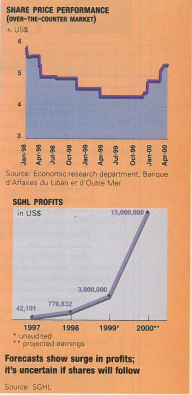
Vendome Hotel in 1996, its profits jumped
from $42,101 in 1997 to $3 million, unaudited,
last year. SGHL believes that this
was just a small step towards a real profit
surge. Last March it reopened what was
once one of the most prestigious hotels in
the Middle East before the war: Phoenicia
Hotel. Earnings are forecast at $15 million
for 2000, according to Mazen Salha, chairman.
That’s an increase of 400% – far above
what other companies on the
Lebanese stock market anticipate.
SGHL has a good chance to meet its target.
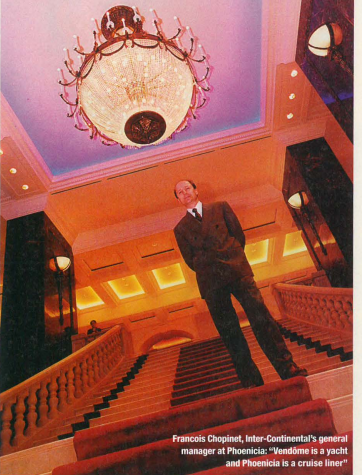
“Vendome is a yacht and Phoenicia is a
cruise liner,” says Francois Chopinet, InterContinental’s
general manager at Phoenicia
(InterContinental runs both SGHL’s hotels).
Unlike Vendome**,** which is a medium-sized
boutique hotel, Phoenicia will function on a
much grander scale. It has the largest conference
room and, once fully operational, will
have more rooms than any competitor in the
local hotel industry. Size matters. Existing
hotels, such as the Marriott, Savoy, Le
Bristol, Al-Bustan, Summerland and
Commodore, can house 300 to 1200 people in
a conference hall and have around 85 to 210
rooms. Phoenicia’s conference hall can hold
2000 guests and will have 450 rooms when
completed this month. According to Ghassan
Matar, previously an independent consultant
for the ministry of tourism, Phoenicia’s competitors
often can’t accommodate all their
guests when hosting events. “At Phoenicia,
with accommodation available in the same
hotel, convenience for the participants, organizers
and tourist agencies will attract many clients away from its competitors,” he says.
Big brand names in the hotel industry
have been scrambling to get in and set up
shop or manage local establishments. Many
believe that international chains, such as Le
Meridien, Starwood, Marriott, Holiday Inn
and InterContinental, will soon dominate the
Lebanese market. Others like Movenpick and
Four Seasons are on the way. “Lebanon is
opening up to the world, and local hotels need
international chains to market worldwide,”
says Tanios Kassis, development manager at
Choice Hotel International, which encompasses
Clarion, Quality, Comfort and Econo
Lodge. “To attract people from other countries,
a hotel needs a brand name,” says
Kassis. “And to market abroad, it takes
expertise and the ability to absorb costs.
Local owners are unable to do it.”
SGHL teaming up with InterContinental to
manage Phoenicia should pay off. InterContinental,
which belongs to Bass Hotels and Resorts, was the driving force that enabled
Vendome to become a moneymaker in a
short period of time. Bass Hotels and Resorts,
which includes Holiday Inn, Crowne Plaza,
Holiday Inn Express and Staybridge, is one of
the leaders in the global hotel business**,** generating
revenues of about $7.43 billion. In the
last three years, the average occupancy rate for
the hotel sector was 40.5% compared to 90%
for Vendome.
SGHL allocated InterContinental an initial
marketing budget of $500,000, to be followed
by 5% to 7% of revenues.
Marketing regionally and internationally,
InterContinental focuses exclusively on
corporate clients. “The hotel has been built
around targeting corporate clients. This is a
businessman’s hotel,” says Salha.
Phoenicia’s location in the Beirut Central
District will also be beneficial as businesses
are expected to migrate to the city center.
And according to Chopinet, corporate
clients are eager to find a new destination in
this region. “On our conference business, we
have 30,000 room nights booked between
March and the end of September,” he says.
“Two thirds of these clients had plans to go
to other destinations, but we stole them
from places like Dubai, Cairo and
Istanbul.” InterContinental, which has a $2-
million stake in Phoenicia, calculated a
conservative 50% occupancy rate for the
first six months. It has already been running
above expectations at 62%.
SGHL has one advantage that its competitors
do not: the name. “Phoenicia is one of the
oldest brand names in Lebanon,” says Pierre
Achkar, the president of the Lebanese Hotel
Association. “It was the first InterContinental
in the Middle East and was the
biggest. Everyone knows Phoenicia.”
SGHL doesn’t plan to stop there. “We
want to develop more hotels in Lebanon
and in neighboring countries,” says Salha.
Following a peace agreement, SGHL plans
to open a hotel in Damascus. Cairo will
probably come next year, while other spots
in North Africa and Iran are being considered.
But can SGHL attract investors? Its shares
have had a bumpy ride on the over-the-counter
market (OTC). Between early 1997
and late last year, its prices bounced
between $3.85 and $5.75. A positive sign: a
23% increase in the last few months, settling
in around $5.38. The recent jump came
from Vendome’s higher-than-expected
results last year and anticipation of
Phoenicia’s opening, according to Nicolas
Sawan, head of trading at Lebanon Invest,
which handled SGHL’s private placement in
1996. Sawan believes there could be more
movement to come, but it may take time.
“This year’s results should affect the share
price,” he says. “What drives share price
movement is psychological. If SGHL meets
its profit target, prices should move.”
But there are forces in Lebanon working
against the traditional rule of thumb of
stock prices moving upward as earnings
improve. “With all the bookings at the hotel
this year, it will be a successful beginning,”
says Nabil Aoun, general manager at Fidus.
“I’m very optimistic about SGHL, but its
shares won’t follow. The market is dead.”
Lebanon’s economic and political uncertainties
have killed investor interest. A good
example is BLOM’s GDRs, which are traded
on a more liquid market than the Beirut
Stock Exchange (BSE) or the OTC. The
largest bank in Lebanon, BLOM increased
earnings by 20%, from $58.7 million to $70.4
million, in 1999, and in the first quarter of
2000 profits jumped 14.5% over the same
period last year**,** despite recessionary pressure
taking its toll on the banking sector.
Even though international investment firms
recommend a buy and target its share price
as high as $44, its GDRs have dropped 9%,
down to $24.68, so far this year.
SGHL has received approval to move its
shares onto the BSE. “We are waiting for the
market to be more active,” says Salha. But
when that will happen is anyone’s guess.
Total trading volume dropped from $640
million in 1997 to $90 million in 1999. It has
sunk even further this year, down 19% in the
first quarter. There is a question of interest
being generated in SGHL itself. Several
analysts at local investment firms claim that
they tried to study the company and report on
its progress for investors, but were rejected.
“We tried to get information from SGHL, like
income statements, but no luck,” says one
analyst. “It’s not transparent at all.”
There is also concern about SGHL’s debt. To
rebuild Phoenicia, the company had to borrow
a total of $80 million. There is a chance that
SGHL will sell off Vendome to help reduce its
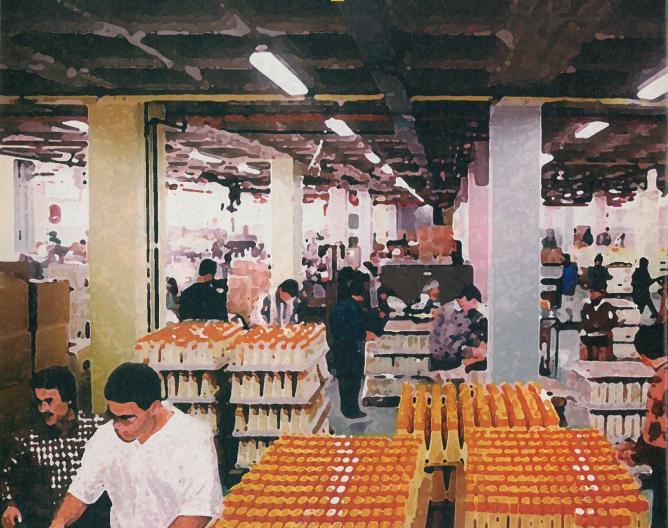
In 1996, Ghazi Kraytem, general manager
and part-owner of Soliver, found
himself in a tight spot. A manufacturer
of glass bottles, Soliver was facing all the
difficulties afflicting local industry: high real
costs, high domestic and regional tariff
barriers, corruption and a slipping economy.
But for Soliver things were more acute.
Competition in the Gulf, its main export
market, had been growing “astronomically,” says Kraytem. In two years, industrial
capacity for glass bottles there grew 600%
while demand was barely growing. “We
got hit pretty bad,” he says. “Our competition
was selling to our customers at 25% less than
our cost.” Making matters worse was the
impact plastic containers were having on
the glass bottle market. Bottles made from
PET (polyethylene terephthalate) have
become favorites of soda and bottled water
producers, because the material offers glass-
like clarity but won’t break like glass and its
lightness makes transportation cheaper.
These factors made Soliver’s future
prospects unappealing. “We had a choice of
either closing down,” says Kraytem, “or
meeting the challenge.” In order to become
competitive, both locally and internationally,
Soliver had to cut costs, replace its outdated,
labor-intensive manufacturing equipment and invest $14 million in new
high-tech machinery.
But just hold on a minute there. What was
that first bit? Cut costs? Isn’t cutting costs
just a euphemism for laying off workers, for
firing people? In Lebanon eliminating old
machinery and investing in new equipment
is fine, but firing people, that’s a different
story. And for Soliver, it was. While the
company faced no interference with its resolution to upgrade its operations, the firm’s
“reluctant” decision to lay off 70 workers
attracted a lot of government attention.
“When we informed the ministry of
labor,” says Kraytem, “they said we could
lay off workers, but not as we wanted to.”
Instead, after talks with the prime minister
and pressure from the ministry, Kraytem
says that Soliver was required to pay $1 million
in compensation for its 70 workers, on
top of their end-of-work indemnities. In
return Soliver was given promises, such
as protection from imports, lower utility and
fuel costs. “We even had a written contract
with the ministry of labor, but nothing
came of it,” he says. And what infuriated
Kraytem even more was that many of the
laborers Soliver hired were not needed in the
first place – they were employed as a result
of political pressure.
Soliver’s case is not unusual; it’s just one of
a few companies willing to go on record
about the issue. Indeed, Kraytem says he
knows of many other companies that were
forced to hire unnecessary workers and pressured
to keep them when times got tough.
The case neatly illustrates what most
industrialists or managers of any other
labor-intensive operations know: keeping staff on,
even if they are redundant, is considered
an unwritten law in Lebanon. And
implicit in this law is the understanding
that if you fire staff, it will cost you.
We say unwritten because the labor law
itself does not encompass such a meaning.
Katia Bou Assy, an attorney at Moghaizel
Law Offices, argues that the Lebanese
labor law is quite clear. “The employer or
the employee can terminate the agreement
at any time provided the conditions are
complied with,” she says. Those conditions?
Firstly, an employee should not
be dismissed unfairly. For example, notice
must be given. An employee with less than
three years’ service at a company must be
given one month’s notice, between three to
six years requires two months, between six
and 12 years three months, and finally
more than 12 years’ service requires a less
than onerous four months. Alternatively, if
the employer is particularly keen for the
employee to go, it can choose to pay in lieu
of giving notice.
Other cases of unfair dismissal include firing
someone because of membership in a
workers’ union or because the employee has
filed legal action against the employer in
order to oblige the employer to conform to
applicable laws. Finally, the employer
can’t fire a worker who is a board member
of a union; in this case the employer must
apply to the labor court, which will in turn
make the decision.
So what about a legal dismissal? By law,
if the employee is incompetent, he or she
can be fired without notice as long as the
employee is given a minimum of three
warnings or if the employee’s negligence
causes damage to the employer. In the latter
case, the employer should inform the
ministry of labor within three days of
becoming aware of the negligence before
firing the employee. If the employee is
absent from work without a legal excuse for
more than 15 days in one year, or seven days
consecutively, the employer can also fire
without notice.
But perhaps the most important clause in
the labor law has to do with terminating
employment based on a company’s financial
difficulties. The law states that a firm can lay
off employees if it is facing financial trouble,
in other words, if keeping workers
would impair or jeopardize the company’s
survival, or if it needs to upgrade technology,
operating or manufacturing systems,
a process that may involve laying off
employees. This is critical: If a company is
not free to cut costs and upgrade during a
recession and as a consequence it folds,
many more would be hurt than the few targeted
to lose their jobs.
In order to lay off employees under this
clause, the employer has to inform the
ministry of labor of those he intends to let
go and the ministry will act as a third party
between the employer and the employee to
negotiate the level of compensation.
Again, according to the law, the level of
compensation is clear. The employer is
required to pay anywhere from two to 12
months of salary in compensation; the court
determines the amount of compensation by
taking into account things like the employee’s
age, years of service and health.
But this is in theory. Nicholas Nahas is a
shareholder and director of Sibline, one of
Lebanon’s largest cement manufacturers and an employer of about 400 people. He
argues the reality is quite different and that
companies often pay much more compensation
than is stipulated under the law,
thanks to interference from the ministry of
labor. The reason, says Nahas, was the
high-inflation period during and after the
war. When inflation was sky-rocketing, at
times the lira dropped 30% a day against the
dollar, the ministry of labor was made
responsible for determining the dollar-
pound exchange rate; in effect, the amount
of compensation to be paid. The problem
with this, says Nahas, is that it opened the
window for the ministry to apply a greater
degree of influence on the private sector in
terms of employee compensation.
Additionally, Nahas argues that once the
economy had stabilized, the established
system continued.
The reason the ministry of labor has continued
to exercise influence over employer-employee
relations is not so much to do with
the simplistic and outdated belief that private
companies are merciless and out to rip
off workers given the chance, but more to
do with the deficiencies of the Lebanese
state. Since the government has not seen fit
to establish a welfare system that provides
unemployment benefits and job search services,
the ministry of labor has been forced
to act as a quasi-department of social security
at the expense of the private sector.
Fares Saad, the head of work force relations
at the ministry of labor, is unabashedly
direct about the ministry’s unofficial
role. “We cannot force any company not to
dismiss an employee; the Lebanese labor
law is clear on this point. But the first thing
we do when an employer wants to lay off
staff is to try to ensure [via negotiations with
the employer] the continuity of work, to
keep them at work,” says Saad. “For example,
if the owner wants 12 employees to go, we try to lower that to eight or less and ask
the employer to transfer the others to different
positions.” Negotiations don’t end
there, however. “If that doesn’t work,”
says Saad, “when we discuss the level of compensation with the business owners,
we try to ensure that the employee is given
more compensation than 12 months’
salary. Why? Because we can’t always
find vacancies at another company for
these employees.”
This is the reality of employer-worker
relations here. “In Lebanon,” says Saad,
“we have no retirement or end-of-service law
while at the same time we have no law for the
people who can’t find a new job. For this reason,
we make the employer pay penalties.”
That statement neatly reveals the conceptual
chasm between government officials
and Lebanon’s private firms. In the
absence of a functioning welfare system, the
ministry of labor wants the private sector to
pay; on the other hand, private companies
and institutions, like their international
counterparts, argue that social security is not
their responsibility.
“We prefer, as the ministry of labor,”
says Saad, “for Lebanese laborers to be
employed for $400 a month than for a foreigner
to be given the job for $150. But the
companies always prefer their profits.”
Indeed. Any manager of a private company
will argue that its number one priority is
delivering growth and profits and that it’s up to
the government to provide the legislative
framework and resources to protect worker
rights and ensure adequate welfare.
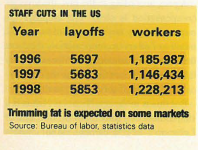
The logical extension of this thinking is
the type of labor relations exercised in the
United States, where companies routinely
hire and fire without government interference
and where private sector icons like
IBM, Boeing and Levi Strauss can lay off
tens of thousands of employees under
restructuring programs, a move that is
generally welcomed by investors.
This kind of labor flexibility is possible in
the context of the world’s strongest economy
and a well-developed social security system
originally put in place through lessons
learned during the Great Depression of the
1930s. It’s impossible to argue that this
could happen any time soon in Lebanon.
The bottom line is that with no welfare
system in place and the ministry of labor the
self-appointed guardian of the Lebanese
worker, laying off staff will remain an
expensive and politically difficult exercise
for local firms, which ultimately raises
their costs and undermines efficiency. If private
companies absolutely have to fire
employees on a large scale, they will face
pressure from officialdom. “I’ve lived
through several ministers of labor,” says
Nahas, “and they always have some connections.
It’s politics. So if you need to lay
off 30% of your work force, you never
know what’s going to happen. And I have
stories where it was really painful.”
The result is that a lot of firms try to lay
off carefully and quietly, or just not at all.
The over-staffed banking sector has a few
examples. Bank of Beirut managed to quietly
reduce its staff from 490 to 417 after its
merger with Transorient Bank at the end of
1998, and aims to reach 400 by the end of
2000. Banque Audi, on the other hand, doesn’t
lay off workers. Although it has a reputation
for a high overhead, it has refrained from
hiring new employees to staff its rapid
branch expansion and has instead been
attempting to transfer existing employees to
the new branch positions.
Until the government is in a financial position
to provide some sort of welfare scheme to
the unemployed, local businesses are unlikely
to see a more flexible labor market. So local
business owners or managers will have to grin
and bear the situation or think of new ways to
increase worker productivity, because the
law certainly won’t help them.
Lebanon’s rivers are once again roaring, swollen by spring
snowmelt in the mountains. This is an annual blessing. In
the parched Middle East, where water rights are so guarded
that countries will go to war to protect the smallest of tributaries,
Lebanon is an oasis. Having so much of what other countries in the
region need, one might expect that there’s money to be made in the
export of bottled water. Certainly, there is no shortage of companies
that are trying to tap into this potentially lucrative market.
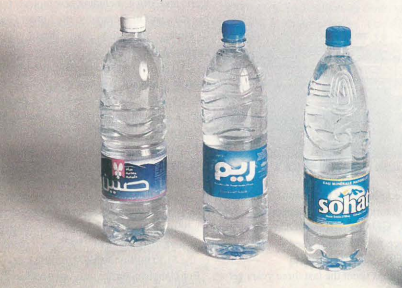
Sohat, Rim, Tannourine, Sabil, Nada and Sannine have invested millions
of dollars in the last few years to upgrade their factories. All
have converted from the use of opaque PVC bottles to the transparent
and exportable PET bottles. (Many countries have banned
the import of PVC bottles because they have been shown to pose
health risks). Water should be a booming business in Lebanon. But
the sad reality is very different.
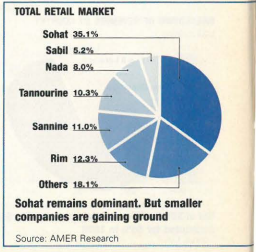
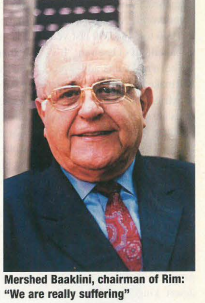
“Nobody is making a profit,” complains Mershed Baaklini,
chairman of Rim, the number two brand on the market, according
to AMER Research. Despite the big investments, those in the business
complain that there is little money being made. Unfortunately,
most companies in the water business are not nearly as transparent
as their new bottles. Sohat, the number one brand, Nada and Tannourine, declined to speak on the record. Rim, Sannine, Sabi! and Dynamic Concepts, a supplier of 19-liter bottles, were willing
to divulge limited information. But some facts are clear.
The combined production capacity of the companies is far greater
than the demands of the domestic market. About 7-8 million cases
of water are sold in Lebanon each year. “The production capacity is
at least double,
maybe triple that,”
says Salah Osseiran,
chairman of the four-year-old Sabi!, the
newest company to
enter the market.
Sabil’s capacity is 4
million cases a year,
but it’s currently running
at 1-1.5 million.
Rim can produce 6
million boxes a year
but is only selling
about 2 million.
If the domestic market’s thirst is quenched, then there must be a market for exports in this arid region
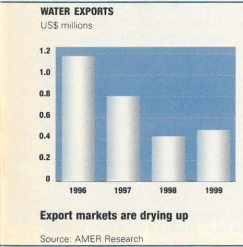
of the world? Actually, no. Exports have dropped from $1.2 million
in 1996 to $481,000 last year. Production costs are increasing in
Lebanon, says Osseiran. “It’s very expensive here to export. Water
is not a real value-added product, so any marginal increase in cost
will make it uncompetitive,” he says. “We had opportunities to export
to Africa, but we couldn’t because it’s so competitive and our
costs are so high.” Sabil’s exports have dropped from 10% to 12%
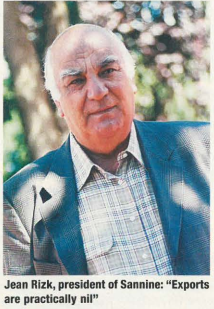
of output in 1996 to 5% to 6% last year. “Exports are practically nil. [Bottled Water] is bulky, heavy and cheap
and that makes the cost of exports high
compared to the price of the water,” says
Jean Rizk, president of Sannine.
The Gulf represents the most important
export market. Saudi Arabia purchased
$104,000 of Lebanese bottled water in
1999, or 21% of exports, and Kuwait consumed
$219,000, or 45%. But even in these
desert kingdoms, it’s hard to compete.
Believe it or not, says Osseiran, the Saudis are
able to produce bottled water less expensively
than the Lebanese by pumping from deep
wells. In 1980, there was just one water factory
in Saudi Arabia, but today there are
nearly 20. In Saudi supermarkets, a case of
Lebanese water generally costs double the
price of the local variety. “They have many
advantages that we don’t have,” says
Osseiran. “Their cost of utilities is one
fourth of ours. They pay 2 to 3 cents a kilowatt.
We pay 12 cents. They don’t have to pay
40% of each employee’s salary for social
security. They pay only 7%. They have land
that is less than nothing to buy in industrial
areas.” In addition, Saudi water companies
benefit from 20% customs tariffs on bottled
water imports. In addition to the usual taxes required of all businesses, water companies are obliged to pay a tax of
LL35 for every liter of water extracted, whether it’s used or not.
With too many swimmers in the pool, firms are desperate to survive.
Companies have been diversifying their product lines (see box) and
investing hundreds of thousands of dollars in splashy marketing campaigns.
At the same time, a fierce price war has developed, with firms
offering supermarkets up to 60 free bottles for every 100 purchased
in an effort to win market share. Instead of passing that on to the customer,
says Osseiran, shops are pocketing the difference and giving the lowest-priced brands better shelf space.
Supermarket prices range from LL500 to LL600
for 1.5-liter bottles.
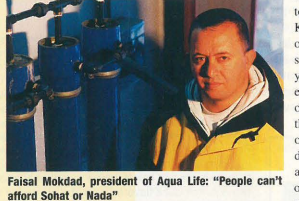
“It is a chaotic market,” says Michel Ghanem,
CEO of Rim. “Companies are dumping prices.”
So who will sink and who will swim? If the companies
themselves are to be believed, all could
drown. The some 200 to 300 unlicensed water
companies (no one knows for sure how many
there are) have become the scourge of the
industry (see box). Legal companies complain
that they are driving the legitimate players out of
business. That, despite the strict rules governing
bottled water. Based on government decree
1039, passed last summer, a water company
must have a factory that is ISO 9002 certified and
follows manufacturing procedures set by the
US Food and Drug Administration. Each company
must also have its own well or spring
located on no less than 1,000m to 1,500m of land,
a minimum investment of no less than $1 million. But the laws are
not being enforced.
Illegal companies dominate the 6-liter to 5-gallon market, which
represents more than a quarter of the total water market. Operating
out of street-level shops or garages, many provide no more than filtered
(sometimes unfiltered) tap water. Most distribute within their
own neighborhoods for prices as low as LL1,000 for a 20-liter bottle.
This has discouraged legitimate companies from entering a
very important segment of the market. Of the eight licensed companies,
only three sell 5-gallon water bottles: Mona Cool, Nahle and
Nada, which is sold by distributor Dynamic Concepts.
“We are really suffering from the little guys who are doing this
without a license,” says Baaklini. Rim is considering entering the
gallon business, but that will require an initial investment of
between $500,000 and $750,000 in bottles and equipment. “Illegal
companies are selling 19 liters for LL1,000,” he says. “I would have
to sell them for LL8,000.” Sabi! is also reluctant to enter the 5-gallon
market. Osseiran says: “The market is so uncontrolled by the
government that we have no appetite for further investment in this
country. We are the good guys, we follow the rules and these fly-by-night bunch of guys come and pay no tax, no fees, sell sickness
to people and nobody bothers to stop them.”
When Sabil opened,
illegal companies controlled
about 10% of the
market. Osseiran expected
the government to crack
down. “We never expected
it was so weak that it couldn’t
enforce its own laws.”
Sabil was expecting to
break even by 1999. Four
years later and revenues
have risen to $5 million,
but the company claims to
be losing money.
Dynamic Concepts is
one of the few licensed
companies taking on the
illegal ones. It intro-
duced 5-gallon containers in 1994.
“[Individuals and companies] used to buy 1.5-liter bottles from
supermarkets or small shops. We tried to convince the institutions
and companies that you can save by using the 5-gallon bottles,” says
Elias Barakat, commercial manager. “I have many examples
where big consumers of our products saved around 30%.” But business
soon started to turn sour. “When others saw that it has a good
rate of return, some started filling bottles without a license,” says
Barakat. “We were depending on the government to stop this, but
like everything in Lebanon, some are supported by politicians.” That
is the root of the problem, according
to the ministry of health.
Karam Karam, the minister of health,
ordered the Internal Security Forces to
shut down the illegal companies last
year, going so far as to blame influential
politicians for protecting these
outfits. Half a dozen were given
three months to get their house in
order and obtain a license. That
deadline was recently extended for
another three months. The rest were
ordered closed. About twenty were
shut down briefly, only to reopen.
Licensed companies say that the government has to make some
tough decisions, and that might involve stepping on some powerful
people’s toes. In the meantime, the number of illegal companies
has been on the rise.
A spokesman for the Internal Security Forces said it was up to the
ministry to take action against the illegal water companies. “It’s their
job to close these down, don’t they have inspectors?” he asked.
Osseiran is tired of the excuses. “Nobody in any government, not
this one or the other one, is willing to take a decision that might upset
any Tom, Dick or Harry,” he says. “Frankly, it might make sense for
all the legal companies to let the illegal ones work alone.”
It’s nice to take a catnap. But if you
wake up to find your multi-million-dollar
company has been reduced to
almost nothing and your former employees
are your biggest competitors, then you
know you’ve overslept. A couple of
decades ago, Contracting and Trading
Company was a name to be reckoned with.
C.A.T. was a giant in the region, responsible
for building landmark structures such as
the Presidential Palace in Iraq and the
Holiday Inn Hotel in Bahrain. It was also
one of the first contracting firms to lay
down thousands of miles of oil and gas
pipelines of different diameters in the Gulf,
Libya, Ghana and Nigeria, as well as being
the first to lay down 48″ and 56″ pipelines.
C.A.T. clawed its way into everything –
from highways to stadiums, airports and
power stations in the Middle East, Gulf
and Africa. Its turnover surpassed the billion-
dollar mark.
But in the early 1980s, C.A.T. went into
hibernation, mainly because of the war and
internal conflict among its shareholders.
By the time it re-emerged five years ago,
business had dwindled to an all-time low.
Turnover was just $25.2 million and the
company had dipped into the red by a few
million. It was time for serious reconstructive
surgery. The owners began hunting for
someone who could turn things around and
stumbled across Fred Habeishi, previously
president of the US-based RUST, a design
and build firm with over 22,000 engineers
on its payroll. RUST, where Habeishi
spent 34 years before joining C.A.T., was
one of the leading contracting firms in the
United States, specializing in the construction
of plants and factories. Can this newly
appointed Mr. Fix-it rebuild C.A.T.?
As far as Habeishi is concerned, that has
already been taken care of. “We’re not coming
back,” he says. “We’re already back.”
Since his arrival, turnover more than tripled
from $25.4 million in 1996 to $80.2 million
last year. Projections for this year put that figure
at $130 million. But to do that, Habeishi
had first to get the company geared up to compete
for contracts that would put it in the big
leagues with the likes of the Consolidated
Contracting Company (CCC). “We had to
reinvest, reinvigorate and get the right people,” says Habeishi. In 1996 a capital investment
of around $50 million was raised by
C.A.T.’s owners, the heirs of founders
Emile Bustani, Abdallah El-Koury and
Shukri Shammas. But with the company
losing $4 million to $6 million a year,
Habeishi knew that wouldn’t last long.
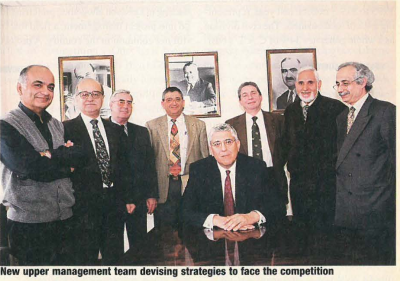
In 1997, Aramco, the world’s largest oil
company and C.A.T.’s major customer in
Saudi Arabia, was getting
ready to kick
C.A.T. out. “They told us we hadn’t done
much in the past ten or
15 years, and the last
few years we’d done
lousy work,” says
Habeishi. Aramco
allotted C.A.T. a probation
period of a few
months. Habeishi was quick to react. “We just
about fired anyone who wasn’t doing his job right,” he says, “especially people in important
positions.” He then rebuilt the work force
with qualified personnel. C.A.T.’s staff
grew from 2,494 in 1996 to 7,452 last year,
while millions were spent on reorganization,
training people and improving standards.
Habeishi also had to replenish the company’s
fleet of equipment. In the early 80s,
C.A.T. was among the best-equipped contracting
firms in the world, with 2,300 pieces
of heavy construction equipment in Nigeria alone. For 15 years the equipment had lain dormant,
been stolen, looted and cannibalized;
hundreds of millions of dollars’ worth was
reduced to almost nothing. C.A.T. managed to
salvage not much more than 60 pieces and
many of these were in need of repair. “We’ll
be spending about $130 million in the next
four years on replacements and new machinery
in the Gulf and
Nigeria combined,”
he says.
C.A.T. was once
again accepted as a
major builder for
Aramco and is now
pre-qualified. “Each
company has to go
through a pre-qualification
process, after
which the lowest bid usually wins the project.
That’s what C.A.T. has done to get mechanical works with Aramco,” says
Bassem Bou Chahine, vice president of
Albinali, a Saudi contracting firm that does
work for Aramco and Sabic and has a
turnover of more than $100 million.
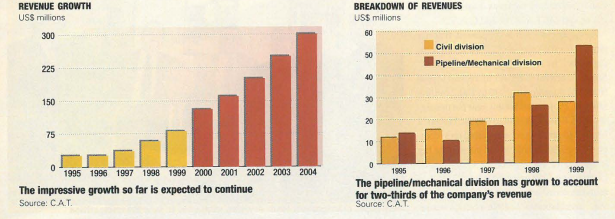
In the pipeline/mechanical division,
which accounted for two-thirds of C.A.T.’s
business in 1999, turnover generated in
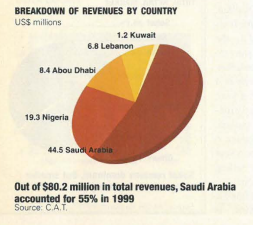
Saudi Arabia sprang from $3.3 million in
1995 to $44.5 million last year. That represents
55% of total turnover. Last year C.A.T. won a plant modernization project
with Aramco for $14 million. In the past two
years C.A.T. was awarded two projects
with ADCO, an oil producer in Abu Dhabi:
a $13 million contract to construct 48″
loading rings and a $38 million contract to
build water supply systems. It also landed
the Khuff Gas Project in the Hawiyah and
Hardh areas for about $500 million last
year, again from Aramco. “C.A.T. has
always been the leading contractor when it
comes to constructing pipelines,” says
Youssef Chammas, CEO of Target and
Jima, a contracting firm based in Dubai.
Chammas was general manager of CCC’s
Oman branch for over 20 years in the
1970s and 1980s and remembers when
C.A.T. was big.
Nigeria is a big playground for civil construction
work, but C.A.T. doesn’t have
the run of the place. There it comes up
against the likes of Stemco, a construction
firm with a yearly turnover of over $50
million. The value of projects for most
road and bridge works in Nigeria varies
between $20 million and $50 million,
according to Luke Okoihue, Stemco’s project
manager. And C.A.T. is better equipping
itself to face the competition. “Recently
we have opened some very substantial
credit facilities for projects in Nigeria,”
says Habeishi. “And we’re in the process of
spending around $30 million on equipment
for Nigeria alone.” Turnover in Nigeria
more than doubled from $9.5 million in
1995 to $19.3 million last year, representing
24% of total business. The civil division
as a whole generates 34% of C.A.T.’s business. It built the Sokoto-Goronyo Damsite
road, a contract worth nearly $30 million
in 1999. “C.A.T. has been a big name in
Nigeria for a long time and still is, but
today there are a lot of companies, especially in
Lagos, performing the same kind of work,”
says Okoihue.
At home, C.A.T.’s turnover rose from
$500,000 to $6.5 million – a contribution of
just 8% to total turnover. The firm has completed its part of the St. Georges Hotel
Complex, a project it was awarded in 1998
for $35 million. It has also finished 25% of
the work on the An Nahar building, a contract
worth $10 million, awarded in 1999.
But here’s the surprise: C.A.T. doesn’t do
construction work here. In fact it avoids contracting
in Lebanon altogether, preferring to
go into project management, a field that is
still not common in the country. A project manager takes on the responsibility of ensuring that a
project is properly executed on time and on
budget, hiring other contractors and engineers
to actually do the work. Should the
price exceed the guaranteed maximum or go
over schedule, C.A.T. is willing to pay a
penalty. Should it come under the maximum,
the savings are shared with the
owner. The Leisure Hill Hotel project, currently
under construction in Dbaye, is
being managed by Soludec Liban, an international
company. “Of course, the client is
informed of our decisions, but we control all
aspects of the project,” says Desire
Nicolai, Soludec’s general manager, who
agrees that project management is a novel
concept in Lebanon.
One example of C.A.T.’s project management
is the modern Lebanese Order of
Physicians Headquarters; ERGA was contracted
to do the architectural work and
Ashada for the concrete construction.
Phase one of the $14 million project is slated
for completion by February 2001. “It’s a
great idea and sure to be popular with project
owners, who have the risk completely
removed from their shoulders,” says
Souheil Abou-Habib, general manager of
Ets Nassim A. Habib, a local contracting
firm. But it might not be so popular with the
contractors: They won’t be able to underbid
to get a job, because it will be more difficult
to reduce costs by using less material.
While project management has allowed
C.A.T. to avoid costly investments in a
stagnant market, it eventually plans to do
construction work in Lebanon. “But only
after the sector picks up and it becomes worthwhile to invest locally,” says
Habeishi, who was initially intending to
do construction work in Lebanon.
Nonetheless Habeishi felt it was important
for a company to work in its home country.
But it was a painful and costly learning
experience. “We had a bunch of guys here
who knew how to build highways in
Amman and buildings in Saudi Arabia, but
they had no earthly idea what was going on
around them,” he says. At the outset C.A.T.
would bid about three times more than the
winning bid on tenders. “We had no idea
about pricing,” says Habeishi. “We didn’t
know the people, and nobody knew us.” So
he sent his staff into the field to learn the
local market. Eventually C.A.T.’s bids
became competitive, and Habeishi’s team
caught on to the aggressive underbidding tactics employed on the Lebanese market.
“Contractors bid below cost in order to get
the job,” says Abou-Habib. “Then they try
to reduce the materials used so they can
come within budget.”
C.A.T. has spent the last three years getting
ready to pounce on the market.
Habeishi believes the company is now
ready to regain its position as one of the
region’s major contractors. In the past few
years, C.A.T.’s biggest project was worth
$50 million, but now Habeishi and crew are
bidding on those in the $100 million to
$200 million range – sometimes as high as
$400 million. “It won’t be easy,” says
Chammas, “all the small companies that
existed in C.A.T.’s early days have grown
to become large contractors. They will face
a lot of competition.” One such foe is
Saudi Arabia’s Ali H. Al-Ghamdi
Est., which has a yearly turnover of
$72 million to $80 million performing
pipeline construction for
Aramco. “C.A.T. is a big name in
this area, but they’re mostly
involved in contracts for testing,
commissioning and maintaining
pipelines for Aramco,” says C.
Sundhyr, the firm’s project manager.
Estimates by some companies
in Saudi Arabia forecast an
increase of 70% from 1999 to 2001 for the pipeline business and the expected construction boom, but CCC is in a much better position to reap the
rewards. CCC employs some 36,000 people
and has a planned turnover of about $1.5 billion
for 2000, 8% of which is in the
pipeline sector. It will be difficult for
C.A.T. to muscle in on CCC’s turf. The
majority of CCC’s work is in the Arab
world and Africa, including new projects for
the Kuwait Oil Company, the Oman Gas
Company and the Abu Dhabi Gas
Company.
C.A.T.’s CEO is cautious about the pace of
growth that the company should expect.
“Today we would be comfortable going
after a project worth maybe as much as
$400 million, especially over a two, three-
year period,” says Habeishi. “I wouldn’t
fool myself that we can go after one worth
$1 billion.” That would stretch our management
and capabilities too far and require
a far greater investment than the company is
ready to make. C.A.T. would be content
with a yearly growth of 25% once it reaches
the $150 million to $200 million mark.
For Habeishi, turnover is not necessarily
a true indicator of size. “To a pure contractor,
it would be the value of the work done,
but to an EPC contractor, who is responsible
for the engineering, procurement and
construction, you also have the value of the
equipment you buy,” he says. If a contractor
builds a plant with $500 million worth
of machinery, turnover becomes misleading.
He especially believes growth through
acquisitions in this business doesn’t work.
Today C.A.T.’s name is still much bigger
than its actual size, but it has made solid
progress. After 15 years of being out of the picture,
the company is trying to build itself
back up to proportions that live up to its
name. The C.A.T. team has more than tripled
business since 1996, re-established a reputation
as potent contractors that produce quality
work, while project management further
refines its skills as a contractor. “They have
every chance of making it back to their initial
position in the market,” says Youssef, a
notion shared by many in the field. They may
just end up proving that old adage about cats
having nine lives. The company has been
reborn into its second one but seems bent on not needing any of its remaining seven.
Remember a few months ago?
You’re in the shower when the
power fails (courtesy of the Israeli
air force) and you have to dash for the generator
with a towel wrapped around you.
Generator sales must have boomed, right?
Wrong, actually.

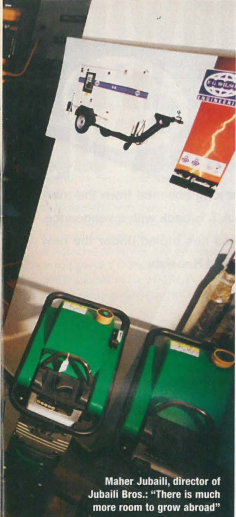
In fact many of those in the generator
business are complaining that these are
their darkest days. The majority of those
who require a generator bought one in the
early 1990s, when wallets were thicker and
power cuts more frequent. With the country
already saturated with generators, the air
strikes barely registered on the market. And
with construction at a standstill, sales
of generators have decreased from $40 million
in 1997 to $23 million in 1999 – a
43% decrease. At the same time, imports
have decreased from $35 million in 1997 to
just $20 million in 1999. Everyone is feeling
the pinch.
M. Ezzat Jallad, the exclusive agent for
Caterpillar in Lebanon, Syria and Jordan,
saw local sales of generators decline from $5
million in 1998 to $4.28 million last year.
Sales for Saccal Power Engineering
decreased from $3.45 million to $2.33 million,
a drop of over 32% (see “Trying to
buck the downtrend,” December 1999).
Jubaili Bros., the number one retail seller
of generators in Lebanon with just over
$20 million in global revenues last year, is
also suffering. Local sales, 70% of which are
from generator sets, have tumbled by 60%
since 1995, from $15 million to about $6 million last year. Time to pack up and call
the bankruptcy lawyer? No way.
Surprisingly, overall revenues actually
increased during that period, from $18 million
to $20.2 million in 1999.
How did they do it? With the domestic
economy stagnant, the company has been
boosting its exports. “Unlike the local market,
there is much more room to grow
abroad,” says Maher Jubaili, the firm’s
director. Jubaili started shipping generators,
most directly from the FG Wilson factory
in the UK, to Nigeria and the UAE in
1996. Both countries have an erratic supply
of electricity. Today these two markets represent
about 70% of the company’s revenue.
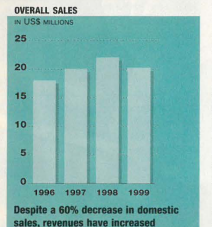
In Nigeria alone. Jubaili currently
controls 15% of the retail and wholesale
markets for generators. It was the first
Lebanese company to enter this untapped
market. Ghaddar Machinery, a competing
retailer of generators, arrived on the scene
more recently. But unlike Ghaddar, which
works through a local agent. Jubaili markets
and sells its generators directly there. This
gives the company an edge, says Jubaili.
The firm has entered other African countries
as well. In 1998, Jubaili spotted an
opening in Ghana, where there were only two
hours of power a day. In that year, the company
sold $2 million worth of generators in
the Ghanaian market, pushing Jubaili’s overall revenues up to $22 million. Most of
the exports were shipped directly from the
UK, but $800,000 worth were sent from
Jubaili’s Tripoli outlet, increasing the
branch’s sales from $900,000 in 1997 to
$1.7 million in 1998. But in 1999, Ghana’s
power problem was solved and sales to
that market stopped, leading to a slight
decrease in revenues last year.
Jubaili is now eyeing the Iraqi market,
another country suffering from power shortages.
But here, the company is a bit of a latecomer.
Ghaddar recently signed his third
contract in Iraq, a deal involving the sale of
250 60KVA generators for about $2 million.
Sacca!, which deals only in wholesale,
sent $4 million worth of generators there in
1999, and the latest deal was a $732,000 contract
with the Iraqi ministry of agriculture.
Despite Ghaddar’s success, Maher Saccal,
CEO of Sacca!, feels that Iraq is not a market
for retailers. “Iraq deals with public tenders
and you need to have the skills and the
know-how to succeed,” he says.
Although Jubaili has been focusing largely
on foreign markets, the firm hasn’t given
up hope that local business will improve**;** if
not now, then maybe in the long run. This has
prompted a diversification of its products in
an attempt to stimulate domestic sales. So
far, results have been mixed.
Jubaili is making a decent income from
renting out electricity. The company
recently landed some big projects, including
a $500,000 contract to provide
Bouygues, a French company in Solidere,
with 2,700 KVA of electricity for 20
months. Other successes include contracts
to provide Mannesmann in Abu Dhabi
with 2,500 KVA, and a Darwish Group
company in Qatar with 1,500 KVA.
Soundproof canopies, which Jubaili
assembles at its Sidon plant, have also
been selling briskly, accounting for
$540,000, or 9%, of local revenue in 1999.
“This is very profitable for us,” says
Jubaili, “because these days very few people
buy generators without canopies.” For
each locally assembled $5,400 27KVA
generator, Jubaili sells a $1,500 canopy.
But many new products have not paid off.
After Jallad’s sales of heavy construction
equipment declined from $7 million in
1998 to $600,000 last year, Jubaili started
selling light construction equipment. But, as
a result of the government’s budgetary policy,
construction never picked up. Jubaili
also tried selling air conditioning units, but
the added revenues were minor. “With so
many competitors in the field and too
many credit facilities, it hasn’t been a success,”
says Jubaili. The company also
earns money from after-sales services,
charging $35 for a routine checkup.
“Although 24-hour after-sales generates a
certain revenue, it barely covers our
employees’ salaries,” he says. Both Sacca!
and Ghaddar concur. With the market
depressed, profit margins are low for those
in the generator business. “We should have
a 10% profit margin,” says Ghaddar, “but it
is much less than this, even though we
have different products and services.”
As if all this wasn’t enough, the company
may soon face a challenge to its exclusive
agency rights for FG Wilson generators.
Caterpillar recently purchased FG Wilson
and Jallad is now selling the same generators
as Jubaili but under the name
Olympian. But Jubaili is not worried that the
two sides will come to blows.
“Caterpillar’s sales focus on a range of
higher-end generators,” he says.
The company has had disputes with
other competitors. Not long ago, Jubaili
began importing Perkins engines, manufactured
by FG Wilson, and assembling
them here. That prompted Ghaddar, who is
the local distributor for Perkins products, to
take Jubaili to court. “We have a right to a
percentage from the sales coming from
Perkins,” says Ghaddar. After an acrimonious
dispute, the two sides came to an
agreement. Jubaili was given full rights to
continue importing Perkins engines, as
long as they were assembled locally and
sold under a different name.
These problems have been a headache for
Jubaili, but they are minor compared to the
slowdown in the economy. Jubaili has
stayed afloat by focusing on markets
abroad, but exports will probably just keep
the company alive. If revenues are really to
grow, a turnaround is needed in the domestic
market. By leaving no stone unturned
locally, Jubaili has played his cards right.
When business in Lebanon hits an
upswing, he will be prepared.