• Donate
  • Our Purpose
  • Contact Us
Executive Magazine
  • ISSUES
    • Current Issue
    • Past issues
  • BUSINESS
  • ECONOMICS & POLICY
  • OPINION
  • SPECIAL REPORTS
  • EXECUTIVE TALKS
  • MOVEMENTS
    • Change the image
    • Cannes lions
    • Transparency & accountability
    • ECONOMIC ROADMAP
    • Say No to Corruption
    • The Lebanon media development initiative
    • LPSN Policy Asks
    • Advocating the preservation of deposits
  • JOIN US
    • Join our movement
    • Attend our events
    • Receive updates
    • Connect with us
  • DONATE
Best Sellers

Bent out of shape

by Hadi khatib May 1, 2000
written by Hadi khatib

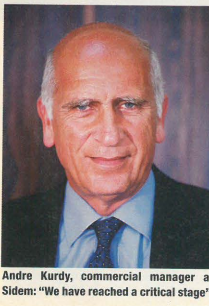
Last year was tough for Sidem. Having long dominated the market for aluminum profiles, the company barely managed to break even. “We have reached a critical stage,” says Andre Kurdy, commercial manager at Sidem. That follows half a century of turning profits, leaving management perplexed as to how to turn its fortunes around. “In our industry, Sidem is a trademark,” says Rafik Azrak, CEO of Folda, which manufactures and supplies aluminum-based products and had a turnover of $8.4 million in 1999. “They’ve enjoyed a monopoly for so long. They didn’t feel the day-to-day competition and may have inherited a heavy structure.”

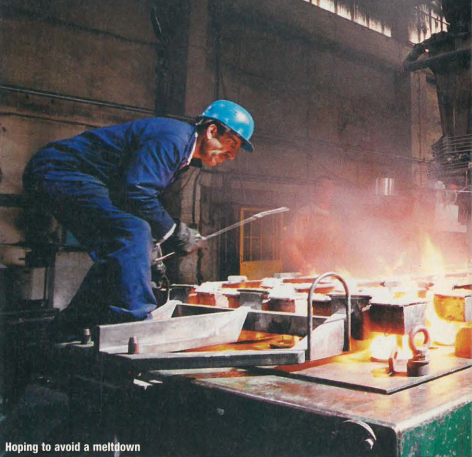
Sidem, an extruder of aluminum profiles (extrusion involves pushing aluminum cylinders through pre-shaped molds to create architectural profiles of different shapes and sizes) used in the manufacturing of doors, windows and curtain walls, dictated prices until 1995. But cheaper imports, the arrival of local competitors and reduced tariffs with Arab countries combined to push prices into a further decline, a trend that had already begun in 1990. Having operations at full capacity, high exports and about $55 million in annual sales have not been enough to secure profits.
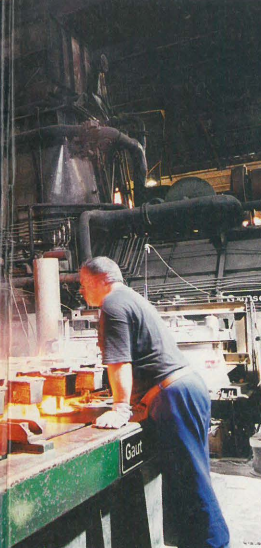
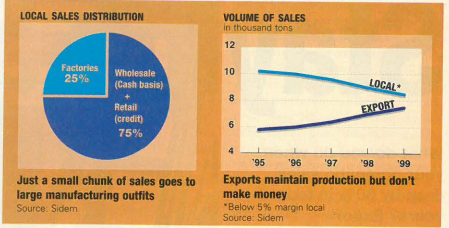
The local demand today is an estimated 12-14,000 tons. Already that’s not enough to absorb Sidem’s production of 16,000 tons. In fact, local sales dropped from 10,200 tons in 1995 to 8,500 in 1999. Now the two newcomers, Aluxal and Alutex, are competing for a chunk of the market. Having started production in 1994, Aluxal churns out some 4,000 tons a year. It sells to the retail market, which also accounts for 75% of Sidem’s sales.

The local market is further crowded by some 2500 tons of imported aluminum profiles, largely from Syria, Jordan, Saudi Arabia and Greece. That figure could have been much higher, had Sidem not systematically reduced prices to keep imports at bay. The company was protected by 20% customs duties on imports from Arab countries three years ago. However, the Arab free trade agreement has brought the tariff down to 14%, to be followed by a drop to about 12% next year, while the bilateral agreement with Syria has cut the duty to 10%.

With the Lebanese market so competitive, Sidem has increased sales abroad, sending half of its production to Europe. But exports are not a money-maker. “The purpose of exports is to keep our factory working at full capacity, which reduces our cost per unit, creating an indirect saving rather than profits on the product itself,” says Kurdy.

The main factor for the decrease in local sales is the stagnant real estate market, bloated with 7000 empty units and a 60% drop in construction permits. Folda, which bought an average of 545 tons a year before 1999, says its purchases have dropped significantly.
As a result prices have been slashed from $4,000 to about $3200 per ton in the local market today. Imports cost $2600 per ton, but many local clients say they still prefer to deal with Sidem because of its proximity to the market, its reliable quality and service. Many imports are below standard specifications. The downturn is difficult to swallow for a company that was the region’s first to specialize in aluminum extrusion, even if it is still the dominant player on the market.

Sidem began in the early 1950s with rolling mills producing aluminum sheets. In the early 1960s, it entered a joint-venture with Pechiney, the world’s second largest producer of aluminum, which purchased an 80% share. Also a manufacturer of extruded profiles, Pechiney sold its stake to the current Sidem shareholders in 1980 because of the war. Since then Sidem has remained fully Lebanese-owned and worked in aluminum extrusion. Believing the war was reaching an end and anticipating a construction boom, Sidem in 1982 embarked on a $10 million investment to double its capacity.

By 1986 the company found itself with three presses and production capacity of 16,000 tons and a country still at war. The short-lived solution was to send 60% of its production to the region. By the mid-80s, customs barriers were fully erected due to rapid regional factories, and the only alternative for Sidem was to go to Europe, a market of some 2 million tons yearly.

Though no longer partners with Pechiney, Sidem was able to take advantage of the earlier association to gain credibility. Additionally, Sidem won the right to manufacture Technal designs under license in 1980. France’s Technal is among the top five extruders of window profiles in the world. “It was our main entry break into Europe, because it means we’re producing under high specifications using the highest of technologies,” says Kurdy. Starting in Italy, the company expanded operations into France, Germany, Holland and the UK. Exports to Europe grew from 2000 tons in 1990 to about 7500 tons today, and Sidem stays competitive by investing $500,000 to $1.5 million yearly to upgrade machinery and install new technologies.
But how will Sidem manage to make money again if its local margins continue to be squeezed and exports aren’t profitable? Sidem cannot compete in the Arab world; energy and labor costs are half what they are here, and governments provide subsidies to encourage exports. Here the government is full of promises but rarely comes through. Additionally, other governments assist industries in recycling or disposing of their waste. There are no such solutions for Sidem.

Sidem, Folda and others have been asking the government to at least restrict the import of cheap products that don’t meet specifications, such as a 4mm thick window profile, which will bend easily in normal wind conditions. “This is not allowed anywhere in Europe or even as close as Syria, but anyone can import those into Lebanon,” says Azrak, adding that since aluminum is priced by weight, the thinner the product the lower the price.

If Sidem was thinking of expanding operations in preparation for the Arab free trade zone, it will find itself at a disadvantage to other factories. “We have a plan to move our operations from our 55,000m² area to a 200,000m² area, where we could increase capacity to 25,000 tons, but we don’t see the right conditions to proceed [with the $40 million investment],” says Kurdy. Sidem might be able to increase margins by streamlining operations and reducing its staff of 500. So far there are no indications that the company is contemplating that option. Sidem is feeling the heat. It will have to make some tough decisions soon if it’s not to go from a year of zero profits to one of losses.

May 1, 2000 0 comments
0 FacebookTwitterPinterestEmail
Best Sellers

Trading on a shoestring

by Hadi khatib May 1, 2000
written by Hadi khatib

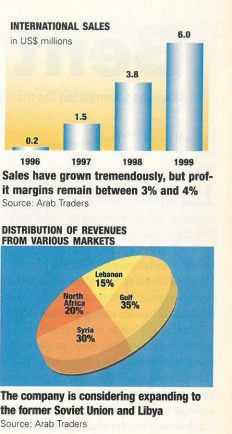
No trucks, no warehouses, not even a single forklift. Just three rooms, two desks, one secretary and a couple of phones. Not much more can be found on the premises of Arab Traders. That’s bare bone facilities for a trading company that generated $6 million in revenues last year, but keeping business simple is one of the reasons for its success. Arab Traders deals primarily in supplies for the oil and gas sector as well as aluminum, steel and power generation units. Its revenues have shot up from just $200,000 in 1996, when the company was founded. How did it do it?

Arab Traders acts strictly as a middleman, placing orders only after closing a deal with a buyer. It avoids tying up its own funds in goods that might sit idle in a warehouse. Once both parties have signed a contract, Arab Traders opens a letter of credit, has the supplies shipped and pockets a commission. The company has built up a working partnership with over 30 suppliers worldwide, including companies in the US, UK and the Czech Republic. It actively markets their products in the Middle East, Central Asia and North Africa. “When we receive inquiries for equipment and we don’t have a supplier, we find one,” says Wissam El-Solh, general manager of Arab Traders. “We also search for new suppliers or manufacturers producing new technologies that will give us an edge.”

Arab Traders’ international reach is a big plus. The company is headquartered in Lebanon with branch offices in the UAE and Syria, but it’s not dependent on any particular country. Unlike traders who are captive to the ups and downs of the domestic market, Arab Traders will fill an order as far away as West Africa or Central Asia. It also has the advantage of being able to search worldwide for the most competitively priced suppliers, giving it an edge on tenders.

The supply of oil field equipment, including metal casings, plastic tubing and pipes, is Arab Traders’ main money-spinner, representing about 65% of total sales, or $4.2 million in 1999. Big markets include Syria, Dubai, Iran and a number of countries in North Africa. Recent oil price hikes have been particularly beneficial. “It was harder at first when oil prices were down. But with prices going up, the governments are more willing to spend money on new equipment and we are selling more,” says El-Solh. “Governments usually set a budget for projects, a certain amount for each barrel [of oil] sold,” says Fred Habeishi, chairman and CEO of C.A.T., a contracting company, which has laid down oil pipelines in Kuwait, Saudi Arabia, Abu Dhabi and Qatar. “When prices go down, they reduce that budget, but when they rise, they tend to spend more.”

But the oil business is also very competitive. Whenever Arab Traders wants to participate in a tender, it has to pre-qualify; references have to be submitted and the company’s track record established. Being a relatively newcomer to the market, Arab Traders often has to resort to offering quotes at cost in order to get its foot in the door. In many countries, Arab Traders has developed a list of contacts that are familiar with the quirks and characteristics of the market and can assist companies in gaining access to the right people. “Just about every other family in the Gulf deals in oil field supplies,” says El-Solh. “It takes a lot of fancy footwork to get in.”

About 16% of Arab Traders’ business comes from local sales of aluminum, supplying wholesalers and workshops with mill-finished sheets, coils and circles. Abiding by its strategy of importing only on order, Arab Traders avoids selling retail altogether. In 1996, aluminum represented 100% of its revenue. By 1999, this segment of business had grown to about $1 million in sales. Even with the real-estate market in a slump, business has been steady. “There isn’t that much going on,” says Toufic Bawab, a dealer in aluminum profiles. “Business has become very stagnant, but the manufacturers have to keep making the frames and stocking up, because with their overheads, it would cost them more to stop operating altogether.”

Arab Traders has been able to counter this problem by concentrating on the import of mill-finished aluminum, which, many in the business claim, is in higher demand than other kinds of aluminum. “It’s a modern product, it’s practical, light and long lasting,” says Fady Khairallah, managing director of Edmond Khairallah Est., a firm whose activities include aluminum wall cladding, partitioning and false ceilings. “The market for the product is always going up,” says Habib Kehdi, technical coordinator for Alumco, a company specializing in aluminum and glass contracting. “Everybody is switching to the use of aluminum in place of other materials.”

Arab Traders has also been adding new products to its line, among them pre-fabricated parts made of aluminum that are used to set up storage facilities and other light structures. “We do look for new products and try to stay ahead, but we don’t want to be a jack-of-all trades,” claims El-Solh.

But there is a downside to the firm’s methods. Though importing back-to-back avoids many of the risks that accompany the stocking of goods, safety has its price. “The margin is about 3% to 4%,” says El-Solh. “If we were to buy the goods ourselves, the margin would jump up to 25% or 30%.” The problem with doing that, says El-Solh, is that the demand for products is neither large enough nor regular enough to make such a commitment worthwhile. If Arab Traders were to have to sit on stock until it were sold, the loss in interest would be considerable.\

The company is also encountering barriers to its growth. “Although we’re selling over $4 million in oil field supplies, we don’t expect to sell much more because the markets tend to get saturated with competitors,” says El-Solh. To counter this trend, Arab Traders has been breaking new ground in the Caucasus and Central Asia of the former Soviet Union. “They will start drilling eventually,” says El-Solh. “We want to be one of the first there when they do.” Another possible new frontier for Arab Traders is Libya. “With the lifting of the embargo, it’s becoming a booming market,” says El-Solh. Are his expectations justified? Habeishi seems to think so. “We are looking for projects in some of these newly emerging countries,” he says. But new markets pose risks. “We faced a lot of problems in Iran,” says El-Solh. “After we opened letters of credit and shipped the goods, they took so long to pay us that we had to sell the LCs off at a discount just to get our money back.”

Increasing revenues from $200,000 to $6 million in four years with nothing but the bare necessities is certainly an accomplishment. But a company can only grow so big when operating on a shoestring. Further expansion may mean taking the giant leap from being a mere middleman to becoming the seller itself. And that would mean taking on new risks. Maybe Arab Traders should be shopping for a warehouse and a couple of forklifts.

May 1, 2000 0 comments
0 FacebookTwitterPinterestEmail
Editorial

On your own

by Executive Editors April 30, 2000
written by Executive Editors

Too often attention is focused on government meddling in the
economy. At the same time, others call on the state for a fix.
But there are companies that are mixing their own medicine.

Look at Uniceramic. Despite a slump in sales last year, profits continued
to rise. This is a result of a massive restructuring program
that reduced expenses, improved products and changed its marketing
strategy.

In the middle of Lebanon’s worst real estate downturn, Massaad
Fares is selling property at some of the highest prices in the city. A
strategy unique in Lebanon, he focuses strictly on demand and doesn’t
build just for the sake of it. Société des Ciments Libanais is doing
its best to get around the Lebanese taboo, laying off workers to
counter another year in the red.

After the war, the situation at Trans Mediterranean Airways (TMA)
<mark>spiraled</mark> out of control. It was stuck with a few old planes, was losing
money and faced stiff competition. But since Fadi Saab came
on board, TMA has been given a major overhaul. It is now making
profits again. That is the opposite of what is happening at MEA, a
state-run enterprise. It has 433 employees for each of its nine airplanes,
the highest in the world, never makes money and is not doing
anything about it.

Perhaps the private sector should be the leader in bringing this economy
back to life and let the government fix itself.

April 30, 2000 0 comments
0 FacebookTwitterPinterestEmail
Executive Living

Rolling dreams

by Avo Tavoukdjian April 7, 2000
written by Avo Tavoukdjian

One look at her smooth, sensuous body and you cannot help wanting her for your own. Gentle curves suggest an inborn grace that would master the envy of all who lay eyes on her. So immense is her beauty that some would pay top dollar to get their hands on her. So, if she is yours, why not capitalize on your investment. Welcome to the world of collectible cars.

Even though the modern motor car is an outstanding technological achievement, comfortable, quiet, safe and extremely convenient, people still lust for the classics. Ever since cars were invented, people around the world have had a passion for owning the rarest and most attractive models, and Lebanon is no exception. The collectible car boom happened in the 80s and demand for these expensive toys has been falling ever since, now even more in the midst of a recession. So if you are looking to sell your vintage Mercedes-Benz at a premium, forget it. But if you are looking to buy, there are great deals to be found.

Investing in a classic is like buying stocks. You gamble that your investment will pay off. If no speculation were involved, everyone would do it. People think that just because a car is old, it will become valuable, says Andre Morcos, co-owner of Garage Mondial, one of the country’s most reputable restorers. Not true. You cannot make a Peugeot 504 into a gold mine. The same goes for a Renault 18 or a 1978 BMW 528. They were mass-produced and are simply not rare enough.

Cars that tend to appreciate in value are models manufactured in limited quantities or early examples of specific models. Keep an eye out for coupes and convertibles, preferably manufactured before 1970. With a little bit of hunting, Mercedes-Benz 220 SEs from the 1960s or 220As and 220Bs from the 1950s are good investments and can be found relatively easily. Other good bets are Mercedes-Benz 350 SLs and 450 SLs from the early 70s, as well as the older 230 SLs, the predecessor of the modern SLK. MGAs from the 60s and MGBs from the 70s, whether coupes or convertibles, are also good choices, as are T-Birds from the 50s and 60s or even Jaguar E-Types.

A Mercedes-Benz 220 will usually sell for about $4,000 to $5,000. MGs can cost as little as $2,000. A T-Bird may cost no more than $5,000. But buying a classic car is not the expensive part. Most will be in need of repair. Depending on the car and its condition, restoration can cost anywhere from $10,000 to $30,000, usually much more than the car’s actual value.

One thing to watch out for when choosing a car is corrosion. If the car has been neglected or has been exposed to too many winters, stay away. Corrosion is like a disease. Once it sets in, it is hopeless. Chassis damage also makes a classic an unsound investment. Aged cars are not a problem, and neither is minor body damage. But if the car needs replacement parts, make sure they are available.

There are several popular restoration shops in the country. Fersan Haddad defines a classic as a car that is both older than 25 years and has some historical or sentimental significance. He has done remarkable work on Triumphs, Mercedes-Benzes, rare American cars and Rolls Royces. Mondial has worked on everything from Porsches, Rolls Royces and Jaguars to MGs and Alfa Romeos. But do not forget restoration takes time, so do not plan on driving away with your showroom classic two weeks after you take it to the shop. Anything between six months to a year may be needed to get a car in shape. Car restoration shops are also good places to go if you are looking to buy.

Although restoring a classic will initially cost more than the car’s value, Morcos says old cars either maintain their prices or increase in value. Meanwhile, you get to drive around in a rare piece of art and will be the envy of all your friends and neighbors, and that is where the real payoff lies. After you spend large amounts of money getting that old T-Bird, Jaguar or Alfa Romeo in original showroom condition, you get to take it out in the sun, drop the top and cruise in a unique piece of history. And, hopefully, the price tag will only increase.

April 7, 2000 0 comments
0 FacebookTwitterPinterestEmail
Executive Living

The quest for samadhi

by Natacha Tohme April 7, 2000
written by Natacha Tohme

In the last two decades, a booming industry has formed
around the increasing drive for that perfect body. A
plethora of gyms, equipped with state-of-the-art fitness
equipment, have opened, exercise videos became all the rage,
and just about every book offering a miraculous weight-loss
plan became a bestseller. But today people are starting to
realize that slim, trim and muscular just isn’t enough, that
there’s more to feeling good than looking good. More and
more people are looking for a holistic approach to health and
fitness. Hardcore workouts are being supplemented, even
replaced, by gentler exercises that incorporate the well-being
of the mind, body and spirit. No better is this demonstrated
than in the growing popularity of yoga.

“Yoga means a union,” says Robert Kfouri, author of nine
Arabic books on yoga and Far Eastern mysticism. Kfouri has
been practicing yoga for about 25 years. The goal of yoga,
he says, is to reach a mystical experience known in yoga circles
as samadhi — a state where the mind transcends the body.

The yoga most people are familiar with involves posture and
breathing exercises aimed at relaxation and well-being.
But there is more to the art than just sitting cross-legged in
the corner. The most serious yoga followers also adhere to
rules and observances governing their personal life, including
non-violence and renouncing materialism.

“This way you can develop your heart. Nobody has reached
samadhi through the physical approach alone,” he says.

While classical workouts develop the superficial muscles of the
body, yoga tones the body from the inside. “Yoga addresses
the health of the glands,” says yoga teacher Nabil Najjar, who
often refers to devoted yoga practitioners as “yogis”. Yoga
positions counter the body’s aging process by keeping the
muscles elastic and the spinal cord — the body’s mainframe —
elastic and straight. The two most important positions, says
Najjar, are the headstand and shoulder stand, which are good
for the body’s glands, especially the pituitary and thyroid
glands, as well as the circulatory system. “Whenever the
body is inverted it does tremendous good for the internal
organs because the pressure on them is inverted and they are
massaged,” says Najjar. Another notable position, the forward
bend, stretches the whole back, massaging nerve centers and
opening them up if they are blocked. Yoga teacher Hayat
Mansour teaches special yoga postures for pregnant women.

But there’s more to yoga. Besides the exercises, a proper
diet, breathing, relaxation and positive thinking are required.
The yogi diet is vegetarian. Coffee and cigarettes are definite
no-nos. Breathing exercises help settle the mind. At the
end of every yoga session, students are guided to perform
what is called “final relaxation”. “Relaxation is like the cooling
system of a car. If you don’t cool the car it will burn out,
and likewise, if human beings do not relax they will burn out,”
says Najjar. Positive thinking is important because negative
thoughts cause negative events to unfold. By replacing negative
thoughts with positive ones, a person won’t become agitated
when yelled at, and then transfer his “bad mood” to someone
else. For those who can’t stop obsessing about that perfect
body, there is good news as well. Yoga can help a person
lose weight. “Yoga checks extreme behavior,” says Najjar.
“If you eat a lot, it naturally reduces your appetite. If you
are nervous, it calms you down.”


Yoga in the workplace

Companies are discovering that yoga and meditation can increase productivity.
Studies show that employees perform more efficiently if they
take a daily break of 20 to 30 minutes to practice yoga. “It produces
a general atmosphere of harmony and more creativity, which boosts
the company’s efficiency and thus has financial rewards,” says
Robert Kfouri. “Employees do less but accomplish much more. A tiger
would not make any move that is unnecessary. Yet he is very alert.
And when he does make a move, it’s the right one.” Yoga, Kfouri
explains, helps to sharpen the mind and improve concentration.
“Sharper minds don’t waste energy.” CAMS recently introduced yoga
classes to its employees, probably the first local company to discover
that yoga is a good motivational tool.

April 7, 2000 0 comments
0 FacebookTwitterPinterestEmail
Executive Living

Offices that make money

by Natacha Tohme April 7, 2000
written by Natacha Tohme

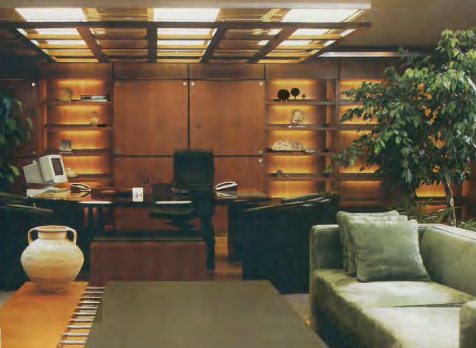
Justifiable or not,
clients often judge a
company by its
offices. Interior designer
Jean-Louis Mainguy, the
creative genius behind
the interior of BNPI in
Borj al Ghazal, understands
that well. His
office features a superbly
crafted floor-to-ceiling
bookshelf, which, when
slid open, reveals a conference
room. Besides
being visually appealing,
the bookshelf serves two
practical functions: it
provides storage and acts
as a wall dividing the executive office and conference room. The office communicates
professionalism and trust, though Mainguy simply
believes people should be comfortable in their workplace.

Ghalal Mahmoud, interior designer for GM Architectes, says
the first thing he considers when designing an executive office
is what the company sells. Aesthetic designs are suitable for
creative businesses, such as advertising or architectural
firms, while for banks or financial institutions the traditional
English look suggests that a business is long established
and credible. “It says ‘don’t worry about giving us your
money, we’ll take good care of it’,” says Mahmoud.

But the tastes of businesses are changing. In the age of
cyberbanking and tech stocks, financial institutions are
opting for more modern designs, “to show that they understand
the technologies they sell,” says Mahmoud. But a company
must be careful. If the decor is too outlandish, clients
are likely to think, “this company is too crazy for me — I’m
not going to give them my money,” he says. Many firms try
to create balance by combining traditional materials, such
as mahogany wood, with modern materials like stainless
steel. GM Architectes recently designed a Financial Funds Advisors
office in this way. “It’s very modern and high tech,
but at the same time it doesn’t cause clients to panic.”

Another important factor to consider is the personality of
the businessperson who will use the office. Mainguy and
Mahmoud say most clients ask that their offices reflect their
hobbies. Executives interested in ethnic art might request
African sculptures to complement the decor, while a weekend
sailor would likely ask for nautical motifs. Personalized
offices break down barriers and create an open and human
relationship between executives and their clients, even staff.

Women tend to understand this better than men, says
Mainguy. Male executives prefer their offices to have a serious
atmosphere, which is achieved by using geometrical
shapes, dark colors and conservative materials, while
women select softer tones and fabrics. “The personality of
a woman in business is totally different from the old manners
of men,” says Mainguy. “Business is life — it’s not so
serious.” He prefers to use circular forms and brighter colors
to convey a more relaxed atmosphere.

Great, but how much does this fancy decorating cost? “It’s
important to know the size of the space and the budget of the
client, and work within that fixed parameter,” says Mainguy.
Of course, costs rise if certain technical items, such as a proper
lighting system, are not already in place. Either way, there
is a considerable price to pay for a successful image. Executive
desks range between $2,000 and $5,000, and executive leather
chairs cost about $1,000. And that’s just for starters.

No man’s office

Got an important interview with the vice president of a big corporation?
You know, the kind where you must wait patiently in the
lobby until his secretary ushers you into a plush office where the “big
man” stares at you from behind a mahogany desk the size of a dining
room table. Don’t be surprised if, instead, your “big interview” actually
takes place in a very public conference room that the employees
use to meet clients.

In the push for efficiency, more companies are redesigning their workplace
environments. “There’s no hierarchy anymore — the boss with his
big office and the employees assigned cubicles,” says interior designer
Galal Mahmoud. Private offices have been replaced by open workstations.
Instead of being placed in lofty offices, far from the rank and
file, managers are being given desks close to their employees. Rather
than working independently, employees are clustered together in
work groups. The only enclosed areas are “unassigned offices” (a new-age
term for conference rooms), which are equipped with the latest
computer and projection technology. When employees, even managers,
want to see clients, this is where the meeting takes place.

Technology is also having an impact on the 21st century workplace.
The information age is also the age of the virtual office. Gone is the day
of the private desk with the private PC. These days, employees are
given unassigned workplaces, or “free addresses,” which they can use
on a first-come, first-served basis. Employees are provided with all the
tools needed for a paperless office, such as laptops. There are no personal
filing cabinets, but rather central filing systems. Desks aren’t even
equipped with phones. Phone calls are made through laptops. “You
come with your laptop, plug it in and you’re in the system,” says Mahmoud.
“You access all the company information you need through a
plug. The only item that is yours is your laptop and pen.”

April 7, 2000 0 comments
0 FacebookTwitterPinterestEmail
Tech Knowledge

Wise guys

by Mira Baz April 7, 2000
written by Mira Baz

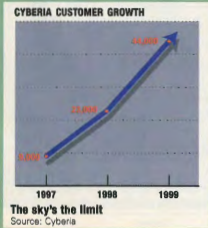
Following PSINet’s acquisition of Lynx

Following PSINet’s acquisition of
Lynx, EXECUTIVE asked several
Internet service providers (ISPs) whether
they’d sell. IntraCom wouldn’t comment,
while Cyberia had “no incentive to sell”
(see “The next wave.com”, March 2000).
Of course it doesn’t; it wants to gobble up
the rest. Soon after, in an email to its customers,
IntraCom stated that it would
“transition” its customers over to Cyberia.
What’s the deal? Talking exclusively to
EXECUTIVE, Aboud Omari, CEO of
Cyberia, and his counterpart at IntraCom,
Adel Rida, highlight the terms of the deal.

IntraCom, which claims to hold the second
position in the consumer market, is leaving
the ISP market to become an application
service provider (ASP), under the name
XtraCom. It will concentrate on the corporate
market, where the big dollars are, by
offering consulting and Internet services,
such as e-commerce and its popular
AudioTex, but no dial-up. “Dial-up will
be handled under the Cyberia brand,” says
Rida. Merger? No. Acquisition? Kind of.

Omari approached Rida last fall. “I
convinced him to sell,” says Omari.
“Costs are high. Only networks with a
significantly high number of clients can be
cost-effective. And the most effective
way is by acquiring.” Going after 6,000
users would cost $1,000 per user over a
period of six months, Omari says.

Rida insinuates that the deal contains two
parts: valuing the customer base and sharing
revenue per customer for a certain period
of time. Omari maintains that “money
will go to pay off any outstanding debts.”

Cyberia gave IntraCom clients, who were
paying $11.99 and $19.99 for unlimited and
digital unlimited access, a two-month period
of free access, until May 1, when
IntraCom would leave the picture.

Simply put, Cyberia bought IntraCom’s
database and dial-up network. There’s a
discrepancy over the number of customers.
Cyberia downplays it to 13,800
customers, 35% of which are inactive.
Omari expects between 6,000 and 7,000 to
shift over to Cyberia. Rida, on the other
hand, boosts the number to 17,000, with
about 12,000 active accounts. Based on
Omari’s estimations, that would pump up
Cyberia’s database from 44,000 to around
50,000. It will control over 60% of the market,
according to Rida.

“We have an infrastructure that can handle
up to 30,000 users and a bandwidth of 512
kb,” Rida maintains. Other major players
remaining are IncoNet, Data Management,
TerraNet, and Sodetel. When it entered the
market in October 1998, IntraCom’s projections
were to reach 30,000 customers in
two years. “But growth is very slow and it’s
a small market,” says Rida. “One ISP is
enough for this market, really.” IntraCom
will concentrate on its dial-up markets in the
UK and especially Nigeria, where the number
of connected users reached 200,000 in
one year, according to Rida.

Oh, and one more thing. “There’s an
understanding of cooperation [between
the two companies] in markets abroad,”
Rida adds, “which will boost Cyberia’s
value-added services.” Who’s next?


From airwaves to cyberwaves

Listening to the radio? That’s so passé.
Now FM stations are battling it out in
cyberspace. Mix FM (104.4 FM) launched
its $4,000 website on the occasion of its
fourth anniversary on February 23. Eat
your heart out, Radio One. But the two
websites project different images. Mix
FM, specialized in dance music, wants to
create a dance club image — “trendy and
cool,” says general manager Roger Saad.

The website was designed by Prezorse,
a US-based company, using the all-popular
Shockwave Flash 4. It has the regular
features: charts, real audio, chatting and
email accounts. The station’s target audience
is listeners between the age of 15 and
40. “We don’t claim we’re number one,”
says Saad. “We say we’re the most listened
to radio station.” The proof, according to
Saad, is that Mix FM can be heard in
shopping centers, restaurants and shops.
The station, which started out with low
costs, started seeing profits after nine
months on the airwaves, and has been
growing steadily. It attributes its success
to the popularity of dance music.

For its part, Radio One received the
award for the “Number One Arab website”
from the UAE satellite TV, and its developer,
Wael el Zanaty, was there to accept
it. Radio One’s new look upgrade is due on
April 1. Let the battles begin.


Lotus notes local company

Anzima Cooperative Solutions (CS)
recently received the “Best New
Comer” award from Lotus Middle East, an
IBM company that includes an area from
Egypt to Pakistan. Anzima CS, owned by
Elie Tabet and Fares Kobaissi, is one of
over 200 companies providing software
solutions to businesses. Launched two
years ago, the company uses the Lotus
Notes software and has an impressive customer
list, including Fransabank and
PricewaterhouseCoopers. Its sales last year
reached $250,000, with a staff of ten.

Going up against heavies like Istisharat
and Software Design, the company operates
in a small market, hindered by a lack
of funding and thin margins.

Anzima is not the only local company
affiliated with Lotus. Two-year-old Trilog
Group, owned by Alex Homsi, is also a
Lotus “Premier Business Partner.”

April 7, 2000 0 comments
0 FacebookTwitterPinterestEmail
Tech Knowledge

Monkey on their backs

by Mira Baz April 7, 2000
written by Mira Baz

Most businesses only dream of making millions each year.
So one would think that Cellis and LibanCell, dubbed
“cash cows,” would be content just counting up the earnings
from their build-operate-transfer (BOT) contract that was
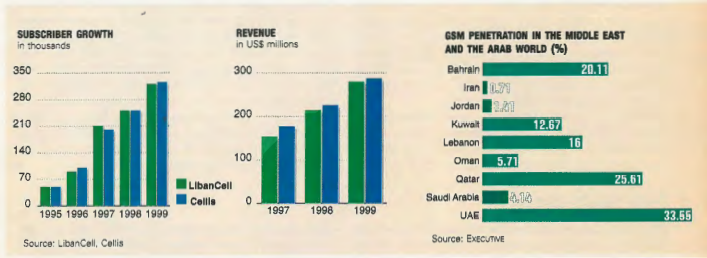
signed with the government over five years ago. Cellis generated
sales of $284 million last year, up from $225 million in 1998 when
it netted close to $37 million in profits. LibanCell made $42 million
in profits from a turnover of $279 million last year. Given the
rarity of such impressive earnings in Lebanon these days, who
wouldn’t want to be running a cellular operation?

But the operators have gripes. That’s because the BOT contract,
though guaranteeing money in the bank, has kept constraints on
growth. The operators are trying to get a license, which would give
them greater freedom in running their business. Ultimately that would
mean a healthier expansion of the market and greater revenues.

The essence of the contract is that the government collects a share
of every cent LibanCell and Cellis make, without investing a
penny. The operators’ networks are the property of the state,
which explains the condition in the BOT specifying the construction
of a network for a minimum of 250,000 users. The government
gets a 20% share of revenues, including those generated from the
connection fee, the monthly subscription and talk-time. In addition,
there’s a 10% municipal tax on each bill and a 6-cent tax per minute,
which was raised by the ministry of post and telecommunications
(MPT) last July. Revenue from international calls and the use of
landlines also go directly to the MPT because of its monopoly. In
total, the government cashes in 40% of all cellular proceeds from
each company, according to LibanCell. That of course is on top of
the 15% corporate tax that firms pay.

To ensure financial gain, the contract dictates the connection fee
at $500, the monthly charge at $25 as well as talk-time rates. It
exempts extra services, such as voice mail and call waiting, from
taxation. The operators argue that fixed prices and taxation
impede the normal growth of the cellular market. Following the tax
hike last year, demand has slowed and talk time has shrunk by about
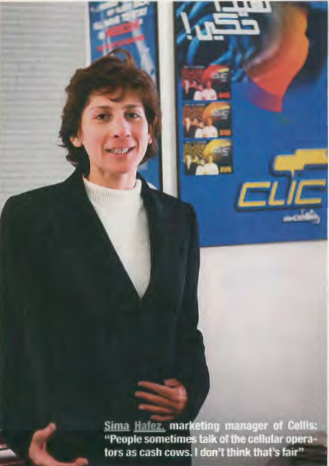
10%, according to Sima Hafez, the marketing manager of Cellis.

The two companies have the market split down the middle,
give or take a bit, with about 320,000 subscribers each. Hafez
explains: “There’s no difference in terms of pricing [on permanent
lines]. And the [area] coverage, as specified in the contract, is the
same. So definitely we share the same number of subscribers.”
Customers buy whichever cards are available, because prices are
the same. “There’s no rational selection,” says Magda Sacre,
commercial manager for LibanCell.

Neither company is happy with the situation, despite the impressive
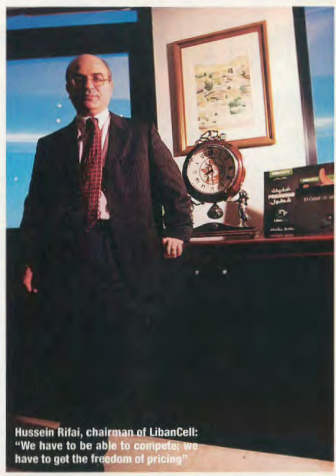
financial gains. They want their freedom. “Lebanon is a competitive
market,” says Hussein Rifai, chairman and general manager
of LibanCell. “We have to be able to compete; we have to get the
freedom of pricing.” Licensing would give them that as well as ownership
of the networks. Salah Bou Raad, chairman and CEO of Cellis,
explains that the government retains ownership of “airwaves,”
which it leases out to operators. He adds that licensing would further
allow the company to float shares on the Beirut Stock Exchange.

Growth has also been hampered by the ongoing fight over the permissible
number of subscribers (see “The government’s thirst for
more,” October 1999). The MPT’s attempt to impose a ceiling of
250,000 is disputed – and already surpassed – by both firms.
Also, a technicality with the numbering system on cellular lines means
the operators will max out their subscriber base at 400,000
each, which is expected to be reached by year-end.

But why all the fuss about licenses now? The answer may lie in
the unforeseen growth of the cellular market. When they were mining
for coal, they didn’t expect to strike gold. “We had to re-think
our investment strategy,” says Rifai. “We didn’t forecast such subscriber
growth and talk time, and so we had to increase our investment quite a lot for the first year.” Both LibanCell and Cellis have
doubled their subscriber bases each year in the first three years (see
graph). The MPT has received over $700 million in the past four
years, already coming close to the $800 million that was initially
projected over ten years.

But the operators claim the market could grow even more in a competitive
environment. The proof is the boom that followed the prepaid
cards. They were first introduced to the market in September
1997 by LibanCell. In just three months, the Premiere cards doubled
LibanCell’s customer base, from 110,000 to 210,000. “They
launched the cards before us at very cheap prices,” Hafez says. “We
were hurt by this offer, and we were losing our customers. We had
to compete. That’s not a duopoly; that’s real competition.” In
December of the same year, Cellis launched its Clic cards to recover
market share. The prepaid cards proved successful, mainly
because they had a wider reach to consumers with limited income.
And that allowed the companies to tap into a new market.

In its fever to bring in funds, the MPT is drawing up plans for a
state-run operator, under the umbrella of privatization. If it does,
the existing operators might get licenses. Otherwise the MPT
would be in breach of the BOT contract that grants exclusivity until
2004, though that could be extended if the agreement is renewed.
The MPT refused to comment on the matter because negotiations
are ongoing. The ministry is considering the options based on its
main objective of pulling in cash, according to one source. Three
meetings have taken place, which are thought to be positive. “All
parties involved want to reach an agreement fast,” says Bou Raad.

A third player would help spur competition. “Will that competition
drastically bring prices down? Competition normally brings
prices down,” Hafez says. “Any normal operator will grab a share
of the market when they enter and then they’ll grow. They might
undercut prices by, say, 10% to get part of the market.” Lower prices
should translate into an increased customer base. Needless to say,
that would benefit customers most. “Increased competition is
always good for the consumer,” says Bassam Yammine, senior manager
of the Corporate Finance Division at Lebanon Invest. “[It
would lead to] possibly lower prices and better services.”

Currently, customers have little choice. They’re the ones who have
full license to complain, really. Take for example the tax hike on
talk time – simply a way to bring in more funds. Compared to the
European average of 150 minutes, talk time in Lebanon is at least
700 minutes a month per person. The equivalent monthly bill for
a subscriber to a permanent line, making local calls only, would be
over $80, excluding taxes and extra services.

Regardless of whether the Lebanese ought to be condemned for having
a mobile phone glued to their ear, the cellular is a worldwide trend
that will continue to grow. Without the constraints of the BOT,
growth could be huge. Rifai estimates a penetration of 35% in the
next five years, a consensus shared by Hafez. She estimates that by 2004,
the number of cellular subscribers will go up to 1.4 million, more than
double the current level, which is roughly 17% of the population.

If privatization and the introduction of a third operator are
delayed, what are the chances of the operators getting licenses when
the contract expires? It’s not clear at this stage. The operators maintain
that licensing would increase government revenues. On the
other hand, the BOT allows the government to increase its share of
revenues to 40% in 2003 and 2004, and to 50% beyond that if
renewed. The MPT might not be eager to loosen the reins on its cash
cows. Unless it draws a good bargain, that is.

Top of Form

Bottom of Form

Two steps ahead

Both LibanCell and Cellis have plans to get into the new trend
sweeping Europe: the merging of Internet and wireless
technologies. Locally, LibanCell might have an advantage
because of its sister company, Internet service provider
TerraNet. “We will definitely have cooperation. We’re working on
providing Internet access to our subscribers,” says Hussein Rifai,
LibanCell chairman and general manager. Cellis, 67% owned by
France Telecom, might be able to bring in Wanadoo, the ISP
subsidiary of the French telecom. Speaking of innovation, both
operators have plans this year for mobile banking (M-banking) and
similar services, especially for their corporate clients.

Wireless Internet has just taken off in Israel. A joint venture,
GoNext, was formed between mobile phone company
Pelephone and Samsung distributor Sunny Electronics with a
$200 million investment. GoNext will enable clients to surf the
Internet in the HTML language and the Wireless Application
Protocol (WAP), especially developed for cellular phones.

Mobile Internet could well take off in Lebanon, as it is expected
to in Europe this year, since the number of cellular users locally
surpasses the number of Internet users by at least six times.
Also, cell phones are cheaper to own than computers. The question
mark remains for access prices.

April 7, 2000 0 comments
0 FacebookTwitterPinterestEmail
Money Matters

Shock therapy

by Executive Contributor April 7, 2000
written by Executive Contributor

There will be a new trading system soon. Please describe what it will be and when it will be implemented.

KHALAF: We’re going to start continuous trading as soon as
we have an agreement with the government. We already
have a deal with the Paris stock exchange to install the same
software program that’s used there. You’ll have on-screen
trading the same as in Paris. We’re hoping to get it within
12 months.

The first step will be the shouting system. It will be a temporary
period to get us to the computerized continuous
trading system. Because it’s a transitory period, we’ll
continue with our fixing system, but just for the opening. I
think we will open for one-and-a-half to two hours of
shouting, as in New York. The fixing system will also permit
small investors who don’t want to wait for the broker to
find other investors in order to be involved in trading.
Everybody will have a chance to trade on the BSE.


Why not a full day of trading?

KHALAF: In other countries they have much greater volume.
If we have more volume, we’ll be flexible. We’ll start with two
hours. When we find that there’s enough volume, we can go to
three hours, four hours, six hours and maybe even eight hours.


The BSE allows no more than a 5% price change in one day. Will you allow more fluctuations?

KHALAF: We will change it a little, keeping 5% for the fixing
and 5% for the shouting – 10% total. The committee can
decide to change this without going to another authority. We
will be going in steps, seeing how the market is acting and
reacting with our plans.


What are the benefits of the new computer system?

KHALAF: It will be easier for brokers to place their orders –
with just a click of the mouse. We have another proposal to
get on the Internet and link all Arab markets on the same
website. You go in and you get information on all the companies
and get connected to any trading room with continuous
pricing on it. This will start with the Kuwait stock market,
Cairo and Jordan.

Someone in another country might ask: “Is there a stock
market in Beirut?” On the Internet I have my CAC, my Dow
Jones, my Nasdaq. So if you have an Arabic website, you can
go and see what’s happening there.


When should we expect the Internet system to be in place?

KHALAF: I have to present it to the committee and sign it. Then
we can start to implement it. In the Gulf it took one year.


Are you pressing for the BSE to have a regulatory body soon?

KHALAF: As soon as possible. We are working on it. I’m
working with the minister of finance and others. Then we
have to propose it to the cabinet and then to parliament.


Can you give us a time frame?

KHALAF: I can’t say. It depends on how long it will take to
get through the cabinet and then how long it will take to be
agreed in parliament. I hope as soon as possible.

Meanwhile we can’t say there’s no department regulating the
market. The BSE is carefully watching the market, and the
central bank is carefully watching the financial institutions.
If there’s a transaction that’s not completely clear, we
can stop it and have it clarified.


It’s obvious that there is lack of transparency with some companies listed on the BSE. How are you going to improve on this?

KHALAF: What we have done is recruited someone to follow
companies for transparency, to make sure that they give us every
statement we need at the proper time. For banks it has to be every
three months, even if it’s not audited. For other companies it has
to be every six months. We haven’t implemented a fixed date.
But there is a logical time limit. As for other information, when
we think there’s information that needs to be published, we call
the company and if they don’t react we send them a letter that
they have 48 hours to inform the public.


But what about companies that are tardy with their financial statements? Will you make them pick up the pace?

KHALAF: It’s not easy to get audited year-end statements in
as early as February. In March we have to have it. We will
enforce it. We will be flexible if there’s a reason. We are not
rude, but we are becoming rigorous.


How will you control insider trading before the regulatory body is established?

KHALAF: It’s a bit hard to control insider trading with a fixing
system and little liquidity. You can control it if you are
watching your staff enough, and that’s what we’re doing.

What can we do with companies? It’s difficult. If you see someone
making a transaction and you think something is wrong, it’s
difficult to prove. We think that with the fixing system and
small liquidity, it’s easier to manipulate prices than with
continuous trading. What’s important is to prepare the market
to be more transparent and to reflect the reality of the transactions.
When you have continuous trading and more liquidity,
you cannot influence the market with only a few shares. It will
be easier to control the situation.


What’s your plan to promote the market?

KHALAF: We are working on putting together a marketing
campaign. The first step will not be talking about the BSE, only
what a stock exchange is, for the investors and the companies.
In the second phase, we will focus on what the BSE is. The third
one will include the progress made to improve the BSE.

To get to the public directly you have to go through television
and newspapers. To talk to investors in person, we will start
conferences in Beirut in April. We are also promoting the stock
exchange in other countries.


Are there any plans to relocate?

KHALAF: We’re trying to find a place in the Beirut Central
District. It will be the BSE building, in which we will have not
only the stock exchange. We have demands from financial
companies and brokers who want to be in the same building.


There is a problem getting companies to go public because of the tradition to keep business in the family. How can you persuade them to list?

KHALAF: To help encourage family businesses to become listed,
there are tax incentives. We are trying to help them become more
aware of the benefits, such as raising capital by being listed.

Dividend taxes were cut by 50%, from 10% to 5%. Some companies
want to be listed but are hesitant because of the lack of activity.
They are waiting for others to do it first. In 1997, when one bank
listed, others followed. When the first company comes, others
will follow.

April 7, 2000 0 comments
0 FacebookTwitterPinterestEmail
Money Matters

The Global Strategist

by Executive Contributor April 7, 2000
written by Executive Contributor

A US soft landing

US fund managers have raised their expectations for GDP
growth for 2000 and 2001. While 83% now expect Fed Funds to
rise over the coming year, they expect a soft landing free from an
upturn in inflation after just two more 25 bps rate hikes. We are
skeptical. In his Humphrey-Hawkins testimony, Alan Greenspan
said that he had been around long enough “to never take an oil
price shock unseriously”. He could have gone further in our view
and said that no central banker, himself included (1987–90),
had ever delivered a soft landing during one. Unless the oil
price falls and stays down, it still feels right to overweight cash.

European optimism is very high

A stronger than expected upturn in non-US growth could
drive the oil price higher. Europe could be one source of upside
growth surprises. Economic optimism is very high. Fund managers
assume that the ECB is hiking rates to offset the inflationary
impact of a weak euro, but they are not targeting below-trend
growth. Importantly, 77% of European fund managers think hiking
rates specifically “to defend the euro” would be a bad idea.
We agree. Such a policy could put the economic upturn at risk
by starting a vicious circle where equity capital leaves Europe,
the euro weakens further and rates are hiked again.

Getting bullish in the UK

Only 67% of UK fund managers expect base rates to be
higher in a year’s time. With inflation expectations modest, bears
of Gilts outnumber bulls by just 5% as against 37% in January.
Earnings expectations have stabilized and fund managers see
value in the market. Bulls of UK equities outnumber bears by
a strong 44%. Support for financials has risen, 41% now
choose it as their favorite broad sector. Financial stocks would
be major beneficiaries of a soft landing.


TMT: Looking for a way out

The TMT phenomenon

Global Tech, Media and Telecom stocks have outperformed the
broad equity market by a massive 180% since 1990. Relative
performance has been especially strong since the interest rate
cuts of 1998. These sectors now make up almost 40% of world
stock market capitalization. A large sector outperforming like
this demands attention. Most fund managers choose Tech,
Media or Telecoms as their favorite global sector.

How to value TMT stocks?

It can be a struggle to value these new companies. Many, especially
fledgling e-commerce businesses with high advertising
and capital spending needs, are not forecast to make a profit for
the foreseeable future. Traditional measures, such as dividend
yield or price-earnings ratio, mean nothing for such companies.
Most fund managers use PEG or EV/EBITDA to value TMT
stocks. These methods are deemed appropriate for fast-growing
profitable companies. For loss-making companies with high
scalability, fund managers prefer EV/Sales.

Overvalued and overweighted

Regardless of which method is being used, fund managers
in every region are unanimous in deciding that TMT stocks are
overvalued. However, the vast majority of these are overweight
TMT stocks. European and Asia-Pacific funds are
particularly overweight.

Looking for a way out

While Asian fund managers are generally happy with their
overweight positions, most fund managers in the US and
Europe expect to reduce their exposure to TMT stocks over the
coming year.

But what would be the trigger to make them sell TMT? In general,
managers are looking at company- or industry-level information.
A total of 57% expect some kind of sell signal from company
fundamentals, technical analysis or sell-side broker
recommendations. Only 15% think macroeconomics is relevant.

Macro factors suggest caution

Fund managers are looking for company-specific developments
to decide when to sell. But TMT stocks did not rise on a company-
by-company basis. They rose en masse. We think macroeconomic
factors will drive the reversal when it comes. Our suspicion
is that the rush into cyclical growth stocks like TMT was driven
by hopes of permanently strong growth with low inflation. The
growth stocks doing well are not the defensive ones, like consumer
products, but the aggressive cyclical ones, like technology.

The interpretation must be that the markets do not see rising
commodity prices as something that can cause inflation. In terms
of the “Investment Clock” diagram we use for our asset allocation,
the markets are assuming that we will always be in Phase II.

A new era or the Japan effect?

We are not convinced that such a new era is upon us. We prefer
to look for more mundane reasons for the strong growth and
low inflation in the US. Alan Greenspan took advantage of the
disinflationary impact of the decade-long slump in Japan by
allowing America to grow more strongly. Inflation fell as it often
does when growth is strong and competition is fierce. However,
non-US recovery could reduce America’s speed limit. As the Fed
slows growth, productivity could worsen, causing companies to
raise prices in response to rising unit costs. Rising inflationary
pressures should drive a move into value stocks. If global growth
peaks, on the other hand, cyclical earnings expectations are likely
to fall and we would find ourselves in Phase I or Phase IV.

Will Greenspan backtrack on the new era?

Alan Greenspan must target the US stock market to cut off the
equity wealth effect that is boosting consumer spending. So far
his rate hikes are having the desired effect on the Dow, but his
frequent affirmation that we are entering a new era seems to be
driving the Nasdaq higher. A strong Nasdaq could partially
counteract the dampening impact of interest rate hikes. This has
an interesting consequence. The more Greenspan verbally backs
the new era, the more he may have to raise interest rates. He risks
having to use a sledgehammer to crack a nut.

April 7, 2000 0 comments
0 FacebookTwitterPinterestEmail
  • 1
  • …
  • 698
  • 699
  • 700
  • 701
  • 702
  • …
  • 707

Latest Cover

About us

Since its first edition emerged on the newsstands in 1999, Executive Magazine has been dedicated to providing its readers with the most up-to-date local and regional business news. Executive is a monthly business magazine that offers readers in-depth analyses on the Lebanese world of commerce, covering all the major sectors – from banking, finance, and insurance to technology, tourism, hospitality, media, and retail.

  • Donate
  • Our Purpose
  • Contact Us

Sign up for our newsletter

    • Facebook
    • Twitter
    • Instagram
    • Linkedin
    • Youtube
    Executive Magazine
    • ISSUES
      • Current Issue
      • Past issues
    • BUSINESS
    • ECONOMICS & POLICY
    • OPINION
    • SPECIAL REPORTS
    • EXECUTIVE TALKS
    • MOVEMENTS
      • Change the image
      • Cannes lions
      • Transparency & accountability
      • ECONOMIC ROADMAP
      • Say No to Corruption
      • The Lebanon media development initiative
      • LPSN Policy Asks
      • Advocating the preservation of deposits
    • JOIN US
      • Join our movement
      • Attend our events
      • Receive updates
      • Connect with us
    • DONATE