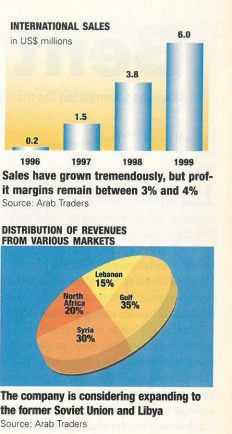
No trucks, no warehouses, not even a single forklift. Just three rooms, two desks, one secretary and a couple of phones. Not much more can be found on the premises of Arab Traders. That’s bare bone facilities for a trading company that generated $6 million in revenues last year, but keeping business simple is one of the reasons for its success. Arab Traders deals primarily in supplies for the oil and gas sector as well as aluminum, steel and power generation units. Its revenues have shot up from just $200,000 in 1996, when the company was founded. How did it do it?
Arab Traders acts strictly as a middleman, placing orders only after closing a deal with a buyer. It avoids tying up its own funds in goods that might sit idle in a warehouse. Once both parties have signed a contract, Arab Traders opens a letter of credit, has the supplies shipped and pockets a commission. The company has built up a working partnership with over 30 suppliers worldwide, including companies in the US, UK and the Czech Republic. It actively markets their products in the Middle East, Central Asia and North Africa. “When we receive inquiries for equipment and we don’t have a supplier, we find one,” says Wissam El-Solh, general manager of Arab Traders. “We also search for new suppliers or manufacturers producing new technologies that will give us an edge.”
Arab Traders’ international reach is a big plus. The company is headquartered in Lebanon with branch offices in the UAE and Syria, but it’s not dependent on any particular country. Unlike traders who are captive to the ups and downs of the domestic market, Arab Traders will fill an order as far away as West Africa or Central Asia. It also has the advantage of being able to search worldwide for the most competitively priced suppliers, giving it an edge on tenders.
The supply of oil field equipment, including metal casings, plastic tubing and pipes, is Arab Traders’ main money-spinner, representing about 65% of total sales, or $4.2 million in 1999. Big markets include Syria, Dubai, Iran and a number of countries in North Africa. Recent oil price hikes have been particularly beneficial. “It was harder at first when oil prices were down. But with prices going up, the governments are more willing to spend money on new equipment and we are selling more,” says El-Solh. “Governments usually set a budget for projects, a certain amount for each barrel [of oil] sold,” says Fred Habeishi, chairman and CEO of C.A.T., a contracting company, which has laid down oil pipelines in Kuwait, Saudi Arabia, Abu Dhabi and Qatar. “When prices go down, they reduce that budget, but when they rise, they tend to spend more.”
But the oil business is also very competitive. Whenever Arab Traders wants to participate in a tender, it has to pre-qualify; references have to be submitted and the company’s track record established. Being a relatively newcomer to the market, Arab Traders often has to resort to offering quotes at cost in order to get its foot in the door. In many countries, Arab Traders has developed a list of contacts that are familiar with the quirks and characteristics of the market and can assist companies in gaining access to the right people. “Just about every other family in the Gulf deals in oil field supplies,” says El-Solh. “It takes a lot of fancy footwork to get in.”
About 16% of Arab Traders’ business comes from local sales of aluminum, supplying wholesalers and workshops with mill-finished sheets, coils and circles. Abiding by its strategy of importing only on order, Arab Traders avoids selling retail altogether. In 1996, aluminum represented 100% of its revenue. By 1999, this segment of business had grown to about $1 million in sales. Even with the real-estate market in a slump, business has been steady. “There isn’t that much going on,” says Toufic Bawab, a dealer in aluminum profiles. “Business has become very stagnant, but the manufacturers have to keep making the frames and stocking up, because with their overheads, it would cost them more to stop operating altogether.”
Arab Traders has been able to counter this problem by concentrating on the import of mill-finished aluminum, which, many in the business claim, is in higher demand than other kinds of aluminum. “It’s a modern product, it’s practical, light and long lasting,” says Fady Khairallah, managing director of Edmond Khairallah Est., a firm whose activities include aluminum wall cladding, partitioning and false ceilings. “The market for the product is always going up,” says Habib Kehdi, technical coordinator for Alumco, a company specializing in aluminum and glass contracting. “Everybody is switching to the use of aluminum in place of other materials.”
Arab Traders has also been adding new products to its line, among them pre-fabricated parts made of aluminum that are used to set up storage facilities and other light structures. “We do look for new products and try to stay ahead, but we don’t want to be a jack-of-all trades,” claims El-Solh.
But there is a downside to the firm’s methods. Though importing back-to-back avoids many of the risks that accompany the stocking of goods, safety has its price. “The margin is about 3% to 4%,” says El-Solh. “If we were to buy the goods ourselves, the margin would jump up to 25% or 30%.” The problem with doing that, says El-Solh, is that the demand for products is neither large enough nor regular enough to make such a commitment worthwhile. If Arab Traders were to have to sit on stock until it were sold, the loss in interest would be considerable.\
The company is also encountering barriers to its growth. “Although we’re selling over $4 million in oil field supplies, we don’t expect to sell much more because the markets tend to get saturated with competitors,” says El-Solh. To counter this trend, Arab Traders has been breaking new ground in the Caucasus and Central Asia of the former Soviet Union. “They will start drilling eventually,” says El-Solh. “We want to be one of the first there when they do.” Another possible new frontier for Arab Traders is Libya. “With the lifting of the embargo, it’s becoming a booming market,” says El-Solh. Are his expectations justified? Habeishi seems to think so. “We are looking for projects in some of these newly emerging countries,” he says. But new markets pose risks. “We faced a lot of problems in Iran,” says El-Solh. “After we opened letters of credit and shipped the goods, they took so long to pay us that we had to sell the LCs off at a discount just to get our money back.”
Increasing revenues from $200,000 to $6 million in four years with nothing but the bare necessities is certainly an accomplishment. But a company can only grow so big when operating on a shoestring. Further expansion may mean taking the giant leap from being a mere middleman to becoming the seller itself. And that would mean taking on new risks. Maybe Arab Traders should be shopping for a warehouse and a couple of forklifts.