• Donate
  • Our Purpose
  • Contact Us
Executive Magazine
  • ISSUES
    • Current Issue
    • Past issues
  • BUSINESS
  • ECONOMICS & POLICY
  • OPINION
  • SPECIAL REPORTS
  • EXECUTIVE TALKS
  • MOVEMENTS
    • Change the image
    • Cannes lions
    • Transparency & accountability
    • ECONOMIC ROADMAP
    • Say No to Corruption
    • The Lebanon media development initiative
    • LPSN Policy Asks
    • Advocating the preservation of deposits
  • JOIN US
    • Join our movement
    • Attend our events
    • Receive updates
    • Connect with us
  • DONATE
For your information

Waiting for Euro-Med

by Executive Contributor April 6, 2000
written by Executive Contributor

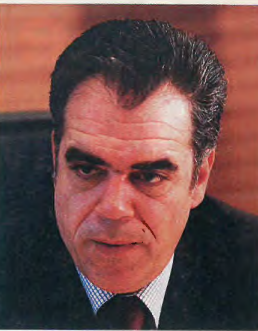
What steps should Lebanon take to join the Euro-Med Association Agreement?

KOURKOULAS
The main obstacle is that Lebanon must reduce or abolish
customs duties. They should replace this method of gaining revenues.
The government is already committed to introducing indirect taxation,
and we are assisting the government in introducing fiscal reforms.
But in the last few years the government has actually
been increasing tariffs.

KOURKOULAS
The rise in protectionism we have seen in the last three
or four years is the opposite of what we are trying to do. I think that the
Lebanese are aware of this, and they have always communicated their
willingness and commitment to go in the other direction. The problem
is the budget deficit and the fact that more than 60% of revenues are generated
from customs tariffs. But this is not the best solution, because not
only does it go against the terms of the association agreement, it undermines
the competitiveness of the Lebanese economy. Lebanon cannot
afford to continue in this manner.

The government is planning to replace customs duties with a value-added tax (VAT). But some economists feel that Lebanon is not transparent enough for it to be effective. What is your view?

KOURKOULAS
You should not underestimate the capacity of the
Lebanese economy to introduce VAT. There are examples of other countries
in the European Union who were reluctant to introduce VAT
because of the argument you have just made. For example Greece,
which was obliged to introduce VAT after its accession to the EU. The
fiscal authorities were not very organized; there was a lot of tax evasion.
But the introduction of VAT helped rationalize the fiscal system
and reduce the tax evasion problem.

Are you preparing future loans or grants for Lebanon?

KOURKOULAS
We are preparing some new programs. One is a
social development fund that will assist in the creation of jobs in remote
and underdeveloped regions. Twenty-five million euros will be dedicated
to the social fund, 11 million euros will be allocated for industrial
organization. We are also preparing a structural adjustment facility
for the Lebanese budget. These are all grants.

There is a lot of fear that Lebanese companies will become casualties once the country lowers its trade barriers. How real are these fears?

KOURKOULAS
The Lebanese market is small and this market
already has a high percentage
of import penetration.
I think that
it’s not correct to say
that customs duties
protect local production. The main reason for increasing customs duties
is for fiscal reasons: to increase revenues for the government.
Sometimes, local industry is the victim of these protections when they
have to pay customs duties for raw materials. We allocated 11 million
euros for industrial modernization with the objective of improving the
performance and the competitiveness of Lebanese industries.

Presumably, the Lebanese sectors that are competitive cannot rely on
this small market. The Lebanese know this better than we do. We feel
that, on the contrary, the realization of our free trade area with
Lebanon and Mediterranean countries will give them a much bigger
market in which to operate.

How can local industry compete? They have high energy and production costs, high labor costs and they pay high prices for raw materials.

KOURKOULAS
Compared to other countries in the region, the cost of
labor here is high, as is the cost of land. But I think that this country’s big
asset is its human resources. They can be competitive in more sophisticated
and more value-added services. In the service sectors or the tourist sector
they can be competitive despite the fact that the cost is higher. They can
be competitive in processing agricultural products. There are other high
value-added sectors that might benefit.

I think that the main obstacle is not the high labor costs but the cost of
administrative procedures. Sometimes, it’s more important for businesses
to reduce or simplify these procedures than to have lower labor costs.

Euro-Med is supposed to encourage European investment. But this is a tiny market and costs for businesses are high. Do you feel that European companies will really want to invest in Lebanon?

KOURKOULAS
I think that what is more important for businesses is
the whole administrative framework in which they will have to operate.
We feel that the conclusion of the agreement will send a strong signal
that Lebanon is going in the right direction, and I think that this will
increase the attractiveness of this country.

The market may be small, but other countries in the region will adopt
the same rules. I think that other businesses in the region would like
to operate on a regional level, not a national level. The sooner this agreement
is concluded, the better it will be for attracting investors.
April 6, 2000 0 comments
0 FacebookTwitterPinterestEmail
For your information

In need of an economic laxative

by Sami Atallah April 6, 2000
written by Sami Atallah

So whatever happened to the Euro-Med partnership agreement?
And wasn’t Lebanon applying as an observer to the
WTO? After all, countries around the world have been integrating
through the flow of goods, services, capital and technology
across borders. Others have gone further by establishing trade
blocs, such as the North American Free Trade Agreement,
European Union or Asia-Pacific Economic Council. Developing
countries are under increasing pressure to liberalize trade. Many
are not enthusiastic because of the disruption it may cause,
whether social, fiscal or economic.

The effects of trade liberalization on Lebanon have not been
properly assessed. Those who oppose it cry that it will lead to
unemployment and economic stagnation. The proponents draw
a rosy picture of growth and a boom in export-oriented industries.
I haven’t seen any serious work that supports these scenarios.
Nevertheless, I will make the following propositions. First, integration
with world markets is a source of disruption and upheaval
as well as an opportunity for profit and economic growth. Take the
East Asian countries. They performed well in the last decades by integrating
their economies with the rest of the world. However, it is this
integration that led to the capital crisis in 1997/8. Being a small country
with the pro-free trade institutions, Lebanon will inevitably undergo
full trade liberalization. And globalization, whether we like it or not,
is here to stay. So the more pertinent question is not whether to globalize
but how to do so.

Dani Rodrik, a professor of international economics at Harvard’s
Kennedy School of Government, suggests that countries should complement
trade liberalization policies with an “internal strategy of institutional
reforms.” He argues that the strategy must have three
components. First, a country must improve the credibility of its state
apparatus. This means that Lebanon can no longer rely on sound
macroeconomic policies of low inflation and stable currency to attract
investments. In the 1950s and 60s, inefficient and corrupt bureaucracy
and weak government institutions went hand in hand with
investment and growth. This formula no longer applies. Investors
expect countries to have transparent and accountable institutions.
Moreover, the government must have an efficient judiciary to
resolve conflicts, lower transaction costs and increase economic
activity. These have become the new prerequisites for investment
and growth.

Second, a country must also improve the mechanism of “voice.”
That is, Lebanon can no longer make policies in a vacuum: the economic
and social actors must be included in the decision-making
process. Private sector participation in economic policymaking is
low, except for the banking sector. Moreover, the labor associations,
despite their internal weaknesses, have often been marginalized by
the state or broken up for political purposes. The government has
also failed to bring other civil society organizations on board, particularly
social ones, and support their activities.

The social safety net must be improved, because trade liberalization
will severely affect certain groups in the economy. The organizations
that provide social care in Lebanon operate in a vacuum, leading to
a duplication of efforts, according to Adib Ne’meh, a lawyer and a
consultant to the UNDP. More than half of the population does not
have social security. And the existing social service system is often
manipulated for political purposes.

Lebanon has failed to prepare itself for globalization. Time is running
out. Economic treaties will soon be put back on the table and
Lebanon will have to sign. Without an internal strategy, the costs of
globalization will be too high. Social tension will inevitably arise.
Frankly, these institutional reforms are good not only as a means to
face globalization, but also as an end in themselves. The question
remains: Why hasn’t the government adopted any of them yet?

April 6, 2000 0 comments
0 FacebookTwitterPinterestEmail
For your information

Gagging the press

by Samia Jouzi April 6, 2000
written by Samia Jouzi

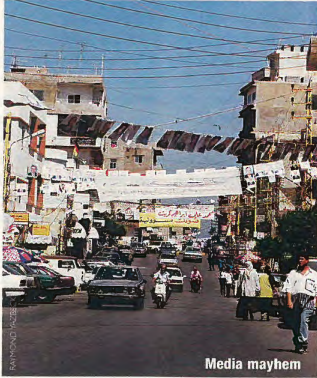
Freedom of the press is under threat, the media is screaming
in unison. The culprit is an apparently well-intentioned
proposal to place a ceiling on campaign expenditure and
advertising in a bid to limit the influence of money in parliamentary
elections. It’s not the spirit but the fine print that has the press
in an uproar. In trying to ensure equal access to airtime and a limit
on spending, the law would make it impossible to stay open for business
during elections, according to the press. “The proposed law prevents
the audio and visual media from covering one of the most
important political events in the life of the Lebanese people – the
parliamentary elections,” says Tanios Deaibess, general manager
of Sowt el Shaib radio station. “It contains
clauses that mix reporting with
advertising.” Private media representatives,
supported by the publishers’
union and the press syndicate, are trying
to have the draft law amended, specifically
clauses nine and ten (see chart).

The proposed law gives state-run
Tele-Liban (TL) and Radio-Liban the
exclusive rights to air campaign advertising.
“That contradicts, first of all, the
right of private television to equal treatment
with TL. Secondly, it undermines
an individual’s right to freely
enter into any commercial deal. And
thirdly, a Lebanese citizen has the right to
choose any form of media for the campaign,”
says lawyer Edmond Naim. Not
surprisingly, granting exclusive privileges
to TL has been rejected by private
stations. “Tele-Liban is a registered company just like all other television
stations. All institutions should be treated equally,” says
Gabriel Murr, advisor to MTV television.

On top of limiting airtime and spending, the elections are seen as
an opportunity to compensate the financially ailing TL. “When the
television licenses were granted in the past they deprived TL of the
right to exclusivity which it had until 2012,” says Hikmat Abou Zeid,
the prime minister’s media advisor. “But there’s a deeper problem
with TL that will not be solved with the one-off $5 million or so that
they might get during the elections,” counters Murr. The law suggests
giving all parliamentary contenders an equal time slot at a fixed
cost of about $1,326 for five minutes on TL and $130 for ten minutes
on Radio-Liban. The government now says that it’s open to
making the airtime free of charge to all candidates.

The government’s proposal to monitor the press on election coverage
would mean blurring what is campaign advertising as
opposed to legitimate reporting. “It prevents the radio and TV stations
from covering the elections as well as from being a medium
of publicity. It says the prohibition covers interviews, platform declarations,
candidate rallies, caricatures,
etc,” says Murr. Media professionals
believe that will make it impossible for
them to cover any political figures or
events during election time. Drawing the
fine line between publicity for candidates
and their platforms and reporting on
those issues is, legally speaking, tricky.
“Electoral advertising is making public
the candidates’ qualifications or informing
the public of the date and place of rallies
or the events. Reporting, on the other
hand, is discussing the platform or the
intentions of the candidates should they
get elected,” says Naim.

There is also the issue of advertising revenue.
Advertising goes up across the
board for all media with a political
license during elections. It increased by
some 15% for An Nahar newspaper during
the 1996 elections. Excluding the private audio-visual media not
only deprives them of revenue from campaign advertising but
also affects their ability to attract advertising during the pre-election
season, according to a memorandum sent to prime minister
Salim Hoss from LBCI and Voix du Liban.

The draft law sets the ceiling at almost $100,000 for campaigning
expenses and about $66,000 for publicity. But candidates have
spent a great deal more in the past. An election hopeful would not
have spent less than $500,000 during the
1996 elections, according to Edmond
Saab, the executive editor of An Nahar. The
cost of political advertising, which is four
to five times more expensive than commercial
advertising, doesn’t come cheap. A
page of platform publicity was priced at $15,000 last time around.

The government is expecting a heated
debate. “The proposed law is the first of its
kind and it is natural that it will cause controversy. The state is committed to two fundamental
principles: that of a ceiling on
campaign spending and ensuring that all
candidates have equal access to the media,”
says Abou Zeid. The draft will probably be
amended. But requests to withdraw and
redraft the law before it goes to parliament
would mean delays. If the law is put forward
in time for the vote, MPs will have the final
say on what they can or cannot do during the
run-up to elections.

Excerpts from the proposed law on campaign expenditure and media coverage

Clause 9 Electoral media and advertising for the benefit
of candidates means: conveying news of campaigns
and electoral lists (meetings, rallies, interviews,
symposiums, etc), promotion of events in
audio and visual media. In the press those that benefit
candidates (headlines, articles, slogans, pictures,
analyses, commentary, caricatures, etc), either directly
or indirectly.

Clause 10 To ensure equality amongst candidates
all private audio and visual media cannot air campaign
publicity for the duration of the election period
which begins when elections are officially
declared by the government.


April 6, 2000 0 comments
0 FacebookTwitterPinterestEmail
For your information

Checking out

by Hadi khatib April 6, 2000
written by Hadi khatib

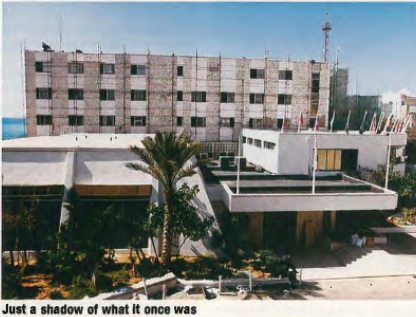
The 36-year-old Coral Beach Hotel, once a summer playground
for Gulf princes, European holiday seekers and
Beirut’s elite, has closed its doors. After suffering three consecutive
losing years, Izzat Kaddoura, the owner, is calling it
quits and pulling out of Lebanon. The empty shell of the once-thriving
resort that employed
over 170 people is up for
sale at a price that has not
yet been disclosed.

Kaddoura blames the
recession, an unstable political
environment and a business-
unfriendly government
for the hotel’s failure. In
1997, Coral Beach had over
2,600 members and received
1,000 guests. Last year, the
hotel saw less than half those
numbers. Occupancy
declined from 60% to less
than 25% during the same
period. But Coral Beach is
not alone. Across the country
hotels are suffering.

An independent survey
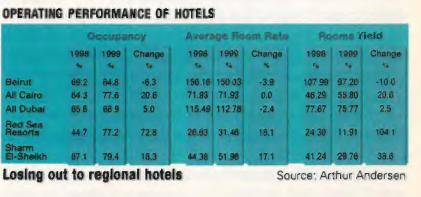
done by Arthur Andersen of six leading hotels in Beirut showed that
the average price for a room has declined from $156.16 in 1998 to
$150.03 last year. The survey also showed that the yield for rooms
(occupancy multiplied by the average room rate) declined by 10%
in that same period, from $107.99 to $97.20. “We used to get company
representatives attending conventions as well as tourists from
all around the world. Today these same people go to the Gulf,
Egypt, Morocco, Tunisia, Turkey or Greece,” says Kaddoura. He estimates
that Rhodes alone attracts 1.3 million tourists annually, compared
to the 670,000 tourists who visited Lebanon last year.

Kaddoura complains that the cost of maintaining the Coral Beach also
took its toll. The hotel was spending nearly $300,000 a year on electricity
and the corrosive sea front climate cost the club another
$300,000 to $350,000 in yearly maintenance. Government policies
toward the struggling hotel sector haven’t helped. Two years ago, a
5% tax was imposed on hotel revenues but the struggling tourism sector
has received little support in return. “The government makes us
pay taxes, social security, transportation, schooling for our employees’
children as well as fees for street and sidewalk maintenance and trash
removal, which we do ourselves,” says Kaddoura.

The ministry of tourism, which plays a central role in promotion,
receives minimal funding. Its budget for this year was a mere $4.5
million, less than one-tenth of a percent of the total budget allocated
to all ministries (see “Switzerland of the Middle East No longer”,
March 2000). “We keep
hearing speeches from the
government that don’t
translate into action, they
simply don’t have a plan of
action and lack vision,”
says Nizar Alouf, managing
partner of the Riviera
Hotel. Last year, the
Riviera underwent a complete
rehabilitation. “The
commercial loan here is
higher than any other
country,” says Alouf,
adding that at best a five-year
loan carries an 11%
interest rate. In the Gulf,
the interest on a 15-year
loan is as low as 6%.

Meanwhile, as hotels suffer,
government officials and some within the industry continue to
act as though everything is fine. Last June, after the Israeli air
strikes, a letter was sent to members of the hotel owners’ syndicate.
It said that the syndicate and ‘responsible’ officials had devised a
plan to use the media to create an image of normalcy. The letter
urged all hotel owners, when speaking to the press, not to mention
any cancellations as a result of the bombings.

Kaddoura has grown tired of the rhetoric. He is investing elsewhere.
Six months ago, construction started on a $42-million residential project
in Conakry, in the Republic of Guinea, which he and seven other
shareholders are financing. The facility will include furnished apartments,
a beach and recreational facilities, supermarkets, restaurants and
hotels. The government gave the investors the 250,000 m² of land for
free as well as a seven-year tax exemption and a free license to build.
Kaddoura also plans to invest $7 million to open a company there that
will export fish to Europe. As for Lebanon, he warns the government
that if it wants to attract tourists it should take a lesson from countries
that have been successful and lay down the proper legal and regulatory
framework where hotels can prosper.

April 6, 2000 0 comments
0 FacebookTwitterPinterestEmail
For your information

Brain drain

by Natacha Tannous April 6, 2000
written by Natacha Tannous

Karim Habib (not his real name) is a young
and bright financial analyst. Four years ago
he was employed with one of the biggest
investment firms in the United States, where
he had a promising career ahead of him. But
the post-war feeling that Beirut would reemerge
as the Middle East’s financial center
inspired Habib to return to his homeland,
where he was offered a position with a newly
established investment company. His enthusiasm
has since waned. “What I came back
for is proving to be an empty shell,” he says.
Now intent on returning to the US, Habib will
be among the thousands of educated
Lebanese that emigrate each year.

Lebanon has long been a major exporter of human resources
(see box), but the civil war pushed unprecedented numbers
of people to emigrate. From 1975 until the end of 1993,
729,000 people emigrated – 19.9% of the net population at that time,
according to a study by statistician Anis Abi Farah. Displacement is
common during wartime, but what is uncommon is that the exodus
didn’t subside when the hostilities ended. By 1996 that number had
increased to 950,000. In other words, between 1994 and 1996 – years
of relative stability – another 221,000 people emigrated, a further
increase of 30.3%.

Should emigration be condemned entirely? “Emigration has
always been a major element of strength for Lebanon, because emigrants
transfer quite a lot of money to their relatives and also capital
savings,” says economist Marwan Iskandar of MI Associates.
“Whenever we achieved a surplus – except in ’96 and ’97 which was
due to borrowing – it was due to transfers from Lebanese.”

However, transfers cannot compensate for the losses due to emigration
of educated people. University graduates accounted for 32%
of emigrants between 1975 and 1996, reducing those within the resident
population to 22.4%. “We lost 300,000 university graduates in
that period. It cost us $30 billion to prepare them,” says Abi Farah, referring
to public and private investments in education. “Have we been reimbursed

$30 billion by them leaving?” Indeed not.

For example, a Lebanese working abroad as an electronics engineer
produces ‘X’ amount of value – let’s say $100,000 annually. He
might transfer $10,000 of his salary to his family in Lebanon. “If this
person was able to be productive here, we would get ten times more
benefit,” says Paul Salem, a political and development analyst.
“Obviously it’s a bad deal, but that’s what is happening because our
productive sectors aren’t able to absorb this amount of skilled labor.”

So the greater value is forfeited to the host countries, most of which
have developed economies. Abi Farah’s study shows that of the emigrant
university graduates, 23.9% went to the United States, 20.1% to
France and 13.4% to Canada.

Iskandar presents yet another, more recent study. “41% of all people
between 20 and 30 years are applying to emigrate – whether they
succeed or not, the desire is there,” he says. Lack of economic opportunity
is identified as the fundamental reason young people emigrate.
For those with jobs, incomes are low (Lebanon’s per capita income is
$3,000 to $3,500 annually) while the cost of living is high. And for thousands
of young graduates entering the job market every year, most cannot
find employment. No statistics are available on job creation.
Considering the economic stagnation of 1996 to 1999, job creation was
probably negligible, while there was possibly even job loss.

The government hasn’t traditionally taken a leadership role in the
economy. “But now, I believe the government should begin to take a
lead in certain areas where Lebanon has a comparative advantage,” says
Salem. Identifying potential sectors is one thing, taking action is
quite another. For example, the government has identified the technology
sector as strategic. “They have been talking about it for the last
year, but I haven’t seen any laws or regulations pass that would help
develop it,” says Habib. For this sector to develop, the government must
give tax breaks, create an information free zone and support specialized
institutes, such as training centers. It must also invest in upgrading
the school curriculums. In 1998 parliament endorsed a new curriculum
to improve the current system, which hasn’t been changed in
about 30 years. However, it was never implemented. The allocation
for the training of teachers was $13 million a year for three years. “We
put the new program on hold to save $13 million, but the returns of education
are enormous,” says Iskandar. If the trend of emigration continues,
“in the coming five years we will lose a further 500,000 people,
of whom 150,000 would be university graduates,” he adds.

Lebanon cannot sustain such losses and expect to achieve growth
via a ‘knowledge-based economy’.

Habib returned to Lebanon “with big plans to modernize and earn
a good living.” But his aspirations have been shattered by harsh realities. He cites nepotism, rampant corruption, bureaucracy, red
tape and wastefulness along with shortsightedness on the part of
the government. There is hope that the peace process will bring foreign
investment to Lebanon. But, according to Habib, “if there is
still chaos in the government, other countries will benefit from the
peace, not us.”

Global networking

The claim is true: The number of Lebanese people throughout the world
far exceeds those that reside within its borders. The first exodus started
in the middle of the 19th century because of economic hardship and
political instability. Since then the flow of emigrants has been steady, but
three periods of war commencing in 1860, 1914 (punctuated by
famine), and 1975, pushed unprecedented numbers to emigrate.

Today it’s impossible to compile accurate statistics on the size of the
expatriate community (including descendants). And the said population
of Lebanon is only an estimate. In the absence of statistics, a simulation
model is the best means to assess such data. Statistician Anis Abi Farah
has developed a software program called nasripop, which can produce
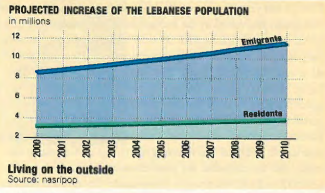
data on the Lebanese population. The program calculated that in 1999
Lebanon’s population was 3.2 million, while the number of Lebanese emigrants
(including descendants) was 8.3 million. According to nasripop’s
projection (see chart), the expatriate community is growing at a
faster rate than the resident population, so that in 2010 there will be 3.9
million residents and 11.6 million emigrants.

“Lebanon stands out as one of the few countries in the world with a
larger expatriate community compared to its own,” says Paul Salem, a
political and development analyst who sees a positive side to this.
“Lebanon needs to recognize that we are – and will always be – a global
country.” Israel is probably the only other “global country” in the world.
It has always recognized this and includes the diaspora in its national
affairs, an approach that has proved beneficial to economic development.
Many expats have achieved success, and Lebanon could gain by similarly
involving them in state affairs. “A lot of them are wealthy, influential
and have global connections,” says Salem. “Have them represented
in parliament, let them have a say in economic policy – involve them
in the country.” Now might just be the time, as Lebanon embarks in the
global economy. “Global trade requires a global network, and our allies
around the world are the Lebanese around the world,” says Salem. “They
are a great resource.”

Salem is a progressive thinker. But personal experience of Lebanese
communities in the United States, South America and the Caribbean
leaves this writer doubtful that such solidarity is possible. True to form,
division and discord characterize Lebanese emigrant communities. It
would take charismatic, dedicated leaders to lobby the Lebanese
worldwide to join hands and contribute to the greater good of Lebanon.

April 6, 2000 0 comments
0 FacebookTwitterPinterestEmail
For your information

Bullet proof bank

by Gareth Smith March 24, 2000
written by Gareth Smith

Even in the occupied zone, people still needed banks. With
its two branches, in Marjayoun and Bint Jbeil, Fransabank
enjoyed a monopoly among 100,000 people. With the
Israelis gone, the bank is in pole position to beat off rivals if stability
returns and the local economy recovers. “They were daring,”
says Nassib Ghobril, an analyst at Lebanon Invest, “and others are
now thinking of following them.”

Thinking, but not acting — at least yet. Lebanese banks are
unlikely to stampede south immediately.

“I don’t think any of the other
banks have applied to work in the
zone,” says Sarni Sfeir, press
spokesman for the Central Bank. “We
will be monitoring the situation.”

Uncertainty persists in the South,
especially with the Shebaa Farms
issue not yet resolved. This leaves
Fransabank sitting pretty. In the
short term, customers require a safe
port and, in due course, Fransabank
will have a firm base.

But think of the worst scenario:
what if someone blows up the bank?
No worries, says Ibrahim Qoleilat,
Fransabank’s deputy general manager:
“The branches in the South hold a
minimum of paper money. What’s
there? Only furniture and PCs.”

And
customers have seen it all before, says
Habib Rohayam, manager of the Bint
Jbeil branch: “People are not unduly worried.
They remember that when the
bank closed in 1978, they could still
withdraw their money from Beirut.”

Back then, the area — known not
so affectionately as Fatahland — slipped into disorder. But gradually
a strange kind of order returned, albeit under Israeli occupation.

“The people who had relocated from the South were
always asking us to go back,” says Qoleilat, “and eventually we felt
the time was right.”

The branches in Bint Jbeil and Marjayoun reopened in 1993,
around the time that the Lebanese ministries increased their presence
in the zone. But Fransabank never closed its branch in
Jezzine, which remained an unofficial part of the zone until last
summer.

In Bint Jbeil and Marjayoun, the bank found a promising
market, as trade with Israel was booming and more than 3,000 local
inhabitants were earning good wages south of the border. The Bint
Jbeil branch has 10,000 customers, which is nearly double the national
banking average of 5,500. The Marjayoun branch is
prominently situated at the entrance to the town.

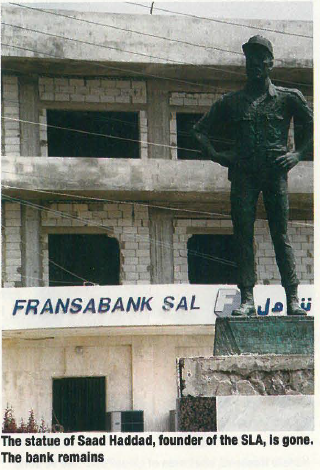
Until the pullout,
a statue of Saad Haddad stood in front of the bank. (It has subsequently
been destroyed.)

“We are serving the whole region,” says
Qoleilat. “Where someone needs a banking service, we provide it.”

In practice, the services offered by the bank are less comprehensive
than elsewhere in the country. Neither branch, for example, has
an ATM. Personal loans have been “limited,” says Rohayam,
adding that it’s not due to difficulties
in assessing or collecting collateral.

Quite how the bank managed during
the years of the occupation, understandably,
is a sensitive matter. But it
has coped successfully with the
anomalies produced by 22 years of
Israeli control.

Think only of the legal
situation: the darak (police) and the South
Lebanon Army (SLA) both had “law
and order” roles; the Israeli-sponsored
civil administration worked alongside
the Lebanese government ministries.
Court decisions were left pending
until the end of the occupation.

How easy was it to deal with default in
such a peculiar legal situation? “The
bank had its own law,” says one
employee. “This could be either the
darak or the SLA.”

Rohayam declined
to elaborate on his policy for bad debts.
“I would protect myself,” he says. “I
don’t know anything else.”

It’s easy to see why Rohayam is
upbeat, at least for now. In the short
term, the cash flows into Fransabank because residents of the now
unoccupied zone save for a rainy day. The local economy went into a downturn
as soon as the Israeli government confirmed its withdrawal.

But there’s an optimistic scenario for the former occupied zone,
at least beyond the short term. A fair proportion of the 100,000 people
who have left the zone during the occupation will want to go
home, and many of them will want to bank.

Front-runners to join Fransabank are probably Al-Mawarid
and Beirut Riyad Bank, which are owned by two natives of
Hasbaiya, Marwan Kheiredin and Anwar Khalil, respectively.

“These banks will know the situation on the ground better than the
bigger, more aggressively marketed retail banks like Audi or
Byblos,” says Ghobril, who is from Hasbaiya. “Local people will
feel more comfortable with them.”

March 24, 2000 0 comments
0 FacebookTwitterPinterestEmail
For your information

Paridora’s mailbox

by Kirsten Vance March 24, 2000
written by Kirsten Vance

While some point the finger at the Canadian-run consortium,
which took charge in October 1998, Fakhoury, like
most, does not. The contract stipulates that all MPT
employees should be able to join LibanPost, based on an assessment
of skills. Some did choose not to transfer. But employees insist that
this was due to the lack of regulation to protect them once transferred,
that the selection process favored youth, and that political pressures
played a role in appointments. (Issam Naaman, the minister responsible,
declined repeated requests for an interview.)

“What is the future
of those who are taken by LibanPost when the contract ends?” asks
Boutros Harb, a lawyer and member of parliament. “Nothing was
stipulated, nothing at all; and I think the government was irresponsible
in this case.”

Part of the problem was trying to get the accord of the Civil Service
Board to allow MPT employees out ‘on loan’ to LibanPost.

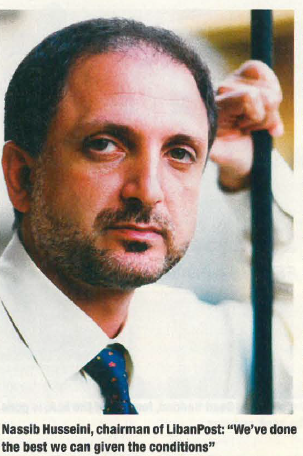
“But this is an internal government matter,” says Nassib Husseini,
chairman of LibanPost. “The priority has always been for MPT
employees. But would you, as a customer or citizen, expect us to wait
another five years to settle this issue?”

Further, there were some
205 ‘untouchables’ that the minister retained to form a regulatory
body, and many of these are the most qualified. Almost 400 didn’t
make it through the selection process, says Husseini.

“We did
put on the table a firm 250 written job offers, and 71 of them accepted,”
he says. The current LibanPost staff totals 450.

But with the employee issue brewing, LibanPost could soon find
itself the receiver of an MPT special delivery: the matter may be headed
to the Council of Ministers.

“LibanPost will have to agree to modify
the contract,” says an MPT official.

Having a regulatory framework
in place, he argues, might sidestep the employee imbroglio and
other problems.

At the same time, MP Georges Kassarcji wants to have
the 12-year build-operate-transfer contract brought back to parliament:

“As soon as we finish with the cellular issue, I want the LibanPost file
put back on the table.”

The debate centers on the constitutionality of the contract. Harb
insists the contract contravenes Article 89 of the Constitution,
while others point to Article One of Decree 126 (see box), which governs
the former Directorate of Post, Telephone, and Telegraph.

An
independent lawyer consulted on the matter said that the decree only
touches on distribution, not running the entire concession, and
that the Constitution takes precedence.

This is not the first time such a debate has erupted. It’s an issue
that just doesn’t seem to die for LibanPost — one that threatens to
be continually questioned by MPs or with each new government
that comes into power.

“Whatever the decision of the government,
we will respect it. But we feel we have a solid contract; so if it is
challenged, there’s compensation linked to that,” says Husseini.

“Our
objective is not to kill the guardian of the vineyard; our objective
is to eat the fruits, which is a project that is good for both parties.”

There’s also the matter of the international couriers (see “Down and
Out in Beirut,” January 2000). The amendments to the contract gave
LibanPost the right to collect, as part of its revenues, what is essentially
a tax on private courier companies.

When the tax was
increased last June from $6 per kilo on inbound documents only to
$12 per kilo on both inbound and outbound,
the couriers cried foul and have
refused to pay. The outstanding tax bill
will reach about $9 million by June.

According to the MPT official, this part
of the contract will also have to be amended.

“I hope that it’s changed too. Why?
Because I am looking for a healthy
environment,” says Husseini. “I think
we share that goal with both the government
and the courier industry.”

If the MPT employees and others
have complaints, it hasn’t been smooth
sailing for LibanPost either. Husseini’s
worry? That LibanPost is working with
a fixed revenue-sharing formula and a
fixed tariff scale, as well as delivering in
villages at a loss.

“How can we compete
with someone who works without a
license and charges local tariffs that are
lower than the government’s?”

The company also suffers from the same bureaucracy that inflicts
most businesses. One problem, which has
slowed down the process of renovating post offices, has
been getting permits. It’s no secret that the municipality
isn’t exactly quick on its feet in that arena.

Some offices
have yet to be passed from MPT control to LibanPost. Bureaucracy
has also impeded the launching of new products. And red tape at
customs undoubtedly makes Lebanese hesitant to send or receive
more than letters internationally.

On the upside, items up to LL 1–2 million in value should be delivered
without going through customs very soon.

Nonetheless, LibanPost is reassessing its expectations of breaking
even by year three. Husseini declined to reveal how much the company
is losing, saying only that this is a time of investment.

While the
volume of mail more than doubled in the last year, it’s still low compared
to levels in the West.

“Unfortunately, the win-win conditions we
were hoping for didn’t materialize, and we are at a turning point,” he
says. “We should make a decision on whether the conditions are now
there to invest more.”

LibanPost has invested
$20 million so far and is committed to
investing at least $50 million over the life
of the project.

While some say the
Canadian team has threatened to leave,
Husseini refutes that claim. The coordination
committee hasn’t met in over a
year and a half — that’s a pretty clear indication
of how poor relations are between
LibanPost and the MPT.

LibanPost is two-thirds owned by Canada
Post Systems Management together with
Profac, a joint venture between Canadian
firms Bracknell and SNC-Lavalin.

The
remaining third is held by Qantara
Holdings, a Lebanese company that
Husseini set up for the project.

“We’ve
done the best we can given the conditions,”
says Husseini. There is still room for
improvement, however (see box).

So are the Canadians
worried by the cellular war?

“What we care for is to be assured
that a written contract is respected
and that arbitration clauses are respected,”
says Husseini.

March 24, 2000 0 comments
0 FacebookTwitterPinterestEmail
Editorial

Cold comfort for change

by Executive Editors March 24, 2000
written by Executive Editors

It is time to celebrate. After 22 years of occupation in South
Lebanon, Israel pulled out quickly and quietly, leaving the
country with a sense of relief and a brighter picture for the future.
But it is also a time to worry. Solidere, Lebanon’s biggest company,
is reeling under the harsh economic conditions and political
uncertainties in the region. If that isn’t enough, the company is
wrestling with the government over permits.

The cabinet has approved the long-awaited privatization bill. A sell-off
of state-run assets could cut the debt by 30%, but it’s unclear how
privatization will be handled, or if it actually happens.

The country’s two cellular telephone operators, LibanCell and
Cellis, have their own reasons for worry. The government, claiming
the companies have breached their contracts, has ordered each
to pay a $300 million penalty or risk having their contracts canceled.

LibanPost, which began pumping new life into the country’s faltering
postal system over a year and a half ago, is also facing a barrage
of difficulties.

This month’s cover story examines the effects of the Israeli withdrawal
on the economy. Peace and stability following the pullout
could bring untold benefits. But if there is violence, the results could
be devastating.

All around, there are uncertainties in Lebanon, and uncertainty is
the enemy of economic development. Some matters, like what will
happen following the Israeli pullout, we have little control over. But
for others, like the cellular contracts, LibanPost, and Solidere, we
do. By hassling companies that are investing in rebuilding the country
and its economy, we are telling future investors that Lebanon
is not a safe place for business. Haven’t the Israelis done enough
of that already?

March 24, 2000 0 comments
0 FacebookTwitterPinterestEmail
Executive Living

Sailing without wind

by Executive Contributor March 22, 2000
written by Executive Contributor

Centuries ago, Phoenicians set sail from these shores
for destinations as far away as the Atlantic coast of
Africa or even, some speculate, America. Today,
despite formidable obstacles, a small group of Lebanese
sailors are struggling to keep this sea-faring tradition alive.

Just four years ago, the Lebanese Yachting Federation was
reestablished after a long absence during the war. Its first
mission was to select athletes to represent Lebanon at the Pan
Arab Games, held in Lebanon in 1997. With a $50,000 grant
secured from the ministry of youth and sports, the federation
was able to buy 12 laserboats and 12 international class
mistrals (sailboards).

The Lebanese team’s performance was hardly noteworthy,
but the event marked the rebirth of competitive sailing in
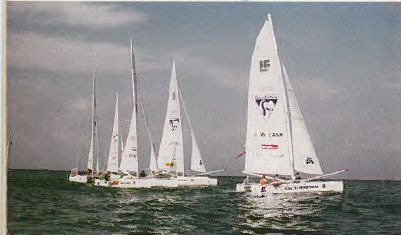
Lebanon. Today, a small but proud group of passionate enthusiasts
is taking to the water in search of that elusive feeling of
freedom that can only be found on the sea.

“You must always have a strategy and expect the unexpected,”
says Eddy Nehme of Laser sailing. “You have to use your
head and angle the boat to get the most from the wind and the
water. It’s fun – the sensation of contact with water and wind.”

Besides selecting teams to compete in international competitions,
the federation organizes a regular program of about
12 regattas every year. But in its drive to advance the sport, the
federation has encountered a number of obstacles.

The federation only owns the boats it purchased for the Pan
Arab Games and one Optimist boat, donated by the Kuwaiti
sailing team. Since the federation’s boats are strictly reserved for competitions, sailors must rely on sailing
clubs to provide them with boats they need for
training. But there is only a limited number of
clubs in Lebanon and most do not have sufficient
funds to buy new boats, which cost
from $2,000 for a Mistral up to $5,000 for a
Laser. This means that only a limited number
of people can participate in the sport. “We
need new clubs,” says Joe Salame, a sailing
buff and owner of Windriders, the exclusive
distributor of Dart and Laser boats.

But huge barriers faced Salame when he
tried to set up a club. First he had to sign an
official contract with the owner of a beach
property. But the properties had to be legally
owned, which is rarely the case in
Lebanon. At the same time, the law prevents
the legitimate owners of beach properties
from subletting. “If they give a concession,
they will lose theirs,” says Salame.

The more popular clubs are private and usually
charge steep annual membership or entry
fees. “We need affordable access to the sea, so
that people can learn to sail,” says Salame.

At the same time, a lack of funds and little
sponsorship means that members of the federation
must donate money in order to keep
activities going.

“The annual budget should be $100,000 to
have a proper and professional federation,”
says Nehme. The actual budget is between
$5,000 and $10,000.

With such modest financing, there’s little
hope of finding a Lebanese sailing team at the
Olympics anytime soon.

There is some local talent around, but no
funds to nurture it. “We don’t have the budget
to qualify for the Olympics,” says Nehme,
adding that it would cost between $20,000 to
$25,000 annually to prepare just one athlete
for the Olympics

March 22, 2000 0 comments
0 FacebookTwitterPinterestEmail
Executive Living

Craving sushi

by Executive Contributor March 22, 2000
written by Executive Contributor

The Lebanese palate may be softening. Not long
ago, if you wanted something raw, kiba nai, raw
lamb meat, was the meal of choice. Now the subtler
Japanese dish of sushi – raw fish – is all the rage. Its chic,
healthy and very exotic. But if you’re thinking of heading
out tonight to one of the multitude of sushi bars that have
opened recently, think again. Reservations often have to be
made days in advance.

“There are a lot of people who want to discover sushi,” says
Fawzi Ghantous, manager of the stylish new restaurant So.

Sushi comes in three varieties: sashimi, slices of plain raw fish;
sushi, slices of raw fish atop small rice patties; and maki, which
can be prepared in a variety of ways but is generally small
pieces of fish or vegetables rolled in rice and held together with
dried seaweed. Maki is by far the most popular dish in
Lebanon. A particular favorite is the California maki, an Americanized
sushi creation made out of processed crabmeat, avocado
and cucumber, rolled up in a rice and mayonnaise mix,
and then sprinkled with sesame seeds.

Part of sushi’s allure is the way that it is eaten. It is always presented with a serving of wasabi (spicy Japanese
horseradish), a bottle of soy sauce and marinated ginger. The
use of chopsticks is encouraged. First, pour some soy sauce
into the small dish provided. With chopsticks, take a bit of
wasabi and stir it into the soy sauce. Place a sliver of ginger
onto the sushi, dip it into the soy sauce and eat.

Saki, Japanese rice wine, is the usual accompaniment for
sushi. It is best sipped hot and is always served in small
ceramic bottles. Saki usually comes in two sizes. The single
is usually priced at about LL10,000 while the double is
about LL16,000. Beer lovers might want to sample the
Japanese brands Sapporo or Kirin, which can be found at
most restaurants for about LL6,900 per bottle.

Like almost everything that is chic, sushi does not come
cheap. Prices vary according to the weight and type of fish
used. Maki is less than half the price of sushi. A serving made
from tuna, crab or salmon is priced at around LL1,500. The
price more than doubles if it is made with eel or salmon roe.

At So, patrons sitting at the ‘sushi bar’ can treat themselves
to an array of dishes that pass before them on a revolving con-
veyor belt. Each dish is priced at LL4,500. Still, the countless
types of sushi listed on menus can prove tricky for novices.

But pre-set platters are always popular. At So, a 16-piece platter
costs LL32,000 while Le Sushi Bar offers a 24-piece platter
for LL35,000. Nippon Maru offers a 26-piece platter for
LL40,000 and an ultra-exotic 46-piece platter, made with imported Japanese fish, for LL95,000. Tokyo restaurant’s ‘Tokyo Set’ includes
eight pieces of sushi and cucumber maki for
LL38,000 and comes with miso soup and
pickled cabbage salad. Benihana has set
business lunches at LL37,500.

March 22, 2000 0 comments
0 FacebookTwitterPinterestEmail
  • 1
  • …
  • 700
  • 701
  • 702
  • 703
  • 704
  • …
  • 707

Latest Cover

About us

Since its first edition emerged on the newsstands in 1999, Executive Magazine has been dedicated to providing its readers with the most up-to-date local and regional business news. Executive is a monthly business magazine that offers readers in-depth analyses on the Lebanese world of commerce, covering all the major sectors – from banking, finance, and insurance to technology, tourism, hospitality, media, and retail.

  • Donate
  • Our Purpose
  • Contact Us

Sign up for our newsletter

    • Facebook
    • Twitter
    • Instagram
    • Linkedin
    • Youtube
    Executive Magazine
    • ISSUES
      • Current Issue
      • Past issues
    • BUSINESS
    • ECONOMICS & POLICY
    • OPINION
    • SPECIAL REPORTS
    • EXECUTIVE TALKS
    • MOVEMENTS
      • Change the image
      • Cannes lions
      • Transparency & accountability
      • ECONOMIC ROADMAP
      • Say No to Corruption
      • The Lebanon media development initiative
      • LPSN Policy Asks
      • Advocating the preservation of deposits
    • JOIN US
      • Join our movement
      • Attend our events
      • Receive updates
      • Connect with us
    • DONATE