• Donate
  • Our Purpose
  • Contact Us
Executive Magazine
  • ISSUES
    • Current Issue
    • Past issues
  • BUSINESS
  • ECONOMICS & POLICY
  • OPINION
  • SPECIAL REPORTS
  • EXECUTIVE TALKS
  • MOVEMENTS
    • Change the image
    • Cannes lions
    • Transparency & accountability
    • ECONOMIC ROADMAP
    • Say No to Corruption
    • The Lebanon media development initiative
    • LPSN Policy Asks
    • Advocating the preservation of deposits
  • JOIN US
    • Join our movement
    • Attend our events
    • Receive updates
    • Connect with us
  • DONATE
Banking & Finance

The financial positioning and performance of alpha banks in 2017

by Dany Baz January 9, 2018
written by Dany Baz

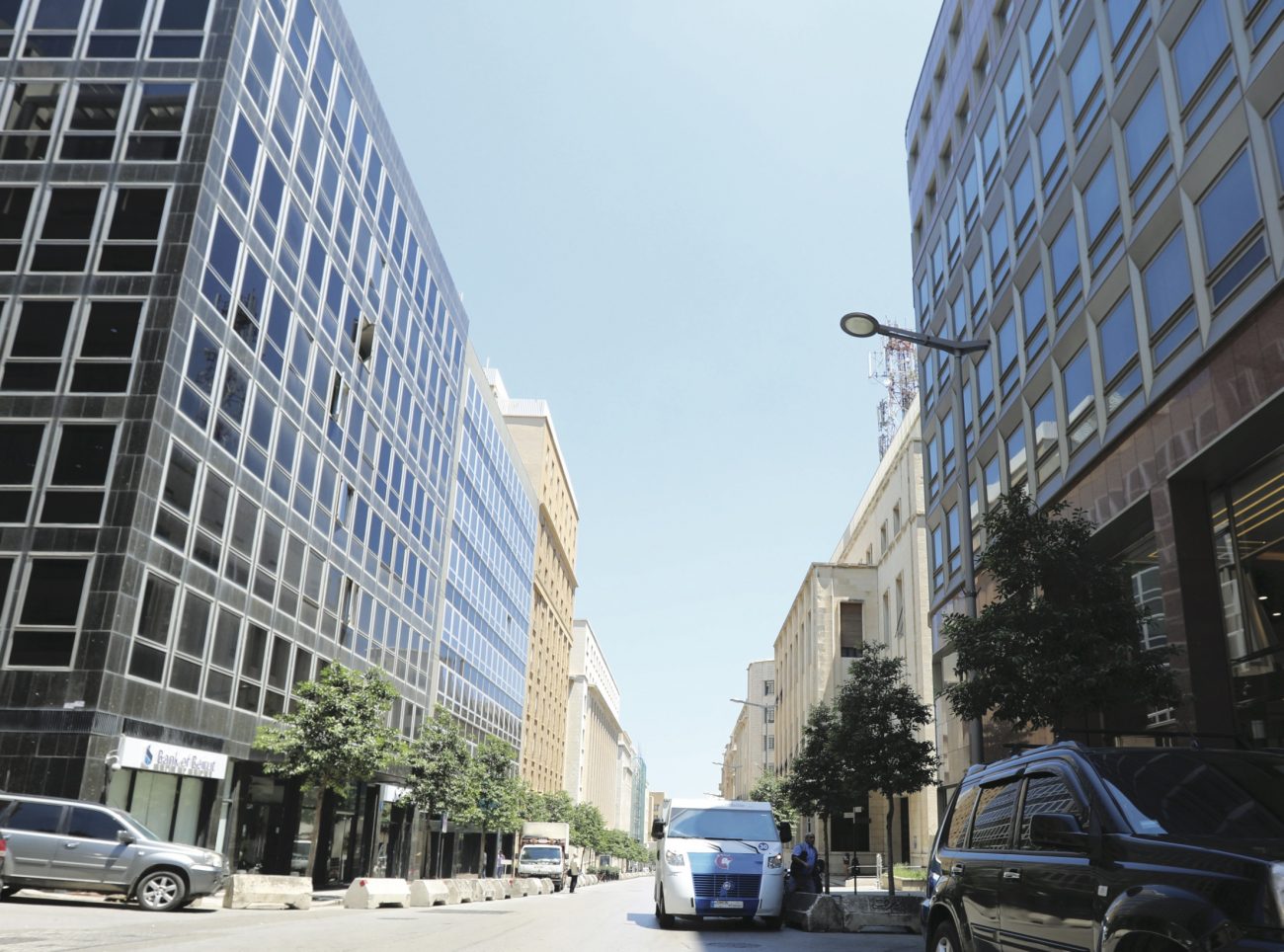
The Alpha Report by Bankdata Financial Services covers 14 banks, each of which have deposits exceeding $2 billion and collectively represent the lion’s share of banking activity—holding 87 percent of the $227 billion in assets at the end of September 2017. Before assessing the performance of Lebanese alpha banks during the first nine months of 2017, it is important to acknowledge the political climate in which they operate.

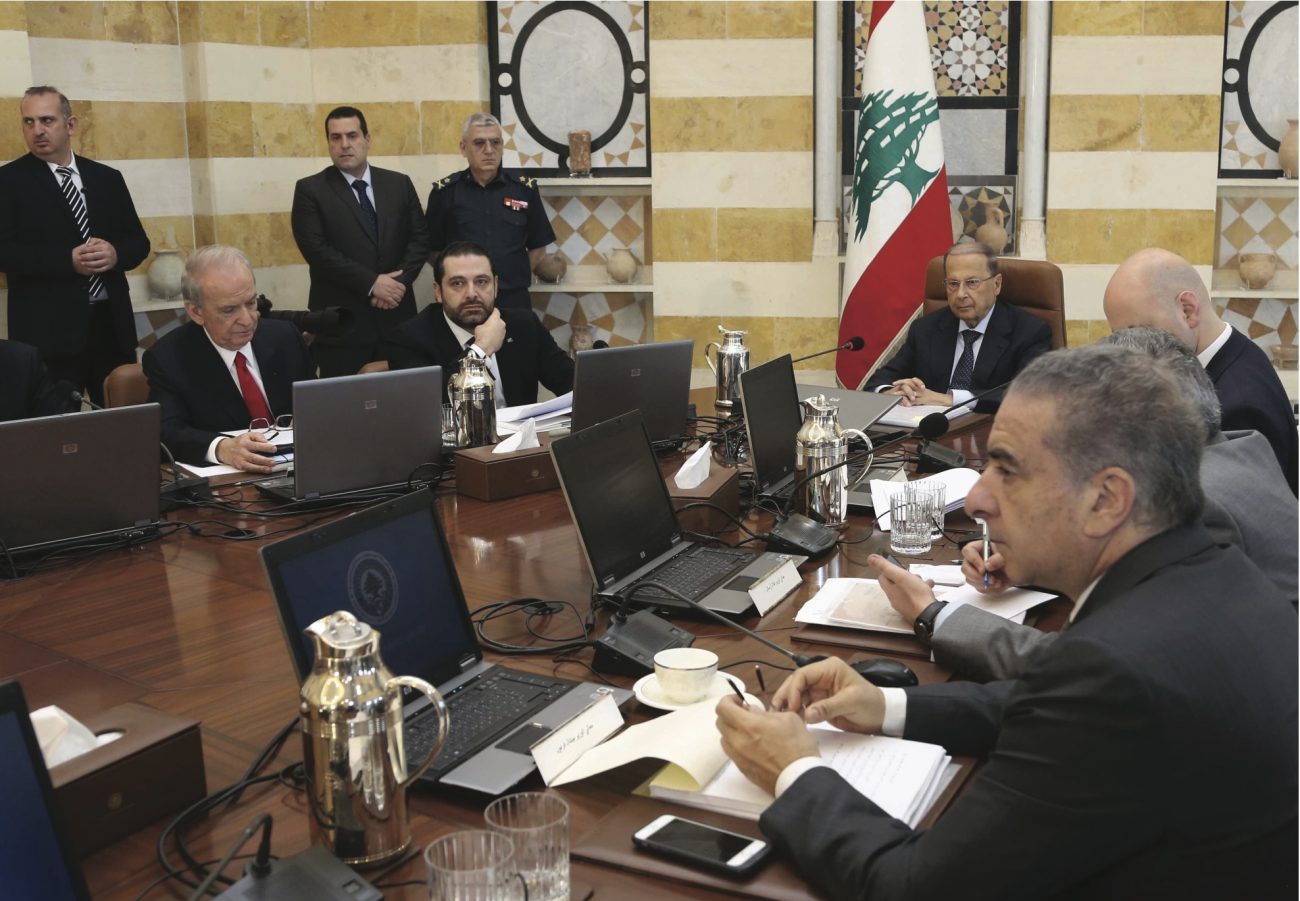
In November 2017, shortly after the Alpha Report was finalized, Lebanon reeled from the shock resignation of Prime Minister Saad Hariri. Much has transpired in the weeks since. Political and economic influencers universally sought to reassure the Lebanese people and their international partners that the stability of Lebanon will persist, and that its economic integrity will be preserved. The prime minister eventually made his way back home, and retracted his resignation—for now. And as the country entered into December of 2017, the commitments of key political stakeholders have seen positive developments toward stability,  reinforced by the  Lebanese economy’s long history of resilience and endurance.

However, given it is not yet possible to assess the impact and potential repercussions of the year-end political period, the following overview is, thus, Bankdata’s diligent view of banking conditions in the first nine months of 2017—without any speculation as to developments in the fourth quarter of 2017.

[media-credit name=”Ahmad Barclay & Thomas Schellen” align=”alignright” width=”640″][/media-credit]

Slow but steady growth

Measured by the consolidated assets of alpha banks, banking activity saw 4.8 percent growth in the first nine months of 2017 to reach $227 billion at the end of September. In terms of human capital and presence on the ground, alpha banks expanded their networks by 14 branches and 707 persons in domestic positions in the first nine months of 2017. With these additions, the 14 banks accounted for 1,202 branches, and a total staff of 31,202 employees at the end of September. It is worth noting that the staff count of employees abroad did not increase, meaning that all additions to the alpha banks’ net employee count were domestic hires.

In continuation of long-term trends in the banking sector, activity growth was driven by customer deposits—whose growth accounted for two thirds of the asset growth in the first nine months of 2017. Customer deposits actually achieved 4 percent growth over the period; noting that alpha banks’ deposit growth was mostly tied to domestic deposits. On a consolidated basis, alpha banks’ domestic deposits rose by 4.6 percent, while foreign deposits grew by 0.7 percent year-to-date. In parallel, the consolidated loan portfolio of the alpha group grew at a slower pace when compared with previous years. As banks found the harsh economic environment restricting their lending opportunities, loan growth was reported at merely 2.6 percent over the nine-month period (compared to 4.7 percent in the first nine months of 2016).

While the bulk of deposit growth was tied to foreign currencies, almost all new loans this year were in Lebanese lira. This development, which occurred in the context of a stagnant FX loan portfolio, was contrary to what was observed last year. Domestic-loan dollarization decreased to a record low of 69.4 percent at the end of September and moved ever closer to the domestic deposit dollarization ratio of 65.4 percent at end of the third quarter. The gap between the two dollarization ratios has been contracting from 7.4 percent at the end of 2016 to 4 percent at end-September 2017. This trend has also been reflective of the impact of the financial engineering operation undertaken in 2016 by Banque du Liban (BDL), Lebanon’s central bank, that increased banks’ liquidity in local currency.

Improved returns

The growth in the alpha banks’ loan portfolio was coupled with a slight retreat in lending quality. The gross doubtful and substandard loans as a percentage of gross loans rose from 6.81 percent in December 2016 to 7.78 percent in September 2017. Net doubtful and substandard loans as a percentage of gross loans likewise rose from 2.43 percent to 3.19 percent over the same period. Nonetheless, while doubtful loans are provisioned to the extent of 71.8 percent by specific provisions, collective provisions were significantly enhanced, reaching an all-time high of 1.71 percent of net loans.

At the profitability level, alpha banks’ net profits from operating activities grew by a mere 3.4 percent over the first nine months (growth was 21.4 percent when adding profits from discontinued activities). It is important to note that the growth in recurrent profits over the first nine months of 2017 saw a real increase above the nominal growth of 3.4 percent when normalizing the profits of the corresponding 2016 period for non-recurrent fees and commissions resulting from BDL’s financial engineering operations. Nominal profit growth was driven by 2.6 percent growth in net interest income, yet offset by a 49.5 percent contraction in net fees and commission income (for the reasons mentioned above), leading to a 6.2 percent contraction in net operating income. Within the context of an 11.1 percent contraction in operating expenses, banks experienced stagnation in operating profits.

With respect to return ratios, Bankdata observed a relative improvement. While a slight increase in the return on average assets from 1.04 percent in the first nine months of 2016 to 1.19 percent in the same period of 2017 was reported, the return on average common equity rose from 12.77 percent to 14.33 percent, though still below the cost of equity of alpha banks. The components of return ratios suggest that spread has contracted by 6 BPS, moving from 1.94 percent to 1.88 percent, coupled with a decline in the ratio of non-interest income to average assets from 1.20 percent to 1.03 percent. All in all, this generated a retreat in the asset utilization rate from 3.14 percent to 2.91 percent.

The unfavorable developments were offset by a noticeable rise in net operating margin from 33.23 percent to 40.96 percent, mainly tied to the drop in credit cost from 8.00 percent to 5.76 percent, while cost to income improved from 49.70 percent to 44.89 percent over the same period. Both the asset utilization ratio, and the credit cost ratio of the corresponding 2016 period were inflated on one side by the non-recurrent revenues and on the other side by the BDL requirement for banks to use their exceptional revenues in one-time extra provisions.
January 9, 2018 0 comments
0 FacebookTwitterPinterestEmail
BusinessDevelopment

From foggy to cloudy

by Thomas Schellen January 9, 2018
written by Thomas Schellen

Ethereal. Ephemeral. Elusive. ETP, perhaps. Questing for upcoming banking-sector development opportunities in 2018 brings a whole palette of e-words to mind, including the “e” in ETP (electronic trading platform), but not the favorite e-word of marketers and their PR minions: exciting. 

It seems that development opportunities in the banking sector are increasingly scarce, partly, of course, because good opportunities are by definition those that are not obvious to all, but also because the business of banking is facing new pressures all around. Before the decade is out, 2017 and 2018 might count among years that drove this point further home.

Earlier in the 2000s, during the quasi-mythical days before the Great Recession, development logics for large Lebanese banks seemed compelling. One strong strategy calculation for a growing top bank was to go cross-border, leverage your comparative advantage of the sophistication of Lebanese financial industry knowledge in conjunction with your cultural proximity to other countries in the wider region, and deploy your accumulated financial ammunition outside of Lebanon to avoid putting pressures on the home market.

Another famed strategy for development was to tackle underserved but potentially profitable market segments, such as private banking, or to find other untapped and potentially lucrative market niches (which, for example, does not apply to efforts for inclusion of the unbanked poor, a segment that is ridiculously underserved in overbanked Lebanon but not intrinsically lucrative).   

During the past year, big headlines about international expansions or takeovers of foreign banks by Lebanese lenders were scarce—with the one notable exception of an acquisition spree by Societe Generale de Banque au Liban (SGBL) and its chairman, Antoun Sehnaoui. SGBL made news over the acquisition of two entities from one banking group in Europe in December, and Sehnaoui was reported to have acquired a small bank in Colorado, United States, in mid-year. Overall, however, most news from local banks shown on the website of the Association of Banks in Lebanon in 2017 or reported in Lebanese media focused on corporate social responsibility, and querying top bankers about development strategies at the end the year felt like pulling teeth.

Understandable hesitancies

Put into national and global contexts going into 2018, however, any banker’s hesitancy in declaring new development opportunities is as unsurprising as reluctance in the face of painful dental procedures. Foggy perspectives, first of all, afflict the Lebanese economic and financial environment, due to the local political climate. That point has been demonstrated indisputably in November of 2017 to all who even might have dared to dream differently.

Foggy perspectives intrude equally, however, from the global economic-policy environment. The impairments of vision in this regard relate to long-standing debates over banking rules and policy twists in the United States, among other things. This is not just about Hezbollah-bashing legislation from American lawmakers but also about legislative measures with global economic implications. At the end of 2017, there is no apparent certainty about the future regulatory climate in US banking, although this climate is widely assumed to become friendlier for financial corporations. In spite of this policy expectation, there certainly are some mixed international impressions of movements on the US regulation and deregulation front—buzzword  Dodd-Frank—which are certain to influence banking internationally.

A December announcement about a reform agreement on the Basel III rules by the Bank for International Settlements (BIS) also tended to leave its own space for ambiguities. The final reform framework for the 2010-initiated Basel III package aims, as BIS states, “to restore credibility in the calculation of risk-weighted assets.” Titillations linked to this reform will quite likely be limited to central bankers and experts in advanced financial accounting, but one noteworthy facet of the package is that it gives countries and banking institutions extended deadlines before the announced reforms come into effect in 2022 and have to be fully implemented in ten years.

More relieving for concerned central banks and government treasuries than the timeframe might actually be that the reform package does not talk about risks when it comes to sovereign bonds. These will still enjoy statutory innocence on bank balance sheets and will be zero-risk assets, since the insolent idea that sovereign bonds could behave any other way was not approved by the Basel committee, which includes central bankers and government-appointed regulators from 28 jurisdictions and operates on a consensus principle. 

Next, the changes in the US taxation system, which are yet to be adopted and signed into law at time of this writing, have economic and equity market implications of uncertain magnitudes and directions in the horizon for the coming few months. Some European bank economists described the corporate US tax cuts in their 2018 outlooks as pro-market and not yet priced-in in December 2017, but the prospects of these cuts also caused some vocal concerns among government economists in the major European export power, Germany.

On the political level, prospects of risk were stoked significantly at the end of 2017 by the ignominious Jerusalem decision by the US president. Such a move can only serve to remind humanity that wars in history have been triggered—if not caused—by irrational elements, from deliberate insults of national pride to football games. Especially from a vantage point in the Eastern Mediterranean, the move is a painful reminder of the recurrent misperception of man as rational being. Optimistic concepts of eternal peace as based on enlightened treaties, or as capitalist peace predicated on the global spread of a fast-food empire, have unfortunately not proven sustainable, Mr. Friedman, just like the idea that no honorable journalist of our times could ever debase himself as a sycophantic scribbler.

[pullquote]Prospects of risk were stoked significantly at the end of 2017 by the ignominious Jerusalem decision by the US president[/pullquote]

Even without a clear understanding of the regional pressure experience from bilateral Saudi-Iranian rivalries in the Middle East, which the risk quarterly of Aon, the international insurance intermediary, in late November 2017 categorized as “the major driver behind the general increase of risk in the region,” it is very hard to ignore the impression that more tinder is piling up in the world’s number-one tinderbox. Who can think about development opportunities at such a time? 

Thinking about the overall uncertainty at the end of 2017, one might finally want to cast a questioning eye on market expectations for the coming year. These are generally optimistic in tenor, even if curiously worded—like one from Bank of America Merrill Lynch (BofAML), a leading wealth-advisory and asset-management player, which titled its 2018 Global Markets Research Outlook, “So bullish, it’s bearish.” But bullish indeed is the consensus of the analyst herd, and the picture is similar even from the watchdog of the developed economies, the Organization for Economic Cooperation and Development (OECD).

From the lofty vantage points of all-impressive charts, the OECD hints of raging economic bulls across member countries. In one OECD powerpoint, economic outlook projections for real GDP growth rates in 2017, 2018, and 2019 by the organization feature 39 arrows of the up, down, and flat varieties for the world, the Euro region, and individual member countries. Of the 13 arrows for 2017, 11 point up versus two year-on-year downers (UK and India). Of the arrow sets for 2018 and 2019, year-on-year development projections for 2019 have 11 down arrows, but when one compares the forecasted growth rates with the 2016 actual rates, each of the three years in the projection timeframe is overwhelmingly up.

That is to say, relative to 2016 actual, projected GDP growth rates for OECD countries are flat only three times. Seven of the 39 arrows point down. That leaves 29 upward projections across the economically dominant part of the world in this and the next two years when compared with 2016. This is scary.

On one probably heuristic level in this writer’s mind, the unscientific scare factor is that overwhelmingly bullish expectations for a coming period in the global economy are associated with years that turned out as leading down to quite the opposite of dominant expectations, like 1928 and 2006.

[pullquote]Seven of the 39 arrows point down. That leaves 29 upward projections across the economically dominant part of the world in this and the next two years when compared with 2016[/pullquote]

It is difficult to forget that in 2006, the IMF opined in the foreword of its September World Economic Outlook (WEO), “Our baseline is that world growth will continue to be strong.” This confident assertion was followed by the fascinating (and bullish) assurance in the April 2007 WEO that “continuation of strong global growth” was the most likely scenario, because risks had declined from the previous year, and compared to six months prior there was “less reason to worry about the global economy.”

What differed markedly from these opinions was not merely the April 2008 WEO acknowledgement that “the world economy has entered a new and precarious territory,” but rather the entire geo-economic experience of the years that followed.

If we pivot back to current 2018 views, Copenhagen-based international trading specialist Saxo Bank at the end of November confessed to having a contrarian view on global growth in 2018 vis-à-vis an overly rosy consensus among financial augurs. Saxo enigmatically opined in its global macro outlook that “2018 is certainly the most favorable occasion for a bubble burst since 2007.” Open warnings seem to be out of favor with analysts this year, but is an overall aversion to trouble the waters more on the good or on the bad side as far as predicating existing trends? 

What works?

From an emerging-markets angle, beyond general intuitive uneasiness it might be a rational fear that things that are good for the big players in the global economy do not have to be in the best interest of countries that comprise the precariat of the global sphere in terms of their absolute shares in world GDP. Usually, these countries do not even appear on index radar screens as frontier economies. This differential between analytics of the global and local could mean that consultation of crystal balls and tarot cards are superior to arduously googled research papers and outlooks by leading international-bank economists. Or, at least, it could mean that inquiries of what worked in 2017 for the top Lebanese banks are preferable to the assessments by their foreign peers who do not have Lebanon in the center of their analysts’ radar, or anywhere else on their research screens.

So what did work for the Lebanese alpha banks with deposits in excess of $2 billion in 2017, and thus might also help them to rich harvests in 2018?

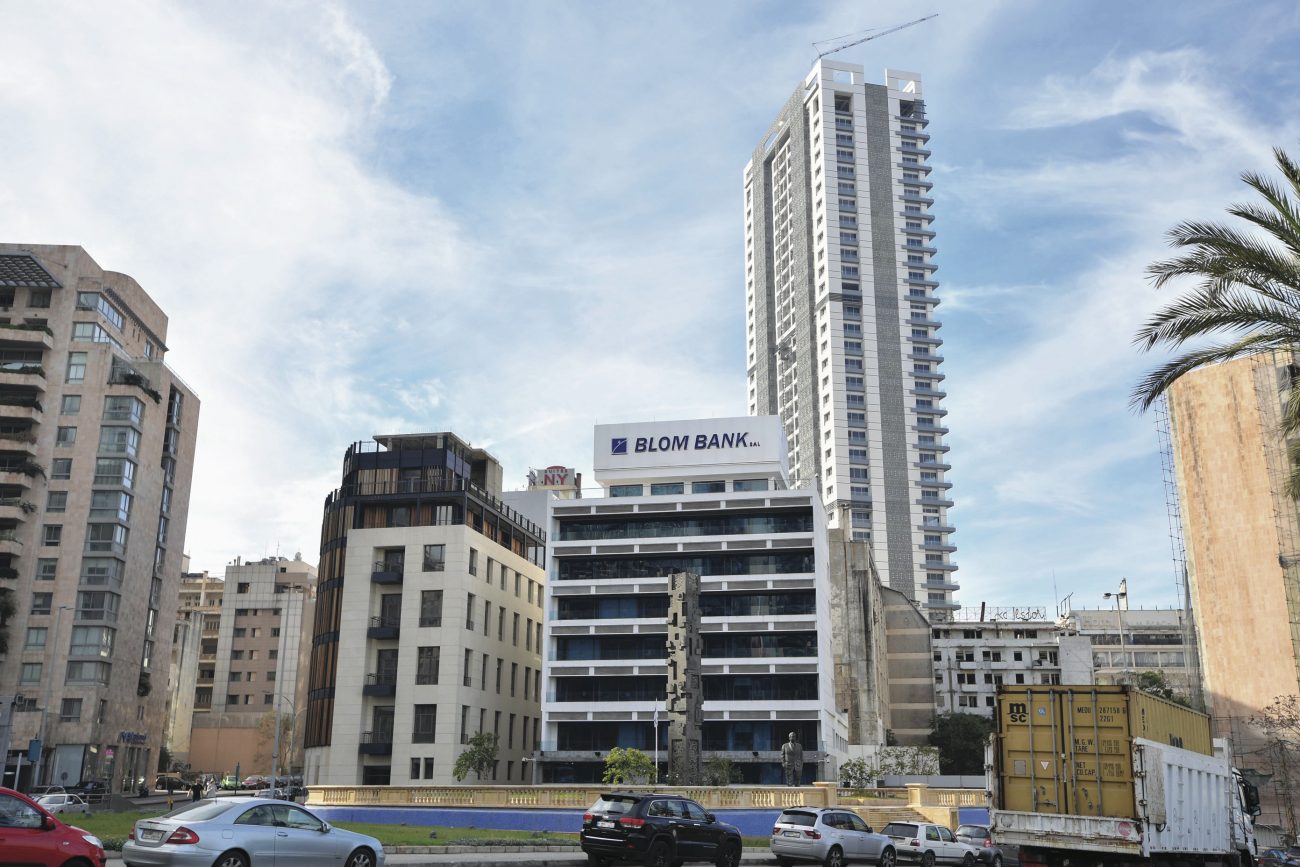
BLOM Group, Lebanon’s runner-up in banking power and winner of 20 different accolades in various financial award categories in 2016 and 2017, according to its website, said in a November 2017 blog entry by its Blominvest unit that over the first nine months of 2017, BLOM Bank “attained the highest level of operational, non-exceptional net profit” and also topped the ranks of the four listed Lebanese banks in two crucial return ratios.

“BLOM Bank recorded the highest [return on average common equity] at 16.93 percent and the highest [return on average assets] at 1.55 percent,” the entry read, before adding that the percentage growth of assets and the lending portfolio at BLOM—with asset growth of 7.7 percent and loan growth of 6.4 percent in the first three quarters of 2017—was higher than that of its listed peers, AUDI, Byblos, and Bank of Beirut.

Asked what was behind the bank’s success leadership in 2017, Saad Azhari, BLOM Group chairman and general manager, explains that the bank’s growth in assets and deposits as well as its higher loan growth than the sector was “definitely linked to the acquisition of the HSBC loan portfolio, which added about $500 million.”

While the acquisition of HSBC Middle East, which BLOM officially announced in November 2016 and completed in June of 2017, did not greatly boost BLOM in size, it was very beneficial for the group’s trade-banking activities, where it facilitated a strong increase in commission income from letters of credit (LC) and letters of guarantee (LG). According to Azhari, the acquired HSBC Middle East business adds some 2 to 3 percent to BLOM’s business, “but in terms of commissions on LCs and LGs, the increase is about 50 percent of the consolidated BLOM activity in this area, and when taken for Lebanon alone, the volume of LG [and] LC was doubled,” he says.

Some processes and digitization at BLOM could also be improved through integration of HSBC staff, and BLOM also succeeded in retaining a very high share of the acquired customer base. “The add-on to profitability is also good; while the size of HSBC portfolio is small, it will add to profitability in future,” Azhari acknowledges, adding that the acquisition worked “overall better than expected.”

[pullquote]2017 was a year of subdued appetite for growth among all Lebanese banks[/pullquote]

When asked about the best development prospects of Lebanese banking going forward, Azhari pointed to the inopportune timing of such considerations in the politically charged month of November 2017, and expressed hope that the problem would be temporary. As positive general perspectives, he cites the oil and gas sector, as well as bank investments into tech entrepreneurship under Circular 331, from Banque du Liban (BDL), Lebanon’s central bank. Granting oil and gas licenses “will definitely open new doors, as there will be companies that will be suppliers and services providers. This activity will boost investments, so I think the oil and gas sector will be an important sector for the future,” he says.

In the view of Freddie Baz, vice-chairman and chief strategist of Lebanon’s largest financial entity, Bank Audi Group, 2017 was a year of subdued appetite for growth among all Lebanese banks. He points to challenges in the two main countries with a Lebanese banking presence abroad, Turkey and Egypt, to explain why pursuit of growth in the external markets was less vigorous than in some previous years. “Both countries are facing many challenges. These challenges are of [a] short-term nature, but short-term strategies [for foreign operations of Lebanese banks] are much more in a consolidation mood than in growth mode,” he explains, adding, “At the same time, in Lebanon, we are seeing a lot of volatility and many unknown parameters. They do not exist to the extent of generating big fears and concerns, but people want to see improvements. These are again being delayed; the situation is delaying, delaying, delaying.”

Underestimated

Emphasizing that Lebanon’s performance over the past 25 years is likely to be underestimated in comparison to other Arab countries, Baz points out, “For reasons of Lebanon’s sectarian dimensions, sensitivity toward regional conflicts is probably the highest among peers in the region. But amazingly, when you look at the long run, there are interesting numbers concerning growth.” He cites recent studies conducted by Bank Audi’s economic research team under Group Chief Economist Marwan Barakat, which show that average annual GDP growth in Lebanon is in the 4 percent range in the past 27 years and, compared to the region, only 20 or 30 basis points lower when viewed over long periods (from 2000 to 2017 in the first comparison, and from 1990 to 2017 in the second comparison).

What impacts the perception of Lebanon are long-standing but largely consistent risks and the presence of high volatility. “The bottom-line reading is that Lebanon gets affected by regional conflicts and domestic difficulties much more than the region, but its capacity to rebound is also much faster. The volatility is high, but in the very long run, Lebanon always catches up,” Baz says.

The perception of Lebanon as especially risky or slow in economic development and political economy might explain many unfavorable perceptions of the nation and its financial industries among the country’s residents and foreign observers, including perceptions of measures relating to the overconcentration of the monetary side in the national mix of fiscal and monetary policies. In 2016, the best things that happened to the banking sector arguably were the central bank’s unconventional measures, driven by BDL’s desire to fill up its vault with foreign-currency reserves, which was explained by the central bank as a measure in the national interest.

It is undisputed that this unusual financial engineering translated for commercial banks into a year that was described with epithets from atypical to significant, but it was not so much by their own initiative as by their willing and skillful participation in the central bank’s scheme.

One of the possible macroeconomic advantages that the World Bank’s Fall 2016 Lebanon Economic Monitor envisioned as result from the 2016 financial engineering was “a positive impact on private lending and, thus, economic growth” from the rise in Lebanese lira liquidity at the commercial banks, contingent on “sufficient demand for the additional liquidity in local currency.” (This was the only advantage noted by World Bank economists with respect to the macro economy, versus four disadvantages.)

In September 2017, Bankdata, the analyst firm and banking consultancy, noted, “It is worth recalling that Lebanese banks are increasingly benefitting from the stimulus packages of the Central Bank of Lebanon providing interest incentives for [Lebanese lira] lending over and above an increasing liquidity in LL which is being more and more targeted toward lending at competitive rates.”

Analyzing alpha bank lending trends over nearly seven years, from December 2010 to September 2017, Bankdata told Executive that annual lending growth in the period was highest in 2013, with $7.3 billion in additional loans, while observing that “the pace has slowed substantially since December 2015, with additional loans of $2.6 billion over the past 21 months.” According to the analysis from November 2017, alpha banks’ overall loan portfolio “stood at $35.8 billion at year-end 2010, and reached $66.5 billion in September 2017, an incremental $30.7 billion, of which 70 percent or $21.4 billion [was denominated] in foreign currencies and $9.3 billion in local currency.”

The share of local-currency loans in the total rose steadily from around 15 percent at the beginning of the period to 22 percent at its end, the consultancy said. By type of loans issued over the past three years, corporate loans represented 40 percent of the overall portfolio, according to Bankdata, and reached almost 50 percent when counting commercial real estate loans. Small and medium-sized enterprise (SME) and housing loans each accounted for around 15 percent, and retail loans for 12 percent of the total. 

Not the time

As the two top bankers, Azhari and Baz, both emphasized, the purpose of the financial engineering of 2016 was to improve dollar reserves at the central bank and simultaneously increase the equities of banks. “Considering the high cost of attracting dollars, the purpose of the financial engineering was not to increase lending,” Azhari says.

Baz notes that banks amassed large amounts of liquidity through the financial engineering, which they absorbed, and that any offer to lend lira at good rates was the result, but not the target, of the engineering. “The result of the engineering was increased liquidity, and banks had to use this liquidity. This is notwithstanding the notion that we need at a certain point to de-dollarize our economy, but this de-dollarization cannot start before fundamental imbalances are adjusted,” he says, referring to Lebanon’s deteriorating capital stock and dependency on inflows, which he characterized as a form of the resource curse. 

Pointing to high correlation between GDP growth and loan growth in the country, he refers to the sluggish economy as related to the equally weak loan growth in 2017. “In Lebanon, additional lending in the economy is commensurate with 1.5 to 2 percent real GDP growth. If you want to achieve 5, 6, 7 percent, you need to double the amount of lending,” he notes. When one puts all this into context of economic pressures experienced by Lebanon from 2011 till today, one sees the role of the BDL measures as positive, when Governor Riad Salameh was faced in 2016 with a weakening balance-of-payment position at a time when money inflows could be mobilized.  “One needs to take money when it is available, because when one needs it, one may not find it,” Baz says, adding that in his view, debates over the cost of the measure were missing the point of comparing the cost of such an adjustment with the cost of a social crisis that could result from not undertaking it.

Looking into virtual opportunities

The sum of volatile economic realities in Lebanon, global uncertainties, and ever-more-complicated regulatory and operational environments for the banking industry in the country might leave the 21st century’s digital frontiers as only the palpable frontier of banking opportunities. Frontiers are always good for adventures and opportunities. They lead to unknown and perhaps even virgin territories, although the natives might object to the viewpoint. But there are no natives on the other side of the digital frontier (one assumes) and that makes it doubly attractive to venture into digital exploration.

The drawback is that the digital realm is not so new and untouched as it was 20 years ago, when the first wave of new finance settlers ventured there during the first bubble phase of the internet revolution—and soon beat retreats after the burst of the dot.com bubble, at least from the concept of “online-only” banking. More than 15 years after the burst, the internet is a standard banking channel and IT investments, online services, and cybersecurity for banks present themselves as must-have development obligations. Just as a bank operating during the Industrial Revolution needed to invest in a building, a counter, and a vault, banks in the current age need to have online services, advanced IT, and powerful cybersecurity. Lebanese banks have allocated investments to their IT departments, from upgrading core systems to adding new processes, they flaunt their online services and are aware of the cybersecurity issue (although it has to be noted that the legal and technical cybersecurity framework in Lebanon is still in considerable need of development on national level).

[pullquote]Banks in the current age need to have online services, advanced IT, and powerful cybersecurity[/pullquote]

The frontier adventures of 2018 and the next few years might be hidden in the jungle of cryptocurrencies, as the bitcoin-mania at the end of 2017 underscores. However, the path into this territory does not yet appear all that clear. Salameh, who in the past few years had been criticized by financial-tech entrepreneurs for blocking the concept of cryptocurrency adoption in Lebanon, recently readjusted his outlook and started talking about a sovereign digital currency, for example, at a cybercrime prevention conference in November. However, it seems that the Lebanese banking sector still has to tune its sensors to the cryptocurrency and distributed ledger technology, not at only in development practice but even in concept. BLOM Chairman Azhari enthused to Executive that the bank already has its version. “We ourselves, if we can say so, have a virtual currency, our golden points. It was started before [the topics of Bitcoin and Blockchain came into existence] and our customers used their golden points to buy merchandise all over the world.”

Loyalty points, in technical terms, are known as tokens. Under a well-established concept they are used by many consumer focused companies, including retailers, airlines, and banks, and they have a specific purpose: to reward and enhance customer loyalty, duh. Importantly, the issuers control their generation, distribution, value, and shelf life. This limits their qualities as fungible, transferrable, or tradeable digital means. Cryptocurrencies and their safety features (the blockchain) are generally designed to be tradeable, have unlimited lifespans, and are thought of as fungible.

The concept of a digital sovereign currency in Lebanon under BDL supervision comes with many questions. Moreover, the timeframe for any adoption of such a scheme is yet to be determined—and if the time that has passed since the first reference to an ETP in a public speech by Salameh is any reference, nobody needs to trouble their mind over a sovereign or any other cryptocurrency in Lebanon for a few years yet. For Audi’s Baz, the much hotter agenda item for Lebanon is the creation of the electronic trading platform (ETP) attached to the Beirut Stock Exchange. “Digital currency talks are very premature for Lebanon. In my opinion, the ETP is more important, and the [BDL] governor is keen on developing it,” he enthuses, adding that not mere words but real action has been dedicated to the establishment of an ETP in the Lebanese context, and needs to result in more concrete steps. 

January 9, 2018 0 comments
0 FacebookTwitterPinterestEmail
BusinessOverview

Five cheers for stability

by Thomas Schellen January 9, 2018
written by Thomas Schellen

A good starting point for reviewing the Lebanese banking sector at the end of 2017 to study a document that was published early in the year and is referred to in financial High Valyrian as a FSAP. For common folks, this stands for Financial Sector Assessment Program. A FSAP is undertaken by the institutions missing from Westeros: the World Bank and International Monetary Fund. To augment insights from the FSAP on Lebanon, which was published under the title Financial System Stability Assessment, one can turn to the findings of the IMF’s Article IV consultations on Lebanon.

For readers who are interested in super-condensed material, the entire economic narrative of Lebanon in 2017, and 2016 before it, is contained in FSAP’s opening paragraphs, in just two sentences: “Lebanon has maintained financial stability for the last quarter-century during repeated shocks and challenges,” but “over time, macroeconomic and financial vulnerabilities have accumulated.” This is the Lebanese paradox of endurance, resilience, and risk in a nutshell. In a sense, nothing more needs to be said about the matter of the tiny Lebanese economy.

As for the banking sector, the FSAP elaborates that despite economic and political shocks, “confidence in the banking sector has been sustained … and the banks have grown and remained profitable.” About Banque du Liban (BDL), Lebanon’s central bank, the report observes, “BDL plays a critical role in sustaining confidence, although, without sustained fiscal adjustment, there are limits to these policies.”

The assessment, which runs to nearly 80 pages in body text and appendices, concludes by saying: “Developing a strategy that addresses the elements noted above, including eventual withdrawal of BDL’s economic stimulus programs, and bringing in views from the financial industry and other stakeholders, could build consensus around reform priorities and sequencing with due regard to financial stability and integrity concerns.”

[pullquote]There are 52 insurance companies for a $1.5 billion market. This results in fierce competition and lower market standards[/pullquote]

This is just as true at the end of 2017 as it was a year earlier. What the paper was naturally unable to predict, however, was the journey of national sentiments from the end of last year to December 2017, a whitewater adventure in a raging stream of unpredictable political twists and economic turns. On this ride, the banking sector proved to be an essential raft of stability, providing stabilizing effects on the financial economy, such as wealth management and insurance, and on the entire country. Moreover, while the past year saw some rumors and debates over allegedly impending financial and economic doom owing to the central bank’s monetary policy, the year’s dangerous instability was not at all related to banking or BDL monetary policy. It arose from pure politics.

The 2017 narrative in brief

In rough strokes, the Lebanese ride through the year was defined by local politics and international circumstances. The journey of notable twists began with political declarations of optimism after the formation of a government in December 2016. Based on this optimism, banks and economic stakeholders started January 2017 full of hope for improved performances. For bankers, February brought with it the first turn toward concern, over speculations about the upcoming end of BDL Governor Riad Salameh’s term. Then, later in spring, concerns in the banking sector grew as reports of new American anti-Hezbollah measures emerged. Speculations and rumors over Salameh’s resignation and debates in the United States over the Hezbollah International Financing Prevention Act (HIFPA) built up uncertainty throughout spring 2017, accompanied by some research essays and speculation about Lebanon’s long-standing economic imbalances, the stability of the lira, and sector-internal matters such as upcoming board elections at the Association of Banks in Lebanon. While political unity and reform remained an issue throughout the first half of 2017, May and June brought the Salameh question and Lebanese political concerns back to the front burner, via the urgently needed new election law.

From outside Lebanon, the global implications of the new regime in the United States and fears over a possible spread of populist influences in Europe spiced up the local journey with imported political concerns, until election outcomes in the Netherlands and France calmed minds all around. In the context of global developments, however, tensions soon erupted into a new bout of mad politics, with North Korea on top of the insanity pole. A competing political performance on center stage was delivered by new global twittertainer, The Donald, with his bizarre “Trump First” show.

Leading financial markets in the US and Germany, in the meantime, achieved stronger growth than pundits had predicted at the onset of 2017. Throughout the year, large economies reported improvements; the picture was peppered in the year’s second half with the occasional dire warning against complacency and “frothy valuations,” uttered by financial powers like IMF head Christine Lagarde or the Bank for International Settlements in Basel.

In Lebanon, July brought a boost of relief to banking emotions as Salameh’s new term was confirmed. Lebanese banking and political officials polished doorknobs in the US in August, while the Lebanese focused on their summer vacations. HIFPA worries, meanwhile, were swept under a rug of artificial calm for a while, only to reappear later in the year (see below for the timeline of HIFPA adoption in the US). In mid-summer, the mood was again dampened by another wave of rumors about trouble for the Lebanese lira and the economy, peaking in a paper in which noted economist Toufic Gaspard argued his case for addressing the “Financial Crisis in Lebanon.” The paper even triggered a sanctimonious response from the usually taciturn BDL.

October came with more optimistic declarations, as locally-held international and national conferences kept bankers on their feet. But any hopeful mood was blown come the first weekend in November and the surprise resignation that Prime Minister Saad Hariri chose to deliver via a Saudi-owned TV network from Riyadh. Thus ensued a month-long story of verbal panic, damage control, and reassurances, followed by ostentatious relief in early December.

Throughout 2017, BDL Governor Salameh iterated his assurance of stability in conferences, interviews, and interventions on all sorts of occasions. At practically every major appearance, he repeated the statements which he had given at the end of 2016, such as, “Our holdings in foreign currency allow us to think that we can keep the Lebanese lira stable,” or affirmations of determination for maintaining interest rates. At a conference in July, just to cite one example, he offered his mantra, “The Lebanese lira is stable and will remain so,” and assured his audience, “Interest rates in Lebanon are stable.”

In no month of 2017 could one count more of these assurances than in November, when the governor voiced his assurances of stability not only nationally, but also sought to appease international concerns about the Lebanese situation. Even when asked in mid-November by a CNBC interviewer how frustrated he was about the disruption of Lebanon’s economic recovery by the latest political turn, Salameh’s answer was, “The Lebanese lira will remain stable.”

By early December 2017, the assurances appeared to have achieved their purpose. Although political question marks still linger en masse and no conclusive summary on the performance of Lebanese economic indicators for full-year 2017 can be drawn up, the performance of the banking sector for the first nine months of the year has been—when compared also to the rather exceptional boon year of 2016—reassuringly stable. Banks in the top tier of the sector delivered remarkable numerical normalcy. Assets rose, deposits rose, and even lending showed increases that seemed commensurate with the overall economy’s (subdued) growth (see comment by Bankdata).

Details about the loan activities by the largest Lebanese lender, Bank Audi, reinforce the impression of shifts in accents within overall persistency. Grace Eid, head of retail banking at Bank Audi Lebanon, informs Executive that the lender saw “strong development in domestic-loan issuance in Lebanese lira,” especially with regard to personal loans. Eid notes an inversion in this segment in particular, saying that in 2017, sales of lira-denominated loans outperformed dollar-denominated ones, whereas in the year 2016, “45 percent of our personal loan executions were in Lebanese lira, versus 55 percent in US dollar. 

“Regarding the home loan, no major changes were witnessed during the past two years, as 80 percent of our lending portfolio remained in Lebanese lira. Although our strategy in 2017 was to increase car-loan sales in Lebanese lira, as we have introduced a new plan in this currency, 99 percent of our lending portfolio was in US dollars,” she elaborates.

In another area where bankers increasingly started seeking to better serve the Lebanese market, small and medium enterprise clients picked up on the idea that large banks could help them with their specific needs, Bank Audi confirms. “[Besides a] remarkable increase in the sales of the retail banks’ core retail products, starting with the personal loan and followed by the home and car loans, we have witnessed, in the SME banking sector, a high demand [for] products that finance the working capital (operating expenses), followed by [demand for] subsidized loans from the central bank for long-term financing,” explain Eid and Hassan Sabbah, head of SME banking at Bank Audi.

Words from stakeholders in other parts of the financial economy

In addition to commercial banking, with its ever-more diversified retail, small commercial, and corporate offerings, other sectors of the financial economy showed either concrete development or at least promise of future development. From the banking sector’s chambers of wonders—the wealth management and private banking space—come tidings that Lebanese High Net-Worth and Ultra High Net-Worth Individuals (HNWI and UHNWI) found themselves able to lean back comfortably on rich cushions. Leading private bankers in Lebanon who opened their hearts to Executive in fall 2017 assured that wealth deities are exceedingly kind to their clienteles. Wealth management specialists representing Swiss private banking group Julius Baer likewise signaled that their local clients have nothing to fear.

During a visit to Lebanon in early November, Remy Bersier, head of Emerging Markets at Julius Baer, confirmed that the bank, which has had an office in Lebanon since it acquired the Beirut operations of Merrill Lynch, has not seen any unusual behavior or irrational capital-flight impulses from clients here. “We are committed to growing here, and are recruiting. We want to reach a higher level of access to the UHNWI segment,” he says. With a strategic concentration on the three pillars of sustainable profitability, client experience, and reputation, “We have many projects ongoing today in the bank and are really careful to respect regulations. One of the key topics is to bring the bank into the next decade and, hopefully, century. Reputation is not negotiable,” he emphasizes. 

Capital markets in 2017 still were as they had been in previous years: underdeveloped to the point of invisibility. But as the FSAP assures and local capital-market wizards confirm, Lebanon’s regulatory Capital Markets Authority (CMA) has not been idle. The FSAP reports said that “Over the past five years, the CMA has built capacity and is now well established as an independent regulatory authority,” and acknowledged that the institution, which is also chaired by BDL Governor Salameh, “has prepared regulations in line with international best practices covering licensing and registration, market conduct, business conduct, securities offerings, listing rules, and collective investment schemes, and has put in place a supervisory program.”

The CMA’s key message to the market in 2017 was confidence, CMA Communications Head Tarek Zebian conveys to Executive. “Today, investors and financial institutions strongly feel the presence of CMA while conducting securities-related business activities. In 2017, CMA formulated, in coordination with experts from the World Bank, a ‘blueprint for market development,’ a document that was shared and consulted upon with all stakeholders of the CMA, including the office of the prime minister, representatives of public institutions, and financial industry professionals. This signaled to the various participants our long-term commitment to shift the capital markets to the forefront of financial activity in Lebanon,” Zebian says, adding that the authority’s measures should ultimately translate into vibrant capital markets which enhance economic growth.

Pointing to progress in the drawn-out saga of attempting to transform the Beirut Stock Exchange (BSE) into a high-performing entity and the vibrant center of Lebanon’s capital markets, Zebian affirms that a cabinet decree issued in August of this year initiated the process of establishing a new entity under the name Beirut Stock Exchange sal, transferring all assets of the “dismantled government-owned Beirut Stock Exchange to the new sal company.” According to him, the new BSE is to be sold within one year. 

Among a host of other new measures, in 2017, the CMA signed a memorandum of understanding with Lebanon’s Insurance Control Commission (ICC) at the Ministry of Economy and Trade. “In essence, the MoU clarifies the relationship between both authorities, especially toward investment insurance policies that has dual oversight as a result of securities-linked (unit-linked) products underlining their formation,” Zebian explains. It is expected that CMA and ICC will exercise joint jurisdictional oversight and collaboration in the interests of insurance policyholders and investors in this industry.

The insurers’ lot

The Lebanese insurance sector is engulfed to quite some deGree in a dichotomy that is not all that dissimilar to the contradictory state of the country’s economy. All insurance companies are private sector players. The companies pride themselves in being pioneers of practicing insurance skills in the region. However, no single insurance company has been listed on the BSE, and sector assets historically represent under 10 percent of GDP. Banks regularly outdo insurers in terms of sector-asset growth and, as the FSAP notes, insurance assets stand small when compared with the banking industry.

In the FSAP description, “The ICC is instrumental in maintaining the industry in a generally sound condition,” but “the insurance sector faces structural challenges to its sound development.”

AXA Middle East confirmed that 2017 saw an increase in competitive pressures in the local market, resulting in decreases in premiums. Coupled with cost increases from the expected VAT increase and rising costs for medical care, the company foresees a “reduction of profit or even losses for insurance companies.” According to Reine Kattar, AXA Middle East’s brand, communication, and reputation manager, the company, which is affiliated with the multinational AXA Group, is also witnessing some cost pressures from an increase in regulatory action, a relatively new phenomenon in the Lebanese insurance market. “Governance requirements are increasing, which leads to higher cost in compliance, risk management, and internal audit,” she explains.

New regulatory pressures included, AXA Middle East General Manager Elie Nasnas confirms growth prospects for the insurance industry. “I can see a growth in the insurance sector for the coming years. This can only be offset currently by the lack of tax incentives for life products,” he tells Executive, adding that the incentives for life insurance savings products exist in many countries and motivate owners of small as well as large businesses to buy these insurance programs.

“Also needed today is a unanimous decision by the Ministry of Finance to exclude the costs of taxes related to health and savings insurance policies from the general tax on wages and salaries, which will in turn encourage business owners to invest in such policies. A driving factor which will drastically help the insurance sector would be a policy shift of making some currently optional policies to become mandatory insurance covers. Most notably, these are civil liability for material damages as well as insurances against fire and natural disasters. In the past, these types of policies were seen as optional, but in today’s world they are indispensable to our everyday lives,” he says.

The assessment of insurance as in need of structural reform is also confirmed by Anthony Khawam, deputy CEO of Sécurité Assurance, who tells Executive, “Compared to regional and international standards, our market is overcrowded. There are 52 insurance companies for a $1.5 billion market. This results in fierce competition and lower market standards, and also makes it difficult for the regulator to monitor and stop the misconduct of some players.”

Regarding measures that would accelerate reform in the insurance sector, Khawam identifies the meager capital requirements as a main reason for the market’s over-crowdedness. “It is very important to raise capital requirements and to create subsidized loans that would encourage mergers and acquisitions. These initiatives would consolidate and strengthen the market, and our understanding is that the regulator is rightfully working on both of those fronts,” he says. In his view, the ICC has indeed been responsive and proactive in dealing with market misconducts. “This sent the right message to stakeholders, not to mention that some corrective measures were much needed,” he concludes.

The CMA’s Zebian confirms that the capital-market regulator favors public listings from the insurance sector. He emphasizes, “The CMA seeks to create a sound legal and operational framework that allows for companies of certain maturity and size to take the decision to float their shares. As such, we see a great potential in insurance companies and strongly believe that the insurance market, which is almost 3 percent of GDP, can have strong growth in the future. This is something that investors continue to look for.”

Within the framework of Lebanese political insecurity, it would certainly be frivolous to predict certainty in any part of the financial economy. Growing cohesion in the interaction of banking and wealth management with capital markets and insurance seems the best hope at the end of 2017—provided that the long experience of Lebanese banking sector stability extends through 2020 and beyond. 

[/media-credit] (Click on image to view timeline)

January 9, 2018 0 comments
0 FacebookTwitterPinterestEmail
Economics & PolicyNumbers & Figures

Economics & policy

by Ahmad Barclay & Jeremy Arbid January 9, 2018
written by Ahmad Barclay & Jeremy Arbid

[media-credit name=”Ahmad Barclay & Jeremy Arbid” align=”alignright” width=”620″][/media-credit]

[media-credit name=”Ahmad Barclay & Jeremy Arbid” align=”alignright” width=”620″][/media-credit]

[media-credit name=”Ahmad Barclay & Jeremy Arbid” align=”alignright” width=”620″][/media-credit]

[media-credit name=”Ahmad Barclay & Jeremy Arbid” align=”alignright” width=”620″][/media-credit]

[media-credit name=”Ahmad Barclay & Jeremy Arbid” align=”alignright” width=”945″][/media-credit]

[media-credit name=”Ahmad Barclay & Jeremy Arbid” align=”alignright” width=”621″][/media-credit]

January 9, 2018 0 comments
0 FacebookTwitterPinterestEmail
Civil SocietyEconomics & Policy

A new hope

by Carmen Geha January 4, 2018
written by Carmen Geha

For the first time in a very long time, I am hopeful that activism in Lebanon is opening up to new ways of mobilizing and engaging citizens in public life. I have been involved in a range of civil-society work for more than a decade. My PhD thesis addressed the challenges imposed by Lebanon’s political system on the ability of civil society to influence reform. I have designed and delivered a number of training sessions for civil society on how to advocate for policy reform, and I have come out frustrated and disappointed each and every time. Here is what I know to be true about what has held back Lebanese politics: Lebanese national institutions are the least important actors when it comes to decisions on public policy-making. In fact, many important policy issues are governed by a non-policy or by the absence of a clear policy framework, not the least of which is the case of Syrian refugees. I have also learnt that sectarian courts are incompatible with a rights-based approach to reform. Lebanese politicians thrive on polarization and the ineffectiveness of state institutions. And civil society’s demands are either neglected or co-opted by the establishment.

But today, I am hopeful because I feel that some activists are beginning to realize these truths and are adapting to them.

Historical constraints

“I don’t think anything is really ever going to change, but I still believe we need to do the things we’ve always done and hope for the best.” This is what one activist explained to me recently, during one of the many ongoing workshops put on by civil society in this country. In Lebanon NGOs continue to be sidelined from reform and policy making, and the national institutions actually responsible for reform and policy making are largely ineffective. Essentially, decisions over reform, or the lack thereof, are made outside Parliament, and even outside the cabinet, by a select handful of the political elite, whose grip over power can be attributed to a 1991 amnesty law that allowed warlords to return to power by taking legislative and executive seats.

This last year was not much different, with its spells of political deadlock, moments of consensus, and the creation of a new cabinet that is now a feather in the Saudi-Iranian winds. Meanwhile, the conflict in Syria is entering its seventh year, leaving over a million registered refugees in Lebanon with no access to basic rights and no government willing to regulate their legal status. In such a context, we cannot expect civil society organizations to be effective advocates for policy reform, as they remain the weakest players in the web of partisan interests and geopolitical commitments that Lebanese politics is so well known for. But that is not to say that there is no hope. If anything, 2017 has given birth to new and exciting avenues for mobilization. Here are some that are likely to meet ongoing success in 2018.

The Beirut Madinati effect

The unprecedented electoral battle led by the competent, hopeful, and visionary team and candidates of Beirut Madinati (My City) has created a ripple effect across the country. There is a new feeling among activists that can be explained as nothing short of “Yes we can,” which manifested in the momentum around the 2016 Beirut municipal elections—and could be poised to leave a mark on the upcoming parliamentary elections as well. In 2017, Beirut Madinati backed the Naqabati (My Syndicate) list, which put Jad Tabet at the head of the Order of Engineers and Architects, beating his establishment-backed opponent in a slender, but significant victory. Suddenly, activists felt that they did not need to remain within the confines of civil society activism, but could also propose their own solutions to vexing problems and push forward their solutions onto public opinion and electoral platforms. Myriad new reform platforms are working on concrete plans and advocating for solutions in newspapers and on political talk shows. It remains to be seen to what extent this experience can be replicated in parliamentary elections or even in other municipal elections, but for now 2017 is ending on a really high note. A shift in mindset from demanding solutions to offering solutions, and proposing candidates who can work on those solutions, is bound to result in a shift of  strategy by activists.

AUB’s Secular Club and independent student movements

Attention from media, political parties, and intellectuals across the country has focused on the success of the American University of Beirut’s secular club, which won a third of the seats of the elected student body in October 2017, as well as on independent clubs in other universities across the country, including Université Saint-Joseph and the Lebanese American University. In a country ripped apart by sectarian politicians, political parties have historically controlled student life, and even sports clubs. It is both remarkable and hopeful for a young group to have emerged as an opponent to politically affiliated clubs on campuses across Lebanon. These students have developed a new rights-based discourse that is focused on access to education, freedom of expression, and youth civic engagement. We have also recently seen the launch of the Mada network, a first of its kind youth-led political platform. For as long as I can remember, I have felt sorry for my students because once they leave the safety of their campus they have very little opportunity to get engaged in public life, aside from joining NGOs as volunteers or as staff. But this appears to be changing—a change that we also have to wait for 2018 to see come to life. 

We are finally on a recognizable path. Moving forward, the challenge will be to capitalize on these new mobilization platforms by adopting issues that civil society has been working on in Lebanon for decades. We need political platforms to address what civil society has been demanding for a long time. Hope is not created in the offices of NGOs or in civil society workshops, but in political decision-making circles where activists have finally earned their seat.

January 4, 2018 0 comments
0 FacebookTwitterPinterestEmail
Economics & PolicyElectoral law

At long last…

by Matt Nash January 4, 2018
written by Matt Nash

Guarded optimism from a variety of anti-establishment groups, political movements, and individuals followed the mid-2017 approval of a new electoral law. Lebanon’s Parliament has thrice extended its own term since the last elections in 2009, ostensibly twice because lawmakers had failed to agree on a new law to govern new polls. After the most recent extension was granted to prepare for elections in spring of 2018, an Executive survey of newcomers running against the country’s established political parties found hope amid fears the vote would once again fail to be held.

The new electoral law uses proportional representation to allocate Parliament seats for the first time in Lebanese history. Such a mechanism allows more opportunity for smaller parties to secure seats. As Executive queried new political entities throughout the summer, all agreed that the anti-establishment movement would fare best if it was just that: a unified national movement.

When we checked back in with those we spoke to during summer 2017, the few who responded confirmed that meetings continue, and unity remains elusive. Putting ego aside and sticking to a consistent, hopeful message of change will arguably be the biggest challenge for anti-establishment candidates—if elections are held on time in 2018­—but committing to implementing a detailed program and refusing to compromise on core principles will be the equally daunting challenges facing reformist candidates, should they become reformist representatives.

While some of the terminology is the same, in 2018 Lebanon will have an electoral system unlike anything it has ever seen. The new electoral law, approved by Parliament in June, features changes to electoral districts and introduces two new components: proportional representation (PR) and preferential voting. It is certainly more complicated than the electoral systems used in the past, but Executive has prepared a guide to help readers understand both how to cast ballots and how their votes will be counted.

New districts

For administrative purposes, Lebanon is divided into governorates (mohafazat) and districts (kadat). Traditionally, each administrative district has also been an electoral district. In 2009, there were only a few exceptions (Baalbek and Hermel were merged into one electoral district, as were Miniyeh-Danniyeh, West Bekaa-Rashaya, and Marjayoun-Hasbaya).

In 2018, the electoral map will not be drastically different. While the previous 26 electoral districts have been reduced to just 15, the number and sectarian division of seats remains largely unchanged. This means that those electoral districts that have been combined retain the number of seats and the divisions they had in 2009. For example, Bcharre, Batroun, Koura, and Zgharta combined become one electoral district with 10 seats: seven Maronite and three Greek Orthodox. Six of the 2009 electoral districts reappear unchanged.

Beirut underwent the biggest makeover. The city was divided into three electoral districts in 2009. In 2018, it will be two electoral districts. The district known in 2009 as Beirut 2 is gone, with the Medawr neighborhood (see map) now merged with 2009’s Beirut 1 (Ashrafieh, Saifi, Rmeil). The Port (Marfaa) and Bachoura neighborhoods are now part of the remainder of the city in 2018’s new Beirut 2. The city’s upcoming electoral division quite nearly mirrors the so-called “green line” of the civil war. The former Beirut 2’s two Armenian Catholic seats went to Beirut 1, as did the evangelical seat representing Beirut 3 in 2009. Beirut 2’s one Sunni and one Shiite seat each remain in 2018’s Beirut 2.

The lists

In past Lebanese elections, political parties would strike alliances to form lists of candidates in an electoral district. However, there were no pre-printed ballots at voting stations. What this meant is that voters either entered the polling stations with party-printed lists to place in their voting envelopes, lists they wrote at home (i.e., creating their own lists by choosing their favorite candidates among the competing lists) or nothing, using the blank pieces of paper and pens in the voting booth to handwrite a list of their chosen candidates. The electoral list was a marketing concept, not a legal requirement. Candidates were free to register and run in a constituency even if they were not part of a list, and voters could mix and match among the lists. However, election results proved that most voters opted to choose entire lists. Many argue that this often led to unfair results as a result of close elections (i.e., a list that garnered 51 percent of the votes saw all of its candidates elected, while candidates who attracted 49 percent of voters got nothing).   

Under the new law, lists will be legally set in stone (meaning no more mixing and matching and no more individual candidates), and voters will be handed pre-printed ballots by electoral officials when they enter a polling station. There is no limit for the number of lists that can run in an electoral district; however, there are some rules. Lists can be either complete or incomplete, meaning if an electoral district has 10 seats, the list can either have 10 candidates (a complete list) or fewer (an incomplete list). An incomplete list, however, cannot be a one-person show. Any incomplete list must have at least three candidates or more, up to a minimum of 40 percent of the seats in an electoral district, and— in electoral units comprised of more than one administrative district— one candidate from each kada.

Proportional representation

The new electoral law also introduces proportional representation, an attempt to better represent voters. Tallying the votes and determining how many seats each list will receive is a three-part process. First, all votes cast in an electoral district are counted and then divided by the number of seats to reach an “electoral quotient” (for example, 100,000 votes cast in a 10-seat electoral district means 10,000 votes is the electoral quotient). Second, the number of votes for each list will be measured against the quotient, and lists below the quotient will be disqualified (in our example, even a list with 9,999 votes wouldn’t make the cut). Third, once lists below the quotient are disqualified, the votes from those lists are subtracted from the overall total of ballots cast and the quotient re-tabulated with seats then distributed to the lists based on the new quotient (see sample ballot). 

When allocating seats based on the quotient, the math typically won’t produce “round” numbers. A list will be allocated 3.567 seats, for example. To handle remainders, lists are first allocated their whole number of seats and the list or lists with the largest remainders get any remaining seats (in a 10-seat district, imagine List 1 gets 4.921 seats; List 2 gets 3.896 seats and List 3 gets 1.895 seats, the final allocation will be: List 1: five seats; List 2: four seats, and List 3: one seat).

Voting systems vary across the world, and there is no absolute best practice for determining an electoral quotient (or threshold) in a PR voting system. In some countries that use party list systems, a percentage of total votes cast is used (any list with more than X percent of the vote gets at least one seat, with more popular lists getting more seats). This percentage can be high—10 or 20 percent—which disfavors parties or candidates with limited popularity. It can also be low—5 percent—to favor the inclusion of less popular parties/candidates. Lebanon’s chosen method of calculation results in varied threshold percentages across the country (i.e., seat distribution is not well-aligned with population distribution, at least according to the imperfect lists of registered voters, meaning that some electoral districts have “more” seats than others based on the comparative populations — (see chart).

Preferential votes

The new law also introduces preferential voting, meaning voters can choose their favorite candidate on the list they vote for (provided the candidate is running in the kada where the voter is registered). It’s as if voters get to vote twice, first for a full list of candidates representing the entire district and second for a specific candidate representing the kada in which the voter is registered. For example, the new electoral district of Batroun-Bcharre-Koura-Zgharta has 10 seats, so the district will see lists with between 4 and 10 candidates. Once a voter has chosen a list representing the entire district, he or she then chooses a favorite candidate from his or her kada (for example, voters registered in Koura can only cast a preferential vote for candidates running in Koura).

Once all lists passing the threshold have been identified and allocated their number of seats, the job of actually filling the seats comes down to the preferential votes. This, again, involves some math. To seat candidates, they are ranked in order of their popularity (calculated by dividing the number of preferential votes received by the total votes cast in each administrative district (kada), not the wider electoral district). Candidates are then ranked based on these percentages and allocated seats. Because seats are still allocated to religious communities, this does not necessarily mean that the most popular candidates on a list will actually get elected (see sample ballot). If there were no seat allocations for religious communities, the strongest candidates on each list allocated seats would win. Community allocations complicate that, however. Imagine a constituency with two Sunni seats and three lists. List 1 received the most total votes and has the most popular Sunni overall (the Sunni candidate with the most preferential votes from his or her kada). List 2 received the second-most total votes, and one of its Sunni candidates received the second-most preferential votes. List 3, meanwhile, received the least number of votes, yet the list’s most popular candidate is a Sunni (i.e., one of the list’s Sunni candidates received more preferential votes than any other candidate on list 3). List 3’s star Sunni is guaranteed to lose because the two more popular Sunnis will get the seats first, and all other Sunni candidates will be disqualified once the two Sunni seats are filled.     

An uphill climb

Civil society organizations have long called for proportional representation as a means to wrest some power from the country’s established political parties. This law certainly gives newcomers a better chance at getting elected than all previous electoral laws. However, it arguably is written in a way to decrease that chance as much as possible. While this law is unlikely to result in drastic changes to the parties and interests filling the seats of Parliament, it offers those hoping to challenge the establishment a fighting chance.

January 4, 2018 0 comments
0 FacebookTwitterPinterestEmail
Economics & PolicyTelecom

Missed connections

by Matt Nash January 3, 2018
written by Matt Nash

Their approaches have been as different as fresh fallen snow is from the salty splash of the sea. Abdel Moneim Youssef, former head of the Lebanese state-owned telecom provider Ogero, was cold. Elusive, even. He avoided questions by dissecting them and firing queries back at his interviewer. Imad Kreidieh—who replaced Youssef after the latter was removed from office amid corruption allegations he was later cleared of—has taken to Twitter to tout accomplishments more often than Donald Trump.

Blame for abhorrently slow internet download speeds in Lebanon often fell at Youssef’s feet. Ogero controls the country’s fixed-line telephone network, which includes a fiber-optic backbone—now fully operational—and connections between individual users and the internet, which happen at Ogero centrale around the country. Ogero is also a key decision-maker for telecom policy along with the Ministry of Telecommunications (MoT), which owns all of the country’s mobile-phone network infrastructure. (The country’s two networks, branded in the market as Alfa and touch by operators Orascom and Zain, are managed on behalf of the MoT). Among other complaints, Youssef allegedly kept internet connection speeds at the centrale slow. The veiled accusation here is that the beneficiaries of slow internet are illegal providers, who serve an estimated 50 percent of the market. Regardless of the reasons, by the third quarter of 2017, Ogero had resolved bottlenecks at the central offices, and internet speeds were indeed much faster for many users—we are talking jumps of download speed from 2 megabits per second (mbps) to near 30 mbps.

A faster future?

Ogero spent most of 2017 tendering new projects designed to speed up the internet for as many users as possible. Ongoing projects include upgrading switching technologies to maximize efficiency from the existing copper telecom network, installing “cabinets” across the country to bring fiber as close to homes as economically feasible, and installing new wireless connections to bring fast speeds to users in remote areas. At a conference in late 2017, Kreidieh went so far as to promise that Lebanon will soon have the world’s fastest network. (He later took to Twitter to clarify that users will not necessarily have the world’s fastest connections, just that the network would theoretically be capable of providing them).   

Many internet users in Lebanon have a copper wire somewhere between their device and the actual internet. Internet via mobile phone is now entirely wireless and fiber—home connections, however, are another story. Most buildings are internally wired with copper, meaning even ‘heavy users’ such as universities, banks, and military installations, which are today connected to the fiber backbone via fiber most likely have copper carrying connectivity from the on-site fiber landing site to individual users spread across campus, or dispersed among dozens of floors in an office building. Copper can achieve 30 mbps speeds, provided the distance it is serving is only a few meters. As distance increases, however, quality and speed decrease.

Ogero aims to alleviate the distance problem by deploying fiber cabinets. Instead of having copper wires stretch several kilometers between end users and the nearest centrale, the cabinets will stand in between, with one fiber line connecting the cabinet to centrale, and copper connecting users a shorter distance between their home and the cabinet.

Kreidieh insists the work is ongoing, although he did not respond to an interview request for this report. A potential storm on the horizon, however, first appeared on the radar in October 2017 when telecom minister Jamal Jarrah (who also did not reply to an interview request) accused Kreidieh of corruption. Whether the accusations will continue, and whether or not a management crisis could derail ongoing projects is unclear, but if there’s one thing that years of empty promises have no doubt taught Lebanese internet users, it is that the proof will be in the streaming.

January 3, 2018 0 comments
0 FacebookTwitterPinterestEmail
Economics & PolicyWater

Lebanon’s mismanagement strikes again

by Matt Nash January 3, 2018
written by Matt Nash

Lebanon is an oasis. In a region synonymous with desert, the only significant stretches of sand in the tiny, water-rich country are along its 220-kilometer Mediterranean coast. It is the only place in the Middle East with a natural ski season, yet it still does not take on-the-ground snowfall measurements—assessments have been done by studying satellite photography and extrapolating estimates. For all its natural blessings, however, the outlook is bleak for Lebanon’s water sector.

Data is admittedly scarce—one cannot manage what is not measured and monitored—but available indicators suggest that key sector management issues, like overexploitation of groundwater resources and gross mismanagement of wastewater, were not adequately addressed in 2017, nor will they be anytime soon.

Lebanon’s current national water and wastewater strategy was written in 2010 and received cabinet approval in 2012, but it remains largely unimplemented. The Ministry of Energy and Water’s 2017 annual report—compulsory under the access to information law approved in February 2017—has not been published at time of writing, and the ministry did not respond to an interview request for this article.

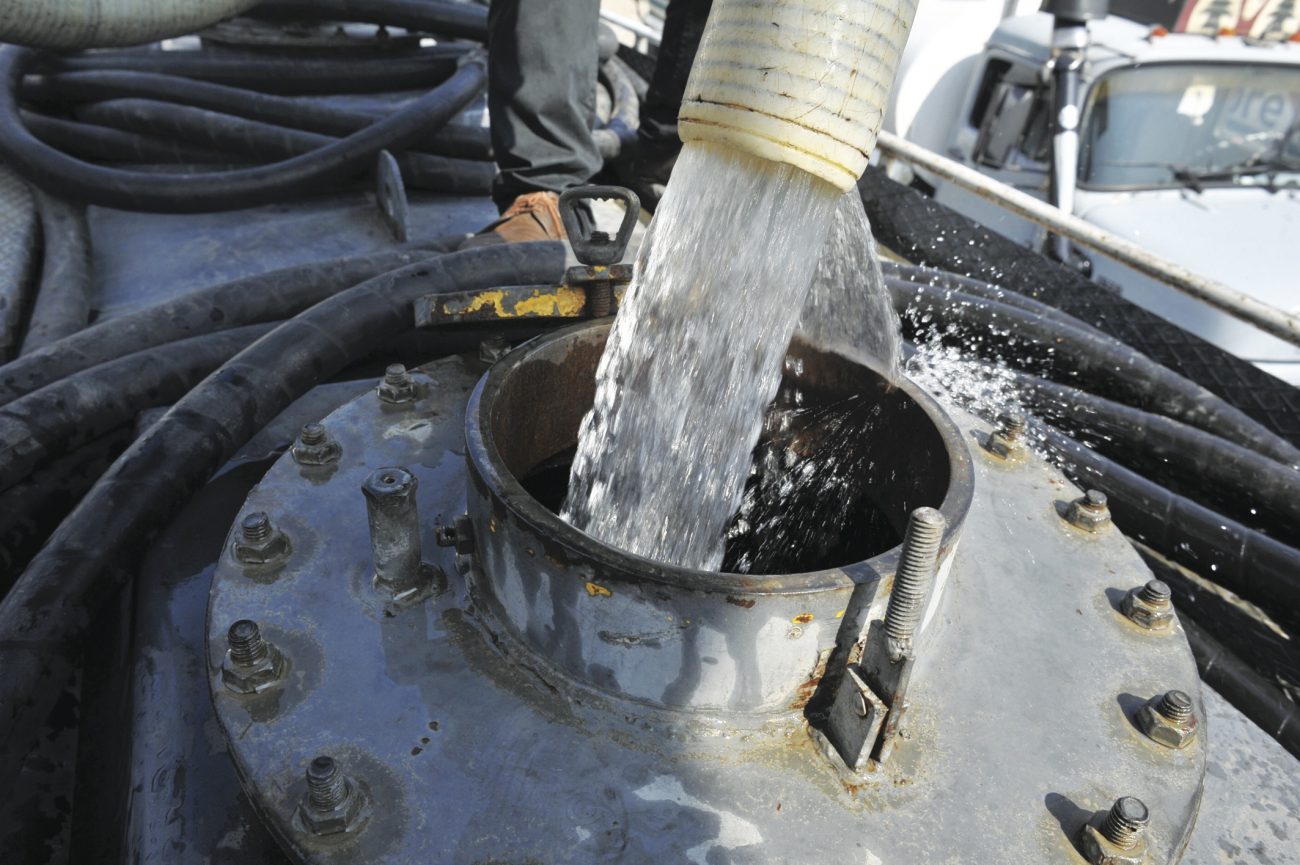
Problems in the water sector are well-studied, if still largely unaddressed. Five decentralized, regional “water establishments”—administrative offices still not fully endowed with their legally mandated decision-making and financial independence—are supposed to supply their regions with safe drinking water, continuous access to “utility water” for showering and cleaning, and wastewater-collection and treatment services. Three of the five water establishments are underfunded, and all of them are understaffed. The country’s drinking and utility water infrastructure is ageing: An estimated 20 percent of its households are not connected to the water network, and Lebanon’s wastewater infrastructure is barely complete, treating only 8 percent of the country’s wastewater, according to estimates from 2010.

The agriculture sector generally relies on inefficient flood irrigation, moving water from source to field through aged canals, compounding water loss. The country suffers annual water shortages, typically during the end of summer. Illegal wells are widespread, estimated to number nearly 60,000 in a country of only 10,000 square kilometers. Two studies on groundwater in Lebanon—one from UNDP in 2015 and another conducted by the American University of Beirut from 2013 to 2014—show seawater intrusion in coastal aquifers. The UNDP study suggested that all of the country’s most heavily relied-on groundwater sources were stressed.

Quality is also a concern. A 2016 study from UNICEF found that only 47 percent of the drinking water provided by Lebanon’s water establishments is free from E. coli bacteria. The study has not yet been published, but some of its findings are available in the 2017 Lebanon Relief Plan report, a document compiled by multiple government agencies with input from various aid organizations.

Each of these studies, however, provides only a snapshot most relevant to the time data was collected. Continuous measurement and monitoring are the only ways Lebanon will be able to evaluate its water resources in order to properly manage them. For this to happen, the water sector must become a priority.

Wastewater is the best example of an easy-to-neglect sub-sector that proves how far down the list of policy priorities the water industry appears.

Lebanon has treatment plants, but resource-starved water establishments do not have the money or workforce to operate and maintain them. Worse, several of the country’s treatment plants are not connected to wastewater-collection networks because these networks can cost thousands of dollars per meter to build, and neither donors nor the government have ponied up the cash to do it.

As the country perhaps enters a new era as an oil and gas producer, it cannot continue to neglect this far more precious natural resource that causes such traffic problems the first time it returns each year.

January 3, 2018 0 comments
0 FacebookTwitterPinterestEmail
Economics & PolicyOil and gas

The saga of Lebanon’s first licensing round

by Mona Sukkarieh January 3, 2018
written by Mona Sukkarieh

At the end of 2017, politics once again threatened the completion of Lebanon’s first offshore oil and gas licensing round. More than four years ago, former Prime Minister Najib Miqati resigned the very day his cabinet was set to discuss two decrees needed to open the bid round. Those decrees finally passed in January 2017, and this year saw development after development that made it seem as though the oil and gas sector was finally a top priority for the government.

However, just as the first licensing round was drawing to a close—following a positive recommendation from the Lebanese Petroleum Administration in favor of awarding licenses for Blocks 4 and 9 to a consortium made up of France’s Total, Italy’s Eni, and Russia’s Novatek, and right before one final government approval—Prime Minister Saad Hariri announced his resignation from Riyadh, Saudi Arabia, on November 4, 2017.

The Ministry of Energy and Water tried to be reassuring. On the sidelines of the Abu Dhabi International Petroleum Exhibition and Conference on November 14, Energy Minister Cesar Abi Khalil put forward a “business as usual” attitude, claiming that the political crisis would not delay the licensing process.

Awarding an exploration and production agreement requires the approval of the Council of Ministers, which authorizes the Minister of Energy and Water to sign, on its behalf, an exploration and production agreement with the winning consortium. This process would likely be impossible under a caretaker government. According to the Constitution, a caretaker government does not exercise its powers “except in the narrow sense of managing day-to-day affairs.” The idea is that a caretaker government cannot take measures that would place a burden, financial or otherwise, on the subsequent government. This would appear to rule out signing exploration and production agreements.

Luckily for Lebanon, events unfolded positively, because the political crisis could have derailed the licensing process. Hariri put his resignation on hold after returning to Beirut on November 22, following a request from President Michel Aoun. The president had previously refused to accept the resignation until Hariri returned to Lebanon to submit it. A prime minister who has not resigned is still an active prime minister, and his government is in its full capacity. A series of consultations among various political factions led to a dissociation policy toward regional conflicts that was unanimously approved by the government and resulted in Hariri revoking his resignation at the beginning of December. 

The government is now expected to resume normal activity. If the government’s priorities remain unchanged —and it appears they are­—it would be reasonable to expect that awarding  EPAs will be on cabinet’s agenda in the coming period. In the meantime, and parallel to the political crisis, the Ministry of Energy and Water, along with the Lebanese Petroleum Administration, successfully concluded a three-day negotiation at the end of November with the Total-Eni-Novatek consortium over the technical part of their offer for blocks 4 and 9. The energy minister will detail the results of the negotiations and the bids put forward by the companies in a report that will be submitted to cabinet for approval. If cabinet approves the offers, the minister will be authorized to sign the exploration and production agreements with the consortium.

Although the situation appears to be less alarming now, this is not an open-ended issue. There are deadlines to take into consideration. According to the tender protocol, an application is valid for a period of 180 days after submission, which took place on October 12, 2017. The energy minister can extend the deadline for up to 90 days based on a recommendation from the Petroleum Administration. Further extensions are possible, but subject to the approval of the consortium.

The saga of the first licensing round has been riddled with one crisis after another. By early December, four and a half years after its launch, it seems to be nearing conclusion. But even at this stage, political decision-making still affects the process. This latest episode confirms what was already obvious: Every step of this process that requires a political decision to move forward is a potential obstacle. This also applies to future licensing rounds. Though the political factor will always be at play, it will probably be less predominant in the post-licensing phase, where other technical and financial considerations will become apparent.

The good news is that the investors that have made the decision to come here are aware of the political risk involved and have factored it in. This tempers the need for crisis communication designed to reassure them. Verbal assurances can only go so far when your interlocutors are fully aware whether a potential threat is serious enough to bring the process to a halt.

[/media-credit] (Click on image to enlarge)

Ahmad Barclay & Jeremy Arbid
January 3, 2018 1 comment
0 FacebookTwitterPinterestEmail
Economics & PolicyElectricity

In need of new energy

by Jeremy Arbid January 3, 2018
written by Jeremy Arbid

Lebanon’s electricity sector was not saved in 2017, despite an emergency plan from the Ministry of Energy and Water (MoEW) endorsed by the cabinet earlier in the year. While the electricity needs for much of the country did not improve much this year, the outlook for 2018 and beyond looks a little brighter.

Lebanon currently has a maximum electricity-generation capacity of 2000 megawatts (MW), far less than the 2017 summer peak demand of 3400 MW. In the coming year, the government could license almost 1200 MW of new electricity-generation capacity. Of those megawatts, 400 could come from the construction of clean, renewable energy. Wind power would generate up to 200 megawatts in a blustery area in north Lebanon, and solar photovoltaic (PV) could produce up to 180 MW across different parts of the country.

Wind farms were originally tendered in 2013, but have faced repeated delays. According to news reports published in summer 2017, the government awarded licenses in 2017 to three companies: Hawa Akkar, Sustainable Akkar, and Lebanon Wind Power. The price at which the companies would sell the electricity to Lebanon’s public utility, Electricite du Liban (EDL), was reported at 11.3 cents USD, but a power purchase agreement (PPA) was, by early December 2017, not yet signed. For solar PV, the government received 42 bids at the end of October 2017. The plan is to build 12 solar plants across four districts of Lebanon—three each in South Lebanon, Mount Lebanon, the Bekaa Valley, and North Lebanon.

Pierre Khoury, head of the Lebanese Center for Energy Conservation (LCEC), an organization attached to the MoEW and responsible for renewables, laid out what should happen next for solar PV and wind at the International Beirut Energy Forum in September 2017. The PPAs for wind must be signed before the end of 2017, the deadline for the government to negotiate the kilowatt price at which it will purchase wind-generated electricity from each of the three companies. Khoury said commercial operation of the wind farms was expected by 2020, and the government would, in 2018, open a second licensing round to construct additional wind farms. As for solar PV, the LCEC was yet to announce its evaluation of the 42 bids as of early December 2017. Khoury told the conference audience he expected solar PPA signatures by the middle of 2018, with electricity from the 12 solar farms being fed to the grid starting sometime in 2020. The government, Khoury says, also plans for a second PV licensing round in early 2019. By the end of 2016, Lebanon had installed 23 MW of solar generation capacity, according to UNDP’s Small Decentralized Renewable Energy Power Generation Project (see PV treemap below).

Government low on energy

Of the 1200 megawatts of potential new capacity in 2018, 800 MW could come in the form of new electricity barges, but the government was—for much of 2017—not able to agree how to tender these. If the government is able to sign contracts for the new electricity barges in 2018, they can be deployed and relatively quickly connected to Lebanon’s electricity grid. Lebanon already has two electricity barges that came online in 2013, adding 367 MW of generating capacity, but the contract for those was renewed once and expires in late 2018, after which it cannot be extended again. Those megawatts will be subtracted from Lebanon’s generation capacity by the end of next year, and it is not clear if the government plans to replace them with a new tender.

By end of April 2018, Lebanon must also figure out what it wants to do in terms of governing the electricity sector. Law 462 of 2002 was supposed to organize the electricity sector and establish the National Electricity Regulatory Authority (NERA), which would be responsible for licensing new power generation, and which, to date, has never been established. In the absence of NERA, Parliament has passed a series of laws giving cabinet the power to award licenses for electricity production, Ramy Torbey, the managing partner of Aziz Torbey Law Firm, tells Executive. Law 775 was passed in 2006, granting cabinet a one-year period to award licenses, but that law was never used. In 2014, Parliament passed Law 288, giving the government the ability to license power plants for a two-year period until April 2016. In 2015, the government was still unable to constitute the regulator, so Parliament passed another law that extended cabinet’s licensing authority from 30 April 2016 to 30 April 2018. “Parliament either has to extend the 2015 law if it feels that the government is not in a position to constitute NERA, or the government will need to create this authority [to license new power producers and distributors] and organize the sector,” Torbey told Executive in a November 2017 interview.

Public officials, like Ministry of Finance Director General Alain Bifani, have been calling for electricity reform since 2015, thanks to a fall in oil prices that cut treasury subsidies to EDL annually by about half. According to the government’s electricity plan from 2010, “The failure of the GoL [government of Lebanon] to reform the electricity sector is causing an annual deficit of $1.5 billion on the public purse and losses on the national economy estimated at not less than $2.5 billion per year.”

No hope for sector reform

In October 2017, the government agreed in principle to import a cheaper source of fuel in the form of liquefied natural gas, and the MoEW indicated it might announce a call for proposals for floating storage regasification units, facilities needed to return liquefied natural gas back to its gaseous form for power plants to burn. But these ideas have languished on the books since at least  the 2010 electricity plan.

It seems unlikely elected officials will have the appetite to reform the electricity sector, either through lower public spending or by fixing the legal framework, ahead of parliamentary elections scheduled for spring 2018. But Lebanon could license the new electricity barges sometime in 2018, adding megawatts to the country’s generation capacity, or it could start building the renewable plants. Those new megawatts will still leave Lebanon far below the power-production capacity it needs to supply 24-hour electricity, and the renewable megawatts would not come online until sometime in 2020 at the earliest, but incremental progress is better than none.

[media-credit name=”Ahmad Barclay & Jeremy Arbid” align=”alignright” width=”945″][/media-credit]

January 3, 2018 0 comments
0 FacebookTwitterPinterestEmail
  • 1
  • …
  • 93
  • 94
  • 95
  • 96
  • 97
  • …
  • 685

Latest Cover

About us

Since its first edition emerged on the newsstands in 1999, Executive Magazine has been dedicated to providing its readers with the most up-to-date local and regional business news. Executive is a monthly business magazine that offers readers in-depth analyses on the Lebanese world of commerce, covering all the major sectors – from banking, finance, and insurance to technology, tourism, hospitality, media, and retail.

  • Donate
  • Our Purpose
  • Contact Us

Sign up for our newsletter

[contact-form-7 id=”27812″ title=”FooterSubscription”]

  • Facebook
  • Twitter
  • Instagram
  • Linkedin
  • Youtube
Executive Magazine
  • ISSUES
    • Current Issue
    • Past issues
  • BUSINESS
  • ECONOMICS & POLICY
  • OPINION
  • SPECIAL REPORTS
  • EXECUTIVE TALKS
  • MOVEMENTS
    • Change the image
    • Cannes lions
    • Transparency & accountability
    • ECONOMIC ROADMAP
    • Say No to Corruption
    • The Lebanon media development initiative
    • LPSN Policy Asks
    • Advocating the preservation of deposits
  • JOIN US
    • Join our movement
    • Attend our events
    • Receive updates
    • Connect with us
  • DONATE