
0 nce their kids had grown Hanan
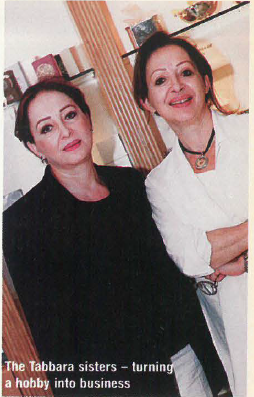
Faour and Dalal Turk, aka the
Tabbara sisters, began making silk
bridal flowers and fancy chocolate arrangements
– the type traditionally offered to
guests at births. “It started out as a hobby, as
favors for friends,” says Turk’s daughter
Reem Albanna. By word of mouth their reputation
grew and before long the hobby
developed into a small business. Their children
encouraged them to register the homebased
enterprise, Heart to Heart, in 1997.
Today business is growing by about 8% a
year, even though they’ve never advertised.
Well, that isn’t completely accurate. “Every
piece of chocolate that goes out of this store
is an advertisement,” says Albanna. The
chocolates, which are sealed with a sticker that
has the company’s name and phone number
printed on it, have gone far. Heart to Heart regularly
receives phone orders from Kuwait,
UAE, Switzerland, London and Paris.
Why the appeal? Big players in the field, like,
Paatchi and La Cigale, are more commercialized,
so their selection has standard designs. At
Heart to Heart all designs are unique. The
personal touch starts from the moment clients
enter the boutique. Customers enter a conference
area resembling an elegant living room,
where they explain what they’re looking for
while sipping coffee. Designs are suggested
based on the client’s preference and budget.
“We cater to all budget.5,” says Faour. A
piece of decorated chocolate starts at $2.
Elaborate designs can reach $20 apiece, in
rare cases $75. Likewise, the price of containers
varies tremendously. A small wicker
basket simply decorated costs $45. A genuine
wicker cradle bedecked with ribbons and
stuffed animals costs $120. Clients sometimes
bring in their own containers, which are then
decorated according to budgets.
Heart to Heart now caters to all occasions,
although chocolate arrangements for births
still constitute about 75% of business. The
company declined to reveal turnover, saying
only that profit margins are 10% to 15%.
Profits are reinvested, mostly into stock
Advertising gets a lift
N abil El-Chemaytelly can appreciate:
the adage that innovative ideas
are often inspired by the mundane.
He came up with a novel concept during a routine
elevator ride, after noticing a small bulletin about plumbing services. “I realized that it’s
a great way to advertise,” says El-Chemaytelly.
“The elevator is something
people use at least twice a day.” Last January,
he resigned from Kodak Lebanon and established
Pin Point Marketing on an initial
investment of $250,000. El-Chemaytelly
owns 51 % of the company.
Pin Point Marketing places advertisements
in elevators, which calls for securing
networks of elevators, largely in residential
buildings. In return the company provides elevator
maintenance valued at $500 annually.
“We’re trying to build networks by region,”
says El-Chemaytelly. The five regions outlined
are highly populated West Beirut, East
Beirut, Dahie, Metn and Kesrouan. “In each
network our initial target is 1,000 buildings,”
he says. ‘That’s about 17,000 households, or
68,000 consumers.”
Phase one concluded three months ago,
with Pin Point securing 1 ,000-plus buildings
in West Beirut. Two billboards, 30X40cm, are
placed in every elevator. The company offers
one package: 1,000 buildings for one week at
$2,900, printing included. ”Clients are receptive
to the idea because the approach is
unique,” says El-Chemaytelly. Pin Point’s
clients include such big names as Americana
and Kettaneh. Clients can buy weekly reports
from Stat lpsos, which was hired to monitor
the system’s effectiveness.
El-Chemaytelly says that profits aren’t
expected for two years. The second network
is progressing, with over 200 buildings
secured in East Beirut, although 5,000 buildings
are required for the project to be feasible.
“For the last ten months we tested the concept,”
says EI-Chemaytelly. “Now we’re
working on building the company.” That
• called for bringing in investors to finance a
$450,000 expansion plan. ‘The investment is
needed to reach our breakeven point.”
Pin Point eventually plans to introduce
market-specific packages, to sell clients
buildings most suited to their target consumers.
EI-Chemaytelly anticipates copycats,
but says he’s prepared for that.
