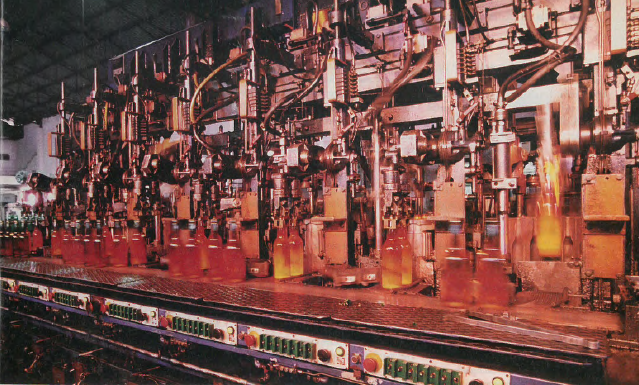
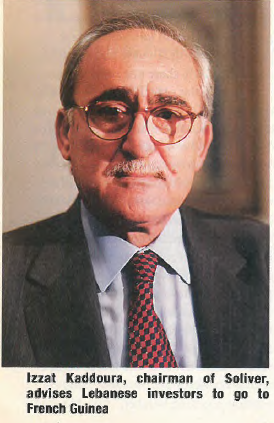
“I had a dream of making this company
the biggest industrial entity
in Lebanon, but I’ve realized that
I can’t and the government doesn’t care to
help,” says Izzat Kaddoura, chairman of
Soliver (Société Libanaise pour l’Industrie
des verres et porcelaines). A glass bottling
factory located in Choueifat, Soliver supplies
Pepsi, Coca-Cola, Almaza, Libby’s, Liban
Jus as well as other oil, wine and spirit manufacturers.
Kaddoura is a major investor in
the hotel industry with over $100 million in
investments, but is also having doubts
about the future of tourism. “I’m leaving my
investments in tourism and industry and
telling all Lebanese investors to go to
Conakry, French Guinea, where opportunities
are a dream,” says Kaddoura.
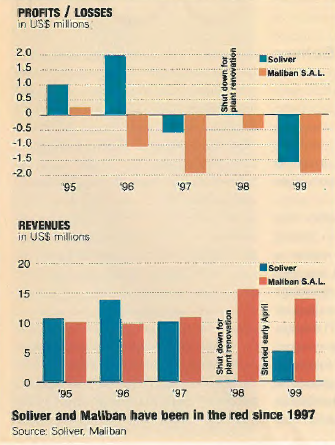
What he says makes sense. When new
management took over Soliver in 1990, it
had between $5 million and $6 million in
debt. Under the current general manager,
Ghazi Kraytem, Soliver posted good earnings
at the outset. It made close to $5 million on
revenues of $50 million from 1991 through
1995, and almost $2 million on revenues of
$13.8 million in 1996. But the following
year things changed. Soliver posted a
$600,000 loss on revenues of $10 million in
1997, shut down for renovations in 1998
and posted $1.6 million in operational losses
last year on revenues of $5.1 million.
Soliver is not alone. Maliban is the only other local
manufacturer of glass bottles and its story isn’t
any better. Its last positive earnings came in
1995 – $238,000 on revenues of $10 million.
Since 1996, Maliban has lost $5.4 million on
$50 million in revenues. A couple of months
ago, Maliban shut down one of its two furnaces,
cutting its production in half, from 150
tons a day to 75. “If we continue in this losing
fashion we will shut down the factory for
sure,” says Amine Tayara, legal advisor,
director and one of the founders of Maliban.
So what has precipitated the negative
returns for those companies? During the
early 90s, glass-bottling factories began
mushrooming in Saudi Arabia and the Gulf.
Capacity increased 600 to 700% for a market
that wasn’t there. Maliban is owned by the
Madvani Group and run by Turner Associates,
an offshore management company. The
Madvani Group actually started the
expansion in Saudi Arabia, opening a factory
there in the early 80s. That factory started
out producing 60 tons a day and ten years later
increased to 600 tons (about 700,000 1-liter
bottles). The company also has ties with
Savco, another Saudi glass factory.
The real expansion came in the early 1990s with
Zujaj, a glass factory in Riyadh. That was followed
by a string of factories in Jeddah,
Jabal Ali Free Zone, Dubai, Oman and finally
Kuwait. A study by the Madvani Group
showed that total demand in Saudi Arabia is
just 380,000 tons of glass containers a year,
while industry supplies over 650,000 tons.
The result was dumping in neighboring
countries, which has been especially felt in
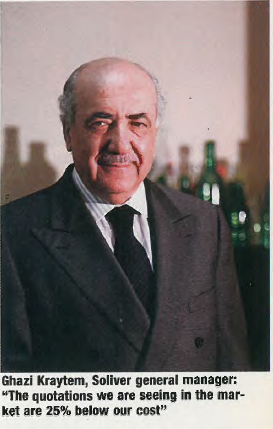
Lebanon. “The quotations we are seeing in the
market to our clients are 25% below our
cost!” says Kraytem. That figure was confirmed
by Tayara.
In an attempt to protect their markets and
stave off foreign competition, the two local
manufacturers have had to sell below cost.
Their prices are still slightly above that of
imports. Some small bottlers are willing to
pay a fractionally higher price for locally produced
bottles to avoid the cost of financing
and warehousing, as they lack the facilities.
“But large bottlers, who have the required
finances and facilities, are not willing to
buy our bottles except when they match the
low prices of imports,” says Kraytem.
Both Soliver and Maliban have completely
lost export markets to Saudi Arabia
and the UAE, which are more than self-sufficient.
Soliver has seen exports to Syria and
Jordan drop from 25% of production to 12%
to 15%. Maliban, which had previously
exported about 60% of its production to
those countries, has averaged 27% in the last
five years.
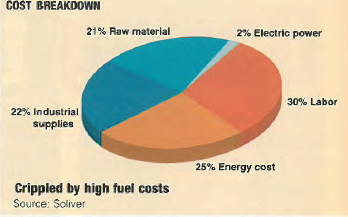
Fuel is another problem. From December
1998, its cost went up from $100 a ton and
currently stands at $190. For Soliver, fuel represents
about 49% of energy costs, while
energy represents 25% of total costs. “We
have to lower our selling price and our cost
is rising, the government doesn’t see the
impact of a 10% price increase in fuel,” says
Tayara. Soliver and Maliban have been lobbying
the government to allow them to
import fuel, or to buy from the government
at market costs without the margins that
they impose on it.
Labor costs are also high,
representing 30% of manufacturing costs.
To make matters worse, the last three or
four years have seen the emergence of a
new player in the container market,
Polyethylene Terephthalate, or
PET plastic bottles. Since our
last interview with Petco’s
“21st Century Plastics” (May
1999), this PET factory has
registered impressive growth
numbers. Petco has twice
raised its capital, which today
stands at $8.5 million, and
has since doubled its capital
equipment investments to
$15 million.
Capacity has
increased from 70 million
bottles last year to 280 million
this year. Petco opened a
brand-new facility four times
bigger (8,000 m²) than the
previous one. Demand for
PET bottles in 1997 was just
40 million bottles. Petco has
also begun exporting to
Syria, Cyprus and Egypt.
PET has entirely replaced glass in the water
bottling industry and has expanded the beverage
bottling market, introducing 2-liter, 5-liter,
6-liter and soon 8-liter bottles. The only
markets where PET has yet to replace glass
are for soft drinks and juice, though boxes have
already stolen a big chunk of the latter. Juice
is filled while hot and glass doesn’t deform
during the bottling process. Though the
technology exists to produce PET bottles that
won’t melt during hot filling, it would require
a $3 million to $4 million investment, while
the market is too small to warrant that.
“However, this is coming in the near future,
and as for the soft drink market, we will totally
start replacing it next month,” says a confident
Hermez. Petco manufactures at 50% savings
on energy; it now has 12 lines of production
and plans to expand to all ranges and sizes of
the container market.
The glass industry has not yet thrown in
the towel. Fortunately for Soliver, the new
management team embarked on an investment
program and strategy, which were the
basis for another major investment when the
crisis hit. Soliver has invested more than $6
million since 1992 to update machinery,
using company profits and loans, while the
general manager was given the freedom to
run the company without interference from
shareholders.
And who better for the job than
Kraytem? The former managing director
of Trans Mediterranean Airlines was largely
responsible for transforming it into one of the
largest cargo carriers, spanning the globe,
during his 37 years there.
Kraytem began by improving the working
environment by giving medical and life
insurance and paying for transportation costs
to get the best out of the employees. He later
worked on company-client relationships,
even coordinating with some of his customers
on plans to help maximize sales and
efficiency in operations.
But when the company began registering
losses a few years ago, management had to
decide whether to shut down or meet the
challenge. They opted for the latter. To do that,
Soliver had to renovate the complete operations
of the factory, installing newer, more
efficient technologies to reduce labor and
operating costs. That investment was $14
million, which brought the total to $20 million
since 1992.
This will enable Soliver to
introduce an innovation, which speeds up production
by 15% and produces lightweight bottles.
That is important because now Soliver
can supply a lightweight bottle (below 160
grams) that can hold the same amount of
liquid as a 200-gram bottle. Because bottles
are priced according to weight, the new bottle
will cost less for the client, giving a competitive
edge. It will also allow Soliver to
compete against other container manufacturers.
Soliver has begun installing a third line to increase flexibility between light and heavy bottles to reduce stoppage time, which previously took up to ten hours, and improve overall efficiency.
The new electronic equipment
allowed the company to lay off 70
employees, but at a heavy cost. Under pressure
from the Ministry of Labor, Soliver had to pay
$1 million on top of employee indemnities.
Similarly for Maliban, a second furnace –
though now closed – and lines came into production
in early 1997 at a cost of $22 million.
Subsequent layoffs at Maliban also totaled 70.
Even still, the two firms are operating
under difficult conditions. The key is to
expand products and markets. Soliver is
striking back at PET, trying to take back a
share of the water market, which plastics
has seemingly conquered. “We believe there
is a demand for water in glass bottles in a market
niche welcomed in hotels and first-class
restaurants,” says Kraytem. He emphasizes
that the glass container is the healthiest bottle.
“Sabil has already put in their order and
others will follow,” he says.
Next for Soliver
is manufacturing glass wine bottles; the
company hopes to sell to the Egyptian market,
where wine consumption is increasing,
and supply local wine producers like
Kefraya and Ksara, who currently import.
Next are the 4- to 5-liter gallons and jars for oil
storage and other purposes. Manufacturing
water pipes (argile) is also part of Soliver’s
current plans, a promising product considering
its high use among Lebanese.
Maliban has similar ideas. “We cannot
rely on the soft drink market, we have to
diversify to get out of this problem,” says
Tayara. Maliban has six lines of production
designed to diversify into jars for the food
industry, table glassware and pharmaceuticals.
The company has installed a sand
plant just for the processing of pharmaceuticals
and cosmetics, which requires
special sand batching. There are also plans
to export to Jordan and Saudi Arabia, which
currently rely on imports.
What are the chances of them picking up the
pieces in such difficult conditions? There’s a
clear shift in the US towards PET except for
alcohol and some soft drinks, but even there
changes are happening. “Europe has not
been as affected by PET as the US market,”
notes Kraytem. The Saudi market is diversified,
using cans, glass and plastic bottles for
the beverage industry. “There’s a 60% drop
in glass containers for soft drinks due to substitution
from either cans or plastic,” says
Mohtaram Kaddoura, Soliver’s executive
director. “The large beverage container market
has been replaced by PET.”
EXECUTIVE
has already seen PET sample containers for
pharmaceuticals, cosmetics and juice, and it’s a
matter of time before they compete against
glass in those markets as well.
Hermez predicts that demand for glass
bottles from the beverage industries will
drop dramatically in the near term. But even
if he’s wrong, it’s unclear how long the
companies can survive.
“Considering all the efforts put in by both
companies, we sense the great difficulties that
the glass industry is facing,” says Kraytem,
adding that there might be good opportunities
for exports once the Iraqi market opens up.
He believes that their prospects can be
improved locally should they get an adjustment
on fuel costs and protection against
dumping from the government.
Kaddoura had obtained two licenses in
1988 to produce glass in Syria and Africa
and considered leaving to where operating
conditions are more favorable.
“The only regret I have is believing the
promises made by ministers during the previous
government, which the new government
said they’re not obliged to fulfill,” he says.