Courier company or restaurant?
They’re not as different as you
might think. The owners of Casper &
Gambini’s (C&G’s) have proven that point.
In 1996, they figured there was good money
to be made in launching a local courier service
— judging by the shambolic state of the
Lebanese postal system. Two of the owners,
John Chedid and Brendan Cody, were
already running the Beirut office of OHL and
knew the business well. But the four partners,
each with a 25% share of the business to
begin with, found themselves in the food
trade by mid-year instead.
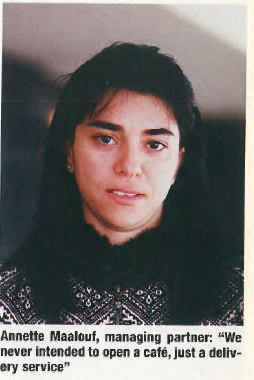
The other two partners, siblings Annette
and Anthony Maalouf, took charge of the
management of C&G’s. The four figured
there were better opportunities in the restaurant
business and, after all, if you understand
logistics, delivering sandwiches is pretty
much the same as delivering packages.
The gamble appears to be paying off. In
1997, C&G’s had a turnover of $400,000
with deliveries from its sole kitchen in
Achrafieh. By the end of this year, with the
addition of two coffeehouses, turnover is
expected to show an increase of 500%, to
reach a couple of million. And the team is
now setting its sights on expansion abroad.
But in a market seemingly saturated with
eateries, how did C&G’s manage to
increase business so rapidly? The company’s
initial strategy was to bypass individual
orders, opting instead to feed the business
community by opening up routes that
targeted companies with a large staff. The
first two were through Hamra and Achrafieh.
Later came Hazmieh and Solidere. Merrill Lynch, the Gefinor
Center and Pepsi were among the pit stops.
C&G’s fleet of two vans and 15 scooters
swung by offices with baskets of sandwiches,
salads, drinks and desserts, while
most delivery outfits prefer to wait for
orders to come in. “Their concept of delivering
cold food to big companies was
great, it helped them get known in the
Lebanese market,” says Joe Abrass, manager
of Crepaway. Individual orders began
to flow in after a few months on the market.
After two years of operation, C&G’s
counted some 20 companies with a total of
700 employees among its clients on basket
deliveries, not including Solidere — C&G’s
big catch. C&G’s was one of several restaurants
for which Solidere supplied its staff with
vouchers. This was exactly the market they
were targeting: middle-income professionals.
C&G’s has since ended its basket service,
but continues to deliver. It opened a
restaurant in Jal el Dib in March 1998 with
an expanded menu. That was followed by a
second outlet in the Beirut Central District
last October. That outlet has taken a total
investment of $500,000. “The idea for a coffee
shop came about because the demand
was so big,” says Annette Maalouf, managing
partner. But opening a restaurant was
going to take a cash injection that the four
partners simply didn’t have and they decided
to sell a 20% share to a silent partner.
At this point, business was growing
quickly. C&G’s was making 250 deliveries
a day in 1998, a figure that rose to more than
500 last year. Profit margins are about 27%
at the coffeehouses and 10% on deliveries.
Deliveries now make up about 40% of business,
while the restaurants account for 60%.
The Achrafieh outlet is scheduled to close in
March, when a special delivery kitchen will
open at the BCD coffeehouse. That move is
expected to bring cost savings for the company
and time savings on deliveries.
Maalouf considers her main competition
to be the Sandwich Factory, Crepaway and
Schtroumpf on deliveries, while restaurants
like Monot and Mie Dorée compete
with the coffeehouse business. “And competition
is getting tougher,” says Maalouf.
“There are more and more people getting
into the restaurant and café business,
because it’s doing well in Lebanon.”
Maalouf says she and her partners have
been surprised by how well they’ve done
here. “Some say it was luck, but I disagree,”
she says, adding that it was through
hard work and a willingness to go that
extra mile on customer service.
For now, profits are being channeled
back into the business, because as
Maalouf says, “the time is right for expansion.”
They are now in the latter stages of
negotiations to become partners with a
group in Egypt to establish a coffeehouse
and delivery service in Cairo. Egypt is a
booming but under-served market, says
Maalouf. C&G’s hopes to get a foothold in
the market by following the same strategy
of targeting big-ticket companies.
If things go well, another three main coffeehouses
and five smaller outlets will be opened
within five years in Cairo, with more possibly
slated for other large centers.
Egyptian operations are expected to generate
a yearly turnover of $5 million after three to four years. Other countries, such as
the UAE, are also being considered as
expansion possibilities. This could be a
welcome reversal of the foreign eatery
invasion that has swept Lebanon.