Few Lebanese were worried about
repairing their cars back in 1990, let
alone restoring a vintage automobile.
That’s the year that Mondial, a repair shop
that has been restoring classics since 1948,
almost went bankrupt. Now a decade later,
Mondial, which is owned by Ibrahim and
Sami Morcos, has become one of
Lebanon’s most reputable and successful
automotive restoration and body repair
centers. Its business in restoration has
dropped significantly, from about 40% of
turnover in the 1980s to 10% in 1998.
Repair work has helped compensate for
that with revenues increasing from $29,000
in 1994 to $213,000 in 1998, while net
earnings, less than $5,000 in 1994, climbed
up to more than $40,000 in 1998.
What makes this interesting is that the
business is growing in the middle of a
recession. “I used to have six or seven
clients for restoration work a month,” says
Fersan Haddad, one of the country’s top
restorers, “now I have six or seven a year.”
None of those who disclosed turnover figures
claimed more than $110,000.
Mondial’s slogan says “We can do the
impossible, but miracles take a bit
longer.” That comes at a price, however.
Mondial acknowledges that its quotes are
two to four times more than most on the
market. Out of 15 estimates that
EXECUTIVE received for a complete paint
job on a 1989 M-B 300E, none quoted
above $1,200, while the majority priced
the job at $500-$700. Mondial charges
anywhere from $1,500 to $2,000. That’s
pretty steep. So what does Mondial have
going for it that allows it to show growth
while charging such high prices?
Mondial caters to high-end clients, with
the majority of its business coming via
Mercedes-Benz, with which it has been
doing business since the mid-1950s. M-B
accounts for a large chunk of the increase in
Mondial’s revenues. This is partly
reflected by the amount of spare parts
Mondial purchases from M-B, up 65%
from DM 62,000 in 1995 to about DM
100,000 last year.
The customer support department at M-B
passes on all body and paint jobs to
Mondial, except when insurance companies
channel the work to other garages.
Mondial is also entrusted with the task of
prepping up every new car before it is
delivered to the customer.
Mondial’s clients include the presidential
palace, the former prime minister, the
speaker of the house, members of parliament
and several embassies. It also has
customers from the United States, Europe,
the Gulf and the Middle East.
But in such a competitive market, why are
car owners willing to pay more at
Mondial? It all has to do with the results.
Restoring a classic or repairing collision
damage means the car has to become as
good as new. If you own the only four-door
Rolls Royce Silver Wraith convertible
ever made, you don’t want it to just “look”
new. You’ll want showroom specifications,
and this is precisely what Mondial delivers.
The company focuses on producing the
highest level of finish. “I wouldn’t trust my
investments with anyone else,” says
Anthony Tannoury, the owner of the said
Rolls, which was custom-built in 1979 at a
cost of £1.2 million. After being restored by
Mondial, the car was the center of attraction
at last year’s Beirut motor show. “The work
done on that car was amazing,” says Ivo
Kapitzki, the after sales manager at
Mercedes-Benz.
With an investment of more than
$30,000, Mondial installed one of the first
prefabricated heated and pressurized spray
booths in Lebanon in 1991. This reduces
waste and produces a medium or high solid
enamel finish that resists scratches and
wear, while reflecting the base color better.
Most garages either use a simple closed
room or pay for the use of other garages’
spray booths, like Mondial’s, to do the job.
Mondial uses brands like Standox,
DuPont and Glasurit, the best in the market.
These are expensive compared to more
widely used brands such as GL and RM. A
kilo of Standox paint, the required lacquer
and additives costs almost $60. On average,
spraying an entire car takes 4 kilos, and
that doesn’t include the cost of primers,
plastic products and stoppers. The same job
using GL paints ($25 a kilo all included)
costs less than a third, but the results are not
of the same quality or longevity. Mondial is
so confident of the results that it backs up the
work with a seven-year written guarantee.
Another policy Mondial follows is to
only use original spare parts. If the part
isn’t locally available, they’ll have it
shipped in from abroad. “Their attention to
detail and use of original spare parts, even
if it means persuading the customer to pay
more, is what achieves such results,” says
Rolf Rosendaal, spare parts manager at M-B.
Most others opt for the less expensive
after-market copies. But these offer neither
the same safety standards nor the same
cosmetic accuracy.
Mondial also tries to keep up with new
developments, studying the intricacies
involved with each new generation of cars.
Techniques themselves also change. “It’s no
more a matter of just knowing how to repair
and paint properly,” says Kapitzki. “New
techniques develop, and without them, you
can’t achieve the desired results.”
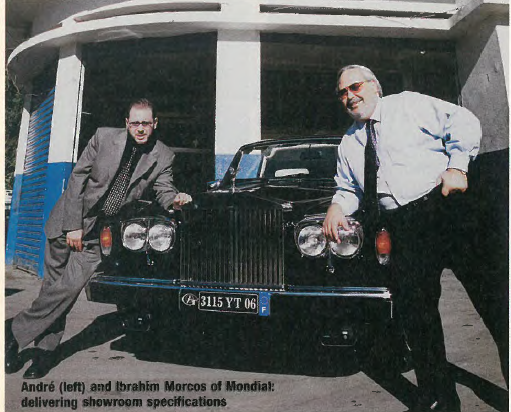
Ibrahim Morcos didn’t just stumble on to
this business — he is a mechanical engineer
by trade and worked as manager of the
mechanical department at Mercedes-Benz in
the 1970s, and then for Volvo. This, along
with the Morcos family’s solid experience in the
business and the experienced professionals
it employs, were crucial factors in making
Mondial one of the leading automotive
repair and restoration centers in the country.
The company plans to expand its line of
services. Such services as work on
engines, suspension, electrical and electronic
systems are currently passed on to
independent outfits. Mondial plans to do all
this in-house. “I don’t expect these services
to increase revenues significantly,”
says Andre Morcos, who co-manages the
company. “But the way the market’s going,
it’ll help maintain the turnover we have.”
Mondial has also closed a deal with a
local distributor and will set up as a sub-agent
and selling point for its automotive paints and
related products. That will provide Mondial
with a new source of income and reduce
costs on the painting materials they use.
Mondial revenues may not compare to
Lebanon’s big firms, but it’s encouraging
that, despite the trend in the market, hard
work combined with top-notch service
can pay off.