Something’s in the air at Société
d’Oxygène et d’Acétylène du Liban
(SOAL). A subsidiary of France-based
Air Liquide (AL France), SOAL has
gone on the offensive since the early 1990s
with new management, a diversified product
line, and a complete overhaul of the company’s
operations. Its target? Regain the 90%
market share it had before three-quarters of
its business evaporated into thin air during the
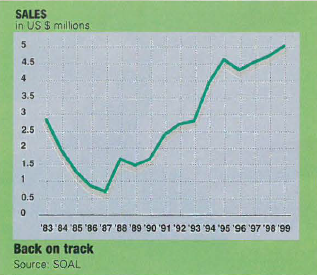
war. While last year’s record sales of $5
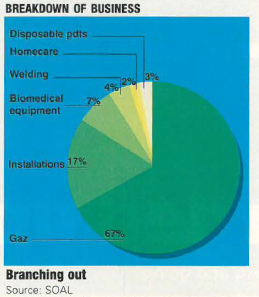
million, 67% from the sale of gases, are a good
start, SOAL’s goal may be more elusive than
management first thought.
Since the end of the Lebanese civil war, the
company has been embroiled in its own
battle, with its foe, Chehab Industrial
Medical Gases (CIMG). “I will attack
SOAL from all directions,” says Emir
Mohammad Chehab, CIMG’s managing
director. While the war saw CIMG lay
claim to two-thirds of the market, SOAL’s
sales hit rock bottom in 1987 at $702,000.
That was down from $2.9 million just four
years earlier. Sales to industry had dropped
by 40% and to the health sector by 35%.
With SOAL’s re-emergence, the two competitors
are separated by little more than a
hydrogen atom: SOAL claims to hold 48%
of the market and CIMG 47%. Based on revenues,
SOAL is the market leader, although
CIMG’s prices are about 30% lower.
How did SOAL battle back? Air Liquide,
which holds a 51% share in the local outfit
and has revenues of over $7 billion, began
deploying new management in 1993.
Cumy Didier, a French technician, was
assigned as the new general manager.
Didier’s strategy was to diversify. He
moved the company into the sale and
installation of medical equipment, including
ventilators for operating rooms, respirators,
and anesthesia machines. That helped compensate
for the firm’s loss in the gas market.
At the same time, SOAL replaced most of
its cylinders in hospitals, starting at the
American University Hospital (AUH), with
containers that could hold 20 times more
oxygen. That gave the company an advantage
over competitors. Selling larger volumes
brought its prices down and, since more
oxygen could be consumed with a smaller
risk of interruption, SOAL increased its
number of client hospitals. By the end of
1993, sales had reached $3.8 million.
But SOAL still wasn’t sufficiently armed
for the long run. In 1995, CIMG began
employing the same technique and was
chipping away at the success of its nemesis.
SOAL’s sales dipped back down 7%, from
$4.65 million in 1995 to $4.35 million in
1996. It still had major internal problems —
a handicap that CIMG didn’t face. The
organization needed to be restructured to
place employees in their areas of expertise.
There were other problems: overpricing,
insufficient market data, and a lack of
correspondence with the parent company.
AL France intervened again in 1997,
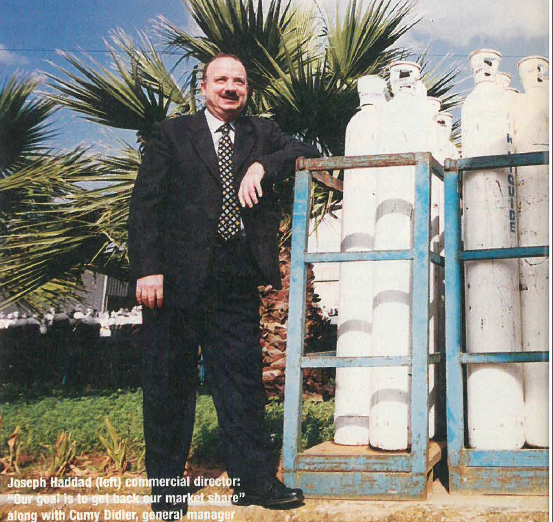
assigning Joseph Haddad as SOAL’s commercial
director. His mission was to
increase sales and regain lost market share.
Haddad reorganized the sales force,
reduced costs, and replaced inexperienced
employees with qualified ones. Each division
was focused on separately to give better
quality control. The company was fully
computerized, market statistics were made
available to employees, and a direct line of
communication was recreated with the
parent company in France. And prices
were reduced by 10% to 15%.
The results?
Sales went up by about 10% from 1997 to
1999, which led to an increase in profits
from $83,000 to $133,333.
Nonetheless, management isn’t satisfied.
“Our goal is to get back our market share in
the near future,” says Haddad. CIMG, however,
is intent on blocking SOAL’s advance.
Backed by Air Products, the world’s second-
largest gas company, CIMG doesn’t
plan on relinquishing any more ground.
And it makes sure to keep abreast of the latest
developments at SOAL by having corporate
spies. “Just like they have insiders, so have
we,” says Chehab proudly.
For example,
upon discovering that SOAL was investing
in a new plant in the mid-1990s, CIMG followed
suit. A race to finish first ensued.
SOAL won that round, when its plant was
opened four months ahead of CIMG’s.
Competition between the two companies
has continued in the same vein, with each
hoping to muscle the other out. Last year,
SOAL bought Oxy-Leban, a distributor of
gas with a 10% market share that was having
financial problems. “Our sales would
have decreased by 20% if we hadn’t
acquired their customers,” says Haddad.
The acquisition of additional customers
helped SOAL increase sales when a
decrease had actually been projected.
While SOAL and CIMG claim market
shares that put them in a close race, their
assessment of the total market varies.
According to Haddad, the market for oxygen
gas has decreased by 22% in volume from
270,000 m³ per month in 1998 to 210,000 m³
per month in 1999. But SOAL’s sales in oxygen
have increased by 5% in dollar value since
1998, while volume increased by 15%.
Haddad claims to supply about
1.2 million m³ of the total oxygen
market of 2.5 million m³.
According to CIMG, the total
market size is 3 million m³,
making it difficult to determine
the share of each company.
In terms of installation and renovation
of gas equipment for hospitals,
SOAL claims to deal with 75% of hospitals in
Lebanon, while CIMG claims
to deal with 70% of new hospitals
and have a 50/50 share in old hospitals
with SOAL.
SOAL has already pulled off an impressive
comeback and is making plans for
future growth. This year, the company will
invest over $1.4 million to increase plant
capacity to supply the health and industrial
sectors, including $1 million that will be
spent on equipment.
SOAL will be aided by
Air Liquide, which provides the local outfit
with technical know-how. Of the total,
$800,000 is being invested in a second carbon
dioxide plant.
The company already
has four plants located on 10,000 m² in
Sin el Fil: for carbon dioxide, nitrous oxide,
acetylene, and one for oxygen and nitrogen.
The new plant is the result of SOAL’s new
six-year contract with Pepsi — business that
it snatched from CIMG. “You know the
bubbles in Pepsi, that’s us,” says Haddad.
Though its ambitions may not be altogether
realistic, SOAL still aims to regain its
original market share of 90%. “Within a
three-year period, this company will be
fully reorganized, healthy, and fully covering
the market,” predicts Haddad, who is
also looking to expand into neighboring
countries by 2003.
But CIMG has plans for
the market too, now slashing prices by a further
20%. That puts its prices about 50%
lower than SOAL’s.
Still, there might be a possible end to this
war of the gases. “The only way SOAL is
going to rule the market is if I sell CIMG to
them — and only at the right price,” says
Chehab. The question is whether there is any
seriousness behind the flippant remark and
whether SOAL would be interested.