• Donate
  • Our Purpose
  • Contact Us
Executive Magazine
  • ISSUES
    • Current Issue
    • Past issues
  • BUSINESS
  • ECONOMICS & POLICY
  • OPINION
  • SPECIAL REPORTS
  • EXECUTIVE TALKS
  • MOVEMENTS
    • Change the image
    • Cannes lions
    • Transparency & accountability
    • ECONOMIC ROADMAP
    • Say No to Corruption
    • The Lebanon media development initiative
    • LPSN Policy Asks
    • Advocating the preservation of deposits
  • JOIN US
    • Join our movement
    • Attend our events
    • Receive updates
    • Connect with us
  • DONATE
Banking 2015Business

The mechanics that keep the boat afloat

by Thomas Schellen January 19, 2016
written by Thomas Schellen

Fear, adoration and envy are emotions with great relevance to human and business relations. If we don’t look at a leader in fear or adoration, we often look at her or him in envy – but usually we keep one eye on the leader. Sometimes the only reason why we don’t look to the leader is because we are too busy trying to become the boss and often it is our biggest loss if we don’t learn from, copy or emulate a relevant leader.

Banks are arguably the businesses that are best positioned for being viewed as leaders in the Lebanese economic context, given their much-larger-than-GDP shares in financial assets and their lifeline function in financing the private and public sectors. In order to gain leader-level perspectives on quantitative and qualitative factors that mattered most in Lebanese banking in 2015, Executive talked to influencers at four banks that between their institutions represent some 53 percent of assets in the Lebanese banking sector, employ nearly 16,000 people in Lebanon and abroad and have networks entailing 300 domestic and 270 foreign branches, demonstrating their strong diversifications and mix of local and global approaches.

[pullquote] Our consolidated balance sheet shows growth of $398 million in assets [/pullquote]

Sector leader Bank Audi ranked first in consolidated net profits but while it increased its assets by 6.2 percent year on year to $42.3 billion, its year-to-date growth in assets, at 0.95 percent, was deceptively low when viewed only in consolidated dollar terms. The background of this dichotomous looking picture resides in the bank’s operations in foreign markets and exchange rate developments between the US dollar and currencies of markets where Audi Group has significant presence, which include the eurozone, Turkey and Egypt, according to Freddie Baz, group strategy director and board member of Bank Audi.  He tells Executive: “Our consolidated balance sheet shows growth of $398 million in assets for the first nine months in 2015. Growth of assets is reported for the year to date, according to the International Financial Reporting Standards. If I consider the constant exchange rate at the beginning of the period, which is end of December [2014] for the year to date, my assets would have grown by $2.4 billion to September.  You have to produce consolidated statements but it is a very conceptual exercise that is done just to give a view how things look if it was one single currency and single entity and single geography. If we apply constant exchange rates, we would have seen a balance sheet not of $42.3 billion but $44.7 billion at end of September.”

Turkish delights

Currency volatility in economies where Audi Group operates was most pronounced in Turkey during the first nine months of 2015, with the Turkish lira weakening by some 30 percent against the dollar, giving up much more of its value when compared with the dollar exchange rate developments of the euro and Egyptian pound in the same period.  Given that Turkey is the most important market after Lebanon for Bank Audi, the reflection of the country’s exchange rate drop in Audi’s consolidated balance sheet would be irksome for presenting results to superficial observers. However, Baz maintains that serious analysts look at results of individual entities and claims that the stability outlook for Turkey has improved due to clear pro-Erdogan election results in early November, and also due to the fact that the lira’s weakening in 2015 was driven by international investors’ anticipations of things that did not come to pass, mainly the increases in benchmark rates in the United States. “Turkey has been affected so far in anticipation of those potential changes in the benchmark rates. If those changes occur [in the near future], Turkey already paid the price in anticipation. [The drop in the lira] was obviously amplified by domestic political tensions but in terms of relative weight, I still believe that two thirds of the currency slip in Turkey was due to international money market considerations, with massive exits among portfolio investors generating this volatility in foreign exchange and in interest rates because the tool [that was available] to the central bank to face the situation was to raise interest rates,” Baz says, with a hidden nod to the positive implications that new growth in the Turkish market has for the performance of Audi Group going forward.

banking sector assets

At BLOM Bank Group, international considerations are no less central but with a focus on foreign subsidiaries that were less or not exposed to the currency turmoils of 2015. Profits for the first nine months in 2015 amounted to $290 million on total assets of $30.7 billion. “We have seen 7 percent increase in profits so far this year and expect to see what happened in the first nine months to continue through the rest of the year. All the growth in our profit was coming from outside, I would say. We had a big improvement especially in the results of our Egyptian subsidiary and also saw good improvements in our Jordanian [unit] and from our presence in the Gulf,” BLOM Group Chairman Saad Azhari tells Executive.

Maintaining the paradigm that conservatism is no contradiction to innovation, Azhari attributes the development of BLOM’s size and performance to a portfolio of conventional sounding initiatives. “BLOM has always been conservative and innovative at the same time. Our expansion in terms of presence in Lebanon is continuing as we are opening new branches in the north and also in the south and in Beirut. We have new products in retail and asset management, [such as] funds, and always try to provide the best service to our customers. We always continue to evolve because without evolving you cannot be a leader in the banking market,” he muses.

Bank of Beirut, the sector’s number three in terms of total profits achieved during the first nine months of 2015, Chairman Salim Sfeir says that his bank reached several milestones and was able to present good growth in the main financial indicators for the first three quarters. Numbers pointed to year-on-year growth above 10 percent in both assets and deposits by the end of September; loan growth was subdued, at 1.6 percent, and the loans to deposits ratio saw a downward variation of 3.17 percentage points, the largest drop by any bank in the alpha group, the tier of Lebanese banks with deposits above $2 billion. Bank of Beirut reported 12 percent growth in net profits when compared with September 2014, ahead of the 9.7 percent increase identified by analyst firm Bankdata as the average for the alpha group. The bank was in a median position for profit growth rates of alpha banks as six lenders showed higher rates of increase, beginning with CreditBank that nearly doubled its net profit year on year.

Highlighting the bank’s activities in asset management – where Bank of Beirut had the alpha group’s second best year-to-date growth in assets under management in the first nine months of 2015 – and trade finance as two areas of special strength, Sfeir explains the importance and scope of trade finance in the context of Bank of Beirut as an activity where the “Lebanese scenario is not really Lebanese” but a regional one. “Trade finance is an international much more than a regional market and we, as Bank of Beirut, are very active in trade finance not only in Lebanon but in the region and in Africa,” Sfeir explains. However, he then goes on to say that trade finance activities have recently been impacted by the weakness of the oil price and related disadvantageous developments in important countries such as Nigeria where the election of the current president was followed by decisions to limit certain trade activities. “The overall situation [for trade finance], be it in the Middle East or in Africa, is regretfully not promising for the near future. So we continue to be very active and continue to look for new opportunities,” Sfeir says.

In addressing the bank’s strategy mix for working in Lebanon versus its expansion steps in other markets, Bank of Beirut’s chairman elaborates: “We are all dependent on Lebanon because Lebanon is our natural market and we have greater room for mobility within our own marketplace. We, meaning the Lebanese entrepreneurs, are not looking to be strong players on the international market because we are fully aware of our dimension. However, we are very active on the international scene insofar as our potential permits. Our role, whether as bankers or traders, is internationally driven by the marginal risk-adjusted returns over and above the returns from our own market. We are, and will remain, heavily invested in Lebanon. Yet within the next 24 months, around 50 percent of our income will be produced outside of Lebanon; mainly in stable A Grade countries.”

Survivor instinct

The long-standing second runner up by assets and deposits in the Lebanese banking sector, Byblos Bank, saw its assets increase to LBP 29.1 trillion, or $19.3 billion, at the end of September 2015 and reported nine-month profits of $113.2 million, almost unchanged from the same period in 2014. Growth in assets was below 2 percent in both year to date and year on year comparisons and the bank slipped one notch in asset rankings, behind relatively stronger gainer Fransabank. Byblos Bank remained in third place for total customer deposits and maintained powerful positions in the domestic market, including leading roles in deposits in Lebanese pounds and in domestic loans, as well as by openings of letters of credit and assets under management.

[pullquote] Without evolving you cannot be a leader in the banking market [/pullquote]

According to Alain Wanna, head of group financial markets and financial institutions and member in the core senior management team at Byblos Bank, 2015 was a year to prove the survivor qualities of Lebanon and Lebanese banks.  “Even with all this uncertainty in Lebanon and the surrounding region and with the drop in oil prices, all of the Lebanese banks are making profits and they might report a slight increase in their profits. Deposits in Lebanon are expected to grow between 5 and 6 percent in 2015 and the assumption for the next year is that it will be the same rate of growth, so I think Lebanese banks know how to manage in difficult and tough times,” he tells Executive.

While Byblos Bank has pioneered expansions into regional and international markets ahead of many of its peers, 2015 continued to be challenging for many of these economies. “The most material subsidiaries that we have are in Syria, Iraq, Sudan [and] Europe, plus different presences on a smaller scale. So these markets are still witnessing tough times, all of them,” Wanna admits and affirms that the bank has no plans to abandon any of them. “When we enter a market, we enter for the long term. It was unfortunate there were unexpected events in several foreign markets that we have entered. But there is no decision at the board level to exit any of these markets. We are downsizing, limiting our exposure. But it is not on the agenda to exit fully from any market,” he says.

He furthermore emphasizes that Byblos is persistent in strategizing for new expansions which could easily boost the bank’s position in the banking sector’s pecking order. In an example cited by Wanna, Byblos Bank had its eyes set on the Egyptian market for a while and placed a bid for Piraeus Bank Egypt early in 2015. However, this did not result in a win; the subsidiary of the Greek Piraeus Bank was acquired by Kuwait’s Al Ahli Bank group. The Gulf lender, which reported assets of 3.82 billion Kuwaiti dinars ($12.55 billion) at end September 2015, paid $149.7 million, representing 1.5 times the book value, for the Egyptian unit, Piraeus Bank said in a November 2015 statement confirming the transaction’s closure.

Interesting narratives

A look across the banking sector’s developments in 2015 beyond the overall numbers and the performances of banks in the top size bracket shows numerous interesting narratives confirming which concerns are current and which have faded or are not yet getting attention. Quite a few of these stories relate to the banking sector’s inner workings and some specifically corroborate that the troubles of the Lebanese economy and state governance from the recent past have not impaired the sector’s appetite for growth and have not deterred aspirations of banks that believe they can mobilize enough competitive energy to push beyond the $2 billion deposits threshold that currently defines the alpha group. 

In one such indication on the sector’s confidence and ruddy health, newcomer Cedrus Bank said in early spring 2015 that it wants to grow into the sector’s top size stratum. The new bank was formed in a collaborative effort between the local Cedrus Invest Bank and emerging markets specialist Standard Chartered which sold its Lebanese operation to Cedrus after trying for about 15 years to make its model succeed in the small market here. Standard Chartered officials did not want to disclose how they priced the sale to Cedrus or how much money they injected into their local adventure over their years of direct presence; both banks emphasized that they would collaborate in future.

private sector deposits in lebanese banking sector

Another bank that voiced its high ambitions in 2015 was Middle East Africa Bank (MEAB). Having just emerged from a succession transfer of ownership and corporate leadership, MEAB’s new chairman, Ali Hejeij, told Executive that it is his declared aim to reach alpha bank status. In response to an interview request for Executive’s year end issue, the bank confirms in a written statement that its goals for 2016 and beyond include “working towards becoming an Alpha bank in Lebanon”. 

“We believe that the stability and notable resilience of the Lebanese market present an opportunity for MEAB to continue to grow in the coming years, both in Lebanon and in foreign markets,” MEAB General Manager Nabih Haddad adds, conceding, however, that it may be “too soon to develop a firm assessment of the bank’s performance” in the short time since the change in leadership in midyear. The transformation at the time had been related to a June 2015 action by the United States’ Office of Foreign Assets Control, which had placed Kassem Hejeij, the father of Ali and the bank’s chairman at the time, on a blacklist of alleged backers of Hezbollah.

Big Brotherism and other foreign ideas

Troubles with US politically-motivated interference in Arab banking have been impacting the operations of regional banks in varied ways since the 9/11 terror attacks against America. More important in 2015 than sanctions against individual businessmen and bankers have been the indirect effects of US policies where international banks tended to cut correspondent banking relationships with Arab banks. This problem had been highlighted by the Union of Arab Banks in several statements and contributions to the international conference in 2015. However, de-risking is a concern for all banks and could even lead to a new banking crisis, comments Bank Audi’s Baz. “By definition, a bank cannot survive if it’s not being provided correspondent banking services. All the global banks have been reducing their number of relationships, leaving medium to small banks without any correspondent relationships; [this] is no prospect for the future. We are talking about thousands of those banks globally,” he explains.

[pullquote] We are all dependent on Lebanon because Lebanon is our natural market [/pullquote]

According to Bank of Beirut’s Sfeir, foreign pressure continues to weigh down banks that are based in the Arab world and a different international leadership paradigm would be more productive. “We are being severely affected by the politically oriented actions of our big brother, the US government, which is being very unfair toward their followers in the region. Our American brothers have to be fair to our markets as much as they are fair to their own market if they are looking for [and maintaining a role of] international leadership. Leadership should be balanced,” he says. 

An existential concern for banking (at least in theory) is the commitment and measurable contribution to society as function of their sound economic performance. More than the charitable engagements and social responsibility undertakings that can be presented in annual CSR reports – but are done so by too few Lebanese banks until now – the core issues in this regard are the governance performances, macroeconomic contributions and model functions vis-a-vis the state and society that banks must have an interest in carrying out, for the sake of their sustainability and long-term profitability.

With respect to governance, banking leaders are rather confident that they have not only come a long way in applying corporate governance standards but also are doing more than complying with the legal minimums that are being raised every now and then by the central bank via new circulars imposing stricter standards. BLOM’s Azhari says that both the Lebanese banking sector and the bank “are definitely improving in terms of governance, [such as] how you manage the bank and how you manage the relations with all stakeholders, in terms of employees, of shareholders and of customers.”

Baz says that for Audi it was a confirmation of extreme validity in the bank’s corporate governance approach when its corporate secretary and “godfather of corporate governance at Bank Audi”, Farid Lahoud, was invited in 2013 and 2014 to first become a member and then the chairperson of the World Health Organization’s audit committee.
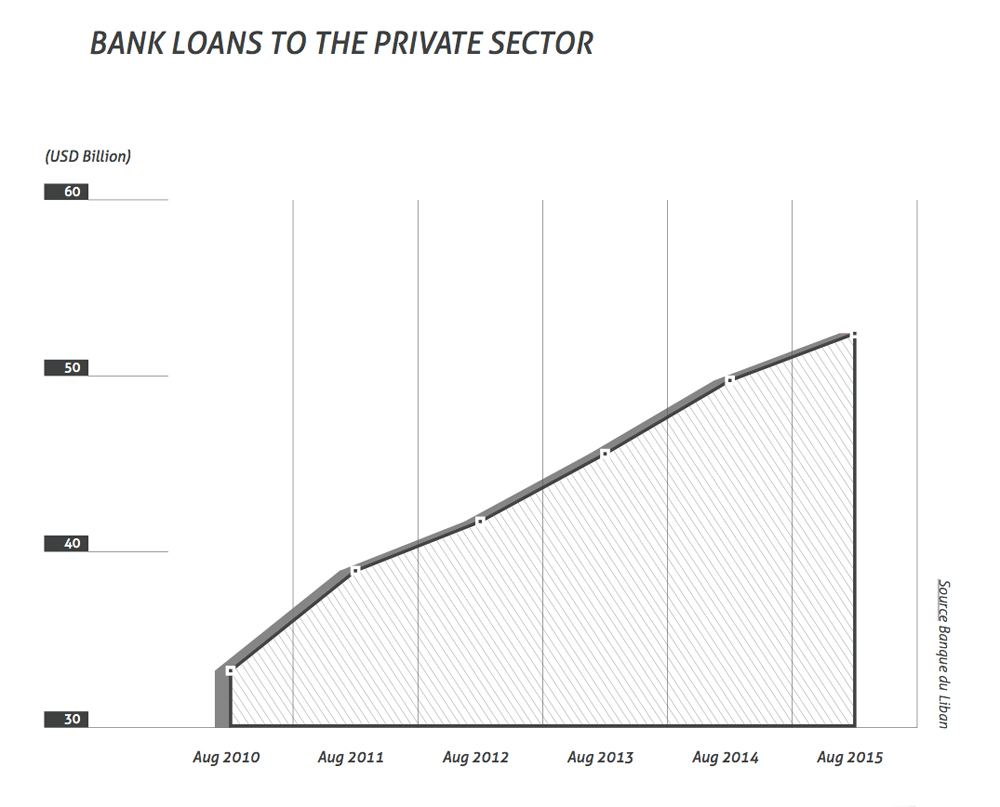
bank loans to private sector

Regarding the cost of corporate governance and increasing compliance regulations, he cites the issuance of a circular by Banque du Liban that required banks to employ a compliance officer in each branch. “We have 82 or 83 branches in Lebanon, [so] we have to have 83 compliance officers, one for each branch, in addition to which a lot of [information technology] systems are required. There is a cost, obviously, and all banks are incurring an additional cost for compliance,” he points out and argues that compliance needs to produce a good balance between certain compliance-induced reductions in the volume of business and improvements in business quality. 

From the cost-benefit perspective, corporate governance is productive in relating to business clients which have stronger sensitivities regarding a bank’s policies that protect clients against information abuses and conflicts of interest but also in interacting with the average retail customer, claims Azhari. According to him the requirement for branch-based compliance officers meant that processes have become “perhaps more regularized” but BLOM could implement the change without direct extra cost to the bank. “But I can tell you that having good governance was always something [that] we felt gave us extra business,” he enthuses.

In the view of Bank of Beirut’s Sfeir, corporate governance in Lebanese banking is indeed on course to a “very positive evolution”. “We are improving yearly and are on the right track,” he says.

About going the macroeconomic mile

Whereas banks have a solid track record of highlighting their vital macroeconomic role of financing the private and public sector needs in Lebanon, 2015 saw some renewed accusations that banks were part of the country’s economic malaise by being in cahoots with political elites in a state of crony capitalism. All bankers in communication with Executive dismissed these accusations outright. Banking and politics don’t mix at Bank of Beirut, argues Sfeir, as each side’s interests conflict fundamentally with the other’s, and “a banker has no advantage to be a politician because he will lose his bank and a politician cannot afford to be a banker because he will lose his market.”

Byblos’ Wanna would not comment on the issue but Azhari says that allegations of mistrust between the Lebanese and their banks are generally unfounded. Pointing to studies on the reputation of different institutions and sectors in Lebanon, he concedes that banks are generally not liked in countries around the world. It may be a universal sentiment that banks are more trusted than liked, “but in Lebanon banks have a good image compared to other industries,” he assures.

[pullquote] The stability and notable resilience of the Lebanese market present an opportunity [/pullquote]

In Baz’s view the tendency to accuse banks of profiteering is in one way still related to times when interest rates on government debt instruments – such as treasury bills and certificates of deposit – were in double digits and ranged during some periods as high as 35 percent. However, this perception is flawed, he reasons, because banks operated with lower interest rate spreads than commonly thought. According to him spreads, which are presently around 2 percent, reached 4 or 4.25 percent “but not 10 or 15 percent” in those days. “I don’t have any respect for those populist messages [accusing banks of crony capitalism] which are not documented and unjustified. If one is professional and technical, one would say that the main suffering of this country entails no implicit or explicit or whatever alliance between banks and any third party, ever,” he exclaims and goes on to say that such accusations fail to address the real problems behind the Lebanese underperformance of many years.    

The problem, he maintains, lies in what he calls the ‘Dutch disease’ of the country’s reliance on recurrent yearly inflows that boosted domestic incomes and triggered household consumption far beyond the domestic output ever since Lebanon’s independence. “This generated very high dependence on imports in order to cover household consumption. At the end of the day [these dependencies] translate into lower potential growth rates in GDP but, more dramatically, it creates not only lower growth rates [in the economy] but also a much lower job component in those lower growth rates,” he reasons.

What is needed for Lebanon in light of this entrenched problem is something that banks cannot produce. “What we need to do – and here our politicians have failed and banks are accused of not helping through inclusion – is initiate a process through a new social contract in Lebanon between politicians, working people and economic associations,” the board member of Lebanon’s top bank advocates with verve. Baz is on a roll and continues “The solution that we need is to shift from a domestic-demand-triggered growth in Lebanon to a foreign-demand-triggered growth, by lowering consumption, [and] by increasing real savings. In order to promote productive investments, to bring back Lebanese labor, to have competitive exports and to lower the dependence toward inflows and inputs, we need a new social contract. Banks can probably speed up the process but we cannot initiate it.”
January 19, 2016 2 comments
0 FacebookTwitterPinterestEmail
Banking 2015Business

Skating on

by Thomas Schellen January 19, 2016
written by Thomas Schellen

It has been documented beyond any question that when it comes to discussions of the outlook for the future, bankers are no more endowed with privileged knowledge or exclusive insights than the next best economist or fortune teller. The caveat against clairvoyance has been enforced in 2015, in no insignificant form, by the frantic performances of analysts and investors in their behavioral reactions to the yearlong grotesque search for the right moment to raise interest rates in the world’s – still – largest economy.

As the fallouts of the global uncertainty over America’s interest rate normalization are tapering out in the year’s waning weeks, Lebanese banks look to the regional future with sanguine humors interspersed with calculated expectations of more-of-the-same-as-2015 for the domestic economy.   

Salim Sfeir, chairman of Bank of Beirut, expects import-boosting impacts on Lebanon to arise from the European setting, which will be tentatively positive for the bank. “The ECB’s quantitative easing will put some downside pressure on the euro. This depreciation in the single currency will lead to increased imports from Europe as Lebanon is essentially an importing country whose economy is dollarized. This is not only true for us, but also for the region whose economies are also dollar-oriented. Thus the decrease in the value of the euro will give Bank of Beirut an advantage for trade finance activities. How much this will act to the benefit of Bank of Beirut’s trade business, we cannot assess for the time being as this will depend [on] if the marginal increase in trade volumes offsets the marginal decrease in the USD value of the transactions,” he says.

In Sfeir’s view, monetary policy in the European Union will have a mixed influence on Bank of Beirut’s business. “The decrease in the value of the currency will certainly affect the trade finance aspect positively; on the other hand, new investment opportunities in Western Europe, as far as banking is concerned, are not on the positive side.  This is why we are now exploring avenues in Eastern Europe and continue to be optimistic for the near future.”

Oil markets effect

Impacts from regional and international developments will be determined not just by interest rate evolutions in global financial markets, but by oil prices that have a cost-mitigating effect on the Lebanese economy when they first unfolded between late 2014 and early 2015, says Alain Wanna, head of international financial markets and institutions at Byblos Bank. The first worry that he sees for Lebanon is, however, political and domestic.

“What will happen in US dollar interest rates is not the main issue for Byblos Bank and for the Lebanese banking sector. It is a factor, but the most important factor is the political uncertainty in Lebanon. Also more important than the dollar interest rates is the oil crisis, because what is the main source of the deposit growth in Lebanon? It’s Lebanese living abroad remitting to Lebanon, and the bulk of these Lebanese who remit to Lebanon live and work in the Gulf. Oil is the main driver for Gulf economies. It provides liquidity, the liquidity is placed with the banks, and the banks lend it to the private sector. Thus if governments [of oil exporting countries in the GCC] start withdrawing money from the banking sector, that means that the banking sector will no longer be lending,” he says.

bank lending to deposits ratios

Reduced spending on infrastructure and restrained lending practices are likely to impact the incomes of Lebanese expatriates across the GCC and not just those working in the energy sector, Wanna adds when explaining why he sees the global oil price environment as a potential critical factor for monetary inflows to Lebanon in 2016.

From the perspective of the banking sector’s earnings, the short-term effect of interest rate normalization in the United States will actually be quite positive, according to views that have prevailed among bank economists for some time. This optimistic expectation from the banks’ perspective is based on a combination of factors, explains Freddie Baz, Bank Audi’s group strategy director. “The deposits in the Lebanese banking sector represent 3.5 times the gross domestic product in Lebanon. This means that we have ample liquidity levels and since we are dollarized; two thirds of this liquidity is in US dollars.” he says.

According to Baz, the placements of this liquidity are normally split between the Lebanese central bank and international correspondent banks. As deposits with either institutions generate interest at rates influenced by the Federal Reserve Bank’s decisions, Lebanese commercial banks stand to reap interest income benefits on both levels. Due to the mechanisms of international financial markets, banks can expect to receive additional basis points in interest “at least for the current year and the next year” when normalization is implemented, says Baz. The impact of normalization will, at some point, reach the Lebanese banking market and clients here will require upward adjustments of their interest receipts on deposits, but Baz does not expect this to occur until US prime rates climb to near the 2 percent mark.

Interest rates

Based on Fed statements that the interest rate normalization will most likely proceed not in regular steps but carefully reviewed small increments, expectations of federal funds rate levels to reach percentages of 1.5, 2, or more  have, from November 2015 onwards, been pointing closer to 2017 than any date in 2016. For average banking customers holding dollar assets, this does not offer great interest income prospects (although better ones than euro assets holders can hope to see in the EU). For Lebanese banks, the picture is better. “It’s easier for banks to manage their spreads in a high interest rate environment than in a low interest rate environment so we always manage to get benefits with time. But [in the near term] we will probably get 100 percent of the improvement in spreads because the interest already paid on our funding is much higher than the benchmark,” Baz suggests. He continues, explaining that “up until rates would reach, in my opinion, close to 2 percent, it won’t trigger in principle any pressure to increase cost of our deposits, so it will be a 100 percent impact. When we get closer to our cost of deposits in US dollars, then our customers will start to require more interest, so [the banks’ advantage from the interest rate developments] will probably be 80 percent [of the total] benefit for us, and then 70 percent, then 60 and 50; but there will always still be a positive carry on our deposits, after all those accumulated negative carries.”

variation in loan to deposit ratios

Looking at strategic opportunities in the settings of 2016, if all regional and national political and security factors were to remain the same, it would be a different form of challenge. Mergers do not necessarily warrant the strongest expectations for 2016, according to Sfeir. Whereas Bank of Beirut advanced by successfully implementing several inorganic acquisitions in the past, he tells Executive that the political environment in Lebanon is not ready and that, in the current environment, it is much better for banks with acquiring potential to use their energies to defend their market positions. He argues that the considerable energy required for combining two banking cultures into one can be used for greater rewards in pursuit of organic growth.

Abroad and at home

As for international expansions, one would err in expecting opportunities to be compelling and the Iranian option is not self-evident for the short term at all, Executive is told. “It is too early for us to speak about Iran. We have yet to see when the sanctions are removed and what sanctions are removed,” explains Saad Azhari, the chairman of Blom Bank. Rather than Iran or any distant country where Blom has no foothold yet, he says that Blom will focus on more familiar territories: “We are looking generally to expand our presence in the countries where we have networks and we are looking at additional countries especially in the Arab world, but there are no immediate plans.”

A solution to the political problems of Lebanon, then, would be the best platform for giving banks their best opportunities in 2016. Any assumption that banks have a benefit from the status quo of a dysfunctional state would be wronger than wrong, says Baz. “Do you think it is [in] the interest of banks to have poor political and economic governance? That this would sustain the good business environment that we need to prosper, to grow? — The answer is no. Everything which translates into improved political and economic governance is welcomed by the business community at large, not only by banks, but by banks more specifically.”

For the Bank of Beirut chairman, human wisdom alone is not what the country should search for in the coming year. In Sfeir’s words, “Our plans for 2016 are directed towards God. We are praying to God to give some wisdom to our politicians; we are praying to God to give some wisdom to our fellow bankers; and we are praying to God to give some wisdom to the players in international politics. There is plenty of room to pray and through prayers, we should be a bit more optimistic.”

January 19, 2016 0 comments
0 FacebookTwitterPinterestEmail
EditorialOpinion

Resolutions for 2016

by Yasser Akkaoui January 15, 2016
written by Yasser Akkaoui

The magazine proposes a few resolutions for 2016. And we’re starting the year by practicing them. First, we call on the best and brightest Lebanese minds to seize the potentially lucrative opportunities that the Paris Agreement on climate change will afford. This is why we’ve put climate change on our cover.

Our second, and most important, resolution is that 2016 will be our year of business ethics. There’s no better place to start than with the worst disaster this country has seen in recent memory: the (mis)handling of waste management. We take an in-depth look at a local company given far more opportunity than international best practice suggests it should have had. We’re setting the stage for a year in which we will take a very hard look at business ethics in this law-ignoring country.

Milton Friedman wrote that a company’s top brass — be they a board of directors or a small number of executives — has only one objective: make more profit year-on-year for the benefit of the company’s most important stakeholder, its shareholders. Of course, the company must obey the law, conduct business in a responsible manner and treat its employees respectfully and well. As we publish our months-long investigation into Averda, parent company of waste managers Sukleen and Sukomi, what we’ve found is plenty of government malpractice. Yet for every rumor we chased, we could not substantiate illegal behavior on the company’s part. Even the notion that the company only received contracts because of its founder’s religion or alleged ties to the late Rafik Hariri is undermined by the fact that each time Sukleen or Sukomi were given a no-bid contract, the entire cabinet approved. The conspiracy to divide the pie is one all of our politicians are in on.

Our system is so broken and the laws and regulations we have on the books are so poorly enforced that it looks perfectly legal for a company to be given not only a monopoly on waste management, but years and years of taxpayer-financed work without having bid on a contract in more than 20 years. In fact, the Shura Council in 2001 gave Averda’s contracting in Lebanon a legal seal of approval. It’s bewildering. No-bid contracts might be legal in Lebanon, but they are neither reflective of international best practice nor of the Lebanon we want to see.

The summer of 2015 saw protests we hoped would achieve more. We published a manifesto to help inform this country’s citizens because we’ve spent nearly 20 years pointing out what’s wrong in Lebanon and what needs to be done to right it. In 2016, you can expect us to name and shame both corporates and government officials. And we won’t be using Lebanese standards. Like the manifesto, our coverage this year is meant to help activists and pressure groups know who is doing wrong and how and what can be done better. We want an inclusive economic system, and the most effective way to get there is by promoting best in class corporate behavior. We’re on a mission, so keep reading.

January 15, 2016 0 comments
0 FacebookTwitterPinterestEmail
LeadersOpinion

Recycling history

by Executive Editors January 15, 2016
written by Executive Editors

We are being governed incompetently. 2015 proved that. Not only did the government’s handling of waste management allow one of the country’s worst environmental disasters to unfold, but it is replicating bad decisions it made nearly 20 years ago. In 1997, the cabinet gave one local company a monopoly on most of the nation’s waste without a competitive tender. As 2015 came to a close, the cabinet was set to simply split that monopoly between two international firms, again without a competitive tender. But for double the price. Worse, the alleged will to let municipalities handle their own garbage announced in September 2015 has yet to translate into action, meaning that if this temporary solution is truly temporary, rotting trash on the streets will be back in fashion for summer 2017.

It’s important to remember that the great “trash crisis” of 2015 actually started with a government decision in early 2014 to close the nation’s largest sanitary landfill. While there was nothing wrong with the decision to shutter the landfill, the blunders soon began piling up like so many uncollected bags of garbage. First and foremost, a ministerial committee tasked in early 2014 with finding a replacement for the Naameh landfill failed spectacularly. The plan this committee eventually settled on consisted of dividing the country into six service zones and tendering waste management in those zones to private companies. Bidding did not open until late in the first quarter of 2015, meaning that even if the tenders were successful, winning companies could not have had replacements for Naameh constructed before the landfill closed. Further, the plan once again would have given one contractor (admittedly a consortia of local and international companies) in each zone full control of waste management, which is not standard international practice and arguably the main grievance against Averda, parent company of waste managers Sukleen and Sukomi.

On top of that, the tender conditions were outrageous. The contracts were slated to last seven years, yet winners were expected to: 1) secure land on which to build waste management facilities; 2) build and operate those facilities; and 3) decrease landfilling from around 80 percent of the total waste stream to 40 percent in the first three years and to 25 percent thereafter. Land in Lebanon is expensive. Capital expenditure on technologies needed to decrease landfilling can cost millions, and resident opposition to waste management facilities “in my backyard” is high. Every private sector player Executive spoke to about the tenders — including those who ultimately submitted offers — said the tenders seemed designed to fail. Executive has not been able to discern exactly how the tender conditions were formulated, but Parliament should do its job and question all involved in an open, televised session. The legislature has this authority, as evidenced by an October committee hearing the press was asked to leave when MPs nearly came to blows.

When the tender winners were finally announced in August — over one month after Naameh closed and trash piles and open burning were common — the contracts were immediately cancelled because of supposedly high costs. As Executive noted at the time, proper waste management is not cheap, and several local politicians are well aware of that. The fall-back plan, formulated in a matter of days and approved by the cabinet in September, had two components: sanitary landfilling for 18 months and devolution of waste management responsibilities to the municipalities. The second part was the more important, as it was envisioned to be long-term and sustainable. Flawed as the reasoning may have been, the idea called for cities and villages to work together, establishing their own service zones and choosing local sites for waste treatment and disposal. While the public generally seems to have no problem littering or despoiling this nation’s natural beauty with festering open trash heaps, the Lebanese have traditionally opposed modern waste management facilities being built anywhere near their homes. The government was supposed to create a committee to build capacities among municipal leaders, getting them ready to handle their own trash — with or without private sector participation. By March 2017, the entirety of Lebanon should have had plans approved, contracts signed and all needed waste management facilities built and ready for operation to accommodate the full devolution of responsibility for this most basic service. While the temporary landfilling component of the plan hit the expected brick wall of public opposition, authorities have done absolutely nothing to prepare for full municipal takeover of waste management. If even one minister who approved the plan took it seriously, he or she should have loudly and frequently called for action on the long-term component. Instead, time has been much better spent bickering over temporary sanitary landfill sites.

[pullquote] The state simply gave the work to Averda instead of going to tender.This is a bad pattern. [/pullquote]

The most confusing part of this saga, however, is the seemingly final chapter. At time of writing, the government says it wants to export the nation’s waste for 18 months at a cost of $212 per ton. Given an average waste generation rate of 3,000 tons per day in the areas that incumbents Sukleen and Sukomi have been servicing, the total bill will be nearly $350 million — more than double the estimated $165 million for 18 months of waste management services the government would have paid Averda, Sukleen and Sukomi’s parent company. And awarding these new contracts without public discussion or competitive bidding is simply a repeat of the worst sin the government committed in dealing with Averda these past two decades.

Executive believes in private enterprise and responsibly earned profit, so we’ve been paying special attention to the so-called “waste file” and have dug deep into allegations of corruption levied against the private company that has been cleaning up after most of us since 1994. We were able to completely debunk some of the accusations against Averda (namely that politicians hold shares in the company and that its prices are extravagant). We could not disprove some of the other allegations against the company (namely that Averda paid bribes to get work, shared profits with the political elite and/or earned profit margins in excess of 30 percent). What is absolutely clear, however, is that Averda’s workload, and thus its revenues, expanded repeatedly without competitive bidding. The tendering process, however, is the government’s responsibility, not the contractor’s.

In dealing with Averda, successive governments seem to have viewed it as the path of least resistance. For example, in 1997 when the government faced a self-imposed deadline to close the open dump in Bourj Hammoud, the cabinet approved an ambitious emergency plan that envisioned the construction of waste sorting and composting facilities as well as a sanitary landfill in around 18 months. The state simply gave the work to Averda instead of going to tender. This is a bad pattern. We should be ashamed of it, not repeating it.

And, while it is uncommon for one company to be offering the full spread of waste management services, what the state pays Averda is not higher than in other countries with Lebanon’s income level for the same range of services. Doubling that cost with no guaranteed long-term benefit, however, is ludicrous and proof our leaders are happy to make incompetent decisions. Everyone loves to hate Averda, but the company did not create the situation in which it works. It should not be demonized for doing its job. That said, more transparency in waste management — as well as all state financed contracts — is long overdue.

Parliament needs to assert itself. If the government awards no-bid contracts, lawmakers should demand answers. In public. The legislature is supposedly the cabinet’s watchdog, and the “waste file” demands immediate action for the greater public good.

And years of accusations against Averda should teach us a few things. Parliament should also develop listing requirements for any company that wins state work of a significant value or duration. The exact requirements are open to debate, but the bottom line is that when public money gets spent, those ultimately footing the bill have the right to a basic level of knowledge and access to information.

January 15, 2016 0 comments
0 FacebookTwitterPinterestEmail
Economics & PolicyWaste Management

Dissecting a waste empire

by Matt Nash January 15, 2016
written by Matt Nash

While everyone in Lebanon — from taxi drivers to elected officials — “knows” the country’s largest waste manager is as dirty as the trash it collects, when pressed for proof, they have little to offer. Indeed, even questioning the “fact” that Sukleen — and, by extension, parent company Averda — is corrupt will likely get you dismissed as a know-nothing. Breaking the near absolute silence the company has maintained since it began operations in Lebanon in the early 1990s, Averda Chief Executive Officer Malek Sukkar opens up to Executive in a two-hour interview after facilitating tours of the company’s operations in Abu Dhabi and Lebanon. Questions about the private, family-founded company remain — most notably concerning their yearly profits — but months of investigation suggest there is more government negligence than corporate wrongdoing to the Averda story.

Bringing it back home

Maysarah Sukkar moved his engineering company, founded in 1968, to Saudi Arabia after the outbreak of civil war in Lebanon. The work Sukkar secured in the kingdom included the operation and maintenance of two slaughterhouse waste incinerators in Mecca. “We had a lot of expertise in that specific technology of incineration,” Maysarah’s son Malek Sukkar says, recalling the company’s entry into the Lebanese market. That experience led the company to bid for a contract in post-war Lebanon to finish building and test-operate a trash incinerator then-located in Amrousiyeh. According to documentation provided by Averda, Sukkar Engineering beat France’s INOR (a company whose name has since changed to Inova) in a competitive bid to complete the project which INOR had taken on in the late 1980s. The contract’s value, Averda says, was $1.752 million. This was the proverbial foot in the door for Sukkar Engineering, which by 1994 adopted the name Averda and is best known in Lebanon under the brand names Sukleen and Sukomi.

Sukkar Engineering later bid to rehabilitate an existing but damaged waste incinerator in the Beirut neighborhood of Karantina. The company lost that contract, but in 1993 won two separate public tenders to operate the Amrousiyeh and Karantina incinerators, contracts valued at $1.35 million and $1.3 million per year, respectively. Operation, however, was short-lived. Angry residents of Amrousiyeh who did not want an incinerator in their “backyard” burned the plant down in 1996, and the Ministry of Environment — under then–Minister Akram Chehayeb — banned waste incineration in 1997. The end of incineration, however, did not mean a halt to publicly financed work for Averda in Lebanon. Sukleen had been collecting waste in the capital and its suburbs since 1994, and the closure of the incinerators brought Averda more business.

International supervision

Lebanon’s infrastructure in the 1990s was in shambles. In 1993, the World Bank loaned the country $175 million for what was supposed to be three years of “emergency reconstruction and rehabilitation” work. One of the loan’s many targets was developing waste management systems across the country. The solid waste component of the loan was later excised from the main project to become a project of its own with a lifespan extended until 2003. However, one of the only successes of these loans came early on, in 1994, when Sukleen won an international tender for waste collection in Beirut and its immediate suburbs, organized by the Council for Development and Reconstruction (CDR) and overseen by the World Bank. According to company records Executive examined, Sukleen bid $14.99 per ton and was paid $3.6 million for collecting 240,000 tons of waste in the contract’s first year. Citing a report by the CDR — a government body that is part of the prime minister’s office and Averda’s contractual partner — Reinoud Leenders quotes the same figure for Sukleen’s first year of operations in his book, “Spoils of Truce: Corruption and State-Building in Postwar Lebanon.” An Amsterdam-based researcher who worked for the International Crisis Group while based in Beirut from 2002–2005, Leenders’ book touches only briefly on the waste management sector. One detail he missed, however, is that the World Bank — according to project documents — paid the collection bill the first two years, and Sukleen’s contract stipulated that CDR provide the company with all equipment needed to do the job. Equipment provision only became the company’s responsibility in 1996, according to both Averda and the World Bank.

Contract augmentation

Sukleen’s original trash collection contract did not include street sweeping, according to Sukkar and Averda’s documentation (Executive was unable to independently verify this). The city, Sukkar recalls, looked like a dump especially because the previous trash collector in Beirut had been doing street sweeping. “CDR called us and said the political apparatus is not happy with the level of cleanliness in the city and said they want to cancel your contract. They told us we need to clean the city […] So we said ‘okay’ when they told us that they would augment the contract to include street sweeping.” Averda says that a government body with a World Bank representative conducted a price study and determined that the price offered by Sukleen was lower than what the city had been previously paying and, ultimately, CDR awarded the company sweeping works without a formal bid on February 20, 1995. The World Bank’s project descriptions do not go into this level of detail, and Executive failed to reach the country director for Lebanon at that time.

Awarding new work without a competitive bid, however, became a new modus operandi for the Lebanese government in handling waste management. Averda’s presentation of its contract history in Lebanon includes specific dates and government decisions for all the additional work Sukleen and Sukomi were given. Executive was unable to find these decisions in old copies of the “Official Gazette” — Lebanon’s mostly non-digital legislative registry. However, one of the most frequent critiques of Averda is that the company frequently received new work without tender. One example is the Sukleen service area. Originally, according to Averda, the service area was less than 100 square kilometers. The company writes, “At the request of the [since re-named] Ministry of Municipal and Rural Affairs, CDR expanded the waste collection operational area from 100 [square kilometers] to 1,380 [square kilometers].” A chart Averda provided Executive with showing the increasing amounts of waste Sukleen was collecting suggests the expansion began in 1995, continued gradually until 1999 and, by 2014, included 266 municipalities generating slightly over 1.1 million tons of trash per year.

Emergency plan

During the war years, preserving the environment was not part of the waste management strategy for Beirut. The divided city had two open dumps — the Normandy dump in the West and the Bourj Hammoud dump in the East. By the time Sukleen began waste collection in 1994, Sukkar says the company was disposing of most of the trash it picked up in the Bourj Hammoud dump. The government repeatedly promised to close the dump, and in early 1997 finally approved an action plan. The plan included construction of new composting facilities, construction of two sanitary landfills and expansion of incineration and sorting capabilities at Amrousiyeh and Karantina. Excluding the landfill construction, Averda explains that in lieu of an international tender for work at the sites Sukomi was already operating, “CDR proposed to the Council of Ministers to subcontract the works to the existing contractor, Sukomi.” Incineration was later banned and the government ultimately only provided land for one composting plant, but Sukomi completed the works. Averda did not disclose the value of the construction contracts, nor did it disclose the value of the contract for building a sanitary landfill in Naameh, work awarded to Sukomi by CDR in 1997, according to Averda documents Executive reviewed.

No amount of sweeping has cleaned up Averda’s reputation in Lebanon

No amount of sweeping has cleaned up Averda’s reputation in Lebanon

A 2001 report on the state of the environment in Lebanon offers a hint at the confused decision-making process that led to the construction of the Naameh sanitary landfill. The report says, “CDR commissioned Sukomi to design, build and operate the Naameh landfill (January 1998),” but notes that operation of the facility began in August 1997. Averda says CDR requested Sukomi to begin construction of Naameh in August 1997, with work actually starting in October. Averda adds that a contract for Naameh was not signed with CDR until January 19, 1998. Averda claims that, despite the lack of a tender, “CDR reviewed Sukomi’s technical and commercial offer,” adding that an unnamed CDR consultant “ensured that the prices are very well competitive with international norms.”

Following the emergency plan, according to Averda, the Council of Ministers combined Sukomi’s two waste treatment contracts (covering works done at the Amrousiyeh and Karantina plants — which includes composting done at the nearby Coral facility) into one contract, again without a competitive bid. This all means that by 1998, largely as a result of contracts awarded without competitive tender, Averda was collecting, treating and disposing of a significant portion of Lebanon’s waste.

The question of price

Given that Averda handles the full waste cycle (from collection to disposal) for hundreds of municipalities in Lebanon, quoting one, per-ton price is arguably counterproductive. As Sukkar explains, “it is a matrix. There are tens of people involved in calculating the costs.” He elaborates, “the issue of pricing is not voodoo. It is very simple. Our profits are generally in line with industry averages.” That last statement, of course, is the most disputed and one impossible to verify as the company does not share its profits in Lebanon.

That said, and contrary to Sukkar’s in-person answer that prices cannot be divulged due to a non-disclosure agreement that is part of Averda’s contracts, the company did share its prices with Executive. As noted earlier, the initial collection bid Sukleen offered was $14.99 per ton. However, Averda notes that the price was revised as per contractual agreement in 1995, reaching $22.66. By 2010, Averda reports that collection prices were $26.17 per ton in Beirut and its suburbs and $36.24 for further flung areas in the service zone. These prices are below the range offered by the World Bank in 2012 for average waste collection costs in a country with Lebanon’s gross national income per capita. The bank gives an estimated collection cost between $40 and $90.

According to an Averda spokeswoman, Sukomi was charging between $30 and $35 per ton to receive waste at the Naameh landfill, within the $25 to $65 range the World Bank estimates as average for a middle-income country. The World Bank did not provide an estimated cost for street sweeping. Averda says Sukleen is only being paid to sweep 1,375 kilometers per day at $21.125 per kilometer while it actually sweeps over 50 percent more, or 2,165 kilometers. Executive learned this after speaking with Sukkar, so was not able to ask why the company is not pushing to be paid in full. One can only assume the margins are loose enough to overlook the discrepancy.

Sukleen has been collecting waste in Lebanon since 1994

Sukleen has been collecting waste in Lebanon since 1994

All told, Averda provided Executive with collection, sweeping and disposal prices — excluding the treatment contracts covering Amrousiyeh and Karantina. Based on Executive’s calculations, these three components come with a yearly price tag of $59 million. The true bill Averda presents CDR every year is, of course, higher because of the treatment contract, which an official involved in implementing a new waste management plan for Sukleen’s service area says totaled $50 million per year, bringing the total to around $109 million. While the local press often cites a single figure (i.e., $140 per ton, $160 per ton or $170 per ton) for what Sukleen “charges” the state, those figures appear to be an attempt to lump all of Sukleen and Sukomi’s services together. The figure is “high” simply because it covers the full waste lifecycle — collection, treatment and disposal.

While there are other waste management companies around the world that offer services covering the full waste lifecycle, it is more common for a company to focus on one or two areas — i.e. collection and street sweeping or treatment. Sukkar himself believes the fully integrated approach is not in Averda’s future as it looks to continue expansion beyond Lebanon. He wants to take the company public as soon as 2017, which would include bringing in what he calls a “professional CEO.” Sukkar says, “When the professional CEO comes in, he will look at [our treatment and disposal operations] and say, ‘This is not core.’ Because we shouldn’t be developing composting systems. We shouldn’t be developing sorting systems. […] He might well divest.”

End of an era?

When CDR put out international tenders for new waste management contracts in early 2015, Averda did not bid. Sukkar says that was because the contracts required the winners to find land for treatment facilities and sanitary landfills — long a problem in Lebanon as no one wants to live near a waste center. If and when a new plan is put into place, Sukleen and Sukomi will leave Lebanon. The issue of finding land, however, is integral to Sukomi’s early history in this country. The emergency plan from 1997 called for more than what was ultimately delivered as the state never provided land for facilities it said it wanted built. Indeed, Sukkar and Averda’s documentation have no shortage of complaints about the client — CDR — either making promises it does not follow through on (such as providing land) or otherwise making life difficult for Sukleen and Sukomi. He denies the company ever paid bribes in exchange for contracts and denies that leading politicians are shareholders (a fact confirmed by documents Executive obtained from the commercial registry). The one question he dodged, however, is why the company continued working in Lebanon despite being at the whims of a fickle and often unresponsive client.

Sukkar also refused to provide the company’s financial statements, making it impossible for Executive to verify his claim that Sukleen and Sukomi’s profit margins in Lebanon are in line with industry averages. Critics often claim that Averda’s Lebanon operations result in profit margins of 35 percent or more. Whether that’s true or not, the state is about to see its trash management bill significantly increase should a December 21 cabinet decision to export waste go into effect. Agriculture Minister Akram Chehayeb told the press that exporting the waste will come with a total price tag of $212 per ton — well above the rumored lump sum rates Sukleen and Sukomi are paid. He also mysteriously said that for 18 months of export, the total bill will come to $200 million. However, given that Sukleen’s service area generates an average of 3,000 tons of garbage per day, at $212 per ton, the $200 million will be spent in around 10 and a half months. The full 18 months would cost nearly $350 million. And, once again, the government will be awarding the trash contracts without competitive bidding.

January 15, 2016 0 comments
0 FacebookTwitterPinterestEmail
Art

A city and its art

by Thomas Schellen January 14, 2016
written by Thomas Schellen

Once again this November, the Lebanese autumn sun bathes the front of the Barakat Building in a warm, sleepy glow that accentuates its imperfections and old wounds just as they were inflicted more than a quarter century ago. But the old structure is very much awake. Just around the corner, workers navigate scaffolding on the heritage building’s side and along the new annex that together with the original nonagenarian structure is slated to form Beit Beirut, the house of memory.

A deceptively obvious allusion to the role as house of memory is the reference to memories of the Lebanese conflict, when the building was turned into a militia position overlooking one of the few crossing points of the Green Line that divided East from West between 1975 and 1990. That is why Beit Beirut will, on the exterior, be a memorial to the conflict years. “The façade is a finished façade that we want to maintain as witness of the war, showing Beirutis what they did to their city once upon a time. Learn from it,” pontificates Beirut mayor Bilal Hamad.

The restored building will, in reference to this past, include a sniper’s nest that controlled the nearby crossing between the two parts of the city. But Beit Beirut is not merely aiming to be a museum of the Lebanese war, as some citizens perceive based on the preserved scars and brokenness of the façade. “This will be a beautiful space for Beirut. My dream is that this will be the museum of memory and the first place to visit for anyone coming to see Lebanon,” Hamad says.

He tells Executive that his vision for Beit Beirut is to have it document and represent every part of the city’s past and every civilization that touched the territory, exhibiting official documents and collections of photographs – “every piece of paper from the history of Beirut.” Moreover, the museum shall be a place for collaborative studies of the civilizations that share its history, such as Canaanite, Phoenician and Aramean cultures, and a presentation hub through its auditorium and future programs.

Greg Demarque | Executive

The interior of Beit Beirut, the outside of which is shown in the main image

Yet currently there is a snag regarding Beit Beirut’s programming, beginning with the opening date. Delivery of the structure is overdue by a couple of years; however, this being Beirut and the museum a public sector project, only the opposite would have been a real surprise. What is nonetheless shocking, as per the state of affairs in November 2015, is that the building will be ready for handover by end of the year, Hamad says, but without the benefit of having a plan for either its inauguration or programming and operations.

He puts the blame for this failure at the door of the Beirut governorate, claiming that an agreement with a heritage consulting firm for devising the Beit Beirut program could not be formalized because the governor had not yet signed off on it. “I am almost finishing the construction and I don’t have a program on how to inaugurate the building and how to run the building. I have no idea. We will have concrete, stone and masonry and it will be an empty place because the governor is taking so much time to act on this matter,” Hamad laments.

Despite the Byzantine plays that seem to perpetuate themselves effortlessly in any Lebanese governance endeavor, it is worth talking about the positive sides of seeing this new museum completed, a public space in a city that is being increasingly overbuilt with monuments to private ownership. It is widely acknowledged that, once operational – hopefully within 2016 – Beit Beirut will be a cornerstone in the cultural identity of the Lebanese capital. It also deserves to be noted that this vestige of the Lebanese dream from the nascence of national statehood has every potential to be a pillar of the urban economy.

The road to hard cultural assets

The pillar in question is the economy of culture. This is something notoriously difficult to assess and almost impossible to quantify in any country (see culture economy). But worse for the economic potency of Lebanese culture is the impression of devaluation forced upon any serious observer by the recent years of careless treatment of many heritage-status deserving buildings and of fruitless protests against destruction of antique sites. Even the fact that activists saved Beit Beirut from demolition in the late 1990s is testimony to the sad truth that both the preservation and the sustainable exploitation of historic cultural assets in the city of Beirut have been dismal.

This impression of severe economic under-appreciation of cultural assets is reinforced just a few blocks up on Damascus Street, at the National Museum. The epitome of Lebanon’s modern history in its own right, having also stood on the Green Line, the National Museum recently recorded visitor numbers of fewer than 30,000 persons – per year. Some specialized history and archeology treasuries elsewhere in the Mediterranean count twice that number per week, or at least several hundred thousand visitors each year. These museums, moreover, do not have the same stories to tell as the Lebanese National Museum, and their collections are not necessarily as splendid.

Despite its appearance, Beit Beirut is nearly ready to open

Despite its appearance, Beit Beirut is nearly ready to open

The observation of underperforming culture is not to insinuate in any way that culture and Beirut have been disassociated in the past or present. It is to say that the continuity of arts and culture in the history of this speck of sometimes troubled Eastern Mediterranean beauty is all too often neglected when compared with popular emphases on the comparatively short but painful conflict periods that comprised the Lebanese Civil War. There are similar emphases on present-day incidents that have led to mistaken characterizations of Beirut as a place with isolated occurrences of beauty and art in an overall dominant state of turmoil.

In that context, it is good news that at least in a manner of perceptions, museum inaugurations in 2015 were beating other high-profile developments of spaces for public leisure hands down, winning out spectacularly over retail space launches and hotel openings, for example.

In early October 2015, it was the reopening of Beirut’s historically most important art space, Sursock Museum, that drew the city’s cultured class onto the lawn in front of the concrete structure’s neo-Moorish, palatial façade. Speeches were given, arias sung and champagne glasses raised in congratulations. The exercise seemed to resonate and another museum inauguration spectacle vied for attention merely two weeks later in the highly-touted opening of the Aïshti Foundation’s art exhibition space along the northern coastline of metro Beirut.   

Prospering plans

Plus, the cultural buzz of late was not only about museum openings. While caterers were still passing around the champagne flutes at the high-society laden Aïshti Foundation opening, laborers were already putting up the construction fence for an archeological excavation in preparation for a large new museum project in the center of the Lebanese capital, at the northern end of Martyrs’ Square. According to Mayor Hamad, work on the Beirut History Museum is finally starting at the location where Lebanon’s Phoenician, crusader and Ottoman past intersect with the Lebanese people’s current strife for true independence and proper governance.

At another downtown spot, currently a parking lot that briefly served as a drive-in open-air cinema at the end of the 1990s, yet another prestige museum should be on its way. This one is set to receive monetary help from the Sultanate of Oman (while Kuwait is the financing partner of the History Museum project). Its working title is House of Arts and Culture, or Dar Beirut. An initial architectural design contest for the project was staged over six years ago and winning results were announced in March 2009.

The snag in realizing the museum is that the Lebanese state did not come to an agreement with the site’s owner, Solidere, Hamad says. “At the time when Fouad Siniora was Lebanon’s prime minister, Oman committed to giving $20 million for the construction of a cultural center, but on the condition that the Lebanese government would provide the land,” he explains, adding that the negotiations did not reach fruition until the Beirut Municipality recently agreed to step in as buyer of the designated plot. According to Hamad, the municipality and the Ministry of Culture are now jointly progressing in negotiations with Solidere over the land acquisition as precondition for developing this cultural asset.   

In addition to the two publicly driven projects with foreign funding in central Beirut, a third major museum project is being pursued in a private sector/civil society initiative by an organization called APEAL, the Association for the Promotion and Exhibition of the Arts in Lebanon. For this project, a plot owned by the University of Saint Joseph has been earmarked in a very attractive location across from the National Museum of Lebanon. The idea is to create a museum for modern and contemporary art by the year 2020, and an architecture design competition for the project was launched in the fourth quarter of 2015.

The Sursock Museum has been renovated and opened to the public

The Sursock Museum has been renovated and opened to the public

APEAL would not provide Executive with budget projections and fundraising targets for either the architecture competition or the museum project itself but made it clear that it will rely on in-kind contributions and private sector donors. “As this initiative aims to develop a civic institution in Lebanon, and in the absence of public funding, APEAL is seeking in-kind contributions for various aspects of the project development,” explains Rita Nammour, the association’s president.

Besides seeking design entries where architects are willing to work under a formula in which “fees, overhead and direct staff will be compensated at a determined amount in lieu of standard fees and will reflect remuneration in line with a non-profit venture,” the project, according to Nammour, relies on the Lebanese cultural community, members of the diaspora and art patrons. “For a project as thoughtful and long-term in its approach as the museum we are building, it is absolutely essential to have such committed support from the diverse communities across Lebanon,” she says.

If one chooses to view the future of Beirut as cultural epitome in terms of economic assets, then these three projects alone suggest that the urban balance sheet of museums as property assets will increase multiple times over the coming four to seven years. Given the locations and potential dimensions of the Beirut History Museum, Dar Beirut and the Modern and Contemporary Art Museum projects, it is safe to expect that the urban investments into art and culture spaces will exceed the approximate $40 million-plus amounts that have been dedicated to the two recently opened spaces, Sursock and Aïshti Foundation, and to Beit Beirut.

The property values of the three recent museums cannot be appraised precisely because Sursock Museum was an existing public property and because the plot for Beit Beirut was purchased at, by today’s standards, a supreme bargain for $2.8 million back in 2002 before land prices in the Lebanese capital exploded. However, the invested amounts in public funding for the Sursock Museum expansion and Beit Beirut inside-out conversion were significant enough, at $12 million and $19.8 million according to Mayor Hamad. In the absence of clearer data from the owners, it would also be hazardous to guess how much of the $100 million investment into the Aïshti Foundation building exactly went into the museum space there, given that 90 percent of the property’s 40,000 square meters in built-up area are consumed by commercial retail and hospitality.

Constructing an economy of culture

Even with those caveats on the exact values of these three cultural assets at end 2015 and the notorious question marks over achievability of intended project delivery dates in Lebanon, it is a reasonable expectation that by the completion of the three aforementioned projects that are currently in the planning or pre-excavation phase, the six museums alone will five or ten years down the road represent cultural assets worth far north of $100 million.   

It should be noted that many museums on our Beirut cultural map have either been newly established since 2006 – e.g. the two AUB art museums, the Beirut Art Center, the Beirut Exhibition Center, the MIM mineral museum and the Robert Mouawad Private Museum – or were significantly restructured and upgraded in the past 10 years. When adding this to the tally of asset valuation, it appears that the metropolitan area is well on its way to being transformed from a museal void to becoming a museum hub.

Can these museums provide a boost to the Lebanese economy? The answer is a multi-layered one, but the immediate business and job generation opportunity will involve leisure explorers of culture. Over the past 25 years, concepts of cultural tourism development have been presenting themselves time and again as natural opportunities to Lebanon, but have been equally often relegated to economic insignificance by the political impossibility to organize safe and easy tours in the countries of the Fertile Crescent.

Due to the region’s latest laments, that impossibility is today greater than at any previous time in the past 25 years. However, a new alternative to combining cultural excursions to Lebanon with travels in the Levant could lie in a Mediterranean exploration paradigm. As Tourism Minister Michel Pharaon tells Executive, Lebanon sees an important future revenue driver in the Phoenician Route project of Mediterranean culture tourism that he says will be developed over the coming years.

“The Phoenician Route resembles the Silk Road and it is a project that is going to be taken care of directly by the UN World Tourism Organization (UNWTO). It is culture that is turned into tourism products. It will take a few years, like the Silk Road which took almost ten years to develop, but it is on the map today,” Pharaon says. According to him, three countries will be steering the Phoenician Route, namely Spain, Tunisia and Lebanon, and the project is on the agenda for a meeting in May 2016 that the UNWTO’s Middle East committee, which is currently being chaired by Lebanon, will convene in Beirut.

Cultural tourism, which is as old as human curiosity to learn about civilizations other than one’s own, can certainly generate revenues for Lebanon and do so all the more thanks to the expansion of high-profile museum assets in Beirut and other potential developments under discussion with ministries and international conservation bodies, such as improved preservation and accessibility of Lebanon’s many diverse sites of archeological, historic and religious interest.

A broader angle yet

However, even a sweeping view of history and cultures from the Phoenician all the way to the Ottoman and French Mandate eras cannot and should not be taken as the whole perspective. Focusing solely on sites and witnesses of historic civilizations could be even counterproductive for realizing Lebanon’s potential from the perspective of an economy of culture. The simple reason for this is Lebanon’s extraordinary vitality in producing and hosting the arts today, which to ignore would mean crippling the growth of this economy.

What is deserving of real fascination in this context is not the growing number of museums or the value of their collections – immeasurable as they are – but their quality and diversity. A journey through the museums and art exhibition spaces of Beirut today confirms this with gusto: the arts, alongside trade skills and the will to survive, are the real constant of Lebanese identity.

From the prehistoric jars and bronze-age statuettes over the Hellenistic sarcophagi, early Christian mosaics and Islamic pottery, to the collections of paintings and photographs from the late 1800s onward up to 20th century jewelry, or the latest disruptive installations by young Lebanese and resident or visiting foreign artists and designers, one only has to keep her or his eyes open when wandering between its museums and the city to see that Beirut is not primarily filled with testimonies to stupid greed (although they too exist aplenty), but with evidence of both creative minds and collectors of all things beautiful. 

The creative treasures and the collected ones are becoming well represented in Beirut’s widening range of museums, from the archeology museum at the American University of Beirut and the National Museum to the contemporary art spaces in the comparatively cramped and unassuming but inspirational Beirut Art Center and the Aïshti Foundation’s magnificent four floors of perfectly designed exhibition area.

Beirut's newly opened Aishti Foundation

Beirut’s newly opened Aïshti Foundation

Perpetuating a creative environment and democratizing access to art is what previously no museum of major size and capacity has been able to provide in Beirut. This is what APEAL aims to produce through their planned Modern and Contemporary Art Museum. “The idea is to help Beirut in developing a museum-going culture not in an elite segment of the city or the society but through a museum that reaches out to the communities, with events tailored to the mission. We want it to be a kind of house of the people but we also are striving for it to be first rate, on a par with great museums of the world,” says Nora Boustany, board member of APEAL who describes herself as the organization’s philosophical or abstract mind when compared with the business expertise of the other board members.

According to Boustany, the museum will seek to showcase above all young Lebanese talent, alongside artists from the region, some of whom cannot hope to see museums being realized in their home countries.   

Pointing to the planned museum’s location that is highly accessible in a geographic as well as social sense from all urban and rural quarters of Lebanon, Boustany tells Executive that the new museum’s mission will include outreach events in rural areas such as the Chouf or the far north of Lebanon. ”We will try to help reel people into the idea of appreciating art. We are going to storm the local communities through visiting arrangements with elementary schools and secondary schools in the countryside and in the cities. And we are not talking about elites. Our target audience is everybody, art connoisseurs and the general public,” she emphasizes.

In its own brand of political awareness targets, the vision of APEAL extends to countering the culture of death that the terror organization ISIS is seeking to push. “We want to run with the young people in the opposite direction and we want the Lebanese and the Arab citizens to reconnect with their humanity, to have a much more serene, esthetic, balanced and spiritual vision of who they are and where they want to go,” she says.

Cognizant that the project in all its cultural aspirations will have to be economically viable, she points out that the museum and the museum-going culture that APEAL seeks to foster will generate jobs for many talented and university-trained young Lebanese who continue to lack opportunities to earn their living as culture workers in Beirut. The museum project itself is being prepared with the help of professionals who work on the budget and APEAL board members who are top consultants and help with strategizing. She concludes, “It will be a challenge, but the Lebanese have made so many institutions and corporations a success that I don’t see how a collaboration of local talents and knowhow and corporate muscle and backing cannot produce something that is economically viable.”

All that professional effort and enthusiasm may very well contribute to anchoring a socially rich and materially satisfying economy of culture in Lebanon and Beirut. But it is the owner of a dukkaneh at the top of Rue Monot who testifies to the tangible business potential underneath all the complicated babble. “I hope the museum opens soon,” he says, pointing at Beit Beirut across the narrow street. “It will be good for me.”

January 14, 2016 0 comments
0 FacebookTwitterPinterestEmail
ArtEconomics & Policy

The economies of cultural wealth

by Thomas Schellen January 14, 2016
written by Thomas Schellen

The cultural concept of the museum is ancient. It is named after the muses, daughters of personified memory as mother and the allfather deity, Zeus. From those distant days when the arch-poet Homer opened his narration of Odysseus’ heroism and victory with a plea to “the muse” to tell him of the “andra polytropon”, or man of many skills, people have dedicated museums as places for history, the arts, crafts and sciences in private, academic and public ownership, with or without entry fees, but generally with considerable investments.

Museums are expensive. When the National Museum of China re-opened its doors in 2011, state media reported that the renovation of the 200,000 square meter space – “said to be the world’s largest national museum” according to china.org.cn – cost $379 million. The Louvre, with 9.3 million visitors in 2014, the top benchmark of all museum statistics, said in its most recent annual report that its budgetary resources for 2014 were 204 million euros, of which 50 percent originated from state subsidies.

But does that mean that museums are cost centers for a society? Actually, that debate is going the other way. In recent years, the presentation of museums has included a growing emphasis on their economic contributions, for example a 2013 special report by The Economist, “Temples of Delight,” highlighted growth statistics on museum visits and the economic value of culture. Evaluation of the real economic contributions of museums adds a new and productive element to most democratic countries’ recurrent debates over public spending on culture and purported wastes of tax money on allegedly unproductive investments in museums, opera houses and subsidized cultural spaces in general.

Pro-museum numbers aplenty are now adorning the debate with the American Alliance of Museums claiming for example that “Governments that support the arts find that for every $1 invested in museums and other cultural organizations, $7 is returned in tax revenues.” Graphs from numbers portal statista.com show a constant customer demand for art museums in the United States, displaying annual visitor counts of over 30 million for 14 out of 15 12-month periods prior to any quarter since spring 2008. The numbers are stable and solid, with 32.3 million people visiting art museums in the US between beginning of summer 2014 and end of spring 2015.

As for the Louvre, the museum’s annual report stated that it has over 2,000 permanent employees, of which about 60 percent are hall supervisors. In implying the size of its contributions to the French tourism sector, the Louvre reported that 71 percent of its visitors were foreigners – including almost a million US citizens and 474,000 Chinese. Both groups are unlikely to be minimum-spending day trippers, even though, also interestingly, half of the museum’s visitors were below 30 years of age. More analytically, an academic paper published in 2009 by a professor of economics at the Sorbonne calculated the Louvre’s annual economic impact on France as ranging between 721 million and 1.16 billion euros in direct and indirect contributions. 

The Louvre, Paris, has an annual operating budget of over 200 million euros.

The Louvre, Paris, has an annual operating budget of over 200 million euros.

Those are impressive numbers. But truth be told there are reports showing that the cost-benefit numbers of the economy of culture are not nearly fully measured anywhere and for once it seems that Lebanon’s notorious absence of meaningful sector data – like on real estate demand for example – is no embarrassment in light of the information paucity on the cultural economy in developed countries.

Measurability of the economy of culture in the European Union is still in its infancy, conceded weighty studies in 2006 and again in 2012. “In relation to direct impact, existing statistical tools are not appropriate and available statistics are scarce. Statistical tools do not enable the cultural & creative sector to be captured properly,” found an oft-cited 2006 study on the cultural economy of Europe. And a 2012 report by the European Statistical System chimes, “The importance of culture within the scope of economic and social development is today unanimously recognized by the European Union. This increased perception of the major role to be played by culture in the achievement of the objectives of key European strategies such as Europe 2020 makes the absence of comparable data at the European level more striking to European institutions and the member states.”

The contributions to national wealth by the economy of culture are understood today to entail value creation through jobs and various other measurables but are also massively important indirect values-added. With human capital and social capital racing to the forefront of economic productivity resources, the presence of cultural assets in an economic hub city is a high-impact factor in attracting human capital. In this context it is interesting to note that Luxembourg, top of the developed world in per capita GDP, in 2014 had the highest ratio of cultural employment in the EU according to Eurostat, at 5.1 percent of all employed persons. Other high scorers, all above 3.7 percent of cultural employment, are the four Nordic countries, Switzerland and the Netherlands. When one of the world’s richest, services-driven and natural resource poor economies affords itself more cultural employment than any industrial neighbor, it bears asking if this correlation is a mere coincidence and if not, if the causality is one-sided or rather mutual, meaning that individual wealth creation and cultural employment support one another.

The National Museum of China, Beijing, cost $379 million to renovate

The National Museum of China, Beijing, cost $379 million to renovate

But there can be no doubt that museums are not just interesting for citizens of countries where per capita GDP is in the top 10 or 20 in the world. As China reopened its refurbished national museum almost four years ago, the state media advised, “As the museum is designed to receive just 30,000 attendants per day, visitors need to make reservations through hotlines, mobile phone services or the museum’s website.” The warning was appropriate. By 2013, the National Museum of China reported 7.5 million annual visitors, second only to the Louvre in the attendance rankings of museums worldwide.

January 14, 2016 0 comments
0 FacebookTwitterPinterestEmail
Hospitality & Tourism

Adaptation skills

by Nabila Rahhal January 14, 2016
written by Nabila Rahhal

Over the past few years, it has become common to hear many Lebanese retailers share their woes on dwindling sales as customers bypass the city’s luxury brand stores in a rush to the best sales or promotions.

While these retailers are not complaining without reason, it seems they have done well in adapting to the unstable situation, and have learned how to grow their businesses despite all the obstacles.

No tourists, no worries

In previous summers, tourists from the Gulf countries were seen strolling through the streets of Beirut with tens of shopping bags hanging from their arms. With their gradual decrease in number, starting from 2011, the retailers interviewed by Executive say they have gotten used to the loss of business caused by this, and are working to move past it.

Mher Atamian, managing director of Atamian, explains that while previously 10 to 15 percent of their sales in the luxury watches segment had come from Gulf tourists, they lost that market five years ago and no longer take it into account when calculating their profits annually, adapting instead to the local market and visiting expats.

Izzat Traboulsi, managing director of Fashion Trading Company, the wholesale agents of Hugo Boss in the Middle East, does not believe that Lebanon was a market heavily reliant on tourism, compared to Dubai, where Hugo Boss has outlets as well. He explained how the retail industry there suffered heavily when Russian and Chinese economies were not as solid as before and their nationals’ visits to Dubai dwindled. “Of course we can do much better, and we are losing the extra growth we could potentially [have] reached had [the situation] been normal. But what we are doing today is still good; the core business is doing well,” he says, placing Lebanon as their second best market in the region after the United Arab Emirates.

The local market and expats to the rescue

Tourists aside, retailers interviewed for this article say the biggest percentage of their clients were the Lebanese expats who came for summer vacation and the general Lebanese population. “We have always relied on our local Lebanese clients as the source of our continuing success; the Lebanese diaspora is a contributing element in our customer base as well,” says Jamil Rayess, general manager of Hamra Shopping & Trading Company (HST), which operates Grand Stores (GS) and several brand stores.

“We lost the tourists who used to shop in Lebanon and these constitute 20 percent of our sales, but this drop was between 2010 and 2011. Since then we have adapted to focus only on the local market and the Lebanese,” says Traboulsi. He goes on to explain that Lebanese expats generally have more disposable income due to the salaries they make abroad, which they often spend on shopping when they visit home.

The attack of the malls

Malls are highly popular among local Lebanese customers, and it is no surprise that all the retailers Executive spoke to have outlets in these large shopping centers.

Traboulsi says their Hugo Boss store in ABC Dbayeh – their first directly owned store in Lebanon which they took over from their franchise partner two years ago – is their number three performing store in the region in terms of turnover per square meter following their two outlets in Dubai Mall and Mall of the Emirates, Dubai, respectively. Atamian says their outlet in ABC Ashrafieh is their strongest point of sale for the high end market in Lebanon.

Atamian explains that the trend of malls started seven to eight years ago and has been on the rise ever since. “It seems that more and more people enjoy shopping experiences in the mall, where it is never hot or cold and you find entertainment for the kids and everything in one place,” he says.

purchases by tourists who reclamed VAT

Traboulsi sees this mix of medium and high end brands that exist in malls as a plus point for retailers like himself. “The trend of malls came to Lebanon and we should not underestimate their footfall. The mall has medium to high end brands, so the footfall gets created in the medium and extends to the luxury,” he explains, noting that people tend to buy low end luxury products, such as accessories, in a mall more than elsewhere.

Street Shopping

While the prevalence of malls has taken its toll on the more traditional retail areas such as shopping streets in Hamra or Ashrafieh, these conventional shops continue to survive. “Of course with the diversity existing in malls, their appeal is on the rise; nevertheless, some shopping streets have kept their status as [key retail] destinations and have flourished in parallel with the development of the ‘mall culture’,” says Rayess.

Atamian sees that those streets now appeal to a different nature of shoppers. “It doesn’t mean that the streets of Hamra or Zalka will die but the purchasing power of people who are going there dropped,” he explains, giving the example of the fact that international brand names in general are opening in malls rather than at street level.

Luxury in Downtown

The retailers that Executive spoke to are adamant that downtown Beirut as a shopping area is guaranteed to live on, despite their current struggles there, due to its concentration of high end and luxury brands. The overall business there, however, is still experiencing serious fluctuations in footfall and revenue.

Atamian says their luxury brand watches saw a drop of 15 percent in sales year-on-year when compared to 2014, and blames this on the global economic crisis and on scarce business in downtown Beirut.

“One of the major reasons [for that] would be because the downtown area, where all the luxury brands are centralized, saw a lot of closures and protests starting July [2015], which is our high season.” Atamian adds that the garbage crisis also caused the Lebanese expats in the country to cut their trips short.

Hugo Boss, which has seen a 12 percent growth from 2014, says the only hit they took in retail in Lebanon was in the downtown area, following the closures and protests. “The problem with Downtown is the footfall, although Lebanese generally love to go to Downtown. The area could have more footfall if they just leave it alone for a while and ensure it’s a safe place for Lebanese to come with no difficulty of access,” says Traboulsi. Such a statement may come across as somewhat hopeful, however, considering much of Downtown has been relatively empty in comparison to other commercial areas in recent years.

In fact, Atamian notes that even before August 2015, Downtown had not been performing as well as usual because of the decrease in tourists. Tourists indeed constituted the main clients in the downtown area, and with their decrease and the many empty shops they left in their wake, one wonders whether businesses there should start adopting the strategy of targeting the local population.    

However, a sign of retailers’ continuing faith in Downtown’s bounce back is their mentioning of new outlets opening in the area. Atamian plans to unveil a Baume & Mercier boutique in Downtown by December 2015; Traboulsi plans on opening a Hugo Boss flagship store on Allenby Street by March 2016; and HST has spoken of a 2,000 sqm GS flagship store to be launched in 2016.

A look back and a look ahead

Their luxury brands aside, Atamian says they were “quite successful” in maintaining their sales across their brands through their reliance on mid-market priced and fashion brand watches, which performed well in 2015.

According to Atamian, 2016 will be similar to 2015. “We do not foresee any major change up or down, and if we can continue to maintain our performance, then it’s okay for us,” he says.

Traboulsi says the process of shifting Boss’s business model from franchise to direct contact sales will be completed by 2016 and is meant to better control the brand and offer clients a “more premium” experience.

Traboulsi maintains a positive outlook, which he says is necessary for operating and growing in Lebanon. He advises retailers not to be discouraged by occasional poor sales and not to react by cutting down on qualified staff or product offerings, since that could cause loyal clients to shop elsewhere.

While the business climate remains generally tense for Lebanon’s retailers, it is a positive sign that they are still investing and expanding in the country, albeit conservatively, keeping faith that when the country bounces back, so will the profits.

January 14, 2016 0 comments
0 FacebookTwitterPinterestEmail
EntrepreneurshipEntrepreneurship in Lebanon

The heart of the matter

by Executive Editors January 12, 2016
written by Executive Editors

This company is part of Executive’s Top 20 for 2015. Read more stories from our entrepreneurship in Lebanon section, for the latest analysis on the country’s ecosystem.

CardioDiagnostics

Industry: Health care and ICT

Product: Heart monitoring devices and analysis

Established: 2011

Employees: 10 fixed employees

Founder: Ziad Sankari

When Ziad Sankari lost his father to a heart attack at the age of 17, the tragic circumstances motivated him to develop tools to monitor cardiac signals from the heart in a bid to catch and prevent life threatening conditions. By 2010, at age 24, he was a biomedical engineer, and in 2012 he founded CardioDiagnostics, a startup which offers wearable hardware and a service package to analyze the data received from the cardiac devices. After two rounds of capital injection, the first in the form of prizes and grants totalling $250,000 and the second an equity investment from Berytech Fund I totalling $540,000, the startup has seen revenues increase and the team size increase every six months since its inception.

CardioDiagnostics offers a complete package of services to their main target market, which is based in the US because they saw it as a more sophisticated and technologically developed market, and also because they manufacture their products in the US. Their product, LifeSense, is a package composed of hardware connecting to the body (which monitors electrical signals from the heart), and feeds data to a device that analyzes it and sends it to a ‘cloud’, an internet-type space where data is stored and collected. Both the analytics and the hardware are an integral part of the product and further, more sophisticated analysis is conducted in the cloud. This affords patients the ability to move while remaining under virtual observation, which can be lifesaving in the event of an emergency when local medical personnel are alerted through notifications.

Their main target market in the US has seen CardioDiagnostics reach an undisclosed seven figure number in terms of sales. Sankari has outlined their expansion, eyeing the UK, Germany and the Netherlands as future places of interest, as competitors are thin on the ground outside of the US market. Their offerings within their market are unique, as they outsource manufacturing, which allows them time to focus only on key elements of the supply chain and licence out their hardware. Their products are also sold in Lebanon, Saudi Arabia and Kuwait, but currently 90 percent of their income comes from US clients. Their devices are purchased high in the supply chain, by Independent Diagnostic Testing Facilities (IDTFs) and are then relayed down to hospitals and cardiology clinics. The scalability of the technology is apparent, as wearable sensors become more and more integrated into daily lifestyles – prominent examples of which can be found as apps on every smartphone that monitor daily steps taken.

While production and manufacturing is done outside of Lebanon, their fixed employees are still based here, with a core team of ten, comprised of engineers, clinical staff and business developers. Sankari hopes that, as CardioDiagnostics moves into new markets, the team in Lebanon expands further to create more job opportunities for local talent, since he retains all his salaried staff in the country. Their previous track record has seen staff numbers nearly double every few months in Lebanon, a trend Sankari wishes to keep over the coming years.

January 12, 2016 0 comments
0 FacebookTwitterPinterestEmail
BusinessReal Estate

Data deficiency syndrome

by Matt Nash January 11, 2016
written by Matt Nash

Incomplete as they are, the numbers look bad for Lebanon’s real estate sector in 2015.

Construction permits are down. The number of transactions is down. Cement deliveries are down. Full-year stats were not available at time of writing, but year-on-year comparisons of the most recent data point to a deepening slump after a boom phase that ended in 2010. That said, developers continue to insist that large, unsold apartments in Beirut do not accurately reflect the state of activity in the market as a whole. With help in the form of subsidized loans made possible through central bank stimulus packages since 2013, young Lebanese couples are still buying, and population growth guarantees local demand for both residential and commercial properties, developers say.

How bad? Tough to say

Available data on the sector, however, prohibits in-depth analysis. Construction permits are misleading. The recipient of a permit has several years to actually begin construction (which he or she can ultimately decide not to do at all), and permits include a developer’s multi-building gated community as well as a private resident’s plans to build a new car garage. Cement deliveries are equally all inclusive, meaning when the corner store goes belly up and the next tenants bring in cement to convert the space to a sandwich shop, deliveries tick up. The statistics on real estate transactions, meanwhile, are also too vague to be of much use.

[pullquote] 2015 looks like another bust year [/pullquote]

As Executive highlighted last year in our Facts and Forecasts edition, the sale of a new apartment is only captured in the statistics once the property deed is handed over to its new owner. The standard marketing strategy for any new development in Lebanon, however, focuses on ginning up a high volume of sales before and during excavation – in part to help finance the project. This means that a sales contract between developer and future owner can be signed years before the sale shows up in the numbers and that delivery of a large-scale project can misleadingly boost the data. On top of that, “real estate transactions” – as delivered by the Central Administration of Statistics (CAS) – include property sales, inheritances and property donations without a subdivision of the numbers by category. Sales breakdowns by new versus existing stock or residential versus commercial, therefore, are out of the question.

The source of transaction data is also mysterious. All real estate transactions in the country go through the Directorate of Land Registration and Cadastre (DLRC), part of the Ministry of Finance. The DLRC does send out monthly stats covering some of the more mundane of the sector’s goings on (such as how many people asked for new official copies of their property deeds because of damage to the original), but they do not include sales transactions. CAS also produces real estate data, which it says comes from the DLRC office in each district (caza). CAS has real estate data stretching back to 2000; however, data is missing for the years 2006 and 2008. And, as noted above, the CAS transaction numbers lump sales in with inheritances and donations.

What the CAS numbers do show, however, are general trends. Between 2000 and 2005, year-on-year growth in transactions was slow and steady – in the single digits. The period began with a yearly total of 48,847 transactions and ended with 60,507. There’s a gap in the data for 2006, but transactions in 2007 reached 77,090, 27 percent up from 2005. Again, there’s a gap in data for 2008, but transactions grew to 94,046 in 2009, up 22 percent in two years. The next year brought another 10.8 percent jump in transaction numbers followed by a nearly equal decline in transaction numbers in 2011, the first year for which data is available that witnessed a contraction. Since then, transaction numbers have been on a downward trajectory: another 10 percent contraction in 2012 and a 9.5 percent decrease in transactions in 2013. There was a slight uptick in 2014, with transactions posting 1.2 percent year-on-year growth, but 2015 looks like another bust year, posting a 36 percent decrease in transactions in the first 9 months compared to the same period last year. That said, transactions for the first three quarters of 2015 are still above the full year 2000 and the past few years have seen transaction numbers above where they were 10 years prior. The market has not crashed, despite what you may have read in the papers or seen on TV. However, all these fuzzy numbers mean that the inquisitive can observe broad trends, but that is about it.

Indexing disappointment

In early November 2015, Byblos Bank announced the launch of a real estate demand index. Entering the press conference, the most pressing question Executive had was, “Where does the data come from?” The answer, as anticipated given the aforementioned statistical insufficiencies for the sector, was disappointing. Numbers for the index come from an opinion survey that asked exactly two questions – “Do you plan to buy a house?” and “Do you plan to build a house?” The bank did not follow up with respondents to find out if they carried through with their plans. And the index – which includes data going back to mid-2007 – shows the same general trends revealed by the already available but incomplete numbers analysts have been using for years. In short, it adds volume, but not necessarily value, to the available data set on the sector.

[pullquote] Demand is strongest for apartments ranging in price between $200,000 and $350,000 [/pullquote]

Earlier in the year, news broke that the Order of Architects and Engineers planned a real estate price index to be launched in the first quarter of 2016. Developers Executive queried on the proposed project welcomed it, but were somewhat skeptical. Namir Cortas and Massaad Fares, heads of both development companies and the sector’s two syndicates, say neither syndicate is directly involved, but note the market needs this data. Aysar Abillama, CEO of Injaz Holding, says he doubts the project will actually be implemented. The price index would undoubtedly be useful for consumers. Take, for example, the issue of prices in 2015. Ramco Real Estate Advisors – the country’s largest intermediary – argues that in Beirut, prices have dropped by less than 5 percent (see Ramco contribution). Developers Executive spoke with said they are offering discounts of 10 to 20 percent. Ramco’s numbers come from its own internal research department, and both journalists and consumers have to take developers at their word. A reliable index would help buyers know where the truth lies and avoid getting ripped off.

number of new buildig permits per year

Developers, too, bemoan the dearth of data on the sector. Abillama specifically blamed the media for distorting the state of the market, leading the public to believe the sector is either crashing or about to collapse. “Ask any buyer today, and he’ll tell you, ‘I’m waiting.’ Waiting for what, he doesn’t know. He’s waiting. Everybody’s waiting,” he says. Developers – who obviously have an interest in pushing the narrative that prices will never significantly drop – repeat the same mantra about the never decreasing prices of apartments in Lebanon: Land is scarce, owners generally do not have an urgent economic need to sell and there is an organic demand from population growth that will drive the sector forward with boom years as periods of stability (or relative stability) bring expatriates and foreigners from the Gulf. While developers readily admit that sales of apartments over $2 million in Beirut have been dead for years, George Chewane, CEO of Plus Properties, argues that, with a presidential election and stability, they will go in no time.

Reforms needed

In addition to more clarity on the sector in the form of better statistics, developers said the market would benefit from a dedicated ministry of housing. For one thing, it could help equitably solve the old rent issue that has been a problem for landlords and tenants since the end of the civil war. Developers also argue that the borrowing limit from the Public Corporation for Housing (or Iskan, as it is locally known) – which offers Lebanese citizens subsidized home loans – should increase from today’s $180,000. Everyone interviewed for this report agreed that demand is strongest for apartments ranging in price between $200,000 and $350,000. While land plays a part in making that price high and will arguably only push it up, Abillama admits that developers have played their role, too. “In the past 10 years, prices have gone up 400 percent. If you want to be realistic, construction hasn’t moved. What happened is two things: Cost of land went up, and our profits went up.” Asked how much profit margins have risen, he laughs. “Maybe more than the price of apartments. Yes, we are earning much more money.”

January 11, 2016 0 comments
0 FacebookTwitterPinterestEmail
  • 1
  • …
  • 135
  • 136
  • 137
  • 138
  • 139
  • …
  • 691

Latest Cover

About us

Since its first edition emerged on the newsstands in 1999, Executive Magazine has been dedicated to providing its readers with the most up-to-date local and regional business news. Executive is a monthly business magazine that offers readers in-depth analyses on the Lebanese world of commerce, covering all the major sectors – from banking, finance, and insurance to technology, tourism, hospitality, media, and retail.

  • Donate
  • Our Purpose
  • Contact Us

Sign up for our newsletter

    • Facebook
    • Twitter
    • Instagram
    • Linkedin
    • Youtube
    Executive Magazine
    • ISSUES
      • Current Issue
      • Past issues
    • BUSINESS
    • ECONOMICS & POLICY
    • OPINION
    • SPECIAL REPORTS
    • EXECUTIVE TALKS
    • MOVEMENTS
      • Change the image
      • Cannes lions
      • Transparency & accountability
      • ECONOMIC ROADMAP
      • Say No to Corruption
      • The Lebanon media development initiative
      • LPSN Policy Asks
      • Advocating the preservation of deposits
    • JOIN US
      • Join our movement
      • Attend our events
      • Receive updates
      • Connect with us
    • DONATE