• Donate
  • Our Purpose
  • Contact Us
Executive Magazine
  • ISSUES
    • Current Issue
    • Past issues
  • BUSINESS
  • ECONOMICS & POLICY
  • OPINION
  • SPECIAL REPORTS
  • EXECUTIVE TALKS
  • MOVEMENTS
    • Change the image
    • Cannes lions
    • Transparency & accountability
    • ECONOMIC ROADMAP
    • Say No to Corruption
    • The Lebanon media development initiative
    • LPSN Policy Asks
    • Advocating the preservation of deposits
  • JOIN US
    • Join our movement
    • Attend our events
    • Receive updates
    • Connect with us
  • DONATE
Comment

Changing of the guard

by Jonathan Wright March 3, 2011
written by Jonathan Wright

After the euphoria of Egypt’s revolution comes the more tedious work, and the devil is in the details. Egyptian society hovers between the yearning for stability through cobbling together the surviving fragments ofthe state and the urge to eliminate the remnants of a dilapidated autocracy riddled with corruption, brutality and incompetence.

The military council that took over from President Hosni Mubarak on February 11 stands firmly in the middle and is disputing both sides of the argument. It is appealing for people to set aside their professional and personal grievances and go back to work, while promising that it will uphold the demands of the revolution and root out corruption.

The council’s latest proposed cabinet shuffle reflects its ambiguous stance: Prime Minister Ahmed Shafik, a former air force officer and one of Mubarak’s younger protégés, will stay, as will Foreign Minister Ahmed Aboul Gheit, one of Mubarak’s most loyal defenders and a diehard opponent of the revolution until defeat was inevitable. Others have not been so lucky: threeformer ministers are in detention for questioning, along with Ahmed Ezz, the steel magnate and ruling party official who oversaw the rigged parliamentary elections of 2010.

Even Hosni Mubarak is in limbo, surrounded by old retainers in comfortable retirement in the Red Sea resort of Sharm El Sheikh — an ominous reminder to some revolutionaries that their work is unfinished. Egypt’s most venerable wise man, journalist Mohamed Hassanein Heikal, says his presence in Sharm El Sheikh is a threat to the revolution.

The committee assigned to redraft the constitution, in whose hands lies the future of the Arab world’s most populous nation, also straddles the divide: Will it merely rescind the most authoritarian constitutional amendments or propose a radical overhaul to give Egypt a system of government fit to last into the 21st century? The military council says it is in a hurryto cede power to elected civilians but the most Egyptians can expect for now is a constitutional provision requiring the next elected government to make the long-term changes.

In the meantime, ambitious Egyptians are launching into the brave new world of political pluralism, forming parties and organizing in a way that was unimaginable during Mubarak’s police state and the reign of his National Democratic Party. After 15 years of fruitlessly seeking recognition under Mubarak, the Wasat Party won it through the courts eight days after Mubarak’s fall. With its recognition of Egypt’s Islamic heritage and its commitment to equality for all citizens in a civil society, Wasat has an ideology that could strike a chord with Egyptian voters in free and fair elections.

In the south of the country, reinvigorated members of the old Gama’a Al Islamiya, which waged war on the state in the 1990s, are meeting openly to plan for a future as a peaceful political party. The Muslim Brotherhood, the largest and best-organized political force in the country, has taken steps in the same direction. The young secular liberals who launched the revolution on January 25 are also jockeying for position in a new environmentof competing political ideologies, despite their distrust of hierarchy and their inexperience in conventional campaigning.

Above the fray looms the military council, inscrutable as the Sphinx, combining the sternness and the benevolence of a patriarch. While foreigners fret over the army’s allegedly vast vested interests in the status quo, especially its network of privilege and patronage, Egyptians tend to give the military the benefit of the doubt, trusting their promises to withdraw from the scene in six months when their task is complete. In the interim, the military may be an effective deterrent to any excess, especially on the law-and-order front.

With the world watching, speculation is rife as to what the revolution will bring about. Will Egypt’s next leaders, like Hosni Mubarak, cooperate with Israel and the United States against Hamas, Iran and their other regional enemies? Will they reconsider the neoliberal economic policies that brought Egypt high growth but a widening gap between rich and poor? Most important of all, what role will Egypt play in what could well be a constellation of newly democratic Arab governments seeking, in their relations with the United States and Europe, a third way between submission and confrontation?

Jonathan Wright is managing editor of Arab Media and Society


March 3, 2011 0 comments
0 FacebookTwitterPinterestEmail
Comment

Mikati’s mire could solve itself

by Nicholas Blanford March 3, 2011
written by Nicholas Blanford

It is popularly believed that when Najib Mikati’s new government takes office, one of its first priorities will be to separate Lebanon from the United Nations tribunal investigating the assassination of former Prime Minister Rafiq Hariri. This, the reasoning goes, is the price Mikati will have to pay in recognition of the support he won for the premiership from Hezbollah and its allies in the former opposition. Such a move would risk a serious confrontation with the UN and Western powers, which would doubtless regard any attempt to cripple the Special Tribunal for Lebanon (STL) as the work of Hezbollah, Syria and Iran, and would act accordingly. However, if Mikati plays his hand carefully, he might succeed in buying some time and possibly even neutralizing the tribunal altogether.

Mikati is not looking for a quarrel with the international community, and in return has been given the benefit of the doubt — for the time being — by the United States and Europe, based on his reputation as a moderate politician and an influential businessman.

The watershed moment for Hezbollah was the handing over of the first set of indictments from the tribunal’s prosecution to the pre-trial judge last month. The imminent transfer of the indictments and the evident reluctance of Saad Hariri to disavow the tribunal spurred Hezbollah’s move to topple the government.

Although speculation has centered on the release date falling some time in March, there are indications that the indictments may not appear for several months. In the meantime, Mikati could table a vote in government to re-open the debate over the protocol between Lebanon and the UN on which the tribunal was established.

The protocol was never approved by parliament nor ratified by the president because of the political deadlock in the months following the 2006 war. In the end, the tribunal was adopted by the UN Security Council under the Chapter Seven mandate, circumventing the need for formal Lebanese approval.But Mikati could argue to the international community that the tribunal is a deeply sensitive issue for the Lebanese, and given the lack of unanimity in the country on the issue, it deserves a re-examination. The government could establish a parliamentary committee to look into the protocol.

The tribunal, of course, will continue working, but Lebanon could stall a response to a release of the indictments by citing the parliamentary review. Alternatively, the Lebanese judges sitting on the tribunal may choose to resign, citing the intolerable pressure they face in such a politically charged case. It is entirely possible that the Mikati government won’t need to do anything if the judges independently tender the irresignations. Given the circumstances, who among Lebanon’s judiciary would volunteer to step into their shoes? If the judges quit and no replacements are found, or if Lebanon continues to stall or decides after a period of time to suspend its cooperation with the tribunal, eventually it will end up in the hands of the UN Security Council.

This is where the debate over the tribunal could become very interesting. If Lebanon chooses to halt cooperation with the tribunal or the Lebanese judges resign, the STL’s mandate will have to be amended from the current Lebanese-international hybrid into a purely international entity. Indeed, there has been talk that the tribunal could end up as a permanent international terrorism court. Yet, it is far from clear how many countries would support such a move.

Some may balk at extending the life of a highly controversial tribunal that owes its existence to the political interests of the US and France and was set up to investigate not acts of genocide or war crimes but essentially the murder of one man. China and Russia, in particular, must be aware that they could be setting a precedent that could backfire on them in the future if the tribunal was charged with investigating, say, human rights abuses in Tibet, or war crimes in Chechnya.

Critics within the Security Council could argue with some justification that it is impermissible to prolong such a tribunal, especially when even the Lebanese themselves appear to no longer want it. Bear in mind that UN Resolution 1757, which established the tribunal in May 2007, squeezed through by a margin of only one vote — 10 in favor and five abstentions (UN Security Council resolutions require at least nine votes for approval). You never know: if Mikati is patient, the UN Security Council may end up doing the dirty work for him.


Nicholas Blanford is the Beirut-based correspondent for The Christian Science Monitor and The Times of London


March 3, 2011 0 comments
0 FacebookTwitterPinterestEmail
Comment

The pearl’s shine bloodied

by Joshua Colangelo-Bryan March 3, 2011
written by Joshua Colangelo-Bryan


The world watched with horror as security forces in Bahrain killed at least seven peaceful protesters and wounded hundreds more. The protesters were seeking a measure of political accountability from the ruling Al Khalifa family and an end to discrimination against Shia Bahrainis.

For the past decade Bahrain has promoted itself as a liberal state in an authoritarian neighbourhood, on the basis of reforms by King Hamadal-Khalifa, who took power in 1999.  These reforms included holding elections — though for a parliament that lacked authority — and largely abolishing torture.

United States officials went out of their way to burnish Bahrain’s image. In December, Secretary of State Hillary Clinton raved, “Bahrain has demonstrated that multi-ethnic, multi-confessional societies can address their challenges through peaceful reform and representative institutions.”  Cables by US diplomats claimed that King Hamad “understands that Bahrain cannot prosper if he rules by repression.”

Such endorsement can be attributed to the fact that Bahrain hosts the US Navy’s Fifth Fleet. The Bahraini government also insinuates whenever possible that its Shia citizens, upwards of 65 percent of the population, would turn Bahrain into an Iranian client state if so allowed.

But independent observers have for several years been raising concerns about the country’s return to the dark practices of the past.

In February 2010, Human Rights Watch released a report documenting the revival of torture. A trove of reports by government doctors backed up victim accounts that security forces were again suspending detainees by their arms and legs and using electro-shock devices. In August, the government instituted a crackdown that began with arrests of opposition activists on charges of being part of a “terror network” and soon extended to the arrests of hundreds more, including children, many on vague or non-existent charges. The government dissolved the board of a human rights group that had suggested detainees should not be abused. Authorities blocked websites of opposition parties, including Al Wefaq, which won a majority of votes in the October elections.  

As for the “terror network,” the testimony of government agents regarding information allegedly provided by unnamed sources made clear that the defendants were being tried for political opinions rather than for any criminal acts. Authorities denied these defendants access to counsel or their families, and most defendants alleged that security officials abused them to elicit confessions.

The government denied these allegations, but hasn’t explained the defendants’ wounds displayed in open court, some of which I observed first hand. Several other prosecutions recently collapsed after independent evidence disproved coerced confessions. In one case, the editor of a pro-government newspaper testified that the defendants who “confessed” to assaulting him bore no resemblance to the attackers. When I interviewed one of those defendants last December, he said, “It’s better to confess before they break everything.”

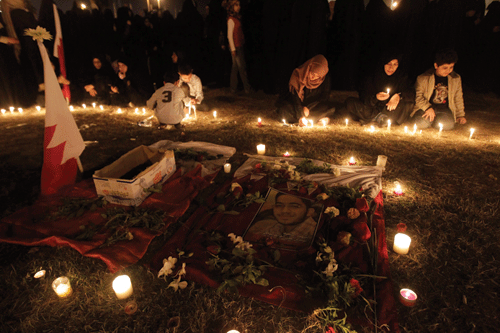
This is part of the background to the protests that erupted on February 14. By all independent accounts, demonstrators peacefully demanded reforms. After riot police killed two protesters on February 14 and 15, King Hamad expressed condolences, leading many to believe that the government might honor its citizens’ right to peaceful assembly. Riot police shattered that illusion on February 17, assaulting men, women and children, many of them sleeping, in a public square, killing several and wounding hundreds. The next day, security forces opened fire on people mourning those killed. The king has again ordered these forces off the streets, but the casualties from the February 18 ambush have yet to be counted.

The government has careened between indiscriminate violence and temporary accommodation, making it impossible to predict how the crisis will resolve. But clearly the US should no longer view Bahrain with rose-tinted glasses, whether due to concerns about Iran, the Fifth Fleet or anything else. There is no evidence of Iranian involvement in the protests, or of any appetite among Bahrain’s Shia to emulate Iran’s authoritarian regime. Nor have protesters expressed antipathy toward the US or questioned the US naval presence.

Bahrain should no longer be allowed to masquerade as liberal even by local standards. Rather, Bahrain has a lot of work to do to persuade its own people, and the rest of the world, that it is anything other than a police state.

Joshua Colangelo-Bryan is a lawyer in private practice in New York and a consultant for Human Rights Watch.


March 3, 2011 0 comments
0 FacebookTwitterPinterestEmail
Society

Secret Affairs: a book by Mark Curtis

by Paul Cochrane March 3, 2011
written by Paul Cochrane


Britain has played a nefarious role in the Middle East’s history. We all know that London re-drew the region’s borders after World War I as part of a “divide and rule” strategy, but few are aware of Britain’s divisive and often contradictory efforts in the region that have remained a core part of its foreign policy. Instead, the United States and Israel tend to get all the “credit” when it comes to the dark arts of Machiavellian political subterfuge.

In ‘Secret Affairs: Britain’s Collusion with Radical Islam,’ author Mark Curtis uses declassified official documents and leaked reports to lay bare Britain’s policies of destabilization and the political-economic ties Britain developed to ensure energy security and financial co-dependence. What Curtis exposes is as damning to Britain as the WikiLeaks US embassy cables have been to Washington, revealing the decisions made away from public scrutiny and what really makes up official policy.

“It is clear that Britain has an interest in divide and rule in the Middle East. If it sounds conspiratorial, it is there, spelled out in the planning files,” Curtis told Executive.

Shady goings-on

‘Secret Affairs’ is an eye opening read that charts the beginnings of British collaboration with radical Islamic forces, a relationship that began during the occupation of India over 150 years ago, was used extensively post-1945 and continues to this day. Britain worked with Islamist groups, particularly the Muslim Brotherhood, and friendly authoritarian Islamic regimes in Egypt, Syria, Saudi Arabia, Iran, Iraq, Bosnia, Indonesia, Pakistan and Afghanistan to ensure that communism, nationalism, pan-Arabism and anti-Western policies didn’t take hold.

Britain would cultivate relationships on both sides of the political fence, showing a willingness to work with essentially anyone, whether the Mahaz-i-Milli Islam (National Islamic Front of Afghanistan), the Libyan Islamic Fighting Group or the ayatollahs in Iran, to achieve short-term goals, irrespective of the longer-term implications, in order to maintain a balance of power.

“In [my] analysis of British foreign policy, it is not all down to economics,” said Curtis. “The collaboration with Islamist groups in the Middle East has been about power status, to not be relegated to a bit player on the fringes. It has seen those groups as essential allies in a region where Britain has often lacked dependable allies. In a lot of the episodes where Britain collaborated with Islamic groups, it was essentially to do the dirty work that the US couldn’t do due to Congressional oversight and the fear of being found out.”

The dirty deeds include assassination attempts – for example on Egypt’s Gamal Abdel Nasser, Libya’s Muammar al-Qadhafi, and Lebanon’s late Ayatollah Mohammad Fadlallah – military assistance and the dissemination of propaganda tools, such as Korans and Islamic literature. British operatives also orchestrated “false flag” operations, such as the one in Iran in 1953 when mosques and public figures were attacked by agents and paid supporters appearing to be members of the communist Tudeh Party. British intelligence also worked in collaboration with Ayatollah Kashani, the mentor of Ayatollah Khomeini, to stir up sentiment against nationalist Prime Minister Muhammad Mossadiq.

Alongside maintaining its power status and ensuring energy security, Britain also worked to make sure oil-producing countries invested their petro-dollars in London to shore up the city’s global financial position. To do so, Britain needed to maintain its status as a power broker and to curry favor with regimes, regardless of the means. One example of this is the “fabricated invasion” of Kuwait by Iraq in 1958, during which Britain intervened to protect its newly-independent former colony against a threat that they had themselves concocted, as British files explicitly show. “Britain wanted to exaggerate the threat to Kuwait so [Britain] would continue its protection and Kuwait would keep investing revenues in the British banking system,” said Curtis.

Blow back

Such covert operations — all documented in ‘Secret Affairs’— have been just one part of Britain’s foreign policy that has gone against London’s purported democratic ideals. The backing of Islamist forces, and its hidden alliance with two chief state sponsors of radical Islam, Saudi Arabia —which has spent more than $50 billion to spread the Wahhabi brand of Islam around the world and is a major sponsor of Islamist groups — and Pakistan, have also had major negative repercussions.

By preventing independent and secular governments from coming to power in much of the Islamic world, Britain’s policies have nurtured the current socio-political malaise and resulted in what the late Chalmers Johnson famously termed “blow back,” when the very forces the West aided and abetted came back to bite the hand that once fed them. Curtis shows how Britain in the 1990s allowed Islamist groups to operate out of London, which they believed could be used to destabilize governments in, among other places, Syria, Iraq and Libya. This was possible through a ‘covenant of security’ between radical Islamists and the security services.

A former Cabinet Office intelligence analyst explained: “The long-standing British habit of providing refuge and welfare to Islamist extremists is on the unspoken assumption that if we give them a safe haven here they will not attack us on these shores.”

This pact meant Britain could keep tabs on such groups’ memberships and finances, and enabled British intelligence access to groups linked to militancy from Afghanistan to Yemen. Even Al Qaeda had an office, the Advice and Reformation Committee, in London until 1998.

Alongside the US and Saudi Arabia, Britain equipped and bankrolled Islamist groups in Afghanistan, Pakistan and Bosnia that were later involved in the September 11 attacks in the United States, terrorist attacks in Saudi Arabia, and the July 7, 2005 bombings in London. Indeed, as Curtis’s research shows, the history of the ongoing “war on terror” is rooted in covert support for the Afghani Mujahedin in its fight against the Soviets and for the terrorism infrastructure co-established with Pakistan’s notorious Inter Services Intelligence (ISI), which trained fighters for operations in Central Asia, India, Bosnia, the Middle East and elsewhere.

It also goes further back in time, to the British-backed partition of India in 1947, which led to the creation of the Islamic Republic of Pakistan and the current imbroglio in Kashmir. Curtis quotes former Indian Ambassador Narendra Sarila as saying, “Many of the roots of Islamic terrorism sweeping the world today lie buried in the partition of India.”

More than 60 years later, Britain is still using divide and rule as a strategy and is contending with the repercussions of what in many ways its foreign policy has created. “There is still this resort to rely on particular Islamist forces to achieve objectives, whether in Southern Iraq[post-2003], where Britain worked with Islamist forces and now [has] a de-facto working arrangement with the Taliban, in the sense that Britain is reliant on them for an honorable exit from Afghanistan,” said Curtis. In a previous book, Curtis called Britain’s foreign policy a “web of deceit.” In his latest, he has further shown how that web was spun and, crucially, how British foreign policy has anurtured global terrorism and instability.


March 3, 2011 0 comments
0 FacebookTwitterPinterestEmail
Society

Executive Insight – S2C

by Salem Osseiran, Zeina Loutfi & Ramsay G. Najjar March 3, 2011
written by Salem Osseiran, Zeina Loutfi & Ramsay G. Najjar


There has been much commotion in Beirut in recent months over the installation of a network of radars on Lebanon’s roads. Though not a new endeavor in the region, this certainly presents an interesting case study on the unique social features of Middle Eastern society and how governments seek to regulate the behavior of citizens.

Within Lebanon, the presence of these radars has deterred most people from speeding, and a testament to its effectiveness has been the drop in the number of fatalities by almost half, according to the interior ministry. This method of regulation is contingent on a fear of punishment as people are coerced into a change in behavior, begging the question of whether this approach is the most effective method to dissuade society from adopting a certain behavior.

The carrot beats the stick

Governments have always used legislation and regulations to create the boundaries of legally acceptable behavior. If an individual crosses that line, they are punished accordingly.

This relies on two assumptions: First, that the general public will be dissuaded from committing such an act because they are too afraid of the consequences; and second, if the act is committed, they will not be able to get away with it because effective enforcement will ensure that the law is upheld. If the radars were removed, would everyone continue to drive in the same restrained manner? Of course not.

This suggests that attempts to make real changes to behaviour only through fear are futile. Methods that rely on incentives are likely to fail in producing something sustainable. The answer may be in combining such methods with an appreciation and understanding of the damage that negative behavior, such as speeding, causes society. More efforts should thus be targeted at influencing the underlying attitude that leads to this behavior, complementing coercion and reward with persuasion. 

In 2007 the government of New South Wales launched an anti-speeding communication campaign to discourage young drivers from speeding. It suggested that young men who speed had limited sexual prowess, effectively debunking the belief, through ridicule, that speeding attracts the attention of the opposite sex. The campaign succeeded in changing behavior and encouraging young men to slow down, as demonstrated by the figures that showed fatalities caused by young drivers speeding decreased by 45 percent over the following year.

It seems obvious that communicating to the general public with the aim of shaping attitudes and beliefs can produce more sustainable results for governments than a one-sided threat of punishment. Although this approach requires more patience and carefully thought out effort, the change at the attitudinal level is more cost effective for society. For example, problems such as heart disease can be dealt with through medication and surgery, but the costs of such measures on society are greater than efforts aimed at encouraging people to adopt healthier lifestyles.

Shaping behavior through successful persuasive communication demands a nuanced and insightful understanding of local mindsets, norms of interaction and culture. Only through a deep-seated appreciation of cultural idiosyncrasies can one develop effective messages that resonate and identify the delivery channels that strike the right cord with the target audience.

Getting the word out

The government of Sweden put in place a ‘Vision Zero Initiative’, which sets targets for road safety by 2020. The campaign is a holistic effort that combines infrastructure and regulatory changes with communication efforts aimed at demonstrating government dedication. The main message behind their communication efforts has been to shape attitudes toward road safety by reinforcing a neglected reality, namely that human beings die whilst driving. To deliver this message to as wide an audience as possible, they proceeded to develop a communication campaign that entailed a series of initiatives such as a website, a brochure, a Facebook page, and even a Vision Zero Academy aimed at improving road safety.

Private sector initiatives have also constituted an important source for novel ideas. “The Fun Theory” initiative developed by Volkswagen is an example that tried to change people’s behavior through, simply, fun.

Contestants were asked to submit ideas that would motivate people to change certain behaviors because they would enjoy doing so, not because they were afraid of the consequences. In 2010, the winner proposed “The Speed Camera Lottery”, the goal of which was to get more people to obey the speed limit by giving positive incentives. Instead of having traditional radars only taking pictures of drivers who were speeding, this camera would also take pictures of those within the speed limit and enter them in a lottery funded by the money generated through speeding tickets. Volkswagen subsequently developed a communication campaign around this idea; testing in the first three days following the launch showed a reduction of 22 percent in average speed.

The playwright George Bernard Shaw once said, “The single biggest problem in communication is the illusion that it has taken place.”Governments need to take this to heart. They cannot assume that their policy efforts will achieve sustainable results without coupling them with coherent communication initiatives. 

A persuasive approach does not exclude coercive or incentive-based methods; it merely proposes a means to amplify their effectiveness through the use of communication to shape attitudes.

It is time for all governments to realize that understanding the belief behind the behavior could become the shortest path to changing it.


March 3, 2011 0 comments
0 FacebookTwitterPinterestEmail
Finance

Riad Salameh speaks to Executive

by Emma Cosgrove March 2, 2011
written by Emma Cosgrove

With praise from international media raining in for his steadiness at Lebanon’s financial helm, Executive sat down with Central Bank Governor Riad Salameh to discuss the current and future state of Lebanese Banks.

E  As a foil to the rest of the world, Lebanese banks have actually struggled to find profitable uses for their excess liquidity, especially in local currency. Do you believe that the banks have enough tools to keep this liquidity from becoming a burden?

Well, as you know, the amounts that came to the banking sector after the collapse of Lehman [Brothers], and between September 2008 and July 2009, were very large amounts compared to the size of deposits already existing in the banking sector. Plus they were mostly converted into Lebanese pounds. It is normal that the banking sector can’t find immediate use for such amounts when they total around $16 billion. The credit market in Lebanon usually increases by $2 billion to $3 billion a year.

So the central bank issued 5-year certificates of deposit (CDs) in Lebanese pounds in order to mop up some of that liquidity, and the

Ministry of Finance also issued more treasury bills in Lebanese pounds than needed, in order to keep discipline, prevent bubbles, speculation and inflation. And this money will be gradually used again in the economy in Lebanon.

Therefore, we have to face the positive aspect of not having been touched by the crisis and embrace the confidence in our system, and we thought that it was an opportunity for Lebanon to receive and keep all these funds, as there will be a need for them in the future, whether to finance the public sector or the private sector.

E  Why did the central bank stop issuing five-year CDs?

We have issued circulars to enhance credit in Lebanese pounds and we have given incentives to lend for housing without placing price ceilings, so you can now see the banks competing to lend money at rates that are around 5 percent for medium-term [loans].

We have also given incentives for the financing of new projects, not only those covered by the previous circulars, which means that any project besides industry, tourism, agriculture, or technology that is launched between now and June 2010, and we’re going to extend it until June 2011, will be able to be funded with low rates of interest. We have also launched student loans and  environmental loans using those same incentives.

Given this package, we thought that we had to leave some liquidity in the hands of the banks in order to motivate them to lend according to these circulars. As we look forward, we can have good growth in 2010 if the credit activity is maintained and intelligently directed. So, the markets started to find a certain equilibrium despite the fact that we stopped these CDs.

We still had conversions from dollars to Lebanese pounds. We still had a balance of payments that showed a positive balance of $6 billion by the end of October, which is a record for any year in Lebanon for the first 10 months. Therefore, we thought that we can now afford now some gradual decrease in rates.

Nonetheless, if we see that our management of the liquidity in the market requires us to reenter by selling CDs, we will do that, and we have announced that we might come back with 7-year and 10-year maturities.

The idea is to acquaint the market with longer maturities in Lebanese pound denominated papers, and that the government later on can also issue bonds for 7-year and 10-year maturities in Lebanese pounds.

By extending the maturities on debt we will have less pressure on the refinancing of that debt on a yearly basis, and that will help maintain a more acceptable structure of interest rates.

E  As interest rates decline, do you expect the dollarization of deposits to remain around 66 percent?

We think the market is keeping that ratio. This is one of the equilibriums that we are starting to see. And today we have approximately $27 billion in liquid foreign currency on our balance sheet at the central bank, which is also a historical high. This means that out of the capital inflows coming to the country, 66 percent remain in dollars, while the rest are converted to Lebanese pounds. We find that it’s up to the market to define the equilibrium, but I believe we have seen the markets at this level for the past three or four months.

E  Both the prime minister and the finance minister have stated that they are keen to implement Paris III initiatives that include raising taxes on interest earned in local banks from 5 to 7 percent. Do you think this will actually happen in this government’s term?

The tax on the interest on deposits is not, I think, a priority for the time being, especially in that this tax was envisaged before the international crisis. And even though it is presented as a law to be voted, there is an understanding that this cannot be implemented before we have stability in the banking sector worldwide and in the region.

The tax approach is also not the priority, as I understand, because the priority is going to be given to more growth in the economy and to fix activities that are creating large deficits for the government, like Electricite du Liban.

Anyway, the government is presently discussing the economic program that they want to present to the Parliament or at least a declaration on that, and we will wait to see what will be approved. But I know that growth is the priority and for that, everything is going to be done to facilitate growth.

E  You’ve been successful in swapping the short-term debt for long-term debt with more maturity. How do you see Lebanon coming out of its debt situation?

Our priorities really are to reduce the yearly deficit because the present stock of debt that is in the market is perfectly sustainable, due to the high liquidity that we have and also to the increased confidence in the financials of the country. As you can see, the credit default swap that is quoted internationally for Lebanon for the past five years has declined to reach 2.3 percent, at certain times it was at 7 and even at 10 percent. So there is demand on the Lebanese paper, and interest rates in the secondary market have substantially decreased.

The future expectations of inflation are going to diminish the real value of that debt, which is stated today at around $48 billion. And the present value or the real value of that debt will look less important in the next four or five years, as the purchasing power of currency is going to be depleted worldwide. So what the market requires are signals showing that the deficit is declining, and for that purpose we hope that the originators of this big deficit be addressed in the reform program of the government. The most important sector to reform is the energy sector in general and electricity in particular.

We have to wait for the government declaration in order to see if the program of privatization is going to be implemented fully or partially and in what ways.

E  In light of the likelihood of the dollar decreasing in value, is the central bank changing the ratio of its foreign currency reserves?

No. We have the same ratios because we intervene in US dollars, so by departing too much from our structure of reserve in the dollar, we will incur risks on the Forex markets, dollar vis-à-vis euro or sterling or yen, which is not good for a central bank.

We cannot be speculators on the exchange markets, but we have created a model that preserves the real values of our reserves and don’t forget; the central bank, on its balance sheet, has a large stock of gold that represents around 30 percent of that balance sheet today. So the country is well hedged against any future development in terms of inflation internationally or a weaker dollar if this trend continues.

E  Is the devaluation of the dollar going to help us get to a higher balance of payments now that our exports are going to be more attractive?

You know, the dollar is decreasing in value against all of the currencies and most economic activity, whether in terms of production or services, is dollarized. This gives a competitive advantage to the country. And we have seen that in the correlation between the growth in the economy in Lebanon and the decline in value of the dollar. Of course we are talking about the economy in general. We are not talking about savings and the purchasing power of savings but this is an issue that concerns the people, the owners of capital, not the central bank. At the central bank, we have a diversified portfolio in terms of currency. We have a large stock of gold. But our transactions will remain related to the US dollar as long as the markets are dealing in that currency. If the markets change to another currency, then we will change as well.

E  To what extent are banks in Lebanon compliant with Basel II?

They are fully compliant to the criteria of Basel II; the solvency ratio in the country is around 12 percent. As you know, most banks worldwide are struggling to get to 8 percent, which is the norm. And this 12 percent is by applying all the criteria of Basel II. We are also working on the governance issue and on the risk and transparency issues along with the banks. We issued circulars in that regard and we have created, at the central bank, a unit for good governance that is going to work in the field to make sure that good governance is implemented, and we will start by a strict analysis of the composition of the board of directors and their prerogatives in the bank’s management.

The group is within the central bank so effectively it will give its recommendation to the governor. The governor will present it to the central board and there will be a decision that has enforcing powers. This is a follow-up activity, nonetheless there is also the banking control commission that is empowered and has the teams that are in the field working to see how our circulars are being implemented in the banking sector.

E  The sentiment at the Union of Arab Banks conference in November was that Basel II is insufficient to prevent a crisis like we are seeing right now from happening again. Do you agree with that?

The crisis happened after Basel II had been approved, so Basel II is not enough to prevent a crisis. Here, we added to Basel II the liquidity factor that did not exist before. So in Lebanon, the banks have to constitute a liquidity of 30 percent on their balance sheets, 15 percent as a reserve requirement with the central bank and 15 percent on their own books. The fact that we have low leverage and high liquidity has helped the sector refrain from going into adventurous credit, and Basel II is more on the capital side than on the liquidity side. So it has to be developed more. Anyway, Basel II is just guidance because the major countries did not even implement it, like the United States or India. There is no better protection for a bank than its management because they know what is really happening in the bank, and for a banking sector, the local central bank should be aware and prudent, to moderate leveraging in the sector.


March 2, 2011 0 comments
0 FacebookTwitterPinterestEmail
Finance

Embracing evolution

by Peter Daou March 1, 2011
written by Peter Daou

In an economy such as the United Arab Emirates, where the government has significant stakes in several of the largest banks, it is hard to isolate successes and attribute them fairly. Still, the success of UAE banks at surviving what have been trying times earns them at least part of the financial accolades of the emirates in 2010; the orderly restructuring of nearly $25 billion of debt was a major achievement on the part of the UAE banking sector and September’s announcement that all 90 of Dubai World’s (DW) creditors had agreed to a restructuring agreement sent positive waves across financial markets. 

“Common sense prevailed, and it was therefore an achievement to get all the banks to agree to the restructuring terms, which reflects the pragmatic structure of the agreement,” says Jeremy Parrish, chief executive officer of Standard Chartered UAE. Emirati banks also withstood exposure to a still-ailing real estate sector and what Parrish describes as “very tight liquidity” in 2010.

Return to liquidity

After the DW debt rescheduling, liquidity was scarce for Dubai’s banks. But in the second half of 2010, banks and sovereign authorities were able to tap into international capital markets. Dubai’s Department of Finance raised $1.25 billion in 5-year and 10-year bonds in September. Emirates NBD raised $221 million in August through securities backed by auto loans, a first in the Middle East, and then followed through in November by raising $410 million in 5-year multi-currency notes. At the same time, banks have actively sought out solutions and new strategies to mitigate the dismal financial and credit conditions.

 EFG Hermes banking analyst Murad Ansari points out that UAE banks, namely in Dubai, offered competitive returns on deposits and organized road shows to raise deposits.

This national increase resulted in an improvement in the loans-to-deposits (LTD) ratio, which slipped into positive territory again at the end of October and is another indicator bankers view as an achievement in a country that has historically been highly leveraged.

Michael Tomalin, CEO of National Bank of Abu Dhabi (NBAD) attributes the decline in the LTD ratio to proceeds from corporate bond issuances and to the attractiveness of interest rates on dirham deposits, especially given the fixed exchange-rate regime.  Tomalin adds that “some of the banks in the country — not NBAD, but other banks in the region — have been quite aggressive at going out into international markets and raising institutional deposits through programs offering relatively high rates of interest in dollars.”

Banks have been actively adopting strategies to align themselves to a new operating environment. Many are focusing on growth sectors such as trade finance, tourism and project finance for infrastructure. Standard Chartered is targeting small and medium-sized enterprises to mitigate exposure to large real estate developers, while Emirates National Bank of Dubai and NBAD are also focusing on their fee-based business.

“We are a local bank that has connections and access, can guide, help and advise on how best to structure a project and so on,” says Tomalin.  “Our international lending activities are directed to advance our client who wants to invest abroad, or an overseas client who wants to sell something, so we support him in that sale.” Tomalin adds that while interest income relative to fee-based income is currently at a ratio of 70:30, he would like to see it at 60:40.

Taking on the big boys

The local banks’ new strategies mean pitting themselves against international banks who have historically dominated the lucrative fee-based businesses such as investment banking and corporate finance. Tomalin admits that local banks have to be smart and realistic in that regard.

“We have to ask ourselves, if we want to compete with Goldman Sachs, Barclay’s or Deutsche Bank, etc, how are we effectively going to compete with these people? They are huge, we are a little bank,” says Tomalin. “Our point of differentiation is that we are a bank in the Arab world. We are here in Abu Dhabi. That makes us different.”

Emirates interbank offered rates

At the same time, expanding deposit bases may prove to be expensive, especially when many banks are rushing to cut their LTD ratio and add more lending capacity. According to Tomalin, “some banks… have been paying very high rates of interest for deposits to get their ratios sorted out. We haven’t been paying this sort of interest [at NBAD] but other banks have.”

Nonetheless, banks may be able to attract deposits through other means than interest rates. Sanjoy Sen, Citibank’s Middle East Consumer Bank Head, believes that customers are increasingly sensitive to the reputation, brand name, financial stability and strength of their bank. “Banks that are in a comfortable liquidity position will not necessarily need to pay high rates for mobilizing retail deposits,” says Sen.

In parallel, fears of rising competition for deposits between international and local banks appear unfounded. “There is an increase in competition between banks but it is a level playing field and all players have equal opportunities to get a ‘share of the wallet,’” says Sen. Parrish adds that “there has always been a healthy competition between international and local banks, but we do not see any shift in the paradigm.”  

On the other hand, the sought-after deposits have already begun to affect profitability. Banks usually seek to attract retail deposits first because they are cheaper compared to their corporate counterparts, which are more interest rate sensitive. But retail deposits are notoriously harder to attract, and given the pressing need to raise long-term debt in order to finance maturing obligations and increase lending, some banks have been aggressive, at the expense of their operating margins.

What make matters even more complicated are speculative capital inflows. Although hedge funds are happy to park their money in high-interest dirham deposits, banks are all too familiar with the 2008 scenario and will not lend against hot money, thus creating an added cost.

As a result, and despite discernible improvements in the ability of UAE banks to counter credit and economic crises, the list of concerns continues to cloud what many bankers view as the emirates’ strong fundamentals.

Tight liquidity is a major concern at banks looking to refinance and lend. Widening credit default swap spreads and expectations of a stable emirates interbank offered rate spread do not support an increase in liquidity. There seems to be a general consensus among bankers and analysts that a continued orderly restructuring and refinancing of large corporates without massive and surprising provisions will go a long way in re-establishing confidence in financial markets and especially banks.

Analysts are carefully tracking developments in asset quality, especially at Dubai banks whose non-performing loan ratios are among the highest in the country, given their tilt toward the embattled real estate sector. Still, the shift to the resilient sectors of the economy such as tourism, trade finance and government, should improve overall asset quality at UAE banks.

 However, fear of additional provisioning and general weakness across some of the largest sectors in the economy, especially in Dubai, may shift the focus of banks more toward stabilizing their balance sheet and liquidity ratios than toward taking on additional risk, unless on a highly selective basis.

At the same time, a 98 percent national LTD ratio, which goes even higher by the central bank’s loans to stable deposits, does not provide much leeway for banks to grow their loan books in 2011. But there is room for measured growth, according to Parrish, who says: “The drop in the LTD ratio is not a signal for the flood gates to open, but we will see a measured increase in loans after what so far has been a flat growth in the last 18 months.”

The general mood of investors and analysts covering UAE banks remains largely skeptical, with several exceptions in the banks and some economic sectors. Nevertheless, the rush of positive news, including airport and port traffic in the second half of 2010, has boosted confidence at the business and consumer levels, generating strong support for the belief that today’s concerns, such as asset quality deterioration and profitability, may form the achievements of 2011.

March 1, 2011 0 comments
0 FacebookTwitterPinterestEmail
Banking & Finance

Regional equity markets

by Executive Editors February 28, 2011
written by Executive Editors

Beirut SE  

Current year high: 1,180.99    Current year low: 939.02

>  Review period: Closed Jan 26 at 1,024.00 Points                  Period Change: 5.3%
The Beirut Stock Exchange had a positive entry into 2011 and the MSCI Lebanon index rose to a 6-month high on January 11. Volatility appeared as the nation and BSE were exposed to the newest twist in the power bickering of Lebanese politics. During the Jan 12 to 26 period, shares of real estate firm Solidere fluctuated between $18 and $20. Bankers affirmed there was no flight of money. In terms of the BSE’s reaction, the uproar over a new PM on the Jan 25 “day of rage” was but a tantrum.

Amman SE  

Current year high: 2,648.36                Current year low: 2,223.30

> Review period: Closed Jan 26 at 2,424.62 Points                  Period Change: 1.2%

The first significant uptrend in several months for the Amman Stock Exchange benchmark index — 125 points, or 5.3% between Dec 19, 2010 and Jan 17, 2011 — fizzled out with the eruption of political protest in Tunisia. The index dropped 2.2% in the following week but there was nary an immolation of Jordanian stock prices by the Jan 26 close. Industrial stocks were involved in driving the market higher and the industrial index was the best performer in the review period, closing Jan 26 up 3.85% on the month. The banking sector index lagged slightly behind the benchmark.

Abu Dhabi SM   Current year high: 2,931.67                Current year low: 2,471.70

> Review period: Closed Jan 26 at 2,668.66 Points               Period Change: -1.9%

Amid broadly negative sentiment affecting most sectors on the Abu Dhabi Securities Exchange, real estate and construction were the sectors that dragged the benchmark index even lower. The industrial index was the upward outlier. The newsmaker among listed companies was developer Aldar, which embarked on a long expected restructuring, including placement of a $760 million convertible bond, a $2.9 billion impairment charge, and a $3 billion transfer of infrastructure assets. The stock subsequently slumped to its lowest quotations ever, beneath the AED 2 mark ($0.54).

Dubai FM   Current year high: 1,880.62                Current year low: 1,461.80

> Review period: Closed Jan 26 at 1,627.97 Points               Period Change: -0.2%

Index movements on the Dubai Financial Market lacked clear direction at the start of 2011. Among sector indices, telecommunications and transportation closed the review period on positive notes banking, investment, real estate and insurance sector indices were bearish. Down 12.1% year-to-date at Jan 26 close, the utilities sector was the DFM’s underperformer. District cooling firm Tabreed fell 9% and Emaar Properties gave up 3.4%. Gainers included telecoms operator Du, up 9.4%, contractor Drake and Skull, up 7.7%, and multi-sector investment company Dubai Investments, up 5.4%.

Kuwait SE   Current year high: 7,575.00                Current year low: 6,319.70

> Review period: Closed Jan 26 at 6976 Points                     Period Change: 0.3%

Movement on the Kuwait Stock Exchange in January stayed loyal to the same point range that had been the theme of the last quarter in 2010, dallying in the 6,900s and not breaking into 7,000 territory but not softening to 6,800 either. Except for the banking sector, which outperformed the benchmark index performance by six percentage points, the domestic sub-indices remained range bound. The index for non-Kuwaiti share values slipped 4.8% during the review period.

Saudi Arabia SE  

Current year high: 6,929.40                Current year low: 5,760.33

> Review period: Closed Jan 26 at 6,697.80 Points   Period Change: 1.2%

Based on a 360-point gain in December, the TASI ascended to an eight-month high on Jan 16 before profit taking in the latter part of the review period curtailed its January gains. Industrial investment was the top gaining sector index at 7.6%. Transport and agriculture stocks saw sector index drops of 4% and 3.8%. At the top, supermarket retailer Othaim climbed 16.5%. Heavy-weight Sabic retreated from a 28-month high after 27% year-on-year improved Q4 profits that narrowly undercut forecasts.

Muscat SM  

Current year high: 7,027.32                Current year low: 6,058.11

> Review period: Closed Jan 26 at 6,943.10 Points   Period Change: 2.8%

Enjoying five closes above 7,000 points, the Muscat Securities Market’s H2, 2010 rally with a cherry on top lasted until January 17, a day that apparently nudged investors across the GCC to think about profit taking. All three sector indices on the Omani bourse closed the review period higher, with the services and insurance index showing the best gains at 9%. Banking and industrial indices added 2.8% and 1.7%, respectively. Incompatible liquids were a happy, if most likely not interconnected, theme as Maha Oil and National Mineral Water each gained more than 18%.

Bahrain SE  

Current year high: 1,605.98                Current year low: 1,361.19

> Review period: Closed Jan 26 at 1,460.67 Points   Period Change: 2.0%

The benchmark index of the BSE recorded notable gains near the end of the review period, propelling the market to the number three spot in the GCC, after Qatar and Oman. Sector indices for investment, services and industry moved north; banking, insurance and hotels headed south. At the extreme points of individual share price movements, Ahli United Bank advanced 12.7%. Bahrain Islamic Bank, announcing Q4 losses, fell 23.3%. The bourse listed a $530 million Bahraini sovereign bond on Jan 20, expanding the number of listed bonds and sukuk to 12.

Doha SM   Current year high: 9,242.63                Current year low: 6,558.45

> Review period: Closed Jan 26 at 9020.24 Points    Period Change: 3.9%

True to the form of recent months, the Qatari market was again the Gulf’s best gainer in January 2011. But even on the World Cup-delighted QSE, where economic prospects were buoyed last month through government reconfirmations of immense infrastructure investment intentions, days of profit taking emerged in mid-January. First, however, the QSE benchmark rallied to highs unseen since the maelstrom of the 2008 crisis. All sectors followed the benchmark trend of rise and retreat. Only banking, up 4.7% by Jan 26, closed the review period higher than the general index.

Tunis SE   Current year high: 5,681.39                Current year low: 4,534.88

> Review period: Closed Jan 26 at 4,552.80 Points   Period Change: -12.7%

From sideways trading in December, the Tunis Stock Exchange crashed in January, losing 665 points in only one week of trading to Jan 14 before the TSE shuttered its gates and remained closed for the remainder of the review period to avoid being fully submerged in political chaos and panic selling. Prices dropped for nearly all stocks that were traded during the period, without indication of any sector or industry being at the center of selling. The upheaval set the TSE back to index levels last seen in January 2010 with a wholly indeterminate outlook.   

Casablanca SE  

Current year high: 13,397.47              Current year low: 10,846.39

> Review period: Closed Jan 26 at 13,183.91 Points             Period Change: 4.4%

The MASI index started 2011 with a 740-point rise to a new historic market peak on Jan 12. This turned into a 3% slide in the wake of the unexpected crisis in Tunisia but investor sentiment stabilized toward the end of the review period; the Moroccan bourse was the period’s best performer in North Africa. Market cap leader Maroc Telecom climbed 6%. Ennakl Automobiles, the Tunisian car distributor cross-listed in Tunis and Casablanca, dropped only slightly on the CSE but bled much more on the TSE.

Egypt CASE  

Current year high: 7,603.04                Current year low: 5,647.00

> Review period: Closed Jan 26 at 6310.44 Points    Period Change: -11.64%

Crash and bang but no boom was the tenor on the Egyptian Exchange, whose indices were driven down sharply during the morning of Jan 26 after violent demonstrations the day before stoked investor fears of national political instability. The benchmark EGX 30 index dropped 6% that day but the wider EGX 70 and EGX 100 indices fell about 10% each. Banking, financial, and real estate sector indices were all heavily involved in the January drops as were food and leisure.

February 28, 2011 0 comments
0 FacebookTwitterPinterestEmail
Feature

Hard Numbers

by Executive Editors February 21, 2011
written by Executive Editors

In a much publicized and internationally heralded move in August 2010, the Lebanese government passed “right to work” legislation for the country’s Palestinian refugee population. For those who thought that this would usher in a new era for the refugees and alleviate the poverty of the Palestinian community, nearing its 62nd year in exile in Lebanon, the unfortunate reality is that little has changed.

While Lebanon’s economy has made gains in recent years (recent incidents notwithstanding), it is glaringly apparent that little, if any of this has reached what remains one of the country’s most disenfranchised communities. Lebanon’s 12 official Palestinian refugee camps are still mired in destitution: in south Beirut’s Shatila Camp sewage runs through the alleys, secondary school drop-outs and unemployed men in their 20s idle in the market and only a minority of homes have access to natural sunlight.

While clearly visible to the eye, the poverty that dominates the economic situation of Lebanon’s Palestinian refugees — estimated  by various organizations at anywhere between 260,000 and 400,000 — has been largely difficult to quantify due to a shortage of reliable data. In late December, the American University of Beirut (AUB) released a report called “Socio-Economic Survey of Palestinian Refugees in Lebanon,” commissioned by the United Nations Relief and Works Agency (UNRWA) and funded by the European Commission, which claims to be the most comprehensive survey of the population in the past decade. The last major benchmark study on the subject was carried out by the Norwegian foundation FAFO, using data collected in 1999.

The AUB report offers a rare statistical quantification of the socio-economic realities and hardships of Palestinians in Lebanon.

Dire poverty

The survey found that 66.4 percent of Palestinians in Lebanon live under the poverty line of  spending $6 per day – deemed enough money to cover basic food and non-food items. Of these, 6.6 percent fell under the extreme poverty line, spending less than $2.17 per day, enough to cover food items alone.

Unlike previous surveys, the AUB report measured spending rather than income as a measure of poverty, which authors of the report argue is more accurate. From these statistics, the study estimates that approximately 160,000 Palestinian refugees live in poverty.

Inside the refugee camps — which are often isolated from urban areas and job opportunities — three out of four residents live below the poverty line, compared to one in two Palestinians who live in gatherings outside of the official camps. Remaining Palestinians not living below the poverty line are by no means affluent: the report mentions that no individual surveyed reported a monthly expenditure of more than $600.

The average monthly expenditure was revealed to be $170; those living in informal gatherings spent an average of $200 per month while those living in camps spent only $150. Little change then, from data collected in 1999 by FAFO, which found that 44 percent of Palestinian refugees in Lebanon made less than $2,400 per year, or $200 per month.

No jobs to go around

The most obvious contributing factor to the poverty facing Palestinian refugees in Lebanon is that most of them do not have jobs. The AUB report shows that only 37 percent of the working age (15 to 64 years old) Palestinian refugee population is employed. The study’s authors assert that widespread discrimination on the part of many Lebanese employers makes finding jobs difficult.

“If a secretary [applies for a job] with a CV that says Shatila Camp [under] residence, they will not employ her,” says Sari Hanafi, an associate professor at AUB and one of the contributors to the report.

Of Palestinians who do have jobs, very few have contracts — prerequisites for obtaining elusive work permits that give the employee legal standing and rights. This leads many Palestinians to work illegally, exposing them to labor abuses.

“Those who are interested in employing Palestinians are exploiters,” says Hanafi. “A few days ago I found three Palestinians working with a construction company. I got the details and found  they work without work permits and they work for half the price that their Lebanese colleagues can get from this company.”

Legal issues remain the largest issue facing Palestinians who want to work, and so far the lauded “right to work” legislation of August 2010 has done little to help the employment situation facing Palestinians.

“[It had] zero impact. I am not exaggerating,” says Hanafi.

As evidence, Hanafi points to the fact that, in the past six months, the Lebanese Ministry of Labor has granted only three work permits to Palestinians. In 2009, 99 permits were issued to Palestinians. Foreign workers from other countries — primarily domestic workers from Asia and Africa, along with non-Lebanese Arabs — were issued a total of nearly 150,000 permits in 2009.

“The Ministry of Labor is supposed to take some implementing measures. Those measures have not been taken yet,” says Salvatore Lombardo, director of UNRWA in Lebanon, adding that the country’s current political crisis is “likely to delay even further the implementation measures.”

With the stagnation of the process, Hanafi says, “the main factor [contributing to unemployment] is really related to the lack of a legal framework allowing Palestinians to get jobs in the private sector.”

Rather than a step toward more equal rights, the report says “the amended law constitutes an institutionalization of discrimination.”

While in theory it would make it easier for Palestinians to obtain work permits, the law did little to help Palestinian professionals trying to enter liberal professions, many of which are syndicated and reserved for Lebanese nations. For unskilled jobs, permits are not as helpful as it might seem, given the reluctance of employers to issue Palestinians contracts and thereby give up the current low labor costs and freedom from worker protection regulations. 

The fear of tawtin — the naturalization of Palestinians — upsetting Lebanon’s delicate sectarian balance has made many Lebanese hesitant toward granting further rights to Palestinians. In a narrow Lebanese job market already saturated by low-wage workers from other Arab countries and further afield, some fear that additional working rights would worsen the situation for Lebanese job seekers.

“A very important conclusion of the study is that [Palestinian refugees] do not represent a threat to Lebanese nationals in terms of job searches,” says Lombardo, taking into account that Palestinians primarily compete with non-Lebanese Arabs and other unskilled foreign laborers for jobs. The sheer number of Palestinians in Lebanon would put the community in a position to be a strong positive economic force in the country, if only they were better integrated into the economy through proper employment.

School’s out forever

The inability to keep students in school is a driving factor behind the undereducated Palestinian workforce. While elementary and preparatory schools that Palestinian children go to enjoy high attendance numbers, enrollment rates crash to 51 percent for secondary school. However, this is an improvement from FAFO’s 2006 study, which found that 74 percent of the Palestinian labor force in Lebanon had less than a secondary education.

Post-graduate opportunities are bleak throughout the Palestinian community: “When these kids see their older brother unemployed after a few years in private university, they have no incentive to go to school,” says AUB’s Hanafi.

For Lebanon’s Palestinians, the path to a brighter economic picture is largely out of their own hands. Their high levels of unemployment and poverty will likely continue as long as there are no serious efforts to integrate the refugees into their host country’s economy. With the country’s politicians currently handling their own problems, it could be some time before a helping hand is given to the Palestinians.

February 21, 2011 0 comments
0 FacebookTwitterPinterestEmail
Editorial

Willfully ignorant of the imminent

by Yasser Akkaoui February 21, 2011
written by Yasser Akkaoui

In the first month of 2011 a storm of popular rage swept across the Arab world. Protests from Morocco to Yemen have brought millions out into the streets to demonstrate against the once-feared powers that be, toppling one long-time titan of autocracy in Tunisia and leaving another clinging to power in Egypt as January ends.

One must remember that Tunisia and Egypt were the North African darlings of international investors looking for high returns in developing markets. Both had been regarded as stable macroeconomic environments right up until their collapse, with proven track records of strong growth and stellar potential. Who could have foreseen these revolts?

Economists and the like have a nice term for an event of such radical departure from the expected: a ‘black swan’ – a freak of nature, unforeseeable, unavoidable and of devastating consequence.

But were the events of the last month really so unexpected? We have known for years that wealth has failed to trickle down in Egypt and Tunisia, that corruption is rampant, that education has failed to match the needs of the economy and that brutal police repression has stymied legitimate protest.

The soaring Tunisian stock exchange led business and political leaders to assume the social economy was also thriving, and that Egypt’s long years of political stability and growing middle class were signs that all was well on the banks of the Nile.

Perhaps it is human nature for greed to settle us softly into irresponsible complacency, where we take for granted the status quo will remain and we blind ourselves from the fires growing around us. Perhaps, then, many ‘black swans’ are not unforeseeable at all –– rather, we ignore obvious threats because wanton disregard seems to make sense when profits are easy. But then the crash comes, and again we claim we’ve been wronged by wicked fate.

In the cases of Tunisia and Egypt, we were simply focused on the wrong indicators. Gross domestic product growth and stock market performance do not tell the health of a nation; to assess the stability of any society you must assess the level of satisfaction of its people.

In the future, analysts will have to revise the indicators they use to assess a country’s risk and investment potential if they want to avoid looking like the archetypal jilted lover, always claiming they never saw it coming.

February 21, 2011 0 comments
0 FacebookTwitterPinterestEmail
  • 1
  • …
  • 389
  • 390
  • 391
  • 392
  • 393
  • …
  • 686

Latest Cover

About us

Since its first edition emerged on the newsstands in 1999, Executive Magazine has been dedicated to providing its readers with the most up-to-date local and regional business news. Executive is a monthly business magazine that offers readers in-depth analyses on the Lebanese world of commerce, covering all the major sectors – from banking, finance, and insurance to technology, tourism, hospitality, media, and retail.

  • Donate
  • Our Purpose
  • Contact Us

Sign up for our newsletter

[contact-form-7 id=”27812″ title=”FooterSubscription”]

  • Facebook
  • Twitter
  • Instagram
  • Linkedin
  • Youtube
Executive Magazine
  • ISSUES
    • Current Issue
    • Past issues
  • BUSINESS
  • ECONOMICS & POLICY
  • OPINION
  • SPECIAL REPORTS
  • EXECUTIVE TALKS
  • MOVEMENTS
    • Change the image
    • Cannes lions
    • Transparency & accountability
    • ECONOMIC ROADMAP
    • Say No to Corruption
    • The Lebanon media development initiative
    • LPSN Policy Asks
    • Advocating the preservation of deposits
  • JOIN US
    • Join our movement
    • Attend our events
    • Receive updates
    • Connect with us
  • DONATE