• Donate
  • Our Purpose
  • Contact Us
Executive Magazine
  • ISSUES
    • Current Issue
    • Past issues
  • BUSINESS
  • ECONOMICS & POLICY
  • OPINION
  • SPECIAL REPORTS
  • EXECUTIVE TALKS
  • MOVEMENTS
    • Change the image
    • Cannes lions
    • Transparency & accountability
    • ECONOMIC ROADMAP
    • Say No to Corruption
    • The Lebanon media development initiative
    • LPSN Policy Asks
    • Advocating the preservation of deposits
  • JOIN US
    • Join our movement
    • Attend our events
    • Receive updates
    • Connect with us
  • DONATE
Economics & Policy

Chasing the dragon

by Thomas Schellen August 3, 2010
written by Thomas Schellen

With monster-sized bank offerings and strong growth in primary markets activity,  the global landscape of initial public offerings made a strong showing in the first seven months of 2010. However, in Arab markets, the picture included pea-sized volumes, vastly overestimated listing numbers and IPOs that went into hiding.  

Keeping count of initial public offerings in the Middle East and North Africa during the first half of 2010 was a simple task, with the total raising of funds in the $1.2 billion range from 16 IPOs with completed subscription by June 30. The tally for standard entries into the sphere of public trading across the MENA is mouse-like next to the 800-pound gorilla in the 2010 global IPO market, China.

Saudi Arabia was the stage for seven offerings across the MENA, followed by four in Tunisia (which included one with a double listing in Morocco), two in Syria, and one each in Egypt and Qatar. Four of these stocks, including Mazaya Qatar Real Estate, which closed its subscription at the end of January, have yet to start trading.  

No starker contrast could be imagined to the Far East. Roaring with new issues to the tunes of $22.6 billion and $8.9 billion, the Shenzhen and Shanghai stock exchanges in the Middle Kingdom led the world IPO action in the first half of 2010, according to a report by the World Federation of Exchanges. That was before the IPO of Agricultural Bank of China (AgBank) raised $19.23 billion in July in a dual offering on the Shanghai and Hong Kong bourses.

The biggest offering in an Arab stock market so far was the 1.02 billion riyal ($272 million) measure by Saudi Arabia’s Knowledge Economic City Co. in May. It attracted almost 2 million investors and subscription demand reached $469 million, said lead manager NCB Capital. At the time of writing, the stock has yet to commence trading on the Saudi Stock Exchange.

The average offering size for MENA IPOs in the first half of 2010 was in the vicinity of $75 million. Regional investors did not limit themselves to the region’s primary market opportunities; China’s AgBank IPO, for example, was rather attractive to GCC money. With subscription to 6.8 billion shares or a stake of over 22 percent, the Qatar Investment Authority is being cited as the largest single holder of AgBank shares issued in Hong Kong. The Kuwait Investment Authority also was a massive subscriber, picking up 1.95 billion shares. The AgBank price per share on July 22 closed near $0.42, confirming that alone the Qatari investment in this Chinese IPO is worth over two times all initial public offerings on MENA exchanges for the year to date.

Including one Middle Eastern IPO in July, of the Saudi Al Jouf Cement Co., the cumulative value of 17 MENA IPOs in the first seven months of this year is $1.38 billion, more than $500 million short when compared with the region’s 11 IPOs in the same period last year, according to Zawya.com data.

The value disparity is mainly on account of the April 2009 Vodafone Qatar issue, which pushed the average offering size in the first six months of 2009 from about $94 million up to over $170 million.  

However, the demand for IPOs in the region has otherwise shown definite upsides in year-on-year comparison. For the offerings in 2010 to date, average subscription demand has exceeded more than nine times the capital offered, which indicates a resurging investor interest when compared with the paltry appetite of four times demand in the first half of 2009.

Investors also saw improved returns on primary market subscriptions when reviewing the performance of IPO stocks in relation to market indices across the Gulf Cooperation Council. While stock market indices provide depressed numbers for the first half in general and individually for the time since floatation of the 2010 IPO stocks, the performance of the new stocks was solid, and overwhelmingly positive for the parameters of first-day, first-month and total time since trading debuts.   

August 3, 2010 0 comments
0 FacebookTwitterPinterestEmail
Economics & Policy

Executive Insight Booz and Co

by George Atalla August 3, 2010
written by George Atalla

Public–private partnerships (PPPs) have helped many countries in the Middle East modernize their highways, upgrade their communications infrastructure and build new power plants. But such partnership models have proven less effective for governments seeking to outsource certain services, such as health care.

Handing over such services to the private sector requires a greater level of collaboration and trust between governments and their partners than straightforward infrastructural works. Creating an electronic payments system, for instance, goes to the heart of what government does and affects its everyday transactions in a way that the construction of a sewage plant does not.

To better manage such services, the Egyptian government is developing a new approach to partnership called ‘joint ownership’, which could be broadly applicable throughout the region. This approach transforms the way in which public services projects are structured and offers opportunities for private sector entities around the world to capitalize on the region’s rapid growth.

In the joint ownership model, both the government and the private entity get a stake in a newly formed private company. The government awards a contract to the jointly owned company, giving it the right to be the sole provider of the service in question. It also contributes regulatory support, clearing a path for the company to operate without interference. The private sector contributes the technical and management know-how, as well as a portion of the financing for the project.

Successful system

The Egyptian government conducted its first experiment with the joint ownership model to launch a nationwide e-payment system in 2007. The newly formed company, e-finance, was created with an initial investment of 60 percent from the government and 40 percent from its private-sector partner, and was granted concession rights that made it the sole entity allowed to operate an electronic payments platform for the Ministry of Finance.

The Egyptian government was also able to ensure the buy-in of the banks, pension fund managers and others that needed to be part of the system. The private partners, meanwhile, provided know-how in the areas of software development, banking, automation, and e-services, as well as designing, installing, managing and maintaining the e-payment system. The new system allows civil servants, who used to line up at cashiers’ windows every week for cash payments, to receive their salaries automatically via an ATM card.

Hundreds of thousands of pensioners now receive their income from the government in the same way. The company is expected to become profitable over the next several years, once the infrastructure is in place and the system reaches its projected number of processed transactions.

The experiment proved so successful that the Egyptian government is now considering other areas in which joint ownership might be effective. For instance, there are opportunities to replicate this model for services as diverse as carrying out customer handling and data processing at customs, providing state-of-the-art training to Egyptian and regional civil servants, and even for conducting government-wide procurement services.

 There is a caveat to these partnerships: They are short-term commitments. Governments, after all, should not be the owners of companies. Their economic role should be to set and enforce the regulations that enable competitive markets. But as long as both parties understand this condition, they can reap several immediate benefits from joint ownership.

Complimentary pairing

Most importantly, the partnership offers access to resources that neither side would independently have access to. The public partner gets the technical, financial and management resources of its private-sector partners: the private sector’s often higher salaries mean it enjoys better-trained workers and deeper expertise than exists in government.

In turn, the public partner can offer concession rights and support regulatory changes that may be vital for the new company’s success.

Second, the venture’s risks are shared in a way that can increase the initiative’s prospects of success. For instance, political, legal and environmental risks are borne by the public partner; after all, the public partner can directly influence outcomes in those areas. Risks relating to the design of the service or financing fall to the private partner, which presumably has more expertise in those areas.

Finally, jointly owned companies offer straightforward exit strategies in the form of initial public offerings or strategic sales that are not available in most other types of PPPs. In particular, if the company is prospering, the public partner can push for an initial public offering, giving it a way to cash out of its position. Or the public partner can sell all or part of its stake to a strategic investor.

The same structure that bestows benefits also creates some risks. If the government has granted concession rights, the new company may be a monopoly player in the market. To address this issue, contracts need to clarify what services must be provided and what is reasonable for consumers to pay.

The joint ownership model also creates a conflict of interest for the public partner. The government would normally push to maintain low prices for its services, but as a stakeholder in the company, it should be maximizing profits. This risk can be diminished by creating a separate entity within the government to monitor the performance of the company.

In the long term, the real priority for any Middle Eastern government must be to figure out what fixes are required in its legal, regulatory and institutional frameworks, so that its private sector can launch public-services projects without such intensive government involvement.

This is the true sign of success — when the government doesn’t need to offer itself up as an owner in order to spur private sector participation. Until that happens, joint ownership will remain a potential short-term strategy.

August 3, 2010 0 comments
0 FacebookTwitterPinterestEmail
Finance

Life saver Lang

by Emma Cosgrove August 3, 2010
written by Emma Cosgrove

Before 2006, Near East Commercial Bank (NECB) was going nowhere. “There was no increase in revenues, no increase in assets — no increase at all,” said Dominique Lang, the Swiss banker who has acquired the task of reviving it. “It was, in our opinion, a dormant company, but it had a good name and good staff.”

Where the Central Bank saw a stain on Lebanon’s thriving banking scene, Lang saw an opportunity.

Playing the long game

Lang, a Swiss banker for nearly 30 years and chairman of Nomina Finance in Zurich, and his business partner Alfred Wiederkehr finalized the acquisition of the bank in April of this year — a deal nearly 10 years in the making.

NECB has been located at the Place de Beyrouth since 1978 when SNA insurance group owned it, before the Caland family took control.

Since 1993, Lang had been aware of Lebanon’s banking potential through a business relationship with the Caland family, and he became a shareholder at NECB when he and Wiederkehr wholly subscribed to a $9 million capital increase at the bank in 2006, gaining a 43 percent stake. Lang remained a shareholder until 2007, when the Central Bank began putting pressure on NECB to shape up its neglected balance sheets. He then became chief executive and soon enough, the sleeping bank began to show signs of life.

And indeed, the Central Bank’s concerns were not unwarranted. At end-2007 NECB had $142 million in assets and just $17.6 million in loans, with 40 percent of these considered “doubtful” and 10 percent classified as “bad debt.” The bank posted $3 million in losses that year.

But soon after Lang took over the management of the bank, he began to clean house.

“The bank had a big portfolio in real estate which was bringing in no money so we sold the biggest part of this portfolio. The operational result was then in the black,” he said.

Lang dropped most of this underperforming portfolio in favor of much higher-yielding treasury bills. This move significantly improved the bank’s interest margin and sped up the transition from red to black. The recovery was helped as well by the fact that NECB managed to spend significant time in red figures without losing a single depositor — a feat Lang attributes to the relationships between bank staff and clients.

In 2008 the bank made $283,000 in profits; 2009 saw more growth to almost $2 million. And according to Lang, the bank has already generated $2.6 million in profits for the first half of 2010 “The bank is now back to a normal situation,” he said.

It was this success in bringing NECB back from the brink, combined with the owning family’s dwindling interest in the bank that led Lang and Wiederkehr to buy the remaining 57 percent of the bank. The decision was made in January of 2010 and the deal, the value of which both parties have agreed not to release, was approved by the Central Bank in April.

According to Lang, the central bank was very receptive to the acquisition. He says that the close involvement of the Central Bank and Banking Control Commission (BCC) with regards to strategic planning has helped, and was not a hindrance as some of the bigger banks often complain.

Selling secrecy

Now Lang has the job of improving the bank past mere profitability.  A feasibility study is currently being conducted regarding the opening of two new branches in Beirut and Lang plans to continue the bank’s niche profile, focusing mainly on retail and private banking. He plans to focus on small and medium loans (ranging from $50,000 to $500,000) as smaller loans have a better profit margin and entail much lower risk.

Further, Lang says that the banking secrecy law and the know-how within the sector are good selling points to international clients.

“We see a slight demand from people in Europe, in Switzerland, to have an alternative to banks in Europe for the secrecy,” he said. “Lebanon is one of the remaining countries that has a law for banking secrecy. Until now we have brought [international] private clients for an approximate amount of $250 million.”

August 3, 2010 0 comments
0 FacebookTwitterPinterestEmail
Comment

A perversion of principles

by Michael Young August 3, 2010
written by Michael Young

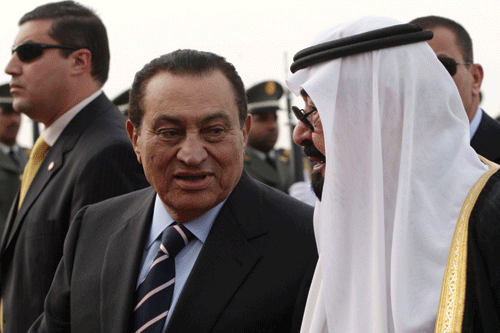
Recently, The Economist took an interest in Arab autocracy, titling a leader on the subject “Thank You and Goodbye.” The premise for this statement was that the leaders of Egypt and Saudi Arabia were getting old, therefore change is coming to both countries “for good or ill.” Change is indeed coming, but the rule in the Arab world has tended to be that the more things change, the more things remain the same.

The tenor of the leader was interesting, if for the wrong reasons. After listing the advantages and disadvantages of the policies of Egypt’s Hosni Mubarak and Saudi Arabia’s King Abdullah, the magazine carried its argument into a minefield of “ought to.” It advised that the regimes in both countries ought to do this and ought to do that, without really explaining why they would want to do so, given that they have spent decades avoiding the path of rule of law, democratic elections, human rights, and so on.


What positive developments there were during their respective rules came on relatively non-political fronts. Mubarak has managed to bring in investment, causing the Egyptian economy to grow quite rapidly of late. King Abdullah has sought to loosen the reins of the Saudi system by expanding education and opening up avenues for internal dialogue. However, as the framers of the Barcelona Euro-Mediterranean process learned years ago, against their initial hopes, Arab regimes’ economic and social liberalizations have not generated much in the way of political openness.

One reason for this is that the business community in the Arab world has tended to avoid rocking the political boat. Prominent businesses or businessmen often have established close ties with regimes (when they are not actually also regime figures), and therefore see few advantages in challenging a profitable status quo. Income disparities in the region also tend to be great, while higher education is of relatively low quality, making it even more difficult for a middle class to emerge and challenge the order in place.

That conundrum is one reason why even usually sharp observers, not least The Economist, are obliged to resort to the circular “ought” formulation – condemned to repeat, with little expectation of a response, what the Arab world needs by way of amelioration, without which reform would be impossible.

But this circular argument also leads to a paradox, one related to revolutionary change: Arab regimes are bad, but they are often better than their likely alternatives, namely militant Islamists who would impose far worse governance systems than the ones we have today. However, for these Islamist oppositions to be marginalized, Arab regimes need to open their systems up politically and economically, to reduce the popular discontent that allows the Islamists to thrive. Yet here is where things goes sour: If regimes become more tolerant, this could be exploited by the Islamists to expand their power, and many have actually done so quite successfully at the ballot box, as in Algeria, the Palestinian territories, Lebanon and even Egypt.  Where does this paradox lead?

Greater acceptance in the West for Arab regimes that abuse their societies, since this keeps Islamists at bay; and a higher likelihood of revolutionary change, because if a regime falters — as happened in Iran in 1979 — the Islamists, having no alternatives, will embrace violent and absolute transformation.

In other words, if Arab regimes untighten their fists, stability may suffer, and if they keep the fist tightened stability may eventually suffer too, in a dramatic way. So the West, particularly the United States, which provides many Arab regimes with vital financial and economic aid, is at a loss about what to do. That’s why the Western states also have a package of ‘oughts’ in hand, though few of them are ever adopted that could threaten the regimes implementing them. 

Here is an irony: standing against those lamenting Western “neo-imperialism” in the Middle East is a reality of harsh Arab sovereignty. It is a sovereignty based on instilling the fear in the hearts of the outside world, the West in particular, that tinkering with the machine of the dictators may have terrible consequences. So Arab regimes everywhere remain free because their people are kept in chains.

August 3, 2010 0 comments
0 FacebookTwitterPinterestEmail
Comment

Grand Ayatollah Mohammed Hussein Fadlallah, 1935-2010

by Nicholas Blanford August 3, 2010
written by Nicholas Blanford

Sayyed Mohammed Hussein Fadlallah was a difficult man to pigeonhole, although many tried. From the early 1980s, he became, in the minds of many, synonymous with Hezbollah and was forever described as the group’s “spiritual leader” who had personally blessed the suicide bomber who blew up the United States Marines’ barracks at the Beirut airport in 1983. It was a tag that endured, even though Fadlallah eschewed a formal role within Hezbollah.

The claim that he blessed the Marines’ barracks bomber has also been put down as a rumor deliberately circulated by Lebanese military intelligence during the presidency of Amin Gemayel to discredit the cleric.

Fadlallah, despite being a leading advocate of an activist and modernist Islamism, tended toward dispensing guidance and advice and disdained the parochial obligations of running a political institution. Yet his teachings and writings served as an inspiration for Hezbollah’s founders and he continued to wield influence from afar during the party’s formative years. Among his early followers was a skinny bespectacled youth named Hassan Nasrallah, who even before reaching the age of 10 was a regular attendee at Fadlallah’s sermons in Nabaa.

Even though the official marja (religious reference for followers) for Hezbollah is Iran’s Ayatollah Ali Khameini, it is no secret that many members of the party actually followed Fadlallah. I know of one Hezbollah fighter who was utterly inconsolable on hearing of Fadlallah’s death and in his grief made unflattering comments about Khameini.

Fadlallah was a magnificent public speaker with a showman’s knack for whipping up an audience. But in the 1970s, he faced stiff competition from Imam Musa Sadr for the hearts and minds of the Shia community. Sadr was an Iranian of Lebanese ancestry who had arrived in south Lebanon in the late 1950s and soon made a name for himself as a progressive and dynamic cleric determined to better the lot of the marginalized Shia. He established the Amal Movement in 1975.

Both Sadr and Fadlallah were brilliant orators, but there the similarities ended. Sadr was slim, tall, charismatic, enlivened with boundless energy that saw him holding meetings, lectures and sermons up and down the country. Fadlallah was short and portly, a scholastic figure who centered his activities on his Nabaa neighborhood, glossing over doctrinal differences between Shia and Sunnis and emphasizing the unity of all Muslims.

Sadr’s purview essentially was limited to the communal betterment of Shias in Lebanon within the Lebanese system, while Fadlallah advocated the creation of a modern Islamic state and espoused a universal Islam that ignored man-made frontiers.

Sadr regarded Palestinian militant activities in south Lebanon with misgivings because of the suffering it brought upon his Shia constituents, but Fadlallah embraced the Palestinian cause, considering the eradication of the Zionist state as a moral and Islamic imperative.

Sadr vanished, mysteriously and famously, on a 1978 trip to Libya. For many Shia, dismayed at the more secular direction of the Amal Movement under the subsequent leadership of Nabih Berri, it was natural to gravitate toward the bolder views of Fadlallah.

Fadlallah originally objected to suicide bombings, but changed his stance in the mid 1980s when Lebanon was in the grip of Israeli occupation. In justifying suicide bombings, he said “there is no difference between dying with a pistol in your hand or exploding yourself.” But he pointedly added that suicide operations could not be condoned lightly and that if alternative means of attacking the enemy were available then they should be used instead.

Fadlallah supported Hezbollah’s goal of establishing an Islamic state in Lebanon, but recognized that given Lebanon’s pluralistic society, the attainment of an Islamic state was an impossibility in the short term. His perspective helped shape Hezbollah’s decision in the late 1980s to reverse its outright rejection of Lebanon’s power-sharing system of governance and to submit candidates for Lebanon’s parliamentary elections in 1992.

NICHOLAS BLANDFORD is a Beirut-based correspondent for The Christian Science Monitor and The Times of London


August 3, 2010 0 comments
0 FacebookTwitterPinterestEmail
Real Estate

Cityscape speaks – Damac Properties

by Nada Nohra August 1, 2010
written by Nada Nohra

Our message over the previous years has been growth, new projects, new demand, but this year it is very much construction and delivery,” says Niall McLoughlin, senior vice president of corporate communications at Damac Properties. With that message, Damac has been marketing every stage of its progress, assuring buyers and investors that the units they bought will be delivered on schedule. Last year, Damac announced that it had 11,313 units under construction. The company has delivered 3,029 in the last 12 months, and will deliver the rest by the end of 2010.

McLoughlin explains that Damac has been working with customers and transferring their investments from longer-term projects to the ones under construction or that are almost completed. “We have approached our customers on a case-by-case basis. It is a winning situation for them because they get the product earlier. It may also be a question of consolidating their portfolio to ease payment terms for them,” says McLoughlin. This strategy has been very successful, as it helped decrease potential payment defaults, which is the last thing either developers or customers want.

The company has also dedicated a new management team to focusing on customer queries, handling them case by case. “Losing a customer is not good for us, and also not good for the customer,” says McLoughlin.

Currently, Damac is not planning any news launches. The company is issuing enabling works contracts for its projects in the United Arab Emirates and Qatar. “By the end of the year, we anticipate awarding two to three main contractor works with a value of over AED 1billion [$272 million],” explains Mc Loughlin.

As for the long term, McLoughlin says the company will be looking to expand regionally, but not before the time is right. “Now the market is not ready for expansion, so our short-term objective is consolidating and constructing what we have launched,” he adds. 


August 1, 2010 0 comments
0 FacebookTwitterPinterestEmail
Finance

Regional equity markets

by Executive Editors July 23, 2010
written by Executive Editors

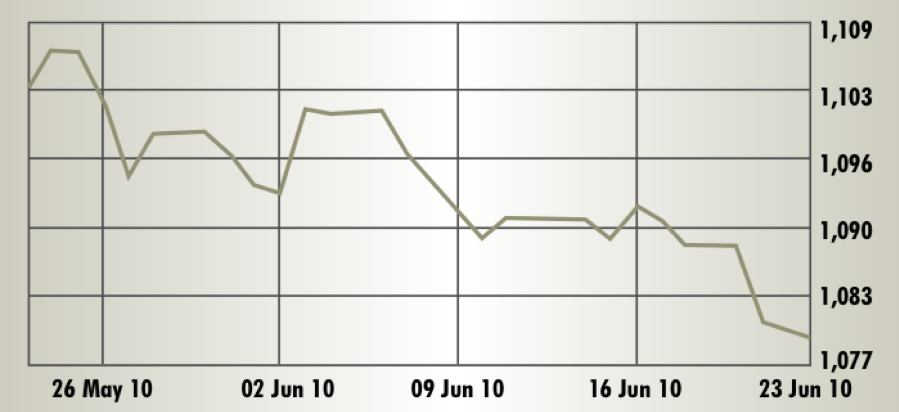
Beirut SE  

Current year high: 1,200.49    Current year low: 991.49

>  Review period: Closed – June 22 at 1079.28 Points          Period Change: -1.5%

The MSCI Lebanon index trended lower in a not overly dramatic fashion in the June 2010 review period, leaving all the excitement for Lebanon’s army of devoted football fans. When compared with its high of 1,180.98 points for the first half of 2010, the index softened by just over 100 points. However, the banking sector could show off another victory with a 31% y-o-y rise in its Q1 2010 aggregate net profit of the top 12 lenders. Market cap leader Solidere scored a goal of $189 million net profit last year in a stable performance.

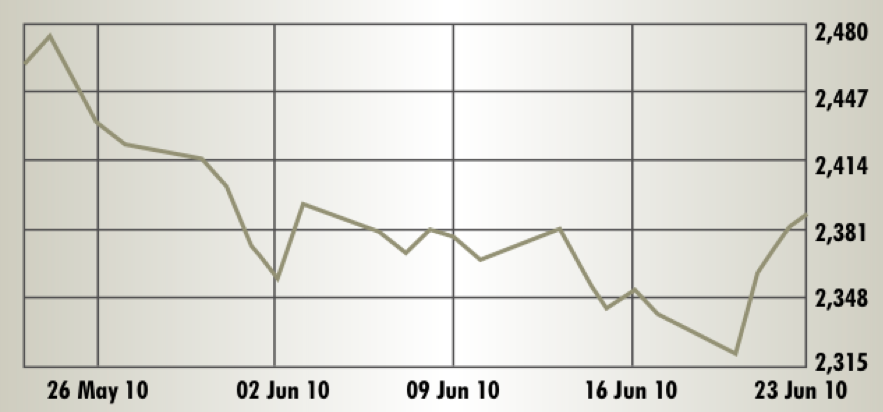
Amman SE  

Current year high: 2,744.07                Current year low: 2,320.14

> Review period: Closed – June 23 at 2,388.94 points          Period Change: -0.5%

Having just passed across a multi-year low of 2,320.14 on June 20, the best wish for the Amman Stock Exchange may be for this to have been rock-bottom for the market and for new stamina to appear after the disappointing first-half. Sadly, endurance training seemed to be of no help to the insurance sector, which dropped 15.2% at the bottom of market trends. Banking, industrial, and services sectors, by contrast, traded range bound with the ASE general index and banking even achieved a tick into positive territory, starting from June 21.

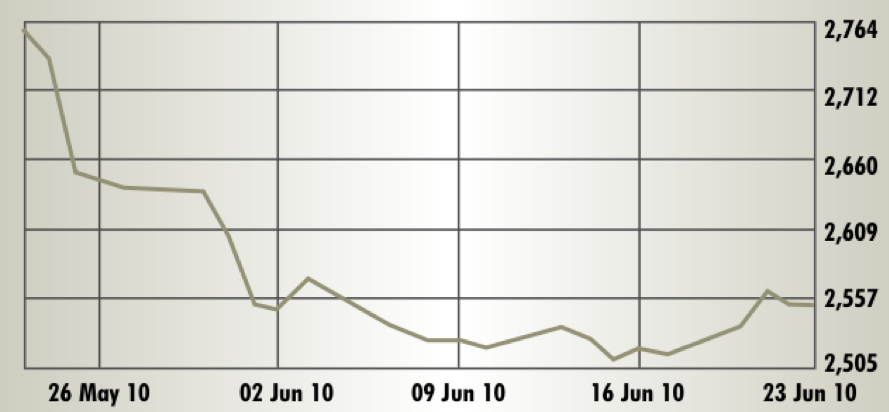
Abu Dhabi SM  

Current year high: 3,239.74                Current year low: 2,467.04

> Review period: Closed – June 23 at 2,551.39 Points                      Period Change: -2.0%

Abu Dhabi’s exchange has dropped a sizeable 7% from the start of 2010, though this decline is only half as steep as the plunge Dubai’s DFM took over the same period. The ADX exhibited some noticeable volatility in June and sector indices fluctuated in uncoordinated trends. The only sector index to end the period in positive territory, however, was the industrial index. Market cap leader Etisalat weakened 2.4% as Methaq Takaful and Gulf Livestock were beaten down 28.4% and 26.8%, respectively. The best gainer was Finance House, up 18.6%. 

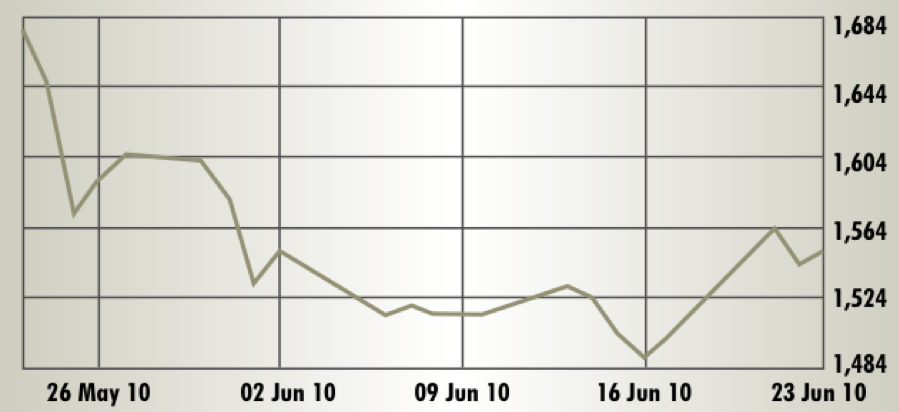
Dubai FM  

Current year high: 2,373.37                Current year low: 1,487.93

> Review period: Closed – June 23 at 1551.19 Points           Period Change: -1.8%

The ‘lord of the dip’ award goes hands-down to the Dubai Financial Market for the first half 2010. With the halfway point for 2010 quickly approaching, the DFM was down 14% for the year to date at its June 23 close and danced around 1,500 – levels last seen in February 2009. No vigor, no football competition, no cultural happening seemed to energize the DFM, where a 10.7% climb of Aramex stock was the only upward outlier. The vast majority of shares tended to the red, as did the sector indices, except for transport. 

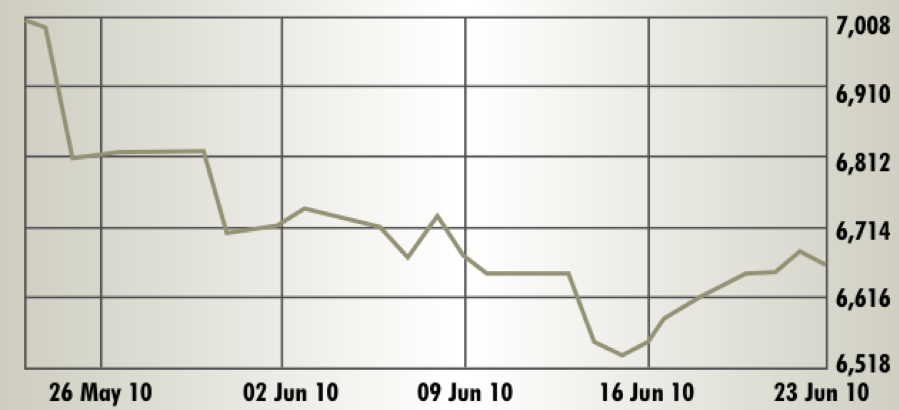
Kuwait SE  

Current year high: 8,140.20                Current year low: 6,528.60

> Review period: Closed – June 23 at 6,653.00 Points          Period Change: -0.7%

The fact that the Kuwait Stock Exchange closed less than one percent down in the review period cannot soften the harsh realities of the bourse’s massive slide in May, which didn’t stop until the index hit a 15-month low of 6,528 on June 15. It remains to be seen if this will be rock bottom for 2010, or if investor nerves have worn so thin that share price performance in Kuwait will fall further. Banking and industry were better than the general index; real estate and investment underperformed.

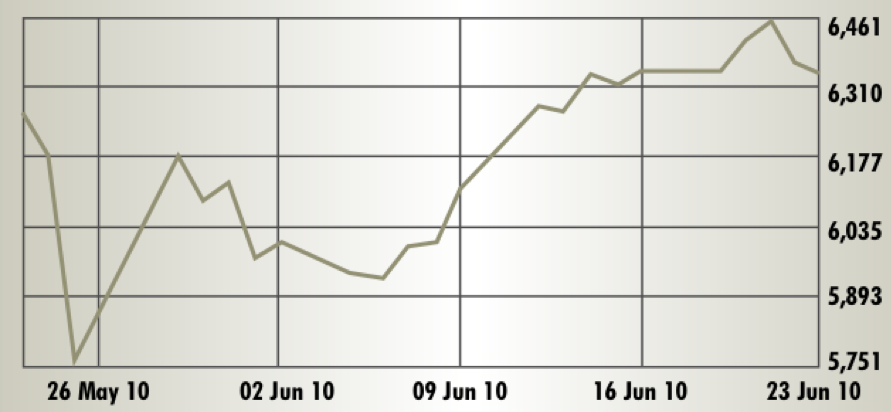
Saudi Arabia SE  

Current year high: 6,929.40                Current year low: 5,407.31

> Review period: Closed – June 23 at 6,343.47 Points          Period Change: 3.6%

After its immune system took a hit from various contagions in the second half of May, the Saudi Stock Exchange resurged in June, in a manner of speaking. Compared to its GCC peers, the SSE index was second best performer in the review period and for the year to date it is still the best student in the GCC securities college, with a 3.6% climb. Most SSE sub-indices moved range-bound with the TASI in the review period; a news-driven 23.1% spike in the Energy and Utilities index was the upward exception.

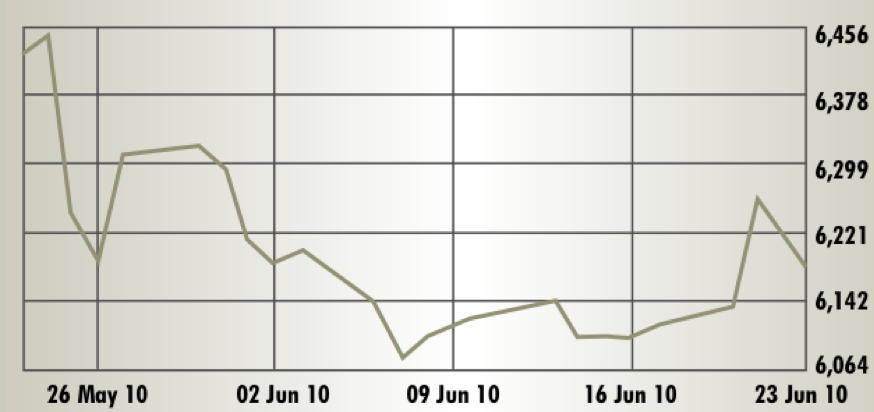
Muscat SM  

Current year high: 6,933.75                Current year low: 5,263.94

> Review period: Closed – June 23 at 6,173.33 Points          Period Change: -1.3%

The Muscat Securities Market had more losers than winners in the review period and the general index seemed to be finding its feet after two months of down pressures. While the industrial sub-index was the June market’s consistent best performer, banking had the most erratic ride. Brokerage Financial Services Co was the MSM’s best individual performer in June and shot up 19.6%, reversing a comparable drop it had suffered in May. National Mineral Water Co found no such mercy, dropping 21.6% from June 1 to 23.

Bahrain SE  

Current year high: 1,613.01                Current year low: 1,390.81

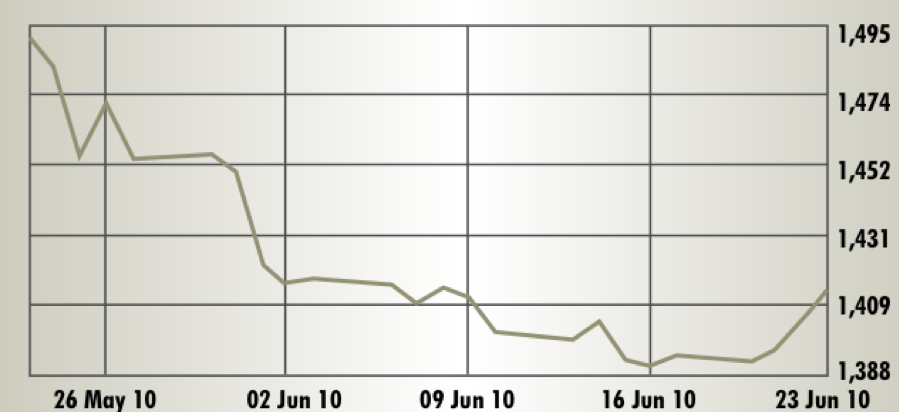
> Review period: Closed – June 23 at 1,413.19 Points          Period Change: -2.6%

Although the BSE’s bow beneath the 1,400 point line between June 15 and June 20 was merely a six-month low, and although the year-to-date performance of minus 3.1% is only the fourth worst in the seven GCC security markets, Bahrain’s investors will still be hoping the second half of 2010 bestows more blessings than the first.  While Esterad Investment fell 28.3% in the review period, a gain of 2.63% was made by Al Salam Bank – Bahrain, the period’s best performer.

Doha SM  

Current year high: 7,801.33                Current year low: 5,731.30

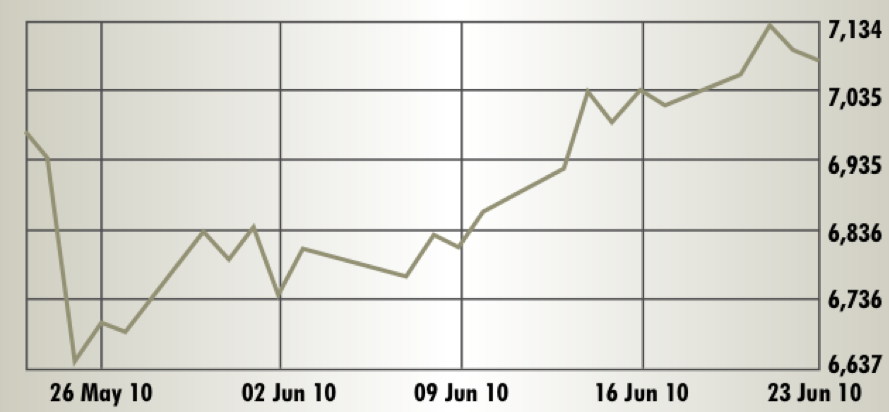
> Review period: Closed – June 23 at 7,072.08 Points          Period Change: 4.2%

Though the Gulf region has no team in the World Cup to bring home glory,  the Qatar Exchange took this month’s trophy for greatest market vigor. After its epic 1,250-point slide between April 13 and May 25, the ensuing gains of June made for a picture perfect V-shaped performance, albeit a V that is still rather short on the upside. The QE’s four sector indices all were positive, with insurance coming out on top as best performer. Was it because the country iterated another energetic bid to host a World Cup (2022)?  

Tunis SE  

Current year high: 4,772.39                Current year low: 3,337.48

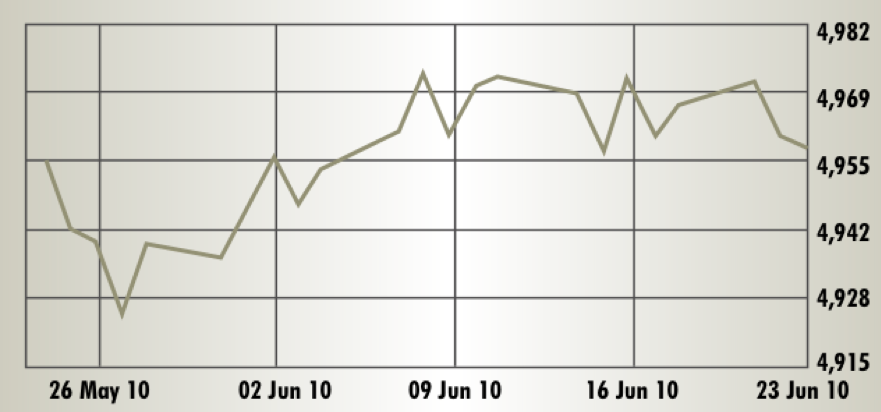
> Review period: Closed – June 23 at 4,957.85 Points          Period Change: 0.4%

Minimal volatility and sideways trading at the ceiling of historic performance was the game on the Tunisian Exchange. The period close represented a tiny retreat, by not even 15 points, from a new index peak of 4971.35, which was scaled on June 21. The market reported a smashing success in the initial public offering of cement maker Carthage Cement. The $89 million share offering for 49.8% in the company’s stock was oversubscribed more than 13 times and the stock debuted on June 22 with a first-day change of 26.3% when compared with the issue price.

Casablanca SE  

Current year high: 12,457.59              Current year low: 9,997.56

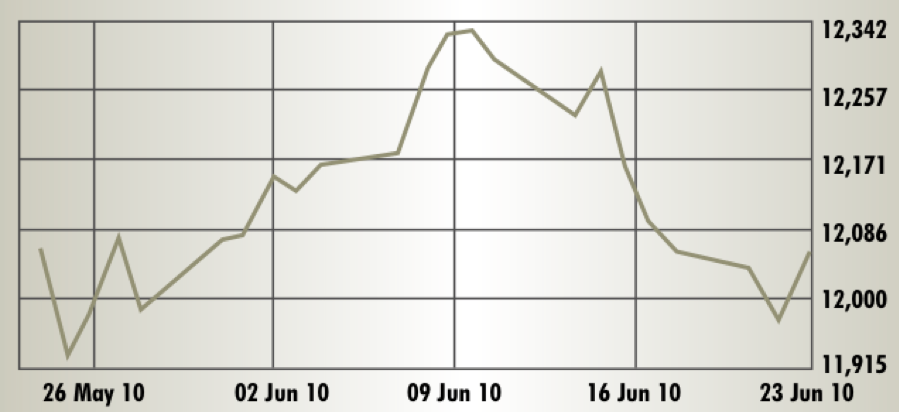
> Review period: Closed – June 23 at 12,055.36 Points        Period Change: -0.1%

The June 2010 match between bulls and bears on the Casablanca Stock Exchange was a draw. As the impact of the downturn in most global markets in late May caused the MASI to correct from record highs of almost 12,500 points, the optimists dominated on the pitch in the first eight sessions of the review period, but the bears came back in the second eight sessions for a flat net balance. Market cap leader Maroc Telecom advanced 4.7%, and leading bank Attijariwafa dropped 1.8%.  

Egypt CASE  

Current year high: 7,603.04                Current year low: 5,229.40

> Review period: Closed – June 23 at 6,319.00 Points                      Period Change: -3.5%

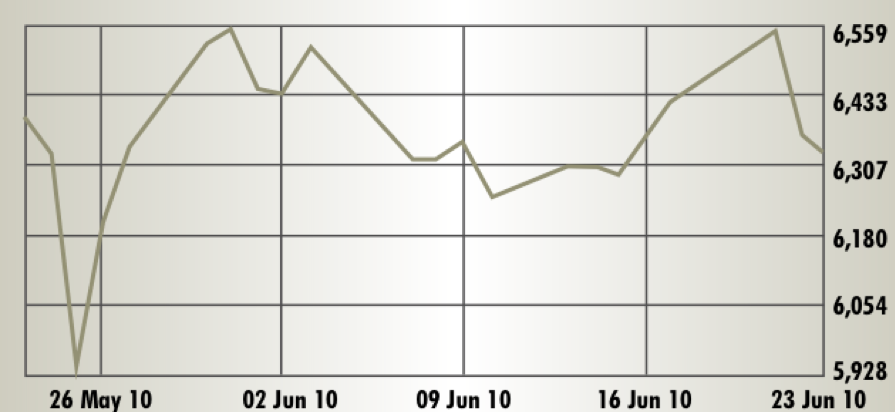
The highest volatility in North African markets marked the flow of trade on the Egyptian Stock Exchange in the June 2010 review period. After a massive drop and sharp rebound between May 18 and 31 into the mid 6,500 range, the EGX 30 fell more than 300 points to June 10, recovered by almost exactly the same point score, and weakened again. Telecom Egypt managed a flat performance but Orascom Telecom lost 14.7% as analysts questioned its planned divestment from Algeria.

July 23, 2010 0 comments
0 FacebookTwitterPinterestEmail
Feature

A species sinks

by Executive Editors July 17, 2010
written by Executive Editors

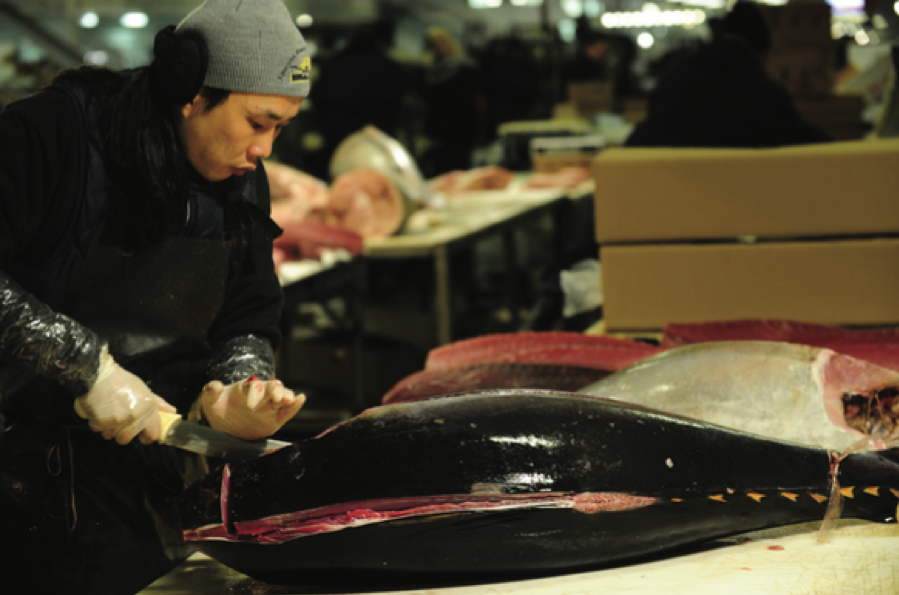
Blame it on the sushi. The rising popularity of the Japanese delicacy has brought the northern bluefin tuna to the brink of extinction, while at the same time profoundly altering the dynamics of fishing in the Mediterranean.

On June 9, the European Commission closed the Mediterranean bluefin tuna season, which had opened just three weeks earlier, because the annual quota had already been caught — predominantly by the ultra-efficient industrial fishing vessels sailed by Spain and France. At 13,500 tonnes, the 2010 quota was already set 40 percent lower than 2009 — a concession to environmental organizations, which had argued for a complete ban on bluefin fishing this year. For them, the European Union’s decision to halt bluefin fishing is too little, too late.

The Mediterranean’s stock of bluefin has shrunk to less than 15 percent of its original size due to overfishing.

“Bluefin tuna must be given a break,” said Sergi Tudela, head of fisheries at the World Wildlife Federation — Mediterranean. He advocates a global trade ban as the only way to ensure a sustainable tuna fishing industry in the Mediterranean. But the latest fishing ban applies only to EU countries — non-European fishermen will continue to fish the waters. Greenpeace believes that European boats will circumvent the ban by flying non-EU flags and gravitating to territorial waters off the North African coast, which are harder to regulate. 

Japan, which receives around 80 percent of the world’s tuna catch, has repeatedly moved to block an international tuna trade ban by the United Nations. Similarly, few Mediterranean countries are volunteering to give up a lucrative source of income, as tuna prices have shot up in recent years with the global popularity of sushi. A ton of the fish now sells for $1,000, up from $300 in 2005.

On the other side of the coin, declining supplies have had a deep impact on local fishing communities, especially in North Africa, where fishermen employ smaller vessels and outdated technology. In Morocco, where fishing is a pillar of the agricultural industry, tuna catches dropped 96 percent between 2006 and 2007, from 8,800 tons to 343 tons, leading to the discontinuation of local tinned tuna brand Tam. 

Some North African countries have increased measures to protect their dwindling fish resources. In April 2010, Tunisia passed a bill aimed at preventing illegal fishing in its territorial waters, where a tuna recovery program was initiated in the summer of 2009. Foreigners found fishing in these waters will be fined up to 300,000 dinars ($196,860), while Tunisian fisherman will be penalized up to 100,000 dinars ($65,620).

However, Africa remains a weak spot for the prevention of bluefin exploitation. The Gulf of Sidra off Libya, previously the largest breeding ground for Mediterranean bluefin, has been identified as the greatest site of illegal fishing in recent years, and yields approximately 40 percent of total bluefin catch.

While Libya has relatively scant fishing production itself, the country sells major European companies access to these waters. As a result, it has been one of the most vocal opponents of a bluefin fishing ban, which it believes disadvantages the developing nations that rely on the trade. 

At the Convention on International Trade in Endangered Species held in March 2010, Libya’s delegate forced a vote on the matter before any debate had taken place. The result was 68 votes against and 20 for, with 30 abstentions, clearly demonstrating that “governments are not ready to adopt trade bans as a way to protect species,” a spokesman for the UN told international press. In the minds of environmentalists, this nearsightedness has sealed the fate of the bluefin tuna. 

July 17, 2010 0 comments
0 FacebookTwitterPinterestEmail
Economics & Policy

For your information

by Executive Editors July 11, 2010
written by Executive Editors

Inking free trade

Lebanon, Syria, Jordan and Turkey came to an agreement June 10 to allow the free flow of goods between the four nations. Under the deal a “Cooperation Council” will be set up to tackle long-term strategic planning and implement a free movement zone. The agreement also included the lifting of visa obligations for individuals traveling between the countries. The deal was agreed by the foreign ministers of each country on the sides of a Turkish-Arab cooperation conference in Istanbul. The statement issued also stated that Turkey and Lebanon were required to complete a bilateral agreement before the multilateral agreement could go ahead. Three days later Lebanon and Syria also inked 15 memorandums and two executive programs covering the environment, consumer protection, agriculture, tourism, culture, justice, education, higher education, economics and vocational training.

Budget steps closer to approval

After several months of delays and almost a full five months past the constitutionally mandated deadline for Parliament to ratify a national budget, the Council of Ministers approved a version of the budget that was then passed on to Parliament for deliberation. If passed, the budget will be the first the country has seen since 2005. The draft budget was first submitted in April by the finance ministry and has been heavily debated by the opposition, specifically Telecom Minister Charbel Nahas and Speaker of Parliament Nabih Berri, who raised concerns about off-budget items and budget increases, respectively.  The proposal itself contained a total deficit of $4.3 billion based on a projection of  $9.2 billion in revenues — an 8.6 percent rise on 2009 — and $13.4 billion in expenditures. A total of $4.3 billion will be spent on servicing Lebanon’s public debt, which reached $51.48 at the end of April according to the latest available figures from the Association of Banks in Lebanon, constituting a year-on-year rise of 7.7 percent. The total debt at the end of the year according to the proposed budget is estimated to reach $55.18 billion, or a debt-to-GDP ratio of 147.47 percent, based on a estimated real growth of 4.5 percent and an inflation rate of 3.7 percent. According to the Central Administration for Statistics, Lebanon’s consumer price index, the primary indicator of inflation, had risen by 4.9 percent year-on-year as of the end of May.

A new plan for power

The Council of Ministers, Lebanon’s cabinet, approved a proposal on June 21 to overhaul and reform the country’s decrepit electricity sector. The plan, originally proposed by Minister of Energy and Water Gebran Bassil in March, lays out a 10-point, four-year agenda to move Lebanon toward producing more electricity through cheaper and more environmentally friendly natural gas, as opposed to the current use of fuel oil. The plan aims to increase the country’s production capacity from the current 1,600 megawatts (MW) to 4,000 MW by 2014, and then to 5,000 MW in 2015.

By 2014 it is envisioned that the country will enjoy 24-hour electricity. As part of the plan, the loss-making sector should be breaking-even by 2014 and generate a profit the following year. This would be achieved through cost cutting measures associated with weaning off fuel oil, and increasing the tariff structure of Électricité du Liban (EDL), Lebanon’s publicly owned electricity provider. The strategy earmarks a total of $4.87 billion to boost production and will be funded by several sources: the Lebanese government ($1.55 billion), the private sector ($2.32 billion) and donor countries ($1 billion). However, for all of the elements of the plan to be implemented, Bassil notes that several decisions will need to be approved by himself, EDL, the cabinet and the Parliament.

According to the energy ministry, the Lebanese pay around $700 million to EDL every year and $1.4 billion towards the private generation of electricity.  “If we don’t decrease the debts after reducing the cost of generation, we would go to $650 million in 2014 as direct losses to the treasury,” said Bassil. Both the finance minister and the International Monetary Fund have also stated that they support an increase in the price of electricity, although Bassil acknowledged the poor and the productive sectors will probably have to be compensated in some way. The energy minister also stated that renewable energy will make up 12 percent of the energy portfolio by 2020, a target first announced by the prime minister at the 2009 United Nations Climate Change Conference in Copenhagen. He added that the high possibility of finding gas offshore was a major factor in deciding to transition to more natural gas production in the plan. A law to regulate the exploration of gas in the country was before the Council of Ministers as Executive went to press.

Broadband: almost there…

Lebanon’s telecom sector is set to receive a boost from the government’s broadband infrastructure project, the first phase of which Minister of Telecoms Charbel Nahas announced on June 15 will cost $66 million. A spokesman for the ministry confirmed, on June 22, that a request for proposals would be issued in a matter of days . In January the Minister estimated that the much-anticipated project would total $166 million, then revised that figure down to $92.9 million in April. In March, Executive cited telecommunications experts at the International Telecommunications Union, the United Nations agency for telecommunications, as stating that the project should cost no more than $40 million. Anders Lindblad, president of Ericsson in the Middle East, confirmed that the project would constitute the “highways” or the national fiber-optic backbone, but did not include the access layer — the final crucial link between telecommunications infrastructure and the user which is still being studied by the ministry. 

“This part [highways], I assume will be public sector and I think that is a sound decision because there is a lot of money going into [it],” added Lindblad.  Nahas estimated that the project would need another 12 months to be completed and stated that in the 2011 budget “there will be a displacement of the tax burden on the telecom price structure,” adding that $800 million of the approximately $1.2 billion transferred to the treasury from the telecom sector last year was in the form of taxes; in a $160 million accounting discrepancy, the finance ministry stated that the total transfer from telecoms was $1.36 billion.

Lebanon praised and chided

The International Monetary Fund has concluded their annual consultation mission with Lebanese policy makers, including the Minister of Finance Raya el- Hassan, Central Bank Governor Riad Salameh, President of the finance commission  Ibrahim Kanaan and others.  “If the trend continues, [real] growth could reach 8 percent or even a bit more,” said Andreas Bauer, mission chief for Lebanon at a press conference alongside Hassan and Salameh.  “We have to caution that despite the progress made the vulnerabilities in Lebanon are still very high,” added Bauer. “There has been little progress on the structural side to address some of the bottlenecks and to strengthen the economic institutions in Lebanon.” The mission identified two main challenges for the country: to manage the strong economy with caution to make sure potential risks such as high inflation do not materialize, and to implement long delayed reforms to ensure the sustainability of the current economic growth. 

The IMF later issued further recommendations that advised Banque du Liban (BDL), Lebanon’s central bank, to privatize its non-financial assets, including Middle Eastern Airlines and its real estate portfolio, to improve its financial balance. Bauer also cautioned that the rise in real estate prices, the sector’s expansion and the amount of credit allocated to it should be watched “carefully.”  Using the finance ministry’s latest gross domestic product estimate (year-end 2009) and the BDL’s latest available figures on loans to the sector (February 2010), total credit extended to real estate in Lebanon is equivalent to some 33 percent of the economy. Speaking with Executive recently, Central Bank Governor Riad Salameh revised upward his previous estimate, from May, that real estate constituted 18 percent of total loans in the country.  “It might be one third, in fact, of the loan portfolio but it does not represent more than 10 percent of the total balance sheet of the banks,” he said. “Therefore, [with] the liquidity being very high in the banking sector, you do not have a situation of leveraging and the risk of bubbles.”

July 11, 2010 0 comments
0 FacebookTwitterPinterestEmail
Real estate

For your information

by Executive Editors July 11, 2010
written by Executive Editors

Lebanon’s real estate sector forges ahead

Total real estate transactions in Lebanon increased 39.5 percent in the first five months of 2010 compared to the same period in 2009. In that time the average real estate sale value jumped 47.2 percent and the number of construction permits rose 53.7 percent, according to Bank Audi’s June real estate report. The greatest indicator of demand, said the report, was the doubling of total real estate sales over the five months — between 2004 and 2009, average growth for this period was 19.5 percent. Lebanese residents and expatriates made up 85 to 90 percent of total demand, while the amount of sales to non-Lebanese grew by 10.7 percent compared to last year, according to the General Directorate of Land Registry and Cadastre.  Housing loans added up to $3.1 billion, thus considerably helping Lebanese residents’ purchasing power, said the report, while noting that these loans take up only 2.5 percent of banks’ balance sheets in Lebanon.

Solidere rakes in record revenue

Solidere, Lebanon’s largest property developer, recorded record revenues for 2009, hitting $336 million last year, up 17.5 percent year-on-year, according to the latest figures released on June 21 by BLOMInvest, the investment arm of BLOM Bank. The number matched BLOMInvest’s expectation of $340 million for the year and was mainly driven by land sales, which made up 91 percent of revenues. Rental revenues increased from $22 million in 2008 to $27 million in 2009, and this year are expected to draw a greater proportion of rental income in line with the recent full opening of the Beirut Souks retail project. Gross income rose 13 percent to reach $234 million, while net income grew only 3 percent, totaling $189 million, compared to $183 million in 2008. Liquidity dropped to $114 million due to necessary dividend payments and payouts for new projects.

More space to grow

Construction permits issued in the first four months of this year covered 5.1 million square meters, a 56.5 percent expansion compared to the same period a year ago, said Albert Aoun, chief executive officer of International Fairs and Promotions, at the opening of the 15th edition of the Project Lebanon exhibition last month at BIEL. Aoun, whose firm organized the event, said in his speech that the booming real estate sector in the country has not been affected by the credit crisis. Project Lebanon showcased regional and international construction, building materials, equipment and technology firms and drew some 600 exhibitors – the largest number to date by a margin of nearly 25 percent.

Noor International’s big talk in the south

Noor International Holding announced in mid June plans to build a residential project of 74 homes and 444 apartment units in the southern district of Azza, 62 kilometers south of Beirut. If construction actually begins, this will be the first project in the south of the country for the Lebanese developer, which has opened an office in Nabatiyeh. Other recently announced Nour projects include the “Cedar Island” off the coast of Lebanon and the “Arab Star Islands” off the coast of Syria, intended to offer “luxury” living communities on artificially created islands. Neither project, however, has yet to progress much beyond blueprints on a page, despite the fanfare.

Egyptian and Syrian developers join forces

Egypt’s fourth largest developer by market value, Six of October Development and Investment (SODIC), will acquire 50 percent of the Syrian developer Palmyra in a $40.5 million deal, according to a press release issued by the Egypt Stock Exchange last month. The newly formed Palmyra-SODIC, financially advised by EFG Hermes Syria, will be managed by SODIC and plans to develop several residential, retail and commercial projects in and around Cairo. “With a population of 20 million, strong economic fundamentals, an underserved real estate market and a strong and reputable partner, we are extremely optimistic about the future of this venture. We believe there’s a lot of value to be generated,” said Maher Maksoud, SODIC’s chief executive officer. Palmyra is a subsidiary of MAS Economic Group, and although it has 2.6 million square meters of land in Damascus, Aleppo, and Lattakia, its only existing project so far is a 169 villa residential compound near the periphery of Damascus, due to be completed by 2012. Real estate exchange set to open in Dubai

The first specialized real estate exchange in the world, trading asset-backed securities in the sector, plans to open branches in Dubai and London. The Irex Group, a Canadian company, announced in a press release last month that it will create and run a marketplace which will list and trade assets in real estate, functioning in a manner similar to a stock exchange. The Irex exchange branches should be open by 2012. All securities listed on the exchange will be approved and licensed by the appropriate government figures, according to the group, which is now in the process of seeking approval from the Dubai government to set up its MENA exchange branch there. Safar al-Harthi, executive chairman of the Irex Group, says that the company has been working on the real estate exchange for 10 years and is now in a position to set it up in the Gulf. “Dubai is the preferred location for the regional branch of the real estate exchange due to its infrastructure and regulatory framework,” he said, adding that the new mechanism will help developers through the credit crisis by offering financial instruments, such as real estate investment trusts, which will increase regulation and confidence among market players.

Concerns raised at real estate forum

The first edition of the Lebanon Property Investment Forum ‘Estate Lebanon 2010’ saw market experts discuss property-related issues, such as the effect of the global and regional financial crisis on the Lebanese real estate sector, property market trends in the country, regulatory framework and urban planning issues. In the first panel entitled “The Fundamentals of the Lebanese Real Estate Sector,” while most of the speakers expressed confidence in the real estate market and the health of the sector, Nassib Ghobril, head of economic research and analysis at Byblos expressed some concerns. Ghobril said he expected growth in the Lebanese property market to slow as expatriates, who used to represent a major share of the market, are finding Lebanese properties expensive and therefore may begin looking elsewhere for other opportunities. He added that there is a high level of land speculation that will hurt the market, in addition to the lack of a price index and adequate data. “No one realizes there is a bubble until it bursts,” he said.

Top award for world’s tallest tower

Less than six months after it opened, the Burj Khalifa in Dubai has won one of the Council on Tall Buildings and Urban Habitat’s awards for ‘Best Tall Building’, according to Emirates Business.  The daily also reported that service charges at the world’s tallest tower are $14.4 per square foot for residential units and $15.16 per square foot for office units. Mohanad Alwadiya, managing director of Harbor Real Estate, told the paper: “If you compare the total maintenance and service charges of Burj Khalifa to other luxurious projects in town, you’ll find that it is not the highest, which is quite impressive, as everyone was expecting the Burj Khalifa charges to break all records in terms of maintenance and service charges.”  Real estate brokers informed Emirates Business that most owners of the units, who all paid in cash, do not want to sell but would rather lease their units for now, as they expect prices to rise. Alwadiya said the current market price for residential units, capped at $1143 per square foot, is higher than the original price issued by Emaar, the Dubai developer that build the tower, which set a maximum of $980 per square foot. According to Gulf News, real estate ads are asking for $81,700 as the starting price of a two-bedroom apartment.

July 11, 2010 0 comments
0 FacebookTwitterPinterestEmail
  • 1
  • …
  • 412
  • 413
  • 414
  • 415
  • 416
  • …
  • 696

Latest Cover

About us

Since its first edition emerged on the newsstands in 1999, Executive Magazine has been dedicated to providing its readers with the most up-to-date local and regional business news. Executive is a monthly business magazine that offers readers in-depth analyses on the Lebanese world of commerce, covering all the major sectors – from banking, finance, and insurance to technology, tourism, hospitality, media, and retail.

  • Donate
  • Our Purpose
  • Contact Us

Sign up for our newsletter

    • Facebook
    • Twitter
    • Instagram
    • Linkedin
    • Youtube
    Executive Magazine
    • ISSUES
      • Current Issue
      • Past issues
    • BUSINESS
    • ECONOMICS & POLICY
    • OPINION
    • SPECIAL REPORTS
    • EXECUTIVE TALKS
    • MOVEMENTS
      • Change the image
      • Cannes lions
      • Transparency & accountability
      • ECONOMIC ROADMAP
      • Say No to Corruption
      • The Lebanon media development initiative
      • LPSN Policy Asks
      • Advocating the preservation of deposits
    • JOIN US
      • Join our movement
      • Attend our events
      • Receive updates
      • Connect with us
    • DONATE