• Donate
  • Our Purpose
  • Contact Us
Executive Magazine
  • ISSUES
    • Current Issue
    • Past issues
  • BUSINESS
  • ECONOMICS & POLICY
  • OPINION
  • SPECIAL REPORTS
  • EXECUTIVE TALKS
  • MOVEMENTS
    • Change the image
    • Cannes lions
    • Transparency & accountability
    • ECONOMIC ROADMAP
    • Say No to Corruption
    • The Lebanon media development initiative
    • LPSN Policy Asks
    • Advocating the preservation of deposits
  • JOIN US
    • Join our movement
    • Attend our events
    • Receive updates
    • Connect with us
  • DONATE
Money Matters

GDR commentary

by Executive Editors March 22, 2000
written by Executive Editors

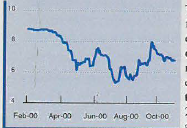
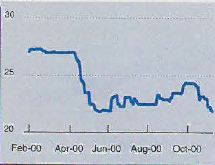
In the middle of January, Solidere

  • Lebanon’s real-estate giant –
    released a list of projects that it
    had been pursuing throughout the
    past year. The firm confirmed
    that it had completed the final
    Jun-99 Aug-99 Oct-99 Dec-99 Feb-00 phase of infrastructure work and
    finished the renovation of 90% of
    ancient buildings in the downtown area. Solidere also confirmed
    continued advanced work on the Saifi residential project, as well
    as the initiation of environmental work by the US firm Radian
    International on the Normandy landfill. Solidere’s GDR witnessed
    much fluctuation in January, whereby its price varied
    between a low of $8.7 and a high of $8.8.

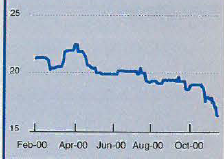
BLC      


Banque Libanaise pour le
Commerce enjoyed a rather rocky
month that saw it subdued by negative
sentiments following its declaration
of 1998 profits of a loss of
$4.3 million.

The bank attributed the loss to a
$16.5 million increase in provisions
and doubtful loans, which
amounted to $24.1 million.

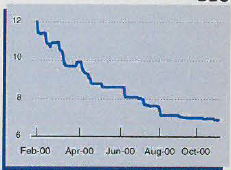
The Bank’s GDR suffered throughout the month, whereby its price
spiraled downwards, dropping consistently from $13 on January 17,
2000, to a low of $10.85 on January 16, 2000, representing a 19.8%
drop in the GDR’s price.

BLOM

Lebanon’s largest bank in terms of
assets and customer deposits,
Banque du Liban et d’Outre Mer
SAL, declared net profits of
$70.43 million for 1999, a 20%
rise over 1998 results. Return on
Average Equity stood at 28.6%
while return on average assets was
1.46%. Total assets reached $5.08
billion, up 10.9% from 1998. Customer deposits amounted to $4.33
billion, a 12.2% rise year-on-year, while loans rose 12.49% to
$1.107 billion. BLOM announced that the results were due to a conservative
lending policy, cost containment and the launch of retail
products and services. Merrill Lynch reaffirmed its long-term “Buy”
recommendation for the stock and it also announced that it expects
the bank’s income from retail products to grow significantly in 2000
compared to fees generated from loans and trade finance.

AUDI

Bank Audi SAL, one of Lebanon’s
top five banks, declared consolidated
net profits of $38.1 million in
1999, an 11.3% decrease from 1998
adjusted figures. Return on average
equity stood at 17.1% while return
on average assets was 1.23%. Total
assets reached $3.246 billion, up
9.88% from 1998. Customer
deposits reached $2.69 billion, an
11.07**%** rise year-on-year and loans rose 0.27% to $862.2.

The Bank attributed the decrease in results to the prevailing economic
recession as well as to the cost of expansion and development.

Following the Bank’s annual earnings results, Merrill
Lynch raised its medium-term opinion on Bank Audi’s GDR from
Neutral to Accumulate, and recommended the stock as a long-term

“Buy”.

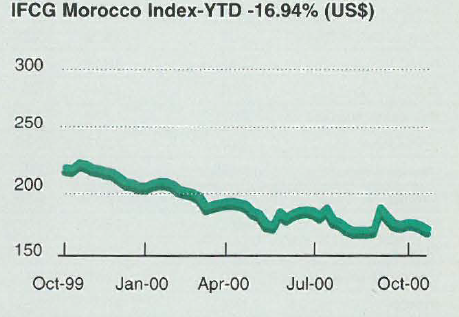
MOROCCO

A surge in turnover, led by block deals, failed to pull the
Casablanca Stock Exchange (CSE) out of negative territory
last month with year-to-date losses totaling 4.8%.

The bourse was occasionally led higher by gains posted
by the subsidiaries of the conglomerate ONA Group.
However, these gains were short-lived as the market
succumbed, driven by losses in major stocks including
Ciment du Maroc, Samir, and SMI. Although the surge in
trading activity indicates potential signs of recovery, the
market is still in need of more liquidity to be injected by
large local and foreign institutional investors to pull it out
of the doldrums.

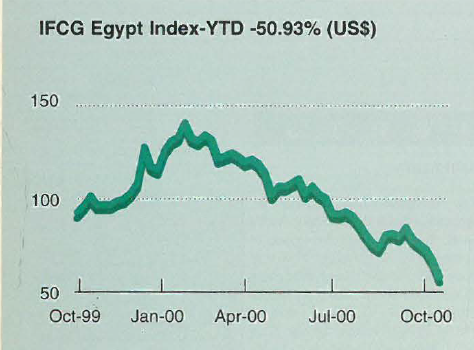
EGYPT

Strength in the cement sector and renewed interest in a
score of blue-chip issues, along with news of falling inter-bank
rates, consolidation and privatization in certain sectors, propelled
the Cairo Stock Exchange (CSE) into positive territory.

Several reports pointing to the privatization of Telecom
Egypt with an initial tranche of 10% slated for the second half
of 2000 also added positive sentiment to the market. The stabilization
in inter-bank rates at around 15% alleviated concerns
of a rising interest rate environment following the US
Federal Reserve’s decision to hike the overnight borrowing
rate by 25 basis points in early February.

JORDAN

The Amman stock exschange recorded substantial losses
on the back of steep declines in leading industrial and
banking blue chips. The banking sector led the decline as
the heavyweight Arab Bank share lost ground after
announcing a marginal rise of 0.9% in 1999 net profit to
$225.6 million, triggering a selling spree among foreign
funds. In the industrial sector, the Jordan Phosphate
Mines Co. dropped steeply dragging the whole sector with
it. However, trading activity was strong thanks to the government’s
continued divestiture of its holdings in Arab
International Hotels as part of its privatization drive.

March 22, 2000 0 comments
0 FacebookTwitterPinterestEmail
Money Matters

Diamonds in rough

by Peter willems March 21, 2000
written by Peter willems

It wasn’t all that bad for Lebanon’s listed
banks last year. Caught in the middle
of the country’s worst recession since the
war, falling interest rates that put a squeeze
on spreads and competition heating up, it is
estimated that the banking sector’s overall
earnings fell about 15% in 1999. There was
a mixed bag of results among listed banks.
One showed a poor performance, others
were resilient to the harsh conditions, while
some surged ahead in profit growth.

Investment firms local and abroad have
come out with their scorecards. And just like
the financial institutions’ mixed performances,
the analysts’ recommendations and
projections for the future are divided on some banks, as well as being cautious, linking
the sector to a potential peace agreement
and economic recovery.

The banks getting the most attention are                                         
Banque du Liban et d’ Outre Mer (BLOM)
and Banque Audi, which have shares traded
on the GDR market. Everybody’s favorite is
BLOM. Rightfully so. BLOM has been, and
will probably continue, to weather the economic
storm and produce healthy returns.

Last year, Lebanon’s largest bank in assets,
deposits and profit volume plowed ahead in
earnings, up 20%, from $58.7 million to
$70.4 million. Return on average equity
(RoAE) stood at 31.9%, far above Byblos
Bank (20.3%) and Audi (20%).

Its net interest income jumped 23%. This is
partly due to BLOM taking advantage of its
image of being one of Lebanon’s safest
banks, allowing deposit rates to be lower than
most of its peers, and having little effect from
interest in arrears. Still focusing mostly on high
net worth corporate clients for lending, its nonperforming
loans (NPLs) to gross loans
u 13
12.8 12.4 ….,. 1.9 472
18.7 13.1 2.4 237
72.3 12116 a7 8.7 1.8 1.2 435
Ill& N/A 17.8 t&.11 NIA UI
dropped from 6.7% in I998 to 6.4% last year.

BLOM’s net interest spread grew from
1.97% to 2.12% year-on-year, while Byblos’
and Audi’s shrank from 4.01% to 3.50% and
3.39% to 3.09% respectively.

Another strength is BLOM’s persistence in keeping
costs low. Its cost-to-income ratio came
down from 45.5% in 1998 to 41.5% in
1999, according to HSBC Investment Bank
in London. “This is the result of our internal
team that for almost four years has been
studying all activities in the bank, both in
branches and administration,” says Samer
Azhari, BLOM’s general manager. “But it’s
long term, a never-ending process.”

There is an ongoing debate, however,
about what will happen to BLOM when the
economy recovers and interest rates fall,
putting serious pressure on margins.
According to HSBC, BLOM will not perform
as well as some of its peers when there is
strong economic growth, as it’s not putting
enough energy into developing retail banking.

Azhari begs to differ. He asserts that the bank has taken the necessary steps to build
the infrastructure to move more aggressively
into retail banking when the time is ripe.
“It is part of our preparation: be aggressive
on products and services that aren’t risky to
the bank,” says Azhari. “The results have
shown that we are quite successful in terms
of the products and services we have
launched so far.” In 1999 BLOM’s products
contributed to non-interest income, which
grew 23%. Philip Khoury, vice president of
Merrill Lynch’s London branch, believes
that the bank’s income from retail products
will grow strongly in 2000. Recently,
BLOM got itself into retail lending, targeting
existing clients to do it cautiously. Last year
loans increased 12.5%.

There is also a difference in projected
earnings. Khoury sees the tightening of the
spreads, for example, beating down on
BLOM’s profit growth in the next two
years, up only 7% and 6%. Spiro
Youakim, senior manager of corporate and
project finance at Schroders, comes out
with different projections: “It has the elements
to support 11.5% average annual
earnings growth over the next five years.”

Regardless, analysts agree on one thing:
“Buy.” Khoury’s valuation targets the
bank’s GDR price at $44 over the next 12
months, a 62% upside to the current price at
$27.10. It’s P/E ratio is 7.1 (’99), one of the
lowest in the local banking sector and the
lowest on the Merrill Lynch Emerging
Europe Universe list of 35 banks.

Unlike BLOM playing it safe, Audi is
aiming to be the leading retail bank. It has
been rolling out unique products (first on the
block bringing out its Net Account, which
has already brought in over 10,000 customers),
has the best capital markets division
in the sector and is expanding its branch network
rapidly, from 42 branches to 55 last
year and aiming at 68 by the end of 2000.

But being aggressive to be a retailer
makes Audi vulnerable to the tough times:
Its profits dropped 11% in 1999. Freddie
Baz, advisor to the bank’s chairman, places
the blame on the squeeze on spreads and flat
growth on non-interest income.

Net interest income increased 0.5%. Its
NPLs to gross loans jumped from 7.4% in
1998 to 10.9% last year, and interest in
arrears (that grew from $6 million to $12 million)
put pressure on margins. For fees and
commissions, the stagnant Lebanese equities
took a toll on Audi’s capital markets division,
trade finance was pulled down and loan fees
didn’t help either. Its strategy can be costly.
Audi’s cost-to-income ratio increased from
50.8% to 52.3%, according to Merrill Lynch.

“What we are paying today is much lower
than what other leading banks will have to pay
without sufficient preparation for the postpeace
era in terms of regional and international
competition,” says Baz. There is little
doubt that Audi is preparing itself. Its capital
markets division will profit handsomely
when Lebanese stocks come back to life.
That department hooked up with Lebanon
Invest in a cooperation agreement between the
two institutions. Audi also plans to buy its two
sister banks abroad this year. The Paris
branch focuses mostly on commercial and
retail lending, while the outlet in Geneva is
involved in private banking and asset management.

To be more regional, “We will be
supported by the European branches,” says
Baz. “A large potential customer base in the
Middle East is related to Europe, doing business
activities in Europe.” And its products
and services should eventually pay off. ‘The
broad range of retail products that came out
in 1999 has started to generate significant
commissions,” says Baz. “After starting last
year, figures will be much higher in 2000.”

But Audi is in a precarious situation.
Boldly going forward to be the first in retail banking links its results a great deal to
peace and economic recovery, which worries
some analysts. ABN AMRO and HSBC
have placed a hold on its shares traded in
Luxembourg. “The future of Lebanon is
speculative. The economy is sluggish and
fiscal adjustments are unsure. It needs a
remedy,” says Ghassan Medawar, the
financial analyst for MENA (Middle East
and North Africa) banks at ABN AMRO.

Khoury, on the other hand, has changed his
recommendation from neutral to accumulate
and a long-term buy. “I don’t expect great
earnings this year, but I do expect good
profit growth in 2001,” says Khoury, who
targets the GDR price at $25, up 22% from
its current price. His forecast on Audi’s
earnings is a 4% increase in 2000, followed
by a 29% jump next year, which is quite different
from Medawar’s: 4%, 12% and 15%
from 2000 through 2002.

Audi is not alone in trying to be the premiere
retail bank. The pioneer was Byblos,
who was the first to offer retail lending in the
early 1990s. But going out to be different
has left Byblos exposed to harsh economic
conditions. It’s profits were flat in 1999,
standing at $49.8 million.

Byblos’ fee-based income, expected to
increase in retailing, didn’t increase in
1999. Its net interest income dropped
0.3%, stemming from margins tightening
affected by unearned interest and deposit
rates not retreating fast enough.

Interestingly, Byblos started pulling back
on some of its aggressive tactics last year to
cope with the slowdown: Loan growth
inched up only 0.86%. It also controlled
NPLs, up slightly from 11.2% to 11.9%. The
bank increased investments in T-bills, from
40.2% to 46% of assets, which took up
50% of its interest earning assets, an
increase from 43.1% in 1998. Byblos can
also be seen as a highly liquid bank.

According to HSBC, its liquid assets stood
at 67% of total assets, below BLOM
(71%), but 14% higher than Audi’s.

Though it appears that Byblos has begun
digging in with a more conservative stance, it’s
making moves this year to improve on earnings.
First, it will be concentrating more on
efficiency. It invested heavily in IT last year.
“We see great potential for efficiency in the
bank. We are now in the process of implementing
our new software,” says Seeman
Bassil, general manager of Byblos. It will
also be funneling its energy into cross-selling
products. “We have a large customer base that
we have not sold more than two products on
average to each customer,” says Bassil.

Byblos has also found markets to tap into. It’s
aiming at small- to medium-sized businesses.
“We found 30% of small businesses that do not
deal with banks,” he says. It will also branch
out into areas not being fully banked, such as
the Bekaa Valley, north and south Lebanon.

But implementing its plans to increase
profits won’t happen overnight. “The kind
of improvements they’re trying to develop
are longer-term in nature,” says Nicolas
Sawan, head of trading at Lebanon Invest.
“This year is too early to predict whether it
will improve profits.” Sawan suggests a
hold on Byblos shares, considering it a
long-term buy. HSBC agrees, predicting
5% earnings increase this year, followed by
a better 10% rise in 2001.

Some analysts say they haven’t been following
Banque Europeenne pour le
Moyen-Orient (BEMO), due to its size
($381.5 million in assets) and expensive
share price (its P/E ratio stood at 16.8 on
February 18, the highest among bank
shares traded on the BSE and GDR market).

But being a very conservative bank,
BEMO is well positioned to withstand
recessionary pressure. Ninety percent of
its balance sheet is made up of foreign currency,
while just 5% of its assets are in T-bills,
well below the sector’s average.

BEMO is into lending, its loan-to-deposit
ratio at 35.6%, and caters only to high net
worth corporate clients (just like BLOM).
This has led to a phenomenal 0.01% of
NPLs to gross loans in the last two years.

Its unique strategy brought in a 6.3%
profit growth in 1999, which isn’t bad in
current conditions. But that’s down considerably compared to 1998’s figure of
79%. Non-interest income moved down a
bit, and interest spread dropped from
1.94% to 1.3%, mostly from competition
that pushed deposit rates up from 5.21% to
5.94%. It also had a cost control problem,
cost-to-income ratio jumped from 58.7% to
62.9%, according to MECG.

Its conservative policy, including not
expanding branches beyond the current
five, may work against it if an economic upswing occurs. But senior associate at
Middle East Capital Group (MECG) Talal
Ghali sees pluses in the bank. He admires its
core banking activities, and because
BEMO has a very large client base in Syria,
it will be able to capitalize on that if peace
comes around and Syria opens up. “I like
BEMO a lot,” says Youakim. “It’s a good
bank, conservative and will do fine during a
recession. Add BEMO to your Lebanon
stock portfolio.” He calculates over a 10%
average increase in earnings over the next
few years and holds a fair market value of its
shares at 10% over the current price.

Bank of Beirut (BoB) is a comer. Starting
out of nowhere in 1993, its rapid growth has
already placed itself in the banking sector’s
top ten. Last year it completed its merger with
Transorient Bank and had the best profit
performance among listed banks, up 27%.

Comparing the unconsolidated income
statement in 1998 and the consolidated
income statement last year shows that net
interest income increased 59.7% and non-
interest income sky-rocketed 138.7%.

This year BoB is planning to concentrate
on profit growth (see ‘Shooting higher,’
February 2000). It is developing private banking, expanding on products and
strengthening income through an alliance
with Emirates Bank International. That
may just be a start as BoB has its eyes on
going more regional in the near future.

Its P/E ratio compared to other banks
implies that its share price is not cheap. And
even though BoB’s growth rate has been very
impressive, it isn’t clear if the recession will
catch up with the bank. The general consensus
among local analysts is that BoB will
probably continue to grow.

The bank that analysts have the least
amount of interest in is Banque Libanaise pour
le Commerce (BLC). Not long after Byblos
and BLC had a bloody break up that left
BLC limping away, the latter merged with
United Bank of Lebanon (UBL). Analysts
were already wary: They wanted to see these
two move in together and settle in before making
a judgment call. They also complain
about BLC’s transparency. BLC is also tardy
on opening its books. Recently BLC
revealed its 1998 results, which showed $4.3
million in losses.

But this is just the start of analysts shying
away from BLC shares. Safi Harb, chairman
of the merged entity, was forced to step
down in late February, due apparently to the
bank lending money to members of Harb’s
family and board members.

Its GDRs have tumbled since rumors of
something fishy happening at UBL (BLC)
first surfaced early last month. And though
the prices are cheap (BSE P/E is 6.8 and
GDR P/E is 5.4), analysts want to stay
clear of the bank.

But not all doubts are focused on BLC.
Brokers grumble that it is difficult to predict
when the down-time in trading Lebanese
stocks, which has lasted more than a year-
and-a-half, will finally come to an end.

Analysts say that if there is a peace agreement,
Lebanese stocks, especially Solidere,
and the banks, will take off and there’s a
chance that the economy will get a boost
(see ‘What will happen after the party’s
over?’ February 2000). On the other hand,
peace talks have stalled, again. Without
peace, Lebanon must get its act together and
reshape its economy. Unfortunately, that
means betting on peace and the government
rather than the fundamentals and performances
of the banks.

Top of Form

Bottom of Form

The Eagle ~

has landed

The first real estate investment company
in Lebanon, Eagle One, has been set up
by The Property House, a subsidiary of local
finance firm The Investment House. The ten-
year,
closed-end fund, pays dividends
derived from rental income and capital gains.

The firm’s focus is on commercial properties
rather than residential units. “The purpose of
the project is to purchase income-producing
real estate,” says Karim Salameh, project
manager. “With the market at a standstill,
now is the time to buy. We can buy at a discount,
pay dividends from rental income,
then when the property values appreciate,
we’ll sell at a profit.”

The firm has already identified $20 million
worth of prime commercial properties in
Beirut that can offer annual yields of 12.5%.
Income from the properties would cover
management fees, taxes and expenses, and the
balance would be paid as dividends twice a
year. Structured like American real estate
investment trusts (REITs), Eagle One offers
investors long-term income from both dividends
and capital gains. It also provides foreign
investors, currently restricted from complete
ownership of local real estate, indirect access
to the Lebanese market. There are plans to list
Eagle One on the Beirut Stock Exchange this
spring and to issue global depository receipts.

The firm has already targeted corporate
investors interested in the Lebanese property
market and it has conducted a pre-marketing
tour of the Gulf and Europe.

FNB looking

to buy

First National Bank SAL (FNB) has
expanded its shareholder base as a
forerunner to a possible acquisition of
another local bank. Among the new shareholders, who now have a 62% share of the
financial institution, are Lebanon
Holdings, Promotion des Investissements
SAL, Abdo Kassir, Salah-El-Din Osseiran, Elias Pierre Sabbagh, Darar Kanaan, and Kabalan Yammine. The sale of shares raised the bank’s capital from $5.33 million to $24 million. “Some banks are now being considered for acquisition,” says Mounir Freiha, operations manager at FNB’s Hamra branch. “Although some appear to be likely candidates, nothing has yet been finalized.“

“These investors didn’t come in to wait for the bank to grow,” says Nicole Gebara, assistant manager for corporate
finance at Lebanon Holdings. “The
bank is now looking to acquire another
bank through which it can expand its
coverage. But, for the time being, we
can’t disclose any names.”

Wedding’s Oli?

There was talk on the street in February
that Bank of Beirut (BoB) was getting
close to acquiring Allied Business Bank
(ABB) for between $30 million and $35 million.

BoB, one of the top ten banks with $1.8
billion in total assets and $1.3 billion in customer
deposits at the end of 1999, had
already proven itself capable of marriage by
smoothly merging with Transorient Bank
last year. The acquisition of a medium-size
bank would have catapulted BoB’s branch
network from 30 outlets to 47.

Both BoB and ABB officials have denied
the rumor. But it looks like ABB is still interested
in merging. Last December, Habib
Abu Fadil, the bank**’**s managing director,
announced that the bank was interested in
consolidating with several other banks. But
it is not clear if that means ABB is off the auction
block. Jordan’s Al-Ahli Bank and local
First National Bank have shown interest in
scooping up ABB.

Whether ABB merges or not, it looks as
though consolidation in the banking sector is
heating up. Analysts believe that now is the
time. If there is a peace agreement in the near
future and Lebanon opens up to the international
market, there is fear that large foreign
heavies will start buying out local banks.

“The time has come to consolidate to be
ready when the environment changes quickly,”
says Freddie Baz, an advisor to Banque
Audi’s chairman. Are the banks showing more interest in mergers and acquisitions?
“Banks have become interested. Three years ago it was a taboo. Today there is a lot of talk.
It is a clear perception among the major players that someday we’ll have to join efforts,” says Baz.

World Bank is

open tor business

The World Bank opened an office in
Lebanon at the end of January in a
move that may help speed up the implementation
of projects funded by the organization.

The bank has approved allocations totaling
$135 million this year to support ten projects,
some still in the pipeline. Should
there be a greater need, the bank can
increase its support to $200 or $300 million,
according to Hari Prasad, the resident representative
of the World Bank in Lebanon.

Over the years, the bank has disbursed
$600 million in loans to Lebanon. But so far
only about $350 million of the allocated
funds have actually been used.

Bureaucratic inefficiencies within the government
administration have been the
main barriers to the implementation of projects.
The problems are not new to the
bank according to Prasad who was stationed
in Colombia from 1986 to I994. In
his opinion, “the essence is to modernize”
and to “reach the stage where loans can be
disbursed more rapidly.” Apart from the
thorny issue of administrative reform, the
bank may provide technical assistance to the
government if it decides to go ahead with its
plans for privatization.

The bank’s complement of 12 staff
members will also be available to offer
consultation to other countries in the
region that do not have representation on the
ground. The bank has offices in Egypt,
Morocco, Yemen and the West Bank/Gaza.

Passive about

privatization

There will be no privatization of the
country’s telecommunications sector
before the middle of 2001, Issam Naaman,
minister of post and telecommunications
recently announced. Even partial privatization,
he says, must wait for parliament’s
passage of a law restructuring the
telecommunications sector. The government’s
five-year plan, proposed last year,
included projects to raise $5 billion,
including $1.4 billion this year, through
privatization of everything from the country’s
utilities to Middle East Airlines. The
revenue was to be used to reduce the public
debt, currently 130% of GDP. But, so
far, very few steps have been taken
towards selling off state-run entities.

Naaman hopes that a law restructuring the
telecom sector will be passed by the end of
April. That will be followed by the ministry
replacing the two cellular operators’ BOT
contracts with licenses and issuing a third
license, most likely to the state-run telephone
company Ogero. Naaman has indicated
that granting Ogero a license would
increase the value of the telecommunications
company, thereby making it more
attractive to buyers.

But according to one economist, the
more the government waits, the less benefit
privatization will bring. The debt will
only be growing larger in the meantime.
“We will be back to where we were in
1998,” he says.

Money under

the mattress

InfoPro, a local market research firm,
has released some disheartening news
about the country’s banks. Even though
Lebanon’s banking industry is the
strongest sector in the country, making up
around 15% of the country’s GDP last
year, in the first quarter of 1999 only 30%
of individuals surveyed had bank
accounts, down from 37% in 1997. A further
28% of people questioned said that, while
they previously had a bank account, they no
longer did. On the service side, 72%
claimed that they never applied for a loan,
while 54% of those who had applied had
been turned down.

Nicolas Photiades, senior vice president
at Thomson Financial BankWatch, gave
several reasons for the study’s results. He
says that the economic slowdown, which
started in 1996, has increased the number of
people below the poverty line. Another cause was the steady flow of Lebanese
leaving the country. But Photiades felt the
main explanation for why people were not
banking is due to a waning confidence in
Lebanon. A rise in political and economic
uncertainty, he says, may be prompting
people to put their savings outside the
country. There is proof of a link between
political uncertainty and money flows.

According to Merrill Lynch, the majority of
deposit growth in 1999 came in the fourth
quarter, partly due to the re-activation of the
peace process between Israel and Syria.

Some banks consider the high number of
people without bank accounts to be an
untapped market. Banque Audi is aggressively
expanding its network of branches. It
opened 13 new branches last year, up to 55
outlets, and has plans to open 12 more this
year. Byblos Bank is aiming at areas that are
considered untapped, such as the Bekaa
Valley as well as north and south Lebanon. But
if the government doesn’t do more to bring the
economy out of the doldrums and peace
remains a dream, the uncertainties may make
it difficult to get a better flow of deposits.

March 21, 2000 0 comments
0 FacebookTwitterPinterestEmail
Money Matters

Premium pressure

by Avo Tavoukdjian March 21, 2000
written by Avo Tavoukdjian

Shape up or ship out. Those were the
words of warning given to insurance
companies when the new insurance
law was finally passed last May, though
the original draft legislation was prepared in
1993. It was about time that something was
done to restrain the chaotic sector. The ministry
of economy and trade had finally
taken the first real step since the 1968 law to
get Lebanese insurance companies back in
line (see ‘Corporate medicine’, September
1999). The new law is expected to shake up
the market, bringing consolidation and
pushing out the slackers, if the authorities
actually come through on enforcement.
Insurers will now have to juggle tougher
government requirements and the pressures
of a competitive insurance market.

The law requires insurance companies to raise their capital to a minimum of $1.5 million,
as opposed to the previous $200,000.
The first installment, 50% of the increase on
their existing capital, is due on June 28,
2000, while the payment of the remaining
50% is to be paid by June 28, 2001.
A company must also secure deposits for
each type of insurance it writes; the minimum
is about $500,000. A deposit of
$800,000 is required for each life and credit
insurance, $500,000 for agricultural and
$233,000 for each fire and transport. A
firm wishing to write all classes of insurance
would be required to secure deposits of
about $3.4 million, on top of the minimum
$1.5 million in capital. These deposits are
due in the same two installments.

But how serious is the ministry really?
Lebanese United Insurance (LUI), which was licensed at the end of 1998 and began
operations in March 1999, months before
the law was passed, wasn’t granted a grace
period. It had to come up with the minimum
capital and required deposits from the get-go
(see ‘Getting tough’, January, 2000).

Companies are also required to have a
realistic solvency ratio. Now the maximum
volume of premiums a company can write is
set at ten times its capital and reserves, with
$15 million being the limit for a company
with no more than the minimum capital.
These requirements are meant to give insurers
the financial credibility to honor claims.

With the weak economy, purchasing
power has been reduced dramatically so
consumers are likely to hunt for the lowest
prices available and the most lenient credit
terms. The insurer expects to face claims from just a small portion of his portfolio and
calculates rates accordingly. But if that
means cash flowing in isn’t sufficient to
honor claims, the company will have to tap
into any available assets. Mesir was forced
to close down in 1999 when its gamble of
undercutting prices failed. It was faced with
millions of dollars in claims and only a few
hundred thousand in the cash box.

Mesir also had its fair share of collection
problems. Insurers can’t afford to be too
lenient in collecting premiums, otherwise
they’ll face serious liquidity problems. In
medical insurance, for example, the probability
of receiving claims is much higher and
less predictable than for car insurance. When
premiums are collected slowly, claims are also
paid slowly, giving the company a bad reputation.
And if premiums are collected too
slowly, the insurer runs the risk of bankruptcy.

LUI doesn’t tolerate long collection periods;
it gives two months at the most with 35%
up front. “I collect premiums up front so
when it’s time to pay claims, the funds are
there,” says Hassan Harb, managing director
of LUI. Middle East Assurance and
Reinsurance Co (MEARCO) is strictly cash and carry with no credit allowed except in rare
cases. Al-Mashrek bases its collection period
on the risk involved, with 45 days for hospitalization
and a maximum of 90 days on the
whole portfolio.

Insurers are faced with a dilemma.
Lowering rates to meet market demand
jeopardizes the firm’s solvency. But opting
for solvency by raising prices, discourages
potential clients. “Often we have to turn
clients away because we don’t allow credit
facilities,” says Rached Rached,
MEARCO’s chairman. “But we have no
outstanding claims as a result of our policy
to remain liquid.” Companies aren’t finding
it easy to strike a balance between competitive
business moves and caution.

Unless, like Arab Lebanese Insurance
Group (ALIG), you have the financial
backing of Arab Reinsurance and
Insurance Group (ARIO), one of the Arab
world’s largest reinsurers with assets of
over $1.7 billion, cutting prices to get market
share is a sure ticket to disaster (see
‘New kid on the block,’ July/August,
1999). Had Mesir’s portfolios been adequately
reinsured, the company probably
wouldn’t have gone bankrupt.

The credibility or risk rating of a reinsurer
makes a big difference when it’s time to pay,
as does the amount of retained risk. The
greater the risk retained by the insurance
company, the more profits-or losses – it can
make. The reinsurer may be less expensive
and allow the insurance company to offer
lower rates, but when it’s time to pay claims,
will it? Ask Mesir. Such decisions should be
based on the risk involved, the firm’s solvency
ratio and its collection period. The law now
requires that a reinsurer be rated B or better.

The maximum risk the local insurance firm
is allowed to shoulder is 5% of its shareholders’
equity, but even at that its assets are
highly involved and may need to be liquidated
quickly if the company’s retention is hit too
many times. Insurers need to calculate the
amount of risk it retains so that it doesn’t need
to liquidate assets to pay liabilities. The higher
a reinsurer’s rating, the better its support to
insurance firms. But it will also require that
the insurer charge higher premiums.

Again, back to the fine line. “Although it’s
a competitive industry with each company trying
to get more business, it’s also a dangerous game,” says Abraham Matossian, chairman of
Al-Mashrek and president of the Association
of Lebanese Insurance Companies (ACAL).
Finding the right combination of prices and
credit terms isn’t so easy. Simply writing a lot
of business and competing to be number one
or two means nothing. “Tomorrow you can
decide to undercut your premiums and be
very free in your collections, absorbing half of
the market, but how long you can continue
being number one is another story,” says
Matossian. “You cannot tell clients when it’s
time to pay that they’ll have to wait until you
collect your dues.” Income, Phoenix and
Mesir tried to get market share by undercutting
prices and allowing extended credit
terms. All were forced to close their doors.

There’s also the matter of what classes of
insurance one operates in. Can a company
decide not to go into medical because of the
risk and headache involved? Some do.
MEARCO has a ‘you want medical insurance,
go somewhere else’ policy. But that
might mean the insurer loses out on the
chance to insure the same person’s car,
house, business or life. Medical makes up
about 12% of LUI’s business – low by
industry standards. Despite offering medical
insurance, LUI is careful about whom they
accept. Mesir went heavily into medical
and lost just as heavily, while its other portfolios
weren’t enough to compensate for
that. For some, it’s just not worth the risk.

Insurers are finding their livelihood
threatened elsewhere as well. Banks, which
contributed 15% to the GDP in 1999, are also
playing the insurance game. Try applying for a loan at a bank. The credit officer will
probably direct you to a particular insurance
company. For a personal loan you will need
life or disability insurance covering about
110% of the loan. Housing loan? Add property
insurance to that life policy. Car loan?
Take out all-risk insurance. It might be difficult
to disregard the suggestion if you
really want the loan.

Though far behind the world trend that
has seen a convergence of banking and
insurance, a grow-ing number of Lebanese banks are either setting up
their own subsidiaries
or buying
shares in already
established insurance
firms. Banque du Liban et d’Outre Mer
(BLOM) has Arope Insurance, Banque Audi
now owns Libano Arabe and part of Societe
Nationale d’ Assurance (SNA), Bank of
Beirut owns 10% of ALIG, UBL has ties with
LUI, Byblos Bank owns ADIR, Fransabank
owns a chunk of Sofrace.

For the banks it’s all pretty profitable,
though it doesn’t leave too many choices for
the consumer. The question for insurance
firms is what it leaves for them. Can they
come up with the funds needed to increase
their capital or will they stop writing business? Can they meet the market
demands? Can they
remain standing in
the face of greater competition? Insurance
firms say they can. MEARCO, which currently
has a capital of $400,000 (see ‘A sure
thing?’ February, 2000), intends to come up
with the funds itself. “We will not bring in
new investors,” says Rached. “The present
shareholders will provide the amounts
required as each due date comes around.”
That’s $550,000 this June, and another
$550,000 a year after that. But there’s still the
matter of coming up with the required deposits. For those
lacking the financial
strength, one
alternative is to
bring in new
investors to increase their capital. Another is to merge.

But that’s not an easy prospect in
Lebanon. While some companies see new
investors as less control and a smaller
share of profits, others see mergers as a sure
way of losing their identity. “They keep
meeting with each other in order to reach
some form of agreement, but the meetings
always break up when it’s time to decide
who will run the company,” says Aline
Kamakian, general manager of Insurance &
Investment Consultant (IIC). “Those who
already have the funds have nothing to
worry about. American Underwriters
Group (AUG), is capitalized at $4 million
and has assets of about $12 million. ALIG
has $7 million in capital.

These might just face less competition, as
it is generally believed that many undercapitalized
companies will not be able to
come up with the funds and will have to close
down. But the question is whether the ministry
will have the guts to be as tough as it is
on start-ups when it comes to pulling the plug
on existing firms that don’t make the grade.
“Only about two thirds of the companies in
the market will probably remain,” says Naji
Habiss, deputy general manager of Al**-**Mashrek,
“with about eight or ten major
players holding the majority of the market.”

Lebanon is a small market. There are
more than 70 insurance companies fighting
over a few hundred million dollars in premiums.
Consolidation would reduce that
number, while solving the capital and solvency
dilemma. Does it really matter who’s
running the show, if the other alternative is
being forced to close down. Remember
Strikers insurance. It was in trouble due to
price competition and was acquired by
Medgulf, which now holds the number one
position in the non-life market with total premiums
of $29 million from the Lebanese
market in I999 (see graph). Large foreign
insurance companies are entering the
Lebanese market. Societe Libano
Francaise (SLF) sold 51 % of the company
to AXA while 51 % of Societe Nationale
d’ Assurance(SNA) is now owned by
Assurance Generale du France. Vulnerable
companies have no chance of surviving in
such an aggressive industry, especially in the
face of international giants. The only way
they can survive is to merge.

March 21, 2000 0 comments
0 FacebookTwitterPinterestEmail
Feature

Moving on up?

by Kirsten Vance March 21, 2000
written by Kirsten Vance

When Carly Fiorino was paid $100 million in stock to take over the helm at Hewlett-Packard (HP) last summer, the media went ga-ga. The spunky, blond 45-year-old was charged with jolting some life back into what had already become a dinosaur of the technology age, when veteran CEO Lewis Platt retired after 33 years with HP. The $200-million relaunching of HP, which had a turnover of $42 billion last year, has been focused on Fiorino herself, so much so that her photo was splashed on the cover of Forbes under the headline “The cult of Carly.” While few have reached her star status, women have gradually made their way into higher echelons of world business. Might that formidable glass ceiling be showing signs of cracking?

Though here in Lebanon such an example would be impossible, the status of women in the workplace is changing, albeit at a slower pace than many would like. “Versus the rest of the world the participation of women in economic activity is relatively low in the region. But I can’t deny it has increased dramatically since a few decades ago,” says Fatima Kassem, the head of the Women and Development Unit at the Economic and Social Commission for Western Asia (ESCWA). She points to the Nordic countries where women’s participation is as high as 50% compared to 19% for the Arab world. In comparison, Lebanon’s rate is high at 27%, though it still lags behind countries like Egypt or the Emirates. It is generally agreed that women’s economic activity is on the rise, but some caution that there is a discrepancy in statistics and Lebanon’s rate may be overstated.

Despite their increased number in the workforce, which most attribute to economic necessity, women are still under-represented in managerial and administrative positions compared to the United States. Administrative and managerial positions account for less than 5% of the female working force in Lebanon, according to ESCWA. Though separate statistics are not available, it is still rare to find women at the top, as is still the case in much of the Western world. So why are women still so outnumbered at work?

“We’re in a part of the world where a woman’s primary role is still considered to be a mother and wife. Norms and traditions play a very important role,” says Mona Khalaf, director of the Women’s Institute at the Lebanese American University. That makes balancing a career and family more onerous for women, while businesses here have traditionally been passed from father to son.

Others are more radical in their views. While women are accepted in certain positions, this changes drastically when they compete with men on a higher level, says Najla Hamadeh, secretary general of the Association of Lebanese Women Researchers. “Men are very threatened by a woman who feels like she’s an equal.” The demand for women is usually as assistants or in professions typically viewed as areas where women excel, says Carole Contavelis of Hunter International placement agency, but employers still demand all the qualifications of a general manager. She also claims that pay scales are often lower, even for the same position.

Claims of gender discrimination are next to impossible to quantify. Is the lack of women in top management due to a real bias, their more recent entry into the labor force, different priorities or a combination? Difficult to ascertain. “Remember that old adage? ‘Women will have gained equality with men when there are bad female managers,’” says Caroline Fattal, customer service manager of Unilever-Fattal. “Women have to make a double effort to get where they are, because there’s no place for women who under-perform.”

But women also have a part to play in pushing back the barriers. “I don’t think it’s men who have impeded women,” says Leila Kobeissi, director of human resources at Fransabank. “I think it’s that spoiled aspect of our society; I wonder if that doesn’t bring an end to ambition. Even in Europe women had to fight to get where they are. We haven’t gotten there yet.”

Many point to the lack of women in decision-making positions as a barrier to getting women’s issues on the nation’s agenda, such as changing the view that a woman’s salary is secondary and thus providing child benefits. There are just three women members of parliament in Lebanon out of a total of 138, and not one holds a post as minister. “What remains is the legal framework in which Arab women work,” says Kassem. “Although the law itself sometimes doesn’t discriminate, there is always a gap between the legislation and how it’s practiced.” Kassem and others want the law to adapt to women’s conditions, suggesting more flexible working schedules for those caught between work and family life. “Many companies have lost good female managers because they couldn’t find a solution for them to balance between family and business,” says Fattal. She believes that the ease of starting up small businesses today could create a human resource problem for companies that aren’t flexible. In some industrialized countries, companies have begun allowing such arrangements, especially with the onset of the information age.

EXECUTIVE spoke with a number of businesswomen about their careers and the issues they face at work, although most were reluctant about being featured in an article. They were virtually unanimous in saying that being a woman never impeded their careers, and in preferring to be judged by their work and success rather than on the issue of their gender.


Caroline Fattal

Customer service manager, Lever-Fattal

The photo hanging on her office wall says it all. At a meeting of sales managers for the Central Asia and Middle East region of Unilever, Caroline Fattal is the sole woman. Just 28, she is surrounded by mostly gray-haired or balding men. Fattal leads the sales, trade marketing and outbound logistics departments of Lever-Fattal, the Lebanese entity of Unilever Levant. Rather remarkable for her young years, especially in a field that is largely dominated by males.

Her pinned-back, shoulder-length hair might portray a school-girlish impression, but her confidence and well-spoken responses do not. “When I go out with my sales force, people initially think I’m the merchandiser or something,” says Fattal. A young woman in her position undoubtedly comes as a surprise to many.

She oversees a department of 25 local recruits, herself the only expatriate. While the average age of the sales administration team is about 26, her field sales team averages about seven years her senior. Her success could be written off as family connections, since Khalil Fattal & Sons was one of four local distributors for Unilever before opening a joint venture with the UK-based firm two years ago. But that wouldn’t be entirely fair.

“I was a good candidate for both parties. I wouldn’t negate that 50% of it was my family and 50% was Unilever,” says Fattal, who was originally returning to Lebanon after 17 years abroad to work in the family business.

Fattal had actually got her foot in the door at the fast-moving consumer goods company several years earlier. “My career with Unilever started without family interference,” she says. Her first position with Unilever was as a marketing assistant in France, following her studies in management at Université Dauphine in Paris. After a year she was transferred to another country. Her next three years were spent in Argentina, first as a marketing assistant and then as a brand manager.

Fattal has overseen sales for a company that has seen double-digit percentage growth in the past two years, though Unilever would not release exact figures for Lebanon. Lever-Fattal is one entity of Unilever Levant, which hopes to capture a 25% share, or $150 million, of the estimated $600 million market in the next five years. The combination of her youth and gender can make negotiations difficult, she says, when there is sometimes an element of disregard. “That’s where you have to stay calm, make the point and be professional,” says Fattal.


Suzanne Bacha

Director of internal audit, Banque Audi

When Suzanne Bacha returned to Lebanon three and a half years ago, she brought with her a wealth of international banking experience to a financial sector that needed to catch up with the rest of the world. But that was not always met with open arms.

“The older generation, mainly men, have difficulty accepting that young people, especially women, have a lot of experience and could threaten their position,” says Bacha, director of internal audit at Banque Audi. Pausing, she chooses her words carefully and adds, “Maybe it’s not only a woman’s problem; it’s the older generation that feels threatened and it’s a response to those who have outside experience.”

Nonetheless, that international background played a large part in her appointment at Audi, Lebanon’s fourth-largest bank with total assets of $3.2 billion. Last year the bank posted net profits of $38.1 million, down 11.3% from 1998.

With a degree in banking and finance, Bacha began as a trainee at Deutsche Bank, one of 200 selected for a managerial trainee program that included a diploma from Germany’s Bank Academy. She specialized in trade finance and financial analysis, working in Germany and Paris for two and a half years before spending a total of 14 years with Deutsche Bank.

When Deutsche Bank shifted from commercial to investment banking, Bacha was asked to create its internal audit department. She later became a natural fit to head Audi’s internal audit function, overseeing a team of 15 and reporting directly to the chairman and general manager.

Noting that there are few women in high positions, Bacha sees change on the horizon. “In the generation after me there is a larger number of women in the workforce with the ability, background and ambition,” says Bacha, 37. As for her own ambitions, she laughs: “If I tell you what they are, the people I want to replace will know.” She laughs.


Nadine Kurban Boutros

Managing director, Kurban Travel

Nadine Kurban Boutros found the working world in Lebanon not entirely hospitable when she first returned seven years ago. Coming from Canada, where she says women are on a more equal footing with men, the adjustment was difficult.

“When I came back you really had to prove yourself, to people you work with and even to your employees,” says Boutros, adding that the situation has improved as more women have entered the workforce. “But I believe a family business is completely different; we are working altogether so it’s not the same thing.”

Boutros oversees the travel agency side of Kurban Travel, including ticketing, incoming and outgoing operations, while her brother runs the local Avis office. The company has four offices and a staff of 40. Together, the siblings have increased turnover by about 20% a year since 1992, reaching roughly $8 million last year, excluding offices in Montreal and Paris run by another sister.

Founded in 1952 by their father, who remains chairman, Kurban Travel is among Lebanon’s largest agencies. About half of its business comes from corporate accounts. Boutros has stepped up marketing efforts in Europe and the United States, including international exhibitions, to promote Lebanon abroad.

After the war, business was sluggish. “Incoming is growing little by little, but not as much as we would like,” she says. “Tourism depends on peace; everyone in the tourism sector is waiting for peace.” She also points to weak coordination among local travel agencies as a structural problem.

Boutros began working in Canada at 26 at her father’s urging. Married young and a mother, she ran the Montreal office for seven years before returning to Lebanon. “When I came here I told my husband I was going to take care of the head office; I didn’t want to stay at home.”


Top of Form

Myrna Bustani

Director, Societe Hoteliere de Tourisme

‘ ‘Women in business; I hate
this topic. It’s so boring
and everybody’s had
enough of it,” says Myrna Bustani, an elegant
woman and former MP who packs an
incredible amount of feistiness in her small
frame. “And it’s unfair because I don’t
think you’d ask a businessman what he
thinks about being a man in business.”
Clearly not amused, and quickly bored, by
an apparently trite line of questioning,
Bustani happily throws a wrench in this
reporter’s idea for a “good feature”. That
same spunk and directness have undoubt-
edly been important ingredients in being a
co-owner of businesses, in which she notes
that over half the employees are women.
The topic here in Lebanon is irrelevant in
her eyes. At an international business con-
ference in the UK and another in New
York, Bustani recalls that she was one of just
two women in attendance.
As director of the Societe Hoteliere de
Tourisme, the holding company of the Al-
Bustan Hotel, she has been overseeing the
remodeling of the 100% family-owned
hotel since the end of the war. Now in its
third stage, the renovations have so far
required an investment of $30 million.
Construction of the five-star hotel in Beit
Mery, which was begun by her
father in 1962, was eventually
completed after his death and
opened in 1967. Bustani is a mem-
ber of the board of directors of
Contracting and Trading Company
(CAT), also founded by her father.
The Bustani family currently holds
a 33% share in CAT, which has a
turnover of about $150 million.
She also holds a seat on the board of
directors of la Banque de
l’Industrie et du Travail in which
the family holds a 70% share.
Assets of the bank totaled $273
million in 1998.
Bustani’s other hat, and perhaps
her most cherished, is as the direc-
tor of the Bustan Festival. Now in its
seventh edition, the festival brings
together hundreds of musicians
from around the world. At a cost of
close to $ 1 million, Like most cul-
tural events the festival is a money-loser
despite its sell-out rate of 80%.
Bustani got her start in the family business
at the age of 24 in the public affairs for CAT
in the 1960s. “I did not choose to be involved
in business at all,” she says in her somewhat
gravelly voice. “When my father died I had
to help my mother; it was not my choice.”
Now a grandmother of six, Bustani prefers to
be judged on her accomplishments. “I don’t
look at business from the financial side
only; it’s what we do,” she says. “The finan-
cial result is sometimes the result of the suc-
cess, but it’s not the success itself.”

Leila Kobeissi

Director of human resources, Fransabank

The view from Leila Kobeissi’s spa-
cious ninth-floor office overlooking
Hamra is magnificent. As someone
“who borders on being a workaholic”,
Kobeissi didn’t get to her position at the helm
of human resources and the sole woman on the
executive committee of Fransabank by
chance. “I am someone who loves to work,
who loves to do things well and I give all my
time to what I do,” says Kobeissi. “That’s how
I have advanced; it comes naturally. I never
told myself that I must reach a certain position
and I must fight to get there.”
It’s easy to see why Kobeissi has garnered
the respect of others; professional and confi-
dent, her responses are delivered with elo-
quence. As for being a woman in business? “I
don’t think there is really a difference
between men and women in the world of
business; I never felt that people acted differ-
ently with me or that there were any con-
straints simply because I am a woman,” she
says. “I believe that from the moment a
woman demonstrates that she is there
because of her competence, a man respects her
and accepts that she might have a higher
position than him.”
Married and already a mother of two as a
student of law at Universite St. Joseph,
Kobeissi embarked on a career path somewhat
late in life, once the third child was old
enough. She came to the banking sector “by
pure chance”. Her first job came at the age of
30 when she created and ran the Centre
d’Etudes et de Documentations Econo-
miques at the chamber of commerce. From
there she moved to the Union of Arab Banks,
where she was responsible for training and
publications on banks. Following a stint with
Banque Audi, Kobeissi took up the reins at her
current position. One of the top ten banks in
Lebanon, Fransabank had assets of $2.2 bil-
lion and profits of $44.9 million in 1998.
There she is responsible for recruiting,
training and staff development of the bank’s
some 800 employees. “Today the role of
human resources is crucial to an organiza-
tion,” says Kobeissi, who looks younger
than her 52 years.
Kobeissi attributes much of her success to
the support that came from her father and hus-
band. “The most important thing is that your
husband supports you; if you don’t have the
support of your husband you won’t go far in
your career.”

Claude el-Alia

Financial and administrative manager, Abela Freres

Petite and soft-spoken, Claude El-Alia
manages the finances and adminis-
tration of pharmaceutical importer
Abela Freres. She is also in charge of the
human resources for her department. Out of
the company’s total staff of 58, El-Alia
directly manages 15 employees.
This is a company that had a turnover of $16
million last year, up more than 150% from the
$6.3 million registered in 1996. The increase
was due largely to the Glaxo-Wellcome
merger as Abela Freres won the exclusive
agency of the new entity, having previously
been the importer of Wellcome.
Switzerland’s Serona and Germany’s Asta
Medica make up the rest of Abela Freres’ phar-
maceutical portfolio, which accounts for
more than 90% of the firm’s business. The rest
of its turnover is through imports from an array
of stationery and parapharmaceutical firms.
Emirates
38
Fully family-owned until 1996, Abela Freres
has since diversified its shareholding.
El-Alia took up her current position upon
joining Abela Freres a decade ago, while her
responsibilities have increased in tune with the
company’s expansion. At the outset the firm
had a smaller portfolio of products and her staff
was a third of what it is today. A year after
graduating in accounting from Sacre Coeur
Jdeide college, she spent six years doing the
accounts for contracting firm Elie Saghbini.
One of four children, she and her twin sister
followed a similar career path, while the third
sister chose not to work. Single with no chil-
dren, 39-year-old El-Alia has no regrets for
devoting much of her time to a career. “You
have to assume the responsibility for the
choice you make,” says El-Alia. “I know my
private life is completely different from
someone who doesn’t have my responsibili-
ties, but I suppose that someone else might
want the responsibilities that I have.”
While El-Alia never encountered any bar-
riers in getting promotions, she does say that
it’s difficult for a woman to get upper man-
agerial positions in Lebanon. “Men still see
women as taking jobs away from them,” says
El-Alia, adding that it is getting easier for
women to be in high positions.

March 21, 2000 0 comments
0 FacebookTwitterPinterestEmail
Feature

Switzerland of the Middle East no longer

by Robert Tuttle March 21, 2000
written by Robert Tuttle

It seems everyone is talking about a peace
dividend these days. Despite their rather
lukewarm first encounter and the subsequent
Israeli raids on Lebanon, there is little
doubt that the chances of Israel, Syria and
Lebanon reaching a settlement are closer
today than in the last five years. Talk of stable
and open borders has been whetting the
appetites of Lebanon’s business community,
long awaiting the economic boost that would
turn this dormant economy around. No one
seems to be more excited than those in the
tourism industry.

With the dark shadow of war no longer
casting its pernicious gaze on the region,
some tour operators expect the Levant to
become what Spain became in the 1970s, or
the Mediterranean coast of Turkey in the
1980s. According to estimates, more than
30 million tourists will visit the Middle East
per year once there is peace — nearly double
current levels. Lebanon, even by the most
conservative estimates, could see a tripling
of tourist numbers.

“I’ve met a number of
international hotel chain executives who say
that Lebanon will be like Singapore when
there’s peace,” says Arthur Nazarian, minister
of tourism. “One who visited recently said
that three years after peace, he expects 6
million visitors per year.” A paltry 673,000
tourists came last year, excluding an estimated
1 million Syrians.

Already, tour operators are privately talking
of running day trips from Beirut to
Jerusalem, of driving all the way to Cairo in
a day. Not long from now we may be scuba
diving in the Sinai in the morning, lunching in
Tel Aviv in the afternoon and spending the
evening partying at a Kaslik nightclub.

“A peace deal would be wonderful. You can’t
have tourism without peace,” says Riad al
Khouri, an economist and director of the consulting
firm Middle East Business
Associates. Khouri, who has written extensively
on tourism, feels that Lebanon could
conceivably become the most important destination
in the Mediterranean basin, second
only to the French Riviera.

“But in fact, it will probably turn into a
hell hole,” he warns. “The Lebanese are
going to shoot themselves in the foot just as
they have done so many times. So long as you
can tear down a forest and build some ugly
apartments, that is going to destroy tourism.”

His assessment is harsh, but it may serve as a
wake-up call. Lebanon, he warns, may have
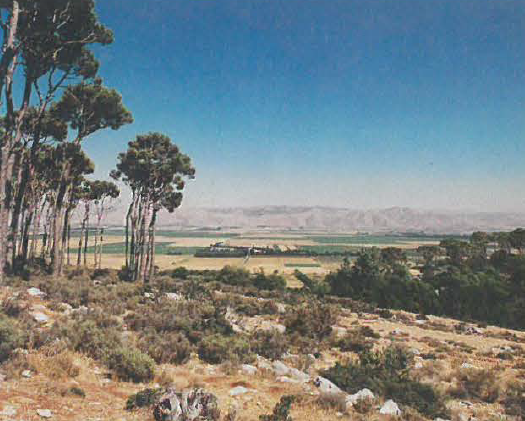
some fantastic archaeological sites and stunning
scenery, but that alone will not turn it into an
attractive destination. Unless serious changes
are made to the way the country is managed
— from its hotels, to its zoning regulations, to
its environment — visitors will not flood in like
they did in the 1960s and 70s just because the
guns have fallen silent. That will require
more than the signatures of a few leaders on
a peace settlement.

But Lebanon does have great potential as a
tourist destination. “We have a niche of
everything,” says Pierre Ashkar, head of the
hotel owners’ association. “We don’t have the
best sea, but we have the sea. We don’t have
the best mountains, but we have the mountains.
Ski resorts, we have. Summer resorts, we
have.”

The problem is that the beaches have been
polluted and many annexed by property
developers; the mountains are riddled with
ugly quarries and strewn with garbage; the
archaeological sites are often unorganized and
poorly managed. Lebanon does have some
very smart hotels, although fewer than before the
war, and a very good international airport. But
other countries in the region have hotels that
are just as attractive and are equipped with
bigger airports.

Today, Egypt has taken over the role that
Lebanon had in the 1960s and 1970s, absorbing
half of all visitors to the
region. “A tourist has a thousand choices. If he
comes to Lebanon and gets ripped off, he’s not
going to come back,” says Khouri.

In a study completed two years ago for the
Lebanese Center for Policy Studies, Tarek
Chemali and Michelle Toumah showed that
while visitor numbers and tourism revenues
have been gradually rising since the end of the
war (see graph), the sector is underperforming.

Between 1988 and 1997, the number of
tourists visiting the Middle East increased
from 8.3 million to 14.8 million and revenues
more than doubled, from $4.2 billion to $8.6
billion. There has been similar growth in
Lebanon in the number of visitors, from
310,743 in 1993 to 568,276 in 1997. But
tourism revenues have only increased by
20%, from $600 million to $719 million.

The sector’s share of GDP has declined, from
7.9% in 1993 to 5.5% in 1996, though these
figures do not include Syrians. That’s quite a
different story compared to 1974, when
Lebanon was the number one destination in
the region. More than 1.4 million tourists
visited that year, a figure that doubles if
Syrians are included, according to the ministry
of tourism. Tourism revenues accounted for
almost a quarter of Lebanon’s GDP and 40%
of the tourism revenues for the Middle East.

The study clearly indicates that while there is an
increasing number of visitors to Lebanon,
they are spending less money. One can
speculate as to why: people’s stays are becoming
shorter, the bulk of the visitors
are of Lebanese descent who stay with the family
rather than in hotels, high-spending
business tourists are not coming. What seems
clear is that most are not coming for
classical tourist purposes.

In 1997, for example, a mere 8% of tourists
visited Baalbek, Lebanon’s most famous cultural
site. “You get walk-ins, there are visitors from the Gulf,
people of Lebanese origin who come and go,
but this is not tourism,” says Myrna Bustani,
co-owner of the Al-Bustan Hotel.

There is no doubt that the fighting in the
south is a major factor. But Fadi Saab, a
member of the board of the National Council
of Tourism in Lebanon, estimates that the
number of visitors could increase by three to
four times even without a peace deal if simple
measures were taken to make the country
more attractive.

“We are trying to entice the
government to put together a master plan for
the tourism sector,” he says, furnishing a list
of areas that need improvement. Lebanon, he
said, needs proper road signs directing
tourists to popular destinations. At archaeological
sites, signs explaining the history and
significance of the location are needed.

The quality of service at hotels and travel offices
needs to be brought up to the prices being
charged. Attractions need to be better promoted
by the ministry of tourism and the private
sector. Pollution levels on the coast and
in the mountains need to be reduced and the
garbage cleaned up. More and better-trained
tour guides are required.

“It is not sufficient to say come and visit
Baalbek or Byblos. If you go to any of the other sites, they are not well
organized. People like senior citizens cannot
visit the Byblos castle for safety reasons. And
we must make a better effort to communicate
the history of these sites,” says Ghassan
Matar, a tourism consultant who has worked
with the ministry of tourism.

Addressing these matters will require coordination.
Promotion requires coordination
between the ministry of tourism, hotels and
travel agencies. Environmental preservation
requires a concerted effort from the ministry
of interior, ministry of environment and individual
municipalities.

But the sad reality, says
Saab, is “that coordination
among different parties is lacking, a
master plan is lacking and a global policy is
lacking.”

A 2,000-page
master plan was written
in 1996 at a cost of
roughly $800,000,
according to Matar,
who was involved in
writing the document. It included a comprehensive
strategy to attract tourists, dealing with
everything from environmental cleanup to
regulating the hotel sector. But it was never
implemented. “It was difficult to execute,
because there were so many other ministries
involved,” says Nazarian.

With that plan effectively dead, another
plan was drawn up a couple of years later at a cost
of about $750,000 by the US-based Stanford
Research Institute and funded by the United
States Agency for International Development.

It singled out tourism as
one of the areas where
Lebanon had a competitive
edge and suggested
ways to improve the
sector. Unlike the first
plan, some action has
been taken to implement
the recommendations
of this one.

The Center for Research and
Development at the
Lebanese American
University was charged
with writing a website
and is composing a
database for the ministry
of tourism. LAU
will assist in drawing up
a new curriculum for hospitality and
tourism for technical schools and in drawing
up new guidelines for hotel rankings.

Current guidelines date back more than 30 years and
tend to concentrate on the size and amenities
offered rather than quality. The government
has also reactivated the National Council of
Tourism Board, which was disbanded in
1992. But progress has been slow, says
Georges Nicolas, director of the research center.

Many recommendations will require
action from various ministries. “But I don’t
think there has been a lot of movement,”
says Nicolas.

Meanwhile, the ministry of tourism, which
plays the central role in promotion and regulation
of the trade, receives minimal funding
and lacks qualified personnel. Its budget this
year is just $4.5 million, less than one tenth of
a percent of the total budget allocated to ministries.

What’s more, its share of the budget has
decreased by nearly 50% since 1994. “In
order to make the government more effective,
we need qualified people and we can’t get
them without paying,” says Nazarian. Bigger
budgets, he adds, might come if there is
peace. But without the bigger budgets now,
implementing any plan will be difficult.

Those within the industry continue to wait
and dream. When asked what is required to
bring in visitors, Pierre Ashkar’s response was
simply “Peace. That’s it.”

Anticipation of a settlement
is prompting investment. Even
though occupancy rates hover below 50% during
most of the year, more hotels are being
built, including a number of big international
chains. Mövenpick, the Ritz-Carlton, the
Four Seasons and possibly the Sheraton are on
the way.

It seems that almost everyone is
gambling that a peace dividend is just around
the corner. “I don’t think that we should wait
till the external factors are opportune before
we tackle the internal factors,” says Saab.

“We should get ready to advance as much as
possible on what’s within our control. If we
have a goose that lays golden eggs, we
should make sure that the goose is properly fed
and cared for so that it will continue to lay
golden eggs. In reality, we are starving that
goose and we will end up not only losing the
golden eggs but also the goose itself.”

March 21, 2000 0 comments
0 FacebookTwitterPinterestEmail
Cover story

Small but solid

by Hadi khatib, Peter willems & Kirsten Vance March 21, 2000
written by Hadi khatib, Peter willems & Kirsten Vance

The Obegi family once owned one of the largest
and most respected banks in Lebanon. But
during the war, the family became fed up running
Credit Libanais under harsh conditions. “It was difficult
to reach many of your branches or even
reach them by phone,” says Henry Obegi, now
chairman of BEMO. The Obegis packed up and
sold Credit Libanais in 1985.

In 1994 they returned to the financial market with
the purchase of Future Bank, and changed the
name to BEMO. Were the Obegis back on the
warpath to take their bank to the top of the industry?
Not particularly. “We are very conservative,”
says Obegi. There is some proof of that. When
BEMO came onto the scene, it had four branches.
It now has five. Foreign currency accounts for
90% of its balance sheet. The average assets that
are funneled into treasury bills (T-bills) for the sector
is around 40%, while just 5% of BEMO’s
assets are in T-bills. “We don’t do mismatching. We
don’t use the word ‘mismatch’ here at BEMO,”
says Obegi.

On attracting customers, he says: “We do not
run after depositors. We have private customers.
We wanted to find a niche and we have a niche.”
BEMO does not do retail lending, like consumer,
car or housing loans. It is strictly into commercial
lending.

But being this conservative does not mean that the
bank doesn’t generate profits. Between 1995 and
1998, its average earnings growth was 55%. In the
middle of a recession, BEMO’s conservative policy
has paid off so far. Last year its earnings grew by
6.3%, while the sector’s average profits are estimated
to have dropped by 15%. Better yet, its
assets grew 29.1% and deposits jumped 35.9%,
much larger gains than three of the leading banks,
BLOM, Banque Audi and Byblos Bank (see chart).

Its “niche” is a profitable tool. BEMO has impeccable
quality in its loan portfolio (the loan-to-deposit
ratio stood at 35.6% last year). BLOM is known for
its high-quality loan portfolio: its non-performing
loans (NPLs) to gross loans came out at 6.4% in
1999. BLOM aims at blue-chip corporate clients to
keep its portfolio squeaky-clean. BEMO uses the
same strategy, but its NPLs to gross loans last year
were 0.01%.

Another unique element in BEMO’s niche market is
its large customer base in Syria. If and when Syria
opens up to foreign banks to enter its market,
BEMO will have a foot in the door. Who will be its
local rival there? BLOM. Its chairman, Naaman
Azhari, is from Syria, was once the minister of
finance and a general manager at a leading Syrian
bank. He has strong ties with the Syrian business
community, which has lured Syrian companies to
bank with BLOM. But the Obegi family is originally
from Aleppo, so they have also brought with them
strong business connections next door.

BEMO may have some obstacles to face in the
future, however. Most of the leading financial
institutions are working towards becoming retail
banks. Banque Audi and Byblos Bank are running
neck and neck out in front, with Credit Libanais
coming up as a threat. “We’re not much into retail
banking,” says Obegi. “We’re mostly into commercial
banking.”

Will BEMO be changing its strategy soon? The
Obegis have now decided to add private banking
to BEMO’s activities.

March 21, 2000 0 comments
0 FacebookTwitterPinterestEmail
Cover story

Cant get enough

by Hadi khatib & Peter willems March 21, 2000
written by Hadi khatib & Peter willems

Ever since the Golden Arches first lit
up the night sky in Dora in
November 1998, the Lebanese just
can’t seem to get enough of that all-American
fast-food chain. Beirut’s five
branches of McDonald’s are almost always
packed to overflowing: a gaggle of kids
dipping fries in ketchup and parents sinking
their teeth into a Quarter Pounder with
cheese, while the drive-thru outside does
just as brisk business. But wait a minute, this
is not an article about the Zoghzoghi’s success
in bringing the Big Mac to Lebanon’s
shores — in fact they have repeatedly
declined to be interviewed. This is the
story of the family in charge of distributing
all McDonald’s consumable products: the
Obegis. Ring a bell? McDonald’s is just one
of their most recent business associations
and is sure to beef up their business even
more. The Obegi family dynasty has
already made it into virtually every
Lebanese home. Look around; you’re sure
to find a detergent, soap, canned food or cosmetics
which Obegi Consumer Products
(OCP) supplies and distributes.

The Obegis’ business is grouped into
three main activities: consumer products
(OCP), chemicals (Obegi Chemicals, OC)
and banking (BEMO). Their size is
impressive. OCP chalked up consolidated
revenues of $71.8 million last year, while
OC did even better, hitting $82 million. At
the same time, BEMO’s assets reached
$381.5 million (see box). As enviable as
those numbers might be, the Obegis didn’t
get there by sitting comfortably in the back
seat. But the family’s thirst has yet to be
quenched; they continue to expand the
activities of their mushrooming business.

It all started in Syria when Yordan Obegi,
grandfather of the current division heads, began
working with BASF in
1905, the number one
chemical company in the
world, and became its agent the following year. OC is still BASF’s
sole agent for Lebanon, Syria and Jordan. In
the late 40s, Obegi entered Lebanon importing
carpeting and all types of furnishings for
the home as Obegi Better Home. Its cooperation
with German manufacturer Henkel
began in 1954 with the importation of Pre, the
predecessor of Persil. Ever since, Obegi has
maintained a strategic alliance with Henkel
— which had revenues of about $42 billion in
1999 — importing, distributing and then a joint
venture manufacturing core products such as
Persil, Der General, Pril and Nice.

“Our partnership with a multinational like Henkel
makes us sustainable for the long run and
gives us access to their know-how and global
expertise,” says Georges Obegi, president
and CEO of OCP since 1994. With
Henkel’s internationally known brands,
OCP has been able to penetrate Syria and
Jordan, and its sights are set on Iraq.

With OCP in the driver’s seat, its market
share for Persil increased from 12% to 48%
from 1985 to 1996. Henkel and OCP then
entered a joint-venture deal, similar to their
agreement prior to 1971, though OCP kept
control of both marketing and distribution.
Backed by strong international brands, the
ability to manufacture locally and solid distribution
that doesn’t rely solely on wholesalers,
OCP has grabbed strong market
shares in its core Henkel products.

OCP is big on detergents and cleaning products,
with a large market share in two core
brands: Persil and multi-purpose Der
General, which are manufactured locally.
Persil still holds the lion’s share of the market
equally with Ariel, despite having
recently lost ground to Syrian imports like
Madar Super Topper, Modhish and
Nourass. How important is that? Very, now
that OCP holds a 42% share of the $56 million
local market for low-foam detergents
with Persil. OCP also leads the multi-purpose
liquid detergent market with its second
core brand Der General with a 65% share.

That compares to 22% for its main competitor
Ajax, which is distributed by the
Abou Adal Group. Though Ajax has a sizable
market share, it is an imported product.
“We’re at a disadvantage against locally
manufactured Der General because they
save on shipping and import duties,” says
Raymond Abou Adal, president and CEO of
the Abou Adal Group.

With its 9% market share for Palmolive,
Abou Adal does compete against Fa, for
which OCP has a 15% share. But this is a market
dominated by Unilever products, such as
Lifebuoy and Lux, both of which are manufactured
by Unilever-Fattal, Dove and Good
Morning. That gives Unilever an estimated
20% market share, while Procter & Gamble
(P&G) holds a 17% share with Camay and
Zest.

Unilever Levant (UL), a locally based
firm covering Lebanon, Jordan and Syria, is
part of the multinational giant Unilever with
$45 billion in revenues last year. Established
in March 1998, UL has a five-year plan to
grab a 25% market share in the Levant, or
$150 million of a $600 million consumer
market in the areas where they compete,
according to Abdul Jessani, UL’s chairman.
“These are the guys we have to watch for;
they have strong brands like Sunsilk shampoo,
Lipton tea, Signal and Close Up toothpaste,
Comfort fabric softener, and others
that can really take off with their undeniable
marketing expertise,” says Obegi.

But while Lux matches OCP’s market
share in soap with a 10% market, according
to AMER research firm, its multi-purpose
detergent Jif has so far underachieved
against Der General with only a 2.8% market
share. P&G is their main competitor on
OCP’s remaining core products with Henkel.

Locally manufactured Nice, a high-foam
multi-purpose powder detergent, has
a 19% market share versus the 65% share of
locally produced Yes, according to Nadim
Tabet, CEO of Transmediterranean, P&G’s
local distributor. Against OCP’s dishwashing
liquid Pril, P&G’s Fairy has a commanding
75% market share, says Tabet.

Obegi says he will take up the challenge
against P&G primarily through greater visibility
and increased presence in the market.

The last of the core products is one that
belongs to the Obegis independently of
Henkel. That’s Al Wadi Al Akhdar, a 50%
locally produced canned and frozen food
brand. Whenever the foodstuff is not locally
available, the product is toll manufactured
in Hungary and Belgium and imported
into Lebanon. Al Wadi Al Akhdar is
OCP’s own-labeled brand, similar to G.
Vincenti & Sons’ Maxim’s brand.

Like Vincenti, OCP manufactures and exports Al Wadi Al
Akhdar to the US, Europe, Brazil and the
Gulf. Exports of this brand represent 50% of
local production and 25% of the brand’s
total turnover. The entire range of core products
represent 60% of OCP’s turnover.

The other 40% of OCP’s revenues are generated by the sale of a range of auxiliary
products, including Hajdu Bihar Kashkaval
cheese, alcohol like White Horse and
Carlsberg beer, frozen foods and cosmetics.
Here, Vincenti and Fattal compete better as
this represents their core products. From
1997 to 1998, OCP increased sales 9% in
these frozen foods, which represent 4% of
the company’s turnover. OCP abandoned
the sale of selective cosmetics in Lebanon
this year in favor of mass cosmetics like
Rimmel and Diadermine, which represent
10% of revenues on auxiliary products.
OCP did it for a good reason: mass cosmetics
target a larger audience, which is in line
with its other products.

So how has Obegi fared since he was put
in charge of marketing and distribution?
OCP’s consolidated revenues have grown
from $60.5 million in 1996 to $71.8 million
in 1999. And he expects that will rise to $83
million as a conservative figure for this year.
“The Obegis have an empire, they are very
respectable, and they get a lot of merit for
developing products,” says Tabet.

Now here comes the exciting part of OCP.
Last June the Obegis took over manufacturing
in Syria from a previous Henkel licensee
that was producing Persil. There they have
embarked on an expansion plan. OCP added
the manufacturing of Nice, Der General, Pril
and recently launched Al Wadi Al Akhdar and
Yemel fabric softener. Almost $1.5 million,
or 2% of OCP’s consolidated revenues, were
generated in Syria, where Henkel has an
option to buy into the manufacturing operations
after two years.

This year Syria is expected to account for
11% of revenues with an additional
$8 million to $10 million. And Obegi
projects at least another $25 million in revenues
in three years. The main office is located
in Aleppo, the Obegi family’s original
stomping ground, while another was set up in
Damascus. With a national sales force of 30,
OCP plans a uniform and aggressive product
launch across the country.

The starting point is a 0% market share
for Der General and Pril, and just a 5% share
for Persil. However, since a July launching,
OCP has grabbed a 7% share of the $26 million
high-foam market with Nice. Could this be a sign of things to come?

The total powder detergent market,
which is at $82 million, is up for grabs.
Nice is already doing well for a few reasons.
“The three-in-one detergent concept is new to
Syria and is designed for low-income people,”
says Obegi. He also has a marketing budget
advantage. Local production relies heavily on
labor so the products are uneven in quality and
quantity, while OCP’s factory is highly automated
and meets international standards.

The competitor for Persil is UL’s Omo.
The retail price for Omo is 235 Syrian
pounds, whereas Persil is at 280 Syrian
pounds for a 2.7kg pack. So shouldn’t
Obegi lower its price to better compete?
Persil is priced at 35% to 40% lower than
the Lebanese product, which is proportional
to the gap of GDP per capita
between the two countries. For now, Obegi
has no intention of lowering the price significantly.

He doesn’t want to widen the gap
in prices between the Lebanese and Syrian
product because of trans-border trade. That
would allow wholesalers to buy in Syria and
sell at cheaper prices in Lebanon. “Omo
started on the high end, then dropped their
prices 17% and it didn’t increase their
sales volume; on the contrary, it damaged
their brand,” says Obegi.

OCP’s Syrian operations are by no means
the first outside Lebanese borders: another
4% of turnover comes from operations in
Hungary. Under the name Dove Cosmetics,
OCP acts as the exclusive marketer and
distributor for suppliers like Chanel,
Clarins, Guerlain, Orlane and Lancaster.

The company also operates in Jordan,
where it markets Henkel products only,
such as Dixan, Persil and Pril. Total Henkel
detergents in Jordan represent about 13.8%
of the market share, according to AMER,
compared to a 19.6% market share for
Unilever products such as Surf and Omo.

While OCP’s products have long been household names, few probably know that OC
is a larger operation in terms of revenue. Its
main activity is the distribution of industrial
chemicals, from suppliers like Egypt’s Dow
Chemicals, BASF or US-based Hercules.

OC supplies plastic, polymer, solvent and
thousands of other chemical products to
industries. Dealing with a high-risk commodity,
the company bears the responsibility
of product selection, shipping and/or storage
and delivery to the client. OC also explains
the nature of products on behalf of the
producer, as well as giving alternate products
and solutions for industry. For these services,
the company collects a hefty fee.

OC increased revenues from $56.7 million in
1996 to $82 million last year. Not bad for a
company not involved in marketing, manufacturing
or retail. OC has eight warehouses
(4,000 m² each) in the Middle East and one in
Brussels, employing some 120 people.

The largest chunk of business comes from the
Gulf at 30%, followed by Syria and Egypt
each at 20%, Jordan at 15%, while Lebanon
accounts for just 8%. “Lebanon is a small market
for a regional company like us,” says
Yordan Obegi, managing director.

But is OC content with distribution? No.
The firm is moving into manufacturing in
Lebanon for some products from its factory
in Bauchrieh. But the bulk of manufacturing
will be done in Aleppo, Syria, where it will
begin making chemical products for textiles
and printing inks for industrial use in two months.

Within a year, another factory will open in
Egypt to produce PVA, used in paint and
adhesives. A joint venture between OC and
an Italian company, the plant required an
investment of close to $10 million. OC will
manufacture under license.

Not only is OC catering to the needs of Syria
and Egypt, where textiles and paints constitute
a big market, but it will also save on import costs.
That’s important for an industry where profit margins
are a slim 2% to 5% on average.

Now that you’ve seen the size and breadth of
their business, you’d think the Obegi family
already had their hands full? Wrong again.

Like we said at the beginning, OCP has been distributing
all the consumable products for McDonald’s five
franchises since November 1998. If history
is any indication, less than 5% of McDonald’s businesses fail
worldwide compared to an overall failure
rate of 65% for restaurants in the US.

This should represent a healthy stream of
income for OCP. Because McDonald’s doesn’t mix the business of the franchisee
with distribution, Zoghzoghi recommended
OCP. “What’s interesting about this
account is the credibility and expertise it
gives us, because we are monitored in a very
strict way,” says Obegi, explaining that
McDonald’s has tight regulations on the timing
of delivery, hygiene, storage temperature
and stock level.

OCP built storage facilities within its existing compounds for its business
with McDonald’s; it is also using existing
facilities to freeze OCP products to benefit
from economies of scale. Although these
operations posted losses for three and a half
months in 1998 and broke even in 1999,
Obegi expects to be in the black in 2000.

Ubiquitous in nature, OCP products have
invaded the homes and lives of just about
every Lebanese consumer. The same is now
happening in Syria, with Iraq next on the hit
list. Will the Obegi dynasty be resilient
enough as it conquers more territory to defy
the odds that all empires eventually fall?

Top of Form

Bottom of Form

A weakness in Obegi’s operations?

Everybody’s heard of Obegi Better
Home, which sells upholstery, carpeting,
wall covering, office furniture, furnishings,
decorations and others.

Maybe fewer have heard of Obegi
Audiovise for audio-visual equipment,
acoustical and telecommunication systems
trading, or Byblos Teppish Fabrik
(BTF), which is mainly involved in carpet
manufacturing. Collectively, these businesses
are on a negative growth path.

Their total revenues decreased from
$14.5 million in 1996 to $9.9 million in
1999. The Obegis are only managing
some of them, and they don’t constitute
part of their core activities.

These operations appear to be nothing
more than excess baggage for a
family firm that is showing tremendous
growth. Georges Obegi said the family
has no intention of divesting those
businesses. “We are reinforcing and
strengthening those companies,” he
says.

Obegi Better Home is undergoing
restructuring to enhance quality of service.
Previously under one umbrella,
management for office furniture and
everything under the home is being
separated. Obegi is also focusing
more on the upper-end market with a
consistency in price and marketing via
direct mail and some press.

As for Audiovise, the decrease came as the
firm got out of retail, continuing only with
distribution. Obegi got rid of Supra TV
and is focusing on high-end German
manufacturers Kenwood and Loewe.

According to Obegi, BTF was in
small part responsible for the decline
but will have a larger effect in turning
things around. There are plans to
expand its export markets for its
machine-made rugs from an estimated
25% to 50%. The expansion will hit
South America, Europe and the Gulf.

Then again, these businesses are so different
from the family’s other operations,
are relatively small and receding
even further. Why not just dump them?

March 21, 2000 0 comments
0 FacebookTwitterPinterestEmail
Best Sellers

Paint it black

by Avo Tavoukdjian March 20, 2000
written by Avo Tavoukdjian

Few Lebanese were worried about
repairing their cars back in 1990, let
alone restoring a vintage automobile.
That’s the year that Mondial, a repair shop
that has been restoring classics since 1948,
almost went bankrupt. Now a decade later,
Mondial, which is owned by Ibrahim and
Sami Morcos, has become one of
Lebanon’s most reputable and successful
automotive restoration and body repair
centers. Its business in restoration has
dropped significantly, from about 40% of
turnover in the 1980s to 10% in 1998.

Repair work has helped compensate for
that with revenues increasing from $29,000
in 1994 to $213,000 in 1998, while net
earnings, less than $5,000 in 1994, climbed
up to more than $40,000 in 1998.

What makes this interesting is that the
business is growing in the middle of a
recession. “I used to have six or seven
clients for restoration work a month,” says
Fersan Haddad, one of the country’s top
restorers, “now I have six or seven a year.”
None of those who disclosed turnover figures
claimed more than $110,000.

Mondial’s slogan says “We can do the
impossible, but miracles take a bit
longer.” That comes at a price, however.
Mondial acknowledges that its quotes are
two to four times more than most on the
market. Out of 15 estimates that
EXECUTIVE received for a complete paint
job on a 1989 M-B 300E, none quoted
above $1,200, while the majority priced
the job at $500-$700. Mondial charges
anywhere from $1,500 to $2,000. That’s
pretty steep. So what does Mondial have
going for it that allows it to show growth
while charging such high prices?

Mondial caters to high-end clients, with
the majority of its business coming via
Mercedes-Benz, with which it has been
doing business since the mid-1950s. M-B
accounts for a large chunk of the increase in
Mondial’s revenues. This is partly
reflected by the amount of spare parts
Mondial purchases from M-B, up 65%
from DM 62,000 in 1995 to about DM
100,000 last year.

The customer support department at M-B
passes on all body and paint jobs to
Mondial, except when insurance companies
channel the work to other garages.
Mondial is also entrusted with the task of
prepping up every new car before it is
delivered to the customer.

Mondial’s clients include the presidential
palace, the former prime minister, the
speaker of the house, members of parliament
and several embassies. It also has
customers from the United States, Europe,
the Gulf and the Middle East.

But in such a competitive market, why are
car owners willing to pay more at
Mondial? It all has to do with the results.
Restoring a classic or repairing collision
damage means the car has to become as
good as new. If you own the only four-door
Rolls Royce Silver Wraith convertible
ever made, you don’t want it to just “look”
new. You’ll want showroom specifications,
and this is precisely what Mondial delivers.

The company focuses on producing the
highest level of finish. “I wouldn’t trust my
investments with anyone else,” says
Anthony Tannoury, the owner of the said
Rolls, which was custom-built in 1979 at a
cost of £1.2 million. After being restored by
Mondial, the car was the center of attraction
at last year’s Beirut motor show. “The work
done on that car was amazing,” says Ivo
Kapitzki, the after sales manager at
Mercedes-Benz.

With an investment of more than
$30,000, Mondial installed one of the first
prefabricated heated and pressurized spray
booths in Lebanon in 1991. This reduces
waste and produces a medium or high solid
enamel finish that resists scratches and
wear, while reflecting the base color better.
Most garages either use a simple closed
room or pay for the use of other garages’
spray booths, like Mondial’s, to do the job.

Mondial uses brands like Standox,
DuPont and Glasurit, the best in the market.
These are expensive compared to more
widely used brands such as GL and RM. A
kilo of Standox paint, the required lacquer
and additives costs almost $60. On average,
spraying an entire car takes 4 kilos, and
that doesn’t include the cost of primers,
plastic products and stoppers. The same job
using GL paints ($25 a kilo all included)
costs less than a third, but the results are not
of the same quality or longevity. Mondial is
so confident of the results that it backs up the
work with a seven-year written guarantee.

Another policy Mondial follows is to
only use original spare parts. If the part
isn’t locally available, they’ll have it
shipped in from abroad. “Their attention to
detail and use of original spare parts, even
if it means persuading the customer to pay
more, is what achieves such results,” says
Rolf Rosendaal, spare parts manager at M-B.
Most others opt for the less expensive
after-market copies. But these offer neither
the same safety standards nor the same
cosmetic accuracy.

Mondial also tries to keep up with new
developments, studying the intricacies
involved with each new generation of cars.
Techniques themselves also change. “It’s no
more a matter of just knowing how to repair
and paint properly,” says Kapitzki. “New
techniques develop, and without them, you
can’t achieve the desired results.”

Ibrahim Morcos didn’t just stumble on to
this business — he is a mechanical engineer
by trade and worked as manager of the
mechanical department at Mercedes-Benz in
the 1970s, and then for Volvo. This, along
with the Morcos family’s solid experience in the
business and the experienced professionals
it employs, were crucial factors in making
Mondial one of the leading automotive
repair and restoration centers in the country.

The company plans to expand its line of
services. Such services as work on
engines, suspension, electrical and electronic
systems are currently passed on to
independent outfits. Mondial plans to do all
this in-house. “I don’t expect these services
to increase revenues significantly,”
says Andre Morcos, who co-manages the
company. “But the way the market’s going,
it’ll help maintain the turnover we have.”

Mondial has also closed a deal with a
local distributor and will set up as a sub-agent
and selling point for its automotive paints and
related products. That will provide Mondial
with a new source of income and reduce
costs on the painting materials they use.

Mondial revenues may not compare to
Lebanon’s big firms, but it’s encouraging
that, despite the trend in the market, hard
work combined with top-notch service
can pay off.

March 20, 2000 0 comments
0 FacebookTwitterPinterestEmail
Best Sellers

Daring to deliver

by Riad Hamoui March 20, 2000
written by Riad Hamoui

Courier company or restaurant?
They’re not as different as you
might think. The owners of Casper &
Gambini’s (C&G’s) have proven that point.
In 1996, they figured there was good money
to be made in launching a local courier service
— judging by the shambolic state of the
Lebanese postal system. Two of the owners,
John Chedid and Brendan Cody, were
already running the Beirut office of OHL and
knew the business well. But the four partners,
each with a 25% share of the business to
begin with, found themselves in the food
trade by mid-year instead.

The other two partners, siblings Annette
and Anthony Maalouf, took charge of the
management of C&G’s. The four figured
there were better opportunities in the restaurant
business and, after all, if you understand
logistics, delivering sandwiches is pretty
much the same as delivering packages.

The gamble appears to be paying off. In
1997, C&G’s had a turnover of $400,000
with deliveries from its sole kitchen in
Achrafieh. By the end of this year, with the
addition of two coffeehouses, turnover is
expected to show an increase of 500%, to
reach a couple of million. And the team is
now setting its sights on expansion abroad.

But in a market seemingly saturated with
eateries, how did C&G’s manage to
increase business so rapidly? The company’s
initial strategy was to bypass individual
orders, opting instead to feed the business
community by opening up routes that
targeted companies with a large staff. The
first two were through Hamra and Achrafieh.
Later came Hazmieh and Solidere. Merrill Lynch, the Gefinor
Center and Pepsi were among the pit stops.

C&G’s fleet of two vans and 15 scooters
swung by offices with baskets of sandwiches,
salads, drinks and desserts, while
most delivery outfits prefer to wait for
orders to come in. “Their concept of delivering
cold food to big companies was
great, it helped them get known in the
Lebanese market,” says Joe Abrass, manager
of Crepaway. Individual orders began
to flow in after a few months on the market.

After two years of operation, C&G’s
counted some 20 companies with a total of
700 employees among its clients on basket
deliveries, not including Solidere — C&G’s
big catch. C&G’s was one of several restaurants
for which Solidere supplied its staff with
vouchers. This was exactly the market they
were targeting: middle-income professionals.

C&G’s has since ended its basket service,
but continues to deliver. It opened a
restaurant in Jal el Dib in March 1998 with
an expanded menu. That was followed by a
second outlet in the Beirut Central District
last October. That outlet has taken a total
investment of $500,000. “The idea for a coffee
shop came about because the demand
was so big,” says Annette Maalouf, managing
partner. But opening a restaurant was
going to take a cash injection that the four
partners simply didn’t have and they decided
to sell a 20% share to a silent partner.

At this point, business was growing
quickly. C&G’s was making 250 deliveries
a day in 1998, a figure that rose to more than
500 last year. Profit margins are about 27%
at the coffeehouses and 10% on deliveries.
Deliveries now make up about 40% of business,
while the restaurants account for 60%.

The Achrafieh outlet is scheduled to close in
March, when a special delivery kitchen will
open at the BCD coffeehouse. That move is
expected to bring cost savings for the company
and time savings on deliveries.

Maalouf considers her main competition
to be the Sandwich Factory, Crepaway and
Schtroumpf on deliveries, while restaurants
like Monot and Mie Dorée compete
with the coffeehouse business. “And competition
is getting tougher,” says Maalouf.
“There are more and more people getting
into the restaurant and café business,
because it’s doing well in Lebanon.”

Maalouf says she and her partners have
been surprised by how well they’ve done
here. “Some say it was luck, but I disagree,”
she says, adding that it was through
hard work and a willingness to go that
extra mile on customer service.

For now, profits are being channeled
back into the business, because as
Maalouf says, “the time is right for expansion.”
They are now in the latter stages of
negotiations to become partners with a
group in Egypt to establish a coffeehouse
and delivery service in Cairo. Egypt is a
booming but under-served market, says
Maalouf. C&G’s hopes to get a foothold in
the market by following the same strategy
of targeting big-ticket companies.

If things go well, another three main coffeehouses
and five smaller outlets will be opened
within five years in Cairo, with more possibly
slated for other large centers.

Egyptian operations are expected to generate
a yearly turnover of $5 million after three to four years. Other countries, such as
the UAE, are also being considered as
expansion possibilities. This could be a
welcome reversal of the foreign eatery
invasion that has swept Lebanon.

March 20, 2000 0 comments
0 FacebookTwitterPinterestEmail
Best Sellers

Message in a bottle: SOS

by Hadi khatib March 20, 2000
written by Hadi khatib

“I had a dream of making this company
the biggest industrial entity
in Lebanon, but I’ve realized that
I can’t and the government doesn’t care to
help,” says Izzat Kaddoura, chairman of
Soliver (Société Libanaise pour l’Industrie
des verres et porcelaines). A glass bottling
factory located in Choueifat, Soliver supplies
Pepsi, Coca-Cola, Almaza, Libby’s, Liban
Jus as well as other oil, wine and spirit manufacturers.
Kaddoura is a major investor in
the hotel industry with over $100 million in
investments, but is also having doubts
about the future of tourism. “I’m leaving my
investments in tourism and industry and
telling all Lebanese investors to go to
Conakry, French Guinea, where opportunities
are a dream,” says Kaddoura.

What he says makes sense. When new
management took over Soliver in 1990, it
had between $5 million and $6 million in
debt. Under the current general manager,
Ghazi Kraytem, Soliver posted good earnings
at the outset. It made close to $5 million on
revenues of $50 million from 1991 through
1995, and almost $2 million on revenues of
$13.8 million in 1996. But the following
year things changed. Soliver posted a
$600,000 loss on revenues of $10 million in
1997, shut down for renovations in 1998
and posted $1.6 million in operational losses
last year on revenues of $5.1 million.

Soliver is not alone. Maliban is the only other local
manufacturer of glass bottles and its story isn’t
any better. Its last positive earnings came in
1995 – $238,000 on revenues of $10 million.
Since 1996, Maliban has lost $5.4 million on
$50 million in revenues. A couple of months
ago, Maliban shut down one of its two furnaces,
cutting its production in half, from 150
tons a day to 75. “If we continue in this losing
fashion we will shut down the factory for
sure,” says Amine Tayara, legal advisor,
director and one of the founders of Maliban.

So what has precipitated the negative
returns for those companies? During the
early 90s, glass-bottling factories began
mushrooming in Saudi Arabia and the Gulf.
Capacity increased 600 to 700% for a market
that wasn’t there. Maliban is owned by the
Madvani Group and run by Turner Associates,
an offshore management company. The
Madvani Group actually started the
expansion in Saudi Arabia, opening a factory
there in the early 80s. That factory started
out producing 60 tons a day and ten years later
increased to 600 tons (about 700,000 1-liter
bottles). The company also has ties with
Savco, another Saudi glass factory.

The real expansion came in the early 1990s with
Zujaj, a glass factory in Riyadh. That was followed
by a string of factories in Jeddah,
Jabal Ali Free Zone, Dubai, Oman and finally
Kuwait. A study by the Madvani Group
showed that total demand in Saudi Arabia is
just 380,000 tons of glass containers a year,
while industry supplies over 650,000 tons.
The result was dumping in neighboring
countries, which has been especially felt in
Lebanon. “The quotations we are seeing in the
market to our clients are 25% below our
cost!” says Kraytem. That figure was confirmed
by Tayara.

In an attempt to protect their markets and
stave off foreign competition, the two local
manufacturers have had to sell below cost.
Their prices are still slightly above that of
imports. Some small bottlers are willing to
pay a fractionally higher price for locally produced
bottles to avoid the cost of financing
and warehousing, as they lack the facilities.
“But large bottlers, who have the required
finances and facilities, are not willing to
buy our bottles except when they match the
low prices of imports,” says Kraytem.

Both Soliver and Maliban have completely
lost export markets to Saudi Arabia
and the UAE, which are more than self-sufficient.
Soliver has seen exports to Syria and
Jordan drop from 25% of production to 12%
to 15%. Maliban, which had previously
exported about 60% of its production to
those countries, has averaged 27% in the last
five years.

Fuel is another problem. From December
1998, its cost went up from $100 a ton and
currently stands at $190. For Soliver, fuel represents
about 49% of energy costs, while
energy represents 25% of total costs. “We
have to lower our selling price and our cost
is rising, the government doesn’t see the
impact of a 10% price increase in fuel,” says
Tayara. Soliver and Maliban have been lobbying
the government to allow them to
import fuel, or to buy from the government
at market costs without the margins that
they impose on it.

Labor costs are also high,
representing 30% of manufacturing costs.
To make matters worse, the last three or
four years have seen the emergence of a
new player in the container market,
Polyethylene Terephthalate, or
PET plastic bottles. Since our
last interview with Petco’s
“21st Century Plastics” (May
1999), this PET factory has
registered impressive growth
numbers. Petco has twice
raised its capital, which today
stands at $8.5 million, and
has since doubled its capital
equipment investments to
$15 million.

Capacity has                                                  
increased from 70 million
bottles last year to 280 million
this year. Petco opened a
brand-new facility four times
bigger (8,000 m²) than the
previous one. Demand for
PET bottles in 1997 was just
40 million bottles. Petco has
also begun exporting to
Syria, Cyprus and Egypt.

PET has entirely replaced glass in the water
bottling industry and has expanded the beverage
bottling market, introducing 2-liter, 5-liter,
6-liter and soon 8-liter bottles. The only
markets where PET has yet to replace glass
are for soft drinks and juice, though boxes have
already stolen a big chunk of the latter. Juice
is filled while hot and glass doesn’t deform
during the bottling process. Though the
technology exists to produce PET bottles that
won’t melt during hot filling, it would require
a $3 million to $4 million investment, while
the market is too small to warrant that.

“However, this is coming in the near future,
and as for the soft drink market, we will totally
start replacing it next month,” says a confident
Hermez. Petco manufactures at 50% savings
on energy; it now has 12 lines of production
and plans to expand to all ranges and sizes of
the container market.

The glass industry has not yet thrown in
the towel. Fortunately for Soliver, the new
management team embarked on an investment
program and strategy, which were the
basis for another major investment when the
crisis hit. Soliver has invested more than $6
million since 1992 to update machinery,
using company profits and loans, while the
general manager was given the freedom to
run the company without interference from
shareholders.

And who better for the job than
Kraytem? The former managing director
of Trans Mediterranean Airlines was largely
responsible for transforming it into one of the
largest cargo carriers, spanning the globe,
during his 37 years there.

Kraytem began by improving the working
environment by giving medical and life
insurance and paying for transportation costs
to get the best out of the employees. He later
worked on company-client relationships,
even coordinating with some of his customers
on plans to help maximize sales and
efficiency in operations.

But when the company began registering
losses a few years ago, management had to
decide whether to shut down or meet the
challenge. They opted for the latter. To do that,
Soliver had to renovate the complete operations
of the factory, installing newer, more
efficient technologies to reduce labor and
operating costs. That investment was $14
million, which brought the total to $20 million
since 1992.

This will enable Soliver to
introduce an innovation, which speeds up production
by 15% and produces lightweight bottles.
That is important because now Soliver
can supply a lightweight bottle (below 160
grams) that can hold the same amount of
liquid as a 200-gram bottle. Because bottles
are priced according to weight, the new bottle
will cost less for the client, giving a competitive
edge. It will also allow Soliver to
compete against other container manufacturers.

Soliver has begun installing a third line to increase flexibility between light and heavy bottles to reduce stoppage time, which previously took up to ten hours, and improve overall efficiency.

The new electronic equipment
allowed the company to lay off 70
employees, but at a heavy cost. Under pressure
from the Ministry of Labor, Soliver had to pay
$1 million on top of employee indemnities.

Similarly for Maliban, a second furnace –
though now closed – and lines came into production
in early 1997 at a cost of $22 million.
Subsequent layoffs at Maliban also totaled 70.

Even still, the two firms are operating
under difficult conditions. The key is to
expand products and markets. Soliver is
striking back at PET, trying to take back a
share of the water market, which plastics
has seemingly conquered. “We believe there
is a demand for water in glass bottles in a market
niche welcomed in hotels and first-class
restaurants,” says Kraytem. He emphasizes
that the glass container is the healthiest bottle.
“Sabil has already put in their order and
others will follow,” he says.

Next for Soliver
is manufacturing glass wine bottles; the
company hopes to sell to the Egyptian market,
where wine consumption is increasing,
and supply local wine producers like
Kefraya and Ksara, who currently import.
Next are the 4- to 5-liter gallons and jars for oil
storage and other purposes. Manufacturing
water pipes (argile) is also part of Soliver’s
current plans, a promising product considering
its high use among Lebanese.

Maliban has similar ideas. “We cannot
rely on the soft drink market, we have to
diversify to get out of this problem,” says
Tayara. Maliban has six lines of production
designed to diversify into jars for the food
industry, table glassware and pharmaceuticals.
The company has installed a sand
plant just for the processing of pharmaceuticals
and cosmetics, which requires
special sand batching. There are also plans
to export to Jordan and Saudi Arabia, which
currently rely on imports.

What are the chances of them picking up the
pieces in such difficult conditions? There’s a
clear shift in the US towards PET except for
alcohol and some soft drinks, but even there
changes are happening. “Europe has not
been as affected by PET as the US market,”
notes Kraytem. The Saudi market is diversified,
using cans, glass and plastic bottles for
the beverage industry. “There’s a 60% drop
in glass containers for soft drinks due to substitution
from either cans or plastic,” says
Mohtaram Kaddoura, Soliver’s executive
director. “The large beverage container market
has been replaced by PET.”

EXECUTIVE
has already seen PET sample containers for
pharmaceuticals, cosmetics and juice, and it’s a
matter of time before they compete against
glass in those markets as well.

Hermez predicts that demand for glass
bottles from the beverage industries will
drop dramatically in the near term. But even
if he’s wrong, it’s unclear how long the
companies can survive.

“Considering all the efforts put in by both
companies, we sense the great difficulties that
the glass industry is facing,” says Kraytem,
adding that there might be good opportunities
for exports once the Iraqi market opens up.
He believes that their prospects can be
improved locally should they get an adjustment
on fuel costs and protection against
dumping from the government.

Kaddoura had obtained two licenses in
1988 to produce glass in Syria and Africa
and considered leaving to where operating
conditions are more favorable.

“The only regret I have is believing the
promises made by ministers during the previous
government, which the new government
said they’re not obliged to fulfill,” he says.

March 20, 2000 0 comments
0 FacebookTwitterPinterestEmail
  • 1
  • …
  • 682
  • 683
  • 684
  • 685

Latest Cover

About us

Since its first edition emerged on the newsstands in 1999, Executive Magazine has been dedicated to providing its readers with the most up-to-date local and regional business news. Executive is a monthly business magazine that offers readers in-depth analyses on the Lebanese world of commerce, covering all the major sectors – from banking, finance, and insurance to technology, tourism, hospitality, media, and retail.

  • Donate
  • Our Purpose
  • Contact Us

Sign up for our newsletter

    • Facebook
    • Twitter
    • Instagram
    • Linkedin
    • Youtube
    Executive Magazine
    • ISSUES
      • Current Issue
      • Past issues
    • BUSINESS
    • ECONOMICS & POLICY
    • OPINION
    • SPECIAL REPORTS
    • EXECUTIVE TALKS
    • MOVEMENTS
      • Change the image
      • Cannes lions
      • Transparency & accountability
      • ECONOMIC ROADMAP
      • Say No to Corruption
      • The Lebanon media development initiative
      • LPSN Policy Asks
      • Advocating the preservation of deposits
    • JOIN US
      • Join our movement
      • Attend our events
      • Receive updates
      • Connect with us
    • DONATE