• Donate
  • Our Purpose
  • Contact Us
Executive Magazine
  • ISSUES
    • Current Issue
    • Past issues
  • BUSINESS
  • ECONOMICS & POLICY
  • OPINION
  • SPECIAL REPORTS
  • EXECUTIVE TALKS
  • MOVEMENTS
    • Change the image
    • Cannes lions
    • Transparency & accountability
    • ECONOMIC ROADMAP
    • Say No to Corruption
    • The Lebanon media development initiative
    • LPSN Policy Asks
    • Advocating the preservation of deposits
  • JOIN US
    • Join our movement
    • Attend our events
    • Receive updates
    • Connect with us
  • DONATE
For your information

What’s the right fix?

by Sami Atallah July 15, 2000
written by Sami Atallah

The signing of the trade agreement between Lebanon and
the UAE in May poses serious questions about the
prospects of the industrial sector, the objective of the government’s
trade policy and the challenges of globalization.
These matters will become more acute as other agreements are
signed with Arab countries, Europeans through the Euro-Med agreement
and the world via the WTO.

The agreement with the UAE, which calls for tariff reductions
(50% before the end of the year, 25% in 2001 and zero tariffs in
2002) is part of the Arab Free Trade accord. When the agreement
was signed, some industrialists threatened to relocate their factories
to Dubai. Although hardly any industrialists call for an import substitution strategy, most, if not
all, ask for protection in the form of higher customs duties.

Some industrialists have been more
pragmatic, requesting tariff protection until
they can deal with high production costs.
Otherwise, they rightly state, they will become
vulnerable to overwhelming competition.

On the opposite end of the spectrum, free
market zealots believe that it’s high time to liberalize
and open borders. This will essentially
boost growth, increase efficiency and productivity,
enlarge the market for our products,
decrease prices, improve quality and so on.
These free trade proponents believe that the
industrial sector is not a significant player in the economy since it contributes 17% to GDP and employs 14% of the
labor force, while Lebanon is a country of services. I confess that
I have purposely polarized these two opinions to better show the
fallacies of both.

The first argument, put forth by industrialists for tariff protection,
is actually less fanatic than it sounds. They basically want more time.
Industrialists advocate higher tariffs on imported goods in order to
allow them to restructure their firms so they can become more competitive
and export. This, at first, sounds convincing. After all, the
industrial sector is facing innumerable problems from uncertain government
policies and bureaucratic obstacles, as well as paying the
price of outdated equipment, lack of financing, low productivity and
the high cost of energy, labor and land. Removing tariffs, particularly
on finished goods, no doubt, will make things even harder.

But to believe that trade protection will make the industrial sector
more competitive is hardly convincing. It will save the industrial
sector from the unforgiving forces of competition and the market
but only for a while. This is because Lebanon will eventually and inevitably reduce all tariffs. The point is that lifting customs
might break the back of the industrial sector, but keeping tariffs
in place will hardly make industries more efficient.

Hence, the key to sustainability and eventually competitiveness lies
elsewhere. Industry will not emerge from the mess it’s in without a
clear and conducive government policy so that investment and
modernization can take place. In other words, the problem is in the
process of policy making. What’s needed is a transparent, serious and
pragmatic mechanism to set an objective and strategy for the industrial
sector given the regional and international changes. Customs
duties could then be used as a tool to achieve this objective.

The second argument has to do with the benefits of trade liberalization. Few people dare to say otherwise,
fearing to be labeled old-fashioned,
communist-fanatic or closed-minded. In any
case, conventional wisdom is that openness to the
region and ultimately the world will boost
growth from lower trade barriers. This goes
through various channels which include an
increase in exports and foreign direct investment,
more job creation and the spillover effect
that raises productivity.

An empirical analysis on several countries by
Dani Rodrik, a professor of economics at
Harvard University, shows otherwise. In fact, he
argues that though countries that have grown faster had also witnessed an increase in
exports, the reverse is not true. One could thus argue that exports
are a source of “learning and technological externalities” for
Lebanon, allowing firms to learn from sophisticated markets
abroad. Rodrik shows that this is true. Exporting firms are indeed
technologically more dynamic, they “tend to have larger plants
that better utilize scale economies, employ a mix of better skilled
workers, and generally outperform non-exporting firms.”

But these firms are in fact dynamic and successful for other reasons.
It is actually because they are dynamic that they export. So
again Rodrik shows that there’s little proof that efficiency benefits
accrue from exporting activities.

To recapitulate, industry cannot develop simply by advocating
protectionism. But it’s equally true that opening up the borders
will not reap the list of benefits advocated by many. The solution
lies somewhere in between: open up the borders selectively to
meet your industrial investment strategy.

Sami Atallah is an economist with the Lebanese Center for Policy Studies. The views
expressed here are those of the author and not necessarily those of the LCPS.
July 15, 2000 0 comments
0 FacebookTwitterPinterestEmail
For your information

Glossy outside, gloomy inside

by Hadi khatib July 15, 2000
written by Hadi khatib

A visitor arriving in Lebanon might be impressed by the bustle
of construction at the new airport. Estimates indicate
that by completion, the total cost will run upwards of $800
million. But not all that glitters is gold. Problems at the airport are
affecting trade and the livelihood of companies operating there.

A big problem, not surprisingly, is customs. “The customs
building is something out of the middle ages, it’s dirty, littered
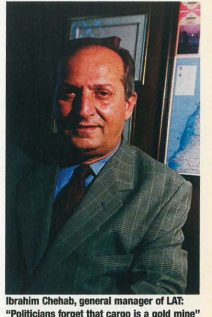
with garbage and nothing works,” says Ibrahim Chehab, general
manager of Lebanese Air Transport (LAT). The erratic customs
procedures and charges, which are often subject to bribes or
wasta, slow the passage of goods. An organized and efficient customs
system would increase cargo and ultimately increase the revenue
for the government, says Chehab. He previously worked as
a cargo manager at Sharjah airport. “It’s small compared to
Dubai’s airport, but their warehouses are full because the government
has a flexible policy and business is booming,” says
Chehab. LAT does cargo and passenger handling as well as
maintenance assistance for 17 international airlines, including Air
France, British Airways and KLM.

The government halted a $15 million BOT project to build a modern
customs building with a warehouse capacity of 200,000 tons a year
and where airlines could have bonded warehouses. “The existing facilities
can absorb 100,000 tons, but Lebanon is only getting 50,000 tons**;**
that’s what stopped the project,” says Fadi Saab, chairman of Trans
Mediterranean Airlines. Customs regulations can impact the cargo
business, adds Saab, but other areas such as industry and trade also
need a boost for the sector to improve. The plans to modernize and
computerize the facilities are encouraging for Saab.

But Chehab believes a better option would be to create a ‘cargo village.’
For 15 years, land would be given rent-free to airlines and cargo
companies to build their own offices and warehouses. “Politicians think the airport is only for
passengers and forget
that cargo is a
gold mine,” says
Chehab. He cites
Singapore as one of
many cities that have
become hubs as the
result of such a project.

The government
did have a plan
to take ownership of
additional land. But
the project failed
because it exceeded the allocated budget for the airport, and
there was political pressure due to its proximity to residential areas,
according to an engineer at the airport’s civil aviation department. “We
don’t have an inch of land to give to companies,” he says.

But land aside, politics have already scuttled one similar completed
project. Last October DHL (see “Down and out in Beirut,” January
2000) invested $2 million in new airside offices that included warehousing
and an area for customs clearance. Those facilities are sitting
idle because no customs officers have been stationed there,
despite promises from both the current and previous government.

Another problem is the high rental fees. Last August, law number
nine increased the rent for offices occupied by airlines or
appointed agents from LL 100,000 to LL 500,000 per m2 and the rent
of hangars and warehouses from nothing to LL 250,000. For LAT
that meant an increase from $7,500 to $35,000 per month.

The new law gave a 50% exemption to local companies that
have scheduled flights, but LAT doesn’t have scheduled flights.
Though the law has since been modified to include companies
without scheduled flights, the ministry of transport is trying to
collect the full fee. The civil aviation authority disputes complaints of high
fees. “It was proven that we have the lowest such fees in the
world, and we need them to cover the operating costs of the airport,”
says one official.

The companies that LAT represents also complain about additional
fees, such as $150 per hour to use the travel counters and
charges of LL 50,000 to LL 150,000 on outgoing passengers. And
on top of the substandard warehousing facilities, the airport has yet
to install telephones and televisions as well as sufficient passenger
seating, arrival and departure monitors. Even with all the
fees it collects, the airport management has failed to provide
good services in return.

July 15, 2000 0 comments
0 FacebookTwitterPinterestEmail
For your information

Breaking down the barriers

by Natacha Tohme July 15, 2000
written by Natacha Tohme

With political and economic issues heading the government’s
agenda, it’s hardly surprising that the rights of
the disabled were put on the back burner. Following
concerted efforts by advocates, the most that law 243 of 1993 stipulated
was that disabled people “have the right to be employed,”
says Jerius Khouri, vice-president of the national association for
the rights of the disabled. “But it didn’t require companies to hire
a certain percentage of the disabled or fine them for not obeying the
law.” The law didn’t even eradicate an antiquated and discriminatory
Turkish law that actually denied handicapped people
access to public jobs.

All that was changed when parliament approved a new anti-discriminatory
law in March. “It cancels or amends unfair texts, clarifies
unclear texts and adds new texts,” says Rita Saba, head of
human resources at the rights and access program of the ministry
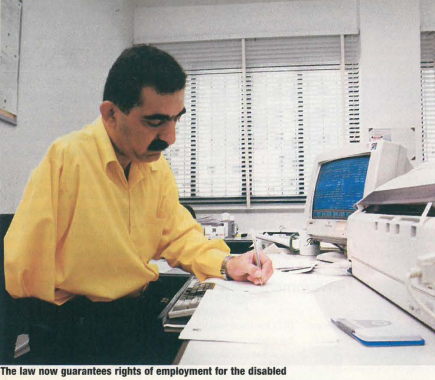
of social affairs. On employment, the law guarantees equal opportunity
for individuals with disabilities. It stipulates that disabled people
will represent 3% of public jobs in all categories.
Private companies with more than 60 employees must reserve 3%
of positions for those with disabilities. For companies with 30 to
60 employees that figure is 1%. Failing to comply will result in a
fine, but the amount has yet to be disclosed. Companies with a staff of less than 30 are not bound by the law to employ disabled people,
but doing so will procure tax exemptions.

“The purpose of the law is to ensure the rights of the disabled on
a long-term basis,” says Saba. It’s an important step towards moving
the status of the handicapped in society from marginalization
to total integration. But the law must still be enforced. “We have to
turn it into applied rules,” says Khouri, who is blind and works as
a freelance journalist and translator. That will require coordination
between the ministries. “Coordination committees must be formed
within each ministry,” says Saba. “Without them we will not be able
to apply anything concerning the law.”

The law also specifies that all public buildings must be accessible
to people with disabilities. “But the criteria still have to be set in
the implementation stage,” says Saba. Adapting the workplace will
be an important component. “As far as I know, most workplaces are
not accessible for the physically disabled,” says Khouri. That
includes making toilets and elevators accessible to wheelchairs.
Solidere showed vision by building in accordance with international
standards that allow for accessibility, but it will be a while before
building specifications become obligatory by law. When they
do, owners of buildings under construction that fail to abide by
specifications will be fined. Tax exemptions will be given to
property owners who restructure existing buildings.

No statistics are available, but it’s safe to say that the number of handicapped
people presently employed is negligible. The Dr.
Mohammed Khaled Social Foundation cares for the physically
handicapped, for whom it provides training in carpentry and sewing. The foundation employs 12
physically handicapped people,
mostly paraplegics.

“They can’t move their legs,
but they can move their
hands. They have brains and
are intelligent,” says Abdul
Hafiz Elladki, the foundation’s
general director.

One barrier to employment
is that just a small percentage of the handicapped population is educated, according to Raif Shwayri, the director of
the Al-Kafaat Foundation.
Before the 1993 law, handicapped
people had no access to
public schooling. Though the ban was lifted, schools are still not accessible to the disabled.
Additionally, no public transportation is available for the handicapped,
making it difficult to get to work or school. Al-Kafaat is a specialized
organization that caters to socially and physically disadvantaged
people. The organization provides daily transportation for its
4,500 beneficiaries, 2,000 of whom are physically impaired. The government
needs specialized buses for the physically handicapped.
“To integrate the handicapped in society, society must be equipped to
receive them,” says Shwayri.

Compiling the cases

Exactly what percentage of
Lebanon’s population is disabled?
Two studies have been
done: one by the ministry of social
affairs in cooperation with the
United Nations population fund
(December 1995 to May 1996) and
the other by the Central
Administration for Statistics
(1997). The studies put the figure at
1% and 1.5% respectively.

According to a source at ESCWA,
“the figure is way too low.”

Recently the ministry of social
affairs began issuing identity cards
for disabled citizens who meet the
classifications set by the ministry.
“Certain health problems are not
classified, such as extreme cases
requiring medical equipment that
we cannot provide and minor
ones,” says Rita Saba of the ministry’s
rights and access program.

The card is required for disabled
people wanting access to services
provided by the ministry, such as
technical aid. To date 24,493 cards have been
issued, indicating 24,763 disabilities
(some have multiple disabilities).
Of these 6.79% are visually
impaired, 11% hearing impaired,
38.7% mentally disabled and
52.2% are physically disabled.

While many people are reached
through ‘outreach services’ provided
by collaborating NGOs,
such as Arc en Ciel, most people must apply for the cards in person at
the ministry’s offices. For this reason, the figure isn’t a good indicator of the real number of the disabled,
which likely stands at 6% to
7% of the population.

July 15, 2000 0 comments
0 FacebookTwitterPinterestEmail
For your information

Cellular circus

by Kirsten Vance July 15, 2000
written by Kirsten Vance

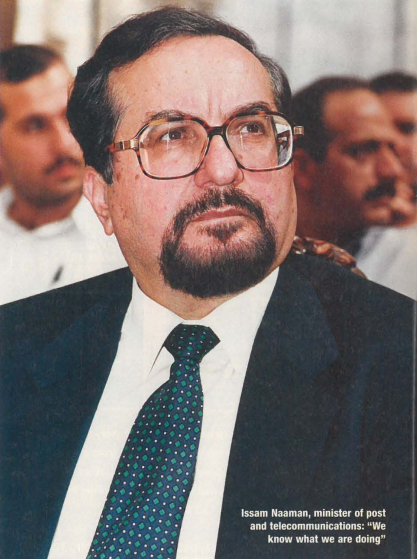
In the eyes of most spectators, the row has
turned into a complete fiasco for the government
and has been sorely mishandled
by Issam Naaman, the minister of post and
telecommunications. International rating
agency Standard & Poor’s (S&P) recently
included the government’s inability to find a
solution to the cellular issue by October in a list
of factors that could lead to a possible sovereign
downgrade for Lebanon. In a telephone interview
with EXECUTIVE, the minister brushed
aside S&P’s warning: “Let them go to hell. We
know what we’re doing.”

But the view from the sidelines tells a different
story. “This could have been resolved
quickly, privately and profitably for the government had they been more
politically astute,” says one analyst. And so the dispute has dragged
on. Many point to the vested interests at play as the major culprit: the
politically powerful hoping to get their fingers in the pie and push forward
companies with which they have or hope to form alliances.

Kamal Shehadi, a consultant on telecom privatizations in the
region, points to the government’s failure to adopt a consistent telecom
policy and law in keeping with the information age (see pp.
27-29). “Other reasons, such as the myopic approach to telecoms as
the cash cow for public finances, at the cost of encouraging
growth and investment in the sector and Lebanon catching up with
the information revolution, must have played a big role,” he adds.

And with elections just around the corner, a solution is probably
not in the cards anytime soon.

Naaman is still hunting down that elusive $300 million in fines
for each LibanCell and Cellis. But neither has received a detailed
explanation of that figure. The minister even threatened that the government
could break the build-operate-transfer (BOT) contracts and seize the two companies’ assets if an agreement is not reached
through talks. But negotiations are made difficult when the two
sides are virtually on non-speaking terms. This does not bode well
for possible future investment. “No investor will invest in a country
where governments decide to shut down a business simply
because it is more profitable than its original business plan had predicted,”
says Shehadi.

Both cellular operators have submitted requests for arbitration to the International Chamber of
Commerce in Paris. “We maintain that we have not
violated our contract and that arbitration is the best
path to resolve the different interpretations of the contract,”
says Hussein Rifai, chairman of LibanCell.

Recently, Naaman has been touting a ‘much better offer’ from Vodafone than what Lebanon’s two cellular
companies are willing to pay for their contracts
to be converted into licenses. The UK-based company
has apparently expressed its readiness to pay $1.5 billion for a license. Contacted by EXECUTIVE,
Vodafone denied making any such offer, oral or written, to the Lebanese government, even insisting that
there are no negotiations between the two parties. “If that’s true, it means
they are not telling the truth. I have all the evidence,” says Naaman,
refusing to elaborate. According to the minister, he is conducting meetings
with representatives of three mobile phone companies that are
interested in investing in Lebanon. “Vodafone for me is a ghost,” says
Sima Hafez, marketing director of Cellis, which submitted an offer in
writing. “He said Vodafone’s offer is better than ours. What are the conditions
of Vodafone’s offer? Nobody knows.”

All this comes in the wake of offers by LibanCell and Cellis to
pay $1.35 billion each for licenses that were snuffed out by the government.
Of that amount, $900 million would be paid upfront with
the rest coming in over the 20-year life of the license that would
allow competition. “Our offer was more than fair and exceeds any
price paid until now for a GSM license,” says Rifai. Indeed, in a
study prepared for the Lebanese government in September 1999,
Booz, Allen & Hamilton assessed the price of a license at between
$800 million and $950 million, based on four different scenarios.
While LibanCell points to the unprecedented high price per population
of the offer, that is the proper index for startups, according
to Shehadi, not going concerns. Nonetheless, the price is fair on a
per subscriber basis, he says: “It compares favorably with prices paid for going telecom concerns in
Europe, where the revenue per subscriber and per
capita income are higher.”

At the council of ministers, sentiment was split. The
nay camp included Naaman and Michel Murr, the
interior minister. Naaman listed his reasons for rejecting the offers at a recent press conference: the
initial installment is too low, the length of the license
too long and the right of first refusal for UMTS, the
third generation of mobile phone systems, should not
be included. Those in favor included Georges Corm,
the finance minister and Nasser Saidi, the minister of economy and trade. “I proposed transforming the
BOT contracts into licenses in December ’98, so I believe it should
have been done then,” says Saidi, adding other issues like competition
and new technologies need to be considered.

The matter appears to be shelved for the time being as the government’s
decision was, er, not to make a decision. Instead the unresolved
dispute was passed onto the auditing department’s lap, with
the operators’ offer not accepted, but not officially refused either, and
it was announced that a law would be drafted to allow a UMTS tender.

“The government should not have accepted the operators’ offer
without making modifications that would ensure a fair and level playing
field for LibanTelecom, the state-owned operator, and other
new entrants to the market,” says Shehadi. “However, that does not
justify the decision reached.”

July 15, 2000 0 comments
0 FacebookTwitterPinterestEmail
Editorial

Deadline time

by Executive Editors July 15, 2000
written by Executive Editors

$2.7 billion is big money. It’s about 15% of Lebanon’s GDP. The
entire economy takes close to two months to generate that much
output. It would have substantially reduced the bloated debt, boosted
investors’ confidence and paved the way for privatization. All the
cabinet had to do was say ‘yes’. Instead of deciding on selling licenses
to LibanCell and Cellis, they dilly-dallied and passed the buck.

Procrastination seems to be the theme of this administration, when
action is what’s really needed. Numerous reforms have been on the
table collecting dust. The telecom privatization law has been with the
council of ministers for three months. The decree to allow Solidere
to develop the souqs has been keeping it company. The value-added
tax (VAT) law is sitting in the parliament’s lap. When it will
be debated and actually passed is anyone’s guess, especially since the
elections are approaching and getting re-elected is the priority. And whatever
happened to administrative and judicial reform, not to mention
the anti-corruption campaign?

Since the government couldn’t accept the cellular offer, Standard &
Poor’s made them an offer it can’t refuse. The international rating
agency has threatened to downgrade Lebanon in the fourth quarter
unless it meets a number of criteria, including hitting its deficit targets,
resolving the dispute with LibanCell and Cellis before October and
passing the VAT law before the elections in August. If the government
can’t reach its own deadline, maybe it can reach someone else’s.

July 15, 2000 0 comments
0 FacebookTwitterPinterestEmail
Executive Living

Philosophy is intrinsic to Japanese flower arranging

by Natacha Tohme July 10, 2000
written by Natacha Tohme

With the principles of Zen Buddhism governing
all aspects of life in Japan of old, it’s no wonder
that many practices from this rich civilization
evolved from meditative study. Take Ikebana, the
ancient art of flower arranging that has an entire philosophy
built around it. “Ikebana means ‘bringing flowers to life’,”
says Viviane Torbey, a pupil of the Ohara school of Ikebana.
The three leading schools Ikenobo, Ohara and Sogetsu
prescribe different styles, but all adhere to the same basic
principles. “The basics are very simple: heaven, man and earth
should be represented in flower arrangements,” says Torbey.
Occidental flower arrangements display man’s control over nature.
Ikebana arrangements depict life, in which man represents
one part of the overall design.

For this reason, the seasons of the year influence what
materials should be used. Whereas occidental arrangements
might use roses all year round, Ikebana arrangements are seasonal.
“You must study nature well,” says Arsho Tutungian,
a pupil of the Sogetsu School. “In the middle of spring you
cannot use autumnal things.”

Everything in nature can be put to use, from blooming
flowers to bare branches and stones. Every element conveys
a meaning. Driftwood symbolizes the past, branches the present
and twigs the future. Likewise, every phase of a flower’s life is symbolic:
buds represent the future, blossoms the present and pods the
past. And every type of flower has its meaning. For example, irises symbolize
man and lotuses, sacredness. By combining
materials, one can express ideas.
“If you know your materials, with a few
branches and a few flowers, you can
create a universe,” says Tutungian.

Heaven is usually represented with a
main branch. For emphasis, smaller auxiliary
branches can be added. The same
concept applies to materials representing
man and earth. Ikebana arrangements can consist of as little as two flowers.
Double arrangements, two separate arrangements of similar themes, are
linked together by branches or other materials. Sculptures of
up to 20 feet are also possible. “This is when you reach the top
when you are a master,” says Torbey.

Flowers may be thrown loosely in a vase. With this style,
which is called Nageire, the flowers rest freely and create
their own harmony. However, ordinarily Ikebana arrangements
are affixed to pin holders, which can be difficult to
work with. Thus, Ikebana teaches self-discipline and optimism.
It also teaches concentration and meditation.

Whereas in occidental arrangements flowers are continuously
added, in Ikebana space is very important. “By taking
your time and studying each material well, Ikebana transfers
you to a completely different world you feel yourself
at one with nature,” says Tutungian.

Ikebana philosophy says that nature may be used, but it must
not be exploited. As a student, Torbey said she was forbidden
to buy flowers from florists. “Because we had to learn how to
cut.” Branches must be cut so as not to bruise the veins, which
absorb water, allowing flowers to live longer. When cutting
flowers, it is important to cut in between the leaves and the stems
must remain in the soil so that plants can regenerate.

Prior to the war Tutungian, who has a master’s degree in Ikebana,
gave classes at the Japanese embassy. They ran at full
capacity. “The Lebanese loved Ikebana before the war,” she
says. “But now they like more elaborate and decorative
arrangements not the poetic Japanese Ikebana.” Today interest
in the art has all but disappeared in Lebanon. Classes are
no longer available, and there’s little chance of finding Ikebana
arrangements at flower shops. Tutungian and Torbey can
accommodate custom orders. Tutungian now works as a floral
designer and wedding planner, and Torbey creates dry
flower arrangements at her shop Style & Nature. Fortunately,
both women are also skilled in occidental flower arranging.
Both women recently gave Ikebana presentations at a flower
show organized by the YWCA and are happy that more people
are expressing an interest in Ikebana. Both talk of starting
courses, in the hope of reviving the art in Lebanon.

July 10, 2000 0 comments
0 FacebookTwitterPinterestEmail
Executive Living

Turning furniture into collection items

by Natacha Tohme July 10, 2000
written by Natacha Tohme

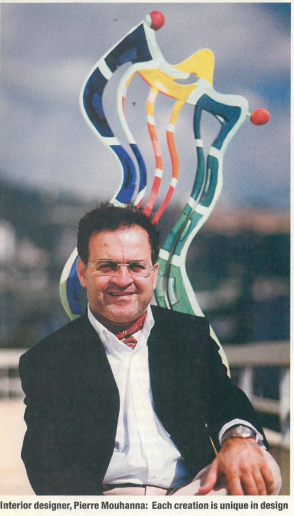
Pierre Mouhanna, interior designer, started creating

interesting furniture in 1988. Two chairs from his first

project still adorn his office in Jounieh. “I liked it so much

that I called it ‘Caiissima’, which means the dearest thing to

me.” Mouhanna is also an artist. His painting style reveals cubist

influences. Mouhanna admits to being inspired by artists such

as Picasso, but explains that his architectural aptitude also affects

his technique. “I work with geometric forms every day.” Five

years ago Mouhanna aspired to merge his two talents. The dubious

proved innovative, and thus began his line of vibrant furniture-

art, Atelier Pierre Mouhanna.

The collection is more art than household furnishings, as every

creation is unique in design and mural. “I never repeat. I

won’t repeat,” says Mouhanna. With his chairs, every design

is symbolic and nai11ed accordingly. One recent creation is a pair

called ‘Love at First Sight’. Both chairs have curvy backs of

different heights that, when positioned side by side, incline to

the other. “The chair is a creation, and it’s a painting at the same time,” says Mouhanna. “You can see my paintings in

three-dimensions.”

Producing any one piece necessitates a number of

processes, from conception to execution. To start, Mouhanna

sketches a design on paper. He then enlarges the drawing

and gives it to a carpenter, who makes a prototype out

of commercial wood. From the li fe-size model Mouhanna

sees where adjustments need be made. “Once we decide on

the form, the carpenter executes it in the right wood,” he

says. It takes about 25 days to make one chair. Painting the

furniture also involves preparatory work. Several studies are

first done on paper. Mouhanna selects the best drawing,

enlarges it, and reproduces it on furniture. It takes about ten

days to hand-paint one chair.

A sampling of Mouhanna’s earl ier paintings hang on his

office walls. Compared to recent works depicted on his furniture-

art, discriminating eyes recognize maturity in technique.

Mouhanna says that to give the geometric forms ‘ life’

he began incorporating figu res of women and teenagers in

his paintings. “The woman because she gives life to the earth,

and teenagers because they symbolize enthusiasm.”

Expect to spend considerably on Mouhanna’s kaleidoscopic

furniture-art. The ‘Love at First Sight’ chairs are each

priced at $3,000. A striking fold ing screen is priced at

$4,000. One chair from the design ‘Masque de Venice,’

which is made from metal, is $ 1,500. Most of the pieces sold

so far grace villas that Mouhanna designed in Lebanon and

Saudi Arabia. “I create a certain corner for one of my

sculptures, with special lighting on it.” To gain exposure,

Mouhanna displays his work every year at two furniture

exhibitions in Beirut, IDEX and Art Deco.

People are beginning to take notice. One organizer invited

Mouhanna to exhibit his work in France at the ‘Salon du

Meuble de Paris’, which will be held next January. The fair

attracts thousands of people from around the world. For optimal

effect, he will only display four masterpieces. If there

is a demand for his work, Mouhanna is considering serializing

designs, but in limited production. “I can do ten or 15

– maximum – of every design.”

July 10, 2000 0 comments
0 FacebookTwitterPinterestEmail
Executive Living

Wild wild east Beirut

by Natacha Tohme July 10, 2000
written by Natacha Tohme

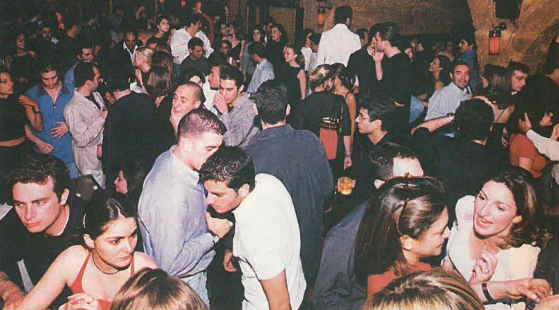
B eirut’s nightlife scene is
livelier than ever, and
nowhere bustles with more
activity than trendy Ashrafieh. After
dark fun-seekers flock to its hip
restaurants, bars and nightclubs. On
weekends the fever reaches epidemic
proportions, as revelers reel from
hotspot to hotspot until the break of
dawn. If you want it, Ashrafieh’s got
it. Prefer a sedate ambience? Go to
Title Out. In the mood to dance to the
pulsating beat of contemporary Arabic
tunes? Try Rai. If exclusive is
what you’re after well, it comes
with the turf, habibi. Glamorous crowds dine, dance and
hobnob at select clubs like Alecco’s and Retro. Thinking about
heading to one? Don’t expect to casually stroll in and be
ushered to the best table in the house reservations must be
made days in advance.

Why the stampede? These restaurant-cum-bars-cum-
nightclubs
cater to the highlife. And to satisfy high society,
good food is essential. But bear in mind that there’s a price to
pay for quality cuisine. A three-course meal at Alecco’s,
Gotha, Circus and Al Mandaloun costs $30 to $40. At Retro
it’s about $75. “A meal can go up to $100 if you order caviar
and salmon,” says Jean Claude Ghosn, co-owner of Alecco’s.
Likewise, the average cost for drinks is $10. Obviously,
certain drinks are more. A glass of Blue Label whisky at Cir-
cus costs $21, while the bottle costs $235. After dining at
Retro, patrons can sip Remy Marten extra old Cognac at
$50 a glass. A bottle of Dom Perignon Rose at Al Mandaloun
sells for a cool $950. Don’t be put off, expensive selections
are stocked just in case. Interesting cocktail creations,
priced at about $10, are recommended.

With cigars à la mode, it’s typical to see male patrons
indulging. Aficionados say it’s pleasurable to puff on a
Cuban, but the air of distinction that cigars convey has
undoubtedly helped their popularity. At these places the
finest, such as Cohiba, Romeo & Julieta and Monte Cristo,
are available. Prices range from $10 to $40. Cigarillos are
priced from $2 to $5.

Food, drinks and cigars aside, nothing tops good enter-
tainment. Ghosn attributes Alecco’s nine years of success
to its live entertainment. Alecco’s co-owner Habib sings a
medley of French, English and Arabic songs. To cut the
routine, Circus has live entertainment a couple of times a
week, but never on set nights. And gigs are always changing.
“The purpose is not to bore people,” says manager Walid
Maalouf. “We don’t want to be a place where people come
every Tuesday to listen to the same group our concept is
to have concerts.” In general, during the week entertainment
isn’t as lively as on weekends, when ecstatic partygoers end
up dancing on tabletops.

Dinner reservations are recommended for weeknights and
must be made days in advance for weekends. At Circus and
Gotha reservations are not needed for the bar. On weekends, at
all venues after 1 a.m., when patrons have finished dining and
head to the dance floor, people without reservations can enter
and join the festivities. But make sure to dress smartly, because
selectivity is practiced at the door. Guys, be forewarned
most places don’t accept all-male groups, even for reservations.
The perception is that single drunk guys offend the ladies. However,
all-female groups are welcome. In fact, all places offer special
packages for bachelorette parties. Alecco’s organizes
menus for such all-female nights for $20 to $35 per person.
For parties of 20, Retro has a menu for $50 a person. Al Mandaloun
can be yours any night other than Fridays and Saturdays,
for reservations of at least 150 people. Prices depend on menus,
but the minimum is $45 a head.

July 10, 2000 0 comments
0 FacebookTwitterPinterestEmail
New companies

A tailor-made operation

by Natacha Tohme July 10, 2000
written by Natacha Tohme

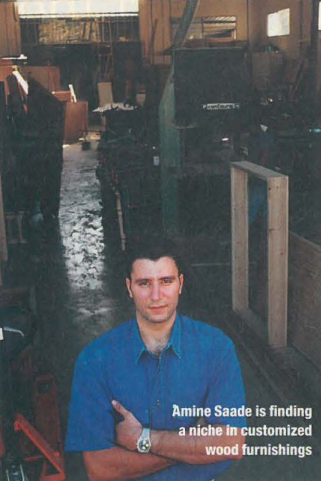
A fter a two-year stint with Byblos
Bank, Amine Saade wanted to satisfy
his entrepreneurial inclinations.
In 1998 he established a contracting
firm that subcontracted woodwork to small
workshops. While the contracting sector
looked bleak, Saade saw potential in setting
up a modern factory that produced custom-made
wood furnishings for contractors and
interior designers. He solicited three friends
to invest in the enterprise: Art Wood Line.

While preparations for the factory were
underway last year, Art Wood Line continued
subcontracting work, mostly for small projects.
That gave the company exposure and,
since the factory opened in January, business
has grown quickly. Sales are increasing by
25% a month, up from 10% when subcontracting.
Saade wouldn’t reveal turnover,
divulging only that since in-house production
began, profit margins increased to 20-25%
from 10-15%. The increased workload
required a bigger workforce. “In January
we had 15 people; now we have 55,” says
Saade. During this period the monthly overhead
ballooned from $8,000 to $25,000.

To date $500,000 has been invested in the
factory. With $300,000 in the latest woodworking
machinery from Germany and 50%
of its staff holding technical degrees, Saade
says that Art Wood Line can bid for any project
in town. Items produced
include door and cabinet frames,
door panels, cabinets and floorings.
Construction contracts worth over
$25,000 account for 50% of business.
Small projects continue to
generate 25% of sales, and custom-made
furniture for interior designers
the remaining 25%.

At a time when most local industries
are up against competitive
imports, why is Art Wood Line faring
so well? Gilles Sayagh of Raymond
Knaider, a timber distributor, says
that imported furniture is cheaper
than local production despite customs
duties of about 45%. But custom-
made production is feasible for
two reasons. Standard measurements don’t
always fit domestic project designs.
Additionally most imported furnishings are
made of commercial materials, such as chipboard,
while a segment of the local market
demands higher quality and costlier materials.
It is more feasible to import quality
wood in its unfinished form because the customs
duty is 5% to 6%.

Saade isn’t able to cite Art Wood Line’s
prices, which are determined by specifications,
wood type and ironmongery. “We specialize
in high-quality woodwork for luxury build-
ings,” says Saade. Art Wood Line faces collection
difficulties like most firms. As a result
the company raised down-payment dues.
“We’re not willing to start a project unless we
get 30% to 40% up front,” says Saade.

Current undertakings include expanding                                        
the factory and bringing in additional
machinery. To keep up with expansion, Art
Wood Line recently recruited two supervisors,
upping the administrative team to seven.
“Delegating management responsibility is
imperative when you reach a certain size,”
says Saade.

Taking care of business

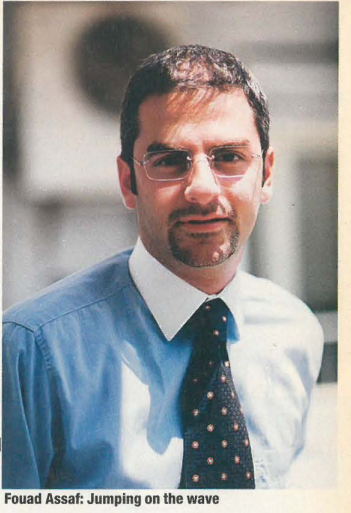
A t 31-years-old, Fouad Assaf oversees
operations and strategies for
the company he established two
years ago, Proactive Business Developers,
which offers marketing and management services.

Proactive audits clients’ problems,
brainstorms with clients and executes the recommended
reforms. “It’s like having marketing
and management departments, but
instead of paying fixed costs for employees,
clients hire us on a project basis,” says Assaf.

He learned fast that local companies
expect a quick fix. “When you’re talking
business development, you’re talking about strategies lasting a minimum of six months,” he
says. Proactive started out handling projects
for a couple of international companies
based in Lebanon, but is now working with
a few local companies, including event
organizer RK&A. But this type of work
hasn’t been sufficient for healthy expansion.

Aware that having a website is an important
part of marketing a business, Assaf set
up Proactive Web Site Developers. The
autonomous unit has its own graphic
designers, programmers, sales and management
departments. The subsidiary
obliged upping investments to about $50,000, mainly on IT equipment. But it’s
been worth it. “Since starting it one year ago,
we’ve had ten times the growth we had in the
first six months. We are tripling in terms of
employees and quadrupling in terms of
turnover,” says Assaf, though he declined to
reveal turnover figures. “This is the time
for it; the market is huge,” says Antoine
Feghali of TimezerO, a web site developer.

Proactive Web Site Developers offers two
packages: The Silver Package is a six-page
website costing $600.
The Gold Package,
with ten pages, costs $1,000. Customized
websites are also available. For added features, such as search engines and e-commerce
capabilities, prices can go up to $50,000.

Proactive has developed websites for companies
such as Morrico TV Shopping, Air
Liquide and Nalbandian Tapis d’Orient. Many
of Proactive’s 60 clients were accessed
through strategic alliances with
Terranet, ODA Liban and 5 Index. Through
partnerships with Kuwaiti-based
Telecommunications Consultants India
Limited, and a British IT consulting firm
Aston Kean, Proactive has created websites for
companies in those countries. These represent
about 40% of turnover, according to Assaf.

“A lot of companies are looking to produce
in Lebanon, because the price is cheaper by
30% to 40%, and the quality is good,” says
Assaf. For these reasons, a US company
recently contracted Proactive to develop its
sports-betting website. He wouldn’t
divulge the company’s name, but explains
that one of its Lebanese shareholders sug-
gested a developer in Lebanon.

Through partnerships, Proactive
is hoping to gain a foothold in the
Middle East. According to
Feghali, penetrating the local
market is easy, “but to have
something lucrative, you have to
concentrate on the regional market.”
TimezerO recently opened
an office in Dubai.

Proactive is also setting up an
ISO department, which is slated
to begin operations this summer.
“We will be developing
and preparing business outlines
for companies to get ISO labeling,”
says Assaf. Like Proactive
Web Site Developers, it will be
an autonomous department that
the “mother” company can
employ for its business development
plans.

Catering to corporate tastes

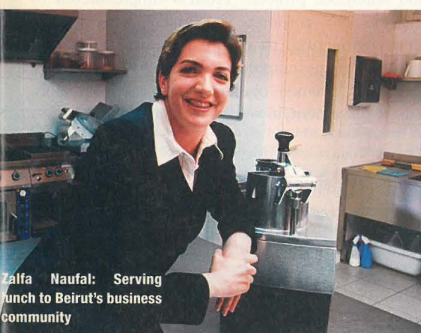
From the time she got her degree in
hotel management, Zalfa Naufal
plunged into the food service business,
working at a number of hotels and
restaurants in Geneva, Paris and Beirut.

But since entering the labor market in 1991,
Naufal had one goal in mind: “To open my
own company in the food sector.” That was
achieved in March with the establishment of
The Food Box, a food delivery company.

“We are targeting the business crowd for
lunch,” says Naufal. Annette Maalouf, managing
owner of Casper & Gambini’s, a
strong contender in the field, says there is
big demand for lunch deliveries at offices.
And many restaurants are jumping on the
bandwagon. “But they don’t realize that
it’s a costly service,” says Maalouf.

For this reason Naufal chose to use
Khadamat for deliveries, while a bakery
supplies specialty breads. Outsourcing these
services meant her initial investment was
just $60,000, the bulk of which financed the
kitchen and computerized system for orders
and accounting.

Maalouf says that a
lot of delivery companies
open up hoping to
capitalize on the
demand. But few withstand
the competition.
Naufal is all too aware
of this. She spent
months researching
and testing recipes for
sandwiches. “We elevated
the sandwich to a
gourmet status,” says
Naufal. Exotic creations
include ‘Prosciutto di Parma’ with
blue cheese and fig preserve. This costs
LL8,000, but prices range from LL3,500 to
LL9,500. Salads are priced from LL3,000
up to LL7,000. The Food Box also sells a
number of publications including An
Nahar and The Wall Street Journal.

Creating an identity is vital to penetrate
this market: restaurants have visibility on
their side, but delivery companies are hidden
kitchens. “That’s why the packaging is
as important as the quality of the food,” says
Naufal. The colors she uses, white, black
and silver, suggest cleanliness, professionalism and urbanism.

After three months, business is not bad.
“People think the food business is like a slot
machine, but you don’t have a return on your
investment immediately,” says Naufal, who
expects to see returns in two years. The fixed
cost for rent, salaries and delivery service is
$2,500 a month, while food is roughly
$30,000. To raise the profile of her company,
Naufal is planning to extend marketing, so far
limited to Ras Beirut, to Ashrafieh. If things
go well, she plans to open a cafe. “With a
restaurant I can be more creative.”

July 10, 2000 0 comments
0 FacebookTwitterPinterestEmail
Tech Knowledge

Cisco to open shop in Beirut

by Executive Contributor July 10, 2000
written by Executive Contributor

C isco Systems, a global leader in
networking for the Internet, has
announced that it will open an
office in Lebanon by August 2000. “We
need to be present to add value in terms of
services and consultancy for our partners
so as to have better customer service,”
says Mohammed Abdel Malak, Cisco
area manager for the Levant region.

US-based Cisco, which has 225 offices
in 75 countries, is opening a base in
Beirut to capitalize on the mushrooming
networking business. “In the past two
years networking has increased by
100%,” says Ziad Yacoub, assistant manager
at Computel.

Cisco provides networking solutions to
large organizations, service providers,
and small and medium-sized businesses in
115 countries. During the first quarter of
this year it generated revenues of $4.92 billion.
The company has been working in
Lebanon through partners for five years.

Its local clients include LibanCell, which
has decided to consolidate its various networks
to a single platform based on Cisco
technology. And Byblos Bank will use
an integrated data and voice network
from Cisco to connect its 47 branches.

“Their excellently priced and welldesigned
products meet the needs of the
Lebanese market,” says Mike Mansour,
marketing manager at PSI Net and partner
of Cisco products. Others disagree. “Not
all Cisco products are excellently
designed, but they sell because Cisco has
an excellent marketing strategy to promote
its brand,” says Serge Bakhos, managing
director at Computel.

Je surfe, tu surfe, il surfe

With competition in the
Internet market as cut-throat
as ever, Internet service
providers (ISPs) are looking for ever
more novel ways to attract customers. In
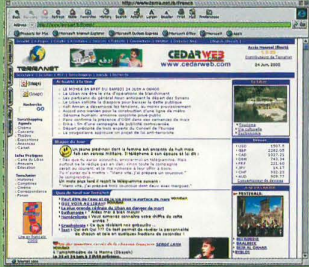
June, Terranet released a new service that
allows people to check the news, search
for sites and send personal announcements
all in, and herein lies the innovation,
French.

Ever since last year’s price war that
saw drops in connection charges from
$30 to an average of $10, ISPs have chosen
to play the quality card rather than to
engage in further tit-for-tat price cuts.

Capturing and, perhaps more importantly,
maintaining even their respective
slices of the 85,000-strong cyber-pie has
become an all-consuming pursuit and
most ISPs have already incorporated
free fax and voice services as value-added
trump cards. “Research shows
that, to 70% of Lebanese, French is the
second language,” says Fady
Ghazzaoui, general manager of
Terranet. “It makes sense to offer a service
that satisfies the needs of the
Francophone community.”

And, though it remains doubtful that
the ISP wars will ever translate into a
battle of tongues, the respectable 2,000
unique hits per day recorded so far on
www.terranetfr.net.lb (compared to
5,000 hits on their English site) do
show that Lebanese internauters can surf
and surfer with almost equal ease.

I just phoned to bug you

It had to happen sooner or later.
In the wake of e-epidemics,
Net-compliant mobile phones
have become the latest target.

“Timofonica” has the dubious
honor of being the first email virus
that can target mobile phones as
well as PCs, spreading primarily via
email using Microsoft’s Outlook. A
file attached to the message makes
the virus spread to everyone in the
infected user’s electronic address book.

The virus does not damage mobile
phones. It merely sends annoying messages
using the SMS (short message service) system
available on GSM phones. But it serves
as a warning for future bugs. According to
computer analyst Mihran Boudromian of
Expervision, “Two or three viruses down the
road we might see these things taking out
phones.” A future virus could access a victim’s
telephone address book, for example.

Things could get even worse with new
mobile phones, which are becoming like
small computers. They allow Web browsing,
online trading and other functions that
could be used by virus writers or hackers.

Fighting cyber-terrorism has largely
been focused on viruses targeted at home
computers or major computer networks.
This latest antack foreshadows the beginning
of attacks on other handheld devices
like PalmPilots. “What’s really significant
about this virus is that the hackers may start
to target handhelds and mobile phones,”
said Boudromian, adding that, in Lebanon,
Timofonica went almost unnoticed, as the
infection was limited to western Europe.

Present mobile phones have too little computing
power to make it feasible for them
to spread viruses directly.

The virus spread by using Visual Basic
Script, the same aspect of Microsoft’s
Windows operating system that was
exploited by the recent Love Bug computer
virus. After the widespread damage
caused by that rogue program, Microsoft
said that it would provide a “fix” for
Outlook. But until then, macro viruses
will be free to infect just about every
Net-linked appliance.

July 10, 2000 0 comments
0 FacebookTwitterPinterestEmail
  • 1
  • …
  • 692
  • 693
  • 694
  • 695
  • 696
  • …
  • 708

Latest Cover

About us

Since its first edition emerged on the newsstands in 1999, Executive Magazine has been dedicated to providing its readers with the most up-to-date local and regional business news. Executive is a monthly business magazine that offers readers in-depth analyses on the Lebanese world of commerce, covering all the major sectors – from banking, finance, and insurance to technology, tourism, hospitality, media, and retail.

  • Donate
  • Our Purpose
  • Contact Us

Sign up for our newsletter

    • Facebook
    • Twitter
    • Instagram
    • Linkedin
    • Youtube
    Executive Magazine
    • ISSUES
      • Current Issue
      • Past issues
    • BUSINESS
    • ECONOMICS & POLICY
    • OPINION
    • SPECIAL REPORTS
    • EXECUTIVE TALKS
    • MOVEMENTS
      • Change the image
      • Cannes lions
      • Transparency & accountability
      • ECONOMIC ROADMAP
      • Say No to Corruption
      • The Lebanon media development initiative
      • LPSN Policy Asks
      • Advocating the preservation of deposits
    • JOIN US
      • Join our movement
      • Attend our events
      • Receive updates
      • Connect with us
    • DONATE