• Donate
  • Our Purpose
  • Contact Us
Executive Magazine
  • ISSUES
    • Current Issue
    • Past issues
  • BUSINESS
  • ECONOMICS & POLICY
  • OPINION
  • SPECIAL REPORTS
  • EXECUTIVE TALKS
  • MOVEMENTS
    • Change the image
    • Cannes lions
    • Transparency & accountability
    • ECONOMIC ROADMAP
    • Say No to Corruption
    • The Lebanon media development initiative
    • LPSN Policy Asks
    • Advocating the preservation of deposits
  • JOIN US
    • Join our movement
    • Attend our events
    • Receive updates
    • Connect with us
  • DONATE
CommentEconomics & Policy

Arab summit shows a Lebanon at the mercy of disinterested regional powers

by Jeremy Arbid February 19, 2019
written by Jeremy Arbid

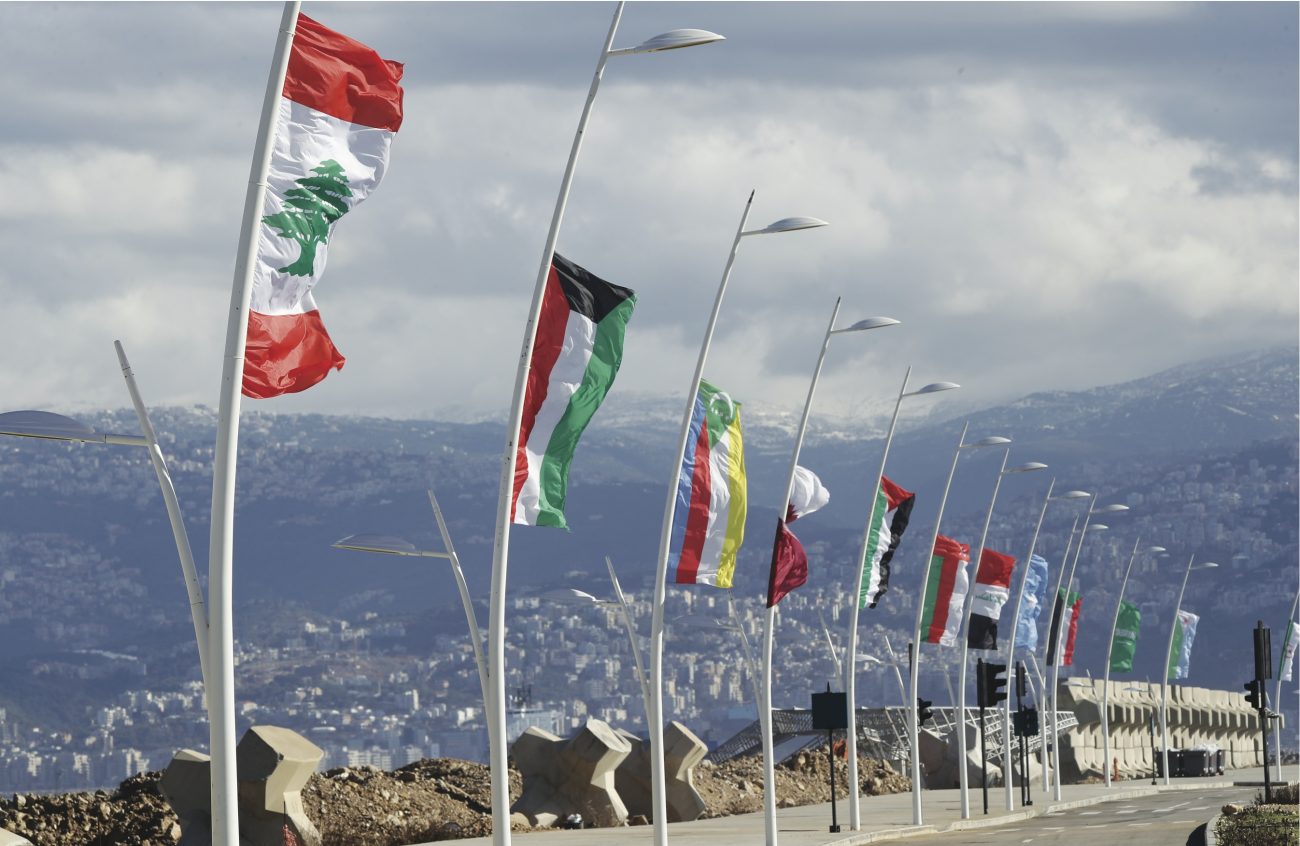
The Arab League Economic and Social Development summit hosted in Beirut in late January produced at least one solid takeaway: the reiterated recognition that Lebanon does not hold the keys to its own future and so must ride the bench during this economically and politically pivotal time for the region. With a government finally formed on January 31, Lebanon finds itself engulfed in domestic and regional uncertainties and struggling on a tightrope to maintain its balance.

The mid-January summit was viewed by some observers as an unsuccessful event when measured against hoped-for outcomes for the host country, which included: a resolution to the myriad and competing perspectives on Arab states’ relations with Syria, the provision of financial or other support to refugees, and a decision regarding the general direction for Lebanon in 2019. According to Paul Salem, president of the Washington-based Middle East Institute, in a late-January Weekly Briefing published by the think tank: “The large number of no-shows reflects a general view among many Arab heads of state that Lebanon is too deeply under the political and security sway of Iran and Hezbollah. It might also reflect a slowing down of the momentum to normalize ties with the Assad regime, and a desire to avoid giving political support to the Lebanese president and his allies, who would like to see the Arab League end its suspension of Syria.”

False hopes

Much of the final communique from the summit comprised of reiterations of previous promises, though there was a new proposal for a $200 million technology and digital economy investment fund for the region. Lebanon’s president called for the creation of an Arab Bank for Reconstruction and Development that would serve as a funding structure for the reconstruction of wartorn Arab states, while Qatar committed to purchase $500 million worth of Lebanese sovereign debt.

What is Qatar actually buying with this offer to purchase government bonds? Perhaps it is backdoor access to Arab decision-making. Before 2010, the political influence of Qatar in Lebanon was mainly limited to the former employing a fraction of their surplus petroleum revenues to help rebuild the latter after the 2006 war with Israel. During the Arab Spring, Qatar placed its bet on the Syrian opposition and supported political Islam in the region (both losing wagers), and has maintained ties with Iran to the ire of Arab counterparts—the latter two Qatari decisions, along with inter-GCC rivalries, were the major driving impulses behind the Saudi-led blockade in 2017. Less than a day after the Qatari bond-buying commitment, Saudi Arabia’s finance minister said at the World Economic Forum that the Kingdom was poised to “support Lebanon all the way,” but did not offer specifics.

Should the Lebanese have hoped for more tangible outcomes? The results of this summit have historically been weak, both in terms of effecting change at the regional level, in either a political or economic sense, and in the fulfillment of past promises made.

In 2007, there was a consensus movement by Gulf countries to try to gather the region together, evidenced by the proposal to integrate the region into a monetary union, borne of the traumatic experience of Iraq’s invasion of Kuwait. Plans to form an Arab customs union and integrate scientific research were announced during the 2009 summit, but as soon as the Arab Spring erupted this consensus evaporated, leaving regional integration proposals still on the table.

When compared with other regional political blocs, the Arab League is often characterized as a political tiger that roars, but whose measures rarely have teeth. The regional body has traditionally been propelled on the strength of the Saudis’ financial clout and Egypt’s political persuasion; when the interests of those two countries aligned, the institution worked.

In the current environment, there is an alignment of Egyptian and Saudi interests in countering Iran and opposing Qatar, but when it comes to solutions for Syria’s war and readmittance of Syria into the body, there seems to be disunity. On the question of discourse at a lower level, it appears that the Arab League is still very far from having an interest-driven joint position, and this is visible when one looks at how Lebanon has reacted to issues such as the Libyan question and Syrian conundrum. The Lebanese position has been internally divided and not based on prioritizing national practical interests, but rather on the political positions of individual parties, and the reemergence of decades-old grievances.

Given the unfulfilled promises of past summits, what could the Beirut summit have produced for Lebanon, within a fragmented region, in which multiple countries see increasing inequality, poverty, and specters of civil unrest? One might have hoped that even if only minor economic solutions were on offer to Lebanon, then outside powers could perhaps have spurred on a political agreement to form cabinet prior to the gathering. But any hope of that was dashed by the maneuvering of various political factions in the lead up to the summit.

Tangled loyalties

While there may still be emotional pain in Lebanon over the disappearance of Imam Musa Sadr 41 years ago, Lebanese political factions’ punishment of Libya for the evils of the Gaddafi regime—and Libya’s subsequent boycott of January’s summit—does not bode well for the future improvement of Lebanon’s regional role and interactivity with other Arab states. If there is any potential for Lebanon to be an actor on the regional stage rather than a pawn thrown around by outside forces, can Beirut afford to harbor such extreme resentment over past injustices?

When it comes to relations with Syria, some observers believed Bashar al-Assad was blocking the formation of Lebanon’s government. The fact that this could even be a possibility, that Assad could theoretically exert such pressure on Lebanon, is because the Lebanese state and its representatives are subsidiary to the links between communities and foreign interests. The Lebanese state may not as driven by foreign interests as it was during and after the civil war, but tribal linkages in society and pressure groups still exert a powerful influence capable of incapacitating the state and preventing it from undertaking activity vital for its survival. Because these groups can basically make the state impotent or operationally dysfunctional, how can Lebanon be made more immune to these pressures?

Despite the Qatari offer, Lebanon walks away from the summit with more questions than answers, or solutions. The country is in a difficult position as domestic economic pressures mount and trust in the country’s financial system erodes. Unfortunately, the post-summit sentiment is that nothing will be decided in Lebanon, or for Lebanon, until foreign-sponsored gatherings shape the future political and economic direction of the region.

February 19, 2019 0 comments
0 FacebookTwitterPinterestEmail
Economics & PolicyQ&A

An accumulation of economic woes

by Thomas Schellen & Jeremy Arbid February 18, 2019
written by Thomas Schellen & Jeremy Arbid

Executive met with then-caretaker Minister of Economy Raed Khoury to discuss McKinsey & Company’s economic vision (commissioned by the government in late 2017 and published in early January), the ministry’s progress in regulating private generation of electricity, and the political and economic situation of Lebanon ahead of mid-January’s Arab League Economic and Social Development summit, which was hosted in Beirut.

E   As the government in its caretaker status is not empowered to make all needed reform decisions, our impression is that ministers such as yourself are trying to keep the public confidence from deteriorating, but that there are many challenges. What can you actually do in this situation?    

There is a tremendous campaign against our economy and our country from internal factors or internal politicians, some media, and there are some external factors, because [various interested parties] know exactly how our economy is so sensitive. The backbone of our economy [relies] mainly on trust and being able to attract foreign deposits and FDIs. And they know our economy is not independent from external factors. If our economy were dependent on internal strengths from industries, agriculture, and technology, we would be more immune to external factors. On the other hand, we cannot ignore the economic problems that have been [accumulating] for the last 25 years, so what we are seeing now is only a result of all of the bad management of the government vis-a-vis the economy, starting with a lack of vision [overall] to the destruction of the productive sectors.

There are many other factors, like the corruption that has been mounting over the years. [This] is a very important negative factor for our economy, because there are a lot of taxes that are not collected, and at the same time it creates a trust issue for any investor [thinking of bringing investments] to Lebanon. There are problems related to the environment, the sewage, and the problem of electricity, to which we have still not been able to find a solution. All of these things have accumulated, and the most important thing, and a result of everything I have mentioned, is the mounting public debt compared to our GDP.

E   Is the idea of an increase in corruption not mainly driven by a self-reinforcing perception that can be likened to a self-fulfilling prophecy? How do you yourself see the problem when, as in a recent accusation leveled against you, allegations of corruption are made, but no mention is made of the fact that you, as a minister of economy, stepped back from your role in an investment bank when you started to serve in a ministerial role? If that is the case, you have actually moved against corruption but the perception of that seems not to be there. Can you do anything to improve the perception of the state and government as corrupt?

I disagree with the perception, because I am probably one of the few fighting real corruption. I cracked down on the generator mafia, which has been a taboo for the last 30 years. We have to face [corruption]. And corruption has many meanings because it has many faces. Corruption could be stealing money and taking contracts. It could also mean a conflict of interest, as you mentioned, and a conflict of interest could also be if I’m going to be nominated to be a deputy and a minister at the same time [because a parliament deputy cannot exercise oversight of themself while also serving in cabinet]. For myself, I did what I needed to do in terms of differentiating between my private job at the bank [and my public office]. [In this regard], managing conflicts of interest is the name of the game. Nothing comes for free. If you’re going to bring in a minister who is a professional, [they likely] have their own business, and this comes with a conflict of interest. But [such a scenario] is better than appointing a minister who does not know what they are doing.

E   In a January television interview you mentioned that over 100 generators have been confiscated, and now 70 percent of generator owners are issuing bills that charge per kilowatt hour usage. What is the main driving force for you in targeting the generators? Is it an issue only of corruption? Or is it an issue of restructuring the value chain of electricity?

There are two electricity providers in Lebanon: the government and the private generators. They are two separate issues, in terms of coming up with a solution. The normal thing is to have the government [meet electricity demand], but the fact is that the government is unable to [do this]. These generator [operators] have been [taking advantage of] the people by giving them the impression that they are so powerful, can do whatever they want, and can charge whatever they want. But they are just taking the people hostage.

So what we are trying to do, and we achieved it, is to crack this mafia for the benefit of the people. It turned out to be true that after they introduced the meters the monthly bill decreased tremendously, for example, from $200 to $60 or $70—and [operators] are still making money. The impact is huge because it affects every individual in Lebanon. The people have felt the difference [since at this time] the most important thing for people is to save some money. Saving this amount of money per month is a huge, huge saving for any household, especially for the poor and the middle class. And at the same time we calculated a margin for these generators. [Because of what we did], operators are still making money, [are able] to pay their costs, [covering] appreciation, fuel, and everything else, and still have a profit margin.

E   Can this be replicated across all the inefficient areas of the economy where pricing is not optimized socially. For example, can you do the same thing with transport or with other private sectors?

No. We were able to control this because generating electricity is the job of the government. So these people are not legal, and given their status of being illegal, we are able to control them. For other sectors it depends, because we are, at the end of the day, a free economy.

E   Do the private generators pay tax on their income from selling electricity?

No, they don’t. They’re outlaws, and the government has accepted that because they fear that they are not able to do their duty of providing electricity.

E   That leads us to the McKinsey report because by first impression the report is assuming the government has a lot of power in directing the economy, which practical experience over the last 20 years indicates Lebanon does not have. What is your economic model for Lebanon to implement?

First, before fighting over how we want to distribute the wealth, we need the economy, and then we will fight over how to divide the wealth, yes? So the idea is that we are going to make the cake bigger and then divide. We took into consideration both, how we want to increase [the size of] our economy, and then how we are going to create jobs, because creating jobs is a social aspect, and we believe that productive people will be rewarded at the end of the day and non-productive people will not be rewarded.

The main part of this [economic vision] is not only the creation of 370,000 jobs, it is also the spread of wealth because the productive sectors are across the whole country not only in Beirut or Mount Lebanon. Second, you can only create a middle class if you create big companies because the middle class is mainly middle management, and that can only exist in big companies, not small ones. In order to have big companies, you have to be competitive so you can grow and be able to pay hundreds of thousands of salaries for the people—and this is the middle class that we have eliminated in Lebanon over the last 30 years.

E    If we listen to the street then there is an accusation that what exists in Lebanon is a rentier economy of unproductive elites that are depriving the work-willing people of economic opportunity. So how is this economic reality and the need to rectify this bad existing “model” reflected in the plan and in your vision beyond the McKinsey plan?

I agree that currently the situation is like this, but you need to understand why it is like this and what we are trying to do; it is useless to describe the situation without understanding the reason. [Lebanon’s economy is currently structured to increase] the gap between the poor and the rich. Creating a productive economy will decrease the gap. Why? [Because of high interest rates, the wealthy class is parking their money in the bank instead of putting it to work by lending it out, while the have-nots are struggling to make ends meet. And there is less borrowing because of the higher interest rates]. [If investments could be channeled] into industries or productive sectors, this turnover of money would have been circulated 10 times in the economy and [would have] created more jobs, creating [and distributing] more wealth. The McKinsey study for the government plan addresses exactly this issue at its core. I hear some magazines or those that call themselves economists describing the situation, and they don’t understand why it is like this or what the benefit is of creating productive sectors. What’s the use of a $100 million deposit in a bank if it benefits one person? But if this $100 million [is channeled] into five to six industries, it creates thousands of jobs, generates more money, and the people make more money. So this needs guidance from the government, and that is what we are trying to do.

E    How do you assess the state of affairs today, in early 2019, versus at the end of 2017, when you commissioned the McKinsey report—before parliamentary elections, before the confidence boost from CEDRE, and before the government deadlock became visible? In terms of ability to implement, do you see structural reforms and economic developments as more likely today than about a year and a half ago, when the decision to commission McKinsey was taken?

If some of the ministers or public opinion at that time didn’t believe in what we are doing, I think now they should believe, given the situation. And I think tackling the core of the problem is the most important thing. We don’t want to take medicine [to mask the symptoms]; we want an operation to solve the problem. [The medicine] probably helps you for a couple of months, and then what will happen? And I really believe if we don’t [do the operation], then we are in deep shit.

E   Do you want everyone in government, Parliament, and the population as a whole to read the McKinsey report on your website?

The stakeholders are everybody—the citizens, the government, the [state] administration, the international community, funds, banks, the World Bank—the report is very global and very reachable for everybody. It’s more than a study; I want to make this a culture in which every citizen understands to a certain level that there’s a government with an economic policy for the productive sectors, and we are moving in the same direction. And this also helps [boost] confidence because you can’t be lost as a citizen, you have to have an identity. It’s not an identity only because you are Lebanese, it is [an] economic identity. If you want to create an economy, this is the way to do it.

February 18, 2019 0 comments
0 FacebookTwitterPinterestEmail
Economics & PolicyLegislation

Lebanon’s parliamentary productivity

by Jeremy Arbid February 18, 2019
written by Jeremy Arbid

At first glance, the legislative output of the Lebanese Parliament impresses with its extreme volatility. To full understand the matter of legislative productivity requires a contextual view that takes political environment into account.

The election of Michel Aoun as president in October 2016 ended almost two and a half years of vacancy in the post, and was the result of an agreement between Lebanon’s political parties to form a government, headed by Saad Hariri, that would oversee negotiations to draft and pass a new electoral law to govern the first parliamentary election since 2009. The beginning of this new era brought changes that were an indication of state productivity, which had been lacking in Lebanon for several years. These changes included: the ratification of two state budgets; the holding of parliamentary elections; the passage of anti-corruption laws; the enactment of anti-torture legislation and other human rights-related measures; the signing of oil and gas exploration contracts; and the appointment of high-level government, security, and judicial officials. 

In considering the output of the state in the last decade, one can discern three distinct political periods. In the first period, 2004 to 2008, there was one set of parliamentary elections, but three resignations of the government, one assassination of a former prime minister, one occupation of Downtown Beirut, and one cross-border war. Skip forward, and we see that between 2014 and 2017 there was the long presidential vacuum and a period of non-performance in terms of the cabinet, as well as the Syrian refugee crisis, the rise of Daesh, and other security concerns. Compared to the preceding and following periods, the Sleiman presidency from 2009 to 2014 was somewhat politically stable, which helps explain the relatively consistent legislative output during Sleiman’s tenure.

Political and economic factors

The low legislative output of Parliament in 2009 might have, in part, been influenced by the global financial events of 2008. The aftermath of the perceived double whammy in 2008 (the burst of the Dubai real estate bubble and the onset of the Great Recession) was expected to have strongly negative impacts on remittances and financial inflows to Lebanon, though the opposite happened. That year also saw local security upheavals that peaked in May 2008 and brought the country to the brink of renewed civil strife. The resolution of the crisis led to the election of Michel Sleiman. The holding of parliamentary elections in spring 2009 or the relationship between the new president, the parliamentary speaker, and the prime minister are also possible explanations for the low number of laws. The failure to organize and hold parliamentary elections was a presumed factor in the low legislative output of 2013, along with the question of who would succeed Sleiman as president when his term ended on May 25, 2014.

It is possible that the extension of the Parliament’s mandate (in 2013, in 2015, and in 2017), and the vacancy of the presidency that began in the middle of 2014 and ended with the election of Michel Aoun in 2016, did not have a significant impact on the quantity of legislative output for the period 2014 to 2016. The quantitative comparison of legislative output allows us to identify distinct periods but does not offer a measurement of the qualitative component of the output. Measuring the quality of legislative output is a challenge because it comprises different streams. For example, legislation related to laws to approve financial transfers to administrative bodies or to conclude official agreements between states depend on procedural or annual conditions, where each transfer or international agreement must be legislated. Although many laws can be passed in a single period, these laws may not have a transformative effect on society, whereas one single law—such as the public sector salary increase or the election law, both passed in 2017—can have a huge societal or economic impact.

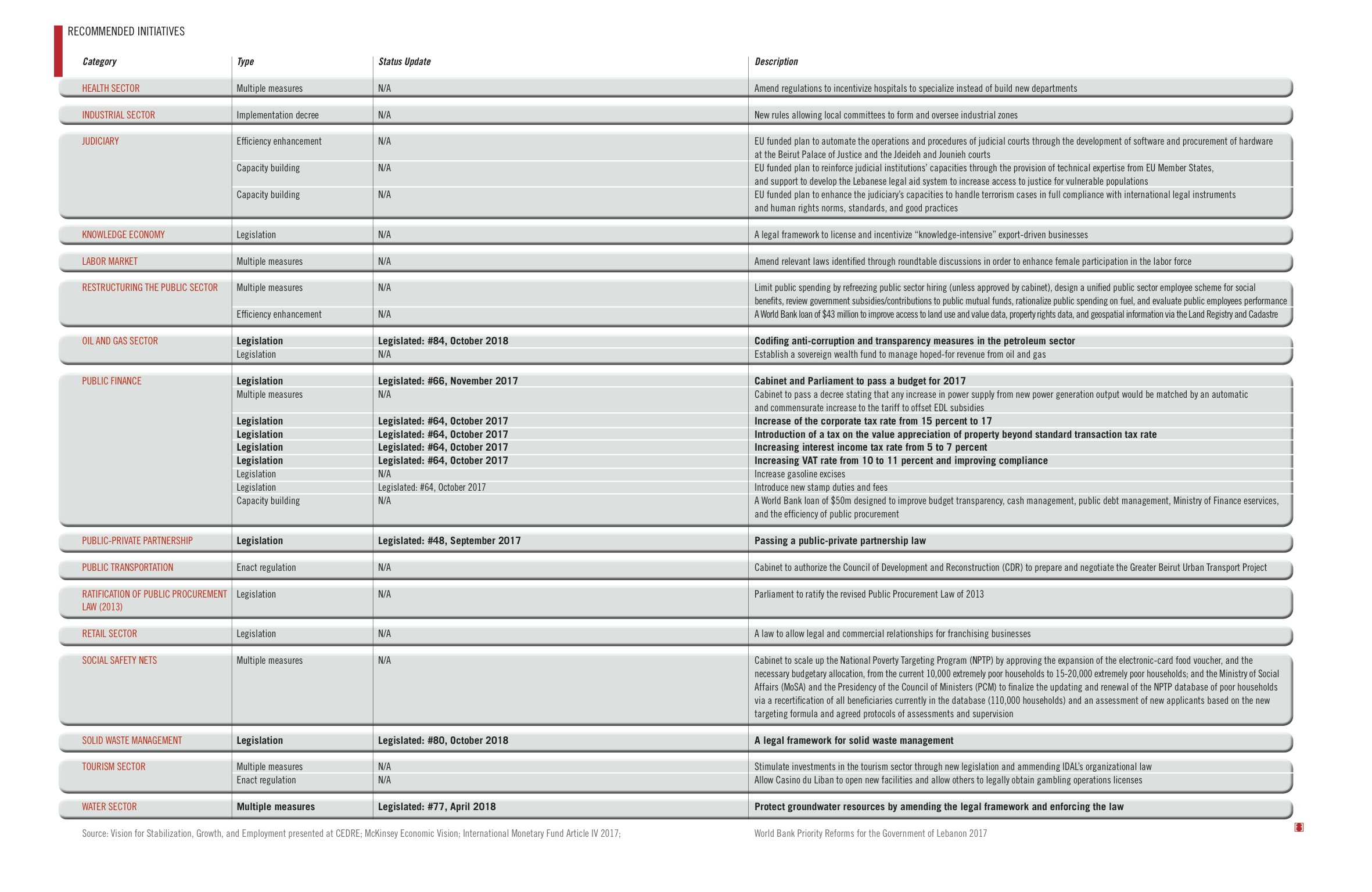
[media-credit name=”Ahmad Barclay and Jeremy Arbid” align=”alignright” width=”590″][/media-credit]

[media-credit name=”Ahmad Barclay and Jeremy Arbid” align=”alignright” width=”590″][/media-credit]

February 18, 2019 0 comments
0 FacebookTwitterPinterestEmail
Cover storyMcKinsey

McKinsey’s economic vision emphasizes microscopic details over fundamentals

by Thomas Schellen February 18, 2019
written by Thomas Schellen

Lebanon has no difficulty evoking the idea of a circus, or, as we said in the previous issue of this magazine, a political carnival. Our absurdist theater troupe had seemingly perfected its performance of the tragicomedy with the title “Government without Head.”

But in January, there were two new and hopeful twists added to the script. At the end of month, the drama found a resolution with a new cabinet, while earlier in the month the Ministry of Economy and Trade (MoET) surprisingly released the “Lebanon Economic Vision (full report).” It became an instant holy duty for stakeholders in the Lebanese economy to analyze this concise plan, or at least pour over its severely abridged executive summary, containing a mere 150 presentation pages in PowerPoint format.

In contrast to the political script of “Government without Head,” whose anonymous authorship had resulted in much local speculation (was it written by the Americans, Russians, Iranians, Syrians, Saudis, Mary Shelley, or Dr Totenkopf?), the authorship of the Lebanon Economic Vision (LEV) (including the plan’s not inconsiderable number of typographic errors and internal incongruences) resides entirely with a team from international consulting firm McKinsey. 

The devil is everywhere

Much more pertinent for any analysis of the LEV than small deficiencies such as typos is arguably the inclusive reach—the buy-in from all stakeholders across all strata of society—as well as the mandate and the meat, or content, of the economic vision. In regard to the mandate behind the LEV, McKinsey says that a decree by the Council of Ministers from October 2017 deemed that the “vision would aim to grow GDP and create jobs through selection of productive sectors that could become competitive.” Moreover, the same text pointedly mentions that the vision would aim “to understand the government’s role in that regard,” presumably referring to the state’s role in GDP growth and job creation. 

On the issue of inclusive reach, McKinsey declares that some 200 stakeholders across multiple economic sectors were interviewed. It specifies at the start of the document that “pre-work interviews” were conducted in the first quarter of 2018 with: 15 ministers; 30 director generals and regulators; five members of Parliament; members of the country’s Economic and Social Council (Ecosoc); 10 local and international civil society stakeholders; over 20 international experts; 30 professional organizations, i.e., associations, syndicates, and orders; and 75 “Lebanese private sector leaders.” Further down in the presentation, the authors say they “interviewed 200+ stakeholders over a period of 8 months,” and list, on four pages with a total of about 140 entries, the meetings that were conducted with these stakeholders, identifying the researchers’ most important interlocutors by name and organization, and mentioning the remainder with more general descriptions of their affiliations and roles (e.g. “Dr. Joseph Torbey & team from the Association of Banks in Lebanon”).

This commitment to provide a list of meetings is helpful in allowing discerning readers to gain an initial understanding of the stakeholder interactions involved in the LEV’s production. But blind spots are not universally removed. Namely, the length and intensity of an interview with a Lebanese political or economic figure—as Executive knows very well—can vary greatly, but there is no indication of the depth or quality of the insights gained in those interviews for the LEV. Moreover, McKinsey makes no attempt to explain the methodology used in selecting its interviewees or explain why there are only three or four entries recording meetings with interviewees from each the real estate and health sectors whereas there are over 16 entries for each of the industry, agriculture, and public sectors.

In sum, there is no methodological attempt to indicate the width or depth or diversity of views, nor the intensity of the interaction. Instead, the stakeholders identified indicate a significant alignment of the interviewees with the original core owners that commissioned the report. This in turn strongly hints at likely similar biases and the possibility of mentally closed feedback loops, which could have resulted in incestuous inbreeding of the perspectives that were entered into the LEV’s underlying information base, from which the report was composed.

McKinsey does not address, in the released report, how it approached the problem of unwanted opinion loops and myopic perspectives—given the narrow layer of mutually interconnected stakeholders in the Lebanese economy and its very limited pool of outspoken and transparent personalities. It deserves to be noted that the LEV generally offers very little detail about the methodologies applied in its research processes, data acquisitions and evaluations, rationales for assumptions, margins of error, and such.

Turning to the beef

When examining the content of the LEV, a clearly positive aspect of the plan is that McKinsey has incorporated into the vision a structuring and prioritization of the Capital Investment Plan (CIP) portfolio of approximately 270 projects. When the CIP portfolio was presented by the government nearly one year ago, it seemed disorganized. Less discreetly said, the CIP in its February 2018 iteration was a total mess of holdover ideas (many going back to unfulfilled project ideas from the political heritage of the Rafik Hariri era) and unstructured needs, which were put together as project lists without even a level of cookbook coherence.

Now the CIP evaluation by the McKinsey team says that 11 percent of CIP projects, worth $3.4 billion, are mission critical, another 15 percent are high importance, and 25 percent are marginal. It is well noted that the LEV attempts to structure the CIP portfolio into a more coherent workflow, in terms of  order of priority. On the other hand, the projects McKinsey identifies as top CIP priorities are exactly the same priorities that the government had already flagged.

Also worthy of examination are two projects that McKinsey added to the proposed portfolio of Lebanese infrastructure-esque investment projects. Called “flagship projects” in the LEV nomenclature, the two project ideas that were not CIP projects but mentioned in the plan’s CIP-related pages were a Smart Lebanon Knowledge Hub, including a proposed “Smart Village Beirut,” and an industrial infrastructure proposal for establishing a specialized “construction technology zone on the border with Syria.” These particular LEV flagship projects are elaborated on across almost 100 of the LEV’s 1274 “pages” (PowerPoint slides), at the very end of the document.

Unmistakably aimed at capitalizing on Syria’s reconstruction in the country’s projected peaceable future, the construction technology zone idea emits a “pie in the sky” quality, in our perspective. This is not only because of the unpredictable timeline for this zone, due to the fact that Syria remains in conflict—one already projected plan imagined the onboarding of a developer by February 1, 2019, beginning of the zone’s construction by June 1 this year, and its operability by March 1, 2020—but also because a specialized industrial construction zone would require the Syrian state to welcome Lebanese companies with low customs barriers and low informal internal barriers, among other political prerequisites.

There simply does not appear to be any indication whatsoever in January 2019 that this could be achieved without a tradeoff of sovereignty, i.e. if Lebanon agreed to become a province of Syria, then maybe Bashar al-Assad would allow this. Any other solution that would allow Lebanese construction companies to basically take over the reconstruction of a large portion of Syrian housing needs is questionable.

In the LEV pages outlining the Beirut knowledge village, as part of the proposed “Smart Lebanon Knowledge Hub,” there is a curious map in which Mckinsey imagines where such a village might go. This map displays a large—today partly residential, partly commercial, and largely high-price—area under a headline that says: “The Beirut Knowledge Village could be built as an aggregation of several ‘Districts,’ BDD being one of them.”

Dreaming big is a virtue, but what are the chances—and what would be the costs—of transforming an area that stretches from the southern and eastern BDD borders to the Salim Salam highway in Bachoura, and that in its northern portion includes most of Saifi Village and extends up to the neighborhood of the current ESCWA building? Credibility is important when presenting a big dream, and it is hard to see the  value of this Beirut knowledge village when simply examining the area reveals that it is amongst the priciest real estate in Lebanon, and that it lacks any research facility or even small university.

The third flagship project earmarked in the LEV relates to tourism. Splashed out over almost 50 pages (1145 – 1182), this project aspires to create “a seamless end-to-end tourism journey” for the brave tourists who visit the country. The concept of this wholesome experience is as detailed as the word “seamless” suggests. It entails proposals ranging from the idea of developing a Lebanese tourism brand image (which this writer has heard more than once before) to novel ideas for significantly reducing the “queuing time at immigration,” for a digitized entry card for foreigners, for data capture, for environmental preservation as part of tourism strategy, and much more.

However, this tourism-focused flagship project needs to be seen in the context of McKinsey’s assumptions about Lebanon’s tourism sector and its envisioned trajectory from now until 2035. These aspects of the tourism plan in the LEV are elaborated on earlier in the document, on pages 802 to 851, and are anything but immune to fundamental questions. 

Tourists, tourists everywhere?

The McKinsey team—very optimistically—projects regular incremental annual increases in arrivals of 10 percent, from 1.9 million in 2017 to 4 million leisure visitors by 2025, as well as (presumably also annual) increases of 11 percent overall, to a grand total of 4.2 million tourists (leisure, business, and medical) in that same period. Under the McKinsey vision this number will increase to 6-7 million by 2035. This is not exactly intuitive, given that global tourism growth has been volatile but more on the side of acceleration, making it curious that the projected growth for the ten years of 2025 – 2035 is actually lower in absolute numbers than the seven-year LEV tourism ambition for the 2017 – 2025 period.

The implied drop in percentage increases—from 10 or 11 percent in the years up to 2025 to much lower annual percentage rates between 2025 and 2035—is not explained in the LEV and seems to assume that some sort of negative shock would have to occur, be it at a global (oil price, environmental crash?), regional (Israeli invasion, Islamist revolution, new American sanctions, universal Arab travel ban?) or local (state bankruptcy, mystery epidemic, mass emigration?) level. 

On the 2025 timeline, the excess of the total projected tourist numbers over the number of leisure visitors is explained through business travelers and medical tourists. However, given that the McKinsey plan acknowledges that the actual number of business visitor arrivals in its 2017 baseline for this ambitious tourism growth projection is not known, the reliability of projecting a goal of 200,000 business and 20-30,000 medical visitors for 2025 seems even more tenuous than the 10 percent annual growth projection of leisure tourists.   

The other two building blocks are medical tourism—a hotly contested realm with significant regional competition—and conference tourism. In the latter, known by the stupid acronym MICE (for meetings, incentives, conferences, and events), Lebanon once was a regional center of attraction. But that was in the previous millennium and before the commerce-in-the-desert hub Dubai started to roll out new five-star conference hotels at a speed that relates to Beirut’s hotel construction timeline like the number of lanes on Sheikh Zayed Road to those on Hamra Street.

Promotion of Lebanon for medical tourism was something that this writer interviewed concerned stakeholders on more than a decade ago, at a time when the regional conditions were much more favorable and a competitive advantage of Lebanese medical tourism destinations for European and Western Asian countries seemed almost feasible. In this regard, McKinsey’s vision seems misplaced.

Moreover, the projection of tourism arrivals on a steadily increasing trajectory has been a long-standing fantasy nurtured eagerly by Lebanese tourism stakeholders in the public and private sector. It just never happened, and the past two decades have cemented the understanding that betting on annual tourism growth is a very fickle gamble, even in prominent destination countries in the Southern and Eastern Mediterranean, such as Turkey, Egypt, or Tunisia, which have all witnessed significant fluctuations.

To specify the volatility of tourism streams in Arab countries in the Southern Mediterranean, it suffices to note that Egypt reported fluctuating tourist numbers ranging between more than 14.7 million in 2010 to less than 6 million arrivals in 2016  (data sourced from Singapore based data compiler CEIC). Moreover, in the 12 years from 2006 to 2017, Egyptian tourist arrivals showed only one two-year period of consecutive increases, meaning that predictability of annual tourism growth rates in this region looks like an exercise in pure economic mythology, because of the overwhelming impacts of risks that do not even have to be as large as nation- or region-wide civil unrests, as seen in the hottest phase of the Arab Spring.

In Turkey, another country with multiple tourism destinations, tourism inflows showed a volatile but broadly rising trajectory over the past 25 years. While the country recorded no more than 8 million annual arrivals before 2000, the annual count almost tripled to over 21 million by 2005 and rose continually from about 19 million in 2006 to over 41 million in 2014, before softening and again recovering in the period from 2015 to 2017.

In the case of Turkey, the country moreover sports a national tourism strategy that was devised initially for the 2007-13 period and then extended to the following ten-year period.  Under this strategy, with its updated targets and validity until 2023, numerous “alternative tourism” opportunities for the country are mentioned, including expo, eco, and health tourism.

In this Turkish tourism development plan, which entails focal tourism development zones, and tourism axes and corridors, there is mention of investments and government incentives under a vision to establish inbound tourism in Turkey as “world brand” and achieve a position among the top five countries (presumably globally) “receiving the highest number of tourist [sic] and highest number of tourism revenues by 2023.”

When an extremely large—in comparison with Lebanon’s—tourism market with a dominant position in the Eastern Mediterranean names health, eco, and MICE-related tourism projects as part of its national development master plan, it seems quite unwise and counterintuitive to design a Lebanon tourism vision without looking at upside and downside potentials in relation to the competition in this global neighborhood.  The LEV has a “case study” page referring to Turkey as offering an example of medical tourism development but makes zero reference to Turkey as a likely competitor for Lebanon’s medical or wellness tourism.

Taking the example of this tourism vision as one of the LEV five structural pillars, after a—admittedly not exhaustive enough—perusal of the contents leads this observer to think that many of the LEV concepts related to tourism appear worthy of much further study and adoption, and makes one foot twitch with the desire to kick the disparate bunch of public and private stakeholders in the tourism sector into LEV-congruent action.

But another part of the observer’s grey matter is greatly puzzled and unconvinced by the LEV’s tourism vision, due to the lacking analysis of the competitive regional environment, the failure to look at risks dispassionately and present balanced, SWOT-type, assessments of the volatile internal and external factors, and the economic baseline assumptions underlying the McKinsey elaborations on future tourism potentials in Lebanon.

Dreams without warranty

The LEV contains many ideas that cannot be discussed in this analytical foray, after only a preliminary peek—ideas related not only to tourism but also to the other proposed focus sectors (agriculture, industry, financial services, the knowledge economy, and the diaspora). The plan also entails much that deserves to be studied by public stakeholders, relating to governmental and administrative responsibilities and coordination needs, even as one has to ask if most of the political and administrative innovation and reform needs are not likely to be more problematic than the vision document lets on.

One must consider the value or danger of adding another layer on top of the existing bureaucracy to execute and implement the ideas put forth in the McKinsey vision, for instance where the LEV proposes the creation of the Performance Management and Delivery Unit (PMDU). It is such a bold attempt at producing improved coordination and efficiency by bureaucracy that it provokes sincere wonderment at the consultants’ overconfidence in this state’s ability to fast-track reform or project implementation.

Such measures bring to mind a similar political project more than 20 years ago. When the empowerment of the Council for Development and Reconstruction (CDR) was set on the political agenda the CDR was constantly clashing with other entities in the ministerial bureaucracy and created a huge bottleneck in terms of decision-making. The question remains whether the PMDU would achieve much more than just adding another layer of administrative bottlenecks in the Lebanese system and if it would, under the purview of the cabinet, perform any better as a coordinator of a national economic effort than the already overburdened bureaucratic entities that exist today.

The consultancy claims that its model “provides guidance on target-setting” and explains that it links its (individually mystifying) sector targets to their macroeconomic impacts through “simple linear regressions.” Even if that means that the plan might be appropriate for discussion in a profoundly disinterested 12th grade high-school setting or within a similarly inclined political class, can we really allow ourselves to be content with this?

After browsing the LEV a few times, the vision document cannot yet resolve the questions over inputs and processes concerning data integrity and quality, methodologies, and fundamental economic assumptions that can only be qualified as either prophetic chutzpah or deliberate whitewashing of what lies in darkness (even the alchemists of economic forecasting in multilateral financial institutions would not dare to try and sell a serious GDP hope with a horizon of seven or 17 years).

Moreover, the LEV gives ample room for detailed irritation with ambient consulting noises. Would Lebanese agricultural producers really benefit from acting upon the proposal to seek increased exports of bananas to Columbia, strawberries to Belarus, avocados to China, and lemons to Azerbaijan? Does it help in the development of our knowledge economy to be told in the LEV that digital hubs have been set up in places from Boston, Dublin, London, and Newcastle to Dubai and Abu Dhabi? What can Lebanon’s cultural and creative industries benefit from being reminded of the K-Pop phenomenon in South Korea and being told of the East Asian country’s musical exports in 2017, and what can farmers learn from a “case study” of Vietnam’s “agricultural transformation during 1990s [sic],” including “land reform”?   

There indubitably are many nuggets of inspiration worth mining from the LEV as Lebanon muddles through the next phase of its economic evolution. When answering Executive’s questions in an interview last month, then-caretaker Minister of Economy Raed Khoury emphasized that the LEV has central value toward the generation of governmental decision culture, a unified mindset, and common yardstick against which future governments would be able check their decisions. He further confirmed that the consultancy delivered all that was expected by the Lebanese government and that the entire output was the document that has been accessible since last month on the MoET website. “This is the best investment that has been [undertaken] by [this] government. [The] return on every penny is the highest in the government in many, many years,” Khoury enthused. 

As firm as the minister’s confidence is, it does not solve questions such as if and how McKinsey could be held accountable if the promises of its plan were to prove unattainable or even faulty, or whether the government’s outsourcing of future socioeconomic plans and thus societal contract formulation is equal to a relinquishing, to a non-elected commercial power, of its responsibility and its mandate given by their electorate.

Finally, as the never-ending political theater show in Lebanon is now in another year and looks fully set to play out with too many intrepid actors and haphazard moves (irrespective of the formation and composition of its next Council of Ministers, which occurred in the last throws of the month, just as this magazine went to print), it might only become evident four or five years from now if the LEV was a great investment or just another outdated script and unfulfilled dream.    

February 18, 2019 0 comments
0 FacebookTwitterPinterestEmail
LeadersOpinion

An uninspiring economic vision

by Executive Editors February 18, 2019
written by Executive Editors

In January, Lebanon published slides outlining McKinsey’s economic vision—the outcome of a report commissioned by the Ministry of Economy and Trade in late 2017 following government discussions. The 1,274-slide document was developed over the first half of 2018, and outlines an economic vision produced by the consulting firm and owned by the government.   

If we consider the country to be a company, we can say that this economic plan has buy-in from three top-level board members—but we do not have clarity on the views of intermediate or upper management, and for that a new cabinet must be formed. There is thus no buy-in at the level of administration or state management. This report would make sense were McKinsey talking to the tiny senior executive management layer of a family-owned corporation, or at best a family-owned rentier state cut from the same cloth as that of certain undemocratic states in the Middle East.

But that is not Lebanon. Despite all the weaknesses of our democracy, such as the disregard for the people’s sovereignty by political bosses or the corruption of unchecked political elites, Lebanon is a democratic state—albeit a democratic state where the public sector does not operate on functional democratic processes. Instead, elected lawmakers negotiate workable solutions for social and economic disagreements between their electorates.

Lebanese democracy enters this period—crucial for not only its growth and future prosperity, but for its very survival—as a state battered by external pressures exerted by foreign powers, with internal dysfunctions reflecting the collusion of politicos who appear to regard society in the same way as a band of horse thieves might regard a herd of mustangs. Even in the best scenario, Lebanese democracy is operated by consociational procedures whereby communities haggle with each other rather than work in the interest of a greater national benefit.

The McKinsey report on an “Economic Vision” for Lebanon appears to be willfully oblivious to this reality. Even as a top-down document, its substructure of “Vision 2025” and “Vision 2035” comes across as a consulting product aimed at owners of a fictitious state, replete with targets for imponderables (such as GDP, GDP volatility, and unemployment rates in 2025 and 2035) that strike knowledgeable readers as blatant figments of the imagination.

McKinsey has not tied its vision to any economic model, and has based it on feeble analytical foundations. Some news outlets have published comments labeling McKinsey’s report a “damning diagnosis”—but it was not a damning diagnosis of our economic state of affairs, it was just a reiteration and accumulation of known numbers. Faced with the report, people who had been free to ignore realities or who were focusing on just part of these diagnostics, can now see the situation as a whole, and do not like the way it looks.

On the other hand, there seems to be only a single opportunity that could come out of this report, and that is the ability to use it as a reference point for further debates over what is necessary and what is needed. We can always say that the Lebanese government, by virtue of their unpreparedness for producing a strategic vision for the nation, outsourced the work to McKinsey; although the consultants produced a long list that may be useless, the fact this work was outsourced demonstrates that one was needed. There is an opportunity for more constructive discussion, and McKinsey’s economic vision, then-caretaker Minister of Economy and Trade Raed Khoury told Executive in a mid-January interview, is the product of the state’s inactivity or non-decision making over the last 30 years.

There are four crucial design flaws in McKinsey’s economic vision, each with implications for its implementation. The first is that the plan is not based on verifiable data, and admits that it is not an economic plan. This economic vision, where it refers to data—whether existing or target data—does not have any kind of fact-checkable veracity, because the fundamental issue in Lebanon is that lack of data means we never know what we are actually talking about. A second design flaw is that there is no understanding of Lebanon’s fundamental economic and social models, an analysis of which is actually what we want and need. A third design flaw is in the methodology and internal coherence of the plan, which offers no measure of confidence that implementation of Recommendation A can be done without any other measure, or that Recommendation C must be implemented after Recommendation B. There is no specification of which measures can be accomplished when and no qualification of what such a specification would be based upon. The final design flaw of the McKinsey economic vision is that the consulting firm has no skin in the game (no accountability), if Lebanon attempts to implement the proposed prescription in the nation’s economy.

Executive reckons that there is much, much more that has to be on the state’s and the public’s agenda for 2019. More understanding of our possible economic futures, more inclusion in our national economic vision, more joint decisions across communities and compromise between divergent interests, and, crucially, more intelligent—well informed—action.

February 18, 2019 0 comments
0 FacebookTwitterPinterestEmail
Editorial

Here we go … again

by Yasser Akkaoui February 18, 2019
written by Yasser Akkaoui

We have a new government and even the most skeptical among us is relieved. Of the 30 ministers, a handful are promising, young, dedicated men and women who have honorable records. It is our hope that these new faces will be able to maintain their untarnished reputations and demonstrate their ability to deliver what is needed in their respective ministries. This will be a challenge, given that in previous governments, new fresh faces have been sucked in and spat out by veteran members, leaving them confused, frustrated, or worse, contaminated by the establishment bug.

What really worries us is the ability of this government to manage the socioeconomic and fiscal challenges that Lebanon is facing. These challenges require a state of mind that will first comprehend the severity of the situation and then be able to address it with the utmost maturity, and selflessness, which unfortunately, is not in our DNA. So let us hope that our political princes realize that their own personal interests are at stake too, and maybe if motivated to save themselves they will bring the rest of us along with them.

We have not read the brief given to McKinsey, and so are unable to judge its content and whether McKinsey has delivered on what it was asked for. As such, it is easy to blame McKinsey on their economic vision that is not, as they were keen to state upfront, an economic plan. And as an economic vision, the McKinsey slide show fails to ask what kind of country we want Lebanon to be. This comes as no surprise, reaffirming as it does our government’s hazy conception of sovereignty. National economic plans are rooted in sovereignty: We would have expected the economic plan’s core to be built around concepts like food sufficiency, energy independence, social development, and inclusiveness—as is, this plan fails to fit into any social contract.

If, and only if, the government reaches out to civil society, recognizes its role, and utilizes its resources will we know that our leaders fully understand the scale of the problem. It is time for inclusiveness. For the past few months, Executive has sat with capable, ambitious, educated, and talented individuals to discuss our economic roadmap. These people are imbedded in their communities and know what they need. Their voices deserve to be heard and empowered. Lebanon’s problems are not new, and solving them requires all stakeholders to come together in the national interest. For too long our establishment has been part of the problem not the solution, and if they are not capable of putting the national interest above their own then it is past time for them to stand aside.

February 18, 2019 0 comments
0 FacebookTwitterPinterestEmail
LeadersOpinion

McKinsey’s uninspiring economic vision

by Executive Staff January 23, 2019
written by Executive Staff

In January, Lebanon published McKinsey’s economic vision slides that were the result of government discussions in late 2017 on commission by the Ministry of Economy and Trade. The 1,274 slide show document was developed over the first half of 2018, and can be seen as an economic vision outsourced to the consulting firm with ownership by the government.

There is buy-in from three, top-level board members, but we do not have clarity of intermediate or upper management, and for that a new cabinet must be formed, hence there is no buy-in at the level of administration or state management. This report appears as if McKinsey is talking to the tiny owner-senior executive management layer of a family-owned corporation, or at best a family-owned rentier state cut from the same cloth found in some undemocratic state in the Middle East.

But that is not Lebanon. Despite all the weaknesses of our democracy, such as the disregard of the people’s sovereignty by the communal political bosses or the overloading of unchecked political elites with corruption, Lebanon is a democratic state. Albeit a democratic state where the public sector and society does not operate on functional democratic processes, where instead elected lawmakers negotiate workable solutions for social and economic disagreements between their electorates.

Lebanese democracy enters this period—crucial for not only its growth and future prosperity, but for its very survival—as a state battered by external pressures from foreign interests, with internal dysfunctionalities reflecting the collusion of politicos that appear to regard society as a band of horse thieves would regard a herd of mustangs, or, in the best (not currently vibrant) scenario where democracy is operated by consociational procedures whereby communities haggle with each other rather than in the interest of a greater national benefit.

The McKinsey document on an “Economic Vision” for Lebanon appears to be willfully oblivious to this reality. Even as a top-down document, its substructure of “Vision 2025” and “Vision 2035” comes across as a consulting product aimed at the owners of a fictitious state and society, replete with targets (for imponderables such as GDP, GDP volatility, and unemployment rates in 2025 and 2035) that strike observers as blatant figments of imagination. There is an obfuscation on the depths of stakeholder interaction because McKinsey writes in the opening slide that some 200 stakeholders across multiple economic sectors were interviewed, but there is no methodological attempt to indicate the width or depth or diversity of views or the intensity of the interaction. Instead, the stakeholders identified indicated an alignment with the original core owners that commissioned the report, showing a feedback loop and bias in interlocutors, so it is a very family centric incestuous inbreeding of insights. How can an economic vision be set when only 200 stakeholders are engaged and when three quarters of them are affiliated to the state?

The social contract of Lebanon has long been a topic discussed by Executive Magazine and McKinsey’s economic vision for the country appears totally oblivious to the question of what social contract might be desired by the Lebanese people and the different stakeholder groups in the country. Other than the board-level input on the plan there seems to be very little attention paid to what the employees of the corporation want, and in this case the employees are the citizens and residents of this nation—a corporation with more than four million people being totally ignored by the consultants. On that, Executive grades McKinsey a clear F.

There is no economic model that McKinsey has based its vision on, and what it is based on is a very feeble diagnostic. Some comments published already by news outlets have labeled McKinsey’s report as a “damning diagnosis.” No, it was not a damning diagnosis of our economic state of affairs, it was just a reiteration of known numbers accumulated in a way where people who had been free to ignore realities or who were focusing on just part of these diagnostics, now see it all together and claim it looks bad.

It is a disgrace for Lebanon, and it is a disgrace for McKinsey to produce an economic vision that claims to be the “first comprehensive study” utilizing a “fact-based scientific approach,” when in truth the 1274 page slide show is merely an aggregation of previously published studies by international and local institutions and uncited news reports and analysis (e.g. “Source: Press search).

The assumptions of the McKinsey report as far as vision 2025 and 2035 are very difficult to comprehend because we do not know their methodology, and so can only guess at how they calculated their predictions that Lebanese GDP per capita would rise from $12,000 in 2017 to $16,000 in 2025 and $22,000 in 2035 making Lebanon a high-income economic country, which would, at current comparison, rank us between 35 and 40 in the global list of economies. Predicting GDP on an annual cycle is haphazard and accuracy is rare, so predicting GDP on a 17-year cycle is better left to Leila Abdul Latif or Michel Hayek.

On the other hand, there seems to be only a single opportunity that could come out of this report and that is to have a reference point for further debates over what is necessary and what is needed. We can always say the Lebanese government by virtue of their unpreparedness for discussing and coming up with a strategic vision for the nation outsourced this to McKinsey and the consultants produced a long list that may be useless, but the fact that this was outsourced shows that it is needed. So there is an opportunity for more constructive discussion, and McKinsey’s economic vision, Minister of Economy Raed Khoury told Executive in a mid-January interview, is the product of accumulating failures over the last 30 years of inactivity or non-decision making by the state.

A positive aspect of the plan is that McKinsey attempts to incorporate the Capital Investment Plan (CIP) portfolio and prioritize its projects. On the CIP portfolio the impression nearly one year ago when it was first released to the public was that it was a total mess of holdover ideas and unstructured needs that were put together without even a level of cookbook coherence. Now the CIP evaluation by the McKinsey team says that 11 percent of CIP projects, worth $3.4 billion, are mission critical, another 15 percent are high importance, and 25 percent are marginal. McKinsey is attempting to structure the CIP portfolio into a more coherent work flow as far as order of priority. On the other hand, the priorities McKinsey identifies are exactly the same priorities that the government already had, so is that an independent evaluation or a contaminated adoption of the government’s point of view?

There were two projects that McKinsey added to the portfolio that were not exactly CIP projects but were included on the CIP slides: Smart Village Beirut and the construction industrial zone for reconstruction of Syria. The industrial zone seems pie in the sky because the political environment of Syria would require the Syrian state to welcome Lebanese companies with low customs barriers and low informal internal barriers to help them in rebuilding Syria.

There does not appear to be any indications whatsoever in January 2019 that this could be achieved without a tradeoff of sovereignty, i.e. if Lebanon agrees to become a province of Syria then maybe Bashar al-Assad would allow this. Any other solution of allowing Lebanese construction companies to basically take over the reconstruction of a large portion of Syrian housing needs is questionable. On the Beirut knowledge village, where the planned area extends from the border of Beirut Digital District to the Salim Salam highway in Bachoura, including most of Saifi Village, just looking at the land cost of that area, which happens to be amongst the most pricey real estate in Lebanon, and the fact that there is not a single university in the area, raises the questions of how much would Smart Village Beirut actually cost, and is it really a feasible idea?

Adding another layer on top of existing bureaucracy to execute and implement the ideas put forth in the McKinsey vision, in the form of the Performance Management and Delivery Unit (PMDU), is a bold attempt at coordination and implies overconfidence by the consultants about the ability of the state to fast-track reform or project implementation. A trip down memory lane to remember what happened with the empowerment of the Council for Development and Reconstruction (CDR) finds that it was constantly clashing with other entities in the ministerial bureaucracy and created a huge bottleneck in terms of decision making. How would the PMDU under the purview of the cabinet perform any better as a coordinator of already overburdened bureaucratic entities that exist today?

There are four existential design flaws in McKinsey’s economic vision and for its implementation. The first is that the plan is not based on verifiable data, and there is a slide that admits it is not an economic plan. But this economic vision where it refers to data, whether existing or target data for Lebanon, does not have any kind of fact-checkable veracity because the fundamental flaw of Lebanon is to not know what we are actually talking about.

McKinsey points this out, but ignores the fact that they do not have any numbers to base their vision on. If unemployment is identified at between 15 to 25 percent, one first needs to conduct a census to measure and understand the size and composition of Lebanon’s total working population so that one can measure this unemployment rate with some semblance of meaning and sectoral accuracy. If we do not know the total working population (as we do not) than what is 15 or 25 percent? Second grade math will inscribe even a mathematically disinterested pupil with the knowledge that one quarter of one hundred is different than one quarter of one thousand.

A second design flaw is that there is no understanding of the fundamental economic model and social model of Lebanon, which is actually what we want and need. This is fraudulent because we need to understand what society we want before we can say what economy we want, otherwise we have only an economy without a society. We do not have a socio-economic vision but an economic vision that is floating in the air.

A third design flaw is in the methodology and internal coherence of the plan that offers no degree of confidence that implementation of Recommendation A can be done without any other measure, or that Recommendation C must be implemented after Recommendation B. There is no level of timeliness in this plan that distinguishes measures that can be accomplished and no qualification of what that would be based upon.On every level of methodological enquiry McKinsey is obfuscating its real methodology.

The final design flaw of the McKinsey economic vision is that there is no skin in the game as far as accountability of the consulting firm in the level of assuredness that McKinsey can offer if Lebanon attempts to apply the methodology and recipe in the nation’s economy. The consultancy claims—in a well-hidden slide in the body of the 1274-slides long presentation—that its model “provides guidance on target-setting” and explains that it links its (individually mystifying) sector targets to their macroeconomic impacts through “simple linear regressions.” Even if that means that the plan might be appropriate for discussion in a profoundly disinterested 12th grade high-school setting or within a similarly inclined political class, can we really allow ourselves to be content with this?

Executive reckons that there is much, much more that has to be on the sovereign’s—meaning all the people’s—agenda for 2019. More understanding of our possible economic futures, more inclusion in our national economic vision, more joint decisions across communities and compromise between divergent interests, and, crucially, more intelligent—well informed—action.

January 23, 2019 0 comments
0 FacebookTwitterPinterestEmail
Reflection

Forever younger, forever on a quest

by Thomas Schellen January 2, 2019
written by Thomas Schellen

“…it seems to have been reserved to the people of this country, by their conduct and example, to decide the important question, whether societies of men are really capable or not, of establishing good government from reflection and choice, or whether they are forever destined to depend, for their political constitutions, on accident and force.” First published 230 years ago in 1788, this sentence from the lead paragraph in a very early American op-ed still holds water today. Even, or especially, when looking at Lebanon in 2018.

A little over 20 years ago, a number of young enterprising Lebanese minds returned to their home country.  They came back with three mental assets: their advanced education from universities in Europe, the US, and Canada, the determination to work for the improvement of Lebanon toward a country that can deliver on its economic and societal potentials, and the awareness that Lebanon needed a top-flight serious economic and business publication in the English language, a publication that would aspire to reach first-world quality in its coverage of local businesses and offer a well-reasoned, authentic, and locally generated perspective on regional and global economic affairs. A publication that would not fall into the traps of prostituting its content for advertising money under regionally entrenched practices, like providing advertisers with mindless propaganda stories and kowtowing to powerful decision makers with hollow and sycophantic praises. A magazine that would not copy and paste content to sell cheap narratives as genuine journalism and call prefabricated content “exclusive.” A publication that would not be in the pocket of a political patron and bow to every wish of its funders. A publication that would not shut up in the presence of any big shot and stakeholder in the Lebanese economy and in economic policy making, but seek to criticize when needed, and praise when warranted.

This was the first step in the journey of Executive. From its “Zero” issue in November 1998 all the way to the publication of an economic plan in this year-end Facts and Forecasts issue of 2018, the road for us has been many things, but not routine. There have been moments of exasperation, searching, questioning ourselves, and longing for an easier, better governed economic environment, and a more rewarding journalistic life—in the senses of profitability as a media enterprise with all the positive implications that has for editorial budgets and remuneration packages of staff, but even more in the sense of finally seeing this magazine’s advocacy for a better economy and its diligent reporting bear fruit in Lebanon’s society.

But there have also been many moments of satisfaction over a job done at the best of our collective abilities in the editorial, production, photo-editing, layout, design, administrative, advertising, public relations, circulation, and, of late, social media departments. These have been the moments of putting the final period at the bottom of an analysis piece or interview write-up, of sending another issue to the printer, and of seeing another great cover and content being delivered from the print-shop to our office, and hearing from our readers, who trusted us with their constructive voices and comments.

It is therefore, in this issue’s current edition, which not only reviews 2018 but also seeks a positive way forward for this country at the beginning of 2019, that Executive presents you with its longest read ever: a 50-page elaboration of 16 economic priorities and about 150 suggested measures, which we think are in no way exhaustive or authoritative in themselves as much as they are our plea to invigorate the market of ideas in responsible Lebanese society. We request collaboration, from the consultative contributions to the plan made over the last two months, to the participatory involvement and submission of comments and suggestions over the coming weeks. We are inviting active and passionate, but well-reasoned participations, and calling for such comments to be communicated to Executive via any or all digital and conventional readership interaction channels in the hope of stimulating a Lebanese movement for a better future.

One note to be added in conjunction with developments of media over the past 20 years, not only in Lebanon, but around the world, concerns the increasing diversification of content access channels. When we started, print magazines were only that, print magazines. In the intervening years, when we witnessed the unfolding of two waves of online economic transformation rudely interrupted by the shock of a global recession and its aftermath with the regional addition of the eruption of the greatest hunger for freedom and dignity by Arab populations and then the largest refugee crisis in context of a globalizing economy right on Lebanon’s doorsteps, new concepts of media and consumption have abounded. These new concepts are not yet really mature, but they are progressing, and in this regard, we are also working on the development of our own future as Executive, and the expansion and technology adaptations that we should—urgently—achieve over the next few years. But whatever the changes and advances, Executive is dedicated to do its best, distinguishing this magazine by quality. Whether one calls it value-added or slow journalism or, as one US president did admiringly describe it in another era, muckraking, we will adhere to this tradition and not go for the cheap copy-and-paste, propagandizing, or sensationalist race for short-term returns.

Reporting on media and journalism by media organizations is always tricky, due to built-in conflict of interest issues, narrow personal expertise, and biases of writing about one’s own profession—in the sense of positive distortions, but even more so because of the prevalence for making fear-driven gloom forecasts that obfuscate existing opportunities. The challenge takes on an entire additional dimension when the aim is to report on content media startups and entrepreneurship for journalistic—data, unbiased reporting, customer centric—ventures in the Middle East and North Africa. Existing news media organizations—in online and mobile or print and audiovisual realms—have a hard time with reinventing themselves for the digital era, on/off being faced with regulatory and legal uncertainty, persisting bad business models of the attention merchant playbook, humongous journalistic quality assurance problems, and perception problems as partisan propaganda (political and commercial) apps.

The sentence cited at the top of this article is an example of the power of positive content. It stems from the lead of the first of 85 opinion pieces in the discussion of the proposed constitution of the US. Known today as The Federalist Papers, the op-eds in the collection measure from just under 1,000 to 5,000 words (or approximately between two and upward of 10 pages per article in terms of a magazine like Executive). While sensationalist pieces in the New York penny papers of the mid 1900s allowed papers to double street sales, their impact on society over time is not even worth a footnote in history. The impact of the long reads that Alexander Hamilton, John Jay, and James Madison wrote—well before they respectively became the first treasurer, first chief justice, and fourth president of the United States—is measured in national and global terms over centuries. Hurrah for value-added journalism!   

Sadly, the experience of this journalist’s exposure to Arab media is a harrowing trip into a past of encounters with incompetent, lazy, gullible, or uncaring journalism, superficial research, marketing-poisoned stories and frustrating reads from 20 years across English-language versions of online and offline publications in the Gulf region, Levant, and Anglophone North Africa. The rest is exposure to fluff or, at best, content that is not convincing, as it neither signals authenticity nor investigative rigor.

This is not to say that the journalism of other cultures is intrinsically better than Arab journalism, or that all of the journalists in this region are less competent than their international colleagues. Time Magazine’s recognition of “guardians” of the truth—journalists and media staff who became victims of violence and oppression—most prominently Arab journalist Jamal Khashoggi, but also colleagues in the US, Myanmar, and the Philippines, very well serves to highlight that journalists of all cultures and nations are crucial for the preservation of truth in and across societies. While the recognition of these journalists is a late breaking development for 2018 in context of the vital role that quality media content plays, the fact that journalists around the world take great and often unrewarded risks in their endeavors is highlighted every year by organizations such as the International Federation of Journalists (IFJ), or Journalists without Borders (RSF), which publish annual casualty counts of journalists (by early December 2018, IFJ records 77 victims for the year while RSF specifies its count as 63 journalists, 13 citizen journalists and four media assistants).

Although it should be noted that being a victim is not automatically proof of personal greatness and professionalism in any field of enterprise, the enduring risks involved in seeking the truth and unmasking corruption or crime make it clear beyond any question that the role of journalism in 21st century societies is as vital as it was in any century since the Age of Enlightenment when media started their slow rise to independence and toward actually earning the status of the “fourth estate” in modern societies. Their crucial role is important, not only in the fight for social justice and human rights, the protection of the weak and checking of the powerful, but also for the entire spectrum of building cultural and economic wealth. In this sense, Executive is today as committed as it was when it took the first step on the journey of a publication with the aspiration to offer its readers independent and as good as possible economic and business journalism in the Lebanese context.

January 2, 2019 0 comments
0 FacebookTwitterPinterestEmail
CommentEntrepreneurship

2018 has been a better year for startups

by Abdallah Yafi January 2, 2019
written by Abdallah Yafi

Lebanon’s startup ecosystem is in much better shape today than 10 years ago, thanks in large part to Circular 331 from Banque du Liban (BDL), Lebanon’s central bank. We at B&Y Venture Partners have invested in some fantastic companies with exceptional founders and are very pleased with the quality of our portfolio to date. Most of our Lebanese portfolio companies are tackling global markets, and some of them have recently captured the interest of leading European and US venture capital funds. Circular 331 has made capital available across different stages of startup development (from seed to growth), which is key to developing a self-sustaining cycle of success. Entrepreneurs today also have access to a wider network of support with the recent growth in accelerators, incubators, matching funds, and angel groups. Having an active and engaged pool of angel investors is crucial to building a healthy ecosystem.

Going forward, it is important to deepen the level of support from the private sector. Local corporations across different industries often have major pain points that our startups can solve for them. For that reason, an increasing number of family offices and privately held companies are investing in our startups, and many are adopting and becoming customers of our local startups. This trend needs to continue.

The right legal reforms

Our government has shown willingness to play a bigger role in helping build our startup ecosystem. We are confident that the new government, when it comes, will soon pass new ecosystem friendly laws and update the country’s commercial code.

While there are always some workarounds, the legal infrastructure is too rigid for startups today. For example, there is no simple way of creating an employee stock option plan to attract top talent to Lebanese startups. Also convertible notes, which are allowed by Circular 331 and are one of the most commonly used instruments in startup financing across the globe, cannot be easily used today by Lebanese funds because of Ministry of Finance restrictions.

Along with improving broadband speeds, I believe that easing legal hurdles is one of the most important long-term investments our government should make in this sector. The right legal reforms can help Lebanon become the main hub for regional startups as well as an attractive incorporation destination.

January 2, 2019 1 comment
0 FacebookTwitterPinterestEmail
OverviewReal estate

Is there a real estate crisis?

by Jeremy Arbid December 27, 2018
written by Jeremy Arbid

Since at least 2014, the country’s real estate developers have been warning of troubling times ahead. The sector slowdown had begun much earlier, as Executive reported in its October 2018 real estate special report, and sector stakeholders have, for several years now, expressed hope that the next year would be better—repeating this mantra, as if speaking the words out loud would bring about the positive change they have been seeking. By definition, real estate is always cyclical, so the question is: Where are we on the down leg of this cycle—still declining, at the nadir, or nearing an upward turn?

No to low confidence

Confidence to invest in Lebanese real estate reached a low point in 2018. The sector was negatively affected by political uncertainty and economic distortions due to monetary interventions by Banque du Liban (BDL), Lebanon’s central bank. But the formation of a new government has the potential to bring relief on both fronts.

After Lebanon forms a new cabinet, there will be a confidence boost, and a foundation for renewed economic growth can be set. This could come in the form of fiscal incentives, taxation changes, or legal changes that require government approval, such as regulating the rental market, alongside BDL’s monetary measures. There are many possibilities that could manifest, if, and only if, the new government adopts a clear vision for the real estate sector. One thing to watch for in 2019 is a housing policy—currently being prepared by the Economic and Social Council (an advisory body to the prime minister made up of academics, economic associations, civil society, political parties, and government entities) as part of its 22-point socioeconomic plan—which will require approval by cabinet before any measures can be implemented.

When it comes to asking whether or not real estate will experience pricing adjustments in 2019, the calculation should not only be considered in social or political terms, but also as a macroeconomic factor.

In 2013, there was macroeconomic worry at the central bank because of deflation, and the response was to target specific sectors that BDL at that time thought would be beneficial to the economy, through stimulus packages that cost roughly $1 billion each year. The central bank’s annual subsidy package helped drive up GDP growth, and also contributed to inflation, according to a public sector economist with whom Executive spoke.

On top of that, the 2017 public sector wage scale increase pushed inflation in general, but also property price inflation, as the wage hike increased the eligibility range for subsidized loans.

It was the absence of the housing subsidization scheme in 2018 that proved a pivotal factor, clearly demonstrating that without subsidies (i.e. monetary interventions by BDL) the sector was worse off. The freezing of BDL’s subsidization scheme was correlated to the central bank’s macroeconomic concerns, including the potential overheating of the economy as a result of rising inflation.

If inflation was to be mitigated at a time when the state was opening the money supply tap in terms of the salary scale, the central bank needed to be careful with its incentive packages.

When the public sector salary increase of $800 million was announced in late 2017, and later turned out to far exceed that amount, the central bank concluded that its measures, coupled with the wage increase, would have sent inflation soaring to 7 percent, or higher, in 2018. “Inflation, if you recall before this year, was in the realm of 3-4 percent, and this year it hit 6 percent. If we were to add to that [BDL’s incentive structure], inflation would’ve probably approached a double-digit level,” the public sector economist told Executive.

Unreliable data

The real estate numbers that make headlines are most likely not suggestive of any sort of trend, or whether there is an impending market crisis or not. In 2018, the number of real estate transactions and cement deliveries went down, but have fluctuations over the last two decades had any correlation with economic development? And if there is a correlation, is it a causation, or is it just coincidental?

Before concluding that a real estate crisis can pull the Lebanese economy down, one must first determine whether there actually is a crisis, and that is hard to ascertain. The degree to which real estate transactions contribute to GDP, somewhere in the range of $8-9 billion each year, or $45-50 billion over the last five years, does show that the sector is important, but it should also be noted that it is an inflation driver.

Subsidies for real estate can drive inflation higher, but the overall effect is very difficult to measure. There are more variables to consider when valuing the real estate component of the national economy than what are typically taken into account by analysts, who may have a bias toward thinking that everything is a threat to the sector and suggesting a larger crisis than may actually exist.

This is all to say that there is uncertainty in the straightforward reading of real estate indicators: For example, reading selective indicators that are not thoroughly collected data observations—such as the proxy indicator of cement deliveries—do not necessarily reveal as much as one might think. Survey data on real estate perceptions, which is soft data, combined with hard data that is proxy, can lead readers of real estate indicators to conclusions that may be more dramatic than they are sensible.

What Lebanon is lacking is reliable data, which is not at all unique to the real estate sector. We do not have an official price index to show price per square meter or transaction price increases in given areas. All the numbers we do have to work with are anecdotal—so when the sector says it believes there is $3-6 billion in unsold residential units in Beirut, or that some developers have gone bankrupt, the factors leading to the unsold apartments or bankruptcies are unknown. We say there is a real estate bubble and that there is a downturn, but we do not have reliable data to say which activities of the sector have imploded, which are underdeveloped, or which are in a bubble state at present.

Prognosis: uncertain

Whatever the real status of the sector is, and where we are on the down leg of the cycle, stakeholders may actually have a better year in 2019 than in 2018. This time around, that optimism is based on hope and the tangible measures expected following the formation of a new government, rather than on hope only, as was the case in past years.

Lebanon’s housing authority, the Public Corporation for Housing (PCH), is set to restart its subsidy in 2019 for lower-income, first-time homebuyers, thanks to a one-time allocation of $66 million by Parliament. The subsidy had been offered by the central bank but was discontinued at the end of 2017, leaving borrowers in limbo. In November 2018, Executive interviewed the head of the housing authority, Rony Lahoud, who at that time said the PCH was still negotiating with banks to adjust the financing mechanism for subsidized loans and, possibly, offer a new home loan product to qualifying beneficiaries.

As for developers and apartment owners, a new real estate fund could partly ease the oversupply of high-end unsold apartments in Beirut. In October, real estate developers Namir Cortas and Massaad Fares launched Legacy One, a real estate fund that hopes to raise at least $325 million to buy up housing units in the $500,000-$2 million price range in Beirut.

These developments, coupled with the formation of a new government and the implementation of a housing policy, could mark the beginning of a return of investor confidence to Lebanon’s real estate sector. In the context of the t-junction faced by the Lebanese economy, meaning the economic model has hit a wall and must change direction, the real estate sector in 2019 could very well experience a decisive directional move, either remaining static or moving forward.

December 27, 2018 0 comments
0 FacebookTwitterPinterestEmail
  • 1
  • …
  • 70
  • 71
  • 72
  • 73
  • 74
  • …
  • 685

Latest Cover

About us

Since its first edition emerged on the newsstands in 1999, Executive Magazine has been dedicated to providing its readers with the most up-to-date local and regional business news. Executive is a monthly business magazine that offers readers in-depth analyses on the Lebanese world of commerce, covering all the major sectors – from banking, finance, and insurance to technology, tourism, hospitality, media, and retail.

  • Donate
  • Our Purpose
  • Contact Us

Sign up for our newsletter

[contact-form-7 id=”27812″ title=”FooterSubscription”]

  • Facebook
  • Twitter
  • Instagram
  • Linkedin
  • Youtube
Executive Magazine
  • ISSUES
    • Current Issue
    • Past issues
  • BUSINESS
  • ECONOMICS & POLICY
  • OPINION
  • SPECIAL REPORTS
  • EXECUTIVE TALKS
  • MOVEMENTS
    • Change the image
    • Cannes lions
    • Transparency & accountability
    • ECONOMIC ROADMAP
    • Say No to Corruption
    • The Lebanon media development initiative
    • LPSN Policy Asks
    • Advocating the preservation of deposits
  • JOIN US
    • Join our movement
    • Attend our events
    • Receive updates
    • Connect with us
  • DONATE