The timing was hardly ideal.
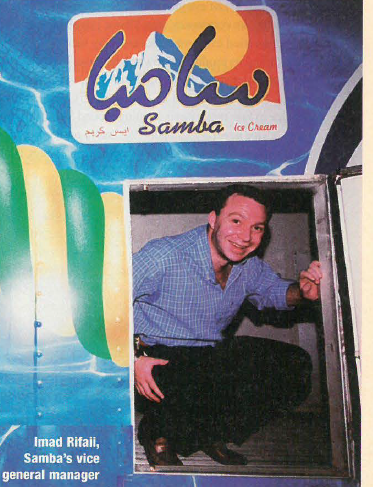
Four years ago, the Samba
ice cream factory in the
Syrian city of Homs began operations,
rolling chocolate-covered ice
cream bars off its modern assembly
line. Samba’s aim was to be one of the first makers of premium ice cream in the country.
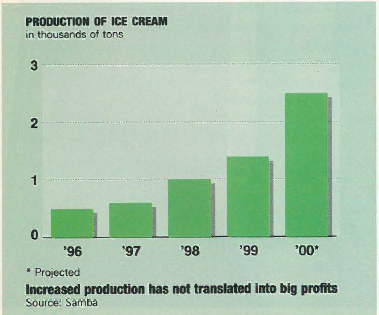
Production jumped from 600 tons in 1997 to 1,400 tons by 1999 with forecasts
at 2,500 for this year. The newly expanded factory is now working
around the clock. The firm’s national distribution network includes
35 refrigerator trucks and vans covering
7,500 points of sale with logistics and distribution
offices in Damascus, Aleppo, Al-
Jazira and Homs. Samba refused IP disclose its revenue. Using the official exchange
rate, sales for 1999 can be roughly calculated
at $4.5 million based on output and an
average price of SL10.
If the story sounds rosy, it’s not.
Expansion has not translated into big profits.
At about the same time that Samba went into
operation, no less than three other new companies
opened top-of-the-line ice cream factories
of their own: Muller, Carina and
Iceman. Carina, which enjoys a formidable
name in Syria. is a joint venture between Saeb
al Nahas and Hasan and Mohamed
Alameddine, the latter being owners of
Lebanon’s Cortina. Iceman, which entered
the market in 1995, produces about 3,000 tons of ice cream annually.
For Samba, the new arrivals meant that as production increased,
competition got stiffer. And with the onslaught of a nationwide recession,
reducing people’s purchasing power, the company had no choice
but to drop its prices. Profit margins shrank from around 15% to less
than 10% for ice cream companies, says Yihiya Talgabini, part-owner
of Muller. Iceman tried to counter that trend by increasing output,
while Samba shifted its production toward the lower end of the market.
When Samba started out, 60% to 70% of sales were in medium range
products (costing between SLI0 and SL15), whereas today
70% of sales are in low-range items (costing around SL5), says Imad
Rifaii, Samba’s vice general manager. “We had to reduce our prices
outside the city, where the purchasing power is lower,” he says, adding
that increased availability of other products created more competition.
“Of course, profits went down with falling prices.”
But there was even more competition for Samba at the low end of
the market. Ice cream has traditionally been produced for mass consumption
in Syria rather than for a premium
clientele. Hundreds of mom-and-pop
type operations manufacture mostly
Arabic ice cream manually. Few have bothered to upgrade their production line
but together they control 30% to 40% of
the market. Al Mees is one of the more
innovative of the traditional Syrian ice
cream companies. The firm started operations
in I %2, producing ice cream manually
until 1980, when it introduced new
machinery. Al Mees claims to have 5,000
points of sale and is planning to expand its
factory. ‘There are only about 10 factories
using machines and about 500 old factories
still making ice cream manually, 200 in Aleppo alone,” says Mohamed
Zoukeir, part-owner of Al Mees.
Focusing on the low end of the market
meant that Samba was forced to reduce the quality of raw materials
it imports such as milk, milk powder and sugar. “We use the same
suppliers but lower than premium quality without it much affecting
the taste for the consumer,” says Rifaii. The firm has also beefed up
its marketing effort. Samba spends about 10% of its sales each year
on advertising-60% on TV ads though the company also uses billboards.
Today, Samba offers more than 40 different ice cream products
in a wide range of flavors.
But probably one of the biggest challenges Samba faces is the limited
Syrian market. Ice cream consumption in Syria is among the
lowest in the region. The average Syrian licks up a mere one kilogram
of ice cream per year, partly because of the absence of large
supermarket chains. The Lebanese, by contrast, gorge themselves,
with a annual per capita consumption of about nine kilograms, which
is still just half the level in Europe and a third of that in the US.
Syria’s Muller recently tried to enter the Lebanese market. But the
venture proved unsuccessful after it became entangled in a legal battle
with a local company. Al Mees is also contemplating moving into
Lebanon. “Muller entered and is now out, but we will follow
Muller’s move next year at this time, and we will compete on both
quality and price,” says Zoukeir. As for Samba, Rifaii says that he has
no plans to move into Lebanon, because that would only increase his
overhead and distribution costs with little effect on profits.
Eitl1er way, the situation in Syria is likely to get worse before it gets
better. New president Bashar Al-Assad is seriously talking about
economic reform, which might mean opening the country to more
imports, including foreign ice cream brands. Perhaps the time has come
for Syrian ice cream companies to team up. “Merging is a sound policy.
We can buy out small factories, improve their production and take
advantage of their market, but we haven’t studied that option yet,” says
Rifaii. He better get busy; times are changing in Syria.