Seven years ago, Imad Kreidieh,
founder and majority shareholder of
Allied Distributors, tried to capitalize
on Lebanon’s building boom by selling construction
materials and electrical supplies.
Business was not brisk, though. The company
had barely got off the ground when it
dawned on Kreidieh that he was on a road to
nowhere. Rather than packing up and calling
it quits, he scanned the horizon for new
opportunities.
The building boom was in full
swing, so why not go into real estate? He
decided against it. The tourism business was
beginning to look promising as well, but he
didn’t open a hotel. Used cars? No. Fast
food? Guess again.
Kreidieh found his pot of gold in something
a bit more titillating: lingerie. It’s sexy and
always sought after. So in 1993, when Allied
Distributors came across a faltering company
selling French-made J&Gils men’s
underwear, it wasted no time in scooping it up.
Making the jump between selling something
heavy-duty to soft and sensuous may
seem a bit extreme. But it’s this flexibility
that has made Allied Distributors successful.
Soon after, it invested the limited profits
earned from construction into another
four lines of European-made women’s lingerie:
Alfa, Gizella, Scandale, and
Nicholetta, as well as Boli Blue swimwear.
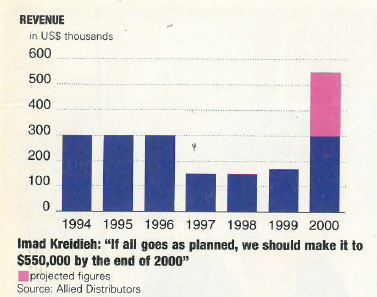
In 1994, the company was distributing to
12 retailers. Two years later, that number
jumped to 165 and the company had double-digit
revenues of more than $300,000. But in
1997, sales started to sag. Increased competition
and the economic slowdown saw
revenues drop 50% to $150,000. They
remained at that level into 1998.
Rather than hanging up the panties and
going into yet another new line of business,
Allied downsized in an effort to reinvigorate
the company. Some employees were laid off
and the firm moved to a smaller office. At the
same time, the sales team was sent out to do
direct marketing with commission-based,
rather than fixed, salaries. The company
also turned on the marketing machine,
devoting 3% of revenues to advertising.
Those measures helped to push up sales to
$170,000 for 1999. For the first quarter of
this year, sales had already reached
$300,000. “If all goes as planned, we
should make it to $550,000 by the end of
2000,” says Kreidieh. That, while operating
on profit margins of
more than 30%.
But there are hurdles.
Competition is fierce.
“I can tell you who my
competitors are,” jokes
Kreidieh, “everyone
who sells underwear.”
That includes Hispaco,
the distributors of
Princessa and Telleno,
as well as Sindia, the lingerie branch of
Fattal, which sells such
big-name brands as Wonder Bra, Cacharel,
and Calvin Klein.
Kreidieh feels that his
prices, ranging between $25 and $50, are
some of the lowest in the business for mid-range
underwear.
Allied has aggressive plans to take on its
challengers. For the first time, the company is
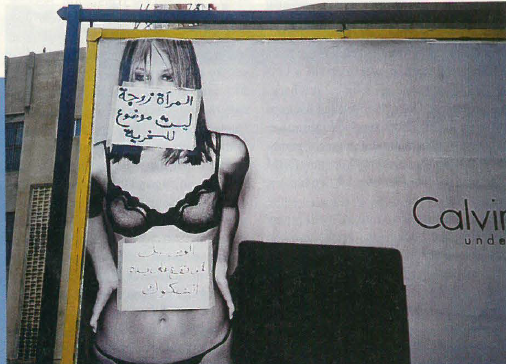
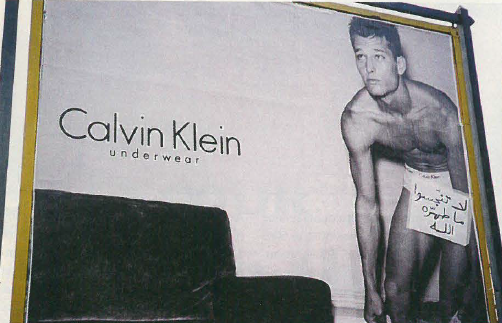
planning a billboard campaign (see box).
Allied is moving into Internet sales as well,
investing nearly $5,000 in an e-commerce
website. “I can buy planes and cars through the
Net, why not boxer shorts?” asks Kreidieh.
“It’s a marketing operation. I’ll be advertising my
products plus getting e-mails. I am concerned about
the young generation, who spend practically
10% of their time on the Net.”
Maya
Waked, business manager at Sindia, disagrees:
“Internet sales are an option, but it’ll
be difficult for lingerie,” she says. Sindia
dedicates 10% of its budget to advertising,
mostly through magazines and billboards. In
its latest campaign, the company inserted
over 100,000 brochures in daily newspapers
and handed them out in movie theaters.
But Allied has another big plan to inflate
revenues. The company will be forming a
joint venture with Afra, one of its suppliers,
and opening its own manufacturing factory
in Tripoli by 2004. By manufacturing
locally, Allied will avoid paying customs
duties, which are at 40%, and be able to
lower prices. “The one who can control his
costs will win,” says Kreidieh.
With the
new machinery, Allied will also be able to
add new lines of products to its collection,
such as babydolls, pajamas, and men’s lingerie,
and broaden its selection of colors
and designs. The company even hopes to
export to the United States and Japan.
What’s next on the list? With Allied Distributors,
you never know — and that’s what
makes the company tick. Flexibility is key
in an economy that is as unpredictable as
Lebanon’s. Who knows, before long we
might be able to walk into a supermarket
and buy edible underwear that tastes like
Kamar El-Din, courtesy of Allied.