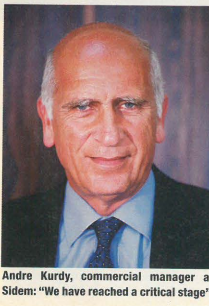
Last year was tough for Sidem. Having long dominated the market for aluminum profiles, the company barely managed to break even. “We have reached a critical stage,” says Andre Kurdy, commercial manager at Sidem. That follows half a century of turning profits, leaving management perplexed as to how to turn its fortunes around. “In our industry, Sidem is a trademark,” says Rafik Azrak, CEO of Folda, which manufactures and supplies aluminum-based products and had a turnover of $8.4 million in 1999. “They’ve enjoyed a monopoly for so long. They didn’t feel the day-to-day competition and may have inherited a heavy structure.”
Sidem, an extruder of aluminum profiles (extrusion involves pushing aluminum cylinders through pre-shaped molds to create architectural profiles of different shapes and sizes) used in the manufacturing of doors, windows and curtain walls, dictated prices until 1995. But cheaper imports, the arrival of local competitors and reduced tariffs with Arab countries combined to push prices into a further decline, a trend that had already begun in 1990. Having operations at full capacity, high exports and about $55 million in annual sales have not been enough to secure profits.
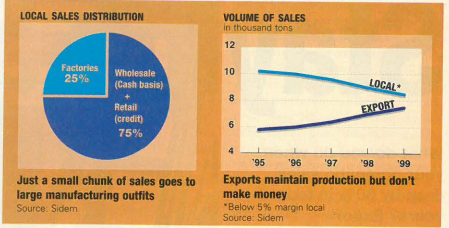
The local demand today is an estimated 12-14,000 tons. Already that’s not enough to absorb Sidem’s production of 16,000 tons. In fact, local sales dropped from 10,200 tons in 1995 to 8,500 in 1999. Now the two newcomers, Aluxal and Alutex, are competing for a chunk of the market. Having started production in 1994, Aluxal churns out some 4,000 tons a year. It sells to the retail market, which also accounts for 75% of Sidem’s sales.
The local market is further crowded by some 2500 tons of imported aluminum profiles, largely from Syria, Jordan, Saudi Arabia and Greece. That figure could have been much higher, had Sidem not systematically reduced prices to keep imports at bay. The company was protected by 20% customs duties on imports from Arab countries three years ago. However, the Arab free trade agreement has brought the tariff down to 14%, to be followed by a drop to about 12% next year, while the bilateral agreement with Syria has cut the duty to 10%.
With the Lebanese market so competitive, Sidem has increased sales abroad, sending half of its production to Europe. But exports are not a money-maker. “The purpose of exports is to keep our factory working at full capacity, which reduces our cost per unit, creating an indirect saving rather than profits on the product itself,” says Kurdy.
The main factor for the decrease in local sales is the stagnant real estate market, bloated with 7000 empty units and a 60% drop in construction permits. Folda, which bought an average of 545 tons a year before 1999, says its purchases have dropped significantly.
As a result prices have been slashed from $4,000 to about $3200 per ton in the local market today. Imports cost $2600 per ton, but many local clients say they still prefer to deal with Sidem because of its proximity to the market, its reliable quality and service. Many imports are below standard specifications. The downturn is difficult to swallow for a company that was the region’s first to specialize in aluminum extrusion, even if it is still the dominant player on the market.
Sidem began in the early 1950s with rolling mills producing aluminum sheets. In the early 1960s, it entered a joint-venture with Pechiney, the world’s second largest producer of aluminum, which purchased an 80% share. Also a manufacturer of extruded profiles, Pechiney sold its stake to the current Sidem shareholders in 1980 because of the war. Since then Sidem has remained fully Lebanese-owned and worked in aluminum extrusion. Believing the war was reaching an end and anticipating a construction boom, Sidem in 1982 embarked on a $10 million investment to double its capacity.
By 1986 the company found itself with three presses and production capacity of 16,000 tons and a country still at war. The short-lived solution was to send 60% of its production to the region. By the mid-80s, customs barriers were fully erected due to rapid regional factories, and the only alternative for Sidem was to go to Europe, a market of some 2 million tons yearly.
Though no longer partners with Pechiney, Sidem was able to take advantage of the earlier association to gain credibility. Additionally, Sidem won the right to manufacture Technal designs under license in 1980. France’s Technal is among the top five extruders of window profiles in the world. “It was our main entry break into Europe, because it means we’re producing under high specifications using the highest of technologies,” says Kurdy. Starting in Italy, the company expanded operations into France, Germany, Holland and the UK. Exports to Europe grew from 2000 tons in 1990 to about 7500 tons today, and Sidem stays competitive by investing $500,000 to $1.5 million yearly to upgrade machinery and install new technologies.
But how will Sidem manage to make money again if its local margins continue to be squeezed and exports aren’t profitable? Sidem cannot compete in the Arab world; energy and labor costs are half what they are here, and governments provide subsidies to encourage exports. Here the government is full of promises but rarely comes through. Additionally, other governments assist industries in recycling or disposing of their waste. There are no such solutions for Sidem.
Sidem, Folda and others have been asking the government to at least restrict the import of cheap products that don’t meet specifications, such as a 4mm thick window profile, which will bend easily in normal wind conditions. “This is not allowed anywhere in Europe or even as close as Syria, but anyone can import those into Lebanon,” says Azrak, adding that since aluminum is priced by weight, the thinner the product the lower the price.
If Sidem was thinking of expanding operations in preparation for the Arab free trade zone, it will find itself at a disadvantage to other factories. “We have a plan to move our operations from our 55,000m² area to a 200,000m² area, where we could increase capacity to 25,000 tons, but we don’t see the right conditions to proceed [with the $40 million investment],” says Kurdy. Sidem might be able to increase margins by streamlining operations and reducing its staff of 500. So far there are no indications that the company is contemplating that option. Sidem is feeling the heat. It will have to make some tough decisions soon if it’s not to go from a year of zero profits to one of losses.