So Lebanese industry has a checkered past; that doesn’t mean there are not some truly decent operations out there. Bassile Freres is one of them. From a tiny outlet in Hazmieh half a century ago, this modest binding company has become one of the major players in the local stationery manufacturing industry.
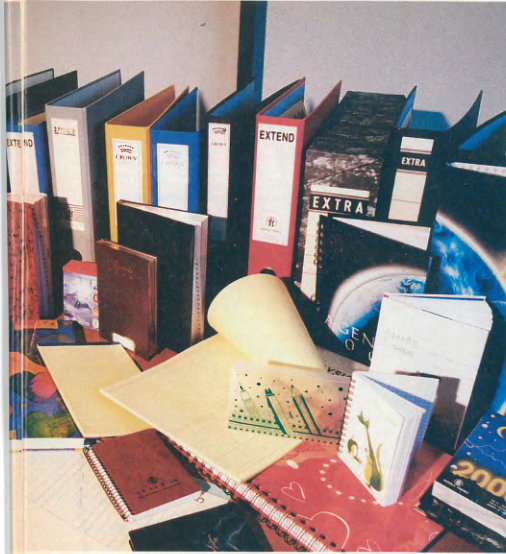
Bassile’s market is school and office supplies. It is so dominant in the latter that competitors such as Stationers, a school supplies importer, and Oriental Paper Products, a local school stationery manufacturer, call it a “monopoly.”
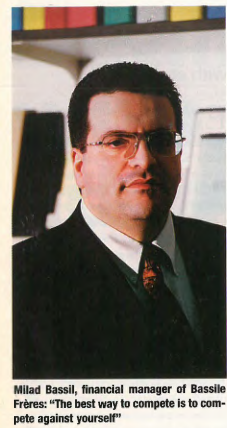
Milad Bassil, the company’s financial manager and one of the eight current owners, is more modest. “Though statistical data is lacking in our line of business, I can safely say that we have a fair market share in office supplies and we are a leader in some 50 to 60 items. But I wouldn’t call that a monopoly.”
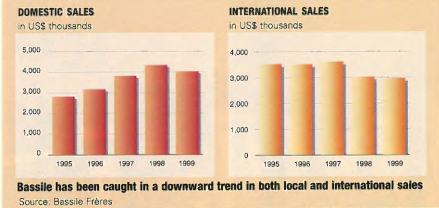
Picture perfect? Unfortunately not. Since the early 1990s, Bassile’s local sales have been growing at around 15% annually, from about $2 million in 1993 to $4.4 million in 1998, with exports adding a respectable $3 million. That, however, is the catch. The export market used to represent 75% of Bassile’s sales during the war years, but has been in a steady annual decline of 5-8% for the last five years.
Cheap stationery imports from Indonesia and increasing industrialization in the region have exposed the uncompetitive operating conditions for Lebanese industry. Fadi Bekdash, for example, was once a part-owner of stationery manufacturer OPP but left five years ago to concentrate on importing from Indonesia. Now the general manager and part-owner of Stationers, Bekdash doesn’t miss the manufacturing side of the business. “The local manufacturing industry is not much appreciated by the government or the consumer,” he says. “Although equal in quality, people would rather buy imports.”
And now with the recession biting, Bassile’s total sales have dropped by 5% last year, $4 million, with a corresponding 3% drop in its net profits.
The timing wasn’t good. In 1997 it embarked on a $6.5 million investment strategy to solidify its position locally and compete regionally by adding 3,500 m² of warehousing space, renovating and increasing manufacturing capacity and expanding printing operations.
So while GDP growth slipped from around 4% in 1996 to an estimated -1% in 1999, Bassile’s new machinery came online in the first six months of last year. The result was stacks of inventory it could not sell. In 1998, Bassile’s stocks increased by a typical $400,000 between January and the end of September. But during the same period last year, inventory jumped $1 million in preparation for the school term and business.
To make matters worse, in the second half of the year last-minute buyers, who represent 10-20% of Bassile’s business, did not come through. That brought the company’s extra inventory to $400,000 near the end of 1999. Bassile froze its investment program with only two-thirds complete and cleared $130,000 worth of products at 20% of their market value, around $22,000.
Adapting to these conditions has meant big changes. Most importantly, Bassile introduced a whole new brand last year called Quest. “The best way to compete in these conditions,” says Bassil, “is to compete against yourself.” Although the new brand covers the company’s traditional product range such as files, indexes, account and office books, school notebooks and diaries, its target is different.
Instead of focusing on good quality items with standard specifications and constant prices for all his clients, Bassile will target the low-end buyer. Quest uses 60-gram paper instead of a good quality 80-gram paper, uses smaller-sized paper instead of A4 and lower quality binding and covers. “If people today cannot afford good quality stationery, I’m giving them a choice. We cut corners here and there and offer cheaper prices, even giving discounts for large orders,” says Bassil. “And since the product doesn’t carry our name we protect our image.” The brand now represents 8% of Bassile’s total sales.
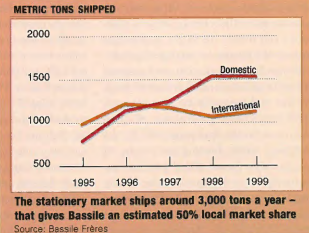
And although Bassile’s investments did not come at the best time, they have helped it cut costs by improving on efficiency. In order to satisfy its yearly production of some 2,674 metric tons of products, an employee earning $300 and producing 4,000 items daily can now earn $500 and produce 10,000 items using the new machinery. Speed of production also goes towards better servicing of clients. For example, it used to take the company one month to produce 10,000 notebooks, but now an order of 10,000 privately labeled notebooks can be delivered within one week. Bassile’s competitors have not had that luxury for lack of serious investments in that type of machinery.
Bassile could go a step further by dropping unnecessary employees to compensate for overproduction or to cut costs even further, but it won’t. “We don’t have the heart to do what it takes, which is send a few employees home and stuff like that,” says Bassil.
Additionally, the company needs to compensate for the high hidden costs of storing raw materials and finished products, which run at 25-30% of the total cost. Bassile uses around 800 different types of raw materials, such as paper, plastics, glue, steel plates, just to name a few. Company suppliers have not been able to commit to just-in-time delivery, where the material gets used at the same time it is needed. So when looking at the aggregate between raw materials, storage and finished product stock, they end up with a 1.1 turnover ratio, ratio of goods sold over raw materials and finished goods in dollar value. “For us that ratio is too low, because the quality of some paper adhesive deteriorates, and paper products get damaged from moving equipment for lack of maneuvering space,” says Bassil.
OPP, on the other hand, is fully aware of cost cutting and has set out a plan to streamline operations and management to cut costs by 5% a year, even if it means reducing the labor force while trying to maintain the same efficiency.
OPP approached the economic slowdown differently. Instead of investing heavily in its core stationery manufacturing business, it put money into diversifying. It decided not to build more on producing seasonal goods that create a lag time, but rather move into year-round products. OPP invested $500,000 in 1997-98 to produce computer paper, using available space within its factory. It quickly grabbed about a 20% share of the market, competing with four other producers. It also invested in a sheeting and cutting business, which cuts reels of paper into standard-sized paper used, for example, for photocopying.
Bassile is still standing strong with a wide customer base of about 450 clients, mostly bookstore owners, but also small businesses, banks, insurance companies and other stationery wholesalers, both locally and abroad. It now distributes directly to its customers, doing away with the distributors it used to rely on. This came about partly because it could not reach some areas during the war. In order to maintain a constant price, the company used to take 2% out of its profits to compensate for the distribution costs, but not anymore.
Bassile has also done well in financing half of its investments. While 50% was self-financed, Bassile utilized the Arab Trade Finance Program (ATFP) to secure investment at an interest rate of Libor + 1.5%, now around 6.5%. By comparison, OPP resorted to local bank financing for its expansion program at rates of 8% or more. And for once, some outside forces were there to help Bassile’s business. After a five-year fight lobbying the government, customs on stationery imports went up by 50% last year.
If the economy improves, Bassile will benefit. The company is highly liquid, having the benefit of using the ATFP fund. This is a revolving credit line that finances the company in an amount equal to 80% of its export invoices any year it wants it. Still, OPP has a solid 40% market share in a business that grew with the generations of students using notebooks, note pads and school copybooks with OPP printed in bold.
It might be a good idea for Bassile to concentrate on its strengths in supplying office stationery. Will its ‘monopoly’ be broken up?