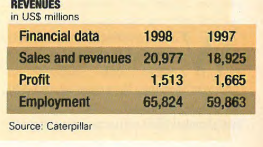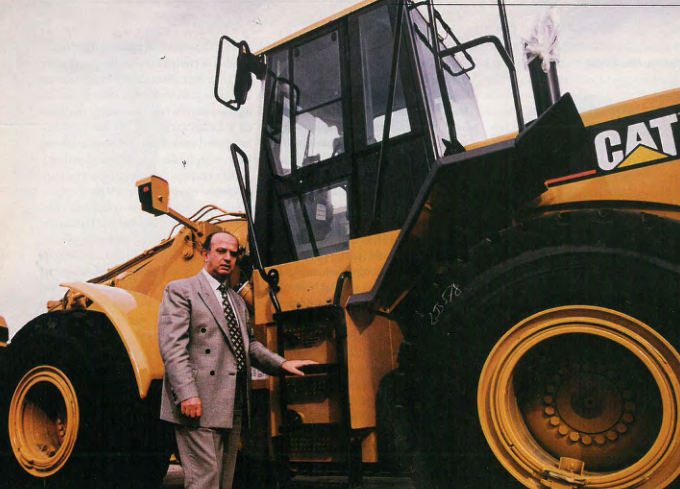
What’s big and yellow, rips up the ground, flattens the earth and breathes fire? Caterpillar, the world’s leading brand in construction equipment. Okay, it might not breathe fire, but it is one tough piece of machinery. The quality and endurance of the Caterpillar product line, which includes everything from excavators and loaders to trucks, tractors, forklifts and a diverse range of engines, are the reasons behind the success of the company and the record sales it has had for six consecutive years. Sales and revenues for 1998 totaled almost $21 billion worldwide, a record for the company, although the first nine months of 1999 showed a drop of almost 5.6% over the same period of 1998.
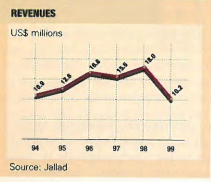
Business for M. Ezzat Jallad & Fils, the agents for Caterpillar in Lebanon, Syria and Jordan, has taken a much sharper turn for the worse. The company’s revenues from the Lebanese market had been rising steadily from $10.9 million in 1994 to $18 million in 1998, but 1999 was a disappointment. Business dropped 43% from the previous year, plummeting to $10.2 million. Even business in Syria and Jordan, both potentially far larger markets than Lebanon, has seen better days. So what has so dramatically affected Jallad’s sales?
In Lebanon, the weak economy and government deficit are the main factors that have hurt the company’s construction equipment side of business. While gross domestic product shrunk by 1% in 1999, according to the Economist Intelligence Unit, the government’s efforts to reduce the deficit included putting a freeze on most public construction projects. This forced contractors to focus more on private projects, such as building and renovation works, where heavy construction equipment is used less.
“The drop in demand is tremendous,” says Walid Tamari, general manager of Michel Sehnaoui and Sons Plant Division, which also deals in construction equipment. “As long as the government has funding problems, the slowdown will continue.”
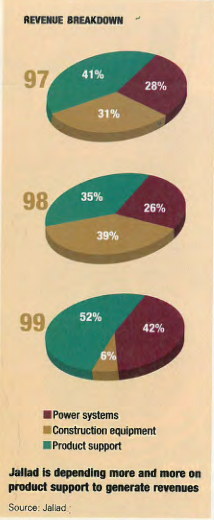
Jallad’s revenues from sales of construction equipment, about $7 million and 39% of total revenues in 1998, nosedived by more than 90% to some $600,000, a mere 6% of 1999 revenues. And despite taking up a greater proportion of total revenues, from 28% in 1998 to 42% in 1999, total sales of generator sets dropped by almost 10%, down from $4.68 million in 1998 to $4.28 million in 1999.
Sales of generators have been adversely affected by the same factor that has hit the construction equipment side of business: projects in Lebanon are dead. On top of the smaller demand for generators, especially since the days of erratic supply of electricity seem to be behind us, there are more players taking a chunk of the $35 million-a-year business. One such firm is Saccal Power Engineering, a local assembler of generator sets that launched in 1987. By 1998 it had grabbed around 10% of the market with a turnover of $3.7 million. Jallad claims to have a 22% to 25% share of the market for generator sets.
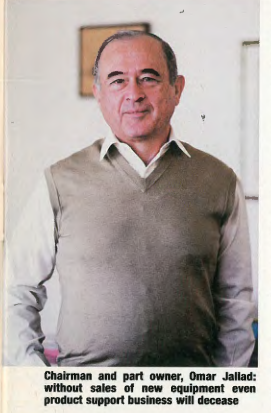
The only side of Jallad’s business that is doing better is its product support. Here revenues climbed nearly 50% from $6.3 million in 1998 to $9.36 million in 1999. But this doesn’t come as a surprise. If contractors aren’t purchasing new equipment, they’re maintaining the ones they already have, and since maintenance requires the replacement or repair of parts, this boosts Jallad’s revenues from its product support department. “Without sales of new equipment,” says Omar Jallad, the company’s chairman and part owner, “even this will decrease eventually.”
In 1997, revenues from Jallad’s business in Jordan surpassed revenues from the local market, but 1999 was disappointing even abroad. The combined revenues from both Jordan and Syria barely equaled that of Lebanon, and an upturn isn’t expected soon. “As long as the Syrian government doesn’t receive funding for public construction projects,” says Jallad’s chairman, “we can’t expect business to pick up.” It’s a shame. The volume of business that Syria is capable of putting Jallad’s way could make that from the Lebanese market seem trivial.
The same goes for Jordan. Phosphate mining has not only become a major contributor to Jordan’s economy, but that same mining created the demand for Jallad’s products. Now, with Jordan’s economic slowdown, Jallad’s business there has also dropped significantly, especially after 1997.
But what can Jallad do to face this slowdown? It can’t really diversify. The most it can do in this regard is to push sales of related products such as forklifts, a strategy Sehnaoui is trying in order to offset the drop in demand for construction equipment. “We are turning our attention to warehouses that use products related to our existing line,” says Tamari. Although that might generate some income, it can hardly compensate for the lack of sales of heavier equipment.
Furthermore, competitors in generator sets such as Saccal, Jubaili, and Ghaddar have an option not open to Jallad. They can export. In fact, these companies have been able to increase their business dramatically through exports. Since April 1999, Saccal landed two contracts with the Iraqi government totaling $8.75 million, or about 240% of 1998’s turnover. Ahmad Rajah Jubaili, a local assembler for FG Wilson generators, has exported to Nigeria since 1997 and to Iraq since 1998.
Ghaddar, assembler of Perkins and Leroy Somer generators, has been present in the international market for ten years and has an annual turnover of over $5 million with contracts in Africa, Dubai, Iraq and Kuwait. But with around 200 agents worldwide with the exclusive representation for Caterpillar products, Jallad can’t market its goods anywhere besides Lebanon, Syria, and Jordan.
But Jallad does have some advantages going for it. Brand power has been instrumental, especially since Jallad is no longer the only supplier of heavy construction machinery. “What makes Jallad number one in generator project sales is branding,” says Maher Saccal, CEO of Saccal Power Engineering. “This makes a difference with clients.” Hasan Ghaddar, owner and CEO of Ghaddar, agrees. “We cannot compete against Jallad who has had the Caterpillar name for over 70 years.”
Some projects executed by Jallad include supplying the American University of Beirut, the Indevco power station, the Beirut International Airport, Ghandour Mills, Liban Cables, Pepsi Cola, Coca Cola, and Casino du Liban, with $11 million worth of business just from the first three.
Brand power helps give Caterpillar products an edge despite higher prices than competitors. “Caterpillar products are 20% to 100% more expensive than others in the market,” admits Emile Copty, Jallad’s general manager. Due to low operating and maintenance costs of the machines as well as a relatively high resale value, Caterpillar products are a good investment in spite of the hefty premiums. One example was a 25-year-old machine that was recently resold for $30,000; its original price tag was $50,000. A new one now costs about $250,000, so considering the machine’s age and the need for repairs, the resale value is good.
Nonetheless, Jallad has already taken steps to become more competitive on pricing for generators. For example, a 1,000 kVA generator, previously priced at $150,000, can now be purchased for $120,000, not much more than $110,000 for the same output product offered by Ghaddar. “Selling at the same price, and backed by discounts from the supplier, he will get the deal because he is Caterpillar,” says Ghaddar.
Today’s market requires different marketing tools. “Before we used to just negotiate the price with the client,” says Copty, “but the consumer is no longer satisfied with a standard product that he can just walk in and buy.” Jallad increasingly uses tools such as operating cost per hour, life cycle costing, and productivity to persuade a client to buy. Since many clients don’t know how to assess the requirements involved in obtaining the right tool for a project, they solicit the dealer’s recommendations.
And Jallad has been quick to integrate that service into its operations. “We now perform five studies for every ten projects as compared to before, when it was one for every ten,” continues Copty. The Indevco plant in Halat, which Jallad supplied with two Cat 3616 generators, each rated 4,200 kW at 1,000 rpm, required six months for study and installation. Caterpillar engines were chosen after studies by 18 different suppliers were considered.
Jallad ensures that stock of the most popular goods never falls below a minimum, 97% of most spare parts are now on hand. Even the stock of heavy construction equipment, though now reduced substantially, still includes the most popular machines ready for delivery. While Jallad also manufactures soundproof chambers and control boards for the power generators, not to mention all supporting equipment and installation, it’s not alone. Local manufacturers like Saccal do the same.
Basically Jallad is in still waters without a paddle. “We will have to suffer,” says Copty, “for the next few years.” All they can do is maintain a solid reputation, whilst taking as big a chunk of the generator market as possible. Having survived as Caterpillar’s Levant dealer for more than 70 years, Jallad should be able to hang on until things get better.
Global operations
Caterpillar Inc., the world’s largest manufacturer of construction and mining equipment, as well as diesel and gas engines, is a Fortune 500 company with $26.5 billion in assets at the end of the third quarter of 1999. Following record revenues of $20.98 billion in 1998 and profits of $1.51 billion, last year brought some slippage. At the end of the third quarter, revenues totaled $14.68 billion versus $15.57 billion for the same period of 1998, while profits were just $707 million, down from $1.2 billion. With a reputation for manufacturing rugged machines that set industry standards for performance, durability, quality and value, the Illinois-based firm, one of a handful of US companies that leads the industry, had clocked in record highs for six consecutive years.
In the past five years, Caterpillar added 88 facilities to its assets, such as warehouses and manufacturing plants, acquired 20 companies, and entered 17 joint ventures. In addition, it introduced 244 new or improved products, with 44 of them introduced in 1998, when revenues climbed by 46% and profits by 58%. Engine sales increased by 37%, a result of recent acquisitions, while the ensuing $6.5 billion in engine business accounted for a third of total sales.
Caterpillar records more than half its sales to overseas customers, with export sales of $6 billion in 1998. Its products are sold in nearly 200 countries through a network of 195 dealers, 131 of which are located outside the United States. Much of its success and reputation has resulted in customers that have remained loyal throughout the years, with 80% of the company’s sales coming from repeat customers.