
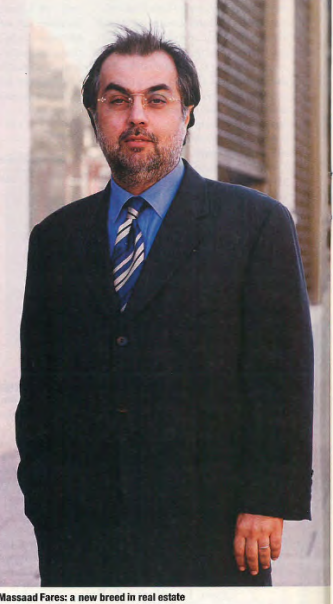
“I’m not really a developer,” says Massaad Fares.
Neither is he a broker and he has no background in
construction. His own, stylish office at the bottom of
Rue Foch is far from the image of a samsaar (real estate broker).
So what is he? “I am a technician,” he replies. Fares pinpoints
demand and finds the liquidity to produce the supply: he doesn’t
supply unless he has good reason to think that demand exists. Meet
a new breed in Lebanese real estate agents. For Fares, real estate
is not so much concrete as cash flow: location is not something to
stick a sign on, but just one part of a package.
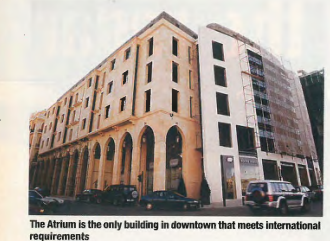
Fares is the man behind the Atrium, “the only building in downtown
that currently meets international requirements,” says Michael
Dunn of the international consultants Healey & Baker. The reason
is simple. Besides its prime location on the corner of Weygand and
Maraad, the Atrium offers the only large, open-plan offices in
downtown. Hence, the Atrium’s 6,000 m² of offices and 3,000 m² of
retail are selling at some of the highest prices in Beirut. Fares studies
demand first. This, in itself, makes him different from many in
the market where it is estimated that there are more than $8 billion
worth of vacant apartments and prices are not adjusting to decreasing
demand. “The real estate sector in Lebanon is marked by several
inefficiencies, with a notable mismatch between supply and
demand, [and] sticky prices despite the current slump,” reads an
HSBC report released last summer. But the dark cloud has a silver
lining. “Despite the inefficiencies,” the report says, “the market hides
some profitable opportunities.”
Unlike some developers who threw up buildings willy-nilly during
the country’s post-war boom, Fares spent nearly a year doing his
homework. He looked at many locations in downtown before settling
on plot 448, housing a burned-out building at the junction of
Weygand and Maraad. The site had some important advantages. “It
was across the street from the souks and adjacent to the banking street.
I thought that if the banks came back, the area of their expansion
would be Maraad-Foch-Allenby,” he says. More importantly,
unlike elsewhere in the locality, Solidere had no plan to renovate the
building. Fares would not be constrained by the existing structure.
Fares realized that large open-plan offices, suiting the up-to-date
requirements of many international companies, would be rare in
Beirut Central District, at least until new purpose-built buildings
appeared much later elsewhere in downtown. Many of the available
plots in Maraad-Foch-Allenby were 200-400 m²; plot 448 was
fully 1,560 m². “There are customers for black shoes and customers
for white shoes,” says Fares. “Small offices might be suitable for
architects but not for brokers, it depends on the kind of business.
Many people don’t want to be going up and down floors every
time they need to speak to a colleague. Modern companies like purpose-
built offices where you can easily put in dividing walls or take
them away.” Another important component that is next to impossible
in restored buildings is the amount of underground parking,
150 spaces on four levels.
Fares carried out a tour de table to raise the capital from Saudi and
Lebanese investors for the Atrium, under the holding company
Prime Group, of which he was managing director with two partners.
The Atrium bought the land in September 1996 for $8 million, the first
plot that Solidere sold. The building’s design, by British architect Terry
Farrell and Lebanese Nabil Azar, was based around an atrium, an
empty, central vertical space that allows light to reach everywhere
inside. But if the product was good, the timing was far from ideal. Enter
recession. Real estate prices had already peaked by 1996, and demand
was falling by the time downtown came on stream. “The recession of
1999 was at the worst time for us, just as we were delivering,” says
Naaman Atallah, Solidere’s real estate sales and leasing manager.
Land and construction costs for the high-tech Atrium were $22 million,
putting Fares under pressure. “The economic downturn made us
a little nervous,” he admits. But, having done his homework, he is in
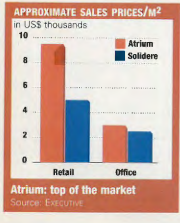
better shape to survive the hard times than other developers. All the retail
at the Atrium has been sold at a top price of $9,500 per
m², around double Solidere’s
target figure for downtown.
Circle Hitti’s move to the
Atrium from Verdun was a
huge boost for the downtown
as a whole. Most of the
Atrium’s retail has gone to
jewelers keen on its location
opposite the gold souk.
Jewelers have also taken the
bulk of the first-floor offices,
usually in lots of 300 m².
Fares is negotiating with Merrill Lynch over one whole floor, and with
a “leading British company” on another. His list price for office space
is $3,000 per m², some 17% above Solidere’s target prices. Two months
ahead of the building’s June hand-over, sales have not been as fast as
Fares once expected, but good considering the vast amount of empty
real estate across the city. “There are too many amateurs around. We
are having fewer inquiries now, but they’re more serious, for example
from large advertising and insurance companies. I think we’re looking
at an internal rate of return over five years of 26%.”
Fares’ next project seems as startlingly obvious as the Atrium.
He has bought a plot of land next to the new HSBC building in
Minaa El Hosn, in the vicinity of the St Georges and the
Phoenicia hotels, where he will construct a block of furnished
apartments for short-term let. The target market will be foreign
business people on assignment, consultants, for example, and
expatriates returning home during the summer. The 20 units will
be both one-bedroom and two-bedroom. Its total floorspace will
be 2,300 m², including retail on the ground floor, and it will have
1,000 m² of underground parking. To buy the land, Fares had to
track down 14 different people who had inherited it from the two
deceased original owners. He won’t disclose exactly how much
he paid for the property, but he concedes it was “close” to the
Solidere asking price, which is $1,050 per m² of built-up area. This
would put the purchase in the region of $3 million plus at least
another $3 million for construction.
Fares is optimistic that he will
recoup his costs. “Furnished apartments fetch up to $150 a day. On
an optimistic scenario, I will recoup the money in five years. On
a pessimistic scenario, it will take seven.”
Fares’ next projects are likely to take him further away from what
is seen as “real estate” in Lebanon. Fares plans on moving more into
asset management for large property owners. He believes there is
potential too in working for banks, especially where they have taken
real estate as security for lending. “We can clean up portfolios,” he
says. “Banks often don’t have this expertise in house. I managed
portfolios in Europe and the United States. I want to enhance our
base of clients.” Another area he wants to expand is sales and marketing.
Prime Group marketed Mouawad Group’s 1,200,000 m² of
land at Tel al Ghazal, above Jal al Dib. Most was sold as plots of
land, but Prime also marketed Parc Jaden, Mouawad Group’s
residential project on part of the land, and successfully sold all the
units (apartments between 200 m² and 350 m² at $800-$900 per m²).
Successful businesses are not afraid of change. The Atrium will
be the last project under Prime Group. The shift away from construction
towards sales, marketing and portfolio management
means the three partners are parting company. Fares will continue
working with Samir Barraj in Prime Realty, the holding group for
the Minaa El Hosn furnished apartments project, while Joseph
Mouawad leaves to continue work more closely linked to construction.
Fares’ emphasis on movement and flexibility is new in a
country where real estate has been seen as family-asset management.
“No developer should proceed just with his own money,” he says.
“They should leverage their investment, sell their mortgages and
move on.” For Fares, the future of real estate is as an investment vehicle,
and not as bricks and mortar.
