Imagine what would happen if 2,000 people were to wake up one day and find that they were out of work, 3,000 struggling farmers were to learn that their primary means of support had been pulled out from under them and 60 local businesses were to discover that their only customer no longer existed. This doomsday scenario suddenly seemed very real last month when the 26-year-old Consumer Cooperatives of Lebanon, the country’s largest supermarket chain, found itself in acute financial difficulty. “Co-op is easily responsible for the livelihood of 500,000 Lebanese people,” says Said Kalache, head office director at Co-op. At a time when the economy is at its lowest ebb, the food chain’s collapse would be a national disaster.
But were fears of ruin really legitimate? It’s rumored that the Co-op mayday call was no more than a politically motivated scheme cooked up by the government opposition to discredit the administration before the elections. “If people feel that their primary source of food, Co-op, is on the verge of collapse, they’re automatically going to point the finger at the government and in turn elect opposition candidates,” says one analyst. “The timing for this crisis, right at election time, is no coincidence.”
According to Kalache, Co-op is suffering from financial troubles but they have been blown way out of proportion. “We opened 11 new stores last year and refurbished a number of older stores,” he says. “We predicted that there would be an economic boom after the Israeli withdrawal, but that didn’t happen. Instead, the recession grew worse and people’s purchasing power dropped.”
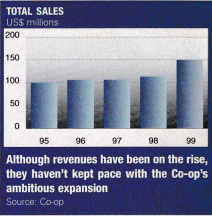
Co-op, unable to reach its sales goal, was faced with a cash shortage. The supermarket chain sells $150 million worth of products a year and usually averages $35 million in debt to suppliers, but this year the debt was $3 million more. “We have agreements with our suppliers,” says Kalache. “We usually pay them three months after we receive the merchandise. Since our sales figure had slightly dropped, we asked our suppliers to extend our payment deadline beyond three months.”
The suppliers agreed. But when rumors emerged that Co-op was on the verge of financial collapse, a large number of its 25,000 shareholders started furiously selling their shares back to the company. Co-op was forced to dish out $7.5 million of much-needed cash. Like Wall Street on that Black Tuesday in 1929, Co-op witnessed an unprecedented run on its stocks. Even the suppliers who had previously agreed to extend Co-op’s payment deadline were beating at the firm’s door demanding their money.
Co-op’s monetary problems snowballed into a huge financial crisis that threatened to impact the very core of the Lebanese economy. But Kalache says that the fears of imminent collapse are overstated. Co-op has $59 million in debt, he says. Of that, $38 million is owed to suppliers, with only $3 million to $4 million due immediately. Co-op also has letters of credit and bank guarantees amounting to $12 million due over several years and $7.5 million in real estate debts, none of which is due within the next three years. What’s more, even though Co-op’s debts stand at $59 million, its assets—valued at $76 million—far exceed its financial obligations.
For the moment, says Kalache, there are no plans to close down any of the stores. But some departments, including clothing and household items, are going to be managed by private companies that will give Co-op a percentage of profits. This will eliminate some of Co-op’s expenses, including stock purchasing and payroll. The company has also temporarily stopped buying back its shares—a move that has irked some shareholders. In addition, the central bank has granted Co-op $5 million to help the supermarket get back on its feet. The company is also negotiating with the government for assistance.
Nonetheless, many find the whole story puzzling. “The company has a cash flow of $150 million a year so I find it strange that they’re facing difficulties,” says Ahmed Itani, spokesman for the Supermarket Owners’ Association. Co-op is offered unique privileges by local banks, such as payment deferral for a period of up to nine months and low-interest loans. The company also gets enviable financial breaks from the government. Unlike other supermarkets, Co-op doesn’t have to pay a registration fee whenever it buys a new store. And it is the only supermarket that does not have to pay a 15% tax on profits—it is recognized as a non-profit organization by the government even though it pays dividends to shareholders.
In times of recession, places like Co-op usually do well and even manage to turn a decent profit. People are financially strapped and spend most of their money on basic necessities such as food. But Itani does believe the supermarket chain is overextended. “Co-op opened 11 new outlets last year, and now they have over 45 stores,” he says. “That’s too many for a small country like Lebanon.”
Shawki Bou Khalil, co-owner of the Bou Khalil hypermarket chain, agrees. He believes that Co-op’s financial problems stem from poorly studied expansion plans. “It’s very expensive to expand,” he says, “and maybe Co-op underestimated how much it would cost to open new branches.”
The central bank assistance will come as a much-needed reprieve for Co-op. But, according to Nassib Ghobril of Lebanon Invest, the supermarket chain will still need to adopt some painful cost-cutting strategies, such as staff reductions.
Other food vendors stand to gain handsomely if the king of supermarkets were to disappear. A discount outfit like Co-op helps keep market prices down. And while most competitors are sympathetic to the company’s plight, some question why there is so much fuss being made about keeping Co-op afloat. A number of supermarkets have closed over the past year without the government batting an eyelid.
“Njeim, Le Message and Sunny Market are all closed now,” says Bou Khalil. Idriss—a Lebanese institution that survived 15 years of war—had to shut down all but its original store in Ras Beirut. But Co-op is different, says Kalache. The supermarkets that have closed, he says, did so because they were either unable to repay debts or were not turning a big enough profit.
Co-op’s goal is not to make larger profits, but rather to sell merchandise at the cheapest possible price, cover its own expenses and pay dividends to its 25,000 shareholders, says Kalache. Either way, with Co-op being such a big cog in the Lebanese economy, the government is not about to let it fail. This is, after all, an election year.