As the saying goes, build your house on stone, not on sand. Arabian Mining Habre (AMH) has taken these words of wisdom a step further by building on marble. But these days the company’s fortunes appear to be resting on quicksand, with revenues and profitability sinking since the mid ’90s. After watching revenues jump from $80,000 in 1982, to $6 million in 1995, the first marble block sawing mill in Lebanon saw revenues recede to $5.21 million in 1999—a 15.1% decrease. Today, the company, which has been in business for almost half a century, is barely breaking even.
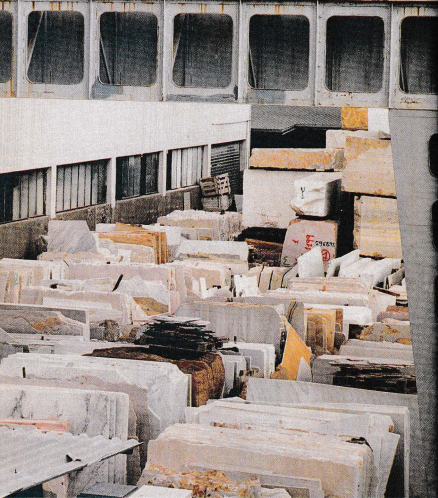
Maintaining a firm footing on marble isn’t easy when the construction industry is stuck in a slump set to last for the indefinite future. Since 1995, the number of construction permits issued by the government have dwindled to a fraction of those issued during the short-lived boom at the end of the civil war. An estimated 6.2 million m2 of land was authorized for construction in 1999—that’s less than 20% of the figure for 1995. With a shrinking market, competition between the nearly 430 local granite and marble factories (only about 100 are considered to be reputable) has increased. Such are the market conditions in Lebanon that those who barely manage to cover their costs feel they are doing well.
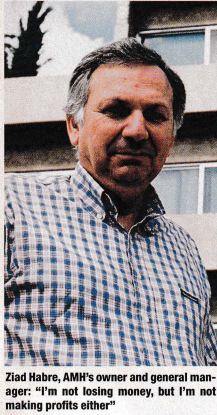
“I’m not losing money,” says Ziad Habre, AMH’s owner and general manager. “But I’m not making profits either. As long as I’m covering my costs, I can continue indefinitely. The ones who do get hurt, however, are the shareholders.” Salim Marj, general manager of Societe Ibrahim Salim Marj, a competitor of AMH, agrees that times are tough for those in the granite market. “It’s a buyer’s market,” he says. “It’s the customer that is setting the prices and the suppliers are adapting accordingly.”
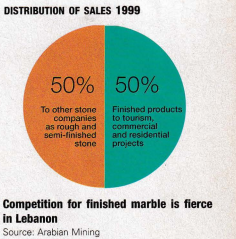
But there are other problems as well. About 50% of AMH’s sales are in rough, semi-finished granite, which the company then sells to other stone companies. Finished marble accounts for the remaining 50% of sales. AMH imports the stone blocks, processes them at the company’s factory in Kahale and then cuts them to standard size and finish. The problem is the steep manufacturing costs in Lebanon.
With high import taxes on raw materials combined with the high cost of electricity, fuel and labor, AMH’s finished marble ends up costing more than the imported variety. This has been particularly troublesome in recent times, as cheaper imports have flooded the market. The Syrian-Lebanese free trade agreement has brought cheap Syrian marble into the local market. And there is even stiffer competition coming from Turkey, Spain and Italy.
“People are buying foreign finished stones,” says Nadine Matta Bassil, the manager of Matta Trading’s decorative department. “It’s cheaper than local products.” But Lebanon’s marble companies do have one advantage, says Kamal Meine, an architect. “While the imported finished goods are more in demand than locally made products because of price, the quality is nowhere near as good as the locally cut stone. Quality control isn’t as rigid on imports.”
AMH has been fighting the effects of the slowdown by seeking out new business abroad. In five years, the company has increased exports by 500%, from about $132,000 in 1995, or 2% of sales, to nearly $780,000 in 1999—15% of total sales.
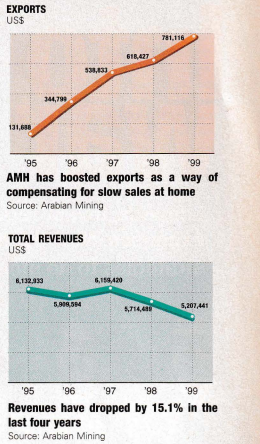
Unfortunately, not quite enough to offset the 26% slump in local sales, which dropped from $6 million in 1990 to $4.43 million last year. The company exports its marble to Italy, the USA, Australia, Kuwait and Egypt. Habre estimates that exports for this year will be around $1.2 million, constituting at least 22% of the $5.4 million in projected revenues.
One of AMH’s survival strategies has been to cut costs. The company reduced the cost of purchasing raw materials by bypassing the middlemen and buying directly from quarries. This helped AMH save as much as 20% on the purchase price of granite. But, due to the costs of transport, buying direct is only viable for large commercial projects, when the company needs to buy large volumes of stones.
Recently, AMH has also been targeting upmarket clients—those who are most able to afford marble in these difficult times. To win over that clientele, the company has become more finicky about the raw materials it uses, and is strengthening its quality control procedures.
“The wealthy spend a lot of money on luxuries,” says Habre. Marj concurs: “The Lebanese like extravagance. If they can afford it, they will usually pay more for the best available.”
But AMH’s strategy has its critics. Lebanese marble is not very competitive on the international market, explains Marj. So exporting, especially in this region, is tough. “In the 1970s, Arab countries needed us because they didn’t have their own factories. Now they have their own, and we can’t compete with them price wise. They pay less taxes, and production costs are much lower,” he says. “Habre is exporting, but the question is whether there is continuity in these sales or whether they are sporadic.”
But recently Habre’s business received a much-needed boost. The Israeli withdrawal from the south of Lebanon has opened up a treasure chest of new opportunities for businesses. “There are very wealthy families in the South,” says Habre. “When it’s time to build, they will want the better products.”
With approximately 5,000 southern homes in need of reconstruction, demand for granite will rise and Habre hopes to get his fair share of the action. He also expects that with suppliers in the South busy trying to meet demand in the former occupied zone, granite companies located further north, such as AMH, will be faced with less competition in their own backyard. That should help counterbalance the continued tight competition from imports.
In other words, the recent liberation of the South might just liberate Habre’s balance sheet as well. Something guaranteed to put smiles on the faces of his shareholders.