Switching from the import of cheap
products to higher quality and now to
projects, Power Tech surged onto
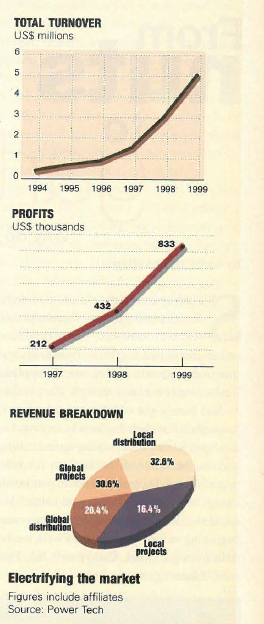
the battery market. Its turnover jumped
from about $250,000 in 1994 to $4.9 million
last year. In the last two years, gross profits
increased fourfold from $212,000 to
$833,000. Not bad for a company that
started out as an importer of cheap batteries
from the Far East. How did this newcomer
to a market saturated with established players
pull it off?
“In the early 90s, the market demand was
for cheap batteries,” says Salim Jean, a
retailer and wholesaler of batteries, “and
that’s what all the importers were bringing
in.” Others in the market concur that at the
time the market was largely flooded with
low-quality products. At the outset, Power
Tech was no different than anyone else.
As an upstart, it may even have been worse off.
“We had no idea what we were doing,”
admits Nabil Haddad, Power Tech’s director
of business development. Neither did the
company have any focus. It sold everything
from mobile phones to lubricants,
gasoline, and whatever cheap batteries it
could get a hold of.
The impasse came when the increase in
prices following the Asian recovery wasn’t
mimicked on the Lebanese market, says
Haddad. While profit margins can be
reduced, selling below cost cannot be sustained
for long. Power Tech discovered
many players were importing batteries
with a smaller amount of lead or the recycled
variety in order to reduce costs. That also
reduced the longevity of batteries.
Power Tech was discouraged. But rather
than following the others, this time the
company decided to go its own way,
importing products of higher quality and
emphasizing that as a part of its sales strategy.
By the end of last year, Power Tech had
captured 6.2%, or $1.18 million, of the $19
million market for automotive batteries — not
bad considering it has more than 50 competitors.
But it wasn’t easy, because retailers
tend to stock up on what’s cheap and
easy to sell. “Importers usually bring whatever
the market demands, and the market
demand is mostly for the cheaper products,”
says Ayman Yazbeck, part owner of
M. Yazbeck Ets. So Power Tech set out to
change the demands of the market. It also
began offering incentives to retailers, such
as larger profit margins and extended credit
facilities, while wholesalers were offered
bonuses at the end of the year.
But would retailers really be interested in
stocking up on batteries that cost more?
Some believe they would be. “A more
expensive battery has a greater profit margin,”
says Tony Hanna, owner of Luca, a
distributor and retailer of automotive supplies.
He also believes that with few outlets
selling quality batteries, a retailer will face
less direct competition. “Nowadays, with
people more capable of buying new cars
because of credit facilities, demand for
good batteries is climbing, although the
greatest demand is still for cheaper ones,”
says Hanna.
Now 53%, or $2.6 million, of
Power Tech’s business is in distribution,
including sealed lead-acid batteries used as
backup power for computers, fire alarms,
and security systems. The company also
stocks specialized batteries.
The other side of Power Tech’s business
involves providing the power supplies and
backup batteries needed in high-tech projects.
Although there are dozens of
importers and hundreds of dealers, only a
handful have the know-how that is
required in this field. For example, when
Ogero put a tender up for bid for backup
power on a project, 36 companies applied.
Only Power Tech was able to submit a proposal
that offered the specific system
required. Here Power Tech dominates the
market. Last year turnover from this side of
business was about $800,000, up from
$100,000 in 1996. Power Tech has a 14%
market share in telecommunications backup
systems and 24% in industrial backup
systems for products supplied to turnkey
projects by the original equipment manufacturer
(OEM). Its share of the non-OEM
market is 68% and 72% for the two sectors,
respectively.
Most projects are equipped with power
supplies and backup batteries from the
manufacturer. Cellis, for example, has 350
relay sites, each equipped with backup batteries,
all initially supplied by Ericsson.
Libancell has 320 sites, all initially handled
by Motorola. Ogero, originally supplied
by Siemens, Alcatel, and Ericsson, has
some 440 relay stations. Each of these sites
requires an average of $10,000 worth of
backup batteries. There are also the
telecommunications systems used by the
Lebanese army and the Internal Security
Forces. Cellis alone has invested over $3.5
million in batteries for its infrastructure.
These local companies and government
organs now figure among Power Tech’s
clients.
“When we were looking for a supplier,
Power Tech offered a very good price
and provided us with quality materials,”
says Antonio El Rami, head of the maintenance
department for radio and transmission
equipment at France Telecom. There are still
power plants, refineries, petrochemical
plants, and cement factories to be considered.
It’s a fairly big market for a few players.
In supplying backup DC power for projects,
Power Tech has several advantages.
On top of the scarce competition, it is able
to compete with international giants on
price. While the products come from the
same manufacturers, Power Tech supplies
the client directly. For example, Ericsson
Lebanon buys from Ericsson Sweden,
which in turn buys from Emerson in the
United States. That’s two intermediaries
before it gets to a client like Cellis. “But they
give us a very favorable rate, especially
because of the large volumes,” says Nael
Salah, vice president and general manager
of Ericsson Middle East.
Also, the longest guarantee on the product
others give is two years, says Haddad,
while Power Tech offers a ten-year warranty.
According to Salah, Ericsson guarantees
are usually for one year with the possibility
of renewal. “I’ve already changed
$1.5 million to $2 million worth of OEM
batteries for them in the past few years,”
laughs Haddad. “If they’d bought from me,
I would have replaced the batteries under
warranty.”
He also says there’s an advantage
in terms of wasted time, claiming that
Power Tech’s small size enables it to react
quicker than large international companies.
“I’m here seven days a week, 24 hours a day,
and I have trained staff who can take care of
a problem on a Sunday,” says Haddad.
But not all of Power Tech’s business is
local. It distributes batteries in Nigeria,
Bahrain, and Qatar, and focuses on Nigeria,
Chad, Georgia, and Syria for projects. Last
year, $1 million of Power Tech’s turnover
came from distribution abroad and $1.5
million from projects abroad. That’s
almost half its total turnover. But can they
really compete away from home?
As far as
distribution is concerned, Bahrain and Qatar are small markets and local suppliers
can only import a limited volume. The volumes
purchased by Power Tech bring bigger
discounts, allowing it to sell to wholesalers
there for less than their purchase
price.
In Nigeria, which is a larger market,
Power Tech deals only in specialized batteries.
In projects, its competitive pricing
again comes into play. For example,
Orascom, a GSM Telecommunications
provider, put a tender up for bid in Chad for
backup power needed on a project. Power
Tech bid alongside giants like Siemens and
Ericsson. Their quotes were around $1 million.
Power Tech’s? $400,000.
After just six years in the market, Power
Tech has made a name for itself. It shows
what a few people can accomplish when
they’re all charged up.