By Avo Tavoukjian
There are companies that can and
companies that do. Unity Group, a
new outfit offering general construction
services and high-rise window
cleaning and renovation, tries hard to be the
latter. Despite starting operations only two
years ago, and in an economic slump,
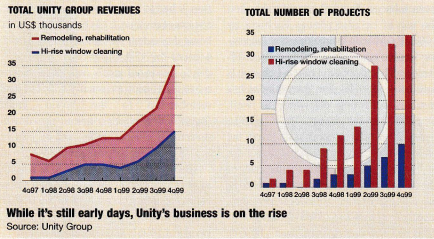
Unity’s revenues increased from $9,000 in the
fourth quarter of 1997 to $67,000 in the third
quarter of 1999. Although these figures are
tiny, they represent an average increase of
33% per quarter with projected revenues of
$100,000 for the final quarter of this year.
This growth is a direct result of the company’s
hands-on, trial-and-error strategy.
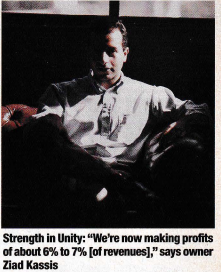
Ziad Kassis, Unity’s owner and general
director, is an example. Not the kind of guy
to run a business from behind a desk,
EXECUTIVE had to wait for half an hour till
the man showed up for the interview, a hard
hat under one arm.
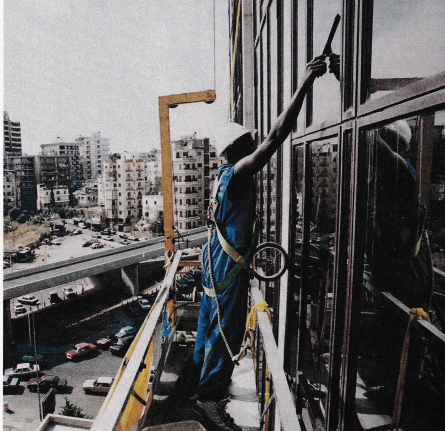
Kassis was keen on talking about Unity’s
high-rise window cleaning as an example of
the company’s strategy. Two years ago, the
first thing on the agenda was to get a firm
hold on the market, given that there were
already other companies such as Just Call,
International Operations Company, Libanet
and Assiana, to name a few, which offered
window-cleaning services. To break in,
Kassis aggressively undercut his competitors’
prices. What counted for Kassis was getting
the business, even if that meant giving
quotes below cost.
For example, Kassis quoted $1,500 for the
Abraj building near Furn al-Shebbak; an offer
which he says was well under the competitors’
best offer of $1,800 and $300 below his
total cost. Similarly, Kassis offered $550 for
the Liberty Tower in Hamra; a job which he says cost Unity $900 to complete. Following
this approach, Unity now has established
clients, such as the Freeway Center,
UNESCO Center, Montelibano Tower, and
the Federal Bank building.
But here is the interesting part. After the first
quarter of 1999, Kassis says that Unity is in the
black even though it has not raised its prices.
“We used to make a net loss of about 2% to 3%
of revenues,” says Kassis, “but now we’re
making profits of about 6% to 7%.” He
intends to increase the profit margin to about
10% of revenues by reducing costs. Kassis
says that the company has gone through the
learning curve. “What used to take us two
weeks to complete now takes less than a
week,” says Kassis. This means that the
amount of time required for a job decreases
every time they tackle it, as they learn the various
tricks that make it possible to perform
more efficiently and quickly.
Take the time needed to assemble and
install the scaffolding as an example. As the
workers become more familiar with the
designs of various buildings, the amount of
time required for assembly and installation
decreases dramatically each time they are
done. And familiarity with the buildings’
features makes it possible to manage the
work more efficiently. This translates into less
expense, as the work crew is paid by the day.
One example is the Abraj building, where Kassis says the cost has dropped from
$1,800 to $1,100.
Costs have also been reduced by the company
manufacturing its own scaffolding,
which Kassis says can be done for a fifth of the
price of buying it. This is especially helpful
because not only does scaffolding wear out, but
the need for more scaffolding increases with the
number of jobs.
Unity has also learned from mistakes
along the way. Initially, having quoted a low
price to secure a window-cleaning job,
Kassis would try to finish the job rapidly to
lower costs, but this was often at the
expense of quality. “This meant we had to
do the job all over again, meaning additional
expense,” says Kassis. Now, they do it
right the first time, even if it takes longer and
costs more than their fee, maintain their reputation
and avoid the expense of redoing the
whole thing.
Jean Rizk, owner of Just Call, feels the
change. “When we started about five years
ago, it was an easy business,” he says, “but
now it’s become more difficult, not only
because people can’t afford to pay, but
because of competition such as Unity
Group.” Rizk’s answer to this difficulty is to
lower prices, but unlike Kassis, he doesn’t go
below his overheads. Tony Saade, owner of
Libanet, confirms that the market has
become more competitive. Kassis, on the
other hand, is bullish. “By December 2000,
I expect the window-cleaning business to
triple,” he says. “And a year after that, I
wouldn’t be surprised if I’m the only one left
in the market.”
For building renovation, Kassis again has an uncommon approach. “It’s very
rare to actually find people who handle
remodeling work completely,” says Raja
Assaf, owner of Architecture Urbanisme
Design. Kassis has set out to handle everything
from A to Z with the same aggressive
pricing strategy. Kassis claims that the
lowest quotes for the renovation of the
Saad building in Mar Takla ranged
between $18,000 to $20,000, while his
quote was $16,100, even though it cost
him nearly that much to carry out. Another
example was a project which involved
repartitioning a client’s apartment, where
his quote was $28,000, as opposed to the
next lowest quote of $35,000, leaving
Kassis with a profit of less than $1,000.
With these tactics, along with economic
conditions making it more feasible to
refurbish existing apartments than to buy
new ones, the number of renovation projects
has increased from one in the fourth
quarter of 1997 to seven in the third quarter
of 1999, with revenues jumping from
$8,000 to $25,000.
And again, according to Kassis, costs have
dropped. As the number of projects
increased, the amount of business Unity
Group gave skilled workers such as painters,
masons, and carpenters also increased, and
economies of scale came into play. The same
went for building materials. More projects
meant larger volumes and lower costs. And
becoming better acquainted with the market
not only taught Unity which workers were
most suitable for a particular job and at the
most competitive price, but also where the
lowest prices could be found for materials. All this, says Kassis, has put Unity in the black
since the beginning of 1999.
The same strategy – offering lower quotes
than competitors – goes for construction. The
going rate for a construction worker is about
$10 a day, but Kassis has an ace up his sleeve.
Having been a managing supervisor in the
Beirut Airport project, he has access to a
workforce of more than 3,000 men, distributed
all over the country. Whenever a project
comes up, the workers nearest the construction
site will be hired, allowing them to work
closer to home and being spared transport
costs. They would, in return, work at a
reduced rate. Noted projects are the Zahrani
Bridge, the Ghazieh interchange, the
Maifouk reservoirs, as well as the Saade
Center in Furn al-Shebbak.
Despite these advantages, however, the
construction business is Unity Group’s
weakest interest. The revenue from this side
of the business has dropped from $127,000
in the third quarter of 1998 to $35,000 in the
third quarter of 1999 (see graph). But Kassis
isn’t taking it lying down. He has already
taken steps to improve his position by
applying to the ministry of public works for
a contracting license which would allow
him to make competitive bids for projects
directly rather than be hired as a subcontractor.
As far as results are concerned, we
will have to wait and see what happens once
the license comes through.
By now, Kassis is so confident that he
predicts domination. “It’s only a matter of
time till we completely squeeze out the
competition,” says Kassis.