A recent survey has estimated that
18,000 ‘at home’ care businesses are
thriving in the United States, generating
$50 billion yearly, or 5% of the total
$1-trillion American healthcare system.
Over the last 20 years, the West has realized
that fortunes can be made providing affordable
medical treatment for the chronically ill
or elderly individuals who do not qualify for
state-sponsored health insurance. The aging
population of the industrialized world, and
busier careers that make it difficult for families
to attend to relatives, have made this a
particularly lucrative market in recent years.
But so far just one Lebanese company has
really caught on to that trend.
“This is a legitimate business opportunity.
It looks like a rather safe investment,
because it will bring a steady source of
income, while capitalizing on a much-needed
service in Lebanon,” says Walid Al
Khalil, general manager at independent consultants
Tulip Investments.


A shareholding company owned by a
group of doctors, bankers and other individuals,
Home Care Lebanon is growing at
an impressive rate after just two and a half
years of experience under its belt and
investment capital of $150,000. The company’s
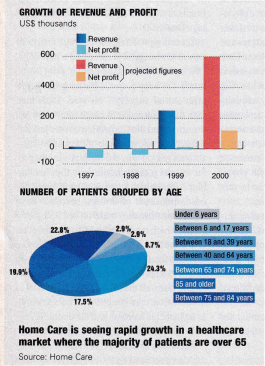
revenue grew from $13,657 for
seven months in 1997 to $250,000 in 1999
while revenues for this year are projected at about $600,000. After spending its first two
years in the red, Home Care Lebanon
expects to move into the black for the first
time in 1999 with profits of about $15,000.
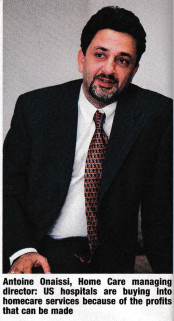
The man behind the enterprise is Antoine
Onaissi, a civil engineer who imported the
idea from the United States, where he studied
at Purdue University. His idea is to provide
affordable care at home for chronically
ill patients or patients with semi-acute
conditions. Onaissi, the managing director,
claims to do this at just 40 percent of the cost
of hospital care. Under the instruction of a
qualified physician, a team of certified
nurses can provide virus treatment,
chemotherapy, wound therapy, and physiotherapy.
Additionally, the nursing care
provides daily companionship for the
elderly who do not qualify for insurance but
who need assistance in their homes, delivering
medication and performing lab tests.
This is a company that came up with a
solid strategy to market its services.
Currently, 80% of Home Care’s patients
come from personal contacts and referrals
and 20% from insurance companies.
Instead of spending money on advertising
through the media, Home Care approached
those who could profit from its services,
such as insurance companies, hospitals and
doctors. Many potential clients are currently
covered by insurance companies and are being treated in hospitals and by physicians.
But Home Care first had to convince
insurance companies, hospitals and doctors
that it was qualified to treat patients at
home and that its services would generate
more money for them.
While the Lebanese spend $1.5 billion
annually on healthcare, US studies have
shown that 5% of patients who are hospitalized
could actually be treated at home.
That translates into $60 million in dollar
terms in Lebanon. If companies like Home
Care can provide cost-savings of 60% over
hospital bills, that would mean $36 million
in savings to insurance companies and
patients. Another benefit for insurance
companies comes from savings on unnecessary
exams, lab tests, and other procedures,
according to Onaissi. Sami Rizk, general
manager at Rizk Hospital, confirms that
many hospitals try to improve their 50%
occupancy rate by keeping a patient for an
additional few days, possibly to perform
further examinations or prescribe medicines,
if it is covered by insurance.
Despite the benefits, insurance companies
have been slow in warming to the homecare
concept, largely because they have not been
able to identify cases that can be treated at
home. Patients can be released from a physician’s
care only if their condition is medically
stable, with no fluctuations in blood pressure
or temperature. Only recently has Home Care
been able to break new ground, striking a deal
with individual insurance companies like Alig
and Medgulf as well as third-party administrators
(TPAs) like MedNet, which deals with
about 20 insurance firms and mutual associations,
and Medical Express, which works
with six insurance companies. Insurance
companies have been working with physicians
to determine which patients can be sent
home and draw up a set of guidelines.
MedNet counts some 150,000 adherents
who are eligible to receive Home Care services.
In addition, the two companies
launched the Home Care card in mid-November
to target the parents of those
adherents. The card offers an additional
20% discount for an annual membership cost of
$25. This discount can be substantial for
those over 65, who are probably not eligible
to receive medical insurance.
It is estimated that 7% of the Lebanese population is 65 and over. And when they
fall ill, there is little alternative but to enter
a hospital. Hospital stays can cost up to $300
a day or $9,000 a month, whereas an average
bill with Home Care is about $1,400 a
month. A 20% discount will save an additional
$180 monthly.
For the company, the Home Care card is a
marketing technique that will help boost
volume. Based on a 10 percent rate of usage,
Onaissi has projected that this year’s revenues
will double to $600,000. That would
generate a $150,000 profit, working at a
25% net profit. In business terms, he projects
that his company’s cost-to-income ratio
will be halved to 17.5% if his plan works.
Another obstacle for Home Care lies in
convincing hospitals to inform patients about
its services and to provide patient referrals. But
when hospitals can charge room and board to
patients who need long-term care, what is
their incentive to do so? Home Care is making
some headway with hospitals like Rizk and
American University Hospital, which have
occupancy rates of 85% and close to 100%
respectively. They would benefit by freeing up
beds for patients in need of immediate care.
“Hospitals make their money in the first three
or four days, when a patient goes in for
exams, x-rays, lab tests, surgery or delivery,”
says Onaissi.
According to Rizk, the average length of
stay at his hospital is three and a half days.
“We specialize in acute care, it’s not in our
interest to keep patients for long-term care
after initial surgery,” he said. Rizk also
says that insurance coverage for ministries,
the army, and the Coop often covers just initial
surgery and a couple of days after that,
another reason why the hospitals might prefer
to send patients home once they are stable.
After initial surgery, which generally
costs thousands of dollars, hospitals have
made more than they make on bed occupancy
alone, which ranges from $40 a day for class
C to more than $150 a day for class A. If more
beds are freed, more money can be made on
surgery. Rizk Hospital is convinced about
Home Care, all the more so since the nurses
are certified, care is administered according
to a physician’s orders and the doctor is kept
informed about the patient’s condition.
According to Onaissi, AUH administrators
are also interested and have asked to speak to some of Home Care’s patients to inquire
about the quality of care. In the United States,
hospitals are a step ahead. “With the profits
that can be made in homecare services, hospitals
are buying out these outfits instead of
staying out of the loop,” says Onaissi.
In actuality, hospital administrators will not
convince the patient directly, but rather the
physician. If the doctor is confident that a
patient’s condition is stable, he would advise
at-home care. But again, what would be the
incentive for a doctor, who is paid for treatment
administered in the hospital but not for
patients who are sent home? “The physician
is paid a full fee (from the insurance company
or private client) for the first three days a
patient is treated at the hospital, it then drops
to 50% and, for day six onward, to 25%,” says
Onaissi. Insurance firms are now considering
paying physicians a fee, though probably
lower than the hospital rate, as an incentive
to prescribe more home care for patients. In
terms of pay, it should make sense then for a
physician to send a patient home for long-term
care, because the physician benefits more
financially from new patients by collecting
higher fees.
Doctors, however, tend to shy away from speaking of possible financial advantages,
pointing rather to the human aspect
of letting patients return home. Dr. Ziad
Salem, an oncologist, has subscribed to
the idea of Home Care, where he sends his
terminally ill patients for long-term care.
For Salem, home care is the less expensive
option for patients and their families,
even if he earns less money.
Dr. Nohad Genadry, a family physician at
both Rizk and St. Charles hospitals, also
favors home care for patients whose condition
is stable because of the lower costs. And the
patient is treated according to doctor’s orders
in the comfort of home and surrounded by
family. “Theoretically there are financial
benefits for the physician if a hospital generally
has a high occupancy rate, but it’s not the
incentive for most doctors,” he said.
There is, of course, an important human factor
involved with the business of home care.
A US study revealed that patients heal faster
when cared for at home. There, a patient is also
less likely to contract nosocomial infection,
otherwise known as the ‘hospital bug,’ a disease
which affects 10 percent of patients
worldwide. Terminally ill patients whose
disease is at an early stage often share a hospital
room with someone in a
more advanced stage of illness,
and their condition is likely to
deteriorate faster. Surrounded by
family and friends at home,
patients can better fight the disease
and heal more quickly.
Being first on the market has
allowed Home Care to make a
healthy 45% profit on its regular
services while it has also gained
from an extra source of income; it
rents out medical equipment like hospital beds, oxygen and asthma machines, services that represent
15-20% of revenues. It has plans to
expand operations to include
greater Beirut, and then to Tripoli,
Zahle, and Sidon, but not before
establishing a firm foothold in its
current range of operations.
Competition is limited, but
one company, Doctors At
Home, does offer a service similar
to Home Care’s nursing service.
The six-month-old company
offers 24-hour service, according to an
employee. A doctor accompanied by a nurse
cares for a patient at home and it offers
ambulance transport to a hospital (about
$66 to $100), in an emergency. Doctors
charge about $20 per visit during the day and
$26 at night. Patients insured by Security
Insurance Company are covered for the service.
Doctors At Home dispatch specialized
doctors from Achrafieh, Antelias, Jounieh
and Hazmieh offices. Each location has four
doctors and four nurses. While its services are
centered around a doctor’s care, the company
has a small nursing division specialized in
certain types of therapy.
Onaissi looks at the competition as an
added marketing tool for his own services,
but he will need to solidify his near 100%
market share to defend his position. Like any
new idea, market dominance will soon give
way to higher costs and greater competition,
putting a squeeze on margins. While
Home Care has laid the groundwork for similar
companies that might follow, it should
have a leg up on the competition as the first
to survive the trials and tribulations of a
start-up and to establish ties with TPAs, hospitals
and doctors.