Imagine being a factory owner who needs to purchase the
right tool or spare part for a critical machine that has just broken
down. Then imagine having to go to Burj Hammoud or
Dora and visit a plethora of shops to find it. This frustrated consumer
is the guy Kumaro Industrial Supply Trading is targeting in
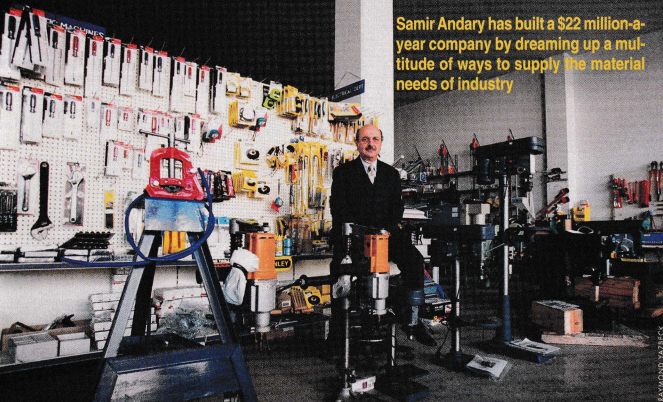
Choueifat with its 800 m² industrial supermarket that services
around 1,000 surrounding factories. The shop allows the customer
to select machine accessories such as water chillers, sealers, mixers,
etc., spare parts (filters, silicon, timers), tools (both power and
hand), electrical components (transformers, switches, bulbs) and
entire machines like hydraulic pumps, forklifts, plastics machines,
compressors, welding machines and others.
Only one and a half years old, the supermarket wants to offer a
solution to industrialists needing fast and efficient access to
machines and parts, coupled with a good after-sale service. It’s the
brainchild of its parent company, Kumaro, one of Lebanon’s
largest suppliers of industrial materials.
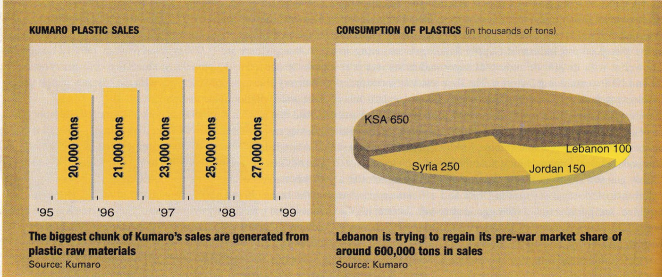
With 39 employees, Kumaro today pulls in $22 million in sales, at
a growth of 8% annually. The biggest chunk of its sales, however, approximately 80%, comes from selling plastic raw materials and
chemicals under the company name Kumaro Plastics and Chemicals.
This year, Kumaro sold some 27,000 tons of plastic raw material – 27%
of the total annual plastics consumption in Lebanon (100,000 tons).
Although there are 11,000 types of plastics, only 12 basic materials
are needed to develop the products that consumers need. The
company able to supply factories with the best raw material at the
best price will dominate the market.
And this is what Kumaro has done. “Kumaro is number one in
plastics raw material,” says Chekrallah Younis, general manager
of Abou Khalil William & Co, a competitor selling chemical and
plastics raw materials. According to Younis, Kumaro is so strong
in this market because of its position as the sole agent of Sabek, one
of the largest brand plastics raw materials manufactured in Saudi
Arabia and sold directly to industries. “Sabek gives Kumaro a huge
advantage over European importers because it is a very good product
at a much cheaper price,” says Younis.
Sabek is derived from petrochemical residue that is usually
burned as waste. A petroleum-producing country, such as Saudi Arabia, can collect this residue and process it at negligible cost
(approximately $50 per ton), turning it into raw material used in
industry. The largest producers of plastic products in Germany,
Japan and Korea are not petroleum producers and their raw material
costs are much higher as they have to buy it from the producers.
Many Lebanese importers get their raw material from non-oil
producers and their unit cost per ton of plastics is higher.
Additionally, the cost to import is also higher as they have to be
shipped by sea rather than by land from
Saudi Arabia. A 20-ton container of raw
material from Hamburg costs $1,000 in shipping and 8% clearance, while from
Italy it is $500 at the same clearance rate.
But by land from Saudi Arabia, the same
20-ton container will cost $200 with a
4% clearance charge.
Behind Kumaro’s success in plastics is
Samir Andary, the company’s majority
owner (his kids own 25%) and its CEO.
A manufacturing engineer by trade,
Andary started Kumaro in 1972 after an
eight-year stint with Plastex, a flourishing
plastics factory in Lebanon in the
mid-60s and early 70s. During that time
Andary invented nylon bags for banana wrapping to protect them from UV rays
and conserve temperature and humidity,
as well as plastic bags for bread and soft paper tissue.
Besides plastics, however, Andary has managed to diversify
Kumaro in other areas. Using its dominance in the local plastics
market and its 268 plastics clients, Kumaro expanded into chemical
raw material sales. It now has 140 chemicals clients for products
like acetone (raw material used for nail polish remover), IPA
(isopropyl alcohol), and caustic soda (a base used in detergents).
“Kumaro is a leader in many chemical solvents and base products used in detergents, paint, printing ink, cleaning agents, etc.,” says
Asaad Hajj, the owner of Anachem, a competitor specialized in
chemical raw material trading. In 1997 and 1998, Kumaro had an
estimated 60% market share of acetone and IPA, and more than 50%
share of caustic soda.
Although chemicals have a variety of representative agents and
places of origin, Kumaro was aided by the fact that many of the factories
that buy plastics from them also purchase chemicals. The
company is thus able to sell more and
buy in larger quantities at a better cost per
container than its competitors.
A natural extension for Kumaro was to sell
machines that turn the raw materials it supplies
to industries into a product. Blow
molding for plastic bottles, extruders for
PVC pipes and plastic bags, injection
molding for plastic chairs, tables and
toys, etc., have a price range going from
$10,000 to $150,000.
Kumaro gives a select group of buyers a
three-year credit facility at around 8.5%,
itself borrowing at 8.25% from the
banks. Without credit, Kumaro would
face difficulty convincing a cash-strapped
Lebanese industrialist to buy a
more expensive, better machine. “I only supply up-to-date machines because they
require less maintenance and use the latest computer technology,
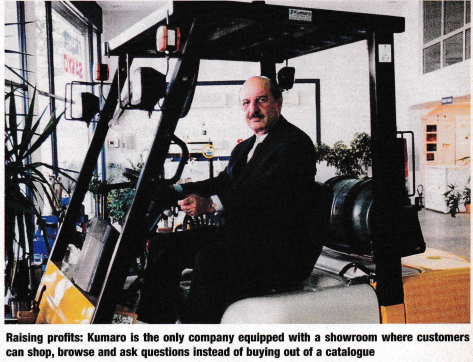
making them very efficient,” says Andary. Kumaro is the only company
equipped with a showroom where customers shop, browse and
ask questions, instead of buying out of a catalogue. It also provides
six months’ free maintenance and charges $500 per year after that
period for the machines it sells.
A major problem here is gray market sales, meaning that
Kumaro not only competes against other importers of new machines but also against imported
used and reconditioned machines
being sold within the range of
$20,000 to $40,000. “Gray market
sales make up about 50% of the
market,” says Younis, a machine
importer himself. Kumaro’s local
plastic machine sales are sluggish
compared to its sales in Saudi
Arabia because the market there is
larger and their clients insist on getting
up-to-date machines.
Best Sellers
As all machines need spare parts
and tools, the company expanded its
sales to include all the items sold in
its industrial supermarket. The
strategy was to buy the best brands
that carry a built-in manufacturer
warranty such as Vickers
(hydraulic pumps used by Boeing,
Caterpillar, Airbus), Bosch (spark
plugs, power tools), Goodyear (V-timing
belts, hoses), FAG (ball bearing, roller bearing), Stanley (measuring tapes, rulers) and a host
of other brands.
Kumaro got around the higher prices of the better-known brands
by buying directly from the manufacturer. German companies such
as Bosch are now manufacturing in China with joint venture
deals; the Chinese firms provide the labor and the Germans the
know-how. Kumaro has a deal to buy Bosch spark plugs from one
such joint venture and sells them at 25 cents, whereas competitors who
buy from the original company sell at 47 cents. Kumaro applies the
same strategy to purchasing Stanley products, now manufactured
in Brazil as opposed to England.
Kumaro has expanded its sales office to Saudi Arabia where it has
two offices in Jeddah and Riyadh. Out of its total $22 million in sales,
the company makes $15 million in direct export sales to Saudi Arabia
using letters of credit, providing machines, parts and raw material.
Kumaro has also been active in designing and building some
37 plastics factories for clients wanting to produce anything from
a Bic pen to plastic kitchenware, shoe heels or toys, averaging
eight to ten such projects per year. For example, the company
was responsible for Saudi’s biggest plastics factory called Al
Sharq, producing 50,000 tons of plastics per year, 13% of
annual Saudi consumption.
Kumaro is also starting operations in Aleppo, Syria. With this
expansion, the company needs a cash injection, especially when
establishing a showroom like the one in Choueifat, that will require
a $2 million investment. “We are a family business,” says Andary,
“but we’re open to foreign capital in order to expand.”
He is talking to German and Korean investors who, however, are
not encouraged by the Lebanese market conditions. But one
thing Andary is fully aware of is that Kumaro cannot depend on
the Lebanese market.
The Korean
Connection
In the year that Century Motors Company’s chairman and
general manager Walid Rasamny brought Korean-made
Hyundai, Daewoo and Ssangyong to Lebanon, Kumaro
boss Samir Andary bought a Hyundai car. However, a month
later he needed a spare part and was surprised at the price.
So Andary decided to set up his own spare parts business
for Korean-made parts called Kumaro Motors in 1994. KM
now averages a turnover of about $1 million annually, catering
for Korean and non-Korean-made cars.
But what is KM’s advantage over other suppliers or against
the car dealers themselves? Kumaro’s $22 million-a-year business
also sells machines manufactured by companies such
as Bosch, FAG, Goodyear and others, who also manufacture
car parts. With the company’s strategy of sourcing these
brand names from joint ventures in cheaper markets such as
China or Brazil (see story), KM is able to secure the supply of car
parts at cheaper rates. Andary says he has been able to sell
parts that cost 25% less than parts bought directly from the
car manufacturers. KM still depends on the local market for
20% of its purchases, but the rest is bought directly from the
manufacturers of parts for Korean-made KIA, Daewoo and
Hyundai and for Japanese-made Nissan, Mitsubishi, Toyota,
and Honda. “I buy parts at the same price as Hyundai in Korea
buys them,” says Andary.