Changes are afoot in the country to
the east. A serious debate is underway
in Syria – one of the last bastions of
Soviet-style central planning – about economic
liberalization, opening up borders and
making it easier for foreign companies to
invest. Two years ago, the country signed the
Arab free-trade zone agreement, which will
require it to reduce trade barriers on other
Arab states’ goods to zero within a decade.
Syria is also considering entry into the
European Association Agreement, which will
require tariffs on European goods to be
phased out over a ten-year period. Free trade
spells trouble for an array of inefficient public
and private sector companies, which have
been living off the luxury of high import barriers.
In the global economy, only the fittest survive,
and there is one Syrian company that is taking
heed. Joud, one of the largest trade and manufacturing
firms in Syria, with over
1,500 employees and annual revenues
in excess of $115 million, has
proven itself capable of adapting to
change. Whenever a new opportunity
crops up, Joud takes advantage
of it. And now it is getting
ready to compete in a market-driven economy.
Established in 1933 by Mohammed Joud,
an orphan who traveled between Syria and
Lebanon trading apples and flour, the company
rose from humble beginnings and now
commands a hefty portfolio of business
activities. It is one of the country’s biggest
traders in foodstuffs, animal feed, steel,
wood and heating equipment. The company
is the official importer and distributor of
Goodyear and Fulda tires and manufactures
Mandarin, Syria’s number one soft drink.
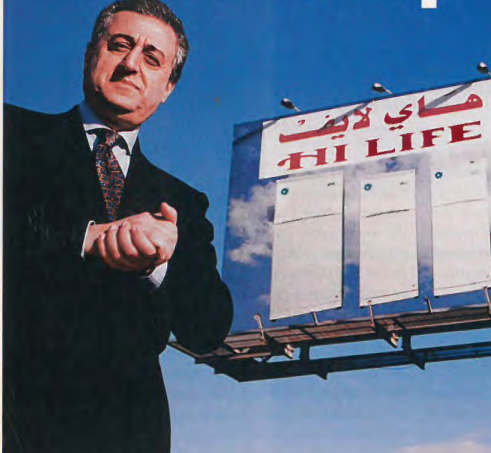
Joud also produces a range of home appliances,
including refrigerators, washing
machines, gas and electric ranges and
microwaves under the Penguin, Hi Life and
Riviera brand names.
How did the company get so big, especially
in an economy under heavy state control? By
anticipating the market and being the first to
take advantage of new opportunities. Today,
many of Joud’s most lucrative lines of business
are in areas that were in the strict
domain of the public sector. In 1975, when
the government opened up the manufacturing
of refrigerators to the private sector,
Joud wasted no time stepping into the business.
It formed a partnership with Penguin,
another private firm, built a factory and
within a year had rolled its first refrigerator
off the assembly line. In 1982, the line of
products was expanded to include freezers,
washing machines, gas and electric ranges, all
under the Penguin name. With demand rising,
a smaller second factory was opened in
Latakia in 1984.
In the early 1990s, two new opportunities
arose. The Syrian government passed
investment law number ten, which made it
cheaper and easier to import industrial
machinery, and began phasing out the use of
CFC (Freon)-producing appliances. Joud
spotted an untapped market. It wanted to use
the new investment law to build the country’s
first factory capable of producing appliances
compliant with the new regulations, but
its partner Penguin was not interested. “We
couldn’t reach an agreement with Penguin to
move to a bigger plant, and we felt we had to
satisfy the demands of the market, so we went
solo,” says Farouk Joud, general manager of
industrial operations. Joud formed another
company called Riviera and launched
Hi Life, Syria’s first brand of CFC-free
refrigerators and the first local manufacturer
to become ISO 9002 certified.
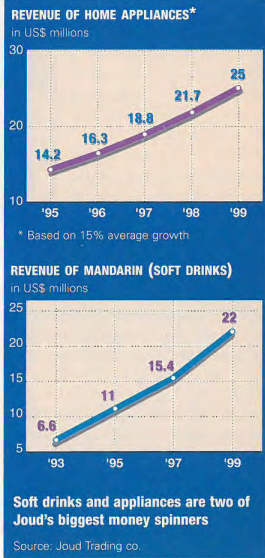
Today, Joud’s home appliance division
earns $25 million in revenues per year.
Thanks, in part, to a $450,000 per year
advertising budget, Joud claims that both its
Penguin and Hi Life brands control 30% to
35% of the 100,000-unit-per-year refrigerator
market. Its competitors, Al Hafez and the
state-owned Barada, each control a further
30% share, although Al Hafez says it produces
60,000 refrigerators a year (see “Chillin’
with the Big Boys,” February 2000). Joud also
maintains that its Riviera washing machines,
produced under the license of Italian manufacturer
Zerowatt, have carved a commanding
70% market share, and its microwaves,
despite having been in the market for only
three years, a 60% share.
Another opportunity that Joud wasted no
time in seizing was the government’s decision,
in the early 1990s, to reopen trade in
food items to the private sector – an area that
had been under the government’s tight control
since 1965. Today, Joud’s foodstuffs
division earns more than $20 million in revenue
annually. It is the importer of such popular
brands as St Louis sugar, Al Malak coffee,
and Chiquita bananas, while nearly 12%
of the division’s revenues come from exports
of locally produced olive oil, apples, lemons,
limes, oranges and seeds to Russia, Spain and
other Arab countries. With a 40% market
share, Joud’s only serious competitor in the
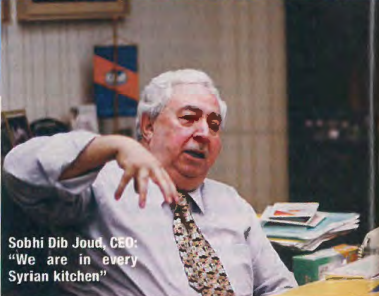
trade is Akhrass with 55%. “We are in every
Syrian kitchen, because my father taught me
how to weigh an honest 200 grams and
instilled the fear of God in me,” says Sobhi
Dib Joud, CEO of Joud and the eldest son of
the company’s founder.
The government also freed up the import
of animal feed to the private sector. Sure
enough, Joud was there. It now sells around
$30 million per year of animal feed, most of
which is imported in the form of yellow corn,
barley, meat meal, fishmeal and soya bean
meal from Belgium and France. Of this trade,
$4 million is by direct export to other countries.
Mohammed Joud, vice president, started
that division in 1992. Another example of
Joud taking advantage of new opportunities
was its entry into the tire business in 1994.
The company became the official importer
and distributor of Goodyear and Fulda
tires. Today, this division generates $3.7 million
a year in revenues, or a 33% share of the
domestic truck tire market and 15% for
farm vehicles.
One of Joud’s most dramatic success stories
has been Mandarin. With the international
cola heavyweights out of the Syrian
market due to import restrictions, Joud has
been able to make Mandarin the number
one brand, pushing sales from $6.6 million
in 1993 to $22 million last year. Mandarin,
the company claims, has a 39% local market
share, just ahead of the number two brand
Cadbury Schweppes, which has a 30% to
35% market share. Much of the soft drink’s
success, argues Haitham Joud, manager of
the soft drinks division, stems from the
nationwide direct distribution network. “In
Syria, once you improve your distribution
and marketing network, you exceed your
competitors,” says Haitham. Another reason
for Mandarin’s success is the diversity of
selection. “Joud has 12 flavors for all tastes
where we only produce three or four flavors,”
says Sidky Lyousfi, general manager of a factory
that produces Cadbury Schweppes.
Now, with economic liberalization on the
horizon, Joud is adding new feathers to its
hat. Two years ago, when Syria signed the
Arab Free Trade Agreement, Procter &
Gamble found the 16 million consumer
market a golden opportunity. For the first
time, the US-based multinational will be able
to import a multitude of brands into Syria –
including Pantene, Pert Plus, Always, Head
& Shoulders, Camay, Zest, Ariel, Tide and
YES – which it has already been producing
at its Saudi and Lebanese factories. The
international heavyweight chose Joud to be
its representative in this important new
market. “We had several criteria that we
presented to five distributors we picked
from hundreds who originally applied,”
says Ziad Chabaan, manager of manufacturing
at P&G Lebanon. “Out of five, we
picked Joud, because it was the company
best suited to our criteria.”
Joud is now P&G’s sole distributor in Syria
for the next 20 years or more. The company
has been busy building a 100-man sales
team, trained directly by P&G personnel, and
the multinational’s products have already hit
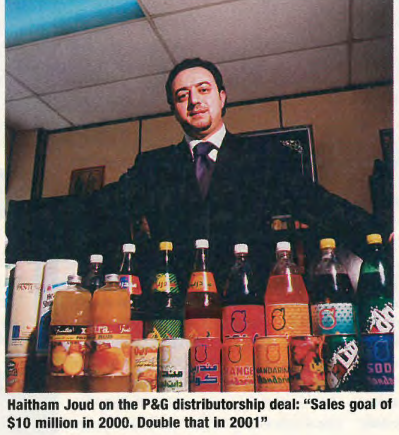
the shelves. “We will focus on diapers, detergents
and shampoo, with a sales goal of $10
million in 2000 and double that in 2001,”
says a confident Haitham. P&G will benefit by
being able to cross-advertise using Joud’s
portfolio of products.
Working with P&G will allow Joud to
improve its long-term planning, management
and distribution know-how. Joud will also be
able to attract contracts from other multinationals,
much in the way that Obegi in
Lebanon won the sole distribution
rights for McDonald’s through its
nearly 25-year connection with the
German-based Henkel corporation
(see “Can’t get enough,” March
2000). “P&G has very good products.
Joud, as a distributor, is very
good,” says Georges Obegi, chairman
of Obegi Consumer Products,
makers of everything from Persil
laundry detergent to Al Wadi Al
Akhdar canned foods. “They’re
professional. We’re not active in
diapers or shampoo in Syria. In
detergents, P&G Syria isn’t active
yet, but when they are, they’ll be a
challenge.”
Another new venture for Joud
was its 1995 partnership with the
Lebanese company BD&A, the
official representatives of Saatchi &
Saatchi (S&S) Middle East. That
deal placed the skills of a dynamic
international advertising firm at the company’s disposal. Today, the S&S
office in Damascus is mostly working for
Joud, helping it build strong brand images.
But in the future, there is significant potential
for the advertising firm to expand its
activities there. That will mean a new source
of profits for Joud.
Internationally, S&S focuses mainly on
big corporate entities like banks and insurance
companies. These sectors of the Syrian economy
are in the hands of the public sector. But what will happen
when the government finally allows the private
sector to enter these fields, like it did with
refrigerators, foodstuffs and animal feed?
“We will be partnered with a world-renowned
media company which will give us
a big advantage in serving those corporations
before any other media companies enter the
market,” says Haitham.
Another future plus for the company is its
position as an advisor for British American
Tobacco (BAT), manufacturers of such cigarette
brands as Viceroy, Lucky and Kent.
Currently, imports represent just 10% of the
tobacco market in Syria, and are controlled
by the state-run regie (Gotha). But, as with
many sectors of the economy, if the government
allows private companies into the cigarette
business, Joud’s association with
BAT will leave it in a position to dominate.
In Lebanon, BAT controls a 51% market
share, while Philip Morris, producers of
Marlboro, Merit, L&M and Chesterfield,
has just 38.5%, according to a retail audit
done by MEMRB in August 1999.
In anticipation of a housing boom – a
strong likelihood in the event of a Middle East
peace settlement – Joud is branching into
steel manufacturing. It has already become
one of the biggest importers of steel, wood and
heating equipment, a division that generates
revenues of $10 million per year. Now, the
company is building a $12 million plant
about 15 km from Latakia able to produce
profile sheets, reinforcing bars and other components
for construction. It will import its
raw materials from Ukraine and Russia and
sell to local dealers and wholesalers.
Even Joud’s soft drinks division is looking
to the future. So far, Coke and Pepsi,
with the exception of Pepsi’s 7-Up, have not
been able to penetrate the Syrian market
because the government forbids the importation
of the cola concentrate. But when
these restrictions are dropped, and
Mandarin is forced to compete, what will
happen to Joud? Well, the competition
might present an opportunity. In 1995, the
company received a letter of intent from the
Coca-Cola Company, giving Joud bottling
and distribution rights for Coke,
Sprite and Fanta. This means Joud
is poised to tap a potential gold
mine. Per capita cola consumption
is 12 liters a year in Syria,
whereas in Lebanon it is around 30
liters. “If Coke and Pepsi make
their way into the market in the
future, they will help bring the
soft drink consumption higher,”
says Haitham.
But a broadening of the economy
also poses new challenges. For the
first time, the home appliance
division is under attack from
imported Korean brands. While
the law prohibits the importation
into Syria of products that are
already produced domestically, a
trade agreement with Jordan
allows Korean brands produced in
that country, like LG and Daewoo
refrigerators, to enter the Syrian market.
“They have a fantastic finish and use digital
controls, but that kind of technology is not
needed in Syria and their prices are 30% to
40% higher than local brands, despite the
customs duties exemptions,” says Farouk.
Selim Antaki, CEO of LG Lebanon, disagrees:
“Although our appliances are digital,
they involve simple configurations that
any consumer can learn easily.”
More such challenges invariably lie
ahead. But Joud is a traditional family
business that has grown strong by adapting
to change. So long as it keeps on its toes,
it will likely do well.