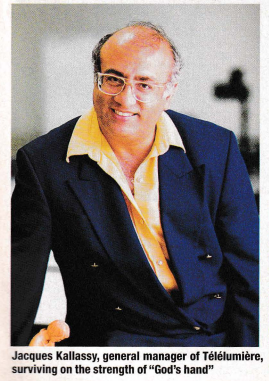
Telelumiere celebrated its tenth year of broadcasting this June. The country’s only non-profit Christian television station has stayed in operation all these years on the strength of “God’s hand,” says Jacques Kallassy, general manager of Telelumiere. He can say that again. In the last four years, this Catholic broadcaster’s monthly running costs have swelled to $150,000 and Telelumiere has accumulated a deficit of $1 million. What’s more, with the bulk of TV advertising revenue coming from ungodly tobacco, spirits and perfume companies, the station refuses to run commercials—the bread and butter of most television stations.
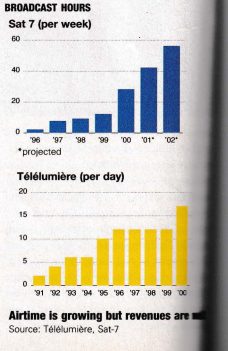
Telelumiere has not yet even applied for a broadcasting license and does not have a regular broadcast frequency. “The license costs $167,000 and it costs another $67,000 a year to rent the frequency. We don’t have that kind of money,” says Kallassy. Despite all of this, Telelumiere has been able to expand. When the station went on air in 1990, it was broadcasting just two hours a day. By 1995, that was up to ten hours, and today the station is on the air 17 hours a day. The station now has over $5 million in total assets and shows no less than 30 programs, 70% of which are produced locally.
So what has kept Telelumiere going, other than perhaps a miracle? Every once in a while, the station passes around the donation plate. “If you are committed to our message of love, peace and gathering and want to be part of Friends of Telelumiere (FTL), then you can be a supporter and contribute,” says Kallassy. Two years ago, Telelumiere started its donation campaign. Since that time, it has gathered a network of 12,000 subscribers, each contributing as little as LL1,000 a month. Last month alone, donations reached $22,000. Telelumiere’s goal is to find 100,000 subscribers willing to contribute $1 a month. This would cover most of the $150,000 in monthly running costs, including the $35,000 in salaries the station pays to its 75 employees.
But handouts are not that easy to come by these days. Whereas religious donations are tax deductible in many countries, they aren’t here. Revenues from donations are growing only 5% annually and just five shareholders contribute about 35% of the cash needed to cover the station’s running costs. Another $3-5 million in revenue is needed if Telelumiere is to upgrade its operations and begin transmitting by satellite, but with the situation as it is, God only knows where that money will come from.
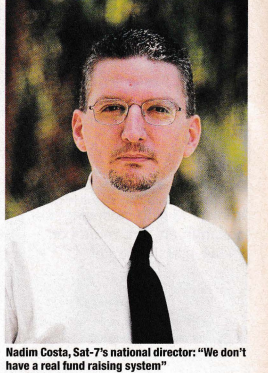
What’s more, Telelumiere has competition. Sat-7, an Evangelical Christian station, broadcasts by satellite out of London. “I want the 20 million Christians living in the region to know that someone is looking after them, reaching out to them, serving their families and friends in all communities,” says Nadim Costa, Sat-7’s national director. The station has a footprint that covers North Africa—from Morocco to Egypt—the Gulf states, Turkey and some parts of Europe. Sat-7 broadcasts 30 satellite hours regionally via both analogue and digital frequencies on Eutelsat W2 and Eutelsat Hot Bird.
In Lebanon, the station has been broadcasting in the 7.30 to 9.30 pm prime-time slot since May 1. Sat-7 plans to increase its broadcast time to 12 hours a day locally by 2001, and then around the clock by 2002. By 2003, Sat-7 expects to be broadcasting 24 hours a day regionally. The station also plans to install a live feed fiber optic cable running to Jouri Al Bailout and a microwave installation on the station’s roof.
More than 58% of Sat-7 programs are produced in Lebanon and Egypt with the rest imported mostly from the United States. The station has also managed to attract a great deal of local talent, including a former MTV programming director, an LBC broadcast manager and an ex-producer and graphic designer from MTV. But like Telelumiere, funding has been scarce for Sat-7. The station does not run commercials and must rely on donations.
Operating costs are high. The station spent close to $500,000 to buy its equipment. The move to prime time cost an added $300,000, and monthly running costs total $100,000. “We don’t have a real fund raising system so we are under-financed,” says Nadim Costa, Sat-7’s national director. “The Lebanese don’t have a sense of giving, whereas an American would run a marathon and for every pound he loses, donate money to a charity.” Costa says that most of Sat-7’s revenues come from relief organizations and private donors. In addition, the station’s employees accept salaries far less than what they would earn at a commercial station.
With the struggle to survive in a market that doesn’t offer the same cash-flow opportunities that are available to McDonald’s and Burger King or Pepsi and Coke, could the two Christian stations work hand in hand towards the same ‘greater’ goal?
“Telelumiere and Sat-7 will never merge,” says Costa. “They complement each other.” But they may be able to cooperate better. Already, both stations sometimes share production teams and tapes when covering religious festivals or other related events. Telelumiere would like to work with Sat-7 in other ways as well. “I met with Sat-7 founder Terrance Ascott twice. We would like to link up with them on Hot Bird and increase our satellite broadcast time from two and a half to six hours,” says Kallassy.
Telelumiere could then save about $1 million in fees and the station would be able to draw on Sat-7’s 7 million regional viewers. At the same time, Sat-7 would be able to negotiate a reduced price on its satellite lease: hourly rates decrease for longer broadcast times. Additionally, Sat-7 would gain Telelumiere’s local audience, estimated at 700,000.
Telelumiere used a popular message to become one of the region’s largest Christian broadcasters: “Give me a book that is 2,000 years old and is still the best seller in the world,” says Kallassy. But it takes more than uplifting programming to stay on the air in the costly world of TV broadcasting. The station’s drive to increase its cooperation with Sat-7 should help reduce costs and expand its viewer base. And if that doesn’t work, there is always good old-fashioned prayer to fall back on.
Islamic airwave
Al Manar is the only local Islamic counterpart to Telelumiere, though there are numerous satellite broadcasts throughout the Arab world, which counts around 350 million Muslims. Programs from countries such as the UAE and Sudan also broadcast in Lebanon. Although a commercial television station, offering news, sports and political talk shows, Al Manar shuns commercial ads that compromise the station’s message. The station offers one-hour of religious broadcasting a week. Two of Al Manar’s programs, ‘Prayer’s Call’ and ‘Religion and Life,’ help people cope with life from an Islamic perspective. The programs invite religious leaders, elite clerics and intellectuals to reflect on issues taking place in the Arab and Islamic world.