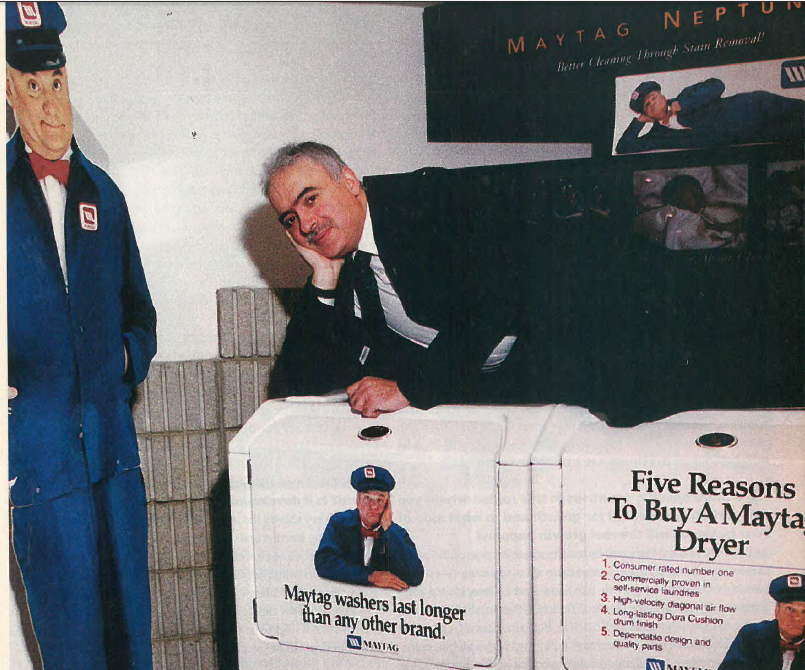
One look at 45-year-old Raji El
Mawla, regional manager of the
Maytag Group, and you would
probably think that life is pretty easy for this
businessman. He speaks with a calm voice
and rarely wears a suit and tie to work. But
first impressions can be deceiving.
It is 9am at Mawla’s office. He has a portable phone close to one ear and a cellular
in his hand. He is busy typing an
email to the corporate office in the US
while trying to resolve a misunderstanding
between an area manager and a distributor.
In the following hour, he manages to
schedule two or three field meetings,
respond to a few of his nearly 70 daily
emails and receive five urgent phone calls,
that he responds to in the same relaxed
manner. “Hello, what seems to be the problem
… I see … don’t worry … relax, I’m
on it as we speak … Your problem will be
solved by tonight … How’s the family?
Good … Keep up the good work, goodbye.”
After two minutes, the crisis is over.
“Easy and effective communication is
essential in this business,” says Mawla.
“People can reach me via email or cellular
24 hours a day.” Mawla must oversee the
work of four area managers based in
Lebanon, Saudi Arabia, Tunisia, and
Tehran. He is responsible for 65 distributorship
accounts in such countries as Saudi
Arabia, Jordan, the UAE, Kuwait,
Pakistan, Egypt, Tunisia, Morocco,
Senegal, and the Ivory Coast. Because of the
overlapping days and hours of operation in
the countries under his command, Mawla
works a seven-day week. With Maytag’s
corporate office in the US eight hours behind local time,
he usually does not get home until late at night.
Mawla is truly sleepless in Lebanon, but has
it paid off? The answer can be found in his
office. Sitting on a shelf is a red Everlast
boxing glove, awarded to him for reaching his
mid-year quota. Next to it are six certificates
given to him by the Iowa home office for
exceeding his quota each year since 1993.
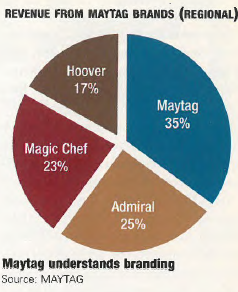
Five years ago, when Mawla introduced
Maytag to the Middle East, it was a little
known brand. Today, it leads the pack among
US imports, both locally and regionally.
Since his promotion from area manager to
regional manager in 1994, Mawla has doubled
local sales of Maytag brands, which
include Maytag, Hoover, Magic Chef,
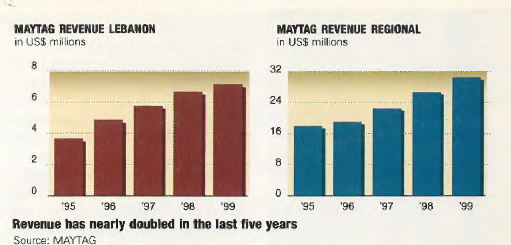
Admiral and Norge. Revenues have gone
from $3.5 million in 1995 to $7 million in
1999 and the company has carved out a
10% share of the local market for refrigerators,
which compose the bulk of
Maytag’s sales, which include washing
machines, floor cleaners and gas ranges.
His performance regionally has been equally
impressive, expanding revenues from
$18 million in 1995 up to $30 million in
1999. In relation to other US brands, local
market share of Maytag’s brands has grown
from 32% in 1997 to 61% in 1999, outpacing
GE, Frigidaire and Kelvinator. In Saudi
Arabia, Maytag has a 45% market share
against other US imports and in the UAE,
42% against US imports.
But what is most impressive is that Mawla
has managed to make these gains in a market
where imports of US refrigerators (the
bulk of the group’s sales) have been declining
rapidly. With the country in a recession,
people cannot afford to buy expensive US
manufactured refrigerators. As such, cheaper
Korean and locally produced refrigerators
have been slicing into the market share of the
US brands.
Statistics from the Ministry of Economy and
Trade indicate that imports of complete
American-made refrigerator units have
dropped from 36,000 units, $21 million, in 1998
down to 15,000 units, $15.7 million, in 1999 (see
“Chill in with the big boys,” February 2000).
This gives US refrigerators a 19% share of the
80,000-unit-per-year local market.
Meanwhile, Concord, a locally produced
brand which sells for at least half the price
of its US rivals, has boosted its output from
2,500 units in 1992 up to 30,000 units in
1999. Sales of popular Korean brands, such
as Samsung and LG, have also been strong.
“Until last year, GE was selling about 7,000
units per year. Last year, they started to
come down and we are taking their share.
Koreans as a whole have been coming in
strongly in the last five years,” says Antoine
Cherfane, president of AC Holdings, distributors
of Samsung refrigerators. The
Korean manufacturer has spent hundreds of
millions of dollars upgrading its manufacturing
facilities, building a state-of-the-art
robotics factory that is able to produce 2 million
units per year. The company sells some
7,500 units a year locally with sales volume
increasing at an annual rate of 25% over the
past three years, according to Cherfane.
Selim Antaki, chairman and CEO of LG
Lebanon, also reports a strong performance
for his company. With between
7,500 and 8,000 units being sold, Antaki
claims that LG refrigerators have carved out
a 10% market share. LG refrigerators are
equipped with patented new technology
called Door Cooling, a system that equalizes
airflow throughout the whole refrigerator.
“The Koreans are improving in their technology
while the Americans are sitting
idle, not really doing much,” says Gabriel
Traboulsi, general manager of Pharaon
Homeline, distributor of US-made brands
Magic Chef and Frigidaire, Taiwan’s
Sampo and France’s Brandt.
Antaki agrees: “American refrigerators
look like boxes with mechanical controls
and outdated technology that no longer
adapts to the consumer’s needs.”
But even as the demand for US refrigerators
declines, competitors admit that
Maytag remains a strong brand. “Among
other US imports, Maytag is the best
refrigerator,” says Antaki.
How did Maytag manage to do so well? A
quick look at the 17 years that Mawla has
been in this business and it is easy to understand
the secret of his company’s success.
From 1983 to 1989, he was an area manager
in Kuwait for Hoover. In 1989,
Maytag took over the Hoover operation
and the company’s two international divisions
were merged to form Maytag International.
After the Iraqi invasion, Mawla
was forced to transfer to London where he
became Maytag’s area manager for the
Gulf market, with the exception of Saudi
Arabia. In 1992, sensing an opportunity, he
brought the company to Lebanon.
Mawla’s direct management style has been
a key ingredient to turning Maytag products
into big sellers. Mawla visits all of the 65 distributors
under his control, checking on products,
quality of service, dealing with technical
problems and assisting his area managers
and distributors. “I do the product knowledge
training responsibly, and visit the service centers
randomly to make sure they are doing
their jobs properly,” says Mawla. The company
will soon have a locally based service
engineer stationed in Lebanon – for now, the
company relies on someone in London. The
engineer will visit the service centers of
wholesalers and Mawla, in turn, will check to
make sure the service engineer is doing his job
properly. He also conducts monthly and
quarterly meetings with his area managers
where he reviews market conditions, measures
the competition’s products and strategies,
evaluates achievements, reviews that year’s
plans and sets new goals.
The company also benefits from being able
to manufacture, under license, in a number of
regional countries, including Saudi Arabia,
Pakistan and soon Tunisia. This cuts the costs
by eliminating import tariffs. Mawla also
benefits from a strong product development
program. The Maytag Corporation, which
had sales in 1999 of $4.3 billion, has sunk
some $220 million into a new technology
called advanced product design (APD). The
system eliminates leaks and noise and makes
the Maytag refrigerator rust-proof. According
to US-based Consumer Reports magazine,
Maytag has been the number one preferred
refrigerator in the US for the last three years.
In February 1999, Consumer Reports ranked
Maytag’s 24-foot refrigerators first in terms
of energy cost, temperature performance,
noise and convenience.
Maytag also understands branding.
“Maytag spends heavily on advertising its
products,” says Traboulsi. Last year, the
company spent some $250,000 to host a creative
interactive TV show in Saudi Arabia, giving
away an equal $250,000 worth of Maytag
and Hoover products to winning contestants.
Locally, Maytag invests about $600,000 a year
in advertising, equal to the budget of
Concord and $100,000 more than the annual
budgets of AC Holdings and LG Lebanon.
But the main reason for Maytag’s success locally
has been its aggressive distribution network,
headed since 1995 by Nassif El Khechef,
chairman and general manager of Linkers
Group, distributor of the Maytag brand.
Khechef is also general manager of Herald
Trading Company, distributor of Hoover
since 1948, and chairman of Mangroup, distributor
of another Maytag brand called
Norge since 1998.
Khechef heads the distribution of three out
of the five Maytag brands. “Out of the 9,000
Maytag refrigerators that were brought into the
country in 1999, we imported 6,000, 75% of
sales,” says Khechef.
Linkers has a modern service and technical
center. It keeps a stock of spare parts for models
going back ten years. Khechef is responsible
for marketing brands locally in cooperation
with the suppliers. Linkers has a strong
relationship with Power Network, a high-impact
advertising and marketing company.
“I believe Maytag has the right partner by associating
itself with us and we made the right
choice by choosing them also. They have a
great product,” says Khechef. His company
also employs a well-trained sales force with
strong knowledge of the products they sell.
The group has an incentive policy for its distributors’
sales force. “The sales people are
greatly motivated. That was a smart move by
Maytag,” says Traboulsi.
Mawla knows. For a man who never rests,
motivation is his middle name. But he has his
priorities. “If you’re talking about choosing the
right partner, I have one at home. And as
long as I bring my children gifts from my trips,
they’re happy,” he says.