• Donate
  • Our Purpose
  • Contact Us
Executive Magazine
  • ISSUES
    • Current Issue
    • Past issues
  • BUSINESS
  • ECONOMICS & POLICY
  • OPINION
  • SPECIAL REPORTS
  • EXECUTIVE TALKS
  • MOVEMENTS
    • Change the image
    • Cannes lions
    • Transparency & accountability
    • ECONOMIC ROADMAP
    • Say No to Corruption
    • The Lebanon media development initiative
    • LPSN Policy Asks
    • Advocating the preservation of deposits
  • JOIN US
    • Join our movement
    • Attend our events
    • Receive updates
    • Connect with us
  • DONATE
Economics & Policy

Pushing for a little more equality

by Thomas Schellen July 18, 2016
written by Thomas Schellen

Titled Capital in the 21st Century, the book by French economic historian Thomas Piketty is a versatile and useful tome.

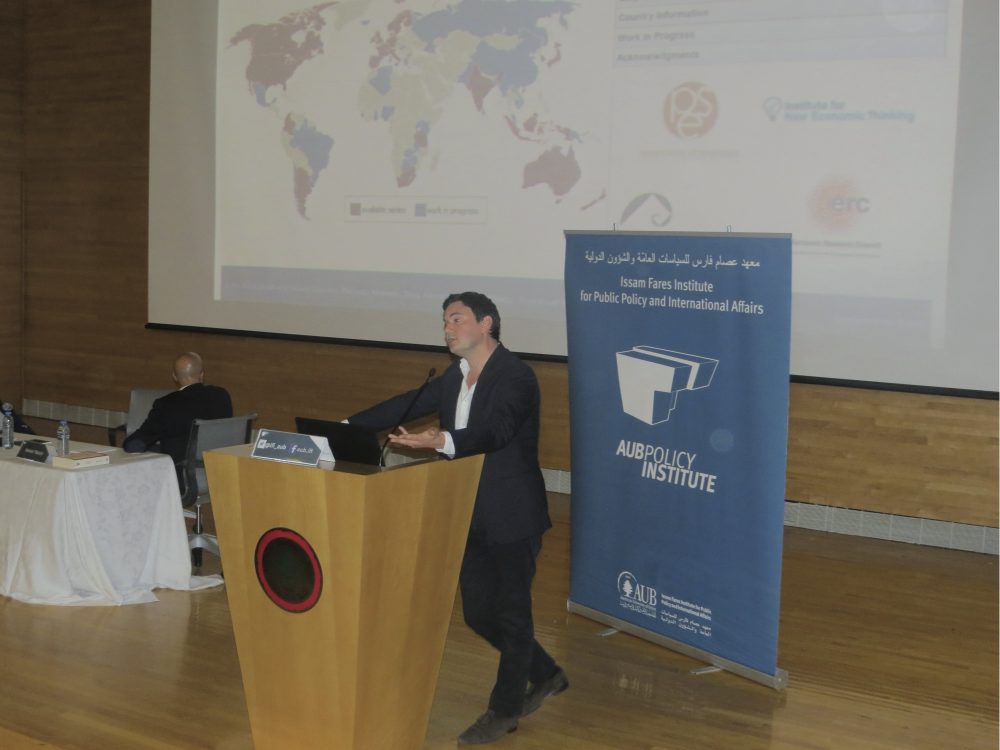
Author Thomas Piketty came to pay his inaugural visit to Beirut and a repeat visit to Cairo last month as part of a promotional tour for his book’s Arabic translation, available in soft cover but with the same distinctive look as the English-language hardcover edition that became such a surprise bestseller.

He noted in numerous presentations and interviews during his tour (as he had said already in interviews in previous years) that the Middle East is probably the world region with the greatest economic inequality and that the deficiencies in data collection and verification make this region difficult to assess from the point of view of an economic historian.

Executive sat down with Thomas Piketty on the occasion of his visit – which unexpectedly entailed three lectures in a single afternoon. Talk about what Nick Taleb – who, like Piketty, benefits in irrational terms from scalability of social matters and, presumably, book royalties – calls Extremistan, where “inequalities are such that one single observation can disproportionately impact the aggregate”.

E   Including the original French, how many languages has Capital in the 21st Century been published in?

I think it is 45 languages.

E   So Arabic is pretty much the last?

Among the major languages, it is the last. There are a few small languages [scheduled to be translated into], but if you take the main ones, it is the last language.

E   How many copies of the book are in circulation?

We have about 2.5 million.

E   When the American translation became a bestseller there was some speculation that few buyers read through the book and that many readers made it only to page five or ten. Where do you see the ratio?

I think most people read a lot; they read more than five, ten or twenty pages. Of course it takes time to read this book and it is okay for me if people read the introduction. There is a lot in the introduction, 50 or 60 pages, and then they read part one and stop and come back in one year. I have no problem with this. It is the kind of book that you can read that way.

E   The American edition was copyrighted to the president and fellows at Harvard University. Is there a similar copyright to the Arabic edition that represents a collaboration with an academic institution?

I don’t think that the Arabic publisher is tied to any academic institution. What happened is that I sold the English rights to Harvard University Press but for all other languages they are dealt with by [Editions] du Seuil, which is my French publisher.

E   Are royalties going to you in France then for all the other editions?

Exactly.

E   Did you make any changes or updates in the Arabic edition?

No (shakes head).

E   So statements like the one (on page 14 in the American edition) that people might by 2050 be paying rent to the emir of Qatar, which might not be seen as very friendly to the Emir, are still in there?

Yes, they are still in there.

E   What relevance do you see in the Arabic edition and what is your expectation?

Each region in the world has its own unique history of inequality and the Middle East, as I tried to say in my presentation, is probably the most unequal region in the world. Even though it doesn’t have this legacy of extreme inequality, like apartheid in South Africa or slavery in Brazil or the south of the United States of America, the oil and the very peculiar system of states that were put in place in the Middle East in the 20th century have in the end created a level of inequality and concentration of resources which is probably the most extreme that we have ever seen in history. And in my opinion it is pretty much related to the instability and to the difficulties in the region with the state formation process.

E   Some people are still blaming this on Sykes-Picot which was signed 100 years ago.

Look, there was no easy solution to Sykes-Picot and we should forget about Mr. Sykes and Mr. Picot and look to the future. But it is clear that the system of frontiers in this region is probably going to change in the future. The best we can hope for is to have some peaceful regional integration with some kind of sharing of resources. I am not saying we should have full sharing of resources. Even in the European Union, Germany and France keep their tax revenues, but they share a little bit through regional funds, through the rule of law and the European Central Bank. This is not perfect but it is better than having merely interstate relations where you have to beg. Right now we have a situation where we have a sort of beggar relationship where Egypt has to beg Qatar or Saudi Arabia. This is not good.

E   Do you want to contribute with your book to an academic debate or a debate involving politicians?

You don’t write books for politicians. You write books for everybody who reads books, for normal people and normal citizens. I believe in the power of ideas and the power of books, because politicians very often just follow what they feel is the dominant public opinion at the time. I think politicians are very often the slaves of public opinion. So I think it is much more interesting to try to influence the development of public opinion through books and other media interventions, than to have breakfast with politicians.

E   Many people I contacted wanted to know if you see the data paucity in the Middle East as a major barrier and in that sense if you regard your book as a call for more data transparency and better data collection in Middle Eastern countries?

The lack of data transparency in the Middle East is at the same time a symptom and a catalyst of the difficulties with the state formation process. It is difficult to build trust in public institutions and in the tax system if you dissimulate some of the tax data. I think it is not good that you have official income taxes in pretty much every Middle Eastern country but it is the only region in the world where you don’t have access to data in any country. That is a symptom which will always create some suspicion that the system will not be administered in a fair and equitable manner. To me, this is a really important issue.

E   Sometimes it seems that inequality in this region is accepted more than elsewhere. Is that in your view an obstacle to development?

I would not talk of acceptance of inequality. When the youth are demonstrating in Egypt and Tunisia, they are demonstrating against the fact that they feel that they don’t get the kind of jobs and the kind of future that they deserve considering the efforts they have put in, particularly as compared with other youth in the West but also in comparison with all these oil countries where some people have so much money that they don’t know what to do with it. I think this is part of the feeling of injustice.

[pullquote]I prefer a global wealth tax, a tax that must be on all forms of wealth, such as financial assets and real estate[/pullquote]

E   But didn’t the eruption of complaints over economic injustice that was part of the Arab Spring soon change into something else? You don’t see an Occupy Wall Street or an anti-IMF gathering for ideological reasons here. That is why I am asking if inequality is still more accepted in countries of this region as opposed to other regions?

Well before you can solve inequality you need to make progress in the process of state formation and institution building. Democracy is always a miracle; the fact that in a country of 90 million people like Egypt we decide on government by a majority decision and accept their decision even if we disagree. We have seen this in Egypt after the 2012 elections, which was for the first time a highly contested election, but then one year later the democratic process was interrupted. I think this was a very sad end to this but it is not final. There will be other attempts. We know from experience in other parts of the world that this kind of process can take a long time. When we used the electoral process in Europe for the first time for deciding which government we should have, in Germany it didn’t work so well. Then finally it worked. We should be realistic about this. It cannot be done in one year.

E   You wrote in your book several times that you see patrimonial capitalism on the rise and that the recession of 2008 was in your view the first crisis of patrimonial capitalism in the 21st century. How do you define patrimonial capitalism and is it in your view still a problem?

I define it in comparison to previous periods particularly in European history. We had a first stage of patrimonial society in the 19th century and until World War I, with a very high level of assets and wealth relative to income. Then there was a complete change with the World War and it took a very long time – ideologically, politically and economically – to recover from this. What I mean by the return of patrimonial capitalism today is that we have for instance the market value of real estate and housing, of stock market assets which is now back to very high levels relative to one year of average wages or average income. Not everything is bad about this. We should not be nostalgic about the 1950s where everything was [socialized]. This was not just a positive policy compromise with wealth owners. It was also negative and [accompanied with] many disruptions. The return of patrimonial capitalism is something which is almost unavoidable but we need to regulate it and need to develop ways to prevent financial crises and housing bubbles and give access to property to broader segments of the population. This is a long-run evolution.

E   So patrimonial capitalism for you is not concentration of capital in the hand of a predefined class?

Not necessarily. I think there are different ways to regulate patrimonial capitalism, so even if we are still [living] in patrimonial capitalism, there are different forms of patrimonial capitalism and I want to push toward a more equitable [version].

E   Would you favor a land value tax to balance the inequalities of ownership in real estate?

I prefer a global wealth tax, a tax that must be on all forms of wealth, such as financial assets and real estate. It is very difficult to separate the land value from the real estate value from the value of financial assets of a company which are then used to buy real estate assets. I think the concept of a land tax doesn’t work. I want a tax on global wealth.

E   A tax on global wealth demands transparency on numbers, as you also stated in your book. But in this region, where transparency on numbers is very low, doesn’t this look to be a more than utopian concept when you can’t obtain the data on even the basic level such as tax records?

It is difficult [to remedy the lack of data] but even in the Middle East you have systems of property tax, which sometimes exist, and you have systems of inheritance tax, which sometimes exist or existed in the past in Egypt until the 1970s. We have to improve the system but don’t have to start from zero.

E   The notion of equality looks fanciful when we consider that we’ve never had equality in history. Is it like the virgin birth, which some faiths determined as a dogma but which is not of practical applicability?

The problem is not to have full equality but rather to moderate inequality.

July 18, 2016 1 comment
0 FacebookTwitterPinterestEmail
Economics & PolicyWaste Management

No high-tech fix for our millennia-old garbage problem

by Matt Nash July 15, 2016
written by Matt Nash

Here’s a question no one asks: What did Adam and Eve do with the apple core? Did they compost it or simply toss it into the nearest river or valley? Waste has been with humanity since the very beginning. And while we might survive in a post-apocalyptic future without coffee, the Kardashians or wearables, garbage will be right there with us (and cockroaches, most probably). The way we view garbage has changed in the past 50 years, and more recently the disruptive power of new technology is altering how we handle waste. But there will never be an app that can stop us from generating garbage.

OUR WASTE: YESTERDAY, TODAY AND FOREVER

For both a synopsis of how trash evolved from refuse to resource and a lesson in newspeak, consider a passage from the UN Environment Programme’s 2015 “Global Waste Management Outlook” report: “Many developed countries have made great strides in addressing waste management, particularly since the environment came onto the international agenda in the 1960s, and there are many good practice examples available for the international community to learn from. However, the initial focus was on waste after it had been discarded, whereas at present attention has moved upstream, addressing the problem at its source through, for example, designing out waste, preventing its generation, reducing both the quantities and the uses of hazardous substances, minimizing and reusing, and, where residuals do occur, keeping them concentrated and separate to preserve their intrinsic value for recycling and recovery and prevent them from contaminating other waste that still has economic value for recovery. The goal is to move the fundamental thinking away from ‘waste disposal’ to ‘waste management’ and from ‘waste’ to ‘resources’ – hence the updated terminology ‘waste and resource management’.”

Trash can, or treasure chest?

Waste is not worthless. But the business model that best turns trash to cash is service provision, not material recovery. Yes, your empty Pepsi can has value, but likely not as much as you think. In June, recyclers could sell a ton of aluminum on the local market for $400 to $500, Yvonne al-Hajj, who runs a for-profit recycling business, tells Executive. The price is particularly low at the moment (as are prices for all recovered commodities, she says), and can reach up to $800 or $900. The trick with aluminum cans, however, is that they’re light as feathers. Almost. While Executive does not have access to a scale precise enough to conduct an in-house experiment, the internet says an empty pop can weighs 14.9 grams. That means you need slightly over 67,114 cans to cash in a metric ton. For a household hoping to recover a bit of their soda purchases, it would have to either be very, very thirsty or committed to long-term can storage. In one year, it would require emptying around 183 cans per day to reach a ton (not to mention that, at the current market price, the cost to buy a ton of full cans is $33,557). For a household that drinks five cans per day, it would take nearly 37 years to amass a ton. Volume is key, and the same is true of other valuable recyclables like paper, cardboard and various types of plastics.

Hajj is the brain behind Zero Waste Act, a commercial enterprise run under Contra International, a local company involved in the waste and construction sectors. Zero Waste collects and sells recyclables from schools, business (including ABC malls) and individual households. Although it’s been up and running since 2011, Hajj admits the company is “so far not that profitable.” In May of last year, before the government closed the Naameh landfill with no alternative in place, Zero Waste began charging households a monthly collection fee to help cover its own operations costs, Hajj explains. The fee starts at $10 per month and varies depending on collection frequency. Zero Waste had more than 800 members prior to imposing the fee, and has “over 600” today, Hajj says. The company opted for a fee in part, she explains, because picking up small volumes of plastic, aluminum and other materials from individual residences can cost more than what the recyclables are worth. 

Both locally and abroad, collecting recyclables is typically a non-profit business unless it is part of the informal market (think a few individuals sifting through unsorted waste in large containers for valuables or driving around to source old refrigerators). As individual collectors try to scale their enterprises, overheads (employees, vehicles, compressing equipment) quickly eat away profits. Not to mention, as Hajj notes, that collected recyclables often need further, non-automated sorting and treatment (caps removed from water bottles, plastics and metals divided into their various types).

Companies making real profit from garbage are the ones removing and disposing of big volumes (regardless of whether treatment technology is state-of-the-art or last century, garbage doesn’t disappear from our doorsteps for free). Waste Management, the creatively named service provider which is the largest trash handler in the US, reported revenues of $13 billion in 2015 (down from $14 billion the year before). Ziad Abi Chaker – founder of Cedar Environmental, which builds waste management facilities locally – explains, “The garbage business is just an industry,” adding: “Waste management costs money for the government that is running [the service]. The one who makes money is the one dealing with the problem because the infrastructure is very expensive. People ask me, ‘Why do you have to collect money from municipalities [to send their waste to your facilities]?’ Because that’s the only way it will be profitable.” Cleaning up after ourselves seems to be a cost humanity will always have to bear.

Innovation, not revolution

The sanitary landfill was an innovation of the 20th century. It was born from the realization that trash left alone to rot in a pile damaged the surrounding environment and posed a public health risk. While this most basic of waste management technologies is still not used worldwide, the pace of innovation in the field of waste disposal is nonetheless in constant mode of development. Waste can be burned in a controlled environment to produce energy. It can be transformed into refuse-derived fuel – a cheap energy source for some industries, like cement manufacturing. Waste can be recycled and up-cycled. There are even smart waste bins (large containers with sensors and an internet connection which alert waste collection companies when a bin is full, optimizing the design of pick-up routes and schedules). A brief Google search reveals that self-sorting trash cans are popular inventions among university students (and Executive met two from Lebanon – Jamil Ballout and Gabriel al-Hakim), yet for individual households no such product is commercially available.

Green Glass Recycling Initiative – Lebanon, a local organization, has put bins in parts of Beirut (Photo: Greg Demarque | Executive)

Lebanon’s entrepreneurs are not ignorant of waste management, but the handful Executive spoke with this month are all pursuing ventures too young to properly evaluate (most only thought of their potential companies as the result of startup competitions with a garbage focus held earlier this year). A new “green” fund, however, recently entered the market with a goal of financing only environmentally friendly startups, pumping more capital for social entrepreneurship into the ecosystem and bringing with it the associated competition for said capital. The fund comes from Foundation Diane, an NGO started by Diana Fadel. Cyril Rollinde, the fund’s manager, and Tracy El Achkar, of the foundation, explain to Executive that waste management will be one area of investment focus. While Rollinde won’t reveal the size of the fund, he explains that it won’t behave like other venture capitalist war chests on the market.

“We want to be liquid,” Rollinde says, noting the fund will exit all investments within five years and does not plan follow-on funding. It is eyeing ticket sizes between $50,000 and $300,000, but Rollinde says there is “no real limit.” The fund does not want to lose money, but is not looking for astronomical returns. Instead, Rollinde and Achkar confirm, the idea is pushing a green agenda into the entrepreneurship ecosystem with an end goal of making the green industry “as competitive as the tech industry.”

July 15, 2016 0 comments
0 FacebookTwitterPinterestEmail
Economics & PolicyWaste Management

Clearing up the mess

by Matt Nash July 14, 2016
written by Matt Nash

This article has been updated from the print edition to reflect news developments. 

There’s a landfill in Lebanon people usually forget about. It’s around 15 kilometers northeast of Beirut in a town called Bsalim. It draws no ire. Nearby residents do not burn tires to demand its closure. Unlike the now-shuttered Naameh sanitary landfill southwest of Beirut, Bsalim only accepts what is known as inert waste – meaning garbage that will not decompose and cause damage to the surrounding environment, like concrete, for example. In the heat of operation, it smells just fine. This was not the original plan. Bsalim was intended to be a second Naameh. However, according to both Averda CEO Malek Sukkar, whose company built both landfills, and a 2001 report commissioned by the Ministry of Environment, plans for Bsalim to become a sanitary landfill for municipal solid waste (MSW) – a stinking, co-mingled garbage stew in a country with nearly no sorting at source – fell through after an environmental impact assessment found that groundwater at the site was too close to the surface. This was back in the 1990s. Flash-forward to July 2015. A few hundred meters away from the Bsalim inert materials sanitary landfill, nearby municipalities began dumping their garbage into the valley. They did not install liners to keep the waste in place nor a drainage system to collect leachate (a toxic sludge produced by decomposing MSW which pollutes groundwater). They created an open dump. Recent trips past the valley reveal that it still has not been cleaned up, no doubt to the detriment of the shallow aquifer.

The garbage crisis: a lasting legacy

The Naameh landfill served Beirut and the districts of Chouf, Aley, Baabda, Metn and Kesourwan (which collectively account for around half the country’s waste, according to the Ministry of Environment). It used to receive a staggering amount of garbage each day – nearly five full trucks per hour, according to information Executive received on a tour of the facility in August 2015. Cabinet closed the landfill in July 2015 without an alternative lined up. As rubbish piles grew in areas that used to depend on Naameh, the Ministry of Environment issued an order to affected municipalities: Tell Sukleen (the service area’s trash collector) where to park your waste. Not all of them did.

This temporary solution ended up lasting nearly eight months. And how much of the “old” waste was collected? The answer is not entirely clear. As noted above, not every municipality in the service area found Sukleen a parking spot. In an email exchange with Executive, a Sukleen spokesperson says 159 of 268 municipalities (59 percent) had their “old” garbage picked up. The “total amount exceeded 900,000 tons.” The remaining 109 municipalities in Sukleen’s service area “did not request the collection service” and the company has “no data nor documentation regarding their accumulated waste,” the spokesperson says.

What comes next?

The waste crisis prompted mass demonstrations in downtown Beirut in 2015. Protesters wanted municipalities – which have a legal right to manage their own garbage – to be financially empowered by the central government to sort their trash worries out themselves. While the government promised to do just that in the wake of a summer of discontent, plans have since changed. The Council for Development and Reconstruction (CDR) – part of the prime minister’s office – is again handling waste management from the contracting side. CDR is Sukleen and Sukomi’s contractual partner in Lebanon, an arrangement much decried last year, and is in the process of tendering new garbage deals as “the street” remains silent. The first tender, which closed in mid-May and called for building a sanitary landfill in the sea near the airport on land known as Costa Brava, was canceled for allegedly high costs on June 24 (the project is being re-tendered with a new deadline of July 15, according to CDR’s website). Bids to build a second landfill in the sea near Bourj Hammoud were due on June 14, according to one contractor who bid. The contractor explained that both landfills will be protected by breakwaters and include multiple types and technologies of liners to prevent waste and leachate from entering the sea. CDR refused repeated interview requests, and Executive was unable to independently verify the contractor’s information. These two contracts only cover landfilling, however. CDR’s website says that a tender to build composting and sorting facilities to handle waste from the Sukleen/Sukomi service area will close on July 25. As for waste collection and street sweeping, CDR’s website lists two tenders, meaning the Sukleen/Sukomi service area is being divided. The first new service zone covers Beirut, Metn and Kesourwan while the second covers Baabda, Chouf and Aley. Bids for these contracts are scheduled to close on July 19, but the website notes the closure date has already been delayed three times.

The new plan, unlike the tenders last year, only covers the Sukleen/Sukomi service area. And Beirut might potentially opt to bow out of the scheme. United Nation’s Development Programme’s Gharib confirms that the outgoing municipal council signed a memorandum of understanding with UNDP in April 2016 to find solutions for the capital’s garbage. With the recent swearing-in of a new municipal council, Gharib says he’s not sure what the future of coordination between the two will be, and notes that no actual plan has yet been written. Indeed, he says the plan will not offer one concrete solution, but rather various options for the city to weigh given its many constraints, the most obvious being lack of land for waste management facilities. He could well be speaking of the fate of the government’s plan in general. The insurmountable obstacle facing government waste plan after government waste plan over the past decade has been resident opposition to living near a management facility. How that will change is a question no one Executive has asked in the past year has been able to answer.

THE BEST LAID PLANS

Choosing a way to clean up after the July 2015 crisis proved no quick task for Prime Minister Tammam Salam’s government. A plan in motion before the crisis erupted called for dividing the entire country into six service zones, each with a comprehensive solution. While the plan did not make demands on what type of technologies had to be employed to manage waste (i.e., incineration, composting, etc), it did call for a significant reduction in the volume of waste sent to landfill. Over 80 percent of the waste Sukleen was collecting got landfilled, according to the Ministry of Environment. Under the now-canceled contracts, winners would have been allowed to landfill 40 percent of collected waste in the first three years and only 25 percent thereafter. While the tendering should have logically been concluded months prior to closing Naameh (so alternatives could be in place), winners were announced a month after the crisis began. The new contracts were then canceled less than 24 hours later. “At least we would have had infrastructure,” laments Nicolas Gharib, who works on waste management issues in Lebanon for the United Nations Development Programme (UNDP), referring to the various sanitary landfills, composting, sorting, waste-to-energy and refuse-derived fuel facilities contractors had agreed to build.

With the contracts canceled, a new plan for trucking waste from the Sukleen/Sukomi service area to other parts of the country gained currency but never came to fruition. Exporting garbage was next on the list, but that idea also fell apart. The most recent plan (approved in March 2016) seems to have stuck. It first tasked Sukleen and Sukomi with collecting some of the waste that had accumulated during the crisis. This “old” garbage was sent to Naameh. All “new” garbage – meaning trash generated after the plan’s approval – was collected by Sukleen, sorted and baled by Sukomi, and parked next to soon-to-be-built offshore landfills near Costa Brava, south of the airport, and Bourj Hammoud. The plan calls for a third landfill to accept waste from the Aley and Chouf districts but the final location of that landfill has not yet been determined.

July 14, 2016 0 comments
0 FacebookTwitterPinterestEmail
LeadersOpinion

Wasted opportunities

by Executive Editors July 14, 2016
written by Executive Editors

The lack of transparency in finding a way out of the July 2015 garbage crisis is appalling. Last August, the private sector put forward offers that would have seen modern waste solutions put in place all over the country. The volume of Lebanon’s waste being sent to landfill would have dramatically fallen (see policy story). Contracts for private companies to build real waste solutions, however, were canceled on a whim with a false cry that they were too expensive.

Today, we’re worse off than we were a year ago. Beirut and the districts of Chouf, Aley, Baabda, Metn and Kesourwan are still preparing around 80 percent of their waste to be sent to a landfill. Those landfills (one at Costa Brava, south of Beirut airport, and one near Bourj Hammoud) have not yet been built. And the contract for the Costa Brava landfill was suspended on June 24. It’s only a matter of time before the temporary storage locations fill up and trash once again floods the streets. In the rest of the country (save for Zahle and Sidon), most residents’ waste is being burned or dumped. While a few municipalities are working on or actually implementing their own solutions, they are doing it without assistance from the central government. This is despite the government having approved a plan last September that called for training municipalities – and empowering them financially – to handle their own waste in a sustainable way. The committee that should have helped municipalities prepare for waste devolution met exactly once, according to Nicolas Gharib, who attended as a representative of the UN Development Programme. So much for long-term planning and awareness raising.

Waste management is expensive. The only real way to reduce your garbage bill is to generate less trash. This is not a difficult concept to understand, so it is mind boggling why the government is not doing anything to raise awareness. For example, the government could have the various experts (and they do exist) working inside different ministries on tours of TV stations and town halls to fully explain this to people – but they don’t. When journalists call with real questions, interview requests are ignored or outright denied. Instead of concrete information, we get half-truths and the standard horseshit. After the Council for Development and Reconstruction (CDR) suspended the Costa Brava contract (the winner of which has still not been publically announced), it claimed in a statement that the price was too high. Soon after, a voice of dissent arose. Walid Safi, the government representative working with CDR, claims the cost argument is a red herring. French daily L’Orient du Jour quotes him saying CDR must rescind its statement or else Safi will disclose “many hidden truths” about CDR’s contracting processes. Think about that for a second. He’s claiming special knowledge seemingly related to corruption. Instead of simply exposing it, he’s trying to pressure the CDR.

Safi is as much a part of the problem as every other minister, MP or person of influence who makes the same threat (this formulation of “I know about corruption but will only tell if…” is unfortunately common in this country). We need accountable governance in this country. In the 26 years since the Lebanese Civil War ended, we’ve mismanaged our waste at every opportunity. The only way to move forward is putting in place sustainable systems that involve waste reduction, sorting at source and modern treatment facilities that will have to be built near someone’s back yard. If we don’t we’ll be doomed to choke on our trash every time a landfill is filled to capacity. Executive has said this all before, and we’ll keep saying it until someone in power decides to listen.

July 14, 2016 0 comments
0 FacebookTwitterPinterestEmail
Hospitality & Tourism 2016Special Report

Municipality matters

by Nabila Rahhal July 12, 2016
written by Nabila Rahhal

May 2016 was municipal council election time in Lebanon and so, every Sunday of that month, many Lebanese headed to their area of origin and cast their vote for who would essentially be in charge of their native town’s internal affairs for the following six years.

While most voters were probably primarily concerned with issues such as waste management or electricity, the development of their city or village’s touristic potential is a factor that should have also featured in their choice of candidate, given the potential benefits tourism, even when locally driven, could bring to an area.

Although most rural villages and towns generally have small municipal budgets, active municipal councils can still work on promoting tourism in their areas in terms of planning, attracting investors and securing donations towards touristic projects.

Please don’t go

According to the municipalities Executive spoke to, one of the the main goals of developing tourism in their city is to keep people in it all year.

One of the activities the municipality of Ehmej has organized to achieve this goal is the development of fifteen hiking trails, also open for snowshoeing in winter.

This project began slowly in 2004, through funding and support from USAID, but grew in earnest over the last three years. In 2015, the trails welcomed 1,500 visitors, including students on school trips as well as Lebanese and expat nature enthusiasts, and 560 visitors in the first four months of 2016 alone.

“Our end goal from all those activities, as a municipality, is to keep people in Ehmej during the winter as well, decreasing migration to the coastal cities. Those who come from Beirut spend money here and enrich local businesses: they eat, they get gas for their cars, they sleep in one of our four guesthouses, and when they have fun on their visit, they will come back again,” says Abi Semaan, boasting that 55 percent of Ehmej’s citizens live there yearlong, working in the area’s schools, hospitals, hotels and restaurants or as guides for the hiking trails.

[pullquote]“It is actually very hard to have tourism without the involvement of the municipality because, for example, you need access to public natural resources, which belong to the baladiyeh [municipality]”[/pullquote]

Generating employment

The creation of job opportunities is one of the reasons Pierre Achkar, mayor of Broumana, cited for encouraging and supporting investments into food and beverage (F&B) outlets in his town, including an eight-restaurant cluster developed and operated by his son George Achkar last year and the addition of another cluster, Printania Villa, this year, also developed by his son.

“Twenty three restaurants will open in Broumana this summer; for Broumana this means creating employment opportunities in the restaurants themselves, mainly university students who would be working part time in these places, and also in the pre-opening phase in terms of construction and back end work, not to mention the money that has been invested in the city itself,” says Achkar proudly.

Seeking out the money

Some municipalities clearly see the financial value of hospitality and tourism activities in their cities and so seek out investors that would develop such projects in their area.

This was the case with The Backyard in Hazmieh, a multipurpose cluster project with a focus on F&B outlets. The mayor’s son suggested to Venture Group – the developers of the project – that it create such a project in Hazmieh instead of the office structure the developers had in mind.

“This is not usually the case but now that Hazmieh did it, I’ve had municipalities who are interested in facilitating similar projects and even considering developing such projects on government owned land. Because these projects bring job opportunities, further tax revenue in the long run, increase the real estate value of the neighborhood and could put a small lesser known area on the tourist map,” explains Marwan Ayoub, copartner in Venture Group.

The Backyard Hazmieh (Photo: Greg Demarque | Executive)

The Backyard Hazmieh (Photo: Greg Demarque | Executive)

The power of local support

Developing the touristic appeal of a town or village does not happen by itself, no matter how beautiful or culturally relevant the area is. According to Kanj Hamade, senior consultant at Lebanese Industry Value Chain Development Program – funded by USAID and currently working on 25 projects related to rural tourism in Lebanon – there is a clear significant difference between a municipal council that is working for a village and one that is not working, calling the municipality a “generator for local development”.

“It is actually very hard to have tourism without the involvement of the municipality because, for example, you need access to public natural resources, which belong to the baladiyeh [municipality]. If you want to build sustainable holistic tourism based on a coalition or network, and not just an individual project, then you need the support of the local authorities,” says Hamade, referencing the examples of areas in Lebanon which have high historical significance but refused to work with the LIVCD on marketing their assets.

Speaking as a private sector investor, Ayoub says their hospitality cluster projects would be much more difficult to actualize without the support of local municipalities. “It would be nearly impossible to have such a project without the support from the local community. They can put obstacles for you every step of the way from the space you need to pour concrete, to the facilities you need when receiving customers, to the tricks that would devalue the size of the land,” says Ayoub.

Finding your niche

[pullquote]The festival was a success for the local cherry growers, as the 7,000 kilograms of cherries picked in one day sold for 7,000 Lebanese lira per kilogram[/pullquote]

Hamade explains that a municipality’s first concrete role is to survey its territorial capital – be it agricultural, historical or natural – and build a story or brand around that asset which would attract visitors. The municipality of Ehmej, for example, did just that: “We looked at our assets and saw that we don’t have industrial areas or agricultural areas in our village, but we do have beautiful forests which we utilized through the development of the hiking trails,” says Abi Semaan.

The municipality of Hammana developed a tourism strategy that capitalized on the fame of their cherries through resurrecting the cherry picking festival three years ago, a tradition that had been very popular before the civil war.

In 2015, the one-day festival attracted 5,500 people to Hammana and this year, when Executive spoke to the organizers at around noon on the day of the event, the festival had already welcomed 5,000 visitors. The festival was a success for the local cherry growers, as the 7,000 kilograms of cherries picked in one day sold for 7,000 Lebanese lira per kilogram. Visitors to the festival – 90 percent of whom are not from Hammana – got to discover the town through fun activities, explains its mayor Bachir Farhat.

Hammana (Photo: Greg Demarque | Executive)

Hammana (Photo: Greg Demarque | Executive)

According to Achkar, Broumana saw its potential in being the closest and most accessible masyaf – or a destination for summering – to Beirut, via the Metn highway (for more on infrastructure and hospitality development, see explainer). As such, they supported the development of F&B operations mainly through facilitating and speeding up paperwork and by developing a marketing campaign that would brand Broumana as a summer destination.

When a plan goes downhill

Sometimes a municipality’s tourism strategy backfires. One example is Bhamdoun El Mhatta, where their branding of being a family oriented town catering to tourists from the Gulf left them with no tourists once GCC nationals decreased their visits to Lebanon.

“Tourists from the Gulf like Bhamdoun because it is well maintained and family oriented. Some people suggested we have nightclubs or things like that to attract people but we don’t agree; we are patient and will wait and preserve Bhamdoun until the Kuwaitis come back,” says Bhamdoun El Mhatta’s Mayor Osta Abu Rjeily, explaining that since Kuwaitis own more than 45 percent of the property in Bhamdoun, there is actually not a lot more they can do to promote tourism there beyond waiting.

[pullquote]Once a branding strategy is set, the municipality’s role turns to supporting its application through identifying and coordinating between potential investors and donors[/pullquote]

Phase two

Once a branding strategy is set, the municipality’s role turns to supporting its application through identifying and coordinating between potential investors or donors. Most municipalities in rural areas have small budgets and cannot afford to finance touristic projects and as such play the role of facilitators.

“The municipality has a leadership role to play, meaning it can coordinate between the local and regional key players, facilitate communication between them, and represent the local community in meetings with donors and the government when it comes to tourism,” says Hamade, admitting that when municipalities have a strong enough budget to fund projects, their work as Lebanon Industry Value Chain Development (LIVCD) becomes easier and faster.

Abi Semaan explains that at first they, as the municipality of Ehmej, had to find and then apply for grants that would support their tourism projects.

The municipality of Hazmieh felt that a project like The Backyard was needed in their community and so provided the incentives needed to facilitate its development. “We needed such a project for the community and we were prepared to offer incentives to get it. Part of the incentives were to do with taxation in that we only started collecting taxes from the restaurants after the project’s first day of operation and not from the first day of rent. But this was not the main incentive for this project: such a project needs our coordination and facilitation with every governmental office that is related to the municipality (technical office for architectural drawing, licensing ….),” says Michel Asmar, a representative of the Hazmieh municipality.

All the efforts made by any municipality cannot circumvent the need for internal stability and regional security in order for international tourism – and not just domestic – to truly flourish in Lebanon, but that does not mean they cannot lay the groundwork while waiting for that day.  “The challenge is to work on projects while there is little demand. The demand is increasing but it’s mainly locally driven; the internationals will eventually come so we are getting ready for that while working with increasing local demand,” concludes Hamade.

July 12, 2016 0 comments
0 FacebookTwitterPinterestEmail
Hospitality & Tourism 2016Special Report

Broken financing

by Jeremy Arbid July 12, 2016
written by Jeremy Arbid

From wellness to cherries, at hospitality clusters and beach resorts, Lebanon’s event organizers and business owners outside the capital agree on one thing: municipalities should do more to bolster their economies. While article 49 of law 118/1977 on municipalities says they can plan roads and other public works – projects like playgrounds, hospitals, sewage and water networks – in practice many are too cash strapped to build or upgrade infrastructure that could support local economic growth. Local business leaders running entertainment venues, restaurants, hotels and other ventures that benefit from an influx of event-goers complain of poor roadways connecting to Beirut and of inadequate public utilities linking businesses to the local grid. Why, asked one business owner before answering their own question, do some people, as anecdotal as it is seemingly commonplace, commute two hours each way to jobs in coastal urban centers? Because residents find few opportunities in rural villages.

What the complaints ultimately boil down to is a criticism of infrastructure investments at the municipal level: more is needed. The hospitality sector is not the only segment of the economy that might benefit from such infrastructure investments, including sanitation, health care and education facilities – public works projects could improve quality of life, boosting access to public services and driving new business growth and job creation in underdeveloped areas of Lebanon. But the municipalities are challenged to do so: they lack money, and a mechanism meant to distribute funding equitably amongst Lebanon’s more than 1,000 cities and villages is broken.

Closing the funding gap

Municipalities are caught in a vicious cycle says Sami Atallah, executive director of the Lebanese Center for Policy Studies, a think tank that has extensively studied the issue of local governance and its financing, lobbying for reform. “The idea is to get poorer and rural areas closer to the average in terms of infrastructure and level of development,” Atallah tells Executive. Cities simply do not have the financial means to implement development projects and maintain or upgrade existing infrastructure he says, pointing out that the problem is more nuanced than just not having cash. A system to distribute money to municipalities, the Independent Municipal Fund (IMF), was set up in 1979 but the mechanism has been plagued by irregular transfers from the pot to the cities.

A portion of the fees on mobile phone and internet service collected by the Ministry of Telecommunications are a large source of revenue meant for the fund, as are taxes collected by the Ministry of Finance. How much money should make its way into the IMF, in terms of assessing whether new taxes and fees are necessary, and whether money meant for municipalities actually goes to them, are entirely separate questions from that of disbursement. On the latter question, a 2011 study by the International City/County Management Association (ICMA), an association of local government administrators advancing professional local governance, in which Atallah was a lead researcher, found a number of unlawful diversions from the IMF to pay for government services at the national level. Between 1993 and 2007 the study found $72 million was transferred out of the municipalities’ trust fund to pay for civil defense. For the same period the ICMA study calculated all unauthorized deductions totaled some $246 million from the trust fund, an amount that, by law, should have gone to municipalities.

Distributing cash to the municipalities from the fund’s account at the central bank has its own challenges. For one, unpredictable timing of transfers makes it all but impossible for cities to think in the long term. Planning infrastructure development, investing, building, even a city’s branding as a place-to-visit or as business-friendly (for example a rural municipality that, because of a new or upgraded road, is now easier to reach) all require outlooks measured in decades rather than years. Compounding the problem of unpredictable transfers are, Atallah says, distribution rules that illogically favor wealthy cities over poorer ones. Just as citizens vote not in the town of their residence but where their family is registered so too do municipalities calculate a part of their share of IMF payments, counting the size of their tax base as registered citizens rather than residents. Municipalities’ share of IMF payments are also calculated based on a two-year average of the revenues they collect from their tax, instead of a municipality’s efficiency to collect taxes and fees.

This further exacerbates inequality between richer and poorer areas, Atallah says, giving more urbanized cities an underlying advantage. Taxes collected at the municipal level are made up mostly of real estate-related revenues like property taxes and fees on transactions, rentals and building permits, so cities with more built-up surface area have an edge in their two-year average of collected revenues. “The more urbanized [a municipality] the more likely it will be able to collect these taxes. So the rural areas where there is unbuilt areas – they don’t have rentals, building permits – that’s where you see the discrepancy taking place between rural and urban,” Atallah says.

Getting the money where it’s needed

Businesses in the hospitality industry wouldn’t be the only beneficiaries of municipal investments into infrastructure. “Infrastructure development is a critical enabler of economic activity,” wrote the for-profit consulting firm The Boston Consulting Group in a 2015 report focused on African infrastructure investment for the World Economic Forum. A crucial question that municipalities must ask when planning infrastructure projects is what economic returns can they expect to “buy” from the investment. Studies of rural economies show that job creation, expanding and attracting new businesses are typical returns from infrastructure investments. And studies on the installation of high-speed broadband internet connections to rural towns in Kentucky, and to other out-of-the-way cities in the United States, found positive growth in employment, property values and the number of businesses.

Atallah says there are intangible benefits of infrastructure development beyond returns to economic growth. Investments into roads and public utilities, as well as health and education infrastructures in rural Lebanon is a must because “there is a huge discrepancy between the poor and the rich,” he says. In terms of connecting the country and closing the gap Atallah adds that “you want the feeling that this discrepancy is closing, and the IMF can play the role by saying that poorer regions get more money, up to a certain percentage.”

But after years of studying municipal financing and lobbying for fixes to the law Atallah says Lebanon’s decision-makers have little appetite to pursue any reform. Without a change to the funding mechanism, and with no other structured frameworks, like issuing municipal bonds or entering public-private partnerships, as a way to raise money to build infrastructure, rural and poor cities have little prospect of bolstering their economies and improving the livelihoods of their residents.

July 12, 2016 0 comments
0 FacebookTwitterPinterestEmail
Hospitality & Tourism 2016Special Report

Hanging on

by Nabila Rahhal July 11, 2016
written by Nabila Rahhal

In May 2016, a collective online call to action, under the hashtag #lawshumasar (whatever happens), was issued by key figures in the creative and productive sector to keep working in Lebanon no matter what happens.

It seems the Food and Beverage (F&B) subsector in Lebanon has heeded this call as its productivity continues to grow despite a challenging and ever changing playing field.

The good old days

Modern day operators in the hospitality sector consider the period between summer 2008 (following the Doha Agreement) and 2011 to be the “golden years” of tourism in Lebanon, wistfully recalling the thousands of visitors who used to flock to the country, mainly to the capital Beirut, annually filling up its hotels and the waiting lists of clubs and restaurants.

Jean Beiruti, head of Lebanon’s Touristic Firms Syndicate, says revenues generated by tourism in 2010 reached $9 billion, according to the World Tourism Council, while Tony Ramy, head of the Syndicate of Owners of Restaurants, Cafes, Night-clubs & Pastries in Lebanon, places the hospitality sector’s contribution to GDP during the period from 2009 to 2011 at 12 percent.

Faded glory

Four years into regional conflicts and internal instabilities (the most recent being the bombings of BLOM bank’s headquarters in Beirut and in the village of Qaa), these golden years are a distant memory, often evoked as validation of the hospitality sector’s potential under more favorable circumstances. Today, according to Beiruti, the sector’s direct contribution to GDP is eight percent, and it rakes in $3.2 billion in revenues, less  than half what it used to in 2010.

With access to Lebanon via land largely blocked, the country lost a main source of touristic revenue from those who used to visit by car. Beiruti estimates, for example, that 220,000 Jordanians used to visit Lebanon that way.

This, coupled with the ongoing sensitivities between Lebanon and the Gulf countries, which include a travel ban preventing nationals from some GCC countries from coming to Lebanon, have led to a decrease in the number of traditional tourists to the country and have thus negatively impacted the hospitality economy.

[pullquote]With inbound tourism at such a low for the past few years, the F&B sector’s main customers have become those residing in Lebanon[/pullquote]

The new tourists

While today tourists from Egypt and Iraq seem to have replaced tourists from the Gulf, Ramy explains that they are incomparable since Gulf nationals stayed for a longer period in Lebanon, often owning homes in the country,  while Iraqis and Egyptians stay for a few days only – judging by the length of their hotel stay – and generally have lower purchasing power than GCC nationals. Ramy estimates that on average, tourists from the Gulf used to spend $5,000 per week in Lebanon as compared to other nationalities, such as Egyptians, that spend around a $1,000 per week.

According to Beiruti, today the main market for tourism in Lebanon are the Lebanese expats who come to Lebanon to visit their families and homeland. F&B operators Executive spoke to attribute the increased activity in their venues during both summer and winter holidays to these expats who want to enjoy their time during their visits home.

Homecoming blues

On the other hand, Ramy sees that even expats who visited Lebanon on an annual basis before are nowadays decreasing the durations of their visit, preferring instead to divide their holidays between Lebanon and neighboring countries such as Cyprus, Turkey or Greece.

“When it comes to Lebanese expats, we have noticed in the last two years that outgoing tourism has become very high. These expats come to visit Lebanon for a few days to see their family and then head to the Greek islands or Cyprus or Turkey or Sharm El Sheik for a vacation. This is because these countries are passing through their own crises and so their prices have gone down and they are competing with us even over the Lebanese expats,” explains Ramy (for more on regional integration of tourism, here).

Counting on the locals

With inbound tourism at such a low for the past few years, the F&B sector’s main customers have become those residing in Lebanon, and F&B operators across the country tell Executive that 90 percent of their current customers are Lebanese. “Until the region calms down, we will always be affected by regional instability. But our focus is on the people who consume our products day in and day out, and we are working to win their loyalty and taste,” says Karim Miknas, managing partner of Miknas Food SAL, the licensee of McDonald’s Corporation in Lebanon.

Catering to Lebanese residing in Lebanon needs a different game book than catering to an influx of tourists and expats. “The local Lebanese are still going out but they have lower purchasing power and so are going out in a different manner than before,” says Ramy, giving the example of people ordering less than they did before in restaurants or drinking a bit at home before going out clubbing. He adds that in 2010 Lebanese generally spent three times more on their outings than they do today.

Out of Beirut

One of those differentiated strategies employed by F&B investors is finding new markets in Lebanon, but out of Beirut, which has become saturated with outlets and is more tourist dependent than other areas in Lebanon. “The year 2016 has been very challenging, and we can feel that Beirut is not [as] sexy as the previous years. This is due to two main factors, which are the political and economic situation, which meant no more extra flow of tourists, and also because you had a lot of new restaurants opening in Beirut for the same traffic. So, you have around 30 percent more restaurants and places to go to, but for the same number of people who go out,” explains Donald Batal, Founder of The Ministry of Food, a company which owns and operates  Classic Burger Joint and Tomatomatic.

[pullquote]“The year 2016 has been very challenging, and we can feel that Beirut is not [as] sexy as the previous years”[/pullquote]

Marwan Ayoub, co-partner in cluster development company Venture Group, says their experience with developing Uruguay Street back in 2010 (the hospitality cluster street located in Downtown was a success when tourism was at its peak but started suffering when tourist numbers declined) taught them to work on projects out of Beirut that would rely on the neighboring communities for their survival.

“We took a big hit in Uruguay but it won’t be the case with such a project [like The Backyard Hazmieh] because it’s not tourist based and instead attracts the community and surrounding environment, same thing for Dbayeh and our future projects. It’s not that tourists won’t visit the clusters, especially since they have become destinations in their own right and we will benefit more if tourists come, but we have learned in the past six years to develop projects that rely mainly on the local community,” explains Ayoub.

Outings for all

Another coping strategy employed by F&B operators is to make sure their offerings target a wide range of tastes and purchasing powers. Miknas gives the example of McDonald’s expanding its product line in Lebanon to include McCafé cakes and coffees: “Just because we don’t open new locations doesn’t mean that we are not growing; we grow in our sub extensions and product offerings, and have seen more growth in the past two years with fewer outlets.”

Boubess Group portfolio includes both hybrid café concepts, such as Cozmo Café or Café Hamra, and fine dining concepts, such as Metropole or The Butcher Shop & Steak House, which ensures they have the Lebanese market’s culinary needs covered. “In this situation, you either try to reduce costs so you can decrease the average cheque and attract the masses or you can go into the niche where the higher prices are more justifiable through the ingredients used, service provided, locations and the prestigious décor; in this case the lower footfall in such places is compensated by the higher average cheque,” explains Hady Fadel, marketing manager of Boubess Group.

Summer lovin’ 

Summer 2016 has been off to a slow start due to the Holy Month of Ramadan falling in June. Beach resort operators south of Beirut are most affected by this, explains Beiruti, in addition to those with outlets catering to nightlife.

Still, Ramadan ends the first week of July and those in the F&B sector are cautiously optimistic that they could benefit from a certain level of increased footfall and activity this season. “I still believe we are going to have a good summer and that people are going to come to Lebanon but we have to be realistic, they are not going to do so in droves,” concludes Miknas.    

July 11, 2016 1 comment
0 FacebookTwitterPinterestEmail
Hospitality & Tourism 2016Special Report

What’s on the tourism menu?

by Nabila Rahhal July 8, 2016
written by Nabila Rahhal

Whether it’s summer resort towns like Bhamdoun, Aley, Zahle or Dhour Choueir which began to flourish in the 1940s – and were frequented by both local Lebanese escaping the heat of Beirut and international tourists from Egypt or Arab Gulf countries following the oil boom – or the coastal city of Beirut, which became a glamorous beach and clubbing destination for jetsetters in the 1950s and 1960s, tourism has traditionally been considered one of the main contributors to Lebanon’s GDP.

Downhill slump

One major prerequisite for tourism is internal stability and security, and whenever those two would be absent from Lebanon, so were the tourists. However, on every occasion, tourism would later bounce back with the first signs of security returning to the country. Currently, Lebanon is passing through its second longest tourism slump (following that of the Lebanese Civil War) starting with the onset of the conflict in Syria in 2011 and the inevitable security incidents that it has since brought to a number of Lebanese towns and villages.

According to figures from the Ministry of Tourism, 2010 – considered a record year for tourism in Lebanon’s recent history – saw 2,167,879 tourists enter Lebanon. The number of tourists who visited the country in 2015, 1,517,904, is down from the 2010 high but is still considered a minor improvement from the previous two years.

Decline of gulf tourists

While citizens from Gulf countries typically made up the lion’s share of tourists to Lebanon, in 2015 they constituted only 32 percent of total visitors, a fact which negatively impacted tourist expenditure in the country.

Pierre Achkar, President of the Association of Hotel Owners in Lebanon, told Executive in late May 2016: “There is an ongoing ban on citizens of the Arab Gulf visiting Lebanon. These tourists had the most capacity to spend money in Lebanon and usually stayed for a month here, whether in their own properties or in hotels, but either way they spent in the country and revived the local economy of cities they stayed in.”

The mayor of Bhamdoun Mhatta, Osta Abu Rjiely, recalls years – giving 2008 as an example – when the town’s main road was crowded with Kuwaiti families and retailers from Beirut would rent shops in the town for the summer to benefit from the flow of tourists.

So what’s new?

After almost five years of downturn, stakeholders in the hospitality and tourism industry are finally accepting that it will be a while before tourists from the Arab Gulf return to Lebanon.

Cities and towns that were traditionally reliant on tourists from the Gulf are now almost completely deserted. “Bhamdoun is very attractive; we have great weather, we have beautified the main street, we have a one of a kind children’s playground and a parking lot with capacity for 600 cars on the main street. But our customers, the people from the Gulf, are not coming to Lebanon, so what can we do?” asks Abu Rjeily.

Counting on Lebanon

Instead, those in the hospitality and tourism industry are trying to identify alternatives to Gulf tourists, be they local Lebanese looking for a staycation – a vacation in one’s own country – or expats returning to the country to visit their families.

Indeed, the Lebanese have become Lebanon’s new tourists. “Today we are working to compile statistics on expats coming to Lebanon because the UNWTO (United Nations World Travel Organization) considers expats as tourists when they are out [of the country] for more than three months,” Tourism Minister Michel Pharaon told Executive late last year.

[pullquote]Getting the Lebanese interested in discovering their country meant seeing old or commonly known sites through a new lens[/pullquote]

All those in the hospitality sector that Executive spoke to recently say the majority of their clients are Lebanese. “At the beginning, all of our guests were foreigners, mainly Westerners. Nowadays, half of them are Lebanese people residing in Lebanon,” says Orphee Haddad, founder of L’Hote Libanais, a network through which tourists make reservations for alternative lodgings, such as boutique guesthouses, in Lebanon.

Guests at their house

Catering to the Lebanese requires a different playbook than the one used with tourists from the Arab Gulf, who were attracted to conventional touristic activities such as beach outings and partying in Beirut or enjoying family time in breezy summer mountain resort towns such as Bhamdoun or Broumana.

Broumana makes the most of its mild summer temperatures (Photo: Greg Demarque)

Broumana makes the most of its mild summer temperatures (Photo: Greg Demarque)

Tourists from the Gulf had different lodging patterns than the Lebanese; even when vacationing in a summer resort type of village they would usually prefer to rent an apartment large enough to accommodate their family and staff than book a stay at a guesthouse, a type of accommodation prefered by those living in Lebanon and looking for a weekend escape. Tourists from the Gulf were also less likely to be interested in wine tourism than local Lebanese.

Getting the Lebanese interested in discovering their country meant seeing old or commonly known sites through a new lens and, as such, Lebanon’s natural, historical and cultural assets were once again placed under the spotlight by promoters of the hospitality and tourism industry.

Discovering Lebanon

Even before the Ministry of Tourism officially adopted the ‘Live Love Lebanon’ campaign in 2014 – a social media campaign started by Live Love Beirut that highlights the different aspects of Lebanon, from nature to food to architecture through beautiful images shared by users – it seemed the Lebanese were waking up to what their country had to offer beyond Beirut and were keen to discover it.

Boutique hotels in rural areas such as Jezzine, Ehden, Beiteddine and Tyre began popping up on the local tourism map starting 2013, showing that private investors were already seeing the potential in rural escapes. Such logdings were soon reporting full occupancy, driven mainly by European and Lebanese tourists, and had waiting lists for the four months of summer, all the while many of Beirut’s five star hotels were bemoaning their empty rooms, as reported in an article published by Executive in 2013.    

Meanwhile, environmental tourism has been gaining momentum since 2005 with venues such as Eco Village and hiking groups such as Vamos Todos that were popularizing outdoor activities among the youth.

Wine tourism grew in parallel with the opening of new wineries in Lebanon. Chateau Kefraya and Chateau Ksara, considered the largest in Lebanon by production size, receive an average of 35,000 visitors per year to their respective wineries.

Wine tourism is more popular with locals than with people from the Gulf (Photo: Greg Demarque)

Wine tourism is more popular with locals than with people from the Gulf (Photo: D.R.)

Health and wellness tourism was also introduced to Lebanon through the Wellness Week at Edde Sands Hotel and Wellness Resort in 2009 and through similar efforts such as Zenotel’s retreats and yoga weekends (Zenotel is a wellness hotel which opened in Bhersaff, near Bikfaya, in 2013).

Riding the Wave

While alternative forms of tourism were already being practiced to some extent around the country, the Ministry of Tourism’s five-year rural tourism strategy, launched in 2014 with the support of international NGOs and governmental organizations such as USAID, provided them with a more structured framework. The strategy includes working with municipalities in remote areas of Lebanon to develop their natural touristic assets and infrastructure in a manner that would appeal to visitors.

“The emphasis we placed on [rural tourism] created a trend which worked incredibly in the summer, even more than we expected it would, but in fact it’s the young people who began to look at it,” Pharaon told Executive in 2015.

“All local social media pages are now promoting Lebanon as a beautiful place. What’s happening lately is an indirect positive brainwashing of society to stop focusing on negative things and to choose to love your country because it is a beautiful one whose value we don’t know of until we travel,” enthuses Anthony Rahayel, founder of No Garlic No Onion, Souk El Akl, The Box and Meshwar, initiatives which have helped promote rural Lebanon and local village food products. Rahayel adds that more youth are now eager to discover Lebanon, finding it a “trendy” thing to do. 

[pullquote]While alternative forms of tourism were already being practiced to some extent around the country, the Ministry of Tourism’s five-year rural tourism strategy launched in 2014…provided a more structured framework[/pullquote]

Religious tourism

Still under the umbrella of rural tourism, the Ministry of Tourism is now turning its attention to supporting religious and cultural tourism in Lebanon.   

As Nour Farra, consultant for religious tourism at the Ministry of Tourism, explains, this form of sightseeing is not new in Lebanon. Our Lady of Lebanon in Harrisa is one of the most visited attractions in the country, says Farra.

In fact, the Center for Religious and Cultural Tourism was developed to promote these forms of tourism in collaboration with the Ministry of Tourism back in 2010, but its work stopped due to political reasons, according to Farra. Today, Pharaon is reviving the center, taking the placement of “Our Lady of Mantara” in Maghdouche on the United Nations World Tourism Organization’s World Map of Religious Tourism on June 7 as an opportunity to announce the reopening.

Farra says the potential for religious tourism is huge and adds that there will be a conference in November to further grow the sector.

Mar Charbel is popular for religious tourism (Photo: Greg Demarque)

Mar Charbel is popular for religious tourism (Photo: Greg Demarque)

The Phoenician route 

June also witnessed the second meeting of the Working Group of the Phoenicians’ Route Cultural Tourism Programme. While still in its infancy stages, the program aims to connect the cities of the Mediterranean in terms of shared culture and history. “We are upon an unprecedented occasion to revive the identity of the Mediterranean and its tourism sector so that all societies in the region can capitalize on the immense opportunities that it brings to 18 participating countries and tourism destinations across more than 2,800 kilometers in terms of economic development and job creation,” UNWTO’s General Secretary Taleb Rifai said during the working meeting.

Although forms of alternative tourism are still in their early stages and currently based mainly on local tourism, there is real potential within each subset of the sector given the right development strategy and most important and inescapable of all: stability and security in the country.

July 8, 2016 1 comment
0 FacebookTwitterPinterestEmail
LeadersOpinion

A strategy, please

by Nabila Rahhal July 8, 2016
written by Nabila Rahhal

Lebanon’s tourism stakeholders have learned the hard way that an over-reliance on one type or one nationality of tourists is akin to shooting yourself in the foot. One need only take a look at cities such as Bhamdoun or Aley – and even Beirut, to some extent, which saw a drastic drop in footfall once tourists from the Arab Gulf decreased their visits to Lebanon – to see the dangers of putting all our touristic eggs into one basket.

As such, private sector investors and civil society groups began developing elements of tourism that would rely more on local demand: one can see signs of these elements through the positive initiatives currently spearheaded by local municipalities across the country. From restaurants and guesthouses opening in rural areas, to wellness retreats and environmental activities, locals and expats have a lot to discover right in their own country.

But despite the flurry of activity, these diversifications are still very much at a grassroots level. If we, as a country, want tourism to truly prosper and be more than a mere internal redistribution of cash, then the government has to devise a national plan which would include the development of infrastructure that would make sure it does.

The Ministry of Tourism has supported rural tourism with a five year strategy and is currently supporting religious tourism initiatives – such as the placement of our Lady of Mantara on the World Religious Map – and cultural initiatives such as developing, alongside the UN World Trade Organisation, touristic experiences shared with neighbouring Mediterranean countries through the Phoenician Route.

[pullquote]Tourism was once the second largest contributor to the country’s GDP and it’s about time more structure and weight is given to it[/pullquote]

Municipalities, in collaboration with international NGOs, are looking at their individual towns’ territorial assets and exploring how they can develop them touristically to attract visitors and improve the local economy. While real potential exists in all those initiatives, they will remain little more than scattered efforts with minimal impact at the country level if there is no solid long term national plan guiding their development.

Tourism was once the second biggest contributor to the country’s GDP and it’s about time more structure and weight is given to it instead of letting it develop haphazardly. The government, along with relevant stakeholders from the private sector, civil society and NGOs, needs to develop a strategy that would incorporate all elements of tourism in Lebanon – from rural to environmental, from religious to wine – under one framework, complete with realistic deliverables, milestones and a clear delineation of responsibility.

Part of this national strategy must be the development of infrastructure to support tourism. Towns like Broumana, Ehmej or Hammana all cited ease of access through the wide highways connecting them to Beirut as one of the main drivers behind their increased footfall. Meanwhile, other towns may have beautiful forests or a significant cultural landmark, but without being fortunate enough to be next to a major highway – municipalities don’t have the authority to develop their own highways – most tourists find it too much of a hassle to get there. Infrastructure is a major consideration in developing tourism, and all areas of Lebanon should be able to benefit from this ease of access to the city.

Despite the security issues in Lebanon, which have unfortunately become almost a fact of life, the country has many beautiful elements to offer. We owe it to Lebanon to diversify our tourism and highlight these elements in a sustainable and organized manner.

July 8, 2016 0 comments
0 FacebookTwitterPinterestEmail
BrexitEconomics & Policy

A post-Brexit world

by Thomas Schellen July 5, 2016
written by Thomas Schellen

After 43 years of – often rocky – togetherness, the United Kingdom is leaving the European Union. What sounds like a run-of-the-mill divorce is much more. It is an economic step that will have ramifications for many countries, including Lebanon, at least as far as tourists and traders, importers, investors, migrants and financial workers are concerned. It is a step of segregation that has implications for politics and decision making. It was a step that caused markets to stumble and politicians from the two largest political parties, Labour and Conservatives, to step down or, if they were exit proponents, ramble triumphantly.   

Many of the economic consequences are unclear. Key central banks’ first reactions were tellingly subdued. The Federal Reserve of the United States said in an initial statement on Friday, June 24, the day after the referendum, that it was “carefully monitoring developments in global financial markets” and prepared “to provide dollar liquidity through its existing swap lines with central banks, as necessary, to address pressures in global funding markets, which could have adverse implications for the US economy.”

The European Central Bank (ECB) commented on the same day and in the same worryingly reassuring tenor (the kind of speak a school principal uses when announcing that your child is unlikely to reach the next level). “The ECB is loosely monitoring financial markets and is in close contact with other central banks,” it said.

The ECB comforted that it would continue to fulfill its responsibilities of ensuring price and financial stability in the euro zone (as if we had suspected that they all had decided to escape to some tropical island) and declared that it has prepared for this contingency. It “stands ready to provide additional liquidity, if needed, in euro and foreign currencies,” it added.

The most elaborate first response was up to the Bank of England (BoE), whose Governor Mark Carney acknowledged in a video statement that “a period of uncertainty and adjustment” would follow the vote to terminate membership in the European Union and that “some market and economic volatility” was to be expected.

The BoE and the Treasury were engaged in extensive contingency planning, including on the night of the vote, Carney said. “The [BoE] will not hesitate to take additional measures as required as those markets adjust and the UK economy moves forward,” he stated, adding that the bank had done its homework in ensuring that the core of the financial system is “well capitalized, liquid and strong”. UK banks have more than GBP 600 billion of high quality liquid assets and the BoE “stands ready to provide more than GBP 250 billion of additional funds through its normal facilities,” he assured. The Bank of International Settlements (BIS) followed suit the next day, on June 25, and said that central bank governors at its Global Economic Meeting on that day “endorsed the contingency measures put in place by the Bank of England and emphasized the preparedness of central banks to support the proper functioning of financial markets.” 

Contingency planning, liquidity assurances and notions of collaboration. Central banks are mightily coordinating their responses, clearly reminiscent of the lessons of recessions past when liquidity posed a big problem. Of course it is nice that they are assuring us of liquidity. But honestly, one is used to the ECB and Fed as moving in discord. The fact that they stand ready to pull with all their power on the same rope, sounds disconcertingly alert of what?

Sudden shock

Earlier in June, the situation looked like it would be all cheers for the status quo. The Swiss had voted no in a referendum that would have mandated a universal basic income. The Fed’s open market committee – in what might prove to be its best move in the sense of stability and confidence support in quite a while – decided on June 15 to keep the prime rate unchanged, i.e. as low as in the past six months. But now this exit vote. Analysts were united in saying that nothing will ever be as before and agreed that Tory leader David Cameron pissed EU membership off by calling for a referendum and Labour leader Jeremy Corbyn delivered a perfect assist by scoring an own goal.

Most of the EU denizens, including the majority of voters in the UK where the average age is around 40, can have no personal history dating back to the days of the UK joining the European Union in 1973. Beginning with the premierships of Edward Heath and Harold Wilson, and lasting through the New Right era of Margaret Thatcher and John Major, and the pro-capitalist New Labour government of Tony Blair and Gordon Brown, it was the one-nation Conservatives Cameron and Boris Johnson who, for whatever reasons, unintentionally facilitated (the former) and championed (the latter) the change that will realign Europe at least in articulating its national identities and/or shared identity.        

The initial signs from the UK were concomitant with what one would expect in any market response to a bad surprise: a double-digit drop in the exchange rate for the pound Sterling from around $1.50 to the pound on June 23 to less than $1.35 on Friday and on Monday and a loss in the shares on the London Stock Exchange. British banks – like Royal Bank of Scotland and Barclays (30 and 33 percent down by Monday, June 27) – suffered harsh share price drops, as did airline stock like easyjet, which lost 500 pence or 33 percent of its share price between the referendum day June 23 and market close two sessions later, on June 27. By the same date, ratings agencies moved to lower their assessment of the UK’s credit worthiness.

Global repercussions

For the citizens of other nations there will be practical – financial, monetary, and lifestyle – consequences even though they had no voice in the decision. How they will be impacted is the first question in this regard that concerns Lebanese investors and local clients of private and investment banks who have invested in the UK or elsewhere in Europe. While the impact is varied and includes a currency shock due to the losses in the value of the Pound Sterling and then in the drop of equity values, Lebanese investors with typically diversified international portfolios face limited exposure as they are commonly “tilted towards the fixed-income space,” said the chief investment officer of Bank Audi Private Bank, Youssef Nizam.

Paul Donovan, economist at UBS and responsible for formulating and presenting the UBS Investment Research global economic view, said that the Brexit’s consequence is uncertainty on multiple levels from local to global. “Middle Eastern investors are no different from any other investors in this situation. They need to adapt to the a less certain environment, and one where political risk is higher,” he told Executive.

Nizam explained that Lebanese are generally more accustomed to investing in fixed income than in equities since local equity markets are not highly developed. “Fixed income is doing well,” he said, but noted that Lebanese investors on the European equity side would be exposed to hits not only because of the currency drop but also on asset valuations because of increased uncertainties translating into higher risk premiums. Lebanese banks with European subsidiaries would on their part “not at all” be experiencing the kind of pressure on their share prices that some British banks have seen in recent days because Lebanese banks are influenced by completely different profitability factors than their European peers.    

[pullquote]The initial signs from the UK were concomitant with what one would expect in any market response to a bad surprise: a double-digit drop in the exchange rate for the pound sterling[/pullquote]

Wealth advisors and asset managers from all over the world rushed to publish statements reacting to the Brexit and generally attempted to allay investor fears. The rate of published reactions from Beirut-based financial institutions was slow by comparison and Executive could not locally reach some private bankers and wealth managers in the days after the Brexit, given the summer season, regular business travels, and the time near the end of the fasting month Ramadan.

While the Lebanon representative of Julius Bär, a Swiss bank that maintains an office in Beirut, was not reachable for comment, the same bank’s chief investment officer Yves Bonzon described the Brexit in a phone conference for investors on June 24, which was uploaded on the bank’s website, as an “exogenous event” and as such not predictable. But the bank was prepared to take advantage of it, he said, pointing to an “intriguing opportunity” in subordinated bank debt and in buying of volatility. Banks in Europe will have pressure on equity and investors would not want to be in the equity structure of banks but will find subordinated debt rewarding as price pressure will create opportunities, he elaborated, and described “selling puts and buying reverse convertibles” as another opportunity, within an overall scenario of taking advantage of investors’ overreaction to the shock. 

Union Bancaire Privee (UBP), also a Swiss Bank with an office in Lebanon, said in a brief published on its website on June 24 that near-term uncertainty after the UK referendum’s outcome led to market anxiety but went on to say that “liquidity and falling discount spreads should make Asian equities an attractive asset class to hold”, mentioning equities in India and ASEAN countries.

Regional players were also quickly seeking to evaluate the Brexit’s impact. Emirates NBD Chief Investment Officer Gary Dugan commented on June 28, saying there was “no clarity at all on the magnitude of the impact on either the Eurozone or the UK economies”. He advised investors to watch out for stress amongst European banks and, for those persons willing to get back involved in trading in the markets, to “get a sense of the trading range in the markets before diving in”.

The National Bank of Kuwait comment on the outlook for GCC markets said, “We do not expect anything particularly big or special, barring persistent volatility in international financial markets.” It expects marginally weaker world growth to be “slightly less supportive of oil prices” and assumes that the Fed will be less prone to raise rates more than once this year, similarly for GCC central banks.

All this may be comforting to investors and wealth clients of banks but of less importance for average income earners who are feeling stuck lower on the wealth ladder. At a World Economic Forum event in China, New York-based economist Nouriel Roubini commented that it seemed unlikely for the Brexit to trigger a new recession in world markets but warned of backlash against globalization spurred by the fruits of growth not trickling down to all segments of society. “What we saw in the UK referendum was a division between rich and less rich, young and old, skilled and less skilled. This kind of pressure is becoming severe,” he said according to a WEF press statement.

In which isle is the single malt on sale?

Irrespective of the prospect (assumed by the UK government and many economists already before the Brexit vote) that the British economy could be contracting in the coming years, Lebanon has, macro-economically and in terms of consumption, not much to fear in the short term. Exporters of Lebanese wines to England will negatively feel the impact of lower British purchasing power but Lebanese tourists and entrepreneurs in the overseas programs of UK-Lebanon Tech Hub will sigh in relief that underground tickets will look, in dollar comparison, less overpriced than they actually are. Fans of Tate Modern (free admission but tempting coffee shop) and the British Museum (pricy special exhibitions) can plan more repeat visits. Looking at buyer accounts, less expensive British painkillers, hard liquors and marmalades will increase the margins of some local pharma importers and supermarkets (price drops are likely not going to be passed on in full). Cars made in UK will be more affordable.

[pullquote]Rejection of joining the EU by electorates is nothing new, starting with Norwegians and Swiss in the 1970s and 1990s[/pullquote]

The euro, which is of greater importance for Lebanese trade than the pound Sterling, will by all signs not be losing as much of its value. Importers will react in ways that reflect their business models: some will take advantage to gain market share from competitors which are importing dollar-based goods, some will import more from euroland than they could already in recent times because the euro to dollar rate of summer 2008 (1:1.50) or spring 2012 (1:1.30) will not make a reappearance anytime soon, if ever. If the current range of 1.06 to 1.15 dollar per euro will weaken further (early last year it had been predicted to happen by the fourth quarter of 2015 but didn’t) and move to parity, that we shall see but it will probably not change our consumption habits.

Birth defects of institutions?

Finally there is the question of what this means for the concepts of trade blocks and even for the concept of democracy. In the days of the 1960s and early 70s when the block was still understood as the European Economic Community and moved from a puny six member countries to nine (1973) and 12 European Community members (1986) before the fall of the Iron Curtain in 1989, the program behind the European pact was “no more war”. The EEC was rooted in a European idea that previously gained political weight after World War I thanks to a few thinkers such as the people behind the Pan-European Union (PEU) in the 1920s. The PEU was headed by two aristocrats for most of the 20th century, its founder Count Richard von Coudenhove-Kalergi and then Otto von Habsburg. While Coudenhove-Kalergi liked to speak of nobility of the mind and not of the blood (he believed, in line with his own Japanese-European DNA, that the future European would be of mixed ancestry), his movement was not one of the masses.

The European idea was driven further onward in the middle of the century by the experience of two devastating European wars that turned into world wars. Its drivers were a few visionaries and politicians – usually cited are Robert Schuman of France, Konrad Adenauer of Germany and Alcide de Gasperi of Italy, plus personalities such as Winston Churchill, Paul-Henri Spaak, Sicco Mansholt, and Joseph Bech – meaning one or two visionaries per country. 

Rejection of joining the EU by electorates is nothing new, starting with Norwegians and Swiss in the 1970s and 1990s. From the treaties of Paris and Rome to the treaties of Maastricht and Lisbon, the EU was described by its critics as an elite creation. It was supported by many, myself included, but the treaties were not expressions of popular will. Yours truly covered the first European Parliament direct elections in 1979 from Germany and was enthusiastic about the prospect of growing citizens’ participation. The election turnout at the time was 62 percent even as the European Parliament was notoriously described as empowered to do nothing but vote on its own budget.

However, since 1979 in every successive election for the Strasburg Parliament’s five-year terms, the election participation dropped and eroded to 42 percent by 2014 (of course the total voting populations of the nine countries voting in 1979 are numerically different from the 28 countries that were eligible to vote in 2014). But also when the project of a European constitution was on the table in 2004, the project proved less inspirational than administrational and was rejected in referenda before it resurfaced in the Lisbon treaty. Last month’s referendum in the UK brought over 72 percent of eligible voters to the polling stations (despite flooding in some towns) and more than 17 million people voted for an exit from the union.

Masses of people, entire countries, followed their political leaders and thinkers into the union but there were always many who demonstrated indifference and others who remained active Eurosceptics. The skeptics, of which there were many in Europe at all times over the past century, even included people who signed (albeit with procrastination) the treaty of Lisbon, like then Czech President Vaclav Klaus, who described the often cited European democratic deficit “as a chronic disease” and the European institutions’ inability to convince the people as incorrigible “birth defects”. He argued in a speech in 2010 that it would be impossible to create a continent-wide European citizenship. The system-related question posited with renewed intensity by Brexit is if the skeptics are right. This issue is worth considering in Lebanon as a society with a high share of expatriates living abroad, such as Lebanese living in Europe. 

In economic terms, the UK exit creates the question of whether or not trade blocks are as good for the people in them as globalists thought. The European Union was studied by the GCC when they researched the road map for their own monetary and political union, which never happened. Turkey, which was the scape goat of populist anti-EU opinionators in the UK for allegedly being on the brink of accession, according to The Guardian, had its deputy prime minister Nurettin Canikli tweet “The European Union’s disintegration has started”, and say that his country was now less likely than ever to pursue the EU membership route.

It will be several years at least, in which article 50 of the Lisbon treaty (which regulates withdrawals from the EU) will be applied to the UK and this period will show what direction Europe will take. Economically, there (most probably) will be much time for Lebanon to ponder its options.

[pullquote]What does it mean for democracies when diffuse fears and anti-foreigner campaigns trump economic predictions and statements by top professionals?[/pullquote]

Does Lebanon, which has been perched on the edge of its chair regarding WTO membership, want to draw conclusions as to if it wants to join any block (like last year’s talk about Jordan and Morocco to accede to the GCC)? Is there merit to the European neighborhood project or any sort of Mediterranean partnership? Or will Lebanon be faced with economic surroundings of rising national interests, in which discussions over a French exit, Dutch exit, Greek exit, or the separation from the EU by other states only grow in the post-Brexit world?   

The continent’s final countdown

Europe has, in the views of union advocates, a chance to pull together after the UK vote and prove the benefits it brings. Or, as others argue, there will be more referendums about this unloved central bureaucracy that the EU has become. For a country like Lebanon that is a historic stakeholder in trade, the question over the viability of trade blocks is worth taking an interest in, not only in Europe but in three continents. 

The second question that seems worth looking into is the role of democracy in interstate blocks. According to different media reports, the UK voters were divided, as the opinion editor of The Telegraph newspaper put it, into tribes within camps. The amazing thing is that, according to the newspapers, two thirds of people who left school at age 16 voted for the exit and two thirds of people with a university education voted to stay. What does it mean for democracies when diffuse fears and anti-foreigner campaigns trump economic predictions and statements by top professionals? It is hardly filling one with confidence in the wisdom of the crowds when premier Cameron steps down with a statement on the need for fresh leadership after admitting failure to convince of his best assessment that, “I was absolutely clear about my belief that Britain is stronger, safer and better off inside the EU.”

The EU was built by visionaries but its appeal is not democratic. In a world where changes of power have limited consequence because the choices are so similar, it has worked to proclaim democracy as the worst form of state management except for all others. Europe may be in the paradox that it only can remain viable when it can mobilize mass support for what has historically been nursed as an elite project. But the Brexit ultimately raises this question: when it comes to matters that are of such economic consequence, do we want to entrust decisions over supranational developments to popular votes?

July 5, 2016 0 comments
0 FacebookTwitterPinterestEmail
  • 1
  • …
  • 120
  • 121
  • 122
  • 123
  • 124
  • …
  • 685

Latest Cover

About us

Since its first edition emerged on the newsstands in 1999, Executive Magazine has been dedicated to providing its readers with the most up-to-date local and regional business news. Executive is a monthly business magazine that offers readers in-depth analyses on the Lebanese world of commerce, covering all the major sectors – from banking, finance, and insurance to technology, tourism, hospitality, media, and retail.

  • Donate
  • Our Purpose
  • Contact Us

Sign up for our newsletter

[contact-form-7 id=”27812″ title=”FooterSubscription”]

  • Facebook
  • Twitter
  • Instagram
  • Linkedin
  • Youtube
Executive Magazine
  • ISSUES
    • Current Issue
    • Past issues
  • BUSINESS
  • ECONOMICS & POLICY
  • OPINION
  • SPECIAL REPORTS
  • EXECUTIVE TALKS
  • MOVEMENTS
    • Change the image
    • Cannes lions
    • Transparency & accountability
    • ECONOMIC ROADMAP
    • Say No to Corruption
    • The Lebanon media development initiative
    • LPSN Policy Asks
    • Advocating the preservation of deposits
  • JOIN US
    • Join our movement
    • Attend our events
    • Receive updates
    • Connect with us
  • DONATE