• Donate
  • Our Purpose
  • Contact Us
Executive Magazine
  • ISSUES
    • Current Issue
    • Past issues
  • BUSINESS
  • ECONOMICS & POLICY
  • OPINION
  • SPECIAL REPORTS
  • EXECUTIVE TALKS
  • MOVEMENTS
    • Change the image
    • Cannes lions
    • Transparency & accountability
    • ECONOMIC ROADMAP
    • Say No to Corruption
    • The Lebanon media development initiative
    • LPSN Policy Asks
    • Advocating the preservation of deposits
  • JOIN US
    • Join our movement
    • Attend our events
    • Receive updates
    • Connect with us
  • DONATE
Business

A problem of domestication

by Jessica Saade February 26, 2016
written by Jessica Saade

Lebanese consumers, living in an oil-importing country, are expected to benefit in the coming months from some benevolent factors in their financial environment, but retailers should not celebrate too soon as the past few years suggest stronger purchasing power does not necessarily translate into significant spending boosts across retail segments. In its November 2015 reading, the Consumer Price Index (CPI) stood at 96.6 points, representing a monthly drop of 0.25 percent according to the Central Administration for Statistics (CAS). Index charts by the Consultation and Research Institute showed CPI inflation to be practically zero when comparing November 2015 to November 2014 and the 12-month moving average was in negative territory at -0.5 percent, down from 0.6 percent inflation a year earlier.

Additionally, projections issued by international online data platform Trading Economics at the end of December 2015 expect the CPI to hover around 97 points in the first three quarters of 2016. At the same time, Trading Economics’ charts for consumer spending in Lebanon project gradual increases in the first three quarters of 2016. The stage setter for the CPI in 2015 and for estimates on CPI and consumer spending going forward is the oversupply of oil coupled with its worldwide decrease in demand, partly due to the weakening of many international currencies against the US dollar, which has been translated into lower oil prices. This suggests that a global increase in disposable income would follow, hence strengthening consumers’ purchasing power and boosting their spending levels. However, while generally perceived as positive, this upward trend might be alarming in countries where it occurs simultaneously with domestic economic problems.

The combination of upward consumer spending and domestic economic troubles is the scenario that most likely applies to Lebanon, as expressed in remarks by central bank Governor Riad Salameh who, according to media reports, told participants in an investor summit on December 22 that gross domestic product increased at best by 2.5 percent in 2014 and is estimated to see zero percent growth in 2015.

More to spend

Available evidence suggests Lebanese consumers should have more disposable income, but retailers are largely not reporting benefits from this extra spending power. Lower global oil prices have had a direct impact on what drivers in this car-loving country pay at the pump. Assuming 2,000L of gasoline is needed for 20,000km, which is the average yearly distance traveled per citizen. In 2014, the price at the pump reached $24 per 20L plunging to $12 per 20L in 2015. This constitutes an important yearly saving of $1,200 per consumer. Oil prices also likely contributed to the deflationary environment Lebanon has been witnessing recently. CPI figures released by the CAS show that the leading contributors to a 3.9 percent year-on-year decline in November 2015 were drops in the categories of: water, electricity, gas and other fuels (-18 percent), transportation (-10.7 percent) and health (-6.8 percent).

Data on consumer spending show two years of increase for most retail segments, a trend seemingly in line with lower commodity prices. The Lebanese Franchise Association provided Executive with a booklet showing the results of retailer surveys conducted every six months beginning in 2012. At time of writing, the most recent data covered H1 2015. The surveys cover six categories of consumer goods (clothing, food & beverages, cosmetics, household goods, luxury items and sports & hobbies) as well as four categories of retail services (hospitality, tourism, medical services and education).Compared to the first half of 2013, the sale of goods across all categories was up 2.8 percent, driven by the food & beverages (+17.6 percent). However, clothing and household goods were the big losers in the two-year period, with sales dropping 12.4 percent and 10.4 percent, respectively. In the same time period, retail services also saw growth of 16.8 percent, largely on the back of the 37.7 percent sales jump in the tourism category. While these figures do not suggest a nation with much excess cash to burn, they do reflect a dichotomy between higher spending and economic productivity. In fact, an extended analysis of the past 30 months highlights domestic economic problems, whereby the retail industry seems unable to achieve a positive rate of growth beyond seasonal surges.

Looking forward to 2016, there may be a ray of hope in the most recent Byblos Bank/American University of Beirut (AUB) Consumer Confidence Index (CCI), which covers the first half of 2015. As the monthly calculations suggest, the Expectations Index posted higher values than the Present Situation Index in each of the first six months of 2015. It is the first instance since 2011 that, for six consecutive months, consumers have a more positive view about the future than their present circumstances. Like purchasing power, however, hope does not necessarily mean spending is set to rise.

*A version of this article appeared in the January 2016 print issue of Executive Magazine, Nº. 198.

February 26, 2016 0 comments
0 FacebookTwitterPinterestEmail
Business

EIP: Equity per mimicry

by Thomas Schellen February 24, 2016
written by Thomas Schellen

In today’s financial universe, the private equity space is a vital quadrant to map and monitor. Private equity (PE) investments –   allocations of capital that institutions and the wealthy inject into companies, not through stock markets but with the help of professional intermediaries – have grown into an alternative investments class worth $3.8 trillion in assets under management (AUM) in 2014 according to the 2015 Preqin Global Private Equity and Venture Capital Report.

Achieving immense growth between 2004 and 2008 before suffering from bloodletting during and after the Great Recession, the worldwide PE industry has undergone a resurrection in the last few years. Worldwide in this context means, as it so often does in investment markets, first the North American market with 57 percent of all PE AUM in 2014, followed by Europe (24 percent) and then Asia (13 percent) – leaving 6 percent of activity for the rest of the world, including the Middle East and North Africa.

But the breadcrumbs of global money can certainly be well worth picking up when one is among the handful of PE specialist firms versed in investments on the southern rim of the Mediterranean – particularly if one has a good narrative and a value proposition for concerned institutions. The challenge is in being attentive to the interests of European development institutions, which in simple terms are to expand investments in MENA countries in the hope that economic empowerment of the native population would curb migration pressure.

The latest arrival to the MENA PE space with a focus on mobilizing European institutional money is Emerging Investment Partners (EIP). Operating from an office in downtown Beirut, the funds management company is run by two directors, Wassim Heneine and Karim Burhani. They are currently working on the establishment of their first PE fund, which they say is about to commence fundraising for $100 million from high net-worth people and from institutions such as the European Investment Bank (EIB), the London-based European Bank for Reconstruction and Development (EBRD), and the German and French public investment agencies Deutsche Investitions und Entwicklungsgesellschaft (DEG) and PROPARCO. “We are raising a fund to develop the economies of the region and of course to make money, but to make money with a developmental mindset. We are pitching all these organizations that have in their mandate to develop our region, to fight poverty, to encourage prosperity, because it is only with prosperity that you kill extremism and terrorism and give people better lives,” explains Heneine.

A social focus for PE

The two EIP directors aim to source up to 70 percent of the first EIP fund from European public investment institutions and target individual investors from the MENA region for 20 to 30 percent. The fund’s first close is planned for the fourth quarter in 2016 with an aim of $75 million, and a second close to reach $100 million is planned for six months after the first. Expecting to be able to deploy all capital within three years and intending for investment-to-exit cycles to range from five to seven years, EIP will be sector agnostic but will be more inclined to invest in sectors such as health, education and food and less to invest in companies in sectors such as tourism. Ticket sizes will be $5 million to $10 million and the fund already has contact with companies that are investment prospects, Heneine says.

“Any company with EBITDA (earnings before interest, taxes, depreciation and amortization) of $1 million to $2 million will be on our radar screen. We are mapping the market and are looking for companies that have a solid and scalable product, large addressable market and good management, and which want the $10 million for purposes such as expanding into a new country or establishing a new production line,” he elaborates. Capital increase and injection of growth capital will be the preferred mode of investment for the EIP fund but the investment approach will also allow for some buyout components when founders or investors of a target company want to liquify their shareholdings.

The fund’s geographic reach will not include Turkey but the managers could look at Iran and other countries in the days of a second fund, adds Burhani. “For the time being we are more focused on countries in North Africa and the Levant; countries that we know well, that we have invested in and where we have exited,” he says. According to Heneine, the first EIP fund’s intended investment focus is on Egypt for about $40 million, Jordan and Lebanon for about $20 million each, and Morocco, Tunisia or Algeria for the remainder.   

Seed money of about 10 percent for the fund has been promised or committed by two sponsors, the Lebanon-based BEMO Group and Generation Alfa, a Geneva-based asset management organization. The two sponsoring organizations are linked to the Obegi and Alfadel families, which are of Syrian extraction. Representing the two families in the venture are Riad Obegi and Imad Alfadel who are shareholders and board members in the EIP funds management company, alongside Heneine and Burhani.

A small pond

EIP is incorporating its PE funds in Guernsey, which is a popular base for PE funds and has been acknowledged by European regulators for compliance with European Union norms. “We will be doing everything by the book,” insists Heneine and tells Executive that the company has been set up with due diligence and procedures and corporate governance guidelines in place. “Once we progress, we intend to sign PRI [the Principles for Responsible Investment, an initiative supported by the United Nations] and UN Global Compact. We really want to make money but we want to make money responsibly and make money while having an impact on our society,” he reiterates.

In legal terms, the EIP headquarters in Beirut is a representative office according to Heneine and the two managing directors have thus far not entered into communications with Lebanon’s Capital Markets Authority (CMA) or issued a prospectus for the fund. “Fundraising in Lebanon is done on a very restrictive basis. We [and the potential investors] know each other and it is not really mass marketing; this is why we did not feel the need to go and have interaction with the authorities,” Heneine says. A prospectus for institutional investors outside of Lebanon will be issued at a certain stage in the fundraising process. It will be based on regulatory requirements of the Guernsey jurisdiction and if at some point EIP will be “required to have our prospectus reviewed by the CMA, we will gladly do so,” he adds. 

The first impression that EIP made on the Lebanese market was in a 2015 sideproject announcement of a 51 percent investment into Beirut-based hospitality sector company Venture Group, the developer of the Backyard Hazmieh cluster project. However, the Venture project was a small investment and done outside the fund’s scope, Burhani explains: “Until the official announcement of the fund we have a bracket to go opportunistically and invest wherever we like. Once the fund is established, the management team of me and Wassim and other team members will be exclusively working to achieve the strategy and ensure the success of the fund, so we will be 100 percent focused on these mandates.”

Strategies of PE investing into North African and Levantine growth companies are still a rarity today. A perusal of the MENA Private Equity Association’s directory of member companies shows a single company, Capital Trust Group, as a non-Sharia focused fund manager with focus on growth companies that addresses the same markets which EIP has on its target list for its first fund. As a matter of fact, Heneine and Burhani both worked previously with the three Euromena private equity funds that Capital Trust Group launched as general partner in 2006, 2009 and 2014.

Clear growth

When Euromena I was launched in Beirut back in 2006, it was a pioneering venture that encountered numerous challenges. At a comparatively humble $63 million in size, the fund included a $12 million participation from the European Investment Bank at a time when EU countries were concentrating their attention for development in areas outside their borders much more on Eastern European countries than on the Mediterranean rim. The Euromena I and II funds delivered notable successes investing in mid-size companies in Egypt, Jordan, Lebanon and Algeria. According to an EIB disclosure from last September, the bank committed $25 million to the Euromena III fund, the current edition, for which Capital Trust Group has projected a second close at $200 million in Q1, 2016.    

While there are quite a few similarities to make one believe that EIP’s founders did not transcribe the knowledge and connections they acquired at Euromena one-to-one into their new venture’s strategies, mimicry has a long tradition as a business development pattern and replication of successful corporate DNA can work well enough. That is, of course, if the replication is within ethical limits and if enough new value-added makes the new company a strong-enough competitor to the incumbent. From the perspectives of entrenching new investment skill sets in Lebanon and of developing economies in the Middle East and North Africa by employment of private equity methodologies, it is positively impressive that the community of PE funds with Lebanese management is broadening today. EIP for its part affirms its readiness to serve the region and deliver on the expectations of its investors. According to Heneine, the biggest worry for an investor in sponsoring a funds management team is team risk, but this does not apply in the case of EIP’s two managing directors. He says, “The last thing an investor wants is to invest in a team and experience on the following day that everyone goes their own way. With us, team risk is very low because we not only know each other but we worked together. This is a good comfort for investors.”

February 24, 2016 0 comments
0 FacebookTwitterPinterestEmail
AdvertisingBusiness

Spinning content from every virtual angle

by Thomas Schellen February 23, 2016
written by Thomas Schellen

Nothing is essentially new, neither under the sun nor in the virtual world of digital marketing and social networking. The insight is not new either but — in the context of examining a digital acquisition in Lebanon — notable for having been voiced in a recent iteration by a key brain in the marketing communications empire of WPP, the world’s top-grossing conglomerate in the realm. “Our industry seems to move in cycles, with the same topics resurrected and rebooted every few years. In fact, one could argue that there is really nothing new, just old ideas and issues recharged with new technology, new names and new passion,” wrote Norm Johnston, top global strategist and chief digital officer of WPP unit Mindshare in an outlook on digital for 2016.

The context that warrants local attention to this view on digital marketing is the communications industry news of the acquisition of Cleartag, a digital marketing agency based in the Beirut Digital District, by J. Walter Thompson (JWT), a big brand agency in the WPP Group. While the assimilation of Lebanese advertising agencies into any of the four first-tier (WPP, Omnicom, Publicis and Interpublic) and half a dozen second-tier international marketing communications conglomerates is a long-standing practice, the pairing of JWT and Cleartag could be breaking new ground for Lebanese advertising talent from the perspective of the rise of digital in this industry. 

The strongest affirmation on the future of Cleartag covers its operational continuity. His company will not be turned into an internal supplier of digital services for JWT in the Middle East and North Africa (MENA), insists Tarek Dajani, Cleartag’s chief executive. “Cleartag is not being acquired to be annexed as part of the digital capability of JWT. To the contrary, JWT might and will probably be continuing its natural buildup, whereas we will find synergies where we find them and we will build on capabilities where we have to, but there will be some orchestration,” he emphasizes.

Dajani will stay on as the company’s CEO with no plans to step away from the enterprise that he founded in 2000 together with three teammates. According to him, the JWT deal was met with hearty enthusiasm by Cleartag employees to the point of the team being “ecstatic” about how he afforded them the opportunity to “make a difference in the world”. While he would not offer an outlook on how many new jobs the digital agency might aim to create at its Beirut head office in 2016 or in terms of other near-term expansion options, Dajani affirms that Cleartag will seek to branch out into additional offices and grow its reach first within the MENA region. He says, “We [have been operating] from Beirut and Dubai, serving a big chunk of the region; we definitely intend to continue doing so and hopefully have presence beyond Beirut and Dubai, to serve our clients locally. The idea is that there is no limit [to where we can grow internationally] but that there is plenty to do [within the region].”

Roy Haddad, chairman of JWT in MENA, is equally adamant that Cleartag will not be assimilated into the larger brand agency. The value which a company like Cleartag adds to the group resides in the areas of creative technology and analysis of customer interactions for delivering new solutions to clients, he explains. “Today a solution is not only a creative solution but it is more an end-to-end solution for how you engage the customer, build loyalty with the customer and enhance his experiences. This is where the forte of the digital comes in. It is a complementary offer; they are not either-or kind of offers,” Haddad tells Executive in an interview organized jointly with Dajani.

Even if the relationship was to see diverging opinions on the ecosystem and creative differences, this would be integral to the deal, Dajani chimes in. “If I give you another spin on the rationale it is simply because the beauty of the step is that we will be able to attack a market from so many different perspectives and facets. Unlike trends where agencies build capabilities in-house or acquire them through annexing a department, a key part of this partnership is an understanding that we all have a role to play and the decision is that the partnership is creating complementarity, scale, speed and agility,” he says.

Rise of the digital sophists

If what Haddad and Dajani say sounds like marketing speak, one can safely assume that it comes naturally to them. The art of producing a rationale for a transaction and narrating it convincingly is what the marketing communications business has been about since the dawn of argumentation. Aristotle, presumably influenced by Plato in his rejection of the trade of sophists, wrote disparagingly that “the art of the sophist is the semblance of wisdom without the reality, and the sophist is one who makes money from an apparent but unreal wisdom.”

This involves singing the praises of win-win scenarios for sellers and buyers as much as intoning chants of business culture preservation, employee satisfaction and new job creations, whether such statements are true or uttered because they sound good. But sophistry, by all historic evidence, is part of what people want in their communications. It thus cannot surprise that Lebanese marketing communications talents do not want to be left out as today’s global academies of sophistry, the worldwide marketing communications conglomerates, are taking their trade increasingly into the digital realm where they can sell their skills dearly as creators of virtual dialogues with the consumer.

As a matter of fact, the global popular hunger to be imbued with marketing narratives seems to be so insatiable that current predictions describe digital as the future cash cow of communications. A recent paper by the Boston Consulting Group cites industry predictions that global spending on digital advertising will reach $178 billion in 2016, or almost 30 percent of total ad spending. Skill gaps in the digital realm are therefore huge concerns for chief marketing officers, BCG says, and advises that “Marketing organizations need to evaluate their current capabilities and build those needed for the next generation of marketing. After taking stock of their current organization structure, they need to design their structure for increased efficiency and effectiveness.” 

A gap in digital capacity between other markets and the MENA region also peeks out from behind the numbers for WPP acquisitions in the digital realm and from the geographic presences of Mirum, the WPP holding for digital agencies that Cleartag will, according to Haddad, be a part of. Mirum, with its head office in Hong Kong, says on its website that it has presence in 20 countries and 46 offices. Not only does neither count yet include Lebanon and Beirut at time of checking in late December but, more tellingly, the only Middle East presence of a Mirum company until the end of 2015 was the Dubai office of UK-based HeathWallace, a digital specialist which WPP acquired in 2008 and which expanded into the United Arab Emirates in 2013.

In the overall picture of its investments into companies in emerging economies, WPP, according to its financial news releases, seems particularly hungry for digital market share in places such as China, India, Brazil and South Africa. Combined with acquisitions of digital and data capabilities in mature markets, WPP creates an impression of overall digital expansionism in which the Cleartag story looks like but one, and not very large, stone in the group’s communications and marketing mosaic.

Coming from behind, regionally spoken

The importance of digital has definitely not been lost on WPP. Recent annual assessments of worldwide merger and acquisition (M&A) trends in the communications industry by New York-based investment bank and M&A consultants Coady Diemar cite WPP as one of the most active acquirers in the digital space for more than two years, competing for inorganic growth leadership against ad group rivals Publicis and Dentsu but also against tech contenders such as Google, Facebook and Yahoo!. In their latest published assessment of the industry in the first half of 2015, Coady Diemar says that M&A activity in digital media, information and technology saw a 24 percent year-on-year increase within an overall vibrant global market for acquisitions; it added that strategic acquisitions in the first six months of last year represented more than two thirds of announced transactions with available data. Transactions attributable to private equity investors increased from 21.7 percent in the first half of 2014 to 32.5 percent of announced transaction values in the same period in 2015.

WPP appeared extremely eager to expand its digital footprint, as evidenced in various financial news releases posted in 2015 on the WPP website. News releases from the five last quarters until end 2015 showed close to 20 items on acquisitions or investments into digital agencies and more than 10 items on investments or acquisitions of companies focused on data and CRM analytics. According to those releases, the group has already passed the 30 percent mark of digital contributions to its $19 billion global turnover and aims to increase the share of digital from 36 percent, or $6.9 billion, of its annual revenues in 2014 to 40–45 percent in the next five years.   

However, these ratios are still quite far for the advertising industry in MENA. Despite loads of chatter over the alleged catalytic role of digital communications in the Tahrir uprising and other Arab Spring events five years ago, MENA has been a laggard in digital marketing communications when compared with other world regions. This lateness, which has been discussed in many a regional advertising industry gathering of the past five years, has been quantified in estimates of digital advertising at around 10 percent of the MENA ad market in 2014.

Secrecy on cash valuations

This analysis of the rather humble position of Arab markets and Lebanese digital providers in relation to trends in the global advertising industry does not make the Cleartag transaction less interesting, however, and especially does not subtract anything from the partnership’s role as an example that other digital agencies in Lebanon might seek to follow.

In this regard, the rationale and the reward of an entrepreneurial company’s sale are two issues of primary interest to other members of an entrepreneurship ecosystem. For Dajani and Haddad, answers come easy in response to the question of the rationale for going with a strategic partner instead of a financial investor from the private equity (PE) or venture capital (VC) side. Dajani concedes that VC funding in the current Lebanese scenario is a valid formula for injecting capital into startups but says that Cleartag is a profitable business that was not in need of VCs. “We did not need capital. What we want is value added and synergy, and the big wave to ride. Cleartag was growing and we will grow more but I’d like to see Cleartag grow globally. [To do that], these are the kinds of partnerships or affiliations you want,” he explains.

JWT and its parent WPP don’t need to shy away from comparison with any PE firm when it comes to introducing new efficiencies to an acquired company, Haddad adds. He says, “The VCs don’t have the appreciation of how important it is to attract talent, grow talent and retain talent. WPP over its history has refined the art of creating financial models to the max and from a financial perspective, the added value contribution that we can have on a business like Cleartag is endless. Plus, sharing of back office, of our treasury, [and] giving them access to all that they require financially  to be able to only focus on their business is different to a VC where they will be hampered by the financial demand. [With us] all the anxieties about finance are the role of the holding company to assume whereas the [Cleartag] team basically just focuses on how to add value and add revenue.”

How much revenue Cleartag might add to the group and how much this potential was worth to JWT in cash compensation under the acquisition agreement is something that Haddad is not willing to discuss. He refuses to provide any number related to the transaction even upon the most emphatic plea for more transparency and only affirms that the transaction was based on a “fair price”. Elaborating a bit further, Haddad adds that the valuation of Cleartag was not discounted because it is based in the Middle East and that the transaction happened within parameters for which WPP has refined a model of multiples. “These multiples have to have a bearing on the way the business has been growing, the kind of clients it holds [and] the retention [span] of these clients. All these affect the multiple and the multiples are not unlike any other multiples around the world. Let’s be very clear. It is not a discounted multiple; it is a fair multiple based on a global standard. We are not vultures; on the contrary, we like to help people create wealth and that is basically why the deal happened,” he emphasizes.

A hint to numbers on which a multiple might be based in the case of Cleartag comes from the WPP financial news release on the transaction. While a parallel JWT release provided only soft information on the deal, WPP said that at year-end 2014 Cleartag’s unaudited revenues for the year were $3.6 million with gross assets of approximately $1.5 million.

Whatever its size, a good portion of the reward has to have benefited Dajani, who is not only co-founder and CEO of Cleartag but also chairman/shareholder of DNY Ventures which last month still was shown in the Lebanese commercial registry as the majority shareholder of Cleartag Holding, which is the majority shareholder in Cleartag sal. He does not want to discuss the size of his shareholding in Cleartag after entering the partnership with JWT and like Haddad, refuses to say anything about the value of the transaction. But the deal unmistakably has been personally motivating for him. “I will still be the entrepreneur that I am and I will still be taking Cleartag in the direction that I am taking it but I do feel that we have a kind of synergy and chemistry that will have an impact beyond the benefits for the clients and for us, also setting a new model of how you could take locally grown talent pools and create global impact. I think one should not shy away from such trajectories,” he enthuses.

Given that valuation multiples these days appear to range in single digit earnings, the Cleartag acquisition should not cause other digital entrepreneurs in Lebanon’s tech ecosystem to break out in dreams of billion-dollar fortunes quite yet. But this might actually be helpful since Haddad claims that local companies need to become more realistic and more pragmatic, managing their expectations when it comes to negotiating deals with strategic investors.

Despite cash rewards that may be lower than in a so-called perfect exit in London or New York, a partnership with a global player can be expected to provide fundamental appeal to young companies in the Lebanese communications industry and perhaps act as a virtual elixir of youth in reinvigorating the role of Lebanese talent in the regional advertising game, where prospects for mobile and online marketing are supported by high mobile penetrations and strong growth rates in Internet usage. According to Internet World Stats, Internet users in the Middle East region (excluding North African countries) number 123.2 million, or 52 percent of the regional population in the 14 countries included in the stats. The regional Internet penetration rate as per November 2015 was six percentage points ahead of the global average and the growth rate in Internet users for the 2000–2015 period, at roughly 3,650 percent in the Middle East, was the world’s second highest after Africa. When considering the mixture of achieved ground and open potentials that these numbers encapsulate, the Middle East appears to be a rather sweet spot for taking digital marketing communications to new profits in the coming years and the Cleartag transaction does herald potential for Lebanese marketing talent and all local adepts of sophism of the new, digitally enabled, type.

February 23, 2016 0 comments
0 FacebookTwitterPinterestEmail
Economics & Policy

Questioning the messenger

by Matt Nash February 22, 2016
written by Matt Nash

“Just five minutes,” the elderly man tells his waiting wife. He’s busy securing their financial future, he explains.

The advertisement by al-Lebananiyeh al-Arabieh lil Tasleef (LAT), a loan company, could not have been clearer: quick and easy money. At the end, the ad duly informed viewers that potential customers need collateral to receive their loans, such as a property or land deed, or a car or truck title. (This information was elaborated in a print ad the company took out in Al-Waseet, a free weekly classified ad newspaper). As the company is not a bank, it was not legally required to disclose the interest rate on the loans it offers. However, the company is now being sued by consumers who allege its owner was executing sales contracts on land and property before borrowers defaulted on their loans.

In focusing on an elderly man, the ad may have been particularly targeting the financially vulnerable. Lebanon does not have a state-run pension program. The National Social Security Fund is an end-of-service indemnity, not a pension. This means retirees receive a lump sum that is meant to last until death. For any number of reasons, retirees may find themselves needing cash but unable to secure a bank loan given their lack of income. When financially distressed, people often make bad financial decisions. LAT’s potentially predatory business practices prompted Executive to investigate non-bank lenders (see story Shark hunt), and the company’s commercial raised questions about ethics in the local advertising industry. The ad did nothing illegal, but preying on the vulnerable is undoubtedly unethical.

On its website, the global International Advertising Association does not have its own formal code of ethics. Rather, it links to the International Chamber of Commerce’s ethics code for advertising and marketing. Among the guidelines, the code includes: “Marketing communications should be so framed as not to abuse the trust of consumers or exploit their lack of experience or knowledge,” as well as “Marketing communications should not contain any statement, claim or audio or visual treatment which, directly or by implication, omission, ambiguity or exaggeration, is likely to mislead the consumer, in particular, but not exclusively, with regard to: […] the value of the product and the total price to be paid by the consumer.” Given the advertisement provides no information on the loan’s interest rate nor does it warn consumers that they stand a chance of losing their collateral, Executive sought to find out what consideration was given to advertising ethics when producing and airing this ad.

An employee at the advertising department of a prominent local television station that aired the ad tells Executive, “I have no idea” how it ended up on the station. This particular media outlet works with a media planning company (which buys airtime and then chooses which ads to run where, meaning the media outlet has no say in which ads get aired). A representative of the media planning company – who asked not to be named – says that because the company does not actually create advertisements, ethics are not a company consideration. She explains that General Security reviews all ads before they can go on television, but says they focus on considerations such as violence, keeping “inappropriate” products – like condoms – off the air when children may be watching, and screening for “more than what we are allowed to see” when it comes to the wardrobe choices of actors and actresses in the ads. Whether an ad encourages retirees to gamble with their homes is not one of General Security’s considerations, she says, thus it was not something the media planning company thought about either.

Executive proceeded to talk ethics with George Jabbour, head of the Advertising Association, Lebanon’s official syndicate for the profession. While Jabbour says ethics in advertising is a priority for local practitioners, he acknowledges the association has no written code of ethics, but hopes to begin drafting one in 2016.

Executive sits with George Jabbour, president of the Lebanese Advertising Association and CEO of the Middle East Communications Network, to talk about ethics in the local advertising industry.

E   What did you think of the al-Lebnaniyeh al-Arabieh lil Tasleef commercial?

If we want to talk about how the advertising was done – purely advertising without evaluating the [company’s business model] – I think it was effective. It was convincing. It was attractive. And it was, in a way, shocking, even.

E  Was it professionally done from a production standpoint?

No. It was not done by an advertising company. Looking at the production value, it was not really impressive at all. It’s basically a very simple, straightforward message: “You want money, ok, get it in five minutes.” So it’s shocking. Because to get money, if you have a bank mortgage, it will take five days to do just the paperwork alone. So there are people who are going to come in, to call and ask how it works.

E   The ad featured an older man who claimed to be securing his family’s future. Traditionally the business model is to trick people in order to acquire their property cheaply. Isn’t that misleading?

The ad was not misleading. It’s the nature of the business that’s misleading. Advertisers usually follow a brief. I can imagine the client said to whomever produced the ad, “I want to tell people that whenever you want money, you come here and get it.” Nobody told them what the conditions were. It’s like an ad for a new house; they don’t tell you how much the house costs, the quality of the materials in the house, or of the electrical and mechanical equipment. All of these are details you negotiate over once you are there. The purpose of advertising is to attract customers. In advertising you don’t give the full message – it’s not a brochure; it’s a 30-second spot where you attract the customers.

E   But there’s arguably a difference between not giving every detail about a new apartment and tricking someone.

Let me elaborate by jumping to other issues because this is very important. For example, Zein al-Atat and his herbal medicines that claimed to cure everything from pimples to cancer. One of his customers died. What did they do to him? They stopped his advertising, but he’s still selling very well. His products are everywhere in town. But the decision taken was to stop the advertising. We have to differentiate between the product itself and the message you deliver as an advertising agency. After all, the advertising agency is not an investigation committee. We have to trust the source – which is the client – and it’s up to the authorities – or the client who is bluffing the authorities – to check the product. So if the product of this 5-minute ad company is faulty, it’s up to the authorities to stop the guy.

Georges Jabbour, head of Lebanon's Advertising Association, sees the need for a code of ethics | Greg Demarque

Georges Jabbour, head of Lebanon’s Advertising Association, sees the need for a code of ethics | Greg Demarque

E   When you read famous quotes by advertising great David Ogilvy, such as you should never write an ad that you wouldn’t want your family to read, one may wonder if it is true that no advertising executive ever lies to their spouse. From a legal perspective, it is not a problem when advertising people and media people just do their jobs. But with regards to the ethical aspects, Ogilvy also said not to advertise anything evil, right?

Basically, you are right. When it comes to the ethical part, unfortunately, it’s subjective. How? It can differ from one country to another. What is ethical in Lebanon may not be ethical in France. You cannot have an ethics practice around the world that’s the same. If we take Lebanon as an example, the Advertising Association is fully in line [with the idea] that no advertising message should be unethical. And when we say unethical, we mean misleading the consumer. But if you have an unethical message, we don’t have the means and tools to stop it right now because this needs either an ethics protocol agreed to by everybody – which is not easy to achieve – or you need measures you can take against the advertiser or advertising agency, as well as a committee to decide what is ethical or not.

E   As we agree that a big problem with financial advertisements arises when they are likely to mislead people who are not well informed about risks and pitfalls of borrowing, could ethical leadership perhaps start from another point? For example, should the advertising industry be a stakeholder in educating the public on financial literacy?

We [at the agency I manage] have started this with [a large Lebanese bank]. It was a project I initiated myself with [the chairman of the bank that is our client]; we have started a program we call financial literacy through which we inform the masses. It is not addressed to professionals, we’re explaining to people how to get a car loan, what it will cost, what [interest cost] is high, what is low. We have a program of everyday messages after the news at 8:30 p.m.

E   Should the Advertising Association be more proactive in this field?

For sure. We have the intention to be, but unfortunately we don’t have the staff. The Advertising Association today has a board of 12 people, all of whom have their own businesses. And we have only one secretary. We do not work full time for the association. And we have many topics to tackle – one of which is ethics. But to do it, we need funds and we need staffing. Today if you tell me, “Look this is an unethical ad,” we will take a decision to stop it. But sometimes we don’t know, because we don’t have a committee supervising every ad being aired. In principle, 100 percent yes [we care about ethical advertising].

E   In Lebanon the state has set a few clear rules for advertising, but there’s a lot of ambiguity, especially concerning whether or not an ad is ethical. Does that not increase the responsibility you as the advertiser have?

Yes, I think the private sector is doing too much on behalf of the state. The state is almost absent. In principle, what we preach in terms of inspiring excellence or the right to choose, yes, we all do respect this and I think today most of the advertising agencies are in line with this practice. If you have any examples of where we need to take a position, I’d like to know them.

E   There are certain ads where the message immediately sounds fishy. This 5-minute ad was one of them.

If you take this ad, even after the court decision to stop the advertisement, many stations continued running it. Even after a court decision. I’m not talking about an advertising agency’s opinion. So what are the measures we can take? We are not here as a dissuasive organization. We’re an advisory organization.

E   Doesn’t it risk reputation harm if ads like this are put on the air?

Sure, but more than 30 percent of advertising goes directly to the media. And most of these are the tricky ones. These ads did not go through advertising agencies.

E   In conversations we had with the TV station and the company that booked the ad, neither seemed to understand the idea of having any ethical obligation of oversight. The ad booker said as long as General Security approves an ad, it’s fine and the obligation ends there.

I understand what you’re trying to say and I believe in it, but how can we find a way to apply what you’re aiming for? We all aim for that.

E   We got close to it with a code of ethics. Do you have one?

No. And I ask you, is there any written code of ethics that would be relevant for Lebanon? Also, we’d need a committee. What you’re talking about is great, but when it comes to implementation – you need a process, you need a vision, you need people, and – before all – you need money. Since I took over the [Advertising Association], I’ve tried many ways to raise money. We need a river, a flow of money coming always. I’m trying to do that.

E   What is your program for 2016 for giving ethics more space?

The first thing I will share in our next meeting with all our board members is this discussion. We will discuss it. Perhaps an advertising campaign would give more information to the consumer. If we raise awareness, we can go from there to write a code of ethics. But I’m not sure it will end in 2016. There are so many people who will give their opinions and we’ll have to amend some things here and there, but we can begin the process.

E   Are ethical considerations a part of the industry today or does everyone know General Security’s red lines and leave it there?

No. It’s a case of just getting the money whenever General Security gives the license. But I think this is more on the media level. When you have a known product, you go to an agency. When you want to sneak in, you do a production for $10,000 and do a deal with a media outlet to run a bulk of ads. The media today are in need of money and they don’t care about ethics. It’s like everything else – whether littering or driving crazily – the media outlets will say everyone else is doing [something unethical], so why should I stop? We don’t have moral values anymore in this country.

February 22, 2016 0 comments
0 FacebookTwitterPinterestEmail
Entrepreneurship

Bireme ad(ventures)

by Thomas Schellen February 19, 2016
written by Thomas Schellen

Startup ecosystems in the United States continue to be major magnets for young Lebanese companies that want to benefit from valuations that the local market seems unlikely to generate. Executive learned of a new fund called Bireme Ventures from Elie Habib, the fund’s managing partner. In an interview during the central bank’s international startup conference BDL Accelerate 2015, Habib tells us that the fund has a target of $20 million and wants to achieve a first close of $5 to 10 million by the second quarter of 2016 to be deployed in facilitating the sojourns of Lebanese and Gulf-based startups across the Atlantic Ocean.

“We are seeing more and more companies maturing and facing the need to expand into the United States to accelerate their growth and acquire new customers. These companies need capital to reach the place from where they can reach the next level in their performance,” Habib tells Executive.

Habib, a Lebanese-American who spent most of his career in Silicon Valley and has been involved with funding efforts in the Lebanese startup scene since 2009, says that the move into the US is as challenging as it is necessary for those local startups that have potential to penetrate global markets. He argues that such companies will do best if they take advantage of the US market for raising funds and later on for realizing the fairytale returns that people associate with the American entrepreneurship ecosystem.

According to Habib, entrepreneurial communities of many countries are represented in the US market by funds that enable startups from nations such as India and China to enter the American scene but the Middle East is lacking such representation and this is the gap that Bireme wants to close.“The only region that does not have representation in the US [through] capital from or direct influence on startups coming from that region is the Middle East,” he claims.

He warns that it is very difficult for young companies to transplant themselves into the US because of the American market’s legal and organizational requirements and that being accepted by American venture capital (VC) and private equity (PE) firms is especially challenging for startups from the MENA region. “Many US VCs are very hesitant to deal with Middle Eastern startups and invest in Middle Eastern companies. The barriers are cultural, legal and perception based, and [about] intellectual property rights. [US VCs] are not going to invest into an intellectual property that is not correctly protected – that is where their assets are,” Habib explains.

Bireme aims to build relationships between Arab startups and US VCs in order to present the American funders with Middle Eastern companies that meet their investment criteria. According to Habib, this approach positions the fund outside of the realm covered by BDL Circular 331 by addressing the needs of Lebanese companies that seek international acceleration. Startup profiles that will be a good fit for Bireme will nonetheless include companies that received funding from a Lebanese VC under the 331 framework, or companies that have been nurtured by VCs in the United Arab Emirates.

In this context, Habib points to his ties with Middle East Venture Partners (MEVP), with whom he has been a venture partner for several years already. Within the now burgeoning environment, the possibilities for sailing startups to the US under Bireme’s participation are much improved, Habib enthuses. He says that the fund has a pipeline of “around nine companies that are at various stages of development but are generally post-A” in their funding stages and Bireme is ready to source companies from any VC in the region. While MEVP is a strategic partner, “this is not about [working with] any specific [VC] firm but about investing into breakthrough best-in-class Lebanese or Middle Eastern entrepreneurs that have the capacity, potential and product to go global,” Habib emphasizes.

Bireme Ventures will have a structure of limited partners (LP) and general partners (GP). The management team comprises three Lebanese-Americans under Habib’s leadership. In legal terms, it will be a US-based partnership with a management company in Delaware and a GP-LP fund in the Cayman Islands in order to facilitate participation by international investors. The fund will require no licensing from the Lebanese central bank, Habib says. He expects LP participations to comprise approximately 60 percent in investments from members of the global Lebanese diaspora and about 40 percent from individual and institutional investors in Lebanon.

Planning for a total life span of eight to 10 years, the fund’s strategy hinges on bringing in US-based VCs and motivating them to co-invest in the companies in Bireme’s portfolio. Beyond the envisioned US money, the fund at a later stage will also grant its LPs the right to co-invest directly into the companies. As Habib notes, the whole enterprise is based on a calculated expectation of high mortality among the invested startups with an aim of developing a group of winners that will provide high returns. He says, “What we are focused on is an [internal rate of return] of 25 percent and a return of 3 to 3.5 times money for the fund. We are going to play the role of the physical platform that is going to impact the three stakeholders (the fund’s participants, the startups and the US VCs), but we are ultimately going to look for creating exits — this is not a developmental fund; this is for profit.”

February 19, 2016 0 comments
0 FacebookTwitterPinterestEmail
Architecture

In with the old, out with the new

by Lynn Soubra February 18, 2016
written by Lynn Soubra

With the exception of politics, Lebanon is the embodiment of the ‘out with the old, in with the new’ mentality. Whether it’s fashion, food or art, Lebanese people seem to jump at the opportunity to give their country a westernized nip and tuck. It’s the year 2016 and Lebanon’s ever-changing skyline is getting more and more plastic surgery, wiping away the wrinkles of its senior buildings. Sure, we might get excited about shiny, new skyscrapers and pretty lights, but we fail to realize that our country’s identity is slowly fading away.

Cargo

Cargo

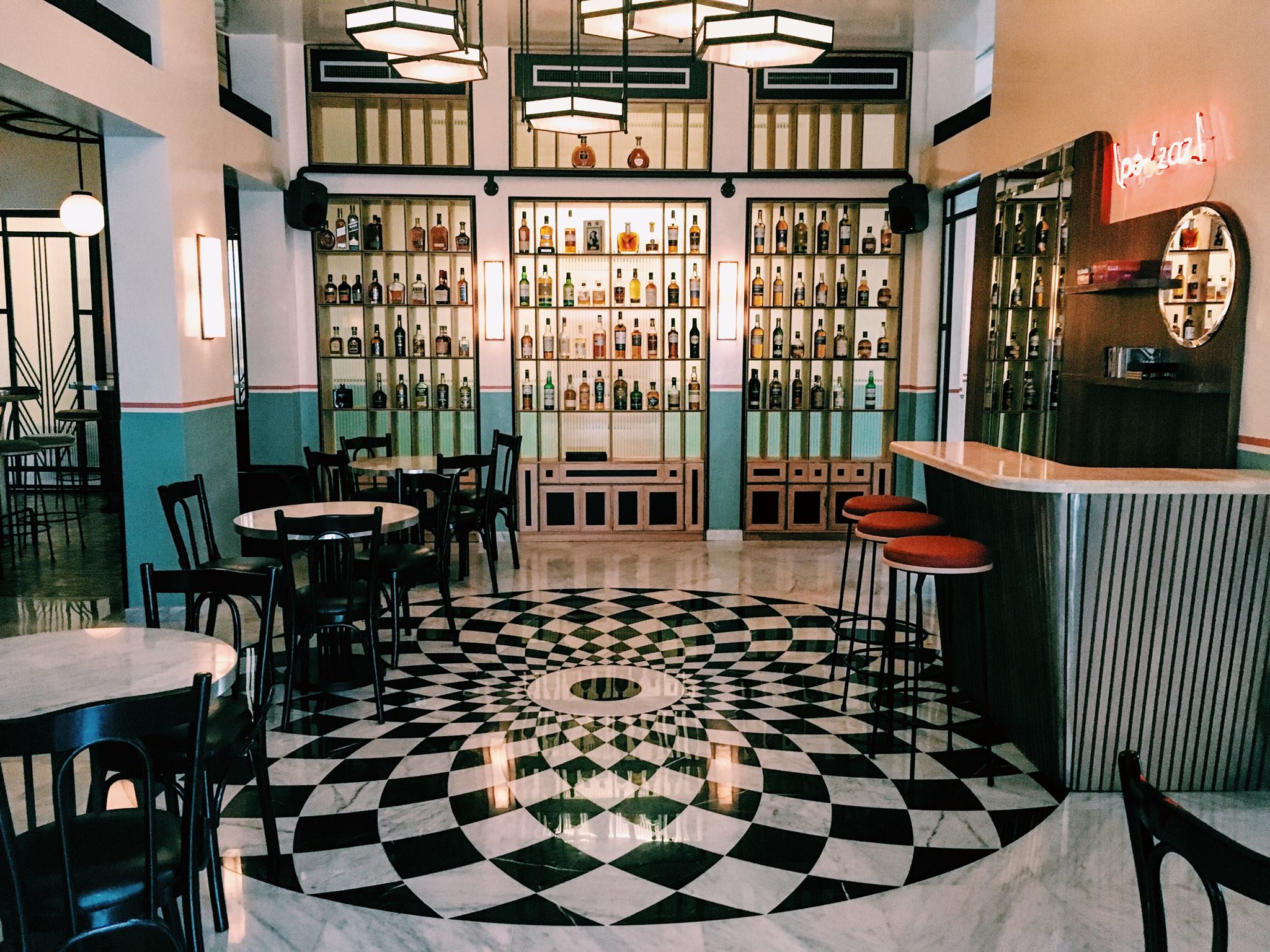
Yet, some people are still holding on to Lebanon’s original architectural beauty. Architect Antoine Maalouf, a lively man with a vibrant mind and a colorful vocabulary, sits with me in one of his latest creations, Salon Beyrouth, a vintage-inspired restaurant-bar tucked in one of the quiet streets of Clemenceau. He expresses his frustration with some people’s denial of Lebanon’s rich heritage and voices his devotion to preserving our country’s landmarks in the new age: “We’re stepping on our culture, we just don’t care. It annoys me, because people invade countries that have what we have and we’re just throwing it away,” he says with dismay. Maalouf, who designed and executed Motto, Cargo, Internazionale and The Grand Factory amongst other work, speaks of the importance of preserving the materials used in old architectural styles and respecting the history of the space instead of shaping it into something completely different: “When you live in a space you leave your print there; the older it is, the more it has spirit and stories,” he explains. “It’s important to learn and see what you have and build on that.”

GR000138-1

Salon Beyrouth

Inspired by Frank Lloyd Wright’s and Walter Gropius’s work, known for its harmony with its environment, Maalouf focuses on creating a dialogue between the interior and the exterior by blending them into one entity that fits the natural location of the space: “Get to know the history in the streets, the people and how they refer to the place,” he explains. “You have to take note of whatever people say and research the whole history of the space,” he adds. “You learn a lot from the heritage.” And while some architects have an itch for big and bold buildings that have their names plastered all over them, Maalouf’s work, is a marriage between traditional materials and modern design, and remains subtle and unpretentious as he lets the space speak for itself: “I hate over-designing. I’d rather highlight the existing interiors and accentuate the old traits,” he says, adding: “I like to remain in the shadows and let people discover the space. I would rather people ask themselves: who did it?

Web_photo_03

The Grand Factory

Ever since he was young Maalouf had a penchant for design and architecture. He could draw perspective when he was seven years old and build shelves when he was 12. He owes his passion to his days with his grandfather, who became the head of the syndicate of architects in Jounieh during former president Fouad Chehab’s presidency: “I would go on site with my grandpa and he would go like ‘take all the nails and straighten them’. Do you know how many times I busted my fingers trying to do that with a hammer?” he says with a smile on his face. “My grandpa taught me everything.”

Maalouf compares his first days on his projects to a blind date: “I just go in, look around and trust my instinct” he says. The more he spends time working on a project, the more he builds a long-term relationship with it, something that’s hard to let go of when the job is done: “It’s like a relationship that someone came and took away from you and you’re like ‘no that’s my woman!’” he says.

1 (1)

Motto

A self-proclaimed vagabond and an avid traveler, Maalouf learns from different cultures and stories of people he encounters, progressively adding depth to his style along the way: “I grow older, I travel a lot, see lots of things and learn new cultures. With that, I add a little touch to my work. Your style grows with you,” he says. However, he refuses to recreate anything he has seen abroad, and he makes sure that a place in Lebanon is solely for Lebanon: “Even if it’s an Argentinian [restaurant], it has to have something that reminds you that you’re in Beirut,” he explains.

Although Maalouf doesn’t see his country getting back on its feet any time soon, he hasn’t stopped loving it: “I’m doing what I can to try to salvage it,” he says. “I will not stop doing any work here.” All he wants is for people to love Lebanon and show “a bit of appreciation for the people who are trying to revive what we have.”

Pic03

Internazionale

A word of advice to aspiring architects? Maalouf stresses on the importance of traveling and exposing oneself to different worlds: “Learn different cultures and you will end up growing. Sit with people and listen. Be open to learning new things and you’ll become a better person,” he says. “You’ll be able to see the world differently and do your job better.”

High ceilings adorned with large windows, Mediterranean tiles accentuated by bricks, wood and concrete are just some of the trademark elements that make up the brainchild of Maalouf’s love affair with Lebanon’s golden era, or as he puts it “before everything got destroyed”. With today’s cookie-cutter real estate development, some people remain attached to the time when Beirut was known as the Paris of the Middle East, and Maalouf’s creations are some of the few time capsules where people can experience Lebanon’s authentic character: “It’s refreshing to see younger generations looking for places like [Salon Beyrouth],” he says. “It means there’s still hope.”

February 18, 2016 0 comments
0 FacebookTwitterPinterestEmail
Entrepreneurship

Talent takes the stage

by Executive Editors February 18, 2016
written by Executive Editors

The entrepreneurship ecosystem is evolving and becoming more ‘startup friendly’, hosting networking events every other week and improving the access youthful entrepreneurs have to information. Little by little, startups are crawling into the spotlight and are being given opportunities, access to capital and resources that weren’t readily available five years ago. The second Banque du Liban (BDL) international conference was held in December 2015. For some Lebanese startups, however, the exposure and prizes of up to $10,000 won through competitions was second to none.

BDL Accelerate is a good example of how the entrepreneurial landscape is changing – the event simply didn’t exist three years ago. There are further examples of showcasing talent to local and international investors, and events which provide young entrepreneurs with real-world experiences of startup success and failure. Fuckup Nights, the Mexican-born event where high-profile entrepreneurs share with the community stories about their past failures, had its third round in AltCity on January 14; their mission is to create solidarity by sharing experiences of failure and lessons learned. Bootcamp by AltCity and Speed@BDD, two of the accelerators Executive profiled in our special report in November 2015, have both finished their rounds of startup acceleration, and hosted their Demo Days – events which showcase accelerated startups in an attempt to generate funding from investors who are invited to attend.

Demo day: first cycle

Both Demo Days were positive, according to Theo Khoury and Sami Abou Saab, managers of Bootcamp and Speed respectively. “People weren’t expecting a lot [from Bootcamp’s first Demo Day] but were very impressed by what was available,” explains Khoury, who notes that present venture capital representatives gave very positive responses to the relatively inexperienced teams that were presenting to a packed room. Khoury admits that AltCity was reluctant to reach out to foreign investors to attend their Demo Day, as the organization lacks enough long-standing and regional credibility to warrant a one-day visit. Aside from contact from the managers of the 500 Falcons, a $30 million regional micro-fund that is an offshoot of seed-funding powerhouse 500 Startups, foreign interest has been quiet. Their plan is for future Demo Days to attract foreign investors based on the credibility that Bootcamp builds at home and abroad. However, the ecosystem’s current pipeline of funding does not help startups at a very early stage, as the money is more readily available at later stages of development. Both Middle East Venture Partners and LEAP, two venture capital powerhouses, only offer ticket sizes to large entities, and often to the tune of hundreds of thousands of dollars, if not millions. Whilst successive Demo Days and rounds of acceleration will tell whether AltCity can build enough reputation and credibility to gain international traction, the startups themselves will only flourish if more money is made available at every stage of the developmental journey.

One Cinderella story from the current Bootcamp, however, is ReAble, a startup featured in Executive’s “Top 20 for 2015” that has created an online mobile wallet app for people with autism to help with cashflow and money management. The company has received external investment of $25,000 from a private Canadian backer, on top of the $10,000 first prize in the Early Stage Startup Competition at BDL Accelerate 2015, and exhibited at the Arab Health Exhibition in Dubai, the second largest health expo in the world. Emile Sawaya, ReAble’s CEO and co-founder, credits AltCity with key development processes at the early stage and helping them transform from idea only to startup. He does, however, credit some of his company’s success to networking through the wider community rather than exposure at Demo Day – the private investment was made through personal contacts.

Accelerators have also begun to evolve, much like the entire entrepreneurial ecosystem. Originally, AltCity’s Bootcamp gave a $25,000 investment to startup teams after a three month acceleration course which took ideas to fully-fledged startups. AltCity shifted their entire acceleration business model from the beginning of the current and fourth Bootcamp cycle; they are no longer giving $25,000 in exchange for a 6 percent equity slice, but are splitting the accelerator into two phases. Phase one will be online, and allow Bootcamp to analyze the teams remotely, thus maximizing the number of participants due to less strain on physical resources. Roughly five teams that complete phase one will be selected to proceed to phase two, thereby halving the number of teams which was in the previous Bootcamp at the physical stage and therefore concentrating its resources on fewer teams. Khoury explains that these changes were made due to time commitments and restraint on resources, which resulted in Bootcamp’s inability to dedicate as much time as was needed for individual startups. “Before Demo Day we decided we had too many teams, and we couldn’t spend enough time with teams individually,” explains Khoury, who notes that the new model will allow for more efficient time expenditure. The original $25,000 per team investment was made through a partnership with AL-MAWARID Bank, which sits on the board of Bootcamp, as AltCity and Bootcamp were only mandated by BDL to take an equity slice (without investment) in order to sustain Bootcamp. They will therefore revert to this mandate, and take 2 percent in equity from teams in phase two only, though the bank would still be able to offer an investment independently of Bootcamp.

Speed’s Abou Saab was also keen to point out how his accelerator has evolved. Part of the culture of Speed is to incorporate feedback mechanisms which allow the accelerator to improve and best serve its startups. One key example of this was the overhaul of how startups receive advice and mentorship during the program. Initially, talks were given by experts to all startups simultaneously, and although they covered generic problems, were largely untailored to specific needs of individual startups which varied drastically from team to team. After consultations with the startups, the three-hour slot that experts were booked for to address the entirety of Speed’s startup class was divided into six half-hour slots, as “a one-to-one mentorship could actually solve specific points a startup has which generic talks cannot address,” explains Abou Saab.

Silicon valley

Charlie Khoury, CEO and co-founder of drone-building company Next Automated Robotics (NAR), was also keen to explain how Speed’s entire accelerator process had helped his company to evolve. “The number one thing that changed was scalability,” says Khoury. “When we first came to Speed our product was just a quadcopter – a simple drone with limited flight. During the acceleration we [changed] to a design that could have outreach and applicability.” NAR incorporated vertical takeoff and landing technology into their drone, which now has better wind resistance, higher speeds, a greater flight range and overall a greater applicability to different industries.

Speed’s great contribution, however, comes in the form of creating a direct vehicle for Lebanese startups to head straight to Silicon Valley. This process enables startups from Lebanon to apply to the ‘LebNet Ignite powered by Blackbox connect program’, an immersion which focuses on global startups and provides access to mentors and resources in Silicon Valley, and, for example, includes coaching on pitching and business strategy. The program was made through a partnership with LebNet, a network of Lebanese-American hi-tech professionals in the Bay Area, and in turn was organized for Speed by Lebanon for Entrepreneurs, some of whose members sit on the board of the accelerator. George Akiki, president of LebNet, explains the driving factors behind the immersion; “Lebanon has been witnessing an accelerated pace of deal flow, innovation, startups and startup capital. Our intent at LebNet is to build a closer relationship with the ecosystem in Lebanon and impact the formation of world-class companies and entrepreneurs.” NAR and Rational Pixels, the latter of which creates product-placement technology, will enroll in the two-week program, and startups in subsequent Speed cycles will be encouraged to apply to the program on a regular basis. For Charlie Khoury, the opportunity is second to none, as direct exposure to Californian firefighters allows them to fine-tune the usability of their drone, which was originally built with the intention of combating wildfires: “We want to see daily examples of how [firefighters] deal with the fires, and can see, for design purposes, how people use and would use [our technology].” As for NAR, the US is a key market for the drones they are developing; therefore being in-country and having the opportunity to have direct meetings with different stakeholders will “have a huge impact on our future” explains Khoury.

By giving entrepreneurs clear access to opportunities abroad and exposure to strategy and business giants within Lebanon, Abou Saab hopes future talent will be more likely to remain in the country rather than seek employment abroad. “We were able to get Rida [Sadek, of Rational Pixels] back from Barcelona after he had lived there for eight years to come for the acceleration [program],” explains Abou Saab, himself a returnee from the US after a career at Microsoft and Skype. “Even for the next batch we have started receiving applications from [Lebanese] living outside of Lebanon, with the idea of coming back. Having something which is retaining them here is a big value added [to the ecosystem] right now,” notes Abou Saab.

Pipeline problems

Participants in both Speed and Bootcamp are encouraged to be open to constructive criticism, alterations and continuous external validation to their product and ideas. For Khoury, one key piece of advice to startups was “never [to] move forward before you have external validation. Stop wasting your time on assumptions.” Speed’s similar ethos is useful for those attending the post acceleration immersion in Silicon Valley, where the final chapter in the disastrous saga of golden startup Clinkle has rocked investors and entrepreneurs alike. After a hugely successful round of initial $25 million seed-funding in June 2013 – despite Clinkle not having a publicly available demo of their highly-anticipated mobile payments app – the company imploded in the summer of last year with a mass exodus of employees, upon realization that the promised app didn’t exist, and a press hounding of the company’s hollow investor promises made by the CEO, Lucas Duplan. According to American business magazine Forbes, in January 2016 investors made the rare move of asking for what was left of their money back from Clinkle’s accounts. Whilst NAR and Rational Pixels are a long way off from seeking funding of $25 million, hopefully the lessons of humility that Duplan has had to learn with a spectacular failure will already be installed, in some fashion, in the Lebanese entrepreneurs thanks to the coaching they initially received.

The work of both Speed and AltCity is crucial to developing the entrepreneurial ecosystem, but only if it is met by similar efforts along the pipeline. At the moment, there seems to be a gap in the development chain as the ticket sizes offered by venture capital powerhouses MEVP and LEAP are far greater than what most startups require. Tickets of up to $1 million are good for series A and B level funding, but are far beyond the requirements for idea and seed-stages which AltCity and Speed offer – traditionally $25,000 and $30,000 respectively. There are tentative steps to amend gaps within the pipeline. Fadi Bizri, managing director at Bader Young Entrepreneurs Program, has joined forces with Abdallah and Ghaith Yafi, managing partners at Y Venture Partners, and Rami Jisr, former general manager of Audi Investment Bank and current managing partner at Broadgate Advisers. The group has created Broadgate and Yafi Venture Partners (BYVP), a $50 million hybrid fund which aims to invest tickets in early stage startups. Ticket sizes are estimated to be between $100,000 and $1 million, and the venture is in final stages of negotiation for the license with the central bank, and is due to go live around March 2016.

However, arguably there need to be further programs like Speed which invest in very early stages, or even up to $100,000 in total, otherwise many startups will fail to get off the ground. Without this investment, as Theo Khoury analogizes, it’s akin to participants in a marathon receiving a gallon of water at the 5km mark, and 50 gallons at the 20km mark, but nothing between 0 and 5km. “They’ll just die of thirst before they even reach 5km,” says Khoury. Only when every inch of the pipeline is fixed, and startups are given investment at earlier stages, can the central bank rest safe in the knowledge that the money from Circular 331 is being spent in a way that most effectively develops and showcases the talent that Lebanon has to offer.

February 18, 2016 0 comments
0 FacebookTwitterPinterestEmail
DrugsEconomics & PolicyUncategorized

Crime and punishment

by Jeremy Arbid February 16, 2016
written by Jeremy Arbid

Not much is known about Captagon prevalence in Lebanon. Anecdotal testimony regarding court cases and rehabilitation treatments suggest that use is low but rising. The prevailing explanation for this is that there is a leakage of pills into the drug-using community as more Captagon is produced in the country and trafficked through it, but there are no statistics to verify the extent. What is known is that individuals caught using the drug are arrested and that there is deficient data on the number of Captagon-specific criminal proceedings. When arrested, users are thrown into a state of limbo that drug users generally face when they are arrested in Lebanon.

“Drugs have spread so much in the last few years,” says Faisal Abdallah, a Lebanese lawyer specialized in criminal law. Executive was not able to obtain statistics on drug-related criminal proceedings, neither in general nor specific to Captagon – the Ministry of Justice did not respond to Executive’s request and Mohammed Saab, a judge who has presided over user-related hearings, declined an interview to discuss the findings of a book he published on drug-related crimes in 2015. Whether user-related arrest figures have risen as a function of drug prevalence or due to vigilant law enforcement cannot be answered.

According to statistics from the Internal Security Forces’ (ISF) drug unit obtained by The Legal Agenda – a non-governmental organization monitoring Lebanon’s judicial system – 5,381 individuals were prosecuted for Captagon use in 2013 and 2014, about 2,000 more than in 2009 and 2010. But the failure to report details of the number of users arrested and prosecuted for popping pills, alongside a complete dearth of data on Captagon rehabilitation, results in an inability to define the problem. Rather, what the figures show is that Lebanon’s police are increasingly arresting, prosecuting and jailing drug users when the law says rehabilitation should be an alternative.

Even first-time offenders face serious and punitive consequences rather than the rehabilitation they should be offered. Depending on the drug, a first-time offender can face fines of 2 million to 5 million Lebanese Lira ($1,327 – $3,318) and prison time ranging between three months to three years. Arrested drug users are, according to the law, entitled to be heard by a committee set up in 2013 to follow up on rehabilitation treatment. The Legal Agenda found that the committee is hardly used, hearing only 120 cases in 2013 and 2014.

A clogged up system

The Legal Agenda, Abdallah and addictions psychiatrist Joseph Khoury all agree that underutilization of the committee has two causes. Its ad hoc nature – the committee’s board members are volunteers and it has no clear mandate – undermines its purpose because the government, the police and the legal profession do not take it seriously. But the greater challenge is due to a backed-up judicial system, Abdallah says. Offenders can only be referred to the committee once a judge has heard their case, but because the court system is so clogged, offenders rarely receive their right to present their case to the committee for treatment referral. Instead, drug offenders face prison time, incurring a criminal record, and are thrown into the general prison population. This, the Legal Agenda says, means that users are subject to upfront punishment that deters them from seeking drug rehabilitation treatment on their own.

Lebanon’s narcotics law 673/1998 classifies drug use as a health issue but in practice the judicial system still views it as a crime, and offenders have many obstacles in their way to receive rehabilitation treatment. A drug user has to be very motivated, Khoury says, because they may have to pay out of pocket – government insurance programs cover psychiatric care and drug addiction treatment for security forces and public sector workers, and private insurers cover some segments of the population, but this leaves many insufficiently covered. Lebanon’s Ministry of Public Health does not have enough money to cover those that fall between the cracks.

A 2010 report from the World Health Organization (WHO) pointed out that some of Lebanon’s public health budget was allocated for mental health services, but that it included neither short-term inpatient care nor outpatient care and only covered certain psychotropic medicines. WHO called for the establishment of in- and out-patient treatment centers for substance abuse, but acknowledged a lack of funding to do so as well as a lack of specialists – psychiatrists and psychiatric nurses – to staff those facilities. Khoury told Executive much the same in a January interview – that Lebanon does not have enough psychiatrists nor the health infrastructure to rehabilitate users.

The recommendation of The Legal Agenda is to empower the committee to enable the treatment alternative to imprisonment. But this, the NGO says, would at least require the expansion of the committee’s mandate, and adding a committee in each of Lebanon’s six governorates to hear rehabilitation cases of offenders in different parts of the country. This, however, would require amendment to the law to both articulate and expand the committee’s mandate, as well as to fund it and a healthcare rehabilitation system to treat users. “I would be for not incarcerating any users – I think people need to be treated,” prescribes Khoury.

February 16, 2016 0 comments
0 FacebookTwitterPinterestEmail
LeadersOpinion

Rehabilitation first

by Executive Editors February 16, 2016
written by Executive Editors

The opening crawl of the movie “Reefer Madness” served as a morality tale to parents of the Silent Generation: “…the new drug menace is destroying the youth of America in alarmingly increasing numbers. Marihuana [sic] is that drug – a violent narcotic – an unspeakable scourge – The Real Public Enemy Number One!” The narrative represents a viewpoint on how to limit drug prevalence in the United States – complete abstinence – otherwise drug users will commit horrific crimes. The 80-year-old film is useful in that it shows just how much the world has changed its perception of illicit drug use.

Nowadays, substance abuse – including alcohol, tobacco and illicit drugs – is considered by the World Health Organization as a mental health disorder. Lebanon’s Ministry of Public Health agrees. In 2015, the ministry introduced a five year roadmap to improve mental health treatment, including substance abuse.

International bodies overseeing narcotics – including the United Nations Office of Drugs and Crime and the International Narcotics Control Board – lay out the best practices of drug enforcement that many of the world’s police agencies follow. The approach is to be a balanced one – stem the source of drug production to reduce its supply and raise its street cost while also going after consumers.

Targeting illegal drug manufacturing facilities and individuals – traffickers and dealers – is challenging but necessary to stop drugs at the source. In this regard Lebanon has destroyed drug crops, raided known drug factories and made arrests. But there are still large swaths of the country with a relatively low level of state control, while instability along the Lebanese-Syrian border is an enabling factor.

That Lebanon is not able to stamp out drug production and trafficking is frustrating, even more so when looking at statistics on user-related drug arrests. Rather than receiving their right to rehabilitation treatment, offenders are locked up. Lebanon’s drug law 673/1998 incorporates rehabilitation as an alternative to prison time but there are problems in the law’s application. The problem is, on the one hand, that cases of drug use are not being heard by a rehabilitation committee [see story Crime and punishment].

On the other hand Lebanon does not have the health infrastructure to cope with rehabilitation demand generated by drug-use arrests. Executive agrees with the view that there needs to be a better and faster process to determining rehabilitation referrals – The Legal Agenda, a local non-governmental organization monitoring Lebanon’s judicial system, recommends the committee be expanded to serve different geographically-located user populations and it must be funded. The health ministry’s five year plan should address the lack of rehabilitation provision.

Since the early 2000s a more progressive approach to drug use has been championed in some countries – Portugal being an example. Drug use and possession in that country is still illegal but is instead punished with administrative penalties (fines or community service) rather than criminal ones (prison time). The idea goes back to drug use as a mental health issue, one that must be treated through rehabilitation. Short of legalizing cannabis and all its products, Lebanon should decriminalize personal use and possession. There are international benchmarks on the classification of drugs and the amounts that define user possession and intent to sell. Lebanon should use these benchmarks as a guide to define decriminalization.

At the very least, Lebanon must amend its drug law to distinguish between possession of any drug for personal use and possession with intent to sell. Portugal considers a 10-day supply as personal use warranting only administrative penalties, any amount more than that warrants criminal penalties. Amending the law to remove facilitating drug use as criminally punishable is also necessary – sharing a joint with a friend or giving them drugs for free can land someone in jail for a minimum of five years.

Best practice in rehabilitating drug users accepts them at their level of readiness to bring them closer to a healthier lifestyle even if that means accepting that some of them will continue to use temporarily. But there is a legitimate need for society to be protected from people that do become violent while under the influence of dissociative drugs (e.g. hallucinogens). With harm reduction programs the aim is not to eliminate drug use but to reduce the negative consequences (to personal health, to interpersonal relations, to livelihood, and with the law) of drug abuse, and there is evidence that harm reduction programs do have positive impacts. The programs can serve to reintegrate users into society whereas criminalization may disenfranchise or disbar them from social welfare programs (e.g. education and housing). NGOs in Lebanon can and are already providing this public good. The risk is always that these programs are too little but are better than nothing.

If Lebanon is to curb illicit drug manufacturing and trafficking then it must go after the big fish – the tycoons living large. Recreational users and those that have become addicted need medical help more than an extended stay in the clanker, and prison time spent for drug use can ruin a person’s life. Decriminalizing personal use and possession of cannabis and its products ensures recreational users don’t end up in prison in the first place.

February 16, 2016 0 comments
0 FacebookTwitterPinterestEmail
Hospitality & Tourism

Advertising alcohol: the business of selling responsibly

by Nabila Rahhal February 15, 2016
written by Nabila Rahhal

Just like all commodities, alcohol revenues are significantly impacted by successful branding and marketing campaigns. When well-crafted advertisements are relatable to consumers, these promotions ultimately influence their perceptions and increase the product’s popular appeal.   

Marketing budgets

Alcohol distributors Executive spoke to say that Lebanon, in comparison to other countries in the region, is an advertising haven because there are no restrictions on alcohol advertisements in media channels.

As such, they consider extensive expenditure on promoting their portfolio of spirits brands (although spirits distributors declined Executive’s request to provide the total amount spent on advertising per year) to pay off well in sales. “In Lebanon, there is always a strong impact of advertising in terms of driving sales. Advertisements also have a strong impact on top-of-mind awareness, but also on commercial awareness. Our ultimate objective is to build our brand and have a strong and healthy brand performance,” says Ziad Chami, marketing manager at Diageo, the multinational alcoholic beverages company with a portfolio of brands such as Johnnie Walker, Bacardi and Smirnoff.

According to suppliers interviewed for this article, the biggest percentage of their marketing budget is usually spent in December which is, distributors say, typically the busiest month of the year for spirit sales. Carlo Vincenti, owner of G. Vincenti & Sons, characterizes his company’s experience: “The months of November and December usually account for 40 percent of annual sales, so obviously we spend a large chunk of our marketing budget in that period whether in traditional media or consumer promotions and visibility. Since December is marked by festivities with lots of family and social gatherings involving both gifting and consumption of spirits, all brands tend to launch special packs with gifts and special offers then.”

To each brand its own

Lebanese spirits distributors often work with advertising or PR companies to create the ideal promotional campaign and say each brand requires a tailor-made marketing strategy depending on its positioning and the age group of its target clientele. “Every spirit category and even every brand has its own strategy and marketing objectives that could include the traditional media tools or more targeted and flexible ones,” says Vincenti.

Anthony Massoud, managing director of Etablissements Antoine Massoud (EAM), a distributing company with a wide line of spirits including Russian Standard Vodka and Nikka whiskey, says: “Every brand has its own strategy, target audience and complexity. We have more than eighty alcohol brands in our portfolio but we have nine core brands which we focus on in our advertising campaigns.”

The classics: television, print and outdoor marketing

Traditionally, mass-media tools such as television, radio spots, print advertisements and outdoor promotions were the most effective means to reach a wide base of consumers. Today, Lebanese spirits distributors still consider these pillar methods for some brands but say they believe there are better, more targeted ways to reach the consumer.

Nahla Haddad, communication manager at Fawaz Holding, a distribution company managing a wide portfolio of brands including spirits such as Chivas Regal, Jameson whiskey and Absolut Vodka, says they don’t heavily advertise their spirits portfolio on television for several reasons.

To begin with, according to Haddad, most of the global brands they represent lack advertisements which are localized for the Lebanese market. Moreover, television requires a huge advertising budget which they can more effectively spend on other more engaging media. “Finally, for brands such as Jameson whiskey or Absolut Vodka, the target audience doesn’t watch local television and so we prefer to appear where the target is,” explains Haddad.

Massoud says he prefers hosting PR events and tastings – where they invite the media and select consumers – to advertisements on television or billboards. “Our marketing is very much PR driven as its effect is sometimes stronger than advertising because here you are talking to the consumer directly and increasing the word of mouth effect which is very important in Lebanon. In mass media, you might reach people who are not interested in your brand, but with PR and events you are getting your message across directly to a few people that represent a lot to your brand rather than the masses who might not be interested,” explains Massoud.

The rise of digital media

Discussions with distributors did not indicate the collapse of traditional advertising methods, only their supplement with more engaging forms of advertisement. “In general, traditional advertising is still a key part of our advertising mix. But, over the last few years, we have become more active on social and digital media, which is a trend that is happening all over the world and is becoming a more important part of the mix,” says Chami.

Davina Atallah, creative director at Leo Burnett which works with Diageo on advertising in Lebanon, says they found a creative way to engage consumers through a mix of social media and outdoor advertising in Johnnie Walker’s Keep the Flame Alive campaign.

In that campaign, recalls Atallah, they asked members of the public across Lebanon why they believe it is worth staying in the country; Leo Burnett then had a fire calligrapher flame-write these statements on the spot, took pictures of the final results and uploaded them on social media. They also released these flame-written statements on LED billboards across the country. “It was an evolution in terms of the brand, from the Keep Walking campaign which focused on stories of well-known Lebanese to a story about the resilience of the Lebanese people [through the Keep the Flame Alive campaign], creating an interaction with them which we had never done before,” says Chami.

Haddad says social media has allowed them to develop a two-way channel of communication with their consumers, while also reaching out to the younger generation for brands such as Ballantine whiskey which were commonly associated with an older generation in Lebanon. For the launch of Ballantine limited edition “Beirut” bottle, Fawaz Holding asked people to share pictures reflecting the true spirit of Beirut on the company’s social media pages. The pictures were then reproduced with an image of Ballantine’s Beirut bottle embedded in them and the name of the photographer who took them mentioned on Fawaz’s social media pages. Those with the best pictures, as voted by Fawaz’s communications team, won the limited edition bottle. “Within three weeks, we were able to increase our fan base, recruit a younger audience and enforce brand awareness,” says Haddad.

The mass and the direct

For categories with a wide appeal to consumers, such as vodka, a mass-marketing approach emphasizing their association with a party spirit works best, explains Massoud. Therefore, Massoud says they invest in sponsorships of design events across Beirut and parties such as Decks on the Beach in the summer or of bars such as the new Pacifico (where they have a banner above the bar).

Vincenti also invests in hosting parties with international DJs through Poliakov, a vodka brand in their portfolio, but they are best known for their Jim Beam Rocks musical festival, a now annual event produced by Jim Beam at the beginning of the summer season showcasing local bands as well as one major international act.

On the other hand, according to Massoud, some categories of spirits, such as malt whiskies and wines, are a more refined niche and benefit from targeted marketing involving direct interaction with the consumer. “In single malts, the one-to-one approach is very important. You need to take your time with the consumers, educate and initiate them: it’s a long but solid process. This is why we launched The Malt Gallery (EAM’s specialized whiskey retail store) as it is an ideal platform to talk directly to the consumer,” explains Massoud, adding that this can also be done through tasting plans in other specialized outlets.

Bartenders are key

Massoud says EAM devises their alcohol marketing campaigns based on whether the particular spirit’s category is consumer or trade driven. With trade-driven brands (mainly used in bars and clubs) Massoud says it is better to invest in the outlets themselves, while with consumer-driven brands interacting directly with the consumers becomes very important.

As such, bartenders and bar owners become the biggest allies of spirit distributors and priority is given to marketing and promotions targeted at influencing spirit choice when preparing cocktails or establishing their bars.

Many spirits distributors invest in bringing brand ambassadors or expert international bartenders to Lebanon to give workshops and training to local bartenders. Some spirits distributors organize worldwide annual mixology (bartending) competitions where the winner of a country-wide contest goes on to represent Lebanon, and their bar, in the international competition. Speaking of the Diageo World Class competitions, Chami says: “The objective is to raise the bar when it comes to mixology and bartending. Sales-wise, World Class creates a strong engagement between the bartenders, and the trade itself, with our brands; it will translate into a stronger performance of our reserve portfolio when it comes to the on-trade.”

February 15, 2016 0 comments
0 FacebookTwitterPinterestEmail
  • 1
  • …
  • 130
  • 131
  • 132
  • 133
  • 134
  • …
  • 691

Latest Cover

About us

Since its first edition emerged on the newsstands in 1999, Executive Magazine has been dedicated to providing its readers with the most up-to-date local and regional business news. Executive is a monthly business magazine that offers readers in-depth analyses on the Lebanese world of commerce, covering all the major sectors – from banking, finance, and insurance to technology, tourism, hospitality, media, and retail.

  • Donate
  • Our Purpose
  • Contact Us

Sign up for our newsletter

    • Facebook
    • Twitter
    • Instagram
    • Linkedin
    • Youtube
    Executive Magazine
    • ISSUES
      • Current Issue
      • Past issues
    • BUSINESS
    • ECONOMICS & POLICY
    • OPINION
    • SPECIAL REPORTS
    • EXECUTIVE TALKS
    • MOVEMENTS
      • Change the image
      • Cannes lions
      • Transparency & accountability
      • ECONOMIC ROADMAP
      • Say No to Corruption
      • The Lebanon media development initiative
      • LPSN Policy Asks
      • Advocating the preservation of deposits
    • JOIN US
      • Join our movement
      • Attend our events
      • Receive updates
      • Connect with us
    • DONATE