• Donate
  • Our Purpose
  • Contact Us
Executive Magazine
  • ISSUES
    • Current Issue
    • Past issues
  • BUSINESS
  • ECONOMICS & POLICY
  • OPINION
  • SPECIAL REPORTS
  • EXECUTIVE TALKS
  • MOVEMENTS
    • Change the image
    • Cannes lions
    • Transparency & accountability
    • ECONOMIC ROADMAP
    • Say No to Corruption
    • The Lebanon media development initiative
    • LPSN Policy Asks
    • Advocating the preservation of deposits
  • JOIN US
    • Join our movement
    • Attend our events
    • Receive updates
    • Connect with us
  • DONATE
Blue Gold aims to improve Lebanon's water system
Economics & Policy

Can civil society save Lebanon’s water?

by Joe Dyke January 8, 2014
written by Joe Dyke

A completely new future for Lebanon’s water network; taking the sector out of the control of feuding politicians and into the realm of citizen control. Well at least that’s how it was billed.

The launch of the Blue Gold initiative, the first project from the newly-formed Civic Influence Hub (CIH), in early December was supported by an impressive line-up — the president, the prime minister designate and the caretaker minister of economy were all in attendance.

Yet while the CIH states a convincing and elaborately documented case that radical reform of Lebanon’s water sector is needed, there are doubts about the project — especially whether or not it has the necessary political support to be a success. In a country where civil society is often willfully ignored by the political classes, the project will need much more than the benefit of scientific accuracy to succeed.

The necessity of change

Blue Gold, developed by more than 30 experts over the course of a year, aims to completely rework Lebanon’s water network over a five-year period from 2015 to 2020. The need for change is clear. Lebanon has the highest amount of rainfall per capita in the Middle East, with an average of 8 billion cubic meters  a year, yet suffers from acute water shortages, with just 17 percent of that rainfall being used. In summer, residents of Beirut can go weeks without water — indeed even as the storms hit the capital in early December many houses in the city were dry. The primary reasons are well-known: a failing and politicized infrastructure network, lack of proper regulation and an extremely high level of leakage. Last year 48 percent of the country’s water was lost through holes and cracks in the network, 11 percent more than the Middle East and North Africa average.

In a report released in November 2012, the United Nations Development Program (UNDP) highlighted the dire state of water management across the Arab world. While the region suffers from a lack of rainfall, the primary cause of water shortages is mismanagement, the UNDP said, calling on states to “reorient policy, reform institutions, promote education and awareness, increase stakeholder participation, establish international agreements and link policy to research and development.”

The Blue Gold project aims to achieve all these things for Lebanon. The broad-reaching proposal suggests 15 ways in which the country can revitalize its water network, ranging from huge technical changes such as rethinking Lebanon’s network of dams to smaller projects such as harvesting rainwater from rooftops. The aim is to reverse Lebanon’s water shortage from a deficit of 73 million cubic meters of water (mm3) in 2011 to a surplus of 500 mm3 by 2020.

Mey Jurdi, head of hydrology at the American University of Beirut and one of the CIH’s expert advisers, believes that there has been nothing as comprehensive or broad ranging as Blue Gold before. Previous reform plans have not, she says, been “an integrated strategy of water resources — they have been lists of activities and this is the difference. When we say integrated water management we mean moving ahead with all areas together.”
CIH aims to be non-political and non-sectarian. Ziad al-Sayegh, CEO of the body, believes that the proposals could prove an all-important moment for public policymaking in the country. “Through water we can unify Lebanese people, from the north to the south. We are talking about a partnership for national wealth; this is new in Lebanon,” he says.

Waves of doubt

Lofty ideals, no doubt, but the mountains Blue Gold will have to move to make the project a reality are perhaps even higher.

The first concern is money. Implementing Blue Gold requires $5 billion, planned to be raised primarily from the private sector without them gaining ownership of the water. Asked about the specifics of the funding mechanism, Sayegh is a little vague. He stresses that it will not be privatization and that the “private sector will be an operator and a service provider but the infrastructure will be protected and owned by the state and by the people.” He continues by saying that some of the money could come from bonds bought by Lebanese citizens — “instead of going only to put your money in the banks, come and put your money in the sector.” He declines to provide further details on how the financing mechanism would work and what return rates they might offer.

Though the plan intends for the bulk of money to come from the private sector and donors, the appetite for international bodies to engage is limited. Public-private partnerships (PPP), the preferred method for infrastructure investments of this type, have yet to become a reality in Lebanon and international donors and multilateral development banks have grown weary of false promises from various Lebanese governments. Indeed in January 2012 the World Bank lent the Lebanese government $200 million for the development of the Greater Beirut Water Supply Project, which is currently behind schedule.

As such, the responsibility for funding will fall on the private sector. Ziad Hayek, secretary-general of the Higher Council of Privatization (HCP) and another expert adviser to the CIH, believes that if conditions were right the capital could be raised. “If the private sector sees there is an environment where it can make money, it will be interested. Every public-private partnership-type tender that has been offered to the private sector [in Lebanon] has had a large number of companies interested,” he said.

A perennial problem

Even if Hayek is right to believe that the money could be found if conditions were right, they are currently far from so. Lebanon not only lacks a PPP law but the various privatization attempts in other sectors, most notably telecommunications, have all ended in failure.

The most fundamental hurdle to Blue Gold’s success is the necessary legal framework. The water sector is currently run by the Ministry of Energy and Water (MoEW) and four water establishments. Blue Gold aims to replace these with a national water council, a water regulatory authority, a national monitoring center, a water users’ association and an independent watchdog.

The water regulatory authority would be the most powerful of these and would include representatives of the government, political parties and civil society. Sayegh is confident that there will be no significant legal hiccups in pushing this body through. “We are working to prepare new laws and out of them we want to implement the public-private partnership. [It will need] a law dedicated to the establishment of a national water council so there is a legal framework,” he says.

Talk of independent regulatory authorities in Lebanon is to be treated with suspicion. There is a long history of politicians committing to them in principle but not in practice, with the Telecoms Regulatory Authority and the Petroleum Administration providing two key examples of bodies that are in theory independent but in practice remain under ministerial control or influence.

Furthermore, there is little reason to believe that the MoEW would embrace the idea of handing over a key sector to the control of an independent authority. Off the record sources stressed that caretaker Minister of Energy Gebran Bassil has opposed Blue Gold.

In fact the ministry has its own proposal for developing the water sector: the 2012 water policy. Sayegh believes that Blue Gold develops this proposal rather than supersedes it, but there is no indication that the ministry sees it that way.

A new goverment

The implementation of the CIH’s bold water sector proposals will first require the formation of a new government in which the energy ministry will play a decisive role in the project’s chances of success. But even if a new government were committed to Blue Gold, the required legislation, the creation of an independent council and the money and technical expertise sourced from private sector partners all mean implementation could still face communal roadblocks.

A history of Lebanon’s water reforms


Younes Hassib, technical adviser with the Lebanese branch of the German development agency GIZ, points out that policies that make sense nationally are often deeply controversial on a local level. “On the ground it might be difficult as water resources are within a given community, and this community says ‘this is our water and we don’t accept water meters’ — these are things that we have seen,” Hassib says.

Partly for this reason, policies are often shelved in parliament for years, waiting for some seal of approval or another. Another factor is the structure of the legislative process, a well-known time consumer. Sayegh admits that even if the government were to adopt the policy, “it should afterwards be passed to the parliament [and] discussed in the committee dedicated to this — the Energy and Water committee.” However, he is enthusiastic that the committee will back the proposal swiftly. “We are already in contact with them,” he says.

Mohammed Qabbani, the head of that committee, tells Executive that he is as yet “not very familiar with the project” but would be interested in learning more. He has been a major critic of Bassil’s 2012 plan, which he says is corrupt, and would prefer to move forward along the basis of an earlier plan, drawn up in 2000. “I think we have a chance of reviewing the [2000] plan; I don’t believe that the plan is something sacred and I think there are mistakes in it. This might be a chance for us.”

With several obstacles standing in the way of the CIH, perhaps the most important thing for the organization is internal unity in making the case for their plan. The CIH professes to have a strong sense of purpose and a shared goal within the organization, but already the movement seems to be fraying at the edges.

Fathi Chatila, hydro-geologist and editor-in-chief of Arab Water World magazine, is listed as a participating expert in Blue Gold’s official five-year plan but says he has had little contact with the group. He accuses Fadi Comair, one of the members of the CIH’s steering committee and a long-time ministry official, of seeking to use a façade of civil society to gain access to new funds, alleging that the MoEW will seek to control the project. “Blue Gold is the best way to revive and re-nourish corruption… at the end of the day the ministry will still appoint the tenders,” he says. “[Politicians] have wasted public money so now they are [hoping to] make the private sector pay.”

Claims of corruption in public bodies are easier to make than to prove but it certainly suggests a lack of unity if such suspicions are raised by an expert listed in Blue Gold’s own literature.

Rising to the challenge?

Blue Gold is a technically solid proposal, according to both the people who worked on it and the parties that examined it, but the incredibly high barriers to implementation are perhaps an indication of why civil society is so reluctant to suggest policy in Lebanon. The predominant fear is that an ultimately innovative series of proposals will become stuck in Lebanon’s political quagmire.

“Everyone involved in this project is well-meaning but by advertising it so much I hope we don’t let people down,” HCP’s Hayek says. “People are going to expect results and unfortunately the CIH or civil society by themselves are not able to deliver the results. It needs government and it needs the cabinet to approve some legislation and send it to parliament and parliament to enact it into law. I worry this may take a long time.”

Yet, as Truman Capote once wrote, “Failure is the condiment that gives success its flavor.” So while Blue Gold may be unlikely to succeed in its entirety, some of its protagonists focus on it not because of its macroeconomic project value, which is as high as it is theoretical, but as an attempt to push policy, rather than politics, back into the Lebanese debate. And if and when there are achievements, they will taste all the sweeter. “I am very realistic and I know not all the projects will be implemented,” says AUB’s Jurdi. “But sometimes if you want to get a 90 you should aim at 100. If you aim at 30 you will end up at zero.”

January 8, 2014 1 comment
0 FacebookTwitterPinterestEmail
The Buzz

Executive Magazine Front Covers 2010

by Executive Staff January 1, 2014
written by Executive Staff

Executive Magazine has been producing in-depth reports about Lebanon and the Middle East since 1999. Here are all our front covers from 2010.

[media-credit name=”Executive” align=”alignnone” width=”500″]cover#126_jan10_leb[/media-credit]

January’s issue focused on future effects climate change will have on Lebanon.


[media-credit name=”Executive” align=”alignnone” width=”500″]cover#127_FEB10_LEB[/media-credit]

February’s issue focused on the Israeli siege on Gaza.


[media-credit name=”Executive” align=”alignnone” width=”500″]cover#128_march10_LEB[/media-credit]

March’s issue focused on the Lebanese real estate market.


[media-credit name=”Executive” align=”alignnone” width=”500″]cover#129_april10_LEB[/media-credit]

April’s issue focused on pre-war Lebanon.


[media-credit name=”Executive” align=”alignnone” width=”500″]cover#130_may10_LEB[/media-credit]

May’s issue focused on tobacco control in Lebanon.


[media-credit name=”Executive” align=”alignnone” width=”500″]cover#131_JUNE10_leb[/media-credit]

June’s issue offered an insight into the Lebanese dog fighting “sports”. You can read the article here.


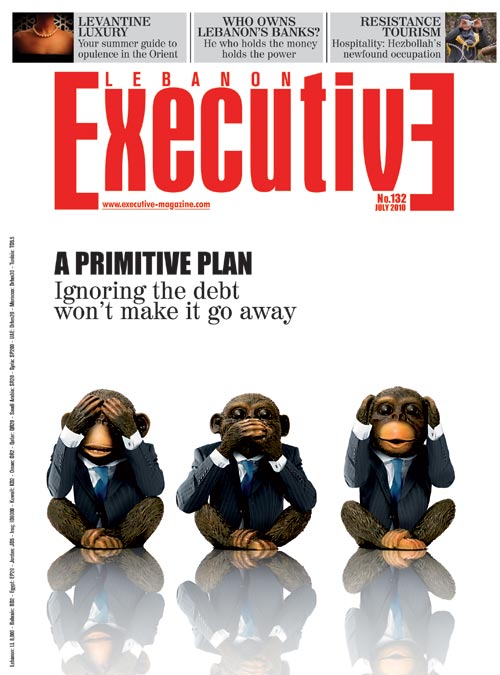
[media-credit name=”Executive” align=”alignnone” width=”500″]cover#132_july10_leb[/media-credit]

July’s issue focused on the government’s lack of plan to fight the increasing debt.


[media-credit name=”Executive” align=”alignnone” width=”500″]cover#133_aug10[/media-credit]

August’s issue with a focus on the Ministry of Energy’s policies.


[media-credit name=”Executive” align=”alignnone” width=”500″]cover#134_sept10_LEB[/media-credit]

August’s issue focused on surging price of wheat, and the government’s costly measures to dull the effects.


[media-credit name=”Executive” align=”alignnone” width=”500″]cover#135_oct10_leb[/media-credit]

October’s issue focused on who the real decision makers are in Lebanon.


[media-credit name=”Executive” align=”alignnone” width=”500″]cover#136_nov10[/media-credit]

November’s issue focused on how to make money in times of recession.


[media-credit name=”Executive” align=”alignnone” width=”500″]cover#137_dec10_leb[/media-credit]

December’s main story is a review on the event’s that occurred throughout the year and an insight into the future.


January 1, 2014 0 comments
0 FacebookTwitterPinterestEmail
The Buzz

Executive Magazine Front Covers 2011

by Executive Staff January 1, 2014
written by Executive Staff

Executive Magazine has been producing in-depth reports about Lebanon and the Middle East since 1999. Here are all our front covers from 2011.

[media-credit name=”Executive” align=”alignnone” width=”500″]cover#138_jan11[/media-credit]

January’s issue focused on the slow internet speed in Lebanon


[media-credit name=”Executive” align=”alignnone” width=”500″]cover#139_feb11LEB[/media-credit]

February’s issue focused on the “Arab Spring”, the revolutions that are reshaping the Arab world.


[media-credit name=”Executive” align=”alignnone” width=”500″]cover#140_march11_LEB[/media-credit]

March’s issue focused on the region’s future in the wake of the “Arab Spring”


[media-credit name=”Executive” align=”alignnone” width=”500″]cover#141_april11[/media-credit]

April’s issue focused on citizen journalism.


[media-credit name=”Executive” align=”alignnone” width=”500″]cover#142_may11_LEB[/media-credit]

May’s issue focused on USA’s warning message for Lebanon.


[media-credit name=”Executive” align=”alignnone” width=”500″]cover#143_june11[/media-credit]

June’s issue focused on the Lebanese economy that’s ready to crash at any moment.


[media-credit name=”Executive” align=”alignnone” width=”500″]cover#144_july11-LEB[/media-credit]

July’s issue focused on the new “Suited” cabinet of ministers, and how they should know they can’t blame anyone else for the cabinet’s mistakes anymore.


[media-credit name=”Executive” align=”alignnone” width=”500″]cover#145_aug11[/media-credit]

August’s issue focused on the reappointment of Riad Salameh as governor of Lebanon’s Central Bank. The article can be read here.


[media-credit name=”Executive” align=”alignnone” width=”500″]cover#146_sep11[/media-credit]

September’s issue focused on the future of post-Gaddafi Libya. It can be read here.


[media-credit name=”Executive” align=”alignnone” width=”500″]cover#147_oct11_LEB[/media-credit]

October’s issue focused on the West’s sanctions against Syria.


[media-credit name=”Executive” align=”alignnone” width=”500″]cover#148_nov11_LEB[/media-credit]

November’s issue focused on the wage hike preposition. The article can be read here.


[media-credit name=”Executive” align=”alignnone” width=”500″]EX#149_dec11_LEB[/media-credit]

December’s main story is a review on the event’s that occurred throughout the year and an insight into the future.

January 1, 2014 0 comments
0 FacebookTwitterPinterestEmail
Editorial

The fall of the gun

by Yasser Akkaoui January 1, 2014
written by Yasser Akkaoui

The Lebanese civil war of 1975 to 1990 did more than destroy the country — it made it impossible to put it back together again. Institutions were demolished, corruption was normalized and, most importantly, a generation of militiamen rose to power who cared little about unity.

The founding fathers of Lebanon — those brave men (for they were sadly all men) who formed the country on the basis of independence, tolerance and moderation — were sidelined, never to return.

In their place the very same militiamen who fought each other for over a decade swapped the sword for the suit and learned to call each other statesmen. But clothes do not make the man and the majority of them have not changed one bit. They claim their share of the pie and keep their foreign masters happy but do nothing to help the country develop independently.

Since 2005, Hezbollah has become the latest party to be transformed from militia to pseudo-statesman, with the 2008 Doha Accords effectively offering them a seat at the top table. And in the past year we have seen a new player on the ground — the Salafis and Al-Qaeda affiliates — pushing for influence. They may be easy to dismiss but make no mistake; they are a rising force and are looking for their share. It is clear that any global agreement over Syria, which will impact Lebanon, will include them.

For those moderates that survived the civil war, it has been a cold winter as the rule of the gun has taken hold. We have been isolated and ignored; condemned as traitors for refusing to pledge allegiance to one foreign power or another.

But we may be seeing the first signs of spring. Prominent businessman Farid Chehab and others have launched the Blue Gold project, which aims to claim the country’s vast and deeply politicized water resources for the Lebanese people. In the process they aim to nurture a strong, independent civil society that puts the country first.

Their plans are grand, utopian some might say, and they are certainly flawed. But they are laudable. Civil society has to demand the impossible, if only to force action from the political class.

The rule of the gun never lasts. One day we will get our country back, and when we do we need a strong civil society to help us move forward.

January 1, 2014 0 comments
0 FacebookTwitterPinterestEmail
The Buzz

Executive Magazine Front Covers 2012

by Executive Staff January 1, 2014
written by Executive Staff

Executive Magazine has been producing in-depth reports about Lebanon and the Middle East since 1999. Here are all our front covers from 2012.

[media-credit name=”Executive” align=”alignnone” width=”500″]EX#150_jan12_LEB[/media-credit]

January’s issue focused on the economic impact of the “Arab Spring” uprisings.


[media-credit name=”Executive” align=”alignnone” width=”500″]EX#151_feb12_LEB[/media-credit]

February’s issue focused on the Lebanese job market and its impact on the Lebanese youth.


[media-credit name=”Executive” align=”alignnone” width=”500″]executive_cover_mar_ME[/media-credit]

March’s issue focused on the Middle Eastern conflicts arising from oil. Read the articles here


[media-credit name=”Executive” align=”alignnone” width=”500″]EX#153_april12_LEB[/media-credit]

April’s issue focused on the price of cancer treatment in Lebanon. Read the articles here


[media-credit name=”Executive” align=”alignnone” width=”500″]EX#154_may12_LEB[/media-credit]

May’s issue focused on legal advice to landlords and old renters. Read the article here.


[media-credit name=”Executive” align=”alignnone” width=”500″]EX#155_june12_LEB[/media-credit]

June’s issue focused on the financial threat Syrian banks face from the USA.


[media-credit name=”Executive” align=”alignnone” width=”500″]EX#156_juLY12_LEB[/media-credit]

July’s issue focused on the rise of the cost of living in Lebanon. Read the article here.


[media-credit name=”Executive” align=”alignnone” width=”500″]EX#157_aug12_LEB[/media-credit]

August’s issue focused on the impact it would have on the economy if drugs, guns and prostitution were to be legalized. Read the article here.


[media-credit name=”Executive” align=”alignnone” width=”500″]EX#158_sept12_LEB[/media-credit]

September’s issue focused on why the Lebanese people generally fail to secure good pensions.


[media-credit name=”Executive” align=”alignnone” width=”500″]EX#159_oct12_LEB[/media-credit]

October’s issue focused on the shortcomings of the government’s economic policy.


[media-credit name=”Executive” align=”alignnone” width=”500″]EX_nov12_LEB-#160[/media-credit]

November’s issue focused on Lebanese entrepreneurs. Read the article here.


[media-credit name=”Executive” align=”alignnone” width=”500″]EX#161_dec12_LEB[/media-credit]

December’s main story is a review on the event’s that occurred throughout the year and an insight into the future.

January 1, 2014 0 comments
0 FacebookTwitterPinterestEmail
The Buzz

Executive Magazine Front Covers 2013

by Executive Staff January 1, 2014
written by Executive Staff

Executive Magazine has been producing in-depth reports about Lebanon and the Middle East since 1999. Here are all our front covers from 2013.


[media-credit name=”Executive” align=”alignnone” width=”500″]EX#162_jan13_LEB[/media-credit]

January’s lead story focused on the entrepreneurship scene in Lebanon, with one article exploring places for entrepreneurs to work and another focusing on the Beirut Creative Cluster.


[media-credit name=”Executive” align=”alignnone” width=”500″]EX#163_feb13_LEB[/media-credit]

February’s lead story focused on why Lebanon’s oil and gas sector is unlikely to solve the country’s electricity crisis. Read the full story here.


[media-credit name=”Executive” align=”alignnone” width=”500″]EX#164_march13_LEB[/media-credit]

March’s lead story focused on why the Lebanese are the advertising industry’s dominant players in the Middle East and North Africa. Read the full story here.


[media-credit name=”Executive” align=”alignnone” width=”500″]EX#165_april13[/media-credit]

April’s issue included a special report on the Lebanese in New York. You can read the articles here.


[media-credit name=”Executive” align=”alignnone” width=”500″]EX#166_may13[/media-credit]

May’s lead story was a special report on the Lebanese healthcare system. Read all the stories here.


[media-credit name=”Executive” align=”alignnone” width=”500″]EX#167_june13_2[/media-credit]

June’s focused on how Lebanon’s banks are moving abroad to dodge stagnation. Read the full story here.


[media-credit name=” Executive” align=”alignnone” width=”500″]EX#168_july13[/media-credit]

July’s lead story investigated the country’s child labor market. Read the full story here.


[media-credit name=”Executive” align=”alignnone” width=”500″]EX#169_aug13[/media-credit]

August’s lead story focuses on the Khoury Home takeover. Read the full story here.


[media-credit name=”Executive” align=”alignnone” width=”500″]EX#170_sept13-final[/media-credit]

September’s issue explored on struggle for gay rights in Lebanon. Read the full story here.


[media-credit name=”Executive” align=”alignnone” width=”500″]EX#171_oct13[/media-credit]

October’s issue looked deep into Lebanon’s offshore oil and gas, including a Q&A with energy minister Gebran Bassil. Read the full story here.


[media-credit name=”Executive” align=”alignnone” width=”500″]EX#172_nov13new[/media-credit]

November’s lead story is focused on Lebanese and Arab entrepreneurs.


[media-credit name=”Executive” align=”alignnone” width=”500″]EX#173_dec13[/media-credit]

December’s lead story is a review on the event’s that occurred throughout the year and an insight into the future.

January 1, 2014 0 comments
0 FacebookTwitterPinterestEmail
Economics & Policy

Killing the economist

by Greg Demarque December 28, 2013
written by Greg Demarque
A carbomb exploded in downtown Beirut on December 27, 2013, killing former finance minister Mohamad Chatah and at least six others, while twisting nearby cars and shattering windows [Photo: Greg Demarque/Executive]
Security forces, firefighters and medics quickly rushed to the scene. At least 50 people were also injured [Photo: Greg Demarque/Executive]
Lebanese media quickly followed [Photo: Greg Demarque/Executive]
Inspectors examine what was formerly a car, twisted beyond all recognition by the blast [Photo: Greg Demarque/Executive]
The shattered facade of a nearby building [Photo: Greg Demarque/Executive]
Downtown is an up-market area in the center of the city, with new developments common [Photo: Greg Demarque/Executive]
December 28, 2013 0 comments
0 FacebookTwitterPinterestEmail
ArtCulture

Back to the drawing board

by Maya Sioufi December 27, 2013
written by Maya Sioufi

Most artists would be over the moon if their work featured in renowned British collector Charles Saatchi’s collection. Not Zeina Assi. She was unaware of the fact that one of her works was in his possession until I mentioned it to her.

Assi works from a ground floor studio in Zalka, east of Beirut, but most of her work focuses on the capital and its urban chaos replete with crammed buildings, electricity wires and laundry on balconies. Each floor of each building in the city tells a different story and this is what Assi attempts to portray. Beirut evolves rapidly, inspiring Assi to continuously adapt her work. Tall structures replace older buildings; whilst the city’s demographics are changing too as it is becomes less accessible to some Beirutis who find themselves compelled to reside in the more affordable suburbs. Her paintings are often a reflection of how changing politics and economics impact the wider society — the key focus of her work.

Assi often shows the plight of the common man and woman. They are not portrayed as happy, nor sad; not as heroes, nor villains. For Assi, happiness is just a moment in time and she has no interest in portraying cheerful faces. Instead she is drawn to the silence around the person and their thoughts.

One such painting that encapsulates this inclination — “Ya Beirut Ya Set A-Douniah” (Oh Beirut, Oh Lady of the Universe) — sold for $75,000 at Christies’ Middle East auction house in Dubai in April this year. A stellar result, but one that Assi does not want to focus on. “I left the advertising industry to be on my little cloud and they push you down back to the real world. You have to learn how to draw the line to keep the little cocoon,” she says. Her pieces have adorned the walls of galleries and fairs in cities including Beirut, Dubai, Manama, Paris, London and Miami.

NO AGENDA

Assi says she does not intend her work to have a clear message. Rather than begin with a defined agenda, she looks around and observes how people are behaving to portray them on her canvases. Her work is a reflection of what is happening around her. So it is only natural for her to explore the Syrian crisis. In her “Bug soldiers” series Assi ruminates on the destruction and futility of war, portraying fighters as mutated insects, deriving strength merely from their power in numbers.

She says she is not with or against the Syrian government; she is merely portraying what she perceives from the ongoing turmoil. “I hate it [when people say] ‘She is with the [Syrian] people against the government,’ or ‘with the government against the people.’ It’s not that.”

Assi was a late bloomer in the art world, having explored a career in the advertising industry before deciding to focus all her energy on art.  With no technical artistic education and no mentor guiding her, she taught herself different styles — from impressionism to abstract — to train her hand, eventually developing the identity that can now be seen on her canvases. Her work is reminiscent of that of Austrian expressionist Egon Schiele, a source of inspiration for her. But she stresses that her inspiration comes from several sources — from painters such as Schiele to illustrators such as the French Jean-Jacques Sempé to animators like the American Tim Burton.

Assi is currently focusing on a sculptural depiction of Beirut made up of small cubes laid one over the other in addition to a complementary set of paintings portraying the Lebanese capital’s often chaotic city-scape.

As she looks to illustrate what is happening around her she finds it essential to include elements that are part of her everyday life; from the logos of Facebook, Starbucks and Marlboro to smartphone emoticons.

Looking forward, Assi plans to continue exploring new ideas and artistic means. Animation movies excite her, to the point she says she would even consider quitting painting altogether to focus on animation within the next five years.

“Work, work, work.” That is Assi’s motto and her advice to young artists looking to succeed. “You know what they say, ‘Inspiration does exist but when it comes knocking, it should find you working.’” As she accompanies me to the door of her studio, she rolls up her sleeves before promptly turning and heading back to her craft. 

December 27, 2013 0 comments
0 FacebookTwitterPinterestEmail
Insurance

Considerable coverage

by Paul Cochrane December 27, 2013
written by Paul Cochrane

“In 2014, [we will] conduct a series of training courses for our member companies. Having strong and growing skills is the key for the success of our member companies”

Jamil Harb, secretary general, Association of Insurance Companies in Lebanon (ACAL)

“We have just finalized a professional liability policy for all members in the Lebanese Insurance Brokers Syndicate. All syndicate members will be covered for professional liability starting January 1, 2014”

ISSAM HITTI, president, Lebanese Insurance Brokers Syndicate

“This is going to be a huge endeavor … we will be working to assure that the refugee population will receive as much as they can in terms of healthcare under the limited budgets provided by the donors”

Walid Hallassou, general manager, GlobeMed Liban, on their recent contract with UNHCR for medical care for Syrian refugees
December 27, 2013 0 comments
0 FacebookTwitterPinterestEmail
AutomotiveVoices

Gearing up in a stalling market

by Paul Cochrane December 26, 2013
written by Paul Cochrane

“We are playing on a different battle field from the Chinese brands. I am not sure they will be able to make inroads, as the Korean brands will not let them take market share”

Anthony Boukhater, co-CEO of ANB Holding, distributor of Mazda

“I built a Lamborghini showroom, but in the end, I need customers. Should I build a Fiat showroom to satisfy the manufacturers? We are not Monte Carlo”

Michel Trad, general manager of Saad & Trad, dealer of Jaguar, Bentley, Lamborghini, Fiat and Abarth

“There’s still a market for luxury, although there’s a downsizing in cars, not because of the economy or politics, but the traffic — we had a trade in of an Aston Martin for a Mini”

Nagy Heneine, general manager of Bassoul-Heneine, dealer for BMW, Renault, Alfa Romeo, Mini and Dacia

“Even when the situation is bad and you can’t control it, having good service helps you to survive and not be forgotten in the market, even if other brands are moving up”

Farid Homsi, general manager of IMPEX, distributor for Chevrolet, GM, Cadillac and Isuzu
December 26, 2013 0 comments
0 FacebookTwitterPinterestEmail
  • 1
  • …
  • 219
  • 220
  • 221
  • 222
  • 223
  • …
  • 701

Latest Cover

About us

Since its first edition emerged on the newsstands in 1999, Executive Magazine has been dedicated to providing its readers with the most up-to-date local and regional business news. Executive is a monthly business magazine that offers readers in-depth analyses on the Lebanese world of commerce, covering all the major sectors – from banking, finance, and insurance to technology, tourism, hospitality, media, and retail.

  • Donate
  • Our Purpose
  • Contact Us

Sign up for our newsletter

    • Facebook
    • Twitter
    • Instagram
    • Linkedin
    • Youtube
    Executive Magazine
    • ISSUES
      • Current Issue
      • Past issues
    • BUSINESS
    • ECONOMICS & POLICY
    • OPINION
    • SPECIAL REPORTS
    • EXECUTIVE TALKS
    • MOVEMENTS
      • Change the image
      • Cannes lions
      • Transparency & accountability
      • ECONOMIC ROADMAP
      • Say No to Corruption
      • The Lebanon media development initiative
      • LPSN Policy Asks
      • Advocating the preservation of deposits
    • JOIN US
      • Join our movement
      • Attend our events
      • Receive updates
      • Connect with us
    • DONATE