• Donate
  • Our Purpose
  • Contact Us
Executive Magazine
  • ISSUES
    • Current Issue
    • Past issues
  • BUSINESS
  • ECONOMICS & POLICY
  • OPINION
  • SPECIAL REPORTS
  • EXECUTIVE TALKS
  • MOVEMENTS
    • Change the image
    • Cannes lions
    • Transparency & accountability
    • ECONOMIC ROADMAP
    • Say No to Corruption
    • The Lebanon media development initiative
    • LPSN Policy Asks
    • Advocating the preservation of deposits
  • JOIN US
    • Join our movement
    • Attend our events
    • Receive updates
    • Connect with us
  • DONATE
Cover story

into the labyrinth

by Kirsten Vance July 20, 2000
written by Kirsten Vance

Let’s face it, in its own way the recent liberation of the South
was as momentous a time for the Lebanese as the
crumbling of the Berlin Wall was for the Germans just over
a decade ago. At last the country was reunited. There was
singing and dancing, and there were tears of joy as relatives were
reunited after years of separation and thousands returned to a
homeland they had once fled. Steady streams of people
flocked to take part in and witness the historic moment. But just
as the Germans quickly discovered, the Lebanese found out that
this was the easy part. The real struggles still lie ahead.

Once the cradle of civilization, where some of the greatest
advances were made in astronomy, philosophy and the sciences,
this part of the world is now faced with daunting challenges
to bring it into the 21st century. Change and development.
These are the issues that matter today in Lebanon.

In a special 12-page cover story, EXECUTIVE takes a look at the
changes taking place, and the changes that Lebanon must make
to develop into a modern society. From the newly liberated South
to neighboring Syria, technology, privatization and economic
recovery, there is hope and fear of what might lie ahead.

In the company of King Abdullah of Jordan and King
Mohammed of Morocco, Syria’s Bashar Assad is the latest
young leader in the region to take up the reins of power following
his father’s death. This brings expectations and uncertainty.
Uncertainty about how Lebanon’s relationship with its
neighbor may evolve. Uncertainty about when, and under what
terms**,** a peace agreement, so vital to a revival in this country,
will be signed. The young western-educated doctor also carries
with him to power expectations of modernization, as have
his counterparts in Jordan and Morocco. The possible political,
economic and social change in Syria, and throughout the
region, could have a significant impact on Lebanon.

And while the regional factor is an important one, Lebanon
must also look to its own backyard, the South. In the wake of
the Israeli withdrawal, business and real estate hawks will probably
scout out the area for opportunities. But the Lebanese
authorities need to ensure continued stability and take measures
to bring the region back into the fold. Those who gained their
livelihood from the occupation, often by crossing the border to
work, must find a new source of income in a region that
boasts little more than tobacco farming. Fully one-fourth of
households live on incomes of less than $330 a month. The
government has launched a reconstruction program for the
South, where the basics like running water, electricity, medical
care and adequate schooling are real concerns.

Seemingly a world away from such a hand-to-mouth existence,
politicians in the capital are talking up the need to enter
the technological revolution. Rapidly evolving technologies have
changed the way the world communicates, works and plays.
Despite Lebanon’s advance compared to much of the region,
this country lags behind the western world with less than
100,000 people “connected”. How quickly and to what extent
Lebanon embraces technology will define its place in the
New Economy.

Clearly the surest path, on top of a coherent government policy,
is via privatization and liberalization of the telecommunications
sector. This region as a whole has been slow off the
mark in privatizing its state-owned entities and Lebanon is being
outdone by countries like Egypt, Morocco and Jordan.
Considering the benefits to consumers, and the economy as
a whole, in terms of prices, quality and a secure supply of services,
the utilities would be better off in private hands. And none
is more important than the telecom sector. The government’s fiscal
readjustment program factored in receipts from privatization
at $4-5 billion over a five-year period. But it is expected that the
revenues could actually be double that figure. Mustering the
political will to get on with the program is vital for the economy**,**
considering the public debt is nearing $22 billion, while the
deficit has topped 50%.

With the Israeli troops gone, Lebanon may be its own worst
enemy, economically speaking. Rating agency Standard &
Poor’s recently delivered a blow to forecasts that better days
are just around the corner. Lebanon risks being downgraded
if it doesn’t get its fiscal house in order and move forward on specific
reforms, including its telecom policy.

So while Lebanon is basking in the excitement of change,
there is also anxiety that this is a make or break window of
opportunity for a country with so much potential, of which so
little has been realized.
July 20, 2000 0 comments
0 FacebookTwitterPinterestEmail
Best Sellers

Short circuit

by Hadi khatib July 20, 2000
written by Hadi khatib

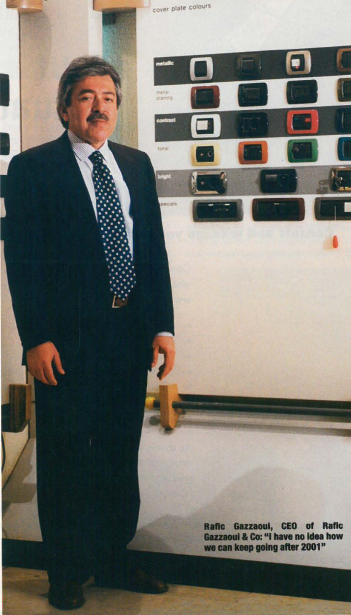
Rafic Gazzaoui, CEO of Rafic
Gazzaoui & Co, has been a little
anxious of late. “I know I can maintain
the same turnover until 2001. But after
that, I have no idea how we can keep going,”
sighs the head of one of Lebanon’s largest
electrical equipment distributors, with revenues
of $13.8 million last year.

It is easy to understand his gloom. The construction
sector is in its worst slump ever, with
the number of construction permits issued in
the last three years down 60%. With projects
scarce, competition has been fierce, reducing
prices and shrinking profit margins.

Gazzaoui has had to pull more rabbits out of
his hat than the best magician in Las Vegas just
to stay in business. Unwilling to lay off
employees, Gazzaoui has been diversifying his
product line. For example, he expanded the
lighting division of his company. In the last two
years, the firm’s Mazda brand lamps have
captured a 20% share of an estimated $9 million
market. At the same time, Gazzaoui has
stepped into the sale of down lights, grabbing
a 10% share of a 40,000 unit ($13 to $14 per
unit) market. Osram, a brand distributed by
Cesar Debbas & Sons, traditionally dominates
the lamps market with approximately a
30% market share.

Gazzaoui has also ventured into the sale of
submersible pumps under the Lowara brand
name. Demand has been on the rise, says Ali
Oueida, retail manager. The depth at which
water can be extracted from wells in Lebanon
has increased from 150 to 250 meters, with
some areas in Mount Lebanon reaching 600
meters. The company has captured 20% of a
2,500-unit ($600 to $700 per unit) submersible
pumps market and increased its market share for the total $1.5 million pump
market to 20%. And as purchasing power
has shrunk, Gazzaoui has also shifted
towards the sale of low-end products. Three
years ago, for example, it started importing a
new line of inexpensive office, kitchen and
bathroom fans from Hong Kong, which have
proven popular. Previously Gazzaoui jumped
on an opportunity by selling supplies used for
UPS (uninterrupted power supply) during
the power shortages of the 1980s. That
move gave a $1.5 million annual surge to the
company’s revenues.

Gazzaoui has expanded operations into
foreign markets. The firm is the only electrical
supplier to have opened an office in Syria.
Until last year, the company was selling
B.Ticino wiring devices (sockets, switches,
cover plates and outlets) in Damascus
through a local distributor, importing the
equipment directly from Italy. That business
represented 5% to 6% of revenues. But in
1999, Gazzaoui opened an office in Aleppo
and a network of direct distributors to service
the rest of the country. “We are expecting to
reach upwards of $1.8 million in sales for 2000
and double that in 2001,” says Gazzaoui. The
company will distribute B.Ticino in a market
for wiring devices worth $12 million a year
as well as supply pumps to a $6 million
market, competing at gross margins set by the
Syrian ministry of supply of about 15% to
20%. Gazzaoui also has plans to start
assembling metal parts and components in
Syria for some of the mechanical and electrical
products it sells.

So far, Gazzaoui’s magic has kept the company alive. While the number of projects
for the company has dropped by 5% in the
last two or three years, Gazzaoui’s wholesale
distribution network and strong exports
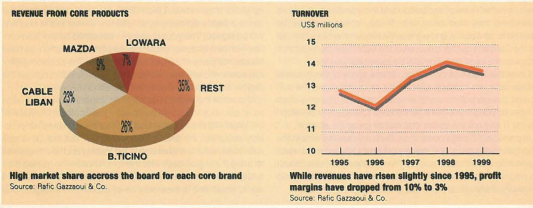
have meant that revenues have actually
increased, from $12.9 million in 1995. The
firm is currently sitting tight with its two core
brands: B.Ticino and Liban Cable. In the
local market, B.Ticino is running neck and
neck with Legrand, a competing brand
distributed by Hermes Hydroelectrique.
Together, the two brands control around
85% of the estimated $9 million Lebanese
electrical wiring device market. Gewiss
and Vimar brands share most of the remainder.

Of the six distributors of Liban Cable,
Gazzaoui controls a 30% market share followed
by Harb Electric with a 25% share.

But sustaining business has come at a
price. Profit margins have shrunk from a
peak of 10% in 1995 to 3% last year, according
to Gazzaoui. The company is certainly not
alone in facing these troubles. Middle East
Markets and Supplies (Memas), a competitor
with exclusive distribution rights to General
Electric lighting accessories, had a turnover
of $3.8 million last year, a 20% drop from
1997. “We averaged revenues from projects
of $1 million between 1994 and 1997. Now
they don’t exceed $100,000,” says Joseph
Harb, assistant general manager for Memas.
Harb Electric, another competitor, saw the
share of projects drop from 45% to 20% of
total sales in the last three to four years.
Today, its turnover stands at $12 million to
$12.5 million annually.

For Gazzaoui, the situation is becoming desperate. Opportunities for expansion
into new markets are limited because the
company has exclusive distribution rights
for Syria and Lebanon only. There is potential
to sell in Iraq, but the country is still
under UN sanctions and its retail market is
flooded with cheap goods. Most alarming,
30% of Gazzaoui’s revenues comes from
construction projects in Lebanon, most of
which were started two or three years ago
and are now nearing completion. With the
economy in a slump, there appears to be little
business to replace them.

“I am hoping for a resurgence of activity
in Solidere, which would help us tremendously,”
says Gazzaoui. But Solidere is
mired in its own problems. On top of the
stagnant real estate market, there has been a
conspicuous absence of government support
for one of the biggest companies in the
Middle East, manifested through the slow
issuance of building permits. A discrepancy
between the master plans drawn up by Dar
Al-Handasah and municipal planning regulations
is causing projects to stop at every
minor technical problem. Gazzaoui may
have plenty of tricks up his sleeve, but the
magic show cannot go on forever. Profit
margins are shrinking and Gazzaoui is
looking for solutions. The company is now
trying to get compensation from suppliers
who “understand the situation,” says
Gazzaoui. But with no economic turnaround
in sight and 30% of Gazzaoui’s
turnover about to vanish, the company is in
for a shock. Perhaps it’s time for Gazzaoui
to rethink its policy of no layoffs.

July 20, 2000 0 comments
0 FacebookTwitterPinterestEmail
Best Sellers

Wearing new hats

by Tania Avoukdjian July 20, 2000
written by Tania Avoukdjian

In 1994, Lebanon looked
like a gold mine to Apave.
The construction business
was booming and the French-based
company, which does
quality and risk management
for construction projects, had
just opened an office in Beirut.
Apave came to Lebanon with
two projects already signed,
together worth $480,000. The
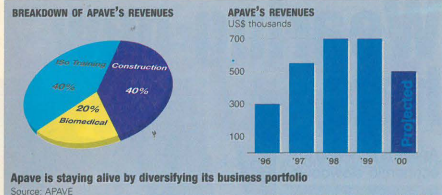
firm saw its revenues climb
from $300,000 in 1996 to
$700,000 in 1998. But by
1999, it appeared that fool’s
gold was all Lebanon had to offer. Total revenues
leveled off, while income from construction
projects declined by $50,000.
This year, the company is forecasting revenues
of just $500,000.

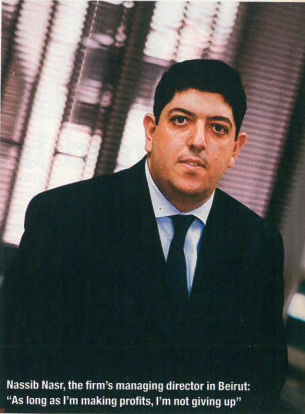
But Nassib Nasr, the firm’s managing
director in Beirut, is not fazed. “It took us
years to get into the Middle East. As long as
I’m making profits, I’m not giving up,” he
says, “even if I need to lay off employees.”

So far, Apave’s response to the building
slowdown has been diversification. Last
year, the company introduced a consultancy
and training service for companies seeking
ISO certification. Sales generated from the
new line of work compensated for losses in the
construction field. Some of Apave’s more
notable clients for ISO training are Khatib &
Alami, Laceco, Hammoud Hospital in Sidon
and St Joseph’s University. The training
costs a minimum of $10,000.

Apave is determined to get its turnover
back on track. Sales from ISO training are
projected to top $200,000 by the end of the
year. The company has recently added a
third dimension to its business: Apave
Biomedical, which does quality control in
the healthcare field.

Apave is already providing this service to
the Beirut Government Hospital, which is
looking to purchase between $25 million
and $30 million worth of equipment, including
scanners and beds. The possibilities for
expansion in this field are vast. Apave plans
to add a control and sterilization department
to its firm as well as a program to train medical
staff. The company is now planning to bid
on a contract to supply radiotherapy equipment
to Hotel Dieu. Revenues from its new
medical department are forecast to reach
$100,000 by the end of 2000.

But Apave is facing stiff competition. The
firm came to Lebanon at the same time that
two other French-based companies arrived,
Bureau Veritas and Socotec. While the latter
restricts itself to quality and risk management in construction, Bureau Veritas is diversified
into other fields. The bidding war between the
three has pushed down profit margins.

In 1999, when revenues were $700,000,
Apave’s profits were $157,000 (22.4% of
turnover). In the first quarter of this year,
with revenues at $180,000, profits were
only $27,000 (15% of turnover). Socotec,
which reported revenues of $1 million in
1999, claims to have profit margins of just
3%, while Bureau Veritas says that half of its
1999 revenues of $850,000 is pure profit.

Even in Apave’s new lines of business,
competition has been fierce. While Apave is
doing ISO certification training, Association
Francaise d’ Assurance de Qualite (AFAQ), an
associate company, actually grants the ISO
certificate to companies. AFAQ is scheduled
to open a local office this year. Similarly,
Bureau Veritas trains clients and Bureau
Veritas Quality International (BVQI) awards
the ISO certificates. Some of the companies
to which BVQI has awarded ISO 9000 certificates
include Obegi, C.A.T and DHL.

Socotec, a former partner of AFAQ, used
to provide ISO training but stopped. “Competition is ridiculous when you are
going up against a company that trains and
gives the certificate, so I don’t want to go
into this field,” says Claude Julliot, director
of Socotec Lebanon and area manager of
Socotec International.

As far as diversification is concerned,
Bureau Veritas has a head start on Apave.
On top of ISO training and certification, it
has ventured into the marine services sector,
where it deals with the control and quality
management for boats. This department
alone generated around $250,000 last year.

Another problem for Apave: Many of its
services are simply not in demand. The
firm provides technical risk management in
17 different fields, including electricity,
fire safety and security systems, environmental
protection and system quality, but
there are very few buyers.

Apave faces plenty of challenges in these
recessionary times. As long as it keeps seeking
out new fields of business, Nasr should be
able to keep the company alive. If that doesn’t
work, he may have to make good on his
word and start handing out pink slips.

July 20, 2000 0 comments
0 FacebookTwitterPinterestEmail
Best Sellers

Blueprint for survival

by Tania Avoukdjian July 20, 2000
written by Tania Avoukdjian

Who would want to
be an architect
these days? With
construction at a virtual halt
and a glut of unsold real estate
on the market, it would seem
that designing new buildings is
the last business anyone would
want to be in. But there is at
least one architectural firm that
is bucking the trend.

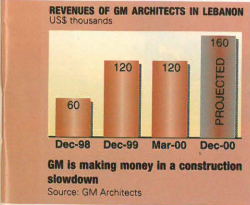
During the first quarter of this
year, GM Architects signed over
$300,000 worth of contracts and
collected $120,000 in revenues.
Compare that with figures for
1999, when just $200,000 worth
of contracts were signed and revenues
totaled $120,000. The previous
year, GM Architects had
signed contracts worth $240,000
and had $60,000 in revenues.

One of the main contributions to GM’s growth has been the firm’s focus on interior
decorating. “Architectural projects need huge
investments, and the country cannot afford this
now,” says architect Pierre El-Khoury.

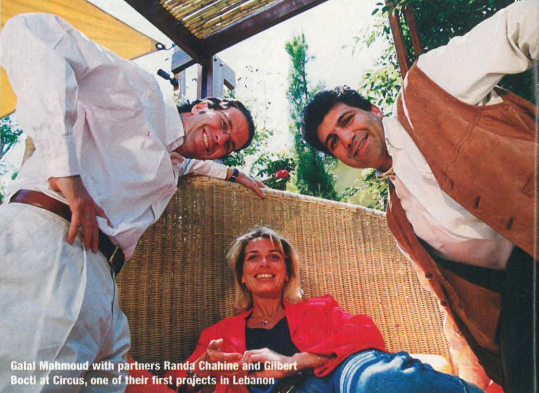
Galal Mahmoud, GM Architects’
founder, moved operations from Paris to
Beirut two years ago. He, and his two partners,
Gilbert Bocti and Randa Chahine,
opened offices in Verdun and Rabieh. The
company has decorated the interiors of a
number of popular establishments. These
include the Country Lodge country club in
Bsalim, the 200-bedroom Crown Plaza
hotel in Hamra, the Circus bar and restaurant
in Ashrafieh, and the Jeitawi branch of
BLOM bank. More recently, GM
Architects signed a deal to decorate the Taj Tower’s cinema, amusement center and
restaurant in Hamra. “I think what attracts
clients to us is our professionalism, our
international exposure and our creativity,”
says Mahmoud. BLOM liked GM
Architects’ work so much that it asked the
firm to decorate its new branch in Nabatieh.
“People recommended them to us and they
fit the requirements,” says Mohammed
Bizri, building manager at BLOM.

GM Architects charges between 8% to
15% of the value of the project, although it often
offers discounts to return customers. But the
firm’s strategy has not been without problems.
Even though interior designers have
not been as badly affected by the recession as
the architects working in the construction
sector, business has been slow. According to Antonie Tabet of the architectural firm Tabet & Partners, business dropped by 40%
between 1998 and 1999. “1999 was a very bad
year,” says architect Bernard Khoury.

To combat the economic slowdown, the firm has been looking overseas for business.
GM Architects has already designed the
interiors of such establishments as the
300m2 Chameleon club and restaurant in
Germany, the 600m2 French Trade Office in
New York, and the 350m² Villa Mykonos in
Greece. It has also done projects in Saudi
Arabia, Ecuador and France. Now the company
wants to break into Middle Eastern
countries where it has not done business, such
as the UAE and Egypt. In addition,
Mahmoud has retained the GM Architects’
office in Paris, where the company was
established in 1987.

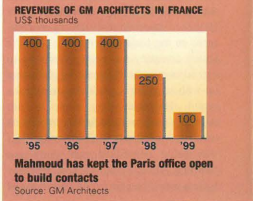
The French division saw revenues drop
from around $400,000 in 1997 to $100,000
in 1999 and made no profits. But the Paris
office allows the company to keep up with the
latest trends in the industry and has helped the
firm establish contacts with other interior
designers as well as furniture companies.
“Keeping the office in France was like keeping
an open door,” says Mahmoud.

GM Architects is not the only architectural
firm in the country seeking business
in foreign markets. Khoury, who projects
local revenues this year to be just under
$500,000, recently agreed with Faber &
Krebs to design a $40 million entertainment
complex that includes restaurants
and theatres, from which Khoury expects
to earn around $1.3 million.

GM Architects’ blueprint for growth in a
sluggish economy has worked. But these
are mere survival skills. Like almost all
companies, what’s really needed is a sharp
turnaround in the economy. In the meantime,
GM Architects might turn an eye to the
recently liberated South, where thousands
of demolished homes are just waiting to be
rebuilt and, of course, redecorated.

July 20, 2000 0 comments
0 FacebookTwitterPinterestEmail
Best Sellers

Another round

by Hadi khatib July 15, 2000
written by Hadi khatib

Two’s company, three’s a crowd, or so
people say. But for Almaza, one was
comfortable enough. Since the mid-1990s, the only locally produced beer was the
big kid on the block. After the war, Almaza
invested almost $15 million in rebuilding its
factory and obtaining ISO 9002 certification.
Brewery production capacity was doubled
from 10 million liters a year to 20 million
liters, although it now operates at half that
level. The company dominated the post-war
beer market, with annual revenues of $10-15
million. Almaza has controlled about 65%
share of the roughly 16-18 million liter yearly
market, according to market estimations.
Its closest competitor, imported Heineken,
claims to have 19%.

Then an old acquaintance moved back into
the neighborhood and things haven’t been
quite the same. Laziza’s boisterous re-entry
into the Lebanese market last year represents
the first serious challenge to Almaza in
almost a decade. Although it was once one
of Lebanon’s leading brands, Laziza is no
longer, in the purest sense, Lebanese. The
company stopped local production in 1995
and is now importing from Holland. But the
firm’s blitz into Lebanon last summer, with
an estimated $1 million advertising campaign,
helped revive the Laziza name.

This summer, the company has turned on
the marketing machine again by launching
two new products, Laziza Light, with
2.5% alcohol, and Laziza Heavy, with 8%
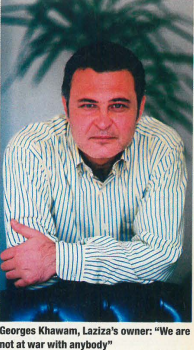
alcohol. Georges Khawam, Laziza’s owner,
claims to have generated $6 million in revenues
since his brand hit the market in May
of last year. He also claims to have 25% of
the market, though his competitors dispute
that assertion. “We are entitled to make a comeback,” says Khawam. “We are not at
war with anybody.” But there is little question
that Almaza has been feeling the heat of
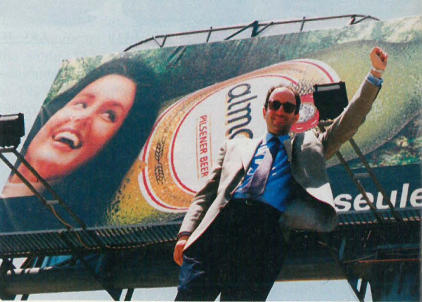
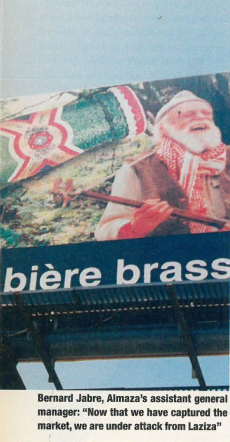
battle. “Now that we have captured the market,
we are under attack from Laziza and we
have to redouble our efforts in order to protect
our market share,” says Bernard Jabre,
Almaza’s assistant general manager.

This has had a sobering effect on Almaza,
which has doubled its marketing budget and
reduced prices since the arrival of Laziza. It
has also begun diversifying its portfolio of
products, including the launch of a new non-alcoholic
malt drink called Malta this year.
The drink will come in a number of flavors,
such as apple and raspberry, and will be sold
both locally and throughout the Arab world.

Almaza is also trying to trim costs. The
recent computerization of its factory has
helped reduce the need for manpower. The
firm has also been trying to convince consumers,
including hotels and restaurants, to
return used bottles, which reduces the costs
of raw materials and storage by about 30%.

Now Almaza is bent on taking over the liberated
South, where it expects to sell
between 10% and 15% of its total yearly output
of 10 million liters. The South is a virgin
market for beer companies. Before the pullout,
Israeli-made Macabi beer dominated the
region and competitors were largely kept out.

Heineken, Laziza’s second biggest competitor,
is less worried about the increased
competition. “They haven’t yet established
themselves with their core product,” says
Salim Bocti, vice president of the Gabriel
Bocti company, the local distributors of
Heineken. “Our estimates indicate that they
have no more than a 5% to 10% market
share in local sales.” But unlike Almaza,
Bocti feels that trying to counter the Laziza
marketing offensive is futile. Prior to
Laziza’s arrival, Heineken’s marketing budget
was $500,000 per year. “For the last two
years, we redirected our advertising budget
into other areas such as promotional items
because of the insane advertising from
Laziza. If they want to spend $1 million, I will
not spend $300,000, because I will look
small,” says Bocti.

But now it looks as if Laziza’s two
biggest competitors might be teaming up.
Heineken already has a 10% stake in
Almaza. Negotiations are currently underway
to increase the international beer
giant’s share in the local brewery. “Last
year, Heineken visited the factory and
wanted to buy shares; we are negotiating
selling 20%, 30%, who knows, but nothing
is finalized,” says Jabre. The move would
increase Almaza’s capital and put the
weight of one of the world’s largest beer
manufacturers behind the local outfit.

Albert Holtzappel, spokesman for
Heineken International, refuses to comment
on the matter, saying only that the
Dutch company has been attempting to
extend its international reach by partnering
up with large local producers around the
world. Heineken may want to use
Almaza’s underutilized factory to brew its
own beer locally. A similar arrangement
was being negotiated two years ago
between Almaza and Laziza, whereby
Laziza would be permitted to make use of the 50% unused capacity in Almaza’s
brewery. But the deal fell through.

Almaza is determined to hold its ground
against the Laziza onslaught. But the battle
has taken its toll. Since Almaza was forced
to cut prices, revenues have dropped,
although Jabre would not provide exact figures.
The company wants to boost exports in
order to make up for the decrease in local
sales, but there are problems. Jabre complains
that customs in nearby countries are
much higher than the local tariff of 55%.
That leaves the tiny Lebanese market,
which is too small to justify new investment.

Almaza could reduce costs further by producing
barley malt locally. But the company
would have to grow a minimum of 100
million tons per year, which is not feasible
in Lebanon. By contrast, the sole brewery in
Egypt, a country of 60 million, produces 500
million liters of alcoholic and non-alcoholic
beer a year and operates at full capacity.
In Holland, Heineken alone has a full
capacity of 12 billion liters per year.

Almaza will also face hurdles when
introducing its new Malta drink. Non-alcoholic
beers represent only 5% of the total
beer market and there is plenty of competition.
Chasco, distributors of Holsten beer,
and Heineken have a head start in distributing
non-alcoholic beverages in the Arab
world. Laziza also makes a non-alcoholic
beer. Since the firm’s arrival, Khawam
claims to have sold 100,000 cases of non-alcoholic
beer in Lebanon alone, and forecasts
selling 500,000 cases by the end of this
year. “By year’s end,” says Khawam, “we will be the third leading malt beverage in
Saudi Arabia and on our way to becoming
leaders in Kuwait and Iraq.”

What’s more, Almaza may soon lose one of
its biggest selling points. Laziza is considering
investing more than $12 million in a
brewery in Lebanon. “I did not have $15 million
to rebuild my factory after the war and no
one would give me a loan, but now I have three
proposals for a factory here,” says Khawam.

It looks like more rough times may lie ahead
for Lebanon’s leading brew.

July 15, 2000 0 comments
0 FacebookTwitterPinterestEmail
For your information

Tapping into the expat community

by Executive Contributor July 15, 2000
written by Executive Contributor

What is the role of the ministry of emigrants?

JOMAA We have organized numerous activities with Lebanese emigrants.
We are trying to create a bridge of communication with the emigrant
community. But we are looking at emigrants from a different perspective;
the existing image is one that paints them as the money or funds
available to the Lebanese.

Lebanese emigrants have influenced other cultures and they play an
important social, educational, political and economic role in other societies.
So we’re dealing with the emigrant community from a social and
economic point of view. Our activities include forging friendly ties in areas
where there are large concentrations of Lebanese living abroad.

Recently, we organized a conference for emigrant business people. So
we have made the first step, but we have a long way to go. The next step
is to organize a follow-up committee, because we are turning this conference
into an institution. For the conference, we received help from
the private sector, about $150,000. We put in around $50,000.

Why are so many people emigrating?

JOMAA This is nothing new. It’s true we need to keep educated and
talented individuals in Lebanon, but we have to provide a favorable climate
for them to stay or for emigrants to return. In addition, there is
competition for intellect around the world; talent is being drawn to East
Asia. It is a very critical and sensitive issue, requiring a plan of action
from the government or the exodus will continue.

What was the general feeling among the emigrants with
regard to investing in Lebanon?

JOMAA Lebanese emigrants dream of investing in their homeland, but
there are complications that impede investments. There should be a special
law for emigrants providing incentives. Now we have a one-stop shop
in IDAL, but it’s only a start and applies to all investors, not emigrants in
particular. We created a committee to facilitate investments from emigrants.
However, the conference achieved several things. It allowed emigrants to
visit Lebanon and not just see it through the eyes of the media. Secondly,
Lebanese emigrants from different countries were able to meet and establish business relations that Lebanon could eventually benefit from.

Can emigrants rebuild the country and the economy?

JOMAA Absolutely, Lebanon would not have been able to withstand
20 years of war without its emigrants. During the war, the money
coming from Australian emigrants to their families back home was about
$1 million AUS per day. Emigrants are great contributors to the local
economy; we don’t have raw materials or natural resources.

Coming back to investments, no real progress will be made unless we
can improve the investment environment and offer incentives. Many
Lebanese emigrants have the means and ideas needed to invest in
tourism, industry or elsewhere, but are wary of the social security system,
the labor situation or red tape.

What about T-bills at no interest for five years?                                                         

JOMAA The idea is for emigrants to participate in reducing the public
debt. Each would invest $100,000 for five years. The annual interest
rate of 7%, or $35,000, would be at the government’s disposal to pay
the interest on the public debt. We presented the idea to the emigrants
during the conference, and 100 were interested. If 200,000 emigrants
participated, we’d no longer have a public debt. The others were
ready to contribute, but some asked for 1% interest to make a nominal
gain. Others asked that the $100,000 be divided into four installments.
Right now we have about 40 people who are ready to contribute.
We are preparing plans with the ministry of finance and government for
that purpose and to increase the number of participants.

What are the chances that action will be taken any time
soon in order to facilitate and offer incentives for direct
investments?

JOMAA We have as a ministry put a plan of action into place, and we
are starting as we speak. Everything takes time, but government incentives
need to come from the ministry of economy and others. We can
only suggest our ideas to those ministries; we can’t control the activities
of other ministries.

July 15, 2000 0 comments
0 FacebookTwitterPinterestEmail
For your information

What’s the right fix?

by Sami Atallah July 15, 2000
written by Sami Atallah

The signing of the trade agreement between Lebanon and
the UAE in May poses serious questions about the
prospects of the industrial sector, the objective of the government’s
trade policy and the challenges of globalization.
These matters will become more acute as other agreements are
signed with Arab countries, Europeans through the Euro-Med agreement
and the world via the WTO.

The agreement with the UAE, which calls for tariff reductions
(50% before the end of the year, 25% in 2001 and zero tariffs in
2002) is part of the Arab Free Trade accord. When the agreement
was signed, some industrialists threatened to relocate their factories
to Dubai. Although hardly any industrialists call for an import substitution strategy, most, if not
all, ask for protection in the form of higher customs duties.

Some industrialists have been more
pragmatic, requesting tariff protection until
they can deal with high production costs.
Otherwise, they rightly state, they will become
vulnerable to overwhelming competition.

On the opposite end of the spectrum, free
market zealots believe that it’s high time to liberalize
and open borders. This will essentially
boost growth, increase efficiency and productivity,
enlarge the market for our products,
decrease prices, improve quality and so on.
These free trade proponents believe that the
industrial sector is not a significant player in the economy since it contributes 17% to GDP and employs 14% of the
labor force, while Lebanon is a country of services. I confess that
I have purposely polarized these two opinions to better show the
fallacies of both.

The first argument, put forth by industrialists for tariff protection,
is actually less fanatic than it sounds. They basically want more time.
Industrialists advocate higher tariffs on imported goods in order to
allow them to restructure their firms so they can become more competitive
and export. This, at first, sounds convincing. After all, the
industrial sector is facing innumerable problems from uncertain government
policies and bureaucratic obstacles, as well as paying the
price of outdated equipment, lack of financing, low productivity and
the high cost of energy, labor and land. Removing tariffs, particularly
on finished goods, no doubt, will make things even harder.

But to believe that trade protection will make the industrial sector
more competitive is hardly convincing. It will save the industrial
sector from the unforgiving forces of competition and the market
but only for a while. This is because Lebanon will eventually and inevitably reduce all tariffs. The point is that lifting customs
might break the back of the industrial sector, but keeping tariffs
in place will hardly make industries more efficient.

Hence, the key to sustainability and eventually competitiveness lies
elsewhere. Industry will not emerge from the mess it’s in without a
clear and conducive government policy so that investment and
modernization can take place. In other words, the problem is in the
process of policy making. What’s needed is a transparent, serious and
pragmatic mechanism to set an objective and strategy for the industrial
sector given the regional and international changes. Customs
duties could then be used as a tool to achieve this objective.

The second argument has to do with the benefits of trade liberalization. Few people dare to say otherwise,
fearing to be labeled old-fashioned,
communist-fanatic or closed-minded. In any
case, conventional wisdom is that openness to the
region and ultimately the world will boost
growth from lower trade barriers. This goes
through various channels which include an
increase in exports and foreign direct investment,
more job creation and the spillover effect
that raises productivity.

An empirical analysis on several countries by
Dani Rodrik, a professor of economics at
Harvard University, shows otherwise. In fact, he
argues that though countries that have grown faster had also witnessed an increase in
exports, the reverse is not true. One could thus argue that exports
are a source of “learning and technological externalities” for
Lebanon, allowing firms to learn from sophisticated markets
abroad. Rodrik shows that this is true. Exporting firms are indeed
technologically more dynamic, they “tend to have larger plants
that better utilize scale economies, employ a mix of better skilled
workers, and generally outperform non-exporting firms.”

But these firms are in fact dynamic and successful for other reasons.
It is actually because they are dynamic that they export. So
again Rodrik shows that there’s little proof that efficiency benefits
accrue from exporting activities.

To recapitulate, industry cannot develop simply by advocating
protectionism. But it’s equally true that opening up the borders
will not reap the list of benefits advocated by many. The solution
lies somewhere in between: open up the borders selectively to
meet your industrial investment strategy.

Sami Atallah is an economist with the Lebanese Center for Policy Studies. The views
expressed here are those of the author and not necessarily those of the LCPS.

July 15, 2000 0 comments
0 FacebookTwitterPinterestEmail
For your information

Glossy outside, gloomy inside

by Hadi khatib July 15, 2000
written by Hadi khatib

A visitor arriving in Lebanon might be impressed by the bustle
of construction at the new airport. Estimates indicate
that by completion, the total cost will run upwards of $800
million. But not all that glitters is gold. Problems at the airport are
affecting trade and the livelihood of companies operating there.

A big problem, not surprisingly, is customs. “The customs
building is something out of the middle ages, it’s dirty, littered
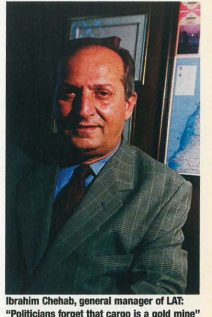
with garbage and nothing works,” says Ibrahim Chehab, general
manager of Lebanese Air Transport (LAT). The erratic customs
procedures and charges, which are often subject to bribes or
wasta, slow the passage of goods. An organized and efficient customs
system would increase cargo and ultimately increase the revenue
for the government, says Chehab. He previously worked as
a cargo manager at Sharjah airport. “It’s small compared to
Dubai’s airport, but their warehouses are full because the government
has a flexible policy and business is booming,” says
Chehab. LAT does cargo and passenger handling as well as
maintenance assistance for 17 international airlines, including Air
France, British Airways and KLM.

The government halted a $15 million BOT project to build a modern
customs building with a warehouse capacity of 200,000 tons a year
and where airlines could have bonded warehouses. “The existing facilities
can absorb 100,000 tons, but Lebanon is only getting 50,000 tons**;**
that’s what stopped the project,” says Fadi Saab, chairman of Trans
Mediterranean Airlines. Customs regulations can impact the cargo
business, adds Saab, but other areas such as industry and trade also
need a boost for the sector to improve. The plans to modernize and
computerize the facilities are encouraging for Saab.

But Chehab believes a better option would be to create a ‘cargo village.’
For 15 years, land would be given rent-free to airlines and cargo
companies to build their own offices and warehouses. “Politicians think the airport is only for
passengers and forget
that cargo is a
gold mine,” says
Chehab. He cites
Singapore as one of
many cities that have
become hubs as the
result of such a project.

The government
did have a plan
to take ownership of
additional land. But
the project failed
because it exceeded the allocated budget for the airport, and
there was political pressure due to its proximity to residential areas,
according to an engineer at the airport’s civil aviation department. “We
don’t have an inch of land to give to companies,” he says.

But land aside, politics have already scuttled one similar completed
project. Last October DHL (see “Down and out in Beirut,” January
2000) invested $2 million in new airside offices that included warehousing
and an area for customs clearance. Those facilities are sitting
idle because no customs officers have been stationed there,
despite promises from both the current and previous government.

Another problem is the high rental fees. Last August, law number
nine increased the rent for offices occupied by airlines or
appointed agents from LL 100,000 to LL 500,000 per m2 and the rent
of hangars and warehouses from nothing to LL 250,000. For LAT
that meant an increase from $7,500 to $35,000 per month.

The new law gave a 50% exemption to local companies that
have scheduled flights, but LAT doesn’t have scheduled flights.
Though the law has since been modified to include companies
without scheduled flights, the ministry of transport is trying to
collect the full fee. The civil aviation authority disputes complaints of high
fees. “It was proven that we have the lowest such fees in the
world, and we need them to cover the operating costs of the airport,”
says one official.

The companies that LAT represents also complain about additional
fees, such as $150 per hour to use the travel counters and
charges of LL 50,000 to LL 150,000 on outgoing passengers. And
on top of the substandard warehousing facilities, the airport has yet
to install telephones and televisions as well as sufficient passenger
seating, arrival and departure monitors. Even with all the
fees it collects, the airport management has failed to provide
good services in return.

July 15, 2000 0 comments
0 FacebookTwitterPinterestEmail
For your information

Breaking down the barriers

by Natacha Tohme July 15, 2000
written by Natacha Tohme

With political and economic issues heading the government’s
agenda, it’s hardly surprising that the rights of
the disabled were put on the back burner. Following
concerted efforts by advocates, the most that law 243 of 1993 stipulated
was that disabled people “have the right to be employed,”
says Jerius Khouri, vice-president of the national association for
the rights of the disabled. “But it didn’t require companies to hire
a certain percentage of the disabled or fine them for not obeying the
law.” The law didn’t even eradicate an antiquated and discriminatory
Turkish law that actually denied handicapped people
access to public jobs.

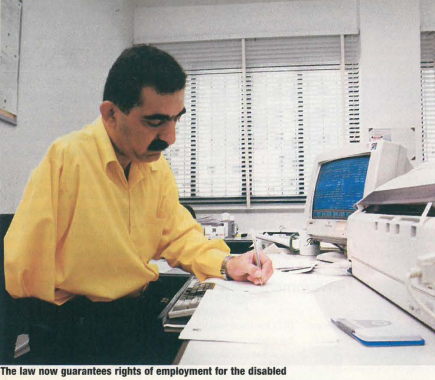
All that was changed when parliament approved a new anti-discriminatory
law in March. “It cancels or amends unfair texts, clarifies
unclear texts and adds new texts,” says Rita Saba, head of
human resources at the rights and access program of the ministry
of social affairs. On employment, the law guarantees equal opportunity
for individuals with disabilities. It stipulates that disabled people
will represent 3% of public jobs in all categories.
Private companies with more than 60 employees must reserve 3%
of positions for those with disabilities. For companies with 30 to
60 employees that figure is 1%. Failing to comply will result in a
fine, but the amount has yet to be disclosed. Companies with a staff of less than 30 are not bound by the law to employ disabled people,
but doing so will procure tax exemptions.

“The purpose of the law is to ensure the rights of the disabled on
a long-term basis,” says Saba. It’s an important step towards moving
the status of the handicapped in society from marginalization
to total integration. But the law must still be enforced. “We have to
turn it into applied rules,” says Khouri, who is blind and works as
a freelance journalist and translator. That will require coordination
between the ministries. “Coordination committees must be formed
within each ministry,” says Saba. “Without them we will not be able
to apply anything concerning the law.”

The law also specifies that all public buildings must be accessible
to people with disabilities. “But the criteria still have to be set in
the implementation stage,” says Saba. Adapting the workplace will
be an important component. “As far as I know, most workplaces are
not accessible for the physically disabled,” says Khouri. That
includes making toilets and elevators accessible to wheelchairs.
Solidere showed vision by building in accordance with international
standards that allow for accessibility, but it will be a while before
building specifications become obligatory by law. When they
do, owners of buildings under construction that fail to abide by
specifications will be fined. Tax exemptions will be given to
property owners who restructure existing buildings.

No statistics are available, but it’s safe to say that the number of handicapped
people presently employed is negligible. The Dr.
Mohammed Khaled Social Foundation cares for the physically
handicapped, for whom it provides training in carpentry and sewing. The foundation employs 12
physically handicapped people,
mostly paraplegics.

“They can’t move their legs,
but they can move their
hands. They have brains and
are intelligent,” says Abdul
Hafiz Elladki, the foundation’s
general director.

One barrier to employment
is that just a small percentage of the handicapped population is educated, according to Raif Shwayri, the director of
the Al-Kafaat Foundation.
Before the 1993 law, handicapped
people had no access to
public schooling. Though the ban was lifted, schools are still not accessible to the disabled.
Additionally, no public transportation is available for the handicapped,
making it difficult to get to work or school. Al-Kafaat is a specialized
organization that caters to socially and physically disadvantaged
people. The organization provides daily transportation for its
4,500 beneficiaries, 2,000 of whom are physically impaired. The government
needs specialized buses for the physically handicapped.
“To integrate the handicapped in society, society must be equipped to
receive them,” says Shwayri.

Compiling the cases

Exactly what percentage of
Lebanon’s population is disabled?
Two studies have been
done: one by the ministry of social
affairs in cooperation with the
United Nations population fund
(December 1995 to May 1996) and
the other by the Central
Administration for Statistics
(1997). The studies put the figure at
1% and 1.5% respectively.

According to a source at ESCWA,
“the figure is way too low.”

Recently the ministry of social
affairs began issuing identity cards
for disabled citizens who meet the
classifications set by the ministry.
“Certain health problems are not
classified, such as extreme cases
requiring medical equipment that
we cannot provide and minor
ones,” says Rita Saba of the ministry’s
rights and access program.

The card is required for disabled
people wanting access to services
provided by the ministry, such as
technical aid. To date 24,493 cards have been
issued, indicating 24,763 disabilities
(some have multiple disabilities).
Of these 6.79% are visually
impaired, 11% hearing impaired,
38.7% mentally disabled and
52.2% are physically disabled.

While many people are reached
through ‘outreach services’ provided
by collaborating NGOs,
such as Arc en Ciel, most people must apply for the cards in person at
the ministry’s offices. For this reason, the figure isn’t a good indicator of the real number of the disabled,
which likely stands at 6% to
7% of the population.

July 15, 2000 0 comments
0 FacebookTwitterPinterestEmail
For your information

Cellular circus

by Kirsten Vance July 15, 2000
written by Kirsten Vance

In the eyes of most spectators, the row has
turned into a complete fiasco for the government
and has been sorely mishandled
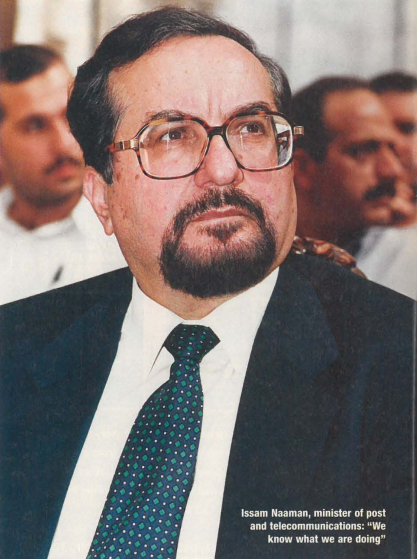
by Issam Naaman, the minister of post and
telecommunications. International rating
agency Standard & Poor’s (S&P) recently
included the government’s inability to find a
solution to the cellular issue by October in a list
of factors that could lead to a possible sovereign
downgrade for Lebanon. In a telephone interview
with EXECUTIVE, the minister brushed
aside S&P’s warning: “Let them go to hell. We
know what we’re doing.”

But the view from the sidelines tells a different
story. “This could have been resolved
quickly, privately and profitably for the government had they been more
politically astute,” says one analyst. And so the dispute has dragged
on. Many point to the vested interests at play as the major culprit: the
politically powerful hoping to get their fingers in the pie and push forward
companies with which they have or hope to form alliances.

Kamal Shehadi, a consultant on telecom privatizations in the
region, points to the government’s failure to adopt a consistent telecom
policy and law in keeping with the information age (see pp.
27-29). “Other reasons, such as the myopic approach to telecoms as
the cash cow for public finances, at the cost of encouraging
growth and investment in the sector and Lebanon catching up with
the information revolution, must have played a big role,” he adds.

And with elections just around the corner, a solution is probably
not in the cards anytime soon.

Naaman is still hunting down that elusive $300 million in fines
for each LibanCell and Cellis. But neither has received a detailed
explanation of that figure. The minister even threatened that the government
could break the build-operate-transfer (BOT) contracts and seize the two companies’ assets if an agreement is not reached
through talks. But negotiations are made difficult when the two
sides are virtually on non-speaking terms. This does not bode well
for possible future investment. “No investor will invest in a country
where governments decide to shut down a business simply
because it is more profitable than its original business plan had predicted,”
says Shehadi.

Both cellular operators have submitted requests for arbitration to the International Chamber of
Commerce in Paris. “We maintain that we have not
violated our contract and that arbitration is the best
path to resolve the different interpretations of the contract,”
says Hussein Rifai, chairman of LibanCell.

Recently, Naaman has been touting a ‘much better offer’ from Vodafone than what Lebanon’s two cellular
companies are willing to pay for their contracts
to be converted into licenses. The UK-based company
has apparently expressed its readiness to pay $1.5 billion for a license. Contacted by EXECUTIVE,
Vodafone denied making any such offer, oral or written, to the Lebanese government, even insisting that
there are no negotiations between the two parties. “If that’s true, it means
they are not telling the truth. I have all the evidence,” says Naaman,
refusing to elaborate. According to the minister, he is conducting meetings
with representatives of three mobile phone companies that are
interested in investing in Lebanon. “Vodafone for me is a ghost,” says
Sima Hafez, marketing director of Cellis, which submitted an offer in
writing. “He said Vodafone’s offer is better than ours. What are the conditions
of Vodafone’s offer? Nobody knows.”

All this comes in the wake of offers by LibanCell and Cellis to
pay $1.35 billion each for licenses that were snuffed out by the government.
Of that amount, $900 million would be paid upfront with
the rest coming in over the 20-year life of the license that would
allow competition. “Our offer was more than fair and exceeds any
price paid until now for a GSM license,” says Rifai. Indeed, in a
study prepared for the Lebanese government in September 1999,
Booz, Allen & Hamilton assessed the price of a license at between
$800 million and $950 million, based on four different scenarios.
While LibanCell points to the unprecedented high price per population
of the offer, that is the proper index for startups, according
to Shehadi, not going concerns. Nonetheless, the price is fair on a
per subscriber basis, he says: “It compares favorably with prices paid for going telecom concerns in
Europe, where the revenue per subscriber and per
capita income are higher.”

At the council of ministers, sentiment was split. The
nay camp included Naaman and Michel Murr, the
interior minister. Naaman listed his reasons for rejecting the offers at a recent press conference: the
initial installment is too low, the length of the license
too long and the right of first refusal for UMTS, the
third generation of mobile phone systems, should not
be included. Those in favor included Georges Corm,
the finance minister and Nasser Saidi, the minister of economy and trade. “I proposed transforming the
BOT contracts into licenses in December ’98, so I believe it should
have been done then,” says Saidi, adding other issues like competition
and new technologies need to be considered.

The matter appears to be shelved for the time being as the government’s
decision was, er, not to make a decision. Instead the unresolved
dispute was passed onto the auditing department’s lap, with
the operators’ offer not accepted, but not officially refused either, and
it was announced that a law would be drafted to allow a UMTS tender.

“The government should not have accepted the operators’ offer
without making modifications that would ensure a fair and level playing
field for LibanTelecom, the state-owned operator, and other
new entrants to the market,” says Shehadi. “However, that does not
justify the decision reached.”

July 15, 2000 0 comments
0 FacebookTwitterPinterestEmail
  • 1
  • …
  • 691
  • 692
  • 693
  • 694
  • 695
  • …
  • 707

Latest Cover

About us

Since its first edition emerged on the newsstands in 1999, Executive Magazine has been dedicated to providing its readers with the most up-to-date local and regional business news. Executive is a monthly business magazine that offers readers in-depth analyses on the Lebanese world of commerce, covering all the major sectors – from banking, finance, and insurance to technology, tourism, hospitality, media, and retail.

  • Donate
  • Our Purpose
  • Contact Us

Sign up for our newsletter

    • Facebook
    • Twitter
    • Instagram
    • Linkedin
    • Youtube
    Executive Magazine
    • ISSUES
      • Current Issue
      • Past issues
    • BUSINESS
    • ECONOMICS & POLICY
    • OPINION
    • SPECIAL REPORTS
    • EXECUTIVE TALKS
    • MOVEMENTS
      • Change the image
      • Cannes lions
      • Transparency & accountability
      • ECONOMIC ROADMAP
      • Say No to Corruption
      • The Lebanon media development initiative
      • LPSN Policy Asks
      • Advocating the preservation of deposits
    • JOIN US
      • Join our movement
      • Attend our events
      • Receive updates
      • Connect with us
    • DONATE