• Donate
  • Our Purpose
  • Contact Us
Executive Magazine
  • ISSUES
    • Current Issue
    • Past issues
  • BUSINESS
  • ECONOMICS & POLICY
  • OPINION
  • SPECIAL REPORTS
  • EXECUTIVE TALKS
  • MOVEMENTS
    • Change the image
    • Cannes lions
    • Transparency & accountability
    • ECONOMIC ROADMAP
    • Say No to Corruption
    • The Lebanon media development initiative
    • LPSN Policy Asks
    • Advocating the preservation of deposits
  • JOIN US
    • Join our movement
    • Attend our events
    • Receive updates
    • Connect with us
  • DONATE
Feature

Drowning

by Robert Tuttle May 2, 2000
written by Robert Tuttle

Lebanon’s rivers are once again roaring, swollen by spring
snowmelt in the mountains. This is an annual blessing. In
the parched Middle East, where water rights are so guarded
that countries will go to war to protect the smallest of tributaries,
Lebanon is an oasis. Having so much of what other countries in the
region need, one might expect that there’s money to be made in the
export of bottled water. Certainly, there is no shortage of companies
that are trying to tap into this potentially lucrative market.

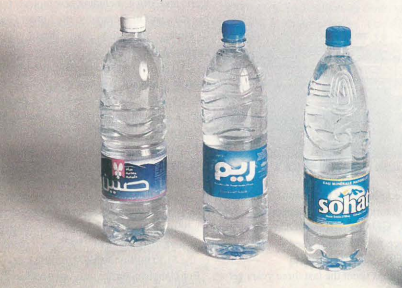
Sohat, Rim, Tannourine, Sabil, Nada and Sannine have invested millions
of dollars in the last few years to upgrade their factories. All
have converted from the use of opaque PVC bottles to the transparent
and exportable PET bottles. (Many countries have banned
the import of PVC bottles because they have been shown to pose
health risks). Water should be a booming business in Lebanon. But
the sad reality is very different.
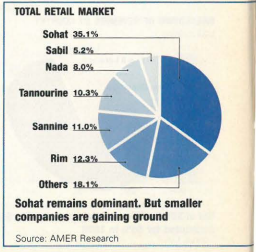
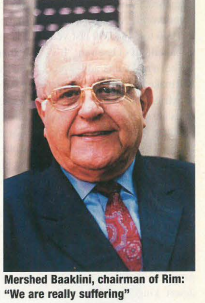
“Nobody is making a profit,” complains Mershed Baaklini,
chairman of Rim, the number two brand on the market, according
to AMER Research. Despite the big investments, those in the business
complain that there is little money being made. Unfortunately,
most companies in the water business are not nearly as transparent
as their new bottles. Sohat, the number one brand, Nada and Tannourine, declined to speak on the record. Rim, Sannine, Sabi! and Dynamic Concepts, a supplier of 19-liter bottles, were willing
to divulge limited information. But some facts are clear.

The combined production capacity of the companies is far greater
than the demands of the domestic market. About 7-8 million cases
of water are sold in Lebanon each year. “The production capacity is
at least double,
maybe triple that,”
says Salah Osseiran,
chairman of the four-year-old Sabi!, the
newest company to
enter the market.
Sabil’s capacity is 4
million cases a year,
but it’s currently running
at 1-1.5 million.
Rim can produce 6
million boxes a year
but is only selling
about 2 million.
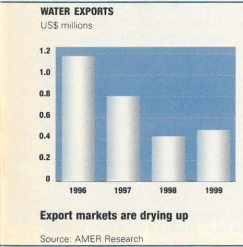
If the domestic market’s thirst is quenched, then there must be a market for exports in this arid region
of the world? Actually, no. Exports have dropped from $1.2 million
in 1996 to $481,000 last year. Production costs are increasing in
Lebanon, says Osseiran. “It’s very expensive here to export. Water
is not a real value-added product, so any marginal increase in cost
will make it uncompetitive,” he says. “We had opportunities to export
to Africa, but we couldn’t because it’s so competitive and our
costs are so high.” Sabil’s exports have dropped from 10% to 12%
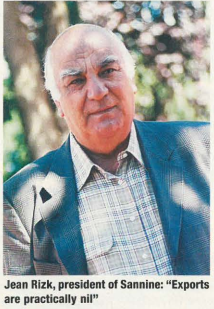
of output in 1996 to 5% to 6% last year. “Exports are practically nil. [Bottled Water] is bulky, heavy and cheap
and that makes the cost of exports high
compared to the price of the water,” says
Jean Rizk, president of Sannine.
The Gulf represents the most important
export market. Saudi Arabia purchased
$104,000 of Lebanese bottled water in
1999, or 21% of exports, and Kuwait consumed
$219,000, or 45%. But even in these
desert kingdoms, it’s hard to compete.
Believe it or not, says Osseiran, the Saudis are
able to produce bottled water less expensively
than the Lebanese by pumping from deep
wells. In 1980, there was just one water factory
in Saudi Arabia, but today there are
nearly 20. In Saudi supermarkets, a case of
Lebanese water generally costs double the
price of the local variety. “They have many
advantages that we don’t have,” says
Osseiran. “Their cost of utilities is one
fourth of ours. They pay 2 to 3 cents a kilowatt.
We pay 12 cents. They don’t have to pay
40% of each employee’s salary for social
security. They pay only 7%. They have land
that is less than nothing to buy in industrial
areas.” In addition, Saudi water companies
benefit from 20% customs tariffs on bottled
water imports. In addition to the usual taxes required of all businesses, water companies are obliged to pay a tax of
LL35 for every liter of water extracted, whether it’s used or not.

With too many swimmers in the pool, firms are desperate to survive.
Companies have been diversifying their product lines (see box) and
investing hundreds of thousands of dollars in splashy marketing campaigns.
At the same time, a fierce price war has developed, with firms
offering supermarkets up to 60 free bottles for every 100 purchased
in an effort to win market share. Instead of passing that on to the customer,
says Osseiran, shops are pocketing the difference and giving the lowest-priced brands better shelf space.
Supermarket prices range from LL500 to LL600
for 1.5-liter bottles.
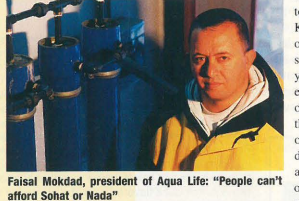
“It is a chaotic market,” says Michel Ghanem,
CEO of Rim. “Companies are dumping prices.”
So who will sink and who will swim? If the companies
themselves are to be believed, all could
drown. The some 200 to 300 unlicensed water
companies (no one knows for sure how many
there are) have become the scourge of the
industry (see box). Legal companies complain
that they are driving the legitimate players out of
business. That, despite the strict rules governing
bottled water. Based on government decree
1039, passed last summer, a water company
must have a factory that is ISO 9002 certified and
follows manufacturing procedures set by the
US Food and Drug Administration. Each company
must also have its own well or spring
located on no less than 1,000m to 1,500m of land,
a minimum investment of no less than $1 million. But the laws are
not being enforced.

Illegal companies dominate the 6-liter to 5-gallon market, which
represents more than a quarter of the total water market. Operating
out of street-level shops or garages, many provide no more than filtered
(sometimes unfiltered) tap water. Most distribute within their
own neighborhoods for prices as low as LL1,000 for a 20-liter bottle.
This has discouraged legitimate companies from entering a
very important segment of the market. Of the eight licensed companies,
only three sell 5-gallon water bottles: Mona Cool, Nahle and
Nada, which is sold by distributor Dynamic Concepts.

“We are really suffering from the little guys who are doing this
without a license,” says Baaklini. Rim is considering entering the
gallon business, but that will require an initial investment of
between $500,000 and $750,000 in bottles and equipment. “Illegal
companies are selling 19 liters for LL1,000,” he says. “I would have
to sell them for LL8,000.” Sabi! is also reluctant to enter the 5-gallon
market. Osseiran says: “The market is so uncontrolled by the
government that we have no appetite for further investment in this
country. We are the good guys, we follow the rules and these fly-by-night bunch of guys come and pay no tax, no fees, sell sickness
to people and nobody bothers to stop them.”

When Sabil opened,
illegal companies controlled
about 10% of the
market. Osseiran expected
the government to crack
down. “We never expected
it was so weak that it couldn’t
enforce its own laws.”
Sabil was expecting to
break even by 1999. Four
years later and revenues
have risen to $5 million,
but the company claims to
be losing money.

Dynamic Concepts is
one of the few licensed
companies taking on the
illegal ones. It intro-
duced 5-gallon containers in 1994.

“[Individuals and companies] used to buy 1.5-liter bottles from
supermarkets or small shops. We tried to convince the institutions
and companies that you can save by using the 5-gallon bottles,” says
Elias Barakat, commercial manager. “I have many examples
where big consumers of our products saved around 30%.” But business
soon started to turn sour. “When others saw that it has a good
rate of return, some started filling bottles without a license,” says
Barakat. “We were depending on the government to stop this, but
like everything in Lebanon, some are supported by politicians.” That
is the root of the problem, according
to the ministry of health.

Karam Karam, the minister of health,
ordered the Internal Security Forces to
shut down the illegal companies last
year, going so far as to blame influential
politicians for protecting these
outfits. Half a dozen were given
three months to get their house in
order and obtain a license. That
deadline was recently extended for
another three months. The rest were
ordered closed. About twenty were
shut down briefly, only to reopen.

Licensed companies say that the government has to make some
tough decisions, and that might involve stepping on some powerful
people’s toes. In the meantime, the number of illegal companies
has been on the rise.

A spokesman for the Internal Security Forces said it was up to the
ministry to take action against the illegal water companies. “It’s their
job to close these down, don’t they have inspectors?” he asked.

Osseiran is tired of the excuses. “Nobody in any government, not
this one or the other one, is willing to take a decision that might upset
any Tom, Dick or Harry,” he says. “Frankly, it might make sense for
all the legal companies to let the illegal ones work alone.”
May 2, 2000 0 comments
0 FacebookTwitterPinterestEmail
Cover story

clawing its way back up

by Hadi khatib & Avo Tavoukdjian May 1, 2000
written by Hadi khatib & Avo Tavoukdjian

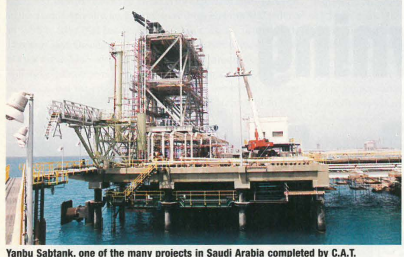
It’s nice to take a catnap. But if you
wake up to find your multi-million-dollar
company has been reduced to
almost nothing and your former employees
are your biggest competitors, then you
know you’ve overslept. A couple of
decades ago, Contracting and Trading
Company was a name to be reckoned with.
C.A.T. was a giant in the region, responsible
for building landmark structures such as
the Presidential Palace in Iraq and the
Holiday Inn Hotel in Bahrain. It was also
one of the first contracting firms to lay
down thousands of miles of oil and gas
pipelines of different diameters in the Gulf,
Libya, Ghana and Nigeria, as well as being
the first to lay down 48″ and 56″ pipelines.
C.A.T. clawed its way into everything –
from highways to stadiums, airports and
power stations in the Middle East, Gulf
and Africa. Its turnover surpassed the billion-
dollar mark.

But in the early 1980s, C.A.T. went into
hibernation, mainly because of the war and
internal conflict among its shareholders.
By the time it re-emerged five years ago,
business had dwindled to an all-time low.
Turnover was just $25.2 million and the
company had dipped into the red by a few
million. It was time for serious reconstructive
surgery. The owners began hunting for
someone who could turn things around and
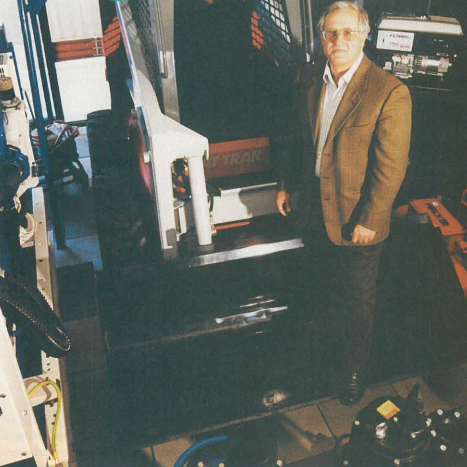
stumbled across Fred Habeishi, previously
president of the US-based RUST, a design
and build firm with over 22,000 engineers
on its payroll. RUST, where Habeishi
spent 34 years before joining C.A.T., was
one of the leading contracting firms in the
United States, specializing in the construction
of plants and factories. Can this newly
appointed Mr. Fix-it rebuild C.A.T.?

As far as Habeishi is concerned, that has
already been taken care of. “We’re not coming
back,” he says. “We’re already back.”
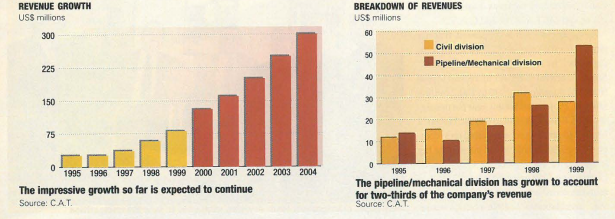
Since his arrival, turnover more than tripled
from $25.4 million in 1996 to $80.2 million
last year. Projections for this year put that figure
at $130 million. But to do that, Habeishi
had first to get the company geared up to compete
for contracts that would put it in the big
leagues with the likes of the Consolidated
Contracting Company (CCC). “We had to
reinvest, reinvigorate and get the right people,” says Habeishi. In 1996 a capital investment
of around $50 million was raised by
C.A.T.’s owners, the heirs of founders
Emile Bustani, Abdallah El-Koury and
Shukri Shammas. But with the company
losing $4 million to $6 million a year,
Habeishi knew that wouldn’t last long.

In 1997, Aramco, the world’s largest oil
company and C.A.T.’s major customer in
Saudi Arabia, was getting
ready to kick
C.A.T. out. “They told us we hadn’t done
much in the past ten or
15 years, and the last
few years we’d done
lousy work,” says
Habeishi. Aramco
allotted C.A.T. a probation
period of a few
months. Habeishi was quick to react. “We just
about fired anyone who wasn’t doing his job right,” he says, “especially people in important
positions.” He then rebuilt the work force
with qualified personnel. C.A.T.’s staff
grew from 2,494 in 1996 to 7,452 last year,
while millions were spent on reorganization,
training people and improving standards.

Habeishi also had to replenish the company’s
fleet of equipment. In the early 80s,
C.A.T. was among the best-equipped contracting
firms in the world, with 2,300 pieces
of heavy construction equipment in Nigeria alone. For 15 years the equipment had lain dormant,
been stolen, looted and cannibalized;
hundreds of millions of dollars’ worth was
reduced to almost nothing. C.A.T. managed to
salvage not much more than 60 pieces and
many of these were in need of repair. “We’ll
be spending about $130 million in the next
four years on replacements and new machinery
in the Gulf and
Nigeria combined,”
he says.

C.A.T. was once
again accepted as a
major builder for
Aramco and is now
pre-qualified. “Each
company has to go
through a pre-qualification
process, after
which the lowest bid usually wins the project.
That’s what C.A.T. has done to get mechanical works with Aramco,” says
Bassem Bou Chahine, vice president of
Albinali, a Saudi contracting firm that does
work for Aramco and Sabic and has a
turnover of more than $100 million.

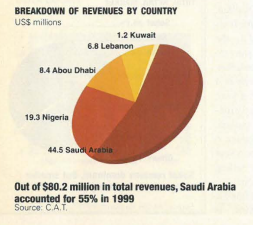
In the pipeline/mechanical division,
which accounted for two-thirds of C.A.T.’s
business in 1999, turnover generated in
Saudi Arabia sprang from $3.3 million in
1995 to $44.5 million last year. That represents
55% of total turnover. Last year C.A.T. won a plant modernization project
with Aramco for $14 million. In the past two
years C.A.T. was awarded two projects
with ADCO, an oil producer in Abu Dhabi:
a $13 million contract to construct 48″
loading rings and a $38 million contract to
build water supply systems. It also landed
the Khuff Gas Project in the Hawiyah and
Hardh areas for about $500 million last
year, again from Aramco. “C.A.T. has
always been the leading contractor when it
comes to constructing pipelines,” says
Youssef Chammas, CEO of Target and
Jima, a contracting firm based in Dubai.
Chammas was general manager of CCC’s
Oman branch for over 20 years in the
1970s and 1980s and remembers when
C.A.T. was big.

Nigeria is a big playground for civil construction
work, but C.A.T. doesn’t have
the run of the place. There it comes up
against the likes of Stemco, a construction
firm with a yearly turnover of over $50
million. The value of projects for most
road and bridge works in Nigeria varies
between $20 million and $50 million,
according to Luke Okoihue, Stemco’s project
manager. And C.A.T. is better equipping
itself to face the competition. “Recently
we have opened some very substantial
credit facilities for projects in Nigeria,”
says Habeishi. “And we’re in the process of
spending around $30 million on equipment
for Nigeria alone.” Turnover in Nigeria
more than doubled from $9.5 million in
1995 to $19.3 million last year, representing
24% of total business. The civil division
as a whole generates 34% of C.A.T.’s business. It built the Sokoto-Goronyo Damsite
road, a contract worth nearly $30 million
in 1999. “C.A.T. has been a big name in
Nigeria for a long time and still is, but
today there are a lot of companies, especially in
Lagos, performing the same kind of work,”
says Okoihue.

At home, C.A.T.’s turnover rose from
$500,000 to $6.5 million – a contribution of
just 8% to total turnover. The firm has completed its part of the St. Georges Hotel
Complex, a project it was awarded in 1998
for $35 million. It has also finished 25% of
the work on the An Nahar building, a contract
worth $10 million, awarded in 1999.
But here’s the surprise: C.A.T. doesn’t do
construction work here. In fact it avoids contracting
in Lebanon altogether, preferring to
go into project management, a field that is
still not common in the country. A project manager takes on the responsibility of ensuring that a
project is properly executed on time and on
budget, hiring other contractors and engineers
to actually do the work. Should the
price exceed the guaranteed maximum or go
over schedule, C.A.T. is willing to pay a
penalty. Should it come under the maximum,
the savings are shared with the
owner. The Leisure Hill Hotel project, currently
under construction in Dbaye, is
being managed by Soludec Liban, an international
company. “Of course, the client is
informed of our decisions, but we control all
aspects of the project,” says Desire
Nicolai, Soludec’s general manager, who
agrees that project management is a novel
concept in Lebanon.

One example of C.A.T.’s project management
is the modern Lebanese Order of
Physicians Headquarters; ERGA was contracted
to do the architectural work and
Ashada for the concrete construction.
Phase one of the $14 million project is slated
for completion by February 2001. “It’s a
great idea and sure to be popular with project
owners, who have the risk completely
removed from their shoulders,” says
Souheil Abou-Habib, general manager of
Ets Nassim A. Habib, a local contracting
firm. But it might not be so popular with the
contractors: They won’t be able to underbid
to get a job, because it will be more difficult
to reduce costs by using less material.

While project management has allowed
C.A.T. to avoid costly investments in a
stagnant market, it eventually plans to do
construction work in Lebanon. “But only
after the sector picks up and it becomes worthwhile to invest locally,” says
Habeishi, who was initially intending to
do construction work in Lebanon.
Nonetheless Habeishi felt it was important
for a company to work in its home country.
But it was a painful and costly learning
experience. “We had a bunch of guys here
who knew how to build highways in
Amman and buildings in Saudi Arabia, but
they had no earthly idea what was going on
around them,” he says. At the outset C.A.T.
would bid about three times more than the
winning bid on tenders. “We had no idea
about pricing,” says Habeishi. “We didn’t
know the people, and nobody knew us.” So
he sent his staff into the field to learn the
local market. Eventually C.A.T.’s bids
became competitive, and Habeishi’s team
caught on to the aggressive underbidding tactics employed on the Lebanese market.
“Contractors bid below cost in order to get
the job,” says Abou-Habib. “Then they try
to reduce the materials used so they can
come within budget.”

C.A.T. has spent the last three years getting
ready to pounce on the market.
Habeishi believes the company is now
ready to regain its position as one of the
region’s major contractors. In the past few
years, C.A.T.’s biggest project was worth
$50 million, but now Habeishi and crew are
bidding on those in the $100 million to
$200 million range – sometimes as high as
$400 million. “It won’t be easy,” says
Chammas, “all the small companies that
existed in C.A.T.’s early days have grown
to become large contractors. They will face
a lot of competition.” One such foe is
Saudi Arabia’s Ali H. Al-Ghamdi
Est., which has a yearly turnover of
$72 million to $80 million performing
pipeline construction for
Aramco. “C.A.T. is a big name in
this area, but they’re mostly
involved in contracts for testing,
commissioning and maintaining
pipelines for Aramco,” says C.
Sundhyr, the firm’s project manager.
Estimates by some companies
in Saudi Arabia forecast an
increase of 70% from 1999 to 2001 for the pipeline business and the expected construction boom, but CCC is in a much better position to reap the
rewards. CCC employs some 36,000 people
and has a planned turnover of about $1.5 billion
for 2000, 8% of which is in the
pipeline sector. It will be difficult for
C.A.T. to muscle in on CCC’s turf. The
majority of CCC’s work is in the Arab
world and Africa, including new projects for
the Kuwait Oil Company, the Oman Gas
Company and the Abu Dhabi Gas
Company.

C.A.T.’s CEO is cautious about the pace of
growth that the company should expect.
“Today we would be comfortable going
after a project worth maybe as much as
$400 million, especially over a two, three-
year period,” says Habeishi. “I wouldn’t
fool myself that we can go after one worth
$1 billion.” That would stretch our management
and capabilities too far and require
a far greater investment than the company is
ready to make. C.A.T. would be content
with a yearly growth of 25% once it reaches
the $150 million to $200 million mark.

For Habeishi, turnover is not necessarily
a true indicator of size. “To a pure contractor,
it would be the value of the work done,
but to an EPC contractor, who is responsible
for the engineering, procurement and
construction, you also have the value of the
equipment you buy,” he says. If a contractor
builds a plant with $500 million worth
of machinery, turnover becomes misleading.
He especially believes growth through
acquisitions in this business doesn’t work.

Today C.A.T.’s name is still much bigger
than its actual size, but it has made solid
progress. After 15 years of being out of the picture,
the company is trying to build itself
back up to proportions that live up to its
name. The C.A.T. team has more than tripled
business since 1996, re-established a reputation
as potent contractors that produce quality
work, while project management further
refines its skills as a contractor. “They have
every chance of making it back to their initial
position in the market,” says Youssef, a
notion shared by many in the field. They may
just end up proving that old adage about cats
having nine lives. The company has been
reborn into its second one but seems bent on not needing any of its remaining seven.

May 1, 2000 0 comments
0 FacebookTwitterPinterestEmail
Best Sellers

Staying alive

by Tania Avoukdjian May 1, 2000
written by Tania Avoukdjian

Remember a few months ago?
You’re in the shower when the
power fails (courtesy of the Israeli
air force) and you have to dash for the generator
with a towel wrapped around you.
Generator sales must have boomed, right?
Wrong, actually.

In fact many of those in the generator
business are complaining that these are
their darkest days. The majority of those
who require a generator bought one in the
early 1990s, when wallets were thicker and
power cuts more frequent. With the country
already saturated with generators, the air
strikes barely registered on the market. And
with construction at a standstill, sales
of generators have decreased from $40 million
in 1997 to $23 million in 1999 – a
43% decrease. At the same time, imports
have decreased from $35 million in 1997 to
just $20 million in 1999. Everyone is feeling
the pinch.

M. Ezzat Jallad, the exclusive agent for
Caterpillar in Lebanon, Syria and Jordan,
saw local sales of generators decline from $5
million in 1998 to $4.28 million last year.
Sales for Saccal Power Engineering
decreased from $3.45 million to $2.33 million,
a drop of over 32% (see “Trying to
buck the downtrend,” December 1999).

Jubaili Bros., the number one retail seller
of generators in Lebanon with just over
$20 million in global revenues last year, is
also suffering. Local sales, 70% of which are
from generator sets, have tumbled by 60%
since 1995, from $15 million to about $6 million last year. Time to pack up and call
the bankruptcy lawyer? No way.

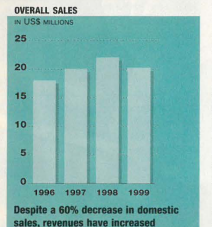
Surprisingly, overall revenues actually
increased during that period, from $18 million
to $20.2 million in 1999.

How did they do it? With the domestic
economy stagnant, the company has been
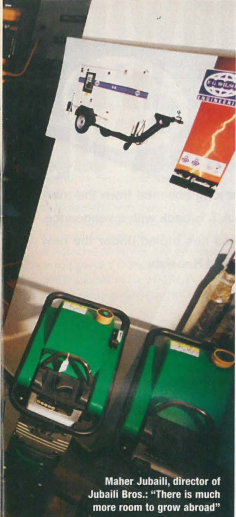
boosting its exports. “Unlike the local market,
there is much more room to grow
abroad,” says Maher Jubaili, the firm’s
director. Jubaili started shipping generators,
most directly from the FG Wilson factory
in the UK, to Nigeria and the UAE in
1996. Both countries have an erratic supply
of electricity. Today these two markets represent
about 70% of the company’s revenue.

In Nigeria alone. Jubaili currently
controls 15% of the retail and wholesale
markets for generators. It was the first
Lebanese company to enter this untapped
market. Ghaddar Machinery, a competing
retailer of generators, arrived on the scene
more recently. But unlike Ghaddar, which
works through a local agent. Jubaili markets
and sells its generators directly there. This
gives the company an edge, says Jubaili.

The firm has entered other African countries           
as well. In 1998, Jubaili spotted an
opening in Ghana, where there were only two
hours of power a day. In that year, the company
sold $2 million worth of generators in
the Ghanaian market, pushing Jubaili’s overall revenues up to $22 million. Most of
the exports were shipped directly from the
UK, but $800,000 worth were sent from
Jubaili’s Tripoli outlet, increasing the
branch’s sales from $900,000 in 1997 to
$1.7 million in 1998. But in 1999, Ghana’s
power problem was solved and sales to
that market stopped, leading to a slight
decrease in revenues last year.

Jubaili is now eyeing the Iraqi market,
another country suffering from power shortages.
But here, the company is a bit of a latecomer.
Ghaddar recently signed his third
contract in Iraq, a deal involving the sale of
250 60KVA generators for about $2 million.
Sacca!, which deals only in wholesale,
sent $4 million worth of generators there in
1999, and the latest deal was a $732,000 contract
with the Iraqi ministry of agriculture.

Despite Ghaddar’s success, Maher Saccal,
CEO of Sacca!, feels that Iraq is not a market
for retailers. “Iraq deals with public tenders
and you need to have the skills and the
know-how to succeed,” he says.

Although Jubaili has been focusing largely
on foreign markets, the firm hasn’t given
up hope that local business will improve**;** if
not now, then maybe in the long run. This has
prompted a diversification of its products in
an attempt to stimulate domestic sales. So
far, results have been mixed.

Jubaili is making a decent income from
renting out electricity. The company
recently landed some big projects, including
a $500,000 contract to provide
Bouygues, a French company in Solidere,
with 2,700 KVA of electricity for 20
months. Other successes include contracts
to provide Mannesmann in Abu Dhabi
with 2,500 KVA, and a Darwish Group
company in Qatar with 1,500 KVA.

Soundproof canopies, which Jubaili
assembles at its Sidon plant, have also
been selling briskly, accounting for
$540,000, or 9%, of local revenue in 1999.
“This is very profitable for us,” says
Jubaili, “because these days very few people
buy generators without canopies.” For
each locally assembled $5,400 27KVA
generator, Jubaili sells a $1,500 canopy.

But many new products have not paid off.
After Jallad’s sales of heavy construction
equipment declined from $7 million in
1998 to $600,000 last year, Jubaili started
selling light construction equipment. But, as
a result of the government’s budgetary policy,
construction never picked up. Jubaili
also tried selling air conditioning units, but
the added revenues were minor. “With so
many competitors in the field and too
many credit facilities, it hasn’t been a success,”
says Jubaili. The company also
earns money from after-sales services,
charging $35 for a routine checkup.
“Although 24-hour after-sales generates a
certain revenue, it barely covers our
employees’ salaries,” he says. Both Sacca!
and Ghaddar concur. With the market
depressed, profit margins are low for those
in the generator business. “We should have
a 10% profit margin,” says Ghaddar, “but it
is much less than this, even though we
have different products and services.”

As if all this wasn’t enough, the company
may soon face a challenge to its exclusive
agency rights for FG Wilson generators.
Caterpillar recently purchased FG Wilson
and Jallad is now selling the same generators
as Jubaili but under the name
Olympian. But Jubaili is not worried that the
two sides will come to blows.

“Caterpillar’s sales focus on a range of
higher-end generators,” he says.

The company has had disputes with
other competitors. Not long ago, Jubaili
began importing Perkins engines, manufactured
by FG Wilson, and assembling
them here. That prompted Ghaddar, who is
the local distributor for Perkins products, to
take Jubaili to court. “We have a right to a
percentage from the sales coming from
Perkins,” says Ghaddar. After an acrimonious
dispute, the two sides came to an
agreement. Jubaili was given full rights to
continue importing Perkins engines, as
long as they were assembled locally and
sold under a different name.

These problems have been a headache for
Jubaili, but they are minor compared to the
slowdown in the economy. Jubaili has
stayed afloat by focusing on markets
abroad, but exports will probably just keep
the company alive. If revenues are really to
grow, a turnaround is needed in the domestic
market. By leaving no stone unturned
locally, Jubaili has played his cards right.
When business in Lebanon hits an
upswing, he will be prepared.

May 1, 2000 0 comments
0 FacebookTwitterPinterestEmail
Best Sellers

Bent out of shape

by Hadi khatib May 1, 2000
written by Hadi khatib

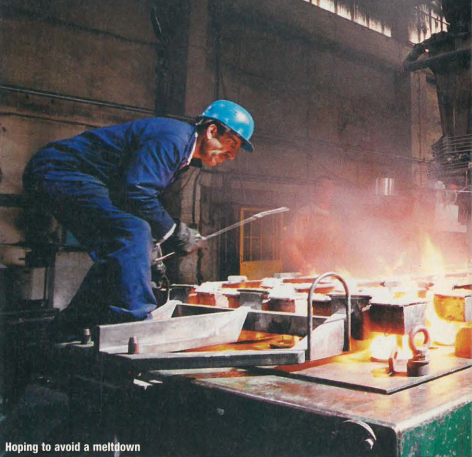
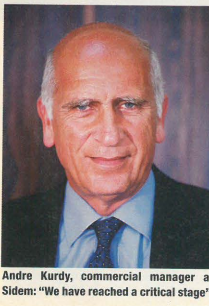
Last year was tough for Sidem. Having long dominated the market for aluminum profiles, the company barely managed to break even. “We have reached a critical stage,” says Andre Kurdy, commercial manager at Sidem. That follows half a century of turning profits, leaving management perplexed as to how to turn its fortunes around. “In our industry, Sidem is a trademark,” says Rafik Azrak, CEO of Folda, which manufactures and supplies aluminum-based products and had a turnover of $8.4 million in 1999. “They’ve enjoyed a monopoly for so long. They didn’t feel the day-to-day competition and may have inherited a heavy structure.”

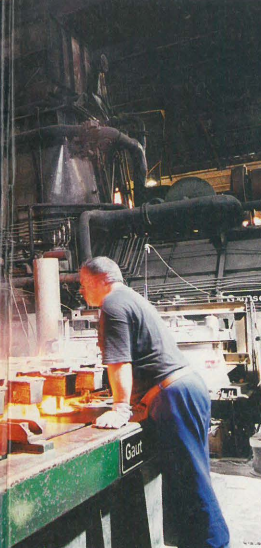
Sidem, an extruder of aluminum profiles (extrusion involves pushing aluminum cylinders through pre-shaped molds to create architectural profiles of different shapes and sizes) used in the manufacturing of doors, windows and curtain walls, dictated prices until 1995. But cheaper imports, the arrival of local competitors and reduced tariffs with Arab countries combined to push prices into a further decline, a trend that had already begun in 1990. Having operations at full capacity, high exports and about $55 million in annual sales have not been enough to secure profits.

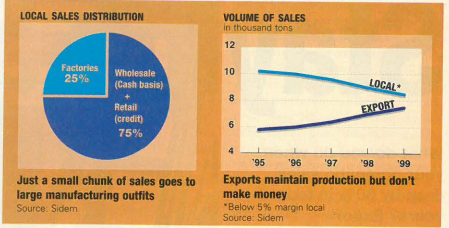
The local demand today is an estimated 12-14,000 tons. Already that’s not enough to absorb Sidem’s production of 16,000 tons. In fact, local sales dropped from 10,200 tons in 1995 to 8,500 in 1999. Now the two newcomers, Aluxal and Alutex, are competing for a chunk of the market. Having started production in 1994, Aluxal churns out some 4,000 tons a year. It sells to the retail market, which also accounts for 75% of Sidem’s sales.

The local market is further crowded by some 2500 tons of imported aluminum profiles, largely from Syria, Jordan, Saudi Arabia and Greece. That figure could have been much higher, had Sidem not systematically reduced prices to keep imports at bay. The company was protected by 20% customs duties on imports from Arab countries three years ago. However, the Arab free trade agreement has brought the tariff down to 14%, to be followed by a drop to about 12% next year, while the bilateral agreement with Syria has cut the duty to 10%.

With the Lebanese market so competitive, Sidem has increased sales abroad, sending half of its production to Europe. But exports are not a money-maker. “The purpose of exports is to keep our factory working at full capacity, which reduces our cost per unit, creating an indirect saving rather than profits on the product itself,” says Kurdy.

The main factor for the decrease in local sales is the stagnant real estate market, bloated with 7000 empty units and a 60% drop in construction permits. Folda, which bought an average of 545 tons a year before 1999, says its purchases have dropped significantly.

As a result prices have been slashed from $4,000 to about $3200 per ton in the local market today. Imports cost $2600 per ton, but many local clients say they still prefer to deal with Sidem because of its proximity to the market, its reliable quality and service. Many imports are below standard specifications. The downturn is difficult to swallow for a company that was the region’s first to specialize in aluminum extrusion, even if it is still the dominant player on the market.

Sidem began in the early 1950s with rolling mills producing aluminum sheets. In the early 1960s, it entered a joint-venture with Pechiney, the world’s second largest producer of aluminum, which purchased an 80% share. Also a manufacturer of extruded profiles, Pechiney sold its stake to the current Sidem shareholders in 1980 because of the war. Since then Sidem has remained fully Lebanese-owned and worked in aluminum extrusion. Believing the war was reaching an end and anticipating a construction boom, Sidem in 1982 embarked on a $10 million investment to double its capacity.

By 1986 the company found itself with three presses and production capacity of 16,000 tons and a country still at war. The short-lived solution was to send 60% of its production to the region. By the mid-80s, customs barriers were fully erected due to rapid regional factories, and the only alternative for Sidem was to go to Europe, a market of some 2 million tons yearly.

Though no longer partners with Pechiney, Sidem was able to take advantage of the earlier association to gain credibility. Additionally, Sidem won the right to manufacture Technal designs under license in 1980. France’s Technal is among the top five extruders of window profiles in the world. “It was our main entry break into Europe, because it means we’re producing under high specifications using the highest of technologies,” says Kurdy. Starting in Italy, the company expanded operations into France, Germany, Holland and the UK. Exports to Europe grew from 2000 tons in 1990 to about 7500 tons today, and Sidem stays competitive by investing $500,000 to $1.5 million yearly to upgrade machinery and install new technologies.

But how will Sidem manage to make money again if its local margins continue to be squeezed and exports aren’t profitable? Sidem cannot compete in the Arab world; energy and labor costs are half what they are here, and governments provide subsidies to encourage exports. Here the government is full of promises but rarely comes through. Additionally, other governments assist industries in recycling or disposing of their waste. There are no such solutions for Sidem.

Sidem, Folda and others have been asking the government to at least restrict the import of cheap products that don’t meet specifications, such as a 4mm thick window profile, which will bend easily in normal wind conditions. “This is not allowed anywhere in Europe or even as close as Syria, but anyone can import those into Lebanon,” says Azrak, adding that since aluminum is priced by weight, the thinner the product the lower the price.

If Sidem was thinking of expanding operations in preparation for the Arab free trade zone, it will find itself at a disadvantage to other factories. “We have a plan to move our operations from our 55,000m² area to a 200,000m² area, where we could increase capacity to 25,000 tons, but we don’t see the right conditions to proceed [with the $40 million investment],” says Kurdy. Sidem might be able to increase margins by streamlining operations and reducing its staff of 500. So far there are no indications that the company is contemplating that option. Sidem is feeling the heat. It will have to make some tough decisions soon if it’s not to go from a year of zero profits to one of losses.

May 1, 2000 0 comments
0 FacebookTwitterPinterestEmail
Best Sellers

Trading on a shoestring

by Hadi khatib May 1, 2000
written by Hadi khatib

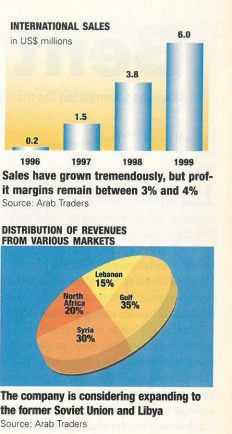
No trucks, no warehouses, not even a single forklift. Just three rooms, two desks, one secretary and a couple of phones. Not much more can be found on the premises of Arab Traders. That’s bare bone facilities for a trading company that generated $6 million in revenues last year, but keeping business simple is one of the reasons for its success. Arab Traders deals primarily in supplies for the oil and gas sector as well as aluminum, steel and power generation units. Its revenues have shot up from just $200,000 in 1996, when the company was founded. How did it do it?

Arab Traders acts strictly as a middleman, placing orders only after closing a deal with a buyer. It avoids tying up its own funds in goods that might sit idle in a warehouse. Once both parties have signed a contract, Arab Traders opens a letter of credit, has the supplies shipped and pockets a commission. The company has built up a working partnership with over 30 suppliers worldwide, including companies in the US, UK and the Czech Republic. It actively markets their products in the Middle East, Central Asia and North Africa. “When we receive inquiries for equipment and we don’t have a supplier, we find one,” says Wissam El-Solh, general manager of Arab Traders. “We also search for new suppliers or manufacturers producing new technologies that will give us an edge.”

Arab Traders’ international reach is a big plus. The company is headquartered in Lebanon with branch offices in the UAE and Syria, but it’s not dependent on any particular country. Unlike traders who are captive to the ups and downs of the domestic market, Arab Traders will fill an order as far away as West Africa or Central Asia. It also has the advantage of being able to search worldwide for the most competitively priced suppliers, giving it an edge on tenders.

The supply of oil field equipment, including metal casings, plastic tubing and pipes, is Arab Traders’ main money-spinner, representing about 65% of total sales, or $4.2 million in 1999. Big markets include Syria, Dubai, Iran and a number of countries in North Africa. Recent oil price hikes have been particularly beneficial. “It was harder at first when oil prices were down. But with prices going up, the governments are more willing to spend money on new equipment and we are selling more,” says El-Solh. “Governments usually set a budget for projects, a certain amount for each barrel [of oil] sold,” says Fred Habeishi, chairman and CEO of C.A.T., a contracting company, which has laid down oil pipelines in Kuwait, Saudi Arabia, Abu Dhabi and Qatar. “When prices go down, they reduce that budget, but when they rise, they tend to spend more.”

But the oil business is also very competitive. Whenever Arab Traders wants to participate in a tender, it has to pre-qualify; references have to be submitted and the company’s track record established. Being a relatively newcomer to the market, Arab Traders often has to resort to offering quotes at cost in order to get its foot in the door. In many countries, Arab Traders has developed a list of contacts that are familiar with the quirks and characteristics of the market and can assist companies in gaining access to the right people. “Just about every other family in the Gulf deals in oil field supplies,” says El-Solh. “It takes a lot of fancy footwork to get in.”

About 16% of Arab Traders’ business comes from local sales of aluminum, supplying wholesalers and workshops with mill-finished sheets, coils and circles. Abiding by its strategy of importing only on order, Arab Traders avoids selling retail altogether. In 1996, aluminum represented 100% of its revenue. By 1999, this segment of business had grown to about $1 million in sales. Even with the real-estate market in a slump, business has been steady. “There isn’t that much going on,” says Toufic Bawab, a dealer in aluminum profiles. “Business has become very stagnant, but the manufacturers have to keep making the frames and stocking up, because with their overheads, it would cost them more to stop operating altogether.”

Arab Traders has been able to counter this problem by concentrating on the import of mill-finished aluminum, which, many in the business claim, is in higher demand than other kinds of aluminum. “It’s a modern product, it’s practical, light and long lasting,” says Fady Khairallah, managing director of Edmond Khairallah Est., a firm whose activities include aluminum wall cladding, partitioning and false ceilings. “The market for the product is always going up,” says Habib Kehdi, technical coordinator for Alumco, a company specializing in aluminum and glass contracting. “Everybody is switching to the use of aluminum in place of other materials.”

Arab Traders has also been adding new products to its line, among them pre-fabricated parts made of aluminum that are used to set up storage facilities and other light structures. “We do look for new products and try to stay ahead, but we don’t want to be a jack-of-all trades,” claims El-Solh.

But there is a downside to the firm’s methods. Though importing back-to-back avoids many of the risks that accompany the stocking of goods, safety has its price. “The margin is about 3% to 4%,” says El-Solh. “If we were to buy the goods ourselves, the margin would jump up to 25% or 30%.” The problem with doing that, says El-Solh, is that the demand for products is neither large enough nor regular enough to make such a commitment worthwhile. If Arab Traders were to have to sit on stock until it were sold, the loss in interest would be considerable.\

The company is also encountering barriers to its growth. “Although we’re selling over $4 million in oil field supplies, we don’t expect to sell much more because the markets tend to get saturated with competitors,” says El-Solh. To counter this trend, Arab Traders has been breaking new ground in the Caucasus and Central Asia of the former Soviet Union. “They will start drilling eventually,” says El-Solh. “We want to be one of the first there when they do.” Another possible new frontier for Arab Traders is Libya. “With the lifting of the embargo, it’s becoming a booming market,” says El-Solh. Are his expectations justified? Habeishi seems to think so. “We are looking for projects in some of these newly emerging countries,” he says. But new markets pose risks. “We faced a lot of problems in Iran,” says El-Solh. “After we opened letters of credit and shipped the goods, they took so long to pay us that we had to sell the LCs off at a discount just to get our money back.”

Increasing revenues from $200,000 to $6 million in four years with nothing but the bare necessities is certainly an accomplishment. But a company can only grow so big when operating on a shoestring. Further expansion may mean taking the giant leap from being a mere middleman to becoming the seller itself. And that would mean taking on new risks. Maybe Arab Traders should be shopping for a warehouse and a couple of forklifts.

May 1, 2000 0 comments
0 FacebookTwitterPinterestEmail
Editorial

On your own

by Executive Editors April 30, 2000
written by Executive Editors

Too often attention is focused on government meddling in the
economy. At the same time, others call on the state for a fix.
But there are companies that are mixing their own medicine.

Look at Uniceramic. Despite a slump in sales last year, profits continued
to rise. This is a result of a massive restructuring program
that reduced expenses, improved products and changed its marketing
strategy.

In the middle of Lebanon’s worst real estate downturn, Massaad
Fares is selling property at some of the highest prices in the city. A
strategy unique in Lebanon, he focuses strictly on demand and doesn’t
build just for the sake of it. Société des Ciments Libanais is doing
its best to get around the Lebanese taboo, laying off workers to
counter another year in the red.

After the war, the situation at Trans Mediterranean Airways (TMA)
<mark>spiraled</mark> out of control. It was stuck with a few old planes, was losing
money and faced stiff competition. But since Fadi Saab came
on board, TMA has been given a major overhaul. It is now making
profits again. That is the opposite of what is happening at MEA, a
state-run enterprise. It has 433 employees for each of its nine airplanes,
the highest in the world, never makes money and is not doing
anything about it.

Perhaps the private sector should be the leader in bringing this economy
back to life and let the government fix itself.

April 30, 2000 0 comments
0 FacebookTwitterPinterestEmail
Executive Living

Rolling dreams

by Avo Tavoukdjian April 7, 2000
written by Avo Tavoukdjian

One look at her smooth, sensuous body and you cannot help wanting her for your own. Gentle curves suggest an inborn grace that would master the envy of all who lay eyes on her. So immense is her beauty that some would pay top dollar to get their hands on her. So, if she is yours, why not capitalize on your investment. Welcome to the world of collectible cars.

Even though the modern motor car is an outstanding technological achievement, comfortable, quiet, safe and extremely convenient, people still lust for the classics. Ever since cars were invented, people around the world have had a passion for owning the rarest and most attractive models, and Lebanon is no exception. The collectible car boom happened in the 80s and demand for these expensive toys has been falling ever since, now even more in the midst of a recession. So if you are looking to sell your vintage Mercedes-Benz at a premium, forget it. But if you are looking to buy, there are great deals to be found.

Investing in a classic is like buying stocks. You gamble that your investment will pay off. If no speculation were involved, everyone would do it. People think that just because a car is old, it will become valuable, says Andre Morcos, co-owner of Garage Mondial, one of the country’s most reputable restorers. Not true. You cannot make a Peugeot 504 into a gold mine. The same goes for a Renault 18 or a 1978 BMW 528. They were mass-produced and are simply not rare enough.

Cars that tend to appreciate in value are models manufactured in limited quantities or early examples of specific models. Keep an eye out for coupes and convertibles, preferably manufactured before 1970. With a little bit of hunting, Mercedes-Benz 220 SEs from the 1960s or 220As and 220Bs from the 1950s are good investments and can be found relatively easily. Other good bets are Mercedes-Benz 350 SLs and 450 SLs from the early 70s, as well as the older 230 SLs, the predecessor of the modern SLK. MGAs from the 60s and MGBs from the 70s, whether coupes or convertibles, are also good choices, as are T-Birds from the 50s and 60s or even Jaguar E-Types.

A Mercedes-Benz 220 will usually sell for about $4,000 to $5,000. MGs can cost as little as $2,000. A T-Bird may cost no more than $5,000. But buying a classic car is not the expensive part. Most will be in need of repair. Depending on the car and its condition, restoration can cost anywhere from $10,000 to $30,000, usually much more than the car’s actual value.

One thing to watch out for when choosing a car is corrosion. If the car has been neglected or has been exposed to too many winters, stay away. Corrosion is like a disease. Once it sets in, it is hopeless. Chassis damage also makes a classic an unsound investment. Aged cars are not a problem, and neither is minor body damage. But if the car needs replacement parts, make sure they are available.

There are several popular restoration shops in the country. Fersan Haddad defines a classic as a car that is both older than 25 years and has some historical or sentimental significance. He has done remarkable work on Triumphs, Mercedes-Benzes, rare American cars and Rolls Royces. Mondial has worked on everything from Porsches, Rolls Royces and Jaguars to MGs and Alfa Romeos. But do not forget restoration takes time, so do not plan on driving away with your showroom classic two weeks after you take it to the shop. Anything between six months to a year may be needed to get a car in shape. Car restoration shops are also good places to go if you are looking to buy.

Although restoring a classic will initially cost more than the car’s value, Morcos says old cars either maintain their prices or increase in value. Meanwhile, you get to drive around in a rare piece of art and will be the envy of all your friends and neighbors, and that is where the real payoff lies. After you spend large amounts of money getting that old T-Bird, Jaguar or Alfa Romeo in original showroom condition, you get to take it out in the sun, drop the top and cruise in a unique piece of history. And, hopefully, the price tag will only increase.

April 7, 2000 0 comments
0 FacebookTwitterPinterestEmail
Executive Living

The quest for samadhi

by Natacha Tohme April 7, 2000
written by Natacha Tohme

In the last two decades, a booming industry has formed
around the increasing drive for that perfect body. A
plethora of gyms, equipped with state-of-the-art fitness
equipment, have opened, exercise videos became all the rage,
and just about every book offering a miraculous weight-loss
plan became a bestseller. But today people are starting to
realize that slim, trim and muscular just isn’t enough, that
there’s more to feeling good than looking good. More and
more people are looking for a holistic approach to health and
fitness. Hardcore workouts are being supplemented, even
replaced, by gentler exercises that incorporate the well-being
of the mind, body and spirit. No better is this demonstrated
than in the growing popularity of yoga.

“Yoga means a union,” says Robert Kfouri, author of nine
Arabic books on yoga and Far Eastern mysticism. Kfouri has
been practicing yoga for about 25 years. The goal of yoga,
he says, is to reach a mystical experience known in yoga circles
as samadhi — a state where the mind transcends the body.

The yoga most people are familiar with involves posture and
breathing exercises aimed at relaxation and well-being.
But there is more to the art than just sitting cross-legged in
the corner. The most serious yoga followers also adhere to
rules and observances governing their personal life, including
non-violence and renouncing materialism.

“This way you can develop your heart. Nobody has reached
samadhi through the physical approach alone,” he says.

While classical workouts develop the superficial muscles of the
body, yoga tones the body from the inside. “Yoga addresses
the health of the glands,” says yoga teacher Nabil Najjar, who
often refers to devoted yoga practitioners as “yogis”. Yoga
positions counter the body’s aging process by keeping the
muscles elastic and the spinal cord — the body’s mainframe —
elastic and straight. The two most important positions, says
Najjar, are the headstand and shoulder stand, which are good
for the body’s glands, especially the pituitary and thyroid
glands, as well as the circulatory system. “Whenever the
body is inverted it does tremendous good for the internal
organs because the pressure on them is inverted and they are
massaged,” says Najjar. Another notable position, the forward
bend, stretches the whole back, massaging nerve centers and
opening them up if they are blocked. Yoga teacher Hayat
Mansour teaches special yoga postures for pregnant women.

But there’s more to yoga. Besides the exercises, a proper
diet, breathing, relaxation and positive thinking are required.
The yogi diet is vegetarian. Coffee and cigarettes are definite
no-nos. Breathing exercises help settle the mind. At the
end of every yoga session, students are guided to perform
what is called “final relaxation”. “Relaxation is like the cooling
system of a car. If you don’t cool the car it will burn out,
and likewise, if human beings do not relax they will burn out,”
says Najjar. Positive thinking is important because negative
thoughts cause negative events to unfold. By replacing negative
thoughts with positive ones, a person won’t become agitated
when yelled at, and then transfer his “bad mood” to someone
else. For those who can’t stop obsessing about that perfect
body, there is good news as well. Yoga can help a person
lose weight. “Yoga checks extreme behavior,” says Najjar.
“If you eat a lot, it naturally reduces your appetite. If you
are nervous, it calms you down.”


Yoga in the workplace

Companies are discovering that yoga and meditation can increase productivity.
Studies show that employees perform more efficiently if they
take a daily break of 20 to 30 minutes to practice yoga. “It produces
a general atmosphere of harmony and more creativity, which boosts
the company’s efficiency and thus has financial rewards,” says
Robert Kfouri. “Employees do less but accomplish much more. A tiger
would not make any move that is unnecessary. Yet he is very alert.
And when he does make a move, it’s the right one.” Yoga, Kfouri
explains, helps to sharpen the mind and improve concentration.
“Sharper minds don’t waste energy.” CAMS recently introduced yoga
classes to its employees, probably the first local company to discover
that yoga is a good motivational tool.

April 7, 2000 0 comments
0 FacebookTwitterPinterestEmail
Executive Living

Offices that make money

by Natacha Tohme April 7, 2000
written by Natacha Tohme

Justifiable or not,
clients often judge a
company by its
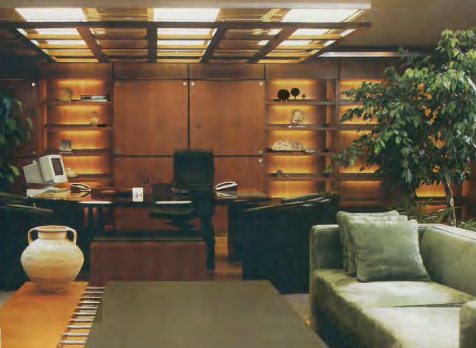
offices. Interior designer
Jean-Louis Mainguy, the
creative genius behind
the interior of BNPI in
Borj al Ghazal, understands
that well. His
office features a superbly
crafted floor-to-ceiling
bookshelf, which, when
slid open, reveals a conference
room. Besides
being visually appealing,
the bookshelf serves two
practical functions: it
provides storage and acts
as a wall dividing the executive office and conference room. The office communicates
professionalism and trust, though Mainguy simply
believes people should be comfortable in their workplace.

Ghalal Mahmoud, interior designer for GM Architectes, says
the first thing he considers when designing an executive office
is what the company sells. Aesthetic designs are suitable for
creative businesses, such as advertising or architectural
firms, while for banks or financial institutions the traditional
English look suggests that a business is long established
and credible. “It says ‘don’t worry about giving us your
money, we’ll take good care of it’,” says Mahmoud.

But the tastes of businesses are changing. In the age of
cyberbanking and tech stocks, financial institutions are
opting for more modern designs, “to show that they understand
the technologies they sell,” says Mahmoud. But a company
must be careful. If the decor is too outlandish, clients
are likely to think, “this company is too crazy for me — I’m
not going to give them my money,” he says. Many firms try
to create balance by combining traditional materials, such
as mahogany wood, with modern materials like stainless
steel. GM Architectes recently designed a Financial Funds Advisors
office in this way. “It’s very modern and high tech,
but at the same time it doesn’t cause clients to panic.”

Another important factor to consider is the personality of
the businessperson who will use the office. Mainguy and
Mahmoud say most clients ask that their offices reflect their
hobbies. Executives interested in ethnic art might request
African sculptures to complement the decor, while a weekend
sailor would likely ask for nautical motifs. Personalized
offices break down barriers and create an open and human
relationship between executives and their clients, even staff.

Women tend to understand this better than men, says
Mainguy. Male executives prefer their offices to have a serious
atmosphere, which is achieved by using geometrical
shapes, dark colors and conservative materials, while
women select softer tones and fabrics. “The personality of
a woman in business is totally different from the old manners
of men,” says Mainguy. “Business is life — it’s not so
serious.” He prefers to use circular forms and brighter colors
to convey a more relaxed atmosphere.

Great, but how much does this fancy decorating cost? “It’s
important to know the size of the space and the budget of the
client, and work within that fixed parameter,” says Mainguy.
Of course, costs rise if certain technical items, such as a proper
lighting system, are not already in place. Either way, there
is a considerable price to pay for a successful image. Executive
desks range between $2,000 and $5,000, and executive leather
chairs cost about $1,000. And that’s just for starters.

No man’s office

Got an important interview with the vice president of a big corporation?
You know, the kind where you must wait patiently in the
lobby until his secretary ushers you into a plush office where the “big
man” stares at you from behind a mahogany desk the size of a dining
room table. Don’t be surprised if, instead, your “big interview” actually
takes place in a very public conference room that the employees
use to meet clients.

In the push for efficiency, more companies are redesigning their workplace
environments. “There’s no hierarchy anymore — the boss with his
big office and the employees assigned cubicles,” says interior designer
Galal Mahmoud. Private offices have been replaced by open workstations.
Instead of being placed in lofty offices, far from the rank and
file, managers are being given desks close to their employees. Rather
than working independently, employees are clustered together in
work groups. The only enclosed areas are “unassigned offices” (a new-age
term for conference rooms), which are equipped with the latest
computer and projection technology. When employees, even managers,
want to see clients, this is where the meeting takes place.

Technology is also having an impact on the 21st century workplace.
The information age is also the age of the virtual office. Gone is the day
of the private desk with the private PC. These days, employees are
given unassigned workplaces, or “free addresses,” which they can use
on a first-come, first-served basis. Employees are provided with all the
tools needed for a paperless office, such as laptops. There are no personal
filing cabinets, but rather central filing systems. Desks aren’t even
equipped with phones. Phone calls are made through laptops. “You
come with your laptop, plug it in and you’re in the system,” says Mahmoud.
“You access all the company information you need through a
plug. The only item that is yours is your laptop and pen.”

April 7, 2000 0 comments
0 FacebookTwitterPinterestEmail
Tech Knowledge

Wise guys

by Mira Baz April 7, 2000
written by Mira Baz

Following PSINet’s acquisition of Lynx

Following PSINet’s acquisition of
Lynx, EXECUTIVE asked several
Internet service providers (ISPs) whether
they’d sell. IntraCom wouldn’t comment,
while Cyberia had “no incentive to sell”
(see “The next wave.com”, March 2000).
Of course it doesn’t; it wants to gobble up
the rest. Soon after, in an email to its customers,
IntraCom stated that it would
“transition” its customers over to Cyberia.
What’s the deal? Talking exclusively to
EXECUTIVE, Aboud Omari, CEO of
Cyberia, and his counterpart at IntraCom,
Adel Rida, highlight the terms of the deal.

IntraCom, which claims to hold the second
position in the consumer market, is leaving
the ISP market to become an application
service provider (ASP), under the name
XtraCom. It will concentrate on the corporate
market, where the big dollars are, by
offering consulting and Internet services,
such as e-commerce and its popular
AudioTex, but no dial-up. “Dial-up will
be handled under the Cyberia brand,” says
Rida. Merger? No. Acquisition? Kind of.

Omari approached Rida last fall. “I
convinced him to sell,” says Omari.
“Costs are high. Only networks with a
significantly high number of clients can be
cost-effective. And the most effective
way is by acquiring.” Going after 6,000
users would cost $1,000 per user over a
period of six months, Omari says.

Rida insinuates that the deal contains two
parts: valuing the customer base and sharing
revenue per customer for a certain period
of time. Omari maintains that “money
will go to pay off any outstanding debts.”

Cyberia gave IntraCom clients, who were
paying $11.99 and $19.99 for unlimited and
digital unlimited access, a two-month period
of free access, until May 1, when
IntraCom would leave the picture.

Simply put, Cyberia bought IntraCom’s
database and dial-up network. There’s a
discrepancy over the number of customers.
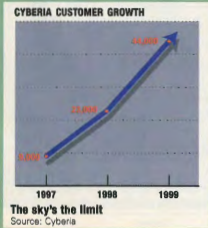
Cyberia downplays it to 13,800
customers, 35% of which are inactive.
Omari expects between 6,000 and 7,000 to
shift over to Cyberia. Rida, on the other
hand, boosts the number to 17,000, with
about 12,000 active accounts. Based on
Omari’s estimations, that would pump up
Cyberia’s database from 44,000 to around
50,000. It will control over 60% of the market,
according to Rida.

“We have an infrastructure that can handle
up to 30,000 users and a bandwidth of 512
kb,” Rida maintains. Other major players
remaining are IncoNet, Data Management,
TerraNet, and Sodetel. When it entered the
market in October 1998, IntraCom’s projections
were to reach 30,000 customers in
two years. “But growth is very slow and it’s
a small market,” says Rida. “One ISP is
enough for this market, really.” IntraCom
will concentrate on its dial-up markets in the
UK and especially Nigeria, where the number
of connected users reached 200,000 in
one year, according to Rida.

Oh, and one more thing. “There’s an
understanding of cooperation [between
the two companies] in markets abroad,”
Rida adds, “which will boost Cyberia’s
value-added services.” Who’s next?


From airwaves to cyberwaves

Listening to the radio? That’s so passé.
Now FM stations are battling it out in
cyberspace. Mix FM (104.4 FM) launched
its $4,000 website on the occasion of its
fourth anniversary on February 23. Eat
your heart out, Radio One. But the two
websites project different images. Mix
FM, specialized in dance music, wants to
create a dance club image — “trendy and
cool,” says general manager Roger Saad.

The website was designed by Prezorse,
a US-based company, using the all-popular
Shockwave Flash 4. It has the regular
features: charts, real audio, chatting and
email accounts. The station’s target audience
is listeners between the age of 15 and
40. “We don’t claim we’re number one,”
says Saad. “We say we’re the most listened
to radio station.” The proof, according to
Saad, is that Mix FM can be heard in
shopping centers, restaurants and shops.
The station, which started out with low
costs, started seeing profits after nine
months on the airwaves, and has been
growing steadily. It attributes its success
to the popularity of dance music.

For its part, Radio One received the
award for the “Number One Arab website”
from the UAE satellite TV, and its developer,
Wael el Zanaty, was there to accept
it. Radio One’s new look upgrade is due on
April 1. Let the battles begin.


Lotus notes local company

Anzima Cooperative Solutions (CS)
recently received the “Best New
Comer” award from Lotus Middle East, an
IBM company that includes an area from
Egypt to Pakistan. Anzima CS, owned by
Elie Tabet and Fares Kobaissi, is one of
over 200 companies providing software
solutions to businesses. Launched two
years ago, the company uses the Lotus
Notes software and has an impressive customer
list, including Fransabank and
PricewaterhouseCoopers. Its sales last year
reached $250,000, with a staff of ten.

Going up against heavies like Istisharat
and Software Design, the company operates
in a small market, hindered by a lack
of funding and thin margins.

Anzima is not the only local company
affiliated with Lotus. Two-year-old Trilog
Group, owned by Alex Homsi, is also a
Lotus “Premier Business Partner.”

April 7, 2000 0 comments
0 FacebookTwitterPinterestEmail
  • 1
  • …
  • 696
  • 697
  • 698
  • 699
  • 700
  • …
  • 705

Latest Cover

About us

Since its first edition emerged on the newsstands in 1999, Executive Magazine has been dedicated to providing its readers with the most up-to-date local and regional business news. Executive is a monthly business magazine that offers readers in-depth analyses on the Lebanese world of commerce, covering all the major sectors – from banking, finance, and insurance to technology, tourism, hospitality, media, and retail.

  • Donate
  • Our Purpose
  • Contact Us

Sign up for our newsletter

    • Facebook
    • Twitter
    • Instagram
    • Linkedin
    • Youtube
    Executive Magazine
    • ISSUES
      • Current Issue
      • Past issues
    • BUSINESS
    • ECONOMICS & POLICY
    • OPINION
    • SPECIAL REPORTS
    • EXECUTIVE TALKS
    • MOVEMENTS
      • Change the image
      • Cannes lions
      • Transparency & accountability
      • ECONOMIC ROADMAP
      • Say No to Corruption
      • The Lebanon media development initiative
      • LPSN Policy Asks
      • Advocating the preservation of deposits
    • JOIN US
      • Join our movement
      • Attend our events
      • Receive updates
      • Connect with us
    • DONATE