Remember a few months ago?
You’re in the shower when the
power fails (courtesy of the Israeli
air force) and you have to dash for the generator
with a towel wrapped around you.
Generator sales must have boomed, right?
Wrong, actually.
In fact many of those in the generator
business are complaining that these are
their darkest days. The majority of those
who require a generator bought one in the
early 1990s, when wallets were thicker and
power cuts more frequent. With the country
already saturated with generators, the air
strikes barely registered on the market. And
with construction at a standstill, sales
of generators have decreased from $40 million
in 1997 to $23 million in 1999 – a
43% decrease. At the same time, imports
have decreased from $35 million in 1997 to
just $20 million in 1999. Everyone is feeling
the pinch.
M. Ezzat Jallad, the exclusive agent for
Caterpillar in Lebanon, Syria and Jordan,
saw local sales of generators decline from $5
million in 1998 to $4.28 million last year.
Sales for Saccal Power Engineering
decreased from $3.45 million to $2.33 million,
a drop of over 32% (see “Trying to
buck the downtrend,” December 1999).
Jubaili Bros., the number one retail seller
of generators in Lebanon with just over
$20 million in global revenues last year, is
also suffering. Local sales, 70% of which are
from generator sets, have tumbled by 60%
since 1995, from $15 million to about $6 million last year. Time to pack up and call
the bankruptcy lawyer? No way.
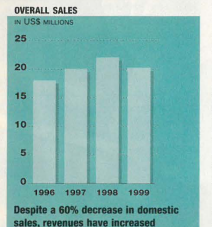
Surprisingly, overall revenues actually
increased during that period, from $18 million
to $20.2 million in 1999.
How did they do it? With the domestic
economy stagnant, the company has been
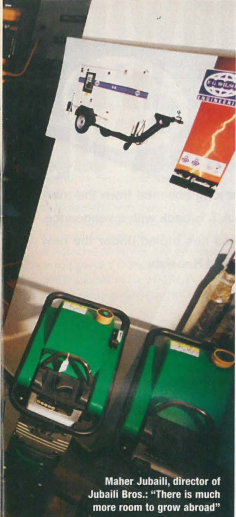
boosting its exports. “Unlike the local market,
there is much more room to grow
abroad,” says Maher Jubaili, the firm’s
director. Jubaili started shipping generators,
most directly from the FG Wilson factory
in the UK, to Nigeria and the UAE in
1996. Both countries have an erratic supply
of electricity. Today these two markets represent
about 70% of the company’s revenue.
In Nigeria alone. Jubaili currently
controls 15% of the retail and wholesale
markets for generators. It was the first
Lebanese company to enter this untapped
market. Ghaddar Machinery, a competing
retailer of generators, arrived on the scene
more recently. But unlike Ghaddar, which
works through a local agent. Jubaili markets
and sells its generators directly there. This
gives the company an edge, says Jubaili.
The firm has entered other African countries
as well. In 1998, Jubaili spotted an
opening in Ghana, where there were only two
hours of power a day. In that year, the company
sold $2 million worth of generators in
the Ghanaian market, pushing Jubaili’s overall revenues up to $22 million. Most of
the exports were shipped directly from the
UK, but $800,000 worth were sent from
Jubaili’s Tripoli outlet, increasing the
branch’s sales from $900,000 in 1997 to
$1.7 million in 1998. But in 1999, Ghana’s
power problem was solved and sales to
that market stopped, leading to a slight
decrease in revenues last year.
Jubaili is now eyeing the Iraqi market,
another country suffering from power shortages.
But here, the company is a bit of a latecomer.
Ghaddar recently signed his third
contract in Iraq, a deal involving the sale of
250 60KVA generators for about $2 million.
Sacca!, which deals only in wholesale,
sent $4 million worth of generators there in
1999, and the latest deal was a $732,000 contract
with the Iraqi ministry of agriculture.
Despite Ghaddar’s success, Maher Saccal,
CEO of Sacca!, feels that Iraq is not a market
for retailers. “Iraq deals with public tenders
and you need to have the skills and the
know-how to succeed,” he says.
Although Jubaili has been focusing largely
on foreign markets, the firm hasn’t given
up hope that local business will improve**;** if
not now, then maybe in the long run. This has
prompted a diversification of its products in
an attempt to stimulate domestic sales. So
far, results have been mixed.
Jubaili is making a decent income from
renting out electricity. The company
recently landed some big projects, including
a $500,000 contract to provide
Bouygues, a French company in Solidere,
with 2,700 KVA of electricity for 20
months. Other successes include contracts
to provide Mannesmann in Abu Dhabi
with 2,500 KVA, and a Darwish Group
company in Qatar with 1,500 KVA.
Soundproof canopies, which Jubaili
assembles at its Sidon plant, have also
been selling briskly, accounting for
$540,000, or 9%, of local revenue in 1999.
“This is very profitable for us,” says
Jubaili, “because these days very few people
buy generators without canopies.” For
each locally assembled $5,400 27KVA
generator, Jubaili sells a $1,500 canopy.
But many new products have not paid off.
After Jallad’s sales of heavy construction
equipment declined from $7 million in
1998 to $600,000 last year, Jubaili started
selling light construction equipment. But, as
a result of the government’s budgetary policy,
construction never picked up. Jubaili
also tried selling air conditioning units, but
the added revenues were minor. “With so
many competitors in the field and too
many credit facilities, it hasn’t been a success,”
says Jubaili. The company also
earns money from after-sales services,
charging $35 for a routine checkup.
“Although 24-hour after-sales generates a
certain revenue, it barely covers our
employees’ salaries,” he says. Both Sacca!
and Ghaddar concur. With the market
depressed, profit margins are low for those
in the generator business. “We should have
a 10% profit margin,” says Ghaddar, “but it
is much less than this, even though we
have different products and services.”
As if all this wasn’t enough, the company
may soon face a challenge to its exclusive
agency rights for FG Wilson generators.
Caterpillar recently purchased FG Wilson
and Jallad is now selling the same generators
as Jubaili but under the name
Olympian. But Jubaili is not worried that the
two sides will come to blows.
“Caterpillar’s sales focus on a range of
higher-end generators,” he says.
The company has had disputes with
other competitors. Not long ago, Jubaili
began importing Perkins engines, manufactured
by FG Wilson, and assembling
them here. That prompted Ghaddar, who is
the local distributor for Perkins products, to
take Jubaili to court. “We have a right to a
percentage from the sales coming from
Perkins,” says Ghaddar. After an acrimonious
dispute, the two sides came to an
agreement. Jubaili was given full rights to
continue importing Perkins engines, as
long as they were assembled locally and
sold under a different name.
These problems have been a headache for
Jubaili, but they are minor compared to the
slowdown in the economy. Jubaili has
stayed afloat by focusing on markets
abroad, but exports will probably just keep
the company alive. If revenues are really to
grow, a turnaround is needed in the domestic
market. By leaving no stone unturned
locally, Jubaili has played his cards right.
When business in Lebanon hits an
upswing, he will be prepared.